








✓ Medically reviewed by · Last reviewed: May 2026
Pharmacy Researcher · 8 years experience
Pharmacy researcher with 8 years reviewing clinical drug information, generic formulation equivalence, and international pharmaceutical standards. Focuses on patient-facing accuracy in medication education.
For years, the most talked-about weight-loss medicines came with a needle. That is changing fast. GLP-1 pills have moved from “coming soon” to “on the shelf,” and in 2026 roughly 11% of US adults report taking a GLP-1 medicine of some kind — a figure that has nearly quadrupled in two years. If needles were the thing holding you back, the maths has shifted.
This guide cuts through the headlines: what these medicines actually are, how well they work compared with the injections, the side effects worth knowing, and which oral option suits which person. One of those options surprises people the most — we will get to why in the section on what is available now.
- GLP-1 pills copy the gut hormone GLP-1 to curb hunger — the same mechanism as the injections, in tablet form.
- In phase 3 trials, oral options reached about 11–14% average weight loss — strong, though the top injections still edge ahead.
- Some GLP-1 pills need an empty stomach and careful timing; one newer pill has no food or water rules at all.
- The most common side effects are digestive — and there is a simple way to blunt them, covered below.
- Pills win on convenience and storage; injections still win on peak weight loss. The right pick depends on you.
- These are powerful medicines, not a shortcut — the results that last come from pairing them with food and activity.
What Are GLP-1 Pills? (Definition & Background)
GLP-1 pills are oral medications that activate the glucagon-like peptide-1 receptor — the same target as injectable drugs such as semaglutide and tirzepatide. By copying a hormone your gut releases after eating, they reduce appetite and help you eat less, which over months translates into weight loss. In short, they are the tablet form of the weight-loss medicines that made headlines as weekly jabs.
The category matters because needles were a genuine barrier for many people. A daily tablet is easier to start, simpler to travel with, and does not need to be kept cold. That convenience is why interest in oral GLP-1 treatment has climbed so sharply — and why 2026 has become the year the pills arrived in earnest.
It helps to separate two related ideas. “GLP-1” describes the drug class and its mechanism. “GLP-1 pills” describes the delivery — swallowed, not injected. Some pills contain the exact same molecule as a well-known injection (oral semaglutide is the tablet cousin of the semaglutide jab); others, like orforglipron, are a different kind of molecule built from the ground up to survive being swallowed. Both aim at the same receptor.
One honest note up front: these are serious medicines with real effects and real side effects, used for people with obesity or weight-related health conditions — not a casual accessory for dropping a few pounds. Used well, and under a clinician’s guidance, they can be genuinely helpful. Used carelessly, they can make you miserable or unwell.
How Do GLP-1 Pills Work? (The Science, Simply)
GLP-1 pills work by imitating the gut hormone GLP-1, which your body naturally releases when you eat. That hormone does three useful things at once: it slows how fast your stomach empties, it signals your brain that you are full, and it helps steady blood sugar. Take that signal and stretch it across the whole day, and hunger quietly fades into the background.
Picture the hormone as a “you’ve had enough” message your gut normally sends only briefly after a meal. A GLP-1 medicine keeps that message switched on for far longer. Meals feel satisfying sooner, snack cravings lose their grip, and most people simply eat less without the white-knuckle willpower that ordinary dieting demands.
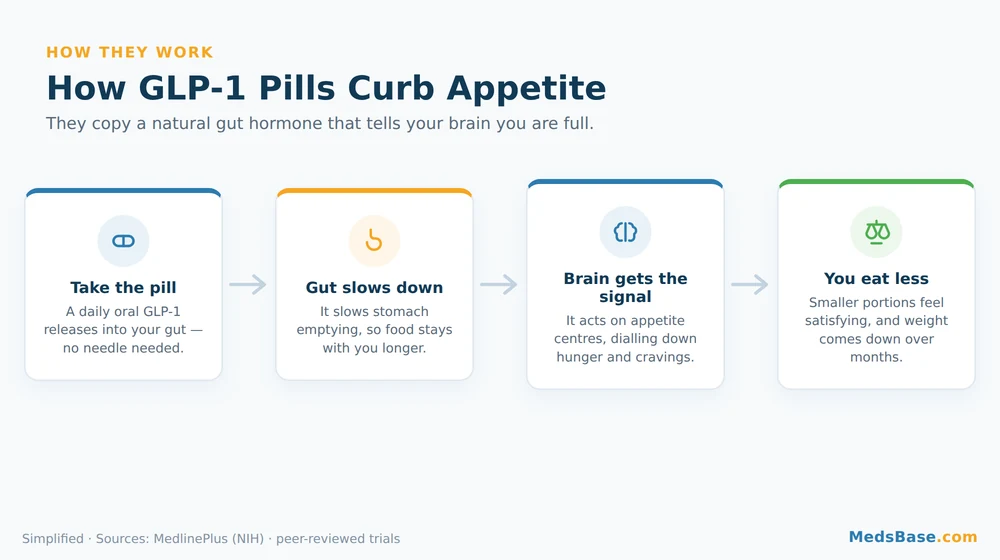
Getting a GLP-1 into a pill was the hard part. Semaglutide is a fragile peptide that stomach acid would normally destroy, so oral semaglutide is paired with an absorption helper and must be taken on an empty stomach for the body to absorb enough. Orforglipron solves the problem differently — it is a small, sturdy molecule that survives digestion on its own, which is why it carries no food or water restrictions. Same destination, two clever routes.
The GLP-1 Pills Available Now
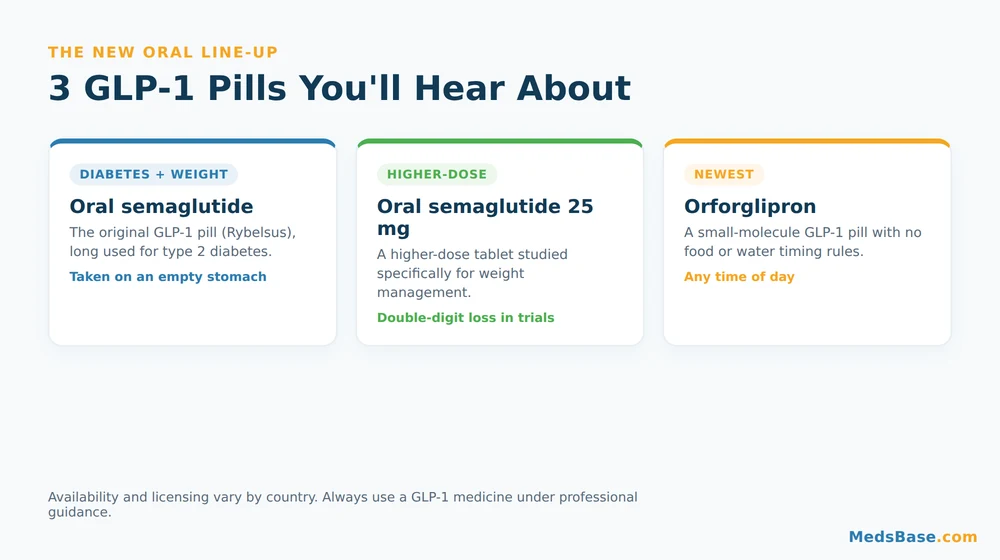
Three oral options dominate the 2026 conversation, and they are not interchangeable. One has been used for years, one is a higher-dose weight-loss version, and one is brand new with a genuinely different set of rules. Here is how the current oral options line up.
Oral semaglutide (the original GLP-1 pill)
Oral semaglutide, sold as Rybelsus, was the first GLP-1 available as a tablet and has been prescribed for type 2 diabetes since 2019. It comes in low daily strengths and is taken on an empty stomach with a small sip of water, then you wait about 30 minutes before eating or drinking anything else. It reliably improves blood sugar and produces modest weight loss — a practical, well-understood starting point. You can read our full oral semaglutide guide for dosing and cost detail.
Higher-dose oral semaglutide for weight loss
A higher-strength 25 mg oral semaglutide tablet has been studied specifically for weight management, and this is where the pill starts to rival the jabs. In trials it delivered double-digit average weight loss — closing much of the gap with injectable semaglutide while keeping the needle-free convenience.
Orforglipron (the newest GLP-1 pill)
Orforglipron is the newcomer that changes the routine most. Approved in 2026 for weight management, it is the first GLP-1 pill you can take at any time of day, with or without food and water — no 30-minute wait, no empty-stomach rule. For anyone who found the timing of oral semaglutide fiddly, that flexibility is the headline feature. And it is unlikely to be the last: several more oral GLP-1 and dual-hormone tablets are in late-stage trials, so the menu of options is set to keep widening.
What GLP-1 pills cost and how to access them
Cost is often the real deciding factor. Branded weight-loss medicines have historically been expensive and unevenly covered by insurance, though the arrival of oral competition is beginning to push prices down and widen access. Coverage still varies enormously by country and plan, and many people pay out of pocket. Generic oral semaglutide from WHO-GMP-certified manufacturers is generally the most affordable oral GLP-1 route, which is why it is the option most people start with when paying themselves. Whatever you choose, factor in that these are long-term treatments — the monthly cost is one you may carry for a year or more.
A reasonable fit: adults with obesity, or with excess weight plus a related condition such as type 2 diabetes, high blood pressure or sleep apnoea, who have struggled to lose weight with diet and activity alone — and who prefer a tablet to an injection.
Not the right tool: anyone who is pregnant, trying to conceive, or breastfeeding; people with a personal or family history of medullary thyroid cancer or the MEN 2 syndrome; those with a history of pancreatitis or severe gastrointestinal disease; and anyone wanting a quick cosmetic fix rather than long-term health change. A clinician should always confirm a GLP-1 pill is safe for you first.
For a wider view of how these tablets sit alongside every other option — from older tablets to the newest injectables — our best weight-loss medications guide maps the whole landscape.
GLP-1 Pills Side Effects, Dosage & Safety
The most common GLP-1 pills side effects are digestive: nausea, constipation, diarrhoea and occasional vomiting, especially in the first weeks and each time the dose steps up. They are usually mild to moderate and tend to settle as your body adjusts. Serious problems are uncommon, but a few are important to recognise early.
Here is the practical trick that helps most people: the nausea is closely tied to how fast the dose is increased. Rushing the titration is the single most common reason people feel awful and quit. Going up slowly — and eating smaller, lower-fat meals while you adjust — blunts most of the discomfort, according to patient guidance summarised by MedlinePlus.
| Side effect | Frequency | Severity | What to do |
|---|---|---|---|
| Nausea | Very common | Mild–moderate | Smaller, low-fat meals; ease the dose up slowly. |
| Constipation or diarrhoea | Common | Mild | Fluids, fibre, movement; usually settles. |
| Vomiting | Common | Mild–moderate | Stay hydrated; tell your clinician if persistent. |
| Reflux, burping, fullness | Common | Mild | Eat slowly and stop when full. |
| Gallstones (with rapid weight loss) | Uncommon | Moderate | Report severe upper-belly pain promptly. |
| Pancreatitis | Rare | Serious | Stop and seek care for severe, persistent belly pain. |
| Allergic reaction | Rare | Serious | Seek urgent help for rash, swelling or breathing trouble. |
Dosing in brief. Every GLP-1 pill starts low and steps up over weeks — this “start low, go slow” schedule is deliberate, giving your gut time to adjust and keeping nausea manageable. Oral semaglutide is taken once daily on an empty stomach with a small sip of water, followed by a 30-minute wait; orforglipron is taken once daily with no food or water restriction. Never double up after a missed dose, and never speed up the titration on your own to lose faster — that backfires into side effects, not results.
When to see your doctor
Most side effects are the mild, self-settling kind. A few are not, and knowing the difference keeps you safe. Contact a clinician promptly if you develop severe or unrelenting abdominal pain (especially pain that bores through to your back), persistent vomiting that stops you keeping fluids down, signs of dehydration, or any allergic reaction. Because these medicines curb appetite so effectively, also flag it if you are barely eating — protein and hydration still matter every day.
What Does the Research Say?
The evidence behind these pills is now substantial and, importantly, published in top journals rather than press releases. Large phase 3 trials show clinically meaningful weight loss with oral options, alongside improvements in blood sugar and cardiometabolic markers. The headline: pills work, and the best of them are closing the gap with injections.
| Study | Year | What it found | Source |
|---|---|---|---|
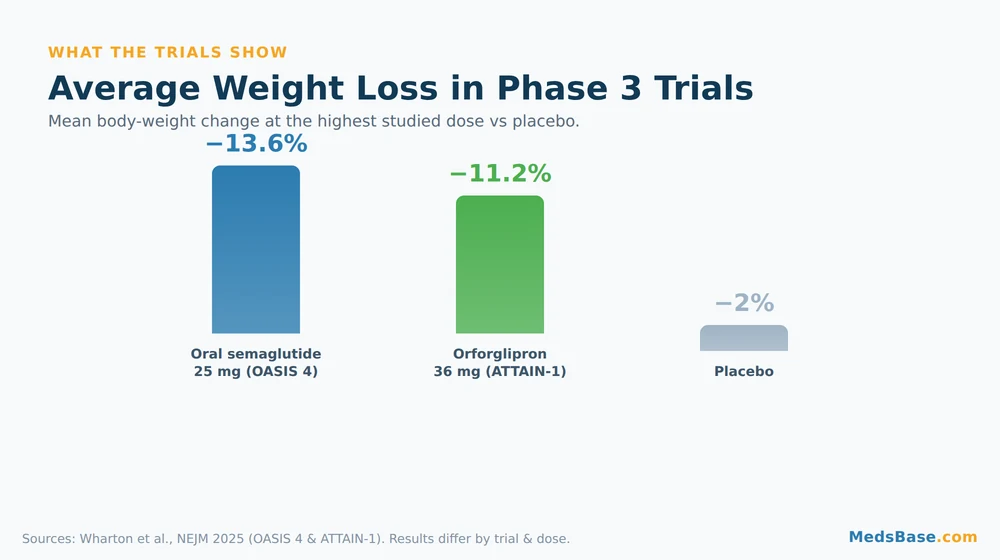
| OASIS 4 (oral semaglutide 25 mg) | 2025 | Adults with obesity lost ~13.6% of body weight vs ~2.2% on placebo over 64 weeks. | PubMed |
| ATTAIN-1 (orforglipron) | 2025 | Highest-dose orforglipron gave ~11.2% weight loss; 54.6% lost ≥10% over 72 weeks. | PubMed |
| ACHIEVE-1 (orforglipron, type 2 diabetes) | 2025 | Cut HbA1c by up to ~1.5 points and reduced weight in early type 2 diabetes. | PubMed |
| Indirect comparison (pill vs pill) | 2026 | Oral semaglutide 25 mg showed ~3 points greater weight loss than orforglipron 36 mg. | PubMed |
What this means for you: the research suggests the strongest GLP-1 pills can produce weight loss in the low-to-mid teens as a percentage — meaningful for health, though trial averages always hide big individual variation. Early indirect comparisons hint that oral semaglutide 25 mg may edge orforglipron on pure weight loss, but head-to-head trials are what will settle it, and convenience may matter more to you than a few percentage points. As always with weight-loss medicine, the results shown in trials came alongside diet and activity support — the pill is one part of the plan, not the whole plan.
GLP-1 Pills vs Injections — Which Wins?
The honest answer: it depends on what you value. GLP-1 pills win on convenience, storage and the simple fact that there is no needle. GLP-1 injections still tend to win on peak weight loss, with the strongest weekly jabs reaching the high teens to low twenties in percentage terms. Neither is universally “better.”
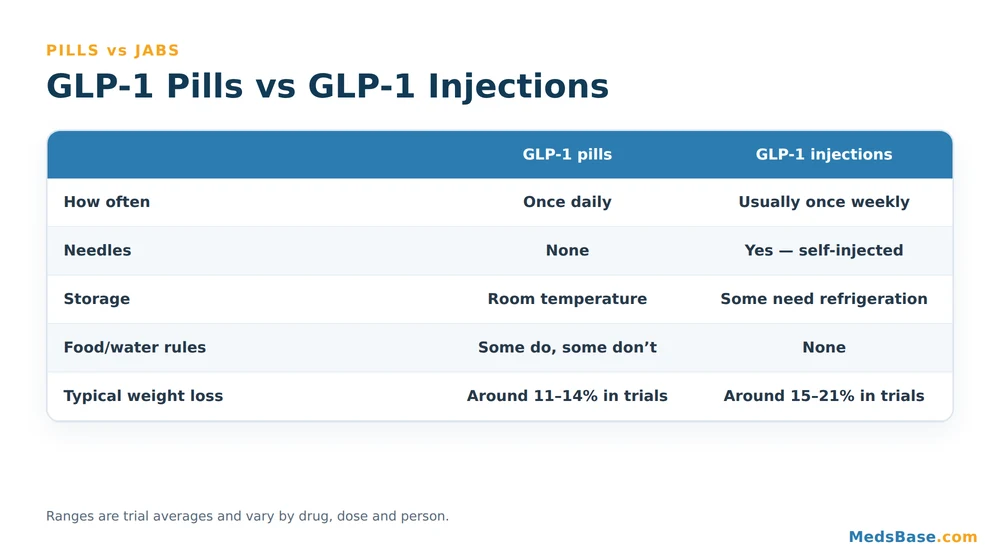
| Factor | GLP-1 pills | GLP-1 injections |
|---|---|---|
| Frequency | Once daily | Usually once weekly |
| Needles | None | Yes — self-injected |
| Storage | Room temperature | Some need refrigeration |
| Timing rules | Some strict, some none | Flexible |
| Typical trial weight loss | ~11–14% | ~15–21% |
Which fits which situation? If needle anxiety, travel, or simply hating injections is your barrier, a GLP-1 pill removes it — and the strongest pills now deliver serious results. If your priority is maximum weight loss and you are comfortable with a weekly jab, injections still hold a modest edge. Many people also start on a pill and switch later, or the other way round. Our GLP-1 injections guide covers the needle side in depth, and Ozempic vs Mounjaro vs Zepbound compares the leading injectables head to head.
How to Take GLP-1 Pills — Practical Guidance
Taking GLP-1 pills well comes down to three habits: follow the specific timing rules for your tablet, let the dose rise slowly, and back the medicine up with food and activity. Get those right and you give yourself the best shot at results with the fewest side effects.
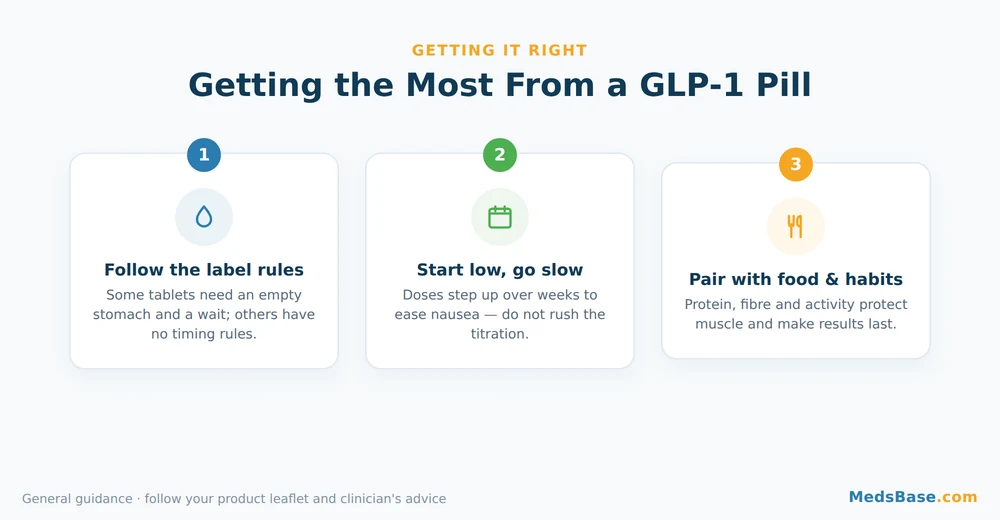
- Follow the label’s timing rules. Oral semaglutide must be taken on an empty stomach with no more than a small sip of water, then wait about 30 minutes before eating, drinking or other medicines — otherwise your body absorbs too little to work. Orforglipron has no such rules and can be taken any time. Know which one you have.
- Start low and step up slowly. Doses climb over weeks by design. If nausea flares when you increase, tell your clinician — staying at a dose longer, or rising more gently, usually fixes it far better than pushing through.
- Protect muscle and make it last. Because you eat less, prioritise protein and fibre, keep hydrated, and add resistance activity to protect muscle. This is how you lose fat rather than strength — and how you keep the weight off if you eventually stop.
Common mistakes to avoid: eating too soon after oral semaglutide; increasing the dose faster than prescribed; skipping meals entirely (which worsens nausea and muscle loss); treating the pill as permission to ignore food quality; and stopping abruptly without a plan, since appetite — and often some weight — returns. If you are choosing between an oral and a compounded product, our compounded vs brand-name semaglutide guide explains the trade-offs, and you can check current oral semaglutide availability at MedsBase.
What Happens When You Stop GLP-1 Pills?
This is the question too many guides dodge, so here is the straight answer: when you stop GLP-1 pills, appetite usually returns, and some — often much — of the lost weight tends to come back over the following months. GLP-1 medicines manage weight while you take them; they do not permanently reset your body’s set point. That is not a failure of the drug, it is how appetite biology works.
Studies of GLP-1 treatments consistently show partial weight regain after stopping, particularly if the medicine is stopped abruptly and old eating patterns return. It is one reason clinicians increasingly frame these drugs as long-term tools for a long-term condition, much like blood-pressure or cholesterol medicine, rather than a short course you finish.
The practical takeaway: if you do stop, taper with your clinician rather than quitting cold, and lean hard on the habits built during treatment — protein-forward meals, fibre, strength training and sleep. Those habits are what carry results forward once the appetite-dampening effect fades. Going in with that expectation, rather than hoping for a one-and-done fix, is the difference between a frustrating rebound and durable progress.
Frequently Asked Questions
Q: What are GLP-1 pills?
A: GLP-1 pills are oral medicines that activate the GLP-1 receptor to reduce appetite and support weight loss and blood-sugar control. They are the tablet form of a drug class better known for injections. The main options are oral semaglutide — including a higher-dose weight-loss tablet — and the newer orforglipron. All work by mimicking a gut hormone that makes you feel full sooner and for longer.
Q: Do GLP-1 pills work for weight loss?
A: Yes — the research shows GLP-1 pills produce clinically meaningful weight loss. In phase 3 trials, the strongest oral options averaged roughly 11–14% body-weight reduction over a year or more, compared with about 2% on placebo. Individual results vary widely, and the weight loss came alongside diet and activity support. They are effective medicines, but not a stand-alone fix.
Q: Are GLP-1 pills as effective as injections?
A: Not quite, on average. The best oral options reach the low-to-mid teens in percentage weight loss, while the strongest weekly injections reach the high teens to low twenties. That gap is narrowing, and for many people the convenience of a needle-free tablet outweighs a few percentage points. The right choice depends on your goals, tolerance and preference — a clinician can help you weigh it.
Q: What are the side effects of GLP-1 pills?
A: The most common side effects of GLP-1 pills are digestive: nausea, constipation, diarrhoea and sometimes vomiting, usually mild and worst during the first weeks or after a dose increase. Rarer but serious risks include pancreatitis and gallbladder problems. Raising the dose slowly and eating smaller, lower-fat meals reduces most of the discomfort. Report severe or persistent abdominal pain to a clinician promptly.
Q: Which GLP-1 pill is best for weight loss?
A: There is no single best GLP-1 pill for everyone. Early evidence suggests higher-dose oral semaglutide may edge orforglipron on pure weight loss, but orforglipron wins on convenience with no food or water timing rules. Oral semaglutide has the longest track record. The best pill for you depends on your health profile, how much timing flexibility you need, and your clinician’s advice.
Q: Can you buy GLP-1 pills online?
A: Oral semaglutide is available to order online, and MedsBase stocks it with worldwide shipping. Whichever route you choose, GLP-1 pills should be used under a clinician’s guidance so your dose, health conditions and other medicines are all accounted for. Be cautious of any source offering “instant” results or refusing to discuss side effects — trustworthy suppliers are upfront about both benefits and risks.
Q: How much weight can you lose on GLP-1 pills?
A: In trials, average weight loss with the strongest GLP-1 pills was around 11–14% of starting body weight over 12 to 18 months — for someone weighing 100 kg, that is roughly 11–14 kg on average. Some people lose considerably more, others less. Weight loss is gradual, tends to plateau, and depends heavily on pairing the medicine with sustainable eating and activity changes.
Q: Who should not take GLP-1 pills?
A: GLP-1 pills are not suitable for people who are pregnant, trying to conceive or breastfeeding, or who have a personal or family history of medullary thyroid cancer or MEN 2. Caution is also needed with a history of pancreatitis or severe digestive disease. Anyone with an eating disorder or seeking a quick cosmetic result should not use them. A clinician should confirm they are safe for your situation first.
The Bottom Line on GLP-1 Pills
GLP-1 pills are the most significant shift in weight-loss medicine since the injections themselves — genuinely effective, needle-free, and now backed by strong trial data. For the right person, an oral GLP-1 removes the biggest barrier to starting treatment while delivering weight loss in the low-to-mid teens as a percentage. The trade-off is that the strongest injections still lose a little more, and every option needs diet, activity and medical guidance to work safely and last.
The one action worth taking: if a GLP-1 pill sounds right for you, speak with a clinician about whether your health profile fits, rather than judging by headlines or a friend’s experience. If you want to prepare for that conversation, compare the oral options against everything else in our best weight-loss medications guide.
Curious how the tablets stack up against the needles in detail? Read our GLP-1 injections guide. Wondering where semaglutide itself came from and how to access it? Our guide to getting semaglutide for weight loss walks through the options.

Written by
Sophie ChenPharmaceutical Content Researcher · 8 years experience
Sophie Chen is a pharmaceutical content researcher with 8 years covering generic medication access and clinical pharmacology. She specialises in international regulatory frameworks, bioequivalence standards, and patient-facing education on therapeutic drug classes. She is not a clinician.