








✓ Medically reviewed by · Last reviewed: May 2026
Pharmacy Researcher · 8 years experience
Pharmacy researcher with 8 years reviewing clinical drug information, generic formulation equivalence, and international pharmaceutical standards. Focuses on patient-facing accuracy in medication education.
In the DXA scans from semaglutide’s landmark obesity trial, roughly 39–40% of the total weight people lost was lean mass — not fat. Read that fast and it sounds like a warning label: lose weight on the pen, hand back a chunk of your muscle. That single figure is fuelling this week’s wave of scary headlines about ozempic muscle loss and “GLP-1 sarcopenia.” Here’s the twist you won’t get from the scare coverage: that number is scarier than it is — and by the end of this article you’ll know exactly what it means, why most short-term trials still show your strength holding steady, and the three levers that protect it.
One thing surprises almost everyone who digs in: even as lean kilos come off, lean mass as a share of your body can actually improve. We’ll unpack that in the research section, because it changes the whole story. There’s also a second twist — a group of people for whom the risk is genuinely real, not hypothetical. We’ll name them clearly, then give you the protection plan competitors leave out.
- In the STEP 1 body-composition substudy, about 39–40% of weight lost was lean mass — but that’s not the same as losing strength, and here’s why.
- Short-term obesity trials mostly show preserved handgrip strength — the muscle-loss fear is real, but often smaller than the headline.
- Losing weight always costs some lean mass — the goal isn’t zero, it’s keeping the share small while you drop fat.
- The people genuinely at risk share five traits — and one of them is easy to change today.
- Protein and resistance training do most of the protecting — one lab-backed target, one weekly minimum, we’ll name both.
- Older adults and long-term type 2 diabetes users show the worst signals — the newest research explains who should watch closely.
Table of Contents
- What is ozempic muscle loss — really?
- How ozempic muscle loss actually happens
- Who loses muscle on Ozempic — and who’s most at risk
- Semaglutide side effects, muscle loss & what the numbers mean
- What the research on ozempic muscle loss really shows
- Ozempic muscle loss vs other weight-loss routes
- How to protect your strength — the practical plan
- Frequently asked questions
- The bottom line
What Is Ozempic Muscle Loss — Really?
Ozempic muscle loss refers to the drop in lean (muscle) mass that can happen alongside fat loss when you take semaglutide to lose weight. It isn’t a mysterious drug toxicity that eats your muscle. It’s the predictable arithmetic of any large, fairly rapid weight loss: when the body sheds kilos, some of those kilos are lean tissue, not just fat. Ozempic simply makes the weight loss big and reliable enough that the lean-mass share becomes visible on a scan.
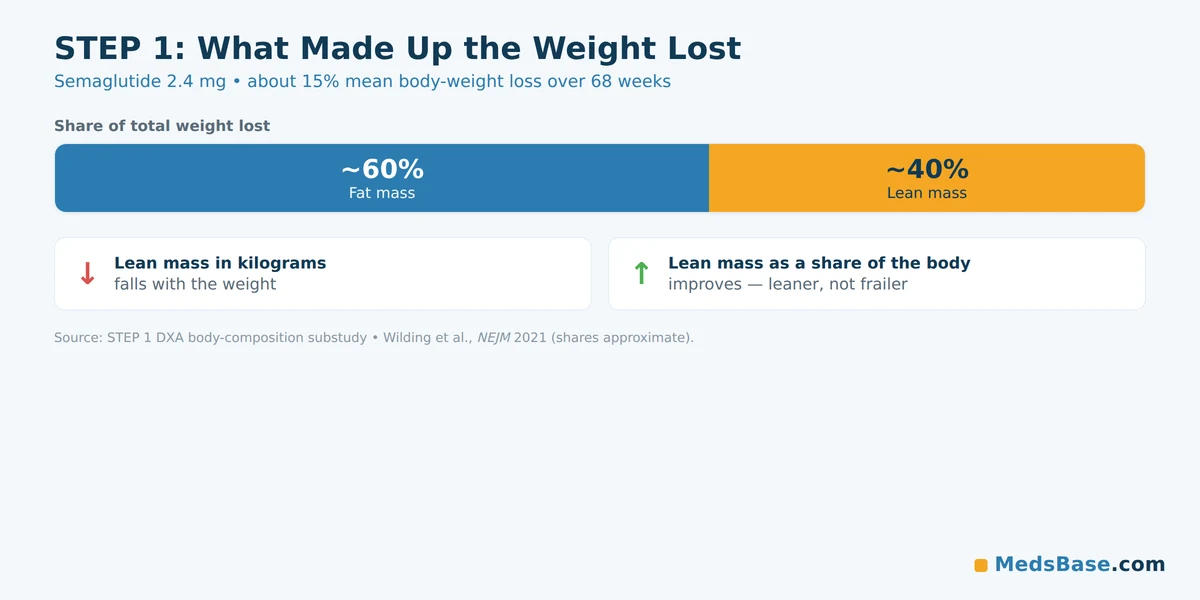
That distinction matters for how worried you should be. Muscle loss on Ozempic is a body-composition question, not a sign that the medicine is quietly damaging you. In fact, in the pivotal STEP 1 trial of once-weekly semaglutide 2.4 mg, participants lost an average of about 15% of their body weight over 68 weeks — a result that reshaped obesity medicine. Buried in that trial was a DXA body-composition substudy, and it’s where the “40% was lean mass” figure comes from.
Here’s the catch worth naming right away: losing some lean mass during weight loss is normal and expected — it happens with dieting, with bariatric surgery, with any method that works. The real question isn’t “did I lose lean mass?” It’s “did I lose too much, and did my strength suffer?” Those are different things, and we’ll keep them separate all the way through. Hold onto that — it’s the thread that untangles almost every scary headline about GLP-1 muscle loss.
How Ozempic Muscle Loss Actually Happens
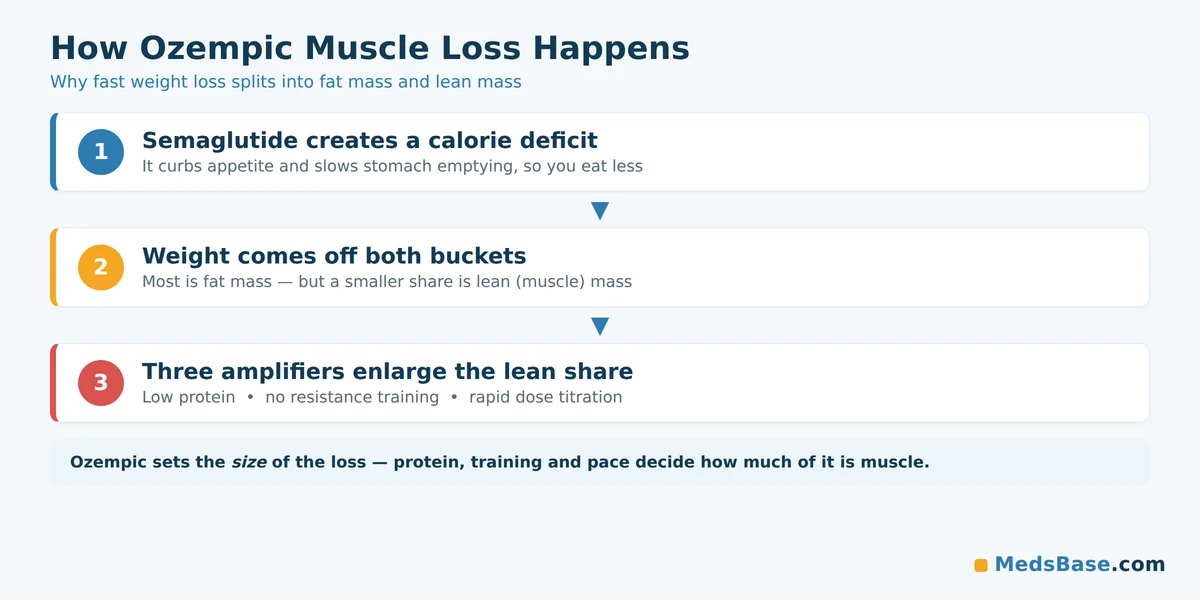
Think of your body weight as two big buckets: a fat bucket and a lean bucket (muscle, organs, water, bone). When you run a calorie deficit — which is exactly what semaglutide creates by curbing appetite and slowing stomach emptying — your body drains both buckets to make up the energy gap. It would be lovely if it drained only fat. It doesn’t. Some lean tissue always comes along.
So what decides how much comes from the lean bucket? Three amplifiers, and all three are things you can influence:
- Not enough protein. Protein is the raw material your body uses to rebuild muscle. Eat too little, and your body cannibalises existing muscle to cover its daily needs.
- No resistance training. Muscle follows a strict “use it or lose it” rule. If you’re not giving muscles a reason to stay, a shrinking body sees them as expensive to maintain.
- Too fast, too soon. Very rapid weight loss — often from escalating the dose quickly and barely eating — pulls a larger share from the lean bucket than slower, steadier loss does.
Notice something: Ozempic itself isn’t on that list. The drug drives the weight loss, but how much of it is muscle is largely set by protein, training, and pace. That’s the whole reason the protection plan later in this article works.
One line to remember: Ozempic sets the size of your weight loss, but your protein, your training, and your pace decide how much of it comes from muscle.
Who Loses Muscle on Ozempic — And Who’s Most at Risk
Everybody who loses significant weight loses some lean mass. But the loss only becomes a genuine health problem — the frailty-and-falls kind — for a specific group. Sorting yourself honestly here is the single most useful thing you can do with this article.
The five risk factors that matter most
- Age 65 and over. Older adults already lose muscle with age (natural sarcopenia). Layer weight-loss lean loss on top and the margin for error shrinks.
- A sedentary lifestyle. No resistance stimulus means no reason for the body to protect muscle. This is the risk factor you can change fastest.
- Low starting muscle. If you began with little muscle to spare — common in frailer or previously inactive people — even a modest loss bites harder.
- Rapid dose titration. Climbing the dose quickly, eating very little, and dropping weight fast all skew loss toward the lean bucket.
- Long-term use in type 2 diabetes. This is where the newest data gets pointed, and it deserves its own look.
The strongest warning signal in the current literature comes from older adults with type 2 diabetes on prolonged treatment. A 24-month retrospective cohort of adults 65 and older with type 2 diabetes found that semaglutide users showed accelerated sarcopenia versus matched controls: greater loss of appendicular skeletal muscle, and — critically — measurably lower grip strength and slower gait speed by the end. The effect was dose-dependent: higher doses predicted faster muscle loss. That’s a real signal, in a real at-risk group, and it’s fair to take it seriously rather than wave it away.
The reassuring flip side: for the majority of people using semaglutide for weight loss in mid-life, muscle loss on Ozempic is a manageable trade-off, not a trap — provided you don’t leave the protection plan to chance.
Semaglutide Side Effects, Muscle Loss & What the Numbers Mean
Let’s put muscle loss where it actually belongs in the bigger safety picture. Semaglutide’s most common effects are gastrointestinal — and they matter here because they’re indirectly tied to muscle. The MedlinePlus semaglutide reference lists nausea, vomiting, diarrhoea, constipation and abdominal discomfort among the frequent semaglutide side effects, plus a boxed warning about thyroid tumours seen in animal studies (human risk unknown). Here’s the muscle connection people miss: when nausea kills your appetite, protein is usually the first thing to fall off your plate — and low protein is exactly what tips weight loss toward the lean bucket.
| Side effect | Frequency | Severity | What to do |
|---|---|---|---|
| Lean-mass loss (as part of weight loss) | Common with any large weight loss | Usually mild if you train + eat protein | Prioritise protein ~1.2–1.6 g/kg/day; resistance-train 2–3×/week; track strength, not just the scale |
| Nausea / reduced appetite | Very common, early | Usually mild–moderate, eases with time | Eat smaller protein-first meals; don’t skip eating entirely; slow titration if severe |
| Vomiting / diarrhoea | Common | Mild–moderate | Hydrate; report if persistent (raises dehydration + under-eating risk) |
| Grip-strength / gait decline | Signal mainly in older, long-term T2D users | Potentially serious (falls, frailty) | Ask your doctor about strength/gait checks; add resistance training; review dose |
| Fatigue / weakness | Occasional | Usually mild | Check you’re eating enough; rule out low intake before blaming the drug |
Read the table and the pattern jumps out: the muscle-related risks all have the same antidote — eat enough protein and give your muscles a reason to stay. The medicine doesn’t decide whether you keep your strength; your protein and your training largely do.
That resolves the open loop from the intro. The group for whom ozempic muscle loss is genuinely worrying is the older, sedentary, long-term-use crowd — and even for them, the response is monitoring and strength work, not fear. A pharmacist’s practical note: the people who run into trouble are almost always the ones who under-eat through the nausea phase and never lift a thing. It’s rarely the drug acting alone.
What the Research on Ozempic Muscle Loss Really Shows
This is where honesty earns trust, because the evidence genuinely points in two directions depending on who you study and for how long.
| Study | Year | Key finding | Source |
|---|---|---|---|
| STEP 1 (semaglutide 2.4 mg, obesity) | 2021 | ~15% mean weight loss over 68 weeks; DXA substudy: ~39–40% of weight lost was lean mass, yet lean mass rose as a proportion of body weight | NEJM (Wilding et al.) |
| Prokopidis review — GLP-1 & muscle strength | 2026 | Short-term trials preserved handgrip strength despite lean-tissue loss; lean loss is not a reliable predictor of strength change | British Journal of Pharmacology |
| 24-month cohort — older adults with T2D | 2025 | Accelerated sarcopenia, lower grip strength and gait speed vs controls; dose-dependent | Drug Design, Development & Therapy (PMC) |
| Older-adult function trial (~76 yrs) | 2024 | Small trial testing whether semaglutide + lifestyle protects function/body composition — data still maturing | Innovation in Aging (PMC) |
Two findings deserve unpacking. First, the STEP 1 reframe: yes, roughly 39–40% of weight lost was lean mass — but because far more fat was lost than lean, participants’ lean mass as a body composition proportion actually improved. You ended up leaner relative to your size, not frailer. That’s the context the headlines drop.
Second, the split by population. In short-term obesity trials, the 2026 British Journal of Pharmacology review notes that handgrip strength was statistically preserved even as lean tissue fell — reassuring. But in older adults with type 2 diabetes on long-term treatment, the same review flags reduced grip strength and accelerated sarcopenia. And an ongoing trial in adults averaging about 76 years old is still gathering the function-and-body-composition data we’d most like to have — a candid reminder that the long-term picture in older people isn’t settled.
What this means for you: if you’re in mid-life, active and eating well, the evidence is reassuring — lean mass falls but strength tends to hold, and your body composition can improve. If you’re older, sedentary, or a long-term type 2 diabetes user, the signals are real enough to warrant a plan and monitoring. The evidence base on GLP-1 muscle loss is still short-term and mixed, especially in the over-65s — so treat any single dramatic headline, in either direction, with caution.
Take Marta, 68 — a purely illustrative example. She has type 2 diabetes, spends most of her day sitting, and loses weight quickly after a fast dose climb. Six months in she’s delighted with the scale but notices jars are harder to open and stairs feel longer. That’s the profile the research worries about — and, importantly, the profile that responds best to protein and twice-weekly strength work. Her story isn’t a warning to avoid the drug; it’s a case for wrapping the right habits around it.
Ozempic Muscle Loss vs Other Weight-Loss Routes
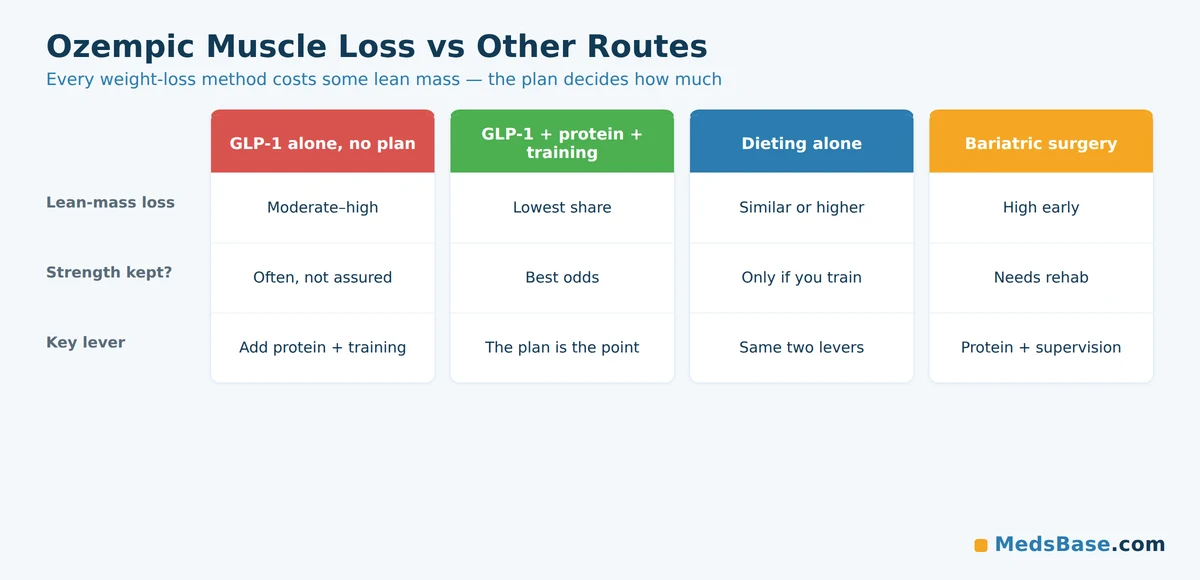
Here’s where it gets clarifying: muscle loss isn’t unique to Ozempic. Every effective weight-loss method costs some lean mass. What differs is how much, and how easily you can protect against it.
| Approach | Typical lean-mass loss | Strength preserved? | Key lever |
|---|---|---|---|
| GLP-1 (Ozempic) alone, no plan | Moderate–high share | Often, but not guaranteed | Add protein + training |
| GLP-1 + protein + resistance training | Lowest realistic share | Best odds | The combination is the point |
| Calorie-restriction dieting alone | Similar or higher lean share | Only if you train + eat protein | Same two levers apply |
| Bariatric surgery | Often high lean loss early | Needs structured rehab | Protein + supervised activity |
Which route fits which situation? The honest verdict: the method matters far less than the plan wrapped around it. Dieting alone can strip just as much lean mass as a GLP-1 does — sometimes more, because dieters often lose the appetite for protein-rich food too. The reason Ozempic gets singled out is simply that it produces such large, consistent weight loss that the lean-mass share becomes measurable and newsworthy. Put another way: don’t switch away from an effective treatment to dodge muscle loss, because you’ll meet the same problem on the other side. Instead, keep the treatment and add the two things that solve it everywhere — protein intake and resistance training.
There’s a related question many people reach next: what happens to all of this when the weight loss stops progressing? If your loss has stalled and you’re wondering whether your dose or your routine needs a rethink, that’s a different but overlapping problem — and a good moment to reassess your protein and training too.
How to Protect Your Strength — The Practical Plan
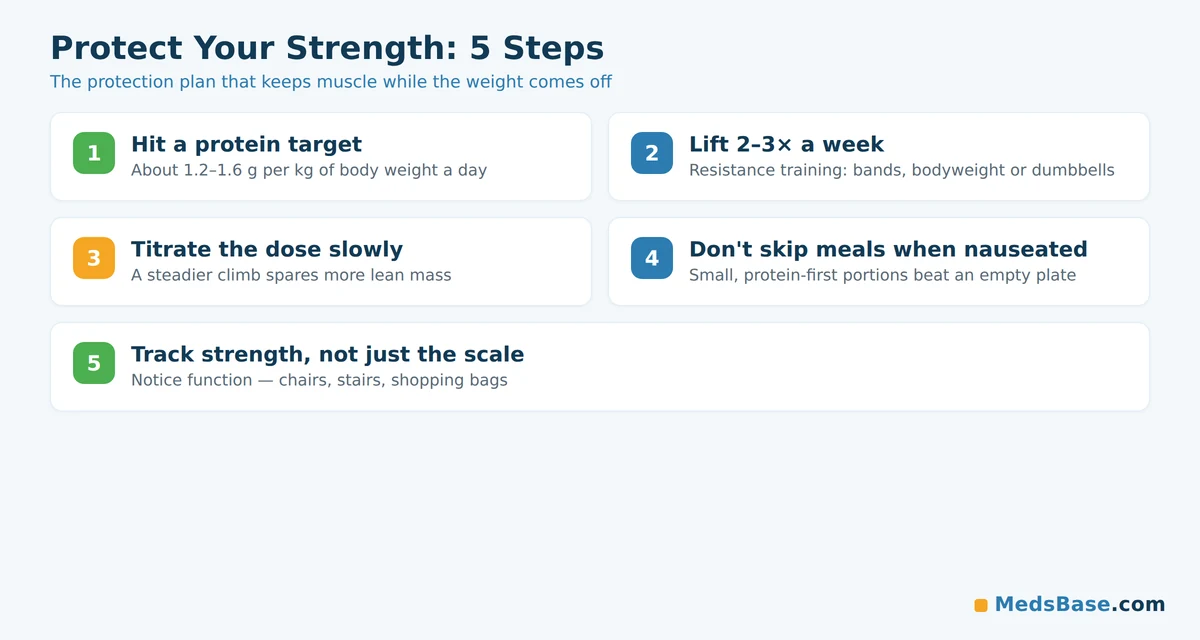
This is the section the scare coverage skips. If you take nothing else from this article, take these five steps. They’re the difference between losing weight and strength versus losing weight while keeping it.
- Hit a protein target — roughly 1.2–1.6 g of protein per kg of body weight per day. This is the single biggest lever. During weight loss, higher protein helps preserve lean mass. Practically: aim for a palm-sized protein source at every meal, and front-load it earlier in the day when appetite is best. (Use a sensible reference weight if you carry a lot of excess — your clinician or dietitian can set the number.)
- Do resistance training 2–3 times a week. This is non-negotiable if you want to keep strength. It doesn’t mean a gym membership — bodyweight squats, sit-to-stands, resistance bands, or light dumbbells all count. Muscle stays when you give it a job.
- Titrate the dose slowly. Rushing to the highest dose maximises appetite suppression and speed — and skews loss toward the lean bucket. A slower climb usually means steadier, more muscle-sparing weight loss. This is a conversation to have with your prescriber, not a solo decision.
- Don’t skip meals entirely when nausea hits. The instinct on a queasy day is to eat nothing — but zero food means zero protein, and that’s exactly when lean loss accelerates. Small, bland, protein-first portions beat an empty plate. If nausea is what’s derailing your intake, our guide to eating enough protein when nausea kills your appetite has practical fixes that keep protein flowing without triggering your stomach.
- Track strength, not just the scale. Weigh less often; instead notice function — can you rise from a chair without hands, carry the shopping, climb stairs comfortably? If those get harder, that’s your early-warning system. Tell your doctor.
Mistakes to avoid: under-eating protein because you’re “not hungry”; treating the scale number as the only success metric; climbing the dose as fast as possible; skipping strength work because “cardio is enough” (it isn’t, for muscle); and ignoring new weakness or unsteadiness in an older adult.
If you’re weighing whether semaglutide fits your situation in the first place, our full plain-English guide to semaglutide walks through how it works, the strengths available, and what to discuss with your clinician — see options there, then bring specifics to a professional rather than deciding alone.
Frequently Asked Questions
Q: Does Ozempic cause muscle loss?
A: Ozempic doesn’t attack muscle directly — but the large weight loss it produces always includes some lean (muscle) mass, not just fat. In the STEP 1 trial’s body-composition substudy, roughly 39–40% of weight lost was lean mass. The good news: how much muscle you keep depends heavily on protein intake and resistance training, which you control.
Q: How much muscle do you lose on Ozempic?
A: There’s no single number, because it depends on how fast you lose weight, how much protein you eat, and whether you train. Trial data suggest lean mass can make up around 39–40% of total weight lost — but lean mass as a proportion of your body often improves, and short-term studies show grip strength usually holds. Training and protein shrink the muscle share substantially.
Q: Is muscle loss on Ozempic permanent?
A: Not necessarily. Muscle responds to stimulus and protein at any age. If you preserve or rebuild it with resistance training and adequate protein — during and after treatment — much of the functional loss can be limited or reversed. Older, frail adults regain muscle more slowly, which is exactly why prevention beats recovery for them.
Q: Does Ozempic cause sarcopenia in older adults?
A: The concern is real for a specific group. A 24-month cohort of adults 65+ with type 2 diabetes found accelerated sarcopenia, lower grip strength and slower gait on semaglutide, in a dose-dependent way. Younger, active users in short-term trials generally preserved strength. If you’re older or use it long-term, ask your doctor about strength and gait monitoring.
Q: How much protein should you eat on Ozempic?
A: A common target is roughly 1.2–1.6 grams of protein per kilogram of body weight per day to help preserve lean mass during weight loss — higher than the general adult minimum. Spread it across meals and prioritise it when appetite is best. If you carry a lot of excess weight or have kidney concerns, have a clinician or dietitian set your exact number.
Q: How do I prevent muscle loss on Ozempic?
A: Three levers do most of the work: eat enough protein (~1.2–1.6 g/kg/day), do resistance training 2–3 times a week, and titrate the dose slowly rather than rushing to the top. Don’t skip meals entirely during nausea, and track your strength and function — not only the scale — so you catch any decline early.
Q: Will I lose muscle if I stop Ozempic?
A: Stopping the medicine doesn’t cause muscle loss by itself, but weight regain can change body composition, and appetite rebound can affect eating habits. Keeping up protein and resistance training after you stop is the best way to protect the strength you’ve kept. Our guide on stopping semaglutide covers what to expect.
The Bottom Line
Ozempic muscle loss is real, but it’s not the frailty sentence the headlines imply. Yes, roughly 39–40% of weight lost in the STEP 1 substudy was lean mass — but far more fat came off than muscle, lean mass improved as a share of the body, and short-term trials mostly preserved strength, which is what actually matters for daily life. The genuine concern sits with older adults, the sedentary, and long-term type 2 diabetes users, where the newest research shows accelerated sarcopenia and weaker grip. For everyone else, ozempic muscle loss is a manageable trade-off — if you don’t leave your protein and training to chance.
Your one immediate action: pick your two levers and commit this week — hit roughly 1.2–1.6 g/kg of protein a day, and put two short resistance-training sessions on the calendar. Those two habits do more to protect your strength than any change to the medicine itself.
Still weighing the pieces? These are the natural next questions:
- Thinking ahead to life after the pen? Read what happens to your body when you stop taking Ozempic — because keeping muscle matters most in the maintenance phase.
- Worried another everyday medication is behind your muscle aches? Our new guide to statin intolerance and muscle symptoms sorts real drug-related muscle pain from the myths.

Written by
Sophie ChenPharmaceutical Content Researcher · 8 years experience
Sophie Chen is a pharmaceutical content researcher with 8 years covering generic medication access and clinical pharmacology. She specialises in international regulatory frameworks, bioequivalence standards, and patient-facing education on therapeutic drug classes. She is not a clinician.