








✓ Medically reviewed by · Last reviewed: May 2026
Pharmacy Researcher · 8 years experience
Pharmacy researcher with 8 years reviewing clinical drug information, generic formulation equivalence, and international pharmaceutical standards. Focuses on patient-facing accuracy in medication education.
Nearly one in five people who catch COVID-19 are left with symptoms that drag on for months, and the single most common complaint is bone-deep fatigue. So when a rigorous trial reported that an old, inexpensive antidepressant eased that exhaustion, the news travelled fast. The question worth slowing down for is simpler: does fluvoxamine for long COVID actually help, or is this another hopeful headline that fades on a closer read?
By the end of this guide you’ll know exactly what the trial measured, how large the benefit was, why the comparison drug flopped, and — just as important — who should be careful before pinning any hope on this. One detail about the other pill in the study surprised almost everyone, and we’ll get to it in the research section.
- A 399-patient randomized trial found fluvoxamine eased long COVID fatigue at day 60 — and the effect held at day 90.
- The comparison arm, metformin, showed no benefit for fatigue — a result that reframes the whole story.
- Fluvoxamine is a decades-old SSRI; using it for long COVID is still off-label, not an approved treatment.
- The improvement was real but modest — this is a promising signal, not a finish line, and one habit around dosing matters.
- Fluvoxamine isn’t right for everyone — there’s a specific group who should avoid it, covered in the safety section.
What Is Long COVID?
The NHS defines long COVID as symptoms that last longer than 12 weeks after infection and can’t be explained by another cause. Its very first listed symptom is “feeling extremely tired (fatigue).” The World Health Organization-post-covid-19-condition) puts it slightly differently: the condition is usually recognised about three months after illness, with symptoms lasting at least two months. WHO estimates that roughly 10–20% of people who get COVID-19 go on to develop lasting symptoms.
Here’s why fatigue matters so much. It isn’t the tiredness of a bad night’s sleep. People describe a heavy, unpredictable exhaustion that can flatten them after minor effort — a phenomenon researchers call post-exertional malaise. It reshapes work, parenting, and relationships, sometimes for years.
That’s the backdrop against which any new treatment gets judged. If you’re reading this, you or someone you love probably knows this fatigue first-hand, and you want to know whether a pill could genuinely move the needle. Many people also notice their mood dips alongside the fatigue; if that resonates, our guide on whether long COVID and anxiety are linked unpacks that overlap.
The honest starting point: there is no approved drug specifically for long COVID fatigue. That’s precisely why a repurposed, low-cost medicine drew so much attention.
How Does Fluvoxamine Work?
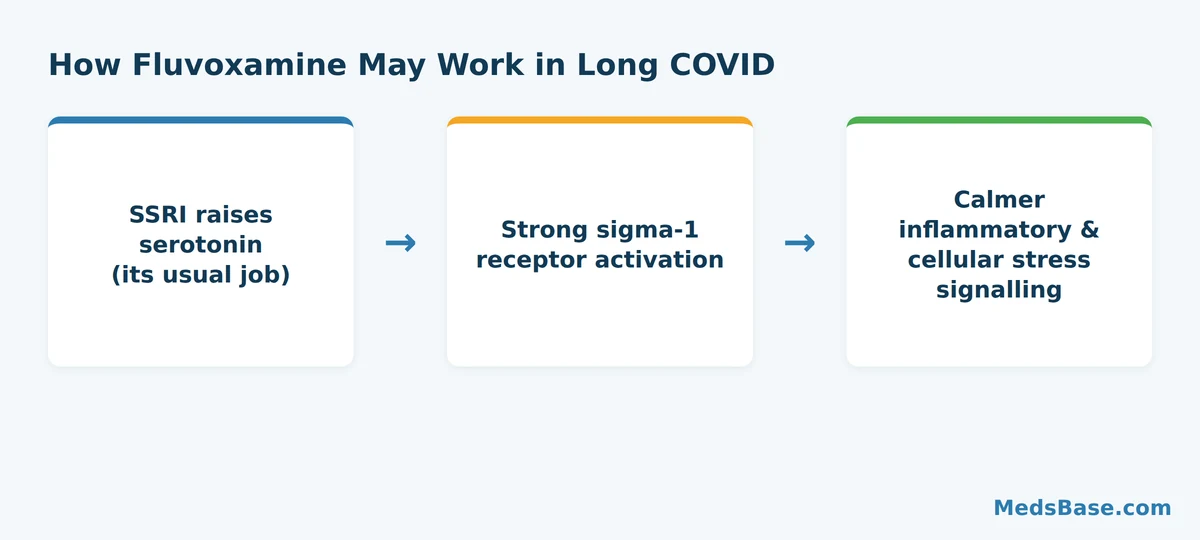
Fluvoxamine is best known as an antidepressant, but its possible role here has less to do with mood and more to do with inflammation and cellular stress signalling.
At its day job, fluvoxamine is a selective serotonin reuptake inhibitor, or SSRI. According to fluvoxamine is a well-established SSRI drug information from MedlinePlus, it raises serotonin activity in the brain and is approved to treat obsessive-compulsive disorder and social anxiety disorder. That serotonin effect is not the interesting part for long COVID.
Think of the sigma-1 receptor as a thermostat for a cell’s stress response. In post-viral states, that thermostat can get stuck “on,” keeping inflammatory and stress pathways running hot. By activating sigma-1, fluvoxamine may nudge that thermostat back toward baseline. It’s a plausible, evidence-informed mechanism — not a proven cause-and-effect for long COVID.
That mechanism is why fluvoxamine was first studied in acute COVID-19, where earlier trials suggested it might reduce the risk of deterioration. The new work asks a different question: can the same pill help people who are already months into the aftermath?
One line to hold onto: the mechanism is a hypothesis that fits the data, not a settled fact. Good science says so out loud.
Key Uses & Applications of Fluvoxamine
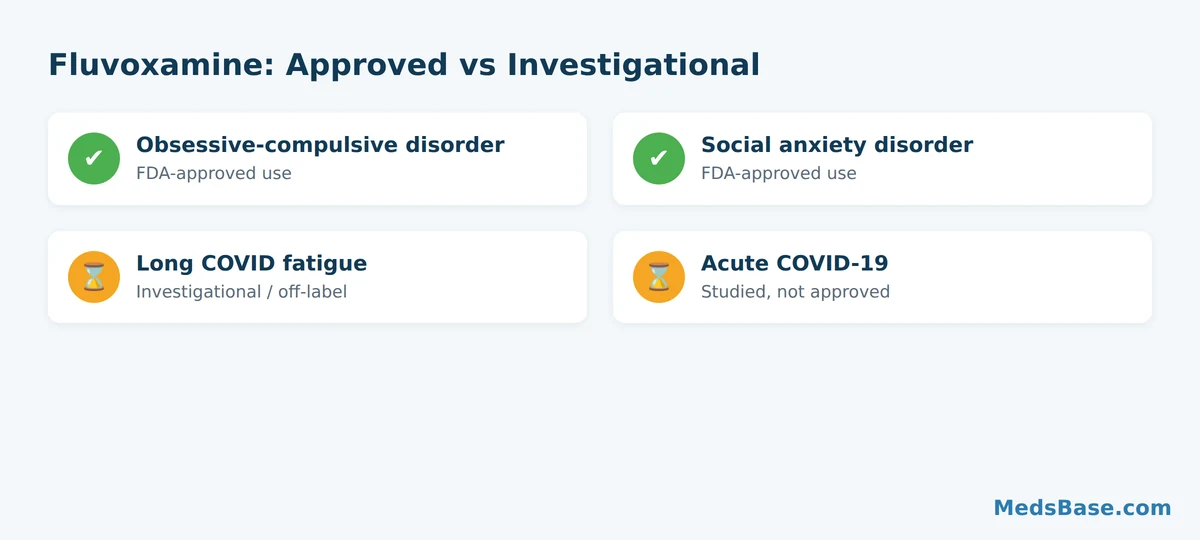
Fluvoxamine has a clear approved lane and a growing research lane. Keeping the two separate is the single most important thing a reader can do with this topic.
What it’s approved for
Fluvoxamine’s on-label uses are psychiatric: obsessive-compulsive disorder and social anxiety disorder, with off-label use for depression in some settings. Decades of prescribing mean its safety profile is well mapped — a big reason researchers keep testing it for new problems.
Where it’s investigational
Long COVID fatigue is an investigational, off-label use. So is acute COVID-19. A positive trial is encouraging, but it does not change a drug’s approved status overnight. Regulators need replication, and clinicians weigh individual risk.
If, after that honest split, you and your clinician decide fluvoxamine is worth a try, you can see the medication itself — Fluvoxin (fluvoxamine) is stocked at MedsBase, and you don’t need a prescription to order it. Availability isn’t a substitute for medical advice, though: the “who should avoid it” list above exists for a reason.
Fluvoxamine Safety Profile, Side Effects & Dosage
Fluvoxamine is not a gentle placebo, and treating it as harmless would be a mistake. It’s a familiar drug with a familiar — and manageable — set of trade-offs.
The trial used 100 mg twice daily. That matters, because tolerability depends heavily on ramping up slowly rather than starting at a full dose. Here’s the promised detail: the most common reason people quit an SSRI early is nausea in the first week or two — and that early nausea is usually blunted by starting low, taking doses with food, and increasing gradually. Rush the titration and you may abandon a drug that might have helped.
| Side effect | Frequency | Severity | What to do |
|---|---|---|---|
| Nausea, upset stomach | Common, especially first 1–2 weeks | Mild–moderate | Take with food; start low and increase slowly; usually settles |
| Drowsiness or insomnia | Common | Mild | Adjust timing with your prescriber; often eases |
| Headache, dry mouth | Common | Mild | Hydration; usually transient |
| Sexual side effects | Common | Mild–moderate | Discuss dose or timing with your doctor |
| Increased suicidal thoughts (under 25) | Uncommon but serious | Serious | Boxed warning; close monitoring early in treatment |
| Serotonin syndrome (with interacting drugs) | Rare | Serious | Emergency care; avoid MAOIs and stacking serotonergic drugs |
| Unusual bleeding (with NSAIDs/blood thinners) | Uncommon | Moderate–serious | Review other medicines with a pharmacist |
Notice what resolves the open loop from the intro: the “one habit that matters” is titration. Start low, go slow, take it with food. That single practice is the difference between tolerating fluvoxamine and giving up on it.
Fluvoxamine also has more drug interactions than most SSRIs because it inhibits several liver enzymes. That’s not a reason for alarm — it’s a reason to have a pharmacist review your full medication list before starting. Pharmacists commonly catch interactions here that a busy clinic visit misses.
What Does the Research Say?
This is the heart of it. Let’s look at exactly what the trial found — no spin.
The study everyone is citing is the REVIVE adaptive randomized trial, published in Annals of Internal Medicine in 2026. Researchers enrolled 399 adults whose fatigue had persisted at least 90 days after a confirmed SARS-CoV-2 infection, and randomly assigned them to fluvoxamine (100 mg twice daily), metformin (750 mg twice daily), or a matching placebo. Fatigue was measured on the Fatigue Severity Scale.
| Study | Year | Finding | Source |
|---|---|---|---|
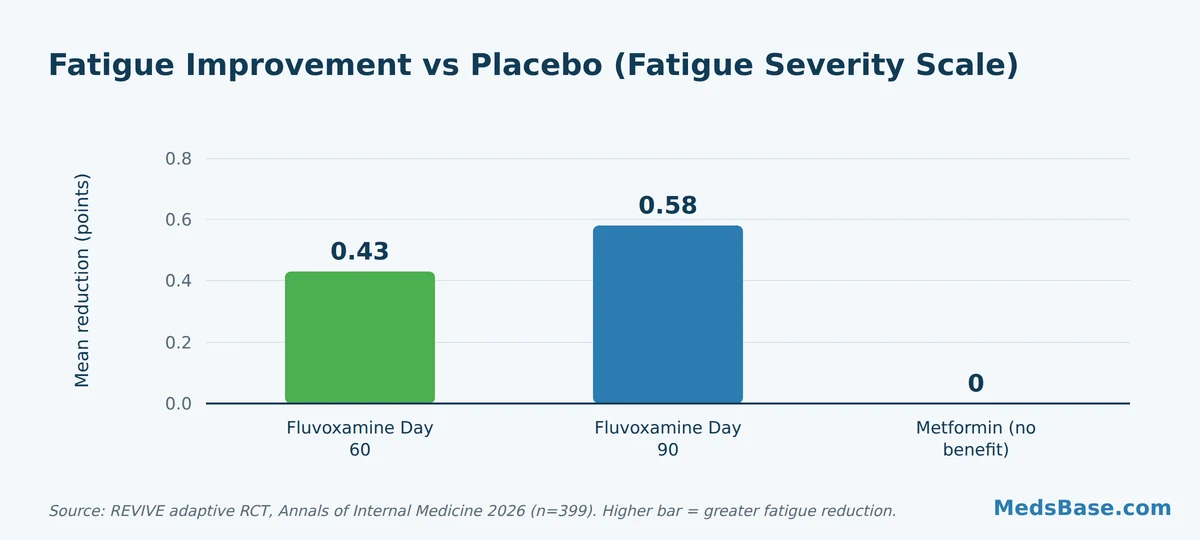
| REVIVE adaptive RCT (fluvoxamine, day 60) | 2026 | Fatigue score improved vs placebo — mean difference −0.43 (95% CrI −0.80 to −0.07) | Annals of Internal Medicine |
| REVIVE adaptive RCT (fluvoxamine, day 90) | 2026 | Effect sustained — mean difference −0.58 (95% CrI −0.98 to −0.16) | Annals of Internal Medicine |
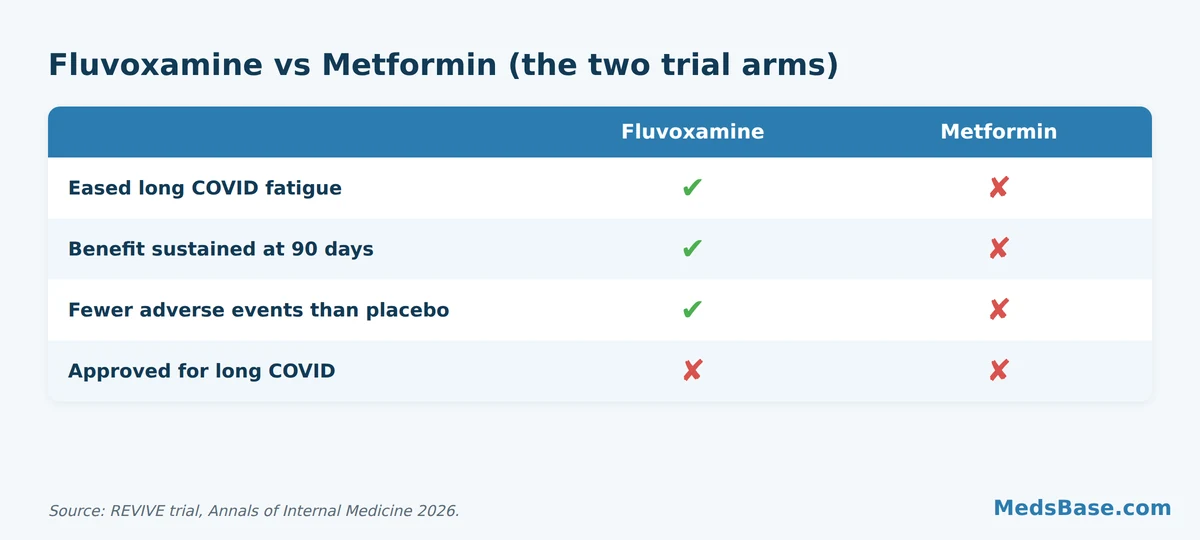
| REVIVE adaptive RCT (metformin arm) | 2026 | No significant benefit for fatigue vs placebo | Annals of Internal Medicine |
| REVIVE adaptive RCT (safety) | 2026 | Adverse events lower with fluvoxamine (20.0%) than metformin (28.8%) or placebo (29.7%) | Annals of Internal Medicine |
Two things stand out. First, fluvoxamine beat placebo at day 60 and the benefit was still there — actually a bit larger — at day 90. A treatment effect that grows or holds over time is more convincing than a flash that fades. Fluvoxamine also improved quality-of-life scores, and, strikingly, people on it reported fewer side effects than people on placebo.
Second — here’s the surprise promised in the intro — metformin, the other active pill in the trial, did nothing for fatigue. That’s important for two reasons. It tells us the fluvoxamine result probably isn’t just a generic “taking any pill helps” effect. And it’s a reminder that metformin, a superb diabetes drug, isn’t a long COVID answer — while carrying its own well-known nutrient caveat. If you take metformin for another reason, our guide on how metformin carries its own well-known nutrient caveat is worth a read.
What this means for you: the evidence now suggests fluvoxamine can produce a real, if modest, improvement in long COVID fatigue for some people. A mean difference under one point on a symptom scale is meaningful at the group level but won’t transform everyone. Research suggests benefit; it does not promise it. One well-designed trial is a strong start, not the final word — replication is what turns a signal into standard care.
What the trial didn’t answer
A single positive trial, however well run, leaves real questions open — and naming them is part of reading evidence honestly.
The improvement was modest. A mean difference under one point on the Fatigue Severity Scale matters across a group, but it can’t tell you in advance whether you personally will be a strong responder or feel little change. The study also ran to 90 days, so it doesn’t tell us what happens over a year, whether benefits keep building or plateau, or how people fare after stopping.
There’s also the question of who was studied. Participants had fatigue confirmed for at least 90 days after infection and met specific entry criteria. Your situation may differ — a different symptom mix, other health conditions, other medications — and that affects how much the results apply to you. And one trial rarely settles a question in medicine; independent replication in different populations is what earns a place in routine care.
None of this cancels the good news. It simply frames it correctly: fluvoxamine for long COVID is an evidence-backed option to explore, not a settled treatment — which is exactly how a careful doctor will present it.
Fluvoxamine vs Alternatives
There’s no head-to-head league table of long COVID fatigue treatments, because so few have been tested rigorously. But we can compare sensibly.
Fluvoxamine vs metformin (the trial’s own comparison). In this study, fluvoxamine helped and metformin didn’t. Both are cheap and widely used, so cost isn’t the deciding factor — the evidence is. For fatigue specifically, fluvoxamine has the data; metformin does not.
Fluvoxamine vs “pacing” and rehabilitation. Structured pacing (carefully balancing activity and rest to avoid post-exertional crashes) remains a cornerstone of long COVID management and has no drug interactions. It isn’t either/or: a medication that trims fatigue can make pacing easier to sustain.
Fluvoxamine vs other SSRIs. Most of fluvoxamine’s proposed benefit is pinned on its unusually strong sigma-1 activity — which not every SSRI shares. So you can’t assume another antidepressant would do the same thing. The trial tested fluvoxamine, so the evidence is about fluvoxamine.
| Approach | Evidence for long COVID fatigue | Best suited to |
|---|---|---|
| Fluvoxamine | One positive RCT (modest, sustained benefit) | Disabling fatigue, other causes excluded, no SSRI contraindication |
| Metformin | Tested in the same trial — no benefit | Not indicated for fatigue |
| Pacing / rehabilitation | Cornerstone of management; low risk | Everyone, alongside any medicine |
| Treating other drivers (sleep, anaemia, thyroid, B12) | Fixes fatigue when they’re the real cause | Anyone with an undiagnosed contributor |
Which fits which situation? If your fatigue is disabling, other causes have been excluded, and you have no contraindication, fluvoxamine is the option with the freshest supporting trial — worth a specific conversation with your doctor. If you also have significant anxiety or OCD, fluvoxamine may do double duty. If you can’t take an SSRI, pacing and treating other drivers of fatigue (poor sleep, anaemia, thyroid issues, nutrient gaps) come first. Crucially, these aren’t rivals: the strongest plans usually stack a sensible medication trial on top of pacing and good sleep, not instead of them.
How to Approach Fluvoxamine Sensibly — Practical Guidance
If you and your clinician decide to try it, a few practical steps stack the odds in your favour.
- Confirm the diagnosis first. Make sure the fatigue is genuinely post-COVID and that treatable mimics — anaemia, thyroid problems, sleep apnoea, B12 deficiency — have been checked. Treating the wrong problem wastes months.
- Have a pharmacist screen your medicines. Fluvoxamine’s interaction list is longer than most SSRIs. This one step prevents the majority of avoidable problems.
- Start low and titrate up. Rushing to 100 mg twice daily invites nausea and early dropout. Slow and steady wins.
- Take doses with food. It blunts stomach upset in the vulnerable first fortnight.
- Give it time and track it. Fatigue scores in the trial kept improving out to 90 days. Judge it over weeks, not days, and keep a simple symptom log.
- Don’t stop abruptly. SSRIs should be tapered, not quit cold, to avoid discontinuation effects.
Mistakes to avoid: starting at full dose; combining it with an MAOI or stacking serotonergic drugs; adding NSAIDs without checking bleeding risk; and expecting an overnight fix. If you want to see the exact product and strengths, Fluvoxin (fluvoxamine) is available at MedsBase — again, medical guidance first, purchase second.
- Is there a link between long COVID and anxiety? What the research says.
- Could a nutrient gap be driving your tiredness? See vitamin B12 injections.
- Why metformin — the trial’s other arm — has its own vitamin B12 caveat.
Frequently Asked Questions
Q: Does fluvoxamine help long COVID fatigue?
A: In one well-designed randomized trial of 399 people, yes — fluvoxamine eased fatigue more than placebo at 60 days, and the benefit held at 90 days. The improvement was modest but real, and it came with fewer side effects than placebo. It won’t help everyone, and one trial isn’t the final word, so treat it as a promising option to discuss with your doctor rather than a guaranteed fix.
Q: Is fluvoxamine approved for long COVID?
A: No. Fluvoxamine is approved for obsessive-compulsive disorder and social anxiety disorder. Using it for long COVID fatigue is off-label — meaning a doctor can prescribe it based on evidence and judgement, but regulators have not cleared it for this specific use. Off-label prescribing is common and legal, but it’s a decision to make with a clinician who knows your history.
Q: What dose of fluvoxamine was used in the trial?
A: 100 mg twice daily. In practice, most people should build up to that gradually rather than starting there, because slow titration and taking doses with food dramatically reduce the early nausea that causes many people to quit.
Q: How does fluvoxamine work for long COVID if it’s an antidepressant?
A: Its proposed benefit here isn’t about serotonin. Fluvoxamine strongly activates the sigma-1 receptor, which helps regulate inflammation and cellular stress. Researchers think that action — not its antidepressant effect — may calm the dysregulated signalling behind post-viral fatigue. It’s a well-supported hypothesis, not a proven mechanism.
Q: Why did metformin fail in the same trial?
A: The trial tested metformin alongside fluvoxamine, and metformin showed no significant benefit for fatigue versus placebo. That doesn’t diminish metformin as a diabetes medicine — it simply means it isn’t a long COVID fatigue treatment. It also strengthens confidence that fluvoxamine’s result wasn’t just a placebo-style effect of taking any pill.
Q: Is fluvoxamine safe for people with long COVID?
A: For most adults without contraindications, fluvoxamine is a well-understood medicine with a manageable side-effect profile — in the trial, adverse events were actually lower than with placebo. But it interacts with many drugs, shouldn’t be combined with MAOIs, and carries a suicidality warning in people under 25. A pharmacist medication review and a doctor’s sign-off make it much safer.
Q: Can I just buy fluvoxamine and try it myself?
A: You can obtain fluvoxamine without a prescription from MedsBase, but self-treating a complex condition isn’t wise. Long COVID fatigue overlaps with treatable conditions like anaemia and thyroid disease, and fluvoxamine’s interactions need checking. Use the access, but pair it with professional guidance — that’s how you get the benefit without the avoidable risks.
The Bottom Line
Here’s the balanced verdict. Fluvoxamine for long COVID is one of the more encouraging stories in a field short on good news: a cheap, familiar pill eased fatigue in a solid randomized trial, the benefit lasted three months, and it was better tolerated than placebo. At the same time, the effect was modest, the use is still off-label, and a single trial — however good — needs replication before it becomes standard care.
Your one immediate action: if long COVID fatigue is wearing you down, book a proper review to rule out treatable mimics, and ask your doctor specifically whether fluvoxamine fits your situation. Bring the trial name (REVIVE) so the conversation starts on solid ground.
Still weighing your options? You might want to read next: Is your tiredness actually a nutrient gap you can fix? And if you take metformin for another reason, don’t miss why it has its own vitamin B12 blind spot. Fluvoxamine isn’t a miracle and no one should sell it as one — but for the right person, it may be a genuinely useful tool.

Written by
Sophie ChenPharmaceutical Content Researcher · 8 years experience
Sophie Chen is a pharmaceutical content researcher with 8 years covering generic medication access and clinical pharmacology. She specialises in international regulatory frameworks, bioequivalence standards, and patient-facing education on therapeutic drug classes. She is not a clinician.