








✓ Medically reviewed by · Last reviewed: May 2026
Pharmacy Researcher · 8 years experience
Pharmacy researcher with 8 years reviewing clinical drug information, generic formulation equivalence, and international pharmaceutical standards. Focuses on patient-facing accuracy in medication education.
Your doctor hands you a prescription for one combination inhaler, you glance at a friend’s identical-looking device with a different name, and the obvious question lands: is one of these actually better than the other? The Advair vs Symbicort debate is one of the most-searched inhaler questions there is — and the honest answer is more useful, and more reassuring, than either brand’s marketing would suggest.
By the end of this guide you’ll understand what’s really inside each inhaler, the handful of differences that genuinely matter, what the strongest evidence says when they go head-to-head, and how to get the same medicines affordably. There’s one thing most comparison articles never mention — the generic route — and it can change the whole calculation. We’ll get there.
- Advair and Symbicort are both “controller” inhalers combining a steroid with a long-acting airway opener — same category, different molecules.
- A large Cochrane review found no clear winner between them for asthma control — the evidence calls them broadly equal.
- One practical difference lets Symbicort do a job Advair can’t — and it hinges on how fast its opener works.
- Device type and dosing convenience often matter more to real-world results than the molecules themselves.
- Both are available as affordable WHO-GMP generics — the option almost no comparison mentions.
What Are Advair and Symbicort?
Neither is a rescue inhaler in the traditional sense — they’re maintenance treatments taken regularly to keep your airways stable. That’s the first thing to get straight, because using a controller inhaler like a blue reliever is a common and dangerous mistake.
The building blocks are the same category in both. As the NHS explains, budesonide is a steroid preventer used for asthma and COPD — and the same is true of fluticasone in Advair. The steroid tackles the underlying inflammation; the long-acting bronchodilator keeps the airway muscles relaxed for around 12 hours.
So at a high level, Advair and Symbicort are doing the same job with different active ingredients. That’s why, for most people, the decision is less “which is superior” and more “which fits my breathing, my device preference, and my budget.” Hold that thought — it’s the theme of this whole comparison.
How Do Both Inhalers Work?
Understanding the shared mechanism makes the real differences much easier to see.
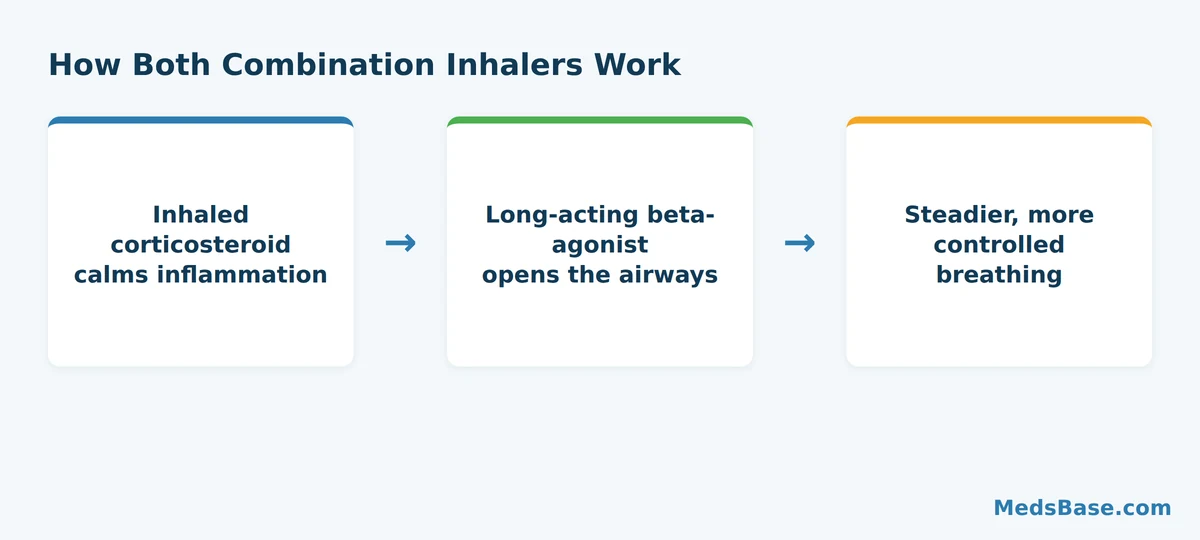
Every combination inhaler in this class does two things at once. First, the inhaled corticosteroid (fluticasone in Advair, budesonide in Symbicort) reduces the swelling and inflammation that make airways twitchy and narrow. Second, the long-acting beta-agonist, or LABA (salmeterol in Advair, formoterol in Symbicort), relaxes the muscle around your airways so they stay open.
Picture your airway as a garden hose that’s both inflamed (the walls swollen) and squeezed (a hand gripping it). The steroid brings down the swelling over days to weeks; the LABA releases the grip within minutes to hours. You need both effects for good control, which is exactly why these combination inhalers exist rather than making you juggle two separate devices.
The takeaway that matters: both inhalers attack asthma and COPD from the same two angles — the differences live in the details of which molecules, how fast, and in what device.
The Key Differences That Matter
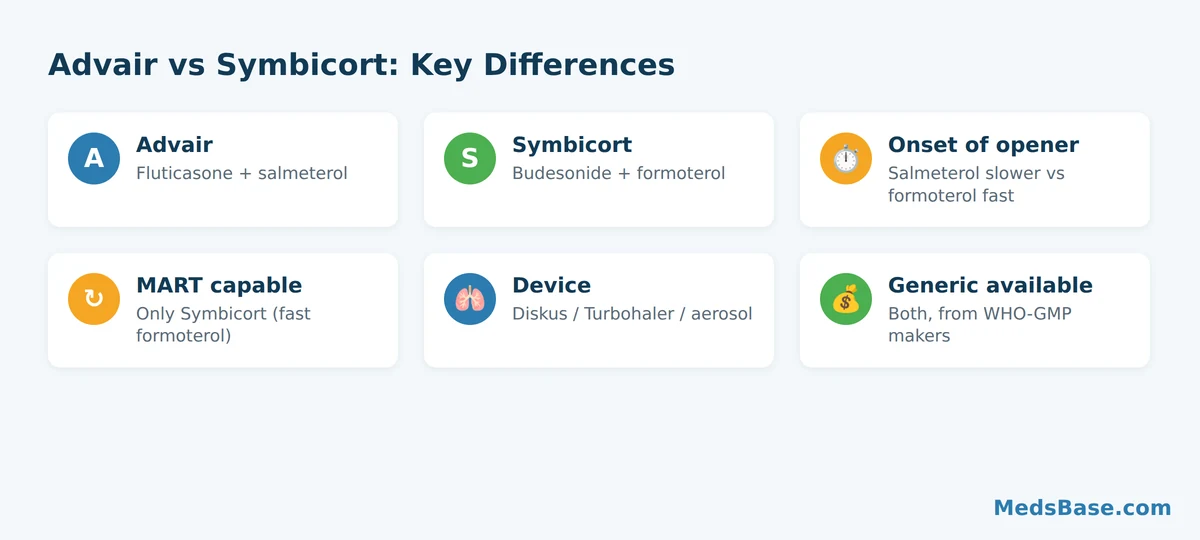
Here’s where the practical decision actually gets made. Four differences do most of the work.
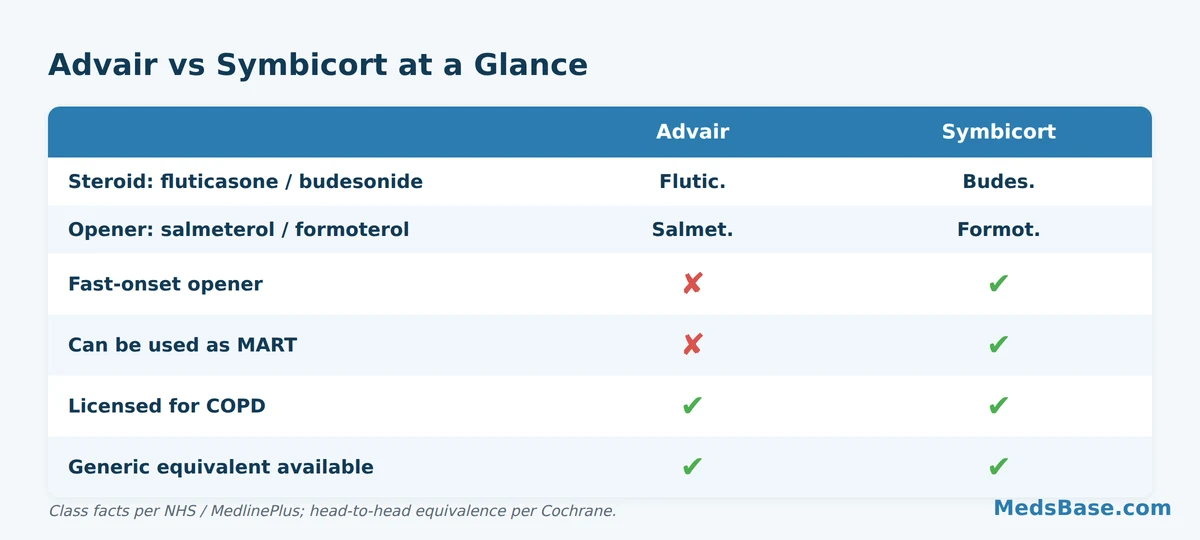
| Feature | Advair | Symbicort |
|---|---|---|
| Steroid (ICS) | Fluticasone | Budesonide |
| Airway opener (LABA) | Salmeterol (slower onset) | Formoterol (fast onset) |
| Typical device | Diskus dry-powder or aerosol | Turbohaler dry-powder or aerosol |
| Onset of the opener | Slower | Within minutes |
| Can double as reliever (MART) | No | Yes (with the right regimen) |
| Licensed for COPD | Yes | Yes |
| Generic equivalents | Yes (fluticasone/salmeterol) | Yes (budesonide/formoterol) |
The headline difference resolves the open loop from the last section: because formoterol works fast, Symbicort can be used as both a daily preventer and a reliever in an approach called maintenance and reliever therapy (MART). Advair, with slower salmeterol, is a maintenance-only inhaler — you’d still need a separate rescue inhaler alongside it. For some people, carrying one inhaler instead of two is a genuine quality-of-life and adherence win.
Device preference is the other underrated factor. A Diskus, a Turbohaler, and an aerosol inhaler each require slightly different technique, and the “best” inhaler is often simply the one you can use correctly every time. Want the deep dives? See our full Symbicort guide and our Seretide guide (Seretide is the fluticasone/salmeterol brand — the same molecules as Advair).
Advair and Symbicort: Safety, Side Effects & Dosing
Both inhalers share a class safety profile, and it’s generally favourable when used correctly.
Because both deliver a steroid straight to the lungs, systemic side effects are far smaller than with steroid tablets. The most common issues are local: oral thrush, hoarseness, and throat irritation. Per MedlinePlus, fluticasone and salmeterol — the components of Advair — should not be used to relieve a sudden attack, and the same applies to the maintenance use of Symbicort. Both carry the class caution that a LABA should always be paired with a steroid in asthma, never used alone.
| Side effect | Frequency | Severity | What to do |
|---|---|---|---|
| Oral thrush | Common | Mild | Rinse mouth and spit after each dose; use a spacer with aerosols |
| Hoarse voice | Common | Mild | Rinsing helps; tell your doctor if persistent |
| Throat irritation, cough | Common | Mild | Usually settles; check inhaler technique |
| Fast heartbeat, tremor | Uncommon | Mild–moderate | Often eases; report if bothersome |
| Oral candidiasis or worsening breathing | Uncommon | Moderate–serious | Seek review; don’t stop a controller abruptly |
The single most protective habit with either inhaler is simple: rinse your mouth and spit after every dose. It sharply cuts the risk of thrush and hoarseness — the two complaints that make people dislike these inhalers. Pharmacists see this technique gap constantly, and fixing it turns a frustrating inhaler into an easy one.
Dosing differs by strength and formulation, and it’s set by your prescriber based on whether you have asthma or COPD and how severe it is. Neither should be started, stopped, or dose-adjusted on your own.
Getting the technique right: Diskus vs Turbohaler vs aerosol
A surprising share of “this inhaler isn’t working” problems are really technique problems, and the two brands lean on different devices that each demand a slightly different knack.
A dry-powder inhaler (Advair’s Diskus or Symbicort’s Turbohaler) needs a quick, deep, forceful breath in — you’re pulling the powder into your lungs, so a weak inhale leaves the medicine in your mouth. An aerosol (pressurised metered-dose) inhaler is the opposite: a slow, steady breath timed to the puff, ideally with a spacer to catch the spray and cut throat deposits. Get these backwards — a gentle breath on a dry-powder device, or a hard fast breath on an aerosol — and even the “right” drug underperforms.
Two quick self-checks: after a dry-powder dose, did you breathe in fast and deep and hold for about ten seconds? After an aerosol dose, did you go slow and use a spacer? If you’re unsure, ask a pharmacist to watch you — it takes two minutes and often fixes months of poor control. This is the clearest example of why device fit can matter more than the molecules inside.
What Does the Research Say?
Now for the question everyone actually wants answered: in a fair fight, does one beat the other?
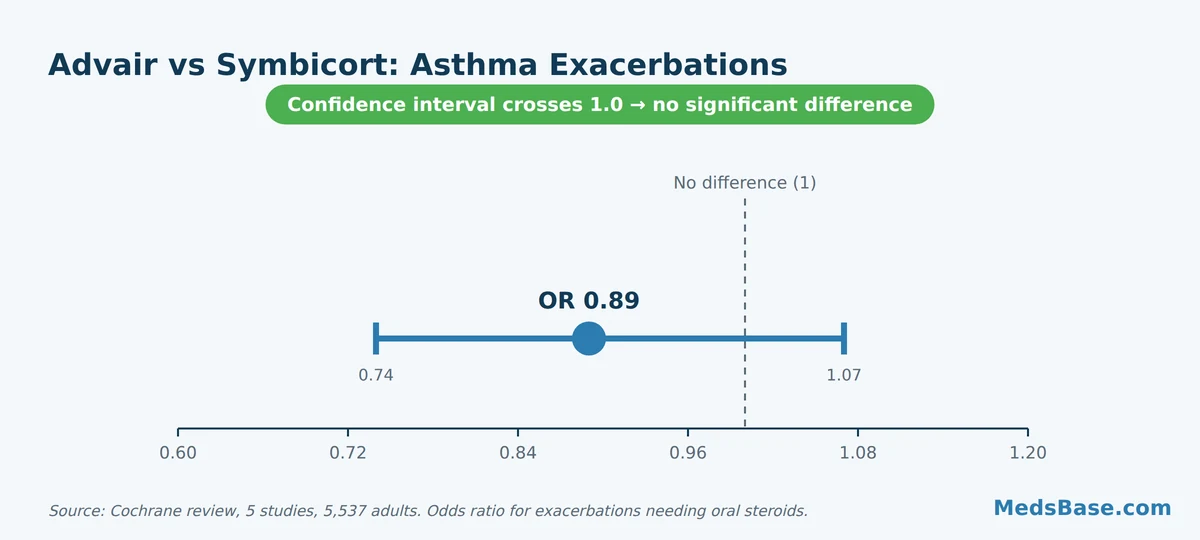
The strongest evidence is a a Cochrane review of 5,537 adults comparing fluticasone/salmeterol (Advair) against budesonide/formoterol (Symbicort) for chronic asthma. Its conclusion is refreshingly plain: there was no statistically significant difference between the two. For exacerbations needing oral steroids, the odds ratio was 0.89 (95% CI 0.74 to 1.07) — a range that straddles “no difference.” Lung function, symptoms, rescue-medication use, and adverse events were all broadly similar.
| Study | Year focus | Finding | Source |
|---|---|---|---|
| Cochrane review (5 studies, 5,537 adults) | Head-to-head asthma | No significant difference; exacerbation OR 0.89 (95% CI 0.74–1.07) | Cochrane |
| Cochrane review (lung function) | Head-to-head asthma | Outcomes “sufficiently similar” that more research unlikely to change them | Cochrane |
| Clinical Therapeutics systematic review | Component comparison | Formoterol edged salmeterol; fluticasone edged budesonide on some measures | Clinical Therapeutics |
There’s a subtle nuance worth knowing. A a systematic review in Clinical Therapeutics that looked at the individual components found formoterol was associated with slightly better lung function and symptom control than salmeterol, while fluticasone edged budesonide on some measures. In other words, each inhaler has a component that scores a little better — which helps explain why the head-to-head comes out roughly even.
What this means for you: for most people, choosing Advair over Symbicort (or the reverse) is unlikely to make or break your asthma control. The evidence says they’re broadly equivalent. That frees you to decide on the things that do vary person to person — device, MART capability, tolerability, and cost.
Advair vs Symbicort vs the Alternatives
These two aren’t the only combination inhalers, and they’re not always the right starting point.
Advair vs Symbicort. Choose Symbicort if MART (one inhaler for prevention and relief) appeals or your clinician recommends it, or if you get on better with a Turbohaler. Choose Advair (fluticasone/salmeterol) if you prefer its device or respond well to it. Clinically, expect similar control either way.
Versus other combination inhalers. There are several other ICS/LABA options and newer triple-therapy inhalers for more severe COPD. The right one depends on your diagnosis, severity, and inhaler technique — which is why a roundup like the best asthma inhalers overall is worth a look before you settle.
Versus a preventer alone. Milder asthma may be well controlled on a low-dose steroid inhaler without a LABA at all. More treatment isn’t automatically better; the goal is the lowest effective step.
Which fits which situation? Frequent symptoms and a wish to simplify to one inhaler Symbicort/MART. Stable on a maintenance routine and comfortable carrying a separate reliever either works. COPD both are licensed, but your clinician may favour a specific combination or add-on. The molecules matter less than the fit.
A note on COPD specifically
Most head-to-head asthma evidence carries over broadly to COPD, but the priorities shift. In COPD, the goal is fewer flare-ups and steadier day-to-day breathing, and inhaled steroids are used more selectively than in asthma because they carry a small increase in pneumonia risk for some patients. That’s a conversation to have with your clinician, not a reason to avoid these inhalers — for many people with COPD, a combination inhaler meaningfully reduces exacerbations. The MART approach, by contrast, is an asthma strategy; COPD is managed with regular maintenance dosing rather than using the same inhaler for on-the-spot relief.
How to Choose — and the Generic Route
Here’s the practical part, including the thing most comparisons leave out.
- Start with your diagnosis and your prescriber’s plan. Asthma and COPD are managed differently; the inhaler is chosen to match.
- Weigh MART. If simplifying to a single inhaler would help you stick with treatment, Symbicort’s fast-acting formoterol makes that possible.
- Pick the device you can actually use. Ask a pharmacist to watch your technique. The best inhaler is the one you use correctly every time.
- Rinse and spit after every dose. The simplest way to avoid the two most common side effects.
- Consider the generic route. This is the overlooked lever: both combinations exist as affordable generics — fluticasone/salmeterol (the same molecules as Advair) and budesonide/formoterol (the same as Symbicort), made by WHO-GMP-certified manufacturers.
That last point is where cost stops being a barrier. At MedsBase you can compare both families — Symbicort Turbohaler (budesonide/formoterol) and Seretide-family fluticasone/salmeterol inhalers — with worldwide shipping and no prescription needed to order. The active ingredients are identical to the brands; the price usually isn’t.
Why does the same molecule cost so differently? Brand pricing reflects marketing, patents, and regional pricing systems more than the chemistry in the canister. A budesonide/formoterol generic made by a WHO-GMP-certified manufacturer contains the same actives at the same strengths as the brand — the regulatory quality standard is what matters, not the label on the box. For people paying out of pocket, or managing a long-term condition where the inhaler is a monthly cost for years, that difference adds up fast. It’s worth asking your prescriber whether there’s any clinical reason not to use the generic; usually there isn’t.
- Everything about the budesonide/formoterol side: our full Symbicort guide.
- The fluticasone/salmeterol side (Advair’s molecules): our Seretide guide.
- Broaden the field: the best asthma inhalers overall.
Frequently Asked Questions
Q: Is Advair or Symbicort better?
A: For most people, neither is clearly better. A large Cochrane review found no statistically significant difference between fluticasone/salmeterol (Advair) and budesonide/formoterol (Symbicort) for asthma control, exacerbations, or side effects. The right choice usually comes down to device preference, whether you’d benefit from Symbicort’s MART option, tolerability, and cost — not a gap in effectiveness.
Q: What is the difference between Advair and Symbicort?
A: They contain different molecules doing the same two jobs. Advair pairs the steroid fluticasone with the airway opener salmeterol; Symbicort pairs budesonide with formoterol. The most practical difference is speed: formoterol acts within minutes, which lets Symbicort double as both a preventer and reliever (MART), whereas Advair is maintenance-only and needs a separate rescue inhaler.
Q: Can Symbicort be used as a reliever?
A: Yes, in a specific regimen called maintenance and reliever therapy (MART), because its formoterol component works quickly. Advair can’t be used this way, since salmeterol is slower to act. MART should only be used if your clinician has set it up for you — it isn’t a green light to reach for any controller inhaler during an attack.
Q: Are Advair and Symbicort the same?
A: No, but they’re in the same class and broadly equivalent in effect. Both combine an inhaled steroid with a long-acting bronchodilator to control asthma and COPD, and head-to-head evidence shows similar results. They differ in their exact molecules, device options, onset speed, and whether they can be used for MART.
Q: Is there a generic for Advair and Symbicort?
A: Yes. Fluticasone/salmeterol (the same molecules as Advair) and budesonide/formoterol (the same as Symbicort) are both available as generics from WHO-GMP-certified manufacturers, often at a fraction of the brand price. The active ingredients are identical to the brand-name inhalers, so for many people the generic route is a sensible, lower-cost option worth discussing.
Q: Can I use Advair or Symbicort during an asthma attack?
A: Advair should not be used to relieve a sudden attack — you need a fast-acting rescue inhaler for that. Symbicort can be used for relief only if your doctor has specifically set you up on a MART regimen. If you’re ever unsure or your breathing is deteriorating fast, use your rescue inhaler and seek emergency help rather than guessing.
Q: Is a generic version of Advair or Symbicort as good as the brand?
A: A generic contains the same active ingredients at the same strengths as the brand, so when it’s made by a WHO-GMP-certified manufacturer it’s designed to perform the same way. Fluticasone/salmeterol is fluticasone/salmeterol whether it’s branded Advair or a generic equivalent, and the same goes for budesonide/formoterol versus Symbicort. Any differences are usually in the device rather than the medicine, which is one more reason to check your inhaler technique when you switch. If you have a specific concern, your pharmacist can confirm the equivalence for your exact product.
The Bottom Line
The verdict on Advair vs Symbicort is a calm one: they’re two well-made combination inhalers that do the same job, and the best head-to-head evidence finds no clear winner. That means you get to choose on the factors that actually differ for you — Symbicort’s fast-acting formoterol and MART option, device comfort, tolerability, and price — rather than agonising over which brand is “stronger.”
Your one immediate action: at your next review, ask your prescriber two specific questions — “Would MART with a budesonide/formoterol inhaler simplify things for me?” and “Could I use a WHO-GMP generic of whichever inhaler I’m on?” Those two questions cover both the clinical fit and the cost.
Want to go deeper before deciding? Read next: our full Symbicort guide for the budesonide/formoterol side, or our Seretide guide for Advair’s exact molecules. Same job, different tools — the winning move is picking the one that fits your life and using it correctly.

Written by
Sophie ChenPharmaceutical Content Researcher · 8 years experience
Sophie Chen is a pharmaceutical content researcher with 8 years covering generic medication access and clinical pharmacology. She specialises in international regulatory frameworks, bioequivalence standards, and patient-facing education on therapeutic drug classes. She is not a clinician.