








✓ Medically reviewed by · Last reviewed: May 2026
Pharmacy Researcher · 8 years experience
Pharmacy researcher with 8 years reviewing clinical drug information, generic formulation equivalence, and international pharmaceutical standards. Focuses on patient-facing accuracy in medication education.
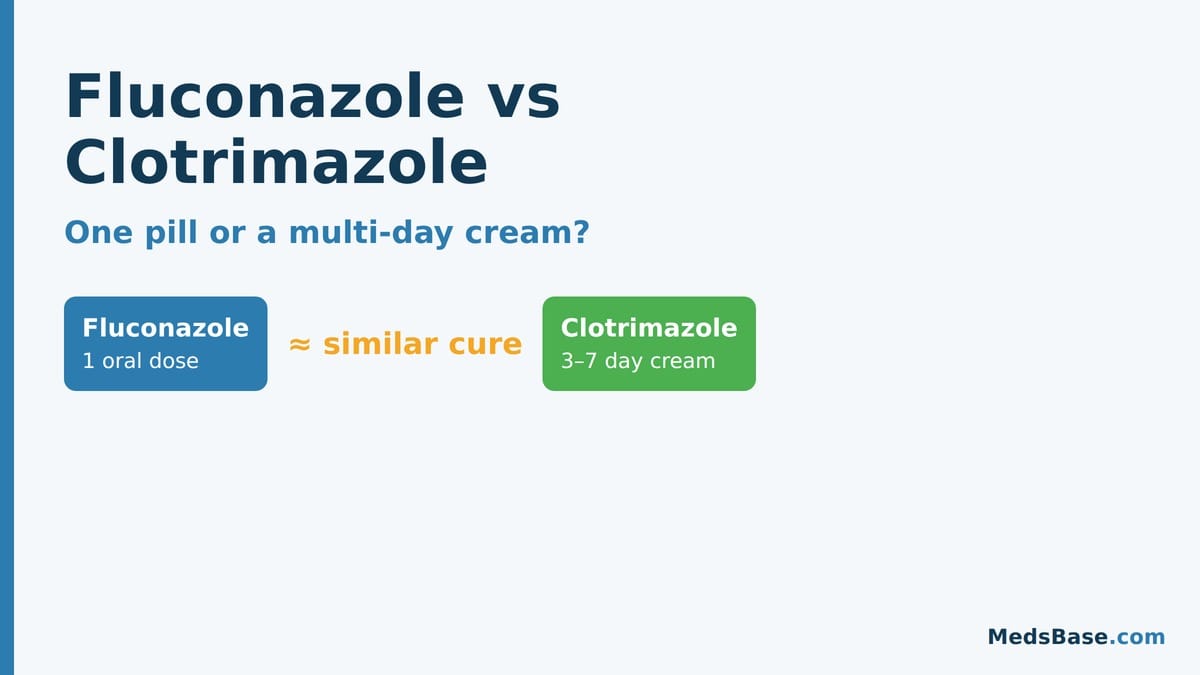
You’re uncomfortable, you’re fairly sure it’s a yeast infection, and now you’re staring at two options: a single pill or a tube of cream you’ll use for several nights. It’s a small decision that feels weirdly high-stakes when you just want relief. So which actually works better — fluconazole vs clotrimazole?
Here’s the honest headline that most pages bury: for a straightforward yeast infection, they cure at similar rates. That means the real question isn’t “which is stronger,” but “which fits your situation.” By the end of this guide you’ll know how each one works, what the research found, and the specific factors — pregnancy, other medicines, convenience — that should decide it for you. One of those factors flips the recommendation entirely; we’ll flag it in the safety section.
- Fluconazole (pill) and clotrimazole (cream) cure uncomplicated yeast infections at similar rates — strength isn’t the deciding factor.
- Fluconazole wins on convenience: often one dose. Clotrimazole wins on staying local.
- One factor flips the choice completely — and it’s not effectiveness. (Safety section.)
- Oral fluconazole works throughout the body; clotrimazole acts only where you apply it.
- For recurrent or first-time infections, the smartest move is a quick clinician check first.
What Are Fluconazole and Clotrimazole?
Both are azole antifungals — medicines that kill the yeast (usually Candida) behind vaginal thrush, oral thrush, and other fungal infections. The difference is how they’re delivered.
Fluconazole is taken by mouth. According to MedlinePlus, it treats yeast infections of the vagina, mouth, throat, and other sites, and is usually taken once a day — for an uncomplicated vaginal infection, that often means a single tablet. Because it travels through your bloodstream, it reaches yeast anywhere in the body.
Clotrimazole, in this context, is a vaginal cream inserted at bedtime for 3 or 7 days depending on the product. It works right where you put it, with very little absorbed into the rest of the body. It’s widely available over the counter.
So the fluconazole vs clotrimazole question is really oral-and-systemic versus topical-and-local — two routes to the same goal. Both belong to the same drug family and target the same organism; the debate is about delivery, not chemistry.
One practical footnote most shelf-labels skip: clotrimazole is also sold as a skin cream for infections like athlete’s foot, ringworm, and jock itch, while fluconazole’s oral route lets it reach places a cream never could — the throat, the esophagus, the bloodstream. For a vaginal yeast infection specifically, though, the two line up as near-equals, which is why this particular comparison comes up so often. Keep the setting in mind: we are talking about an uncomplicated vaginal infection, the scenario where the choice is genuinely a toss-up on effectiveness.
How Fluconazole and Clotrimazole Work
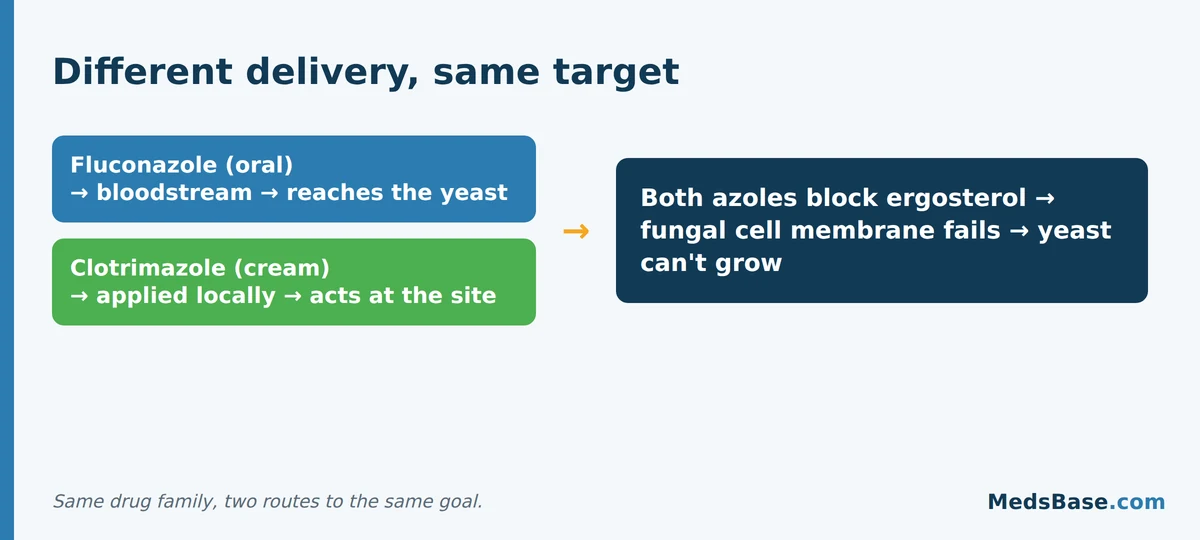
Think of a yeast cell as a water balloon held together by a special skin. That skin depends on a building block called ergosterol. Azole antifungals block the enzyme that makes ergosterol, so the “skin” weakens, the balloon leaks, and the yeast can’t grow or multiply.
Both drugs use this same sabotage — that’s why they’re equally capable of clearing the same infection. What differs is logistics. Fluconazole is swallowed, absorbed into the blood, and delivered to the yeast from the inside. Clotrimazole is applied directly to the affected area and does its work on contact, with minimal systemic spread.
That footprint difference — local versus systemic — is the thread running through every practical decision below.
Neither drug is a stronger weapon; they are the same weapon in different packaging. Once you accept that, the decision stops being about power and starts being about fit — which is exactly how clinicians approach it.
Key Uses: When Each One Fits Best
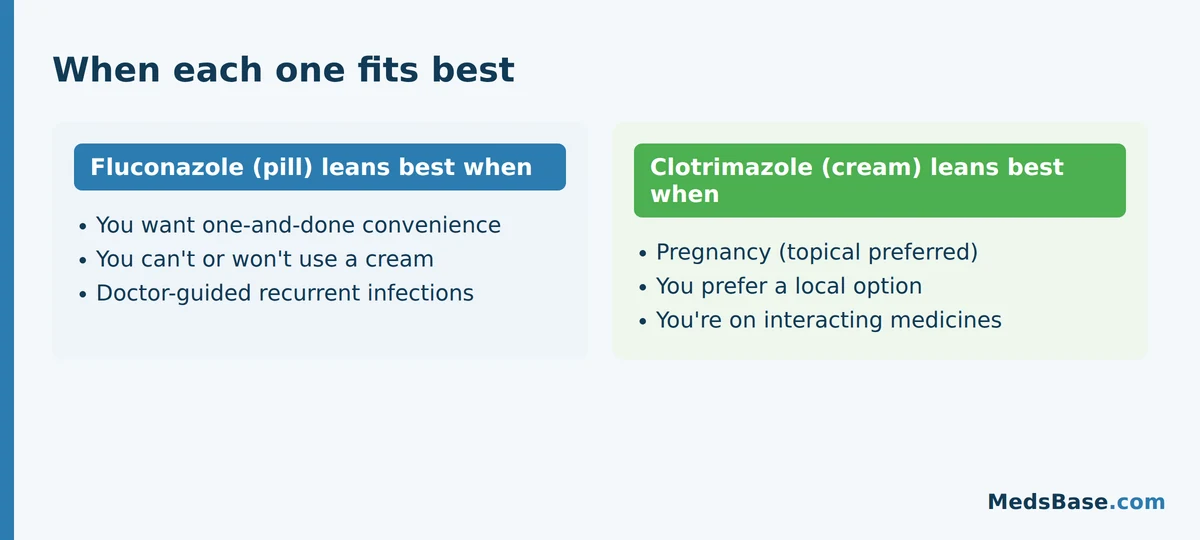
For a single, uncomplicated yeast infection, either works. The tie-breakers are about your circumstances.
When fluconazole (the pill) tends to fit
You want one-and-done convenience, you’d rather not use a vaginal cream, or a clinician is managing recurrent infections with a planned multi-dose course. Its systemic reach also makes it the go-to for yeast infections beyond the vagina, like oral thrush. If that’s your situation, MedsBase stocks oral fluconazole — and no prescription is needed to order from MedsBase.com.
When clotrimazole (the cream) tends to fit
You prefer keeping treatment local, you’re on medicines that could interact with an oral drug, or your symptoms are mild and you’d rather not take a systemic pill. It’s also a familiar first choice for many people who’ve had thrush before, and its wide over-the-counter availability makes it easy to start quickly. Because it barely enters the bloodstream, it’s often the sensible default when you’d simply rather not add a systemic medicine to your body for a localised problem — the topical clotrimazole option is covered in the practical-guidance section below.
Both formats treat the same infection, so there is no “advanced” and “basic” option here. A person who picks the cream is not settling for something weaker, and a person who picks the pill is not being reckless — they are simply weighting convenience, pregnancy, and interactions differently. That reframing takes the anxiety out of the choice.
- Reasonable to self-treat: an adult with typical, mild-to-moderate symptoms of an uncomplicated yeast infection they’ve had before.
- Check with a clinician first: a first-ever suspected yeast infection; four or more infections a year (recurrent); pregnancy; diabetes; a weakened immune system; symptoms that don’t improve; or any doubt about the diagnosis. Yeast, bacterial vaginosis, and STIs can feel similar — and they need different treatments.
If your infections keep coming back, it’s worth understanding the triggers — our guide on why antibiotics trigger yeast infections explains one of the most common ones.
Safety, Side Effects & Precautions
Here’s the open loop from the intro — the factor that can flip the whole decision: pregnancy.
MedlinePlus warns that fluconazole may harm a fetus, especially if taken during the first three months of pregnancy. For that reason, topical treatment like clotrimazole is generally preferred during pregnancy, and oral fluconazole is usually avoided unless a doctor specifically advises it. If you’re pregnant or might be, that single fact often settles the fluconazole vs clotrimazole choice on its own — talk to your clinician.
| Consideration | Fluconazole (oral) | Clotrimazole (vaginal) |
|---|---|---|
| Common side effects | Nausea, headache, stomach upset | Local burning, itching, irritation |
| Pregnancy | Generally avoided (esp. first trimester) | Generally preferred |
| Drug interactions | More (systemic; can affect other meds) | Minimal (stays local) |
| Notable caution | May cause dizziness; affects some medicines | Can weaken latex condoms/diaphragms |
| Who should be careful | Liver problems; multiple medications | Sensitivity to the cream |
Beyond pregnancy, the other big safety difference is interactions. Because fluconazole works throughout the body, it can interact with a range of medicines and isn’t ideal if you have liver problems or take multiple drugs. Clotrimazole’s local action sidesteps most of that — though its cream base can weaken latex condoms and diaphragms during treatment.
This is where the “which is stronger” instinct actively misleads people. A reader on several regular medications might reach for the pill assuming stronger means better, when the smarter, safer choice for them is the cream that never enters the bloodstream. Strength you don’t need is just extra risk. The systemic reach that makes fluconazole handy for infections beyond the vagina is the same reach that adds precautions for a simple local infection. Match the tool to the job, not to the marketing.
A quick word on side effects in practice: fluconazole’s are usually mild and short-lived — a bit of nausea or headache around the dose — while clotrimazole’s are almost always local, like brief burning or itching as the cream goes to work. Neither is typically a reason to abandon treatment, but if a “side effect” is actually worsening irritation, that can be a sign the diagnosis is wrong and it’s time to check in with a clinician rather than push on.
What Does the Research Say — Are Cure Rates Different?
This is the part that should take the pressure off your decision.
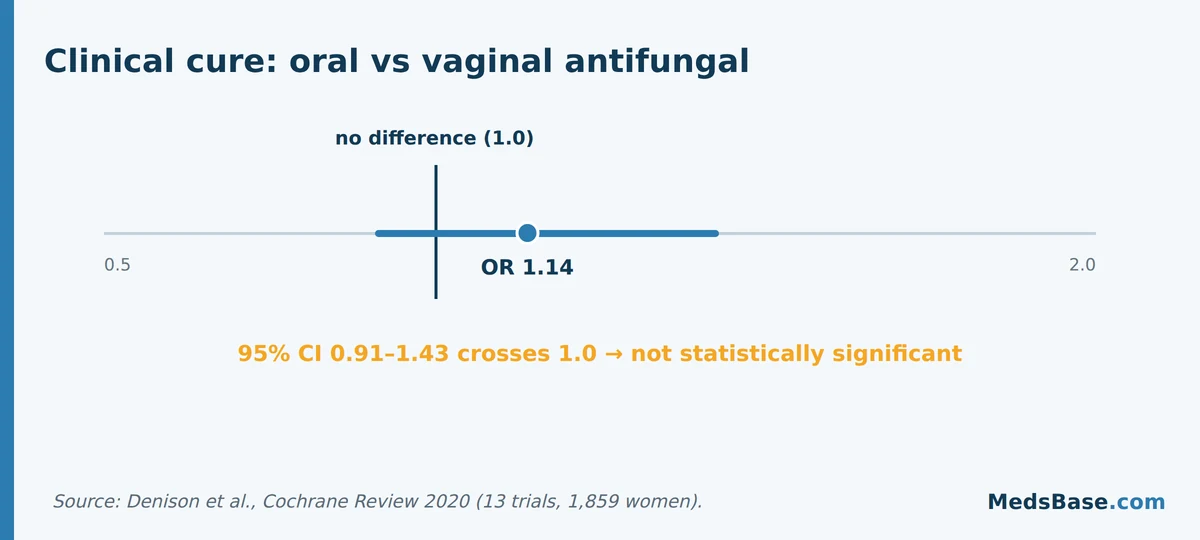
A Cochrane systematic review compared oral antifungals (like fluconazole) with intra-vaginal antifungals (like clotrimazole) for uncomplicated vaginal yeast infections. Its verdict: there is probably little or no difference in clinical cure between the two routes.
| Measure | Finding | Certainty | Source |
|---|---|---|---|
| Clinical cure (short-term) | No significant difference (OR 1.14, 95% CI 0.91–1.43; 13 trials, 1,859 women) | Moderate | Cochrane 2020 |
| Clinical cure (long-term) | No significant difference (OR 1.07, 95% CI 0.77–1.50; 9 trials, 1,042 women) | Moderate | Cochrane 2020 |
| Mycological cure | Slightly favoured oral treatment | — | Cochrane 2020 |
| Withdrawals for side effects | Low for both routes | — | Cochrane 2020 |
What this means for you: on the outcome you care about most — do my symptoms actually clear? — a pill and a cream perform about the same. Oral treatment had a small edge on mycological cure (clearing the yeast on lab testing), but that didn’t translate into a meaningful difference in how people felt. So “which is stronger?” is the wrong question. “Which suits me?” is the right one.
It is worth being clear about what “clinical cure” and “mycological cure” mean, because the gap between them is where a lot of confusion lives. Clinical cure means your symptoms are gone — the itch, discharge, and irritation have resolved, which is what actually matters to you day to day. Mycological cure means lab tests can no longer detect the yeast. Oral treatment edged ahead on the lab measure, but the review found that did not reliably translate into people feeling better, faster. In other words, a slightly cleaner lab result is not the same as a more comfortable patient — and comfort is the point.
The scale of the evidence is reassuring too. This was not one small study but a pooled analysis of many trials across thousands of women, with the reviewers rating the certainty as moderate. That is about as solid a footing as everyday treatment questions get. When high-quality evidence says two options are roughly equal, that is not a disappointment — it is freedom to choose the one that fits your life.
Fluconazole vs Clotrimazole: Head-to-Head
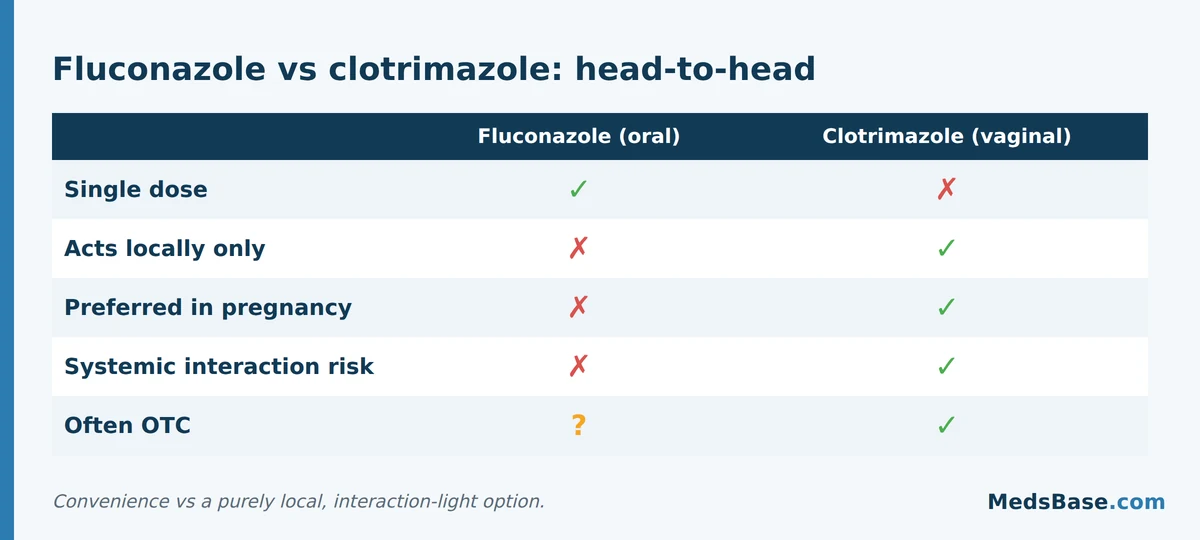
Here’s the whole comparison at a glance.
| Factor | Fluconazole (oral) | Clotrimazole (vaginal) |
|---|---|---|
| Format | Single pill (often one dose) | Cream, 3–7 nights |
| Speed of convenience | One-and-done | Multi-day routine |
| Where it acts | Whole body | Locally only |
| Pregnancy | Generally avoided | Generally preferred |
| Interactions | More | Minimal |
| Availability | Oral tablet | Often OTC |
Which one fits which situation? If you value convenience and have no reason to avoid an oral drug, fluconazole’s single dose is hard to beat. If you’re pregnant, on interacting medicines, or simply prefer to keep things local, clotrimazole is the sensible pick. And if you’re not sure it’s even a yeast infection, neither is right yet — get the diagnosis confirmed before treating.
How to Choose — Practical Guidance
A simple way to decide, plus the mistakes that undermine either treatment.
- Confirm it’s actually yeast. If it’s your first infection or symptoms are unusual, get it diagnosed. Treating the wrong thing wastes time and money.
- Let pregnancy decide first. If you’re pregnant or might be, favour topical clotrimazole and check with your clinician before any oral option.
- Weigh convenience vs interactions. No interacting medicines and you want it over fast? The pill. On several medicines or prefer local? The cream.
- Finish the course. With clotrimazole, complete all 3–7 nights even once you feel better — stopping early invites a relapse.
- Escalate if it doesn’t clear. No improvement in a few days, or infections that keep returning, means it’s time for a clinician rather than another round of self-treatment.
A note on the “single dose” appeal: convenience is real, but it can cut both ways. Some people with more stubborn symptoms find one dose of fluconazole isn’t quite enough and need a second dose a few days later — something a clinician can plan. A cream, by contrast, delivers medicine to the site every night for several nights, which some find more thorough for local symptoms. Neither is a flaw; they are just different rhythms of treatment, and knowing that upfront keeps you from feeling like something “failed” when it simply needed the normal next step.
Common mistakes to avoid: stopping the cream early; using fluconazole in pregnancy without medical advice; assuming every itch is yeast; treating a partner unnecessarily for a routine infection; and treating recurrent infections on repeat without ever investigating why they keep happening.
- Why antibiotics trigger yeast infections — a leading cause of the recurrent kind.
- What a vaginal yeast infection is and how to treat it — the full basics for first-timers.
- Our fungal-infection range — both pill and cream options in one place.
Frequently Asked Questions
Q: Is fluconazole or clotrimazole better for a yeast infection?
A: For an uncomplicated yeast infection, neither is clearly better at clearing symptoms. A Cochrane review found little or no difference in clinical cure between oral antifungals like fluconazole and vaginal ones like clotrimazole. The better choice depends on your circumstances — pregnancy, other medicines, and whether you prefer a single pill or a local cream — rather than on one being fundamentally stronger.
Q: Can you use fluconazole and clotrimazole together?
A: Sometimes a clinician recommends combining an oral dose with a topical cream for stubborn or severe symptoms, but this should be guided by a professional rather than self-decided. For a routine, uncomplicated infection, one or the other is usually enough. If your symptoms are severe or not improving, that’s a reason to see a clinician, not to double up on your own.
Q: Which is safer during pregnancy?
A: Topical clotrimazole is generally preferred in pregnancy. MedlinePlus warns that oral fluconazole may harm a fetus, particularly in the first three months, so it’s usually avoided unless a doctor specifically advises it. If you’re pregnant or think you might be, choose the topical option and confirm with your clinician before taking any oral antifungal.
Q: How fast does each one work?
A: Both start working quickly, but relief isn’t instant. Fluconazole is absorbed and begins acting within a day, though symptom relief can still take a couple of days. Clotrimazole works locally over its 3–7 night course, with itching and irritation usually easing within the first few days. If you see no improvement after several days, follow up with a clinician.
Q: Do I need a prescription for fluconazole or clotrimazole?
A: It varies by country. Clotrimazole vaginal cream is often available over the counter, while oral fluconazole is prescription-only in many places. At MedsBase.com, no prescription is needed to order either. That said, a first-time, recurrent, or uncertain infection is worth a quick clinician check so you treat the right condition.
Q: Why do I keep getting yeast infections?
A: Recurrent infections (four or more a year) can be driven by antibiotics, uncontrolled diabetes, hormonal changes, or a weakened immune system, among other factors. Repeatedly self-treating without identifying the cause rarely solves it. If infections keep returning, see a clinician to investigate — and read our guide on how antibiotics can trigger them for one very common explanation.
The Bottom Line
The fluconazole vs clotrimazole decision is easier than it feels, because the research takes the pressure off: for a straightforward yeast infection, a single pill and a multi-day cream cure at similar rates. So stop asking which is stronger and ask which fits — pregnancy points to the cream, convenience points to the pill, and interactions or a purely local preference point to the cream again.
One immediate action: if you’re pregnant, might be, or it’s your first infection, choose topical clotrimazole and check with a clinician before anything oral. Otherwise, pick the format you’ll genuinely follow through on.
Not sure it’s even yeast, or tired of it coming back? Read what a vaginal yeast infection is and how to treat it and why antibiotics trigger yeast infections next.

Written by
Sophie ChenPharmaceutical Content Researcher · 8 years experience
Sophie Chen is a pharmaceutical content researcher with 8 years covering generic medication access and clinical pharmacology. She specialises in international regulatory frameworks, bioequivalence standards, and patient-facing education on therapeutic drug classes. She is not a clinician.