








✓ Medically reviewed by · Last reviewed: May 2026
Pharmacy Researcher · 8 years experience
Pharmacy researcher with 8 years reviewing clinical drug information, generic formulation equivalence, and international pharmaceutical standards. Focuses on patient-facing accuracy in medication education.
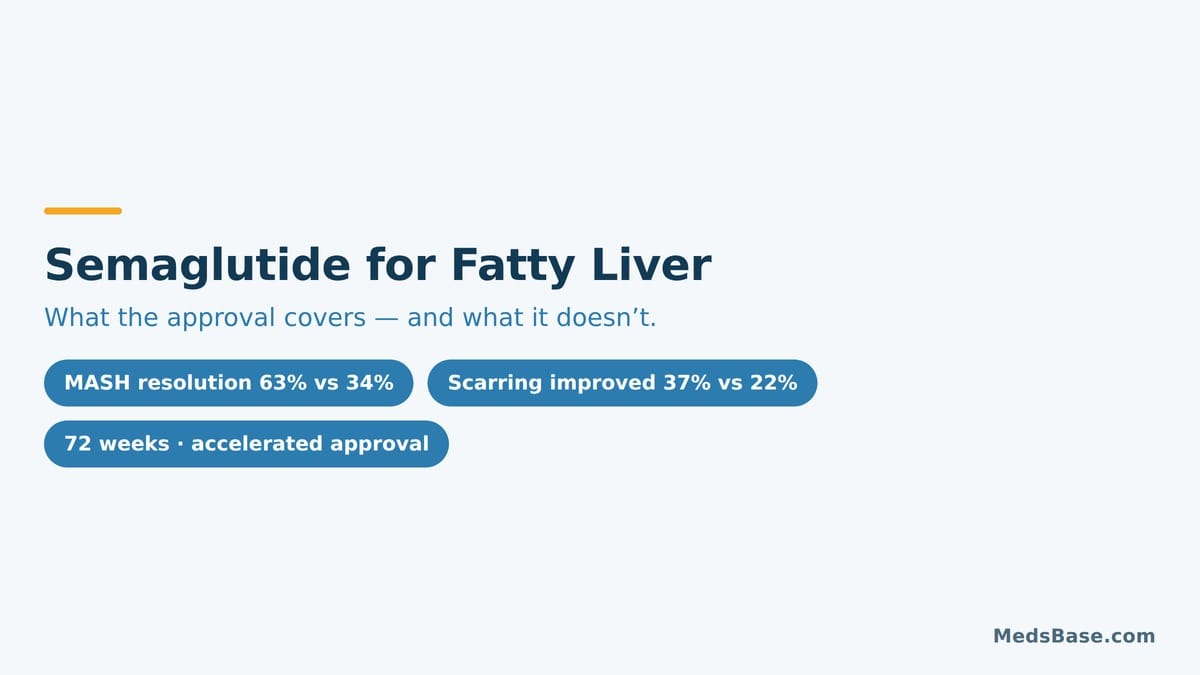
Here is the number that changed how liver specialists talk about weight-loss injections: in a phase 3 trial, 62.9% of people taking semaglutide had their liver inflammation resolve without their scarring getting worse, against 34.3% on placebo. That is not a subtle signal. It is the reason semaglutide for fatty liver stopped being a theory and became an approved treatment.
By the end of this guide you will know exactly which fatty liver the approval covers, why “resolved inflammation” and “reversed scarring” are two different wins, and what a trial published this month adds for people with more advanced disease. There is also one detail in the approval paperwork that most coverage skips — we will come back to it in the safety section, because it changes how confident you should be.
- Semaglutide is now approved for MASH with moderate-to-advanced scarring — but not for every fatty liver, and the distinction decides whether it applies to you.
- Clearing inflammation and reversing scarring are separate endpoints, and the drug performs noticeably better on one than the other.
- The approval came through an accelerated pathway, which carries a condition most articles never mention — details in the safety section.
- A trial published in July 2026 pushed the evidence into a group that had been left out until now.
- Stopping the medication raises an obvious question about whether the liver benefit holds. The honest answer is that nobody has proven it does.
What Is Fatty Liver Disease, and Where Does Semaglutide Fit?
Fatty liver disease is the build-up of excess fat inside liver cells, and in its more serious form that fat drives inflammation and scarring that can progress toward cirrhosis. The mild version and the dangerous version share a name in everyday speech, which is exactly why so many people leave an appointment confused about how worried to be.
Medicine now splits them. MASLD — metabolic dysfunction-associated steatotic liver disease — is fat in the liver alongside metabolic risk factors such as excess weight, type 2 diabetes or high triglycerides. MASH is the subset where that fat has triggered inflammation and liver-cell injury. As NIDDK’s plain-language overview explains, MASH is the form that scars, and scarring is what ultimately threatens the organ.
That distinction is the whole story for you. Semaglutide’s approval is for MASH with moderate-to-advanced fibrosis — not for a scan that simply says “fatty liver.” If your liver has fat but no meaningful inflammation or scarring, you sit outside the studied group, and the honest answer is that the trial data does not speak to you.
Scale explains why this matters. The FDA notes that roughly 6% of US adults — about 14.9 million people — have MASH, and that the number is growing. Most feel nothing at all until the damage is advanced, because a struggling liver is famously quiet. Fatigue, unexplained weight loss and muscle weakness can appear, but plenty of people have none of it.
Here is where it gets interesting: for decades there was no approved drug for this at all. The advice was weight loss, and that was it — which is a difficult prescription to fill when the condition itself makes metabolism harder to move. That vacuum is precisely why a medication that reliably shifts weight ended up being tested on liver tissue.
How Semaglutide Works on a Fatty Liver
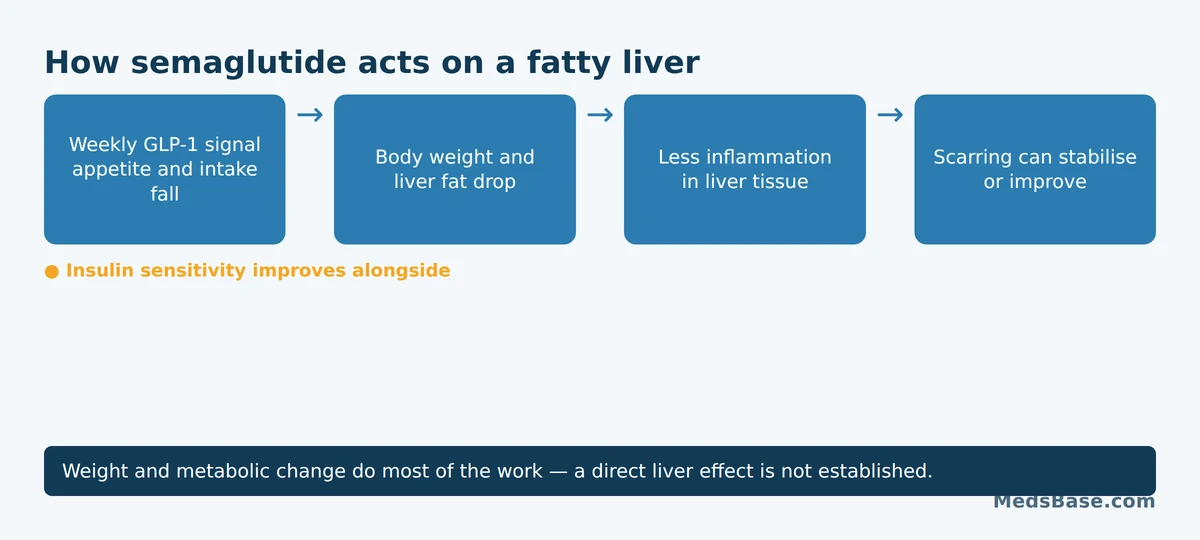
Think of the liver as a warehouse that is supposed to keep a small working stock of fat and ship the rest out. In MASLD the shipments slow, the stock piles up, and eventually the building itself starts taking damage from the overflow. Semaglutide does not go into the warehouse and carry boxes out. It reduces how much arrives.
The mechanism runs in stages. Semaglutide mimics GLP-1, a gut hormone that signals fullness and slows stomach emptying. Appetite and intake fall. Over months, body weight drops and insulin sensitivity improves. With less fat delivered to the liver and less metabolic pressure on it, inflammation tends to settle — and once inflammation settles, the scarring process loses its fuel.
That sequencing explains something readers find counter-intuitive: the two liver endpoints do not move together. Inflammation can quiet down within months, while scar tissue — collagen that has already been laid down — takes far longer to remodel, and sometimes does not. This is why the trials measure the two separately, and why the numbers differ so much between them.
So what does this mean for you? If your fatty liver sits on top of excess weight or type 2 diabetes, the mechanism has something to work with. If your liver fat has another driver entirely, the logic is much weaker — and so is the evidence.
Who Is This For — and Who Should Avoid It?
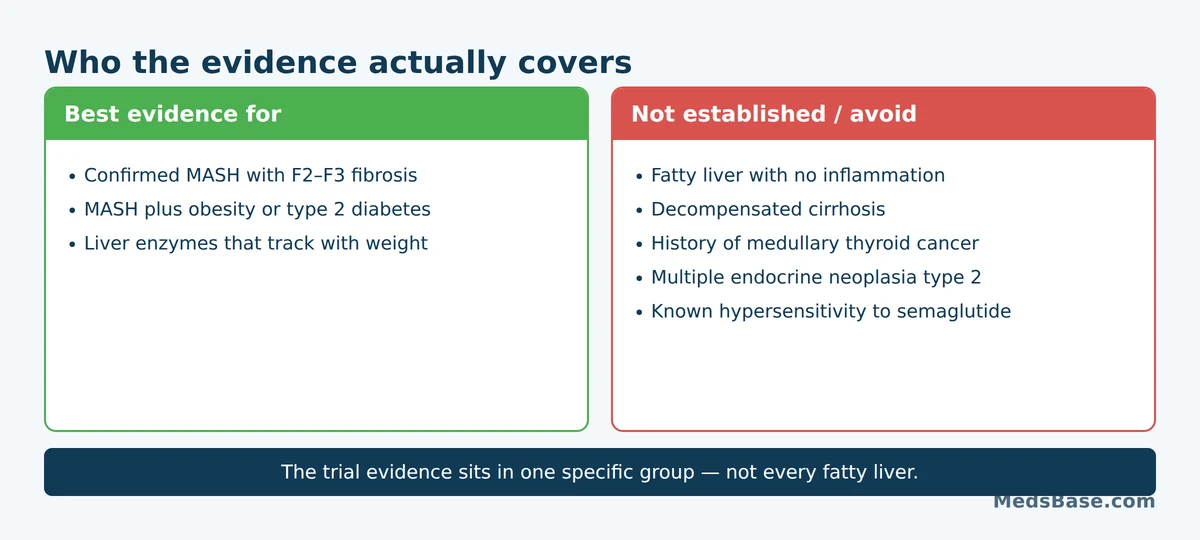
The evidence for semaglutide for fatty liver lives in one fairly specific population, and being honest about the edges of it matters more than a broad recommendation.
Adults with biopsy-confirmed MASH and moderate-to-advanced scarring
This is the group actually studied and the group the approval names. If a biopsy or equivalent assessment has confirmed inflammation plus fibrosis at stage 2 or 3, you match the trial population most closely.
People whose MASH sits alongside obesity or type 2 diabetes
The trial participants were largely in this position, and the mechanism depends on metabolic change. Conditions such as obesity, type 2 diabetes, high triglycerides and high LDL cholesterol all raise the likelihood of developing MASH in the first place, so the overlap is common rather than unusual.
MedsBase stocks semaglutide, and no prescription is needed to order — but the decision about whether a fatty liver warrants it is a clinical one, and it should be made with someone who can see your scans, your biopsy result and your bloods. A medication that fits the trial population is a reasonable conversation; a medication chosen from a search result is not.
Semaglutide Safety, Side Effects and Dosing for Fatty Liver
Time to resolve the open loop from the introduction. Here is the detail in the approval paperwork that most coverage skips: this was an accelerated approval, granted on a surrogate endpoint — what the liver tissue looked like under a microscope at 72 weeks — with confirmation still outstanding.
In plain terms: regulators accepted that better-looking liver tissue is likely to translate into fewer deaths, transplants and liver failures, but that has not yet been demonstrated. The trial is continuing to a total of 240 weeks specifically to find out. So the honest framing is that semaglutide has proven it changes the liver’s appearance and biology, and has not yet proven it changes how long or how well you live. That is a real result, and an incomplete one.
The side-effect profile is the familiar GLP-1 picture, and it is mostly digestive.
| Side effect | Frequency | Severity | What to do |
|---|---|---|---|
| Nausea, vomiting, diarrhoea, constipation | Very common | Usually mild to moderate | Eat smaller meals, go slowly on dose increases, tell your clinician if it persists |
| Abdominal pain, bloating, burping, indigestion | Common | Mild | Often settles over weeks; reduce fatty and very large meals |
| Headache, fatigue, dizziness | Common | Mild | Check hydration; report if it interferes with daily life |
| Reflux, stomach upset, cold-like symptoms | Common | Mild | Symptomatic care; mention at review |
| Low blood sugar (in type 2 diabetes) | Common in that group | Can be serious | Discuss adjusting other glucose medications before starting |
| Thyroid C-cell tumours (rodent studies) | Not established in humans | Serious if applicable | Contraindicated with personal/family history of medullary thyroid cancer or MEN2 |
The single most useful safety habit is slowing down. Most people who abandon a GLP-1 do so because of nausea during dose escalation, not because it failed — and escalation speed is one of the few things that can be adjusted.
On dosing, the studied regimen in MASH is the same weekly injectable semaglutide used for weight management, titrated gradually to 2.4 mg once weekly rather than started there. The liver endpoints in the trial were measured at 72 weeks, which sets a realistic expectation: this is a year-plus commitment measured in scans and bloods, not a treatment you judge after a month.
What Does the Research Say About Semaglutide for Fatty Liver?
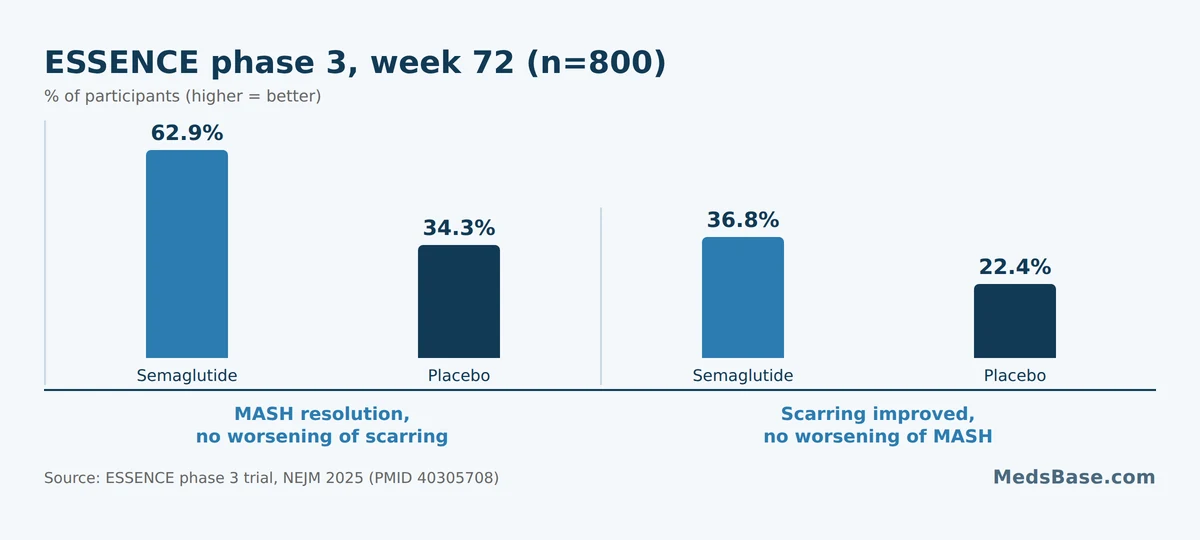
Three pieces of evidence carry most of the weight, and they say slightly different things — which is useful, because agreement across different designs is what separates a real effect from a fluke.
| Study | Year | Finding | Source |
|---|---|---|---|
| ESSENCE phase 3 (interim, week 72; n=800) | 2025 | MASH resolution without worsening fibrosis: 62.9% semaglutide vs 34.3% placebo. Fibrosis improvement without worsening MASH: 36.8% vs 22.4%. | PMID 40305708 |
| Phase 2, zalfermin ± semaglutide (n=698, 52 weeks) | 2026 | In advanced fibrosis and compensated cirrhosis, fibrosis improved in 30% on semaglutide alone vs 16% on placebo. The combination with zalfermin did not beat placebo. | PMID 42456707 |
| Meta-analysis, 7 randomised trials (n=1,800) | 2025 | Pooled across GLP-1 drugs: MASH resolution risk ratio 2.96 (95% CI 1.70–5.15); fibrosis improvement risk ratio 1.59 (95% CI 1.32–1.90). | PMC12969438 |
What this means for you: the effect is consistent across trials, but it is much stronger for calming inflammation than for undoing scarring. Roughly two in three people cleared MASH in the pivotal trial; closer to one in three improved their fibrosis, and a third of the placebo group did too. Those are meaningful odds, not a guarantee — and the gap between the two columns is the single most useful thing to carry into a conversation with your doctor.
The July 2026 trial deserves a note of its own, because it addresses the group that had been quietly excluded. Until now the evidence stopped at moderate-to-advanced fibrosis. That phase 2 trial published in July enrolled 698 people with advanced fibrosis and compensated cirrhosis and found semaglutide alone improved scarring versus placebo — the first trial to show that in this population. It also delivered a genuinely useful negative: adding the experimental drug zalfermin did not improve on placebo, and the combination did not beat semaglutide by itself.
Where the evidence is thin, it is worth saying so. Nobody has yet shown that these tissue changes translate into fewer transplants or longer survival — that is what the 240-week readout is for. And nobody has established what happens to the liver if the medication stops.
Semaglutide vs Other Fatty Liver Options
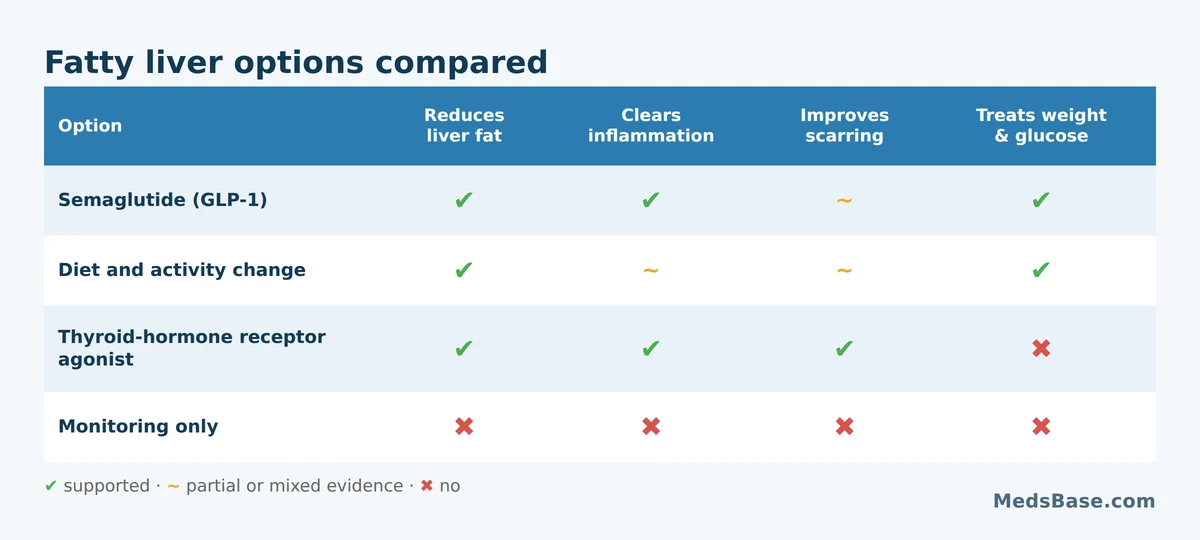
For years the entire treatment plan was weight loss. That advice was never wrong; it was just hard to act on, and it left people with advanced disease without a medical option.
| Option | Reduces liver fat | Clears inflammation | Improves scarring | Also treats weight & glucose |
|---|---|---|---|---|
| Semaglutide (GLP-1) | Yes | Yes — 63% vs 34% in trial | Partially — 37% vs 22% | Yes |
| Diet and activity change | Yes, with sustained loss | Yes, with substantial loss | Possible with major weight loss | Yes |
| Resmetirom (thyroid hormone receptor agonist) | Yes | Yes | Yes | No |
| Monitoring only | No | No | No | No |
Which fits which situation? If you have MASH with scarring and carry excess weight or type 2 diabetes, semaglutide is the option that treats several problems with one intervention — that overlap is its real advantage. If your central problem is the liver alone, a liver-targeted drug may be the more direct route, and that is a hepatologist’s call rather than a search engine’s. And if your scan shows fat with no inflammation, the honest answer is that sustained lifestyle change remains the best-evidenced path, and no drug has been shown to beat it in that group.
One thing no option escapes: none of these are one-off fixes. Every route here is a long-term change in how your metabolism is managed.
How to Approach Semaglutide for Fatty Liver — Practical Guidance
If this looks like it might apply to you, here is a sensible order of operations.
- Find out which fatty liver you have. MASLD with no inflammation and MASH with stage 2–3 fibrosis are different diagnoses with different answers. Ask specifically about your fibrosis stage — the number is what determines whether the approval covers you.
- Get a baseline you can compare against. Liver enzymes, a fibrosis assessment, weight, and glucose markers. Without a baseline you cannot tell later whether anything worked.
- Discuss it with a clinician who has seen those results. Bring the specific question: does my fibrosis stage match the approved indication?
- Titrate slowly if you start. The gradual climb to 2.4 mg weekly exists to keep nausea manageable. Rushing it is the most common reason people quit.
- Judge it on the right timeline. The trial endpoints were measured at 72 weeks. Assess at months, not weeks, and with tests rather than how you feel.
- Keep the lifestyle side running. Every trial participant received dietary and activity support alongside the drug. The medication was tested as an addition to that, not a replacement for it.
- Assuming “fatty liver” on a scan means you qualify — most fatty livers are not MASH with fibrosis.
- Expecting scarring to reverse as reliably as inflammation clears. It does not.
- Treating the accelerated approval as a finished story. The survival data is still being collected.
- Stopping other liver-relevant care — alcohol reduction, glucose control, blood pressure — because a medication is now doing the work.
- Skipping follow-up testing. This is a condition you track with numbers, not symptoms.
If semaglutide is not the right fit, there are other weight-loss medications that work through different mechanisms, and the metabolic groundwork matters regardless of which one you land on.
- What happens when you stop taking Ozempic — the rebound question, which matters here because the liver benefit’s durability is unproven.
- Semaglutide for knee osteoarthritis — the other organ system where this drug is being tested beyond weight.
- Gout attack treatment — another condition that travels with metabolic syndrome, and one people are often surprised to find connected.
Frequently Asked Questions
Q: Does semaglutide treat fatty liver disease?
A: Yes, for one specific form of it. Semaglutide is approved to treat MASH — the inflammatory form of fatty liver disease — in adults with moderate-to-advanced liver fibrosis. In the pivotal trial, about 63% of people had their steatohepatitis resolve without worsening of scarring, compared with 34% on placebo. It is not approved for simple fatty liver without inflammation or scarring, and being told you have “a fatty liver” is not by itself enough to know whether it applies to you.
Q: Can semaglutide reverse liver damage?
A: Partially, and less reliably than it clears inflammation. In the phase 3 trial, 36.8% of people on semaglutide had improvement in liver fibrosis without worsening steatohepatitis, versus 22.4% on placebo. So scarring improved in roughly one in three — a real effect, but far from everyone, and a fifth of the placebo group improved too. Established cirrhosis is a different matter again, and the evidence there is newer and more limited.
Q: Is semaglutide FDA-approved for fatty liver?
A: Yes, since August 2025, under the brand Wegovy, for MASH with moderate-to-advanced fibrosis in adults. Importantly it was granted through the accelerated approval pathway, based on liver-tissue changes at 72 weeks rather than on long-term outcomes. Continued approval depends on a confirmatory trial, which is running to 240 weeks to test whether those tissue improvements reduce death, transplant and other liver events.
Q: How long does semaglutide take to improve the liver?
A: The trial measured its main liver endpoints at 72 weeks — about 17 months. Some markers such as liver enzymes may shift earlier as weight comes down, but the histology results everyone quotes come from that 72-week assessment. Judge this treatment over a year or more, using repeat testing rather than symptoms, since fatty liver disease is largely silent until it is advanced.
Q: What is the difference between MASLD and MASH?
A: MASLD is fat accumulation in the liver alongside metabolic risk factors such as excess weight or type 2 diabetes. MASH is the more serious subset where that fat has caused inflammation and liver-cell damage, which is what leads to scarring and can progress to cirrhosis. Almost everything written about semaglutide and the liver refers to MASH specifically, which is why the distinction decides whether the research applies to you.
Q: Do I need a prescription to order semaglutide from MedsBase?
A: No — no prescription is needed to order from MedsBase.com, and our medications come from WHO-GMP-certified manufacturers. That said, fatty liver disease is diagnosed by imaging, blood tests and often a biopsy, and the treatment decision depends on your fibrosis stage. Ordering without knowing that stage means you cannot tell whether you fall inside the group the evidence covers, so it is worth getting the diagnostic picture first.
Q: Does the liver benefit last if I stop taking it?
A: Nobody knows yet, and that honesty matters. The trials measured people who stayed on treatment; there is no good data on what happens to liver inflammation or scarring after stopping. Since weight regain after stopping GLP-1 medication is well documented, and the liver effect appears to run largely through weight and metabolic change, it is reasonable to assume the benefit may not hold on its own. Treat it as a long-term plan and discuss any stop with your clinician.
Q: Can I take semaglutide for fatty liver if I also have type 2 diabetes?
A: That combination was common in the trials rather than a barrier — MASH and type 2 diabetes frequently travel together. The practical caution is low blood sugar: if you already take glucose-lowering medication, those doses may need adjusting when a GLP-1 is added. Hypoglycaemia is listed among the common effects in people with type 2 diabetes specifically, so this should be planned rather than discovered.
The Bottom Line
Semaglutide for fatty liver is a genuine advance with clearly marked limits. For adults with MASH and moderate-to-advanced scarring, it is the first GLP-1 approved for the condition, and it cleared liver inflammation in roughly two in three people against one in three on placebo. That is a real result from a well-run trial, backed by a meta-analysis across seven studies and now extended into advanced disease by a trial published this month.
The limits are equally clear. It works better on inflammation than on scarring. It has not yet been shown to reduce deaths or transplants — that evidence is still being gathered. It does not apply to a fatty liver without inflammation. And nobody has established what happens when you stop.
The one thing to do next: find out your fibrosis stage. Not whether a scan says “fatty liver,” but the actual stage. That single number determines whether any of the research above is about you — and it is the question that makes your next appointment productive instead of reassuring.
Wondering whether the benefit holds if you come off treatment? Read what happens when you stop taking Ozempic. Curious where else this drug is being tested beyond weight and blood sugar? Our guide to semaglutide for knee osteoarthritis covers the joint evidence with the same scepticism.

Written by
Sophie ChenPharmaceutical Content Researcher · 8 years experience
Sophie Chen is a pharmaceutical content researcher with 8 years covering generic medication access and clinical pharmacology. She specialises in international regulatory frameworks, bioequivalence standards, and patient-facing education on therapeutic drug classes. She is not a clinician.