








✓ Medically reviewed by · Last reviewed: May 2026
Pharmacy Researcher · 8 years experience
Pharmacy researcher with 8 years reviewing clinical drug information, generic formulation equivalence, and international pharmaceutical standards. Focuses on patient-facing accuracy in medication education.
You are three days into a trip you saved a year for, and you have just spent forty minutes in a hotel bathroom wondering whether the pills at the bottom of your bag are the answer. Somebody handed you a strip of antibiotics before you left “just in case.” Somebody else swore by the anti-diarrhoeal tablets. Neither of them told you which one to take first, or whether taking either is a good idea at all.
Here is the short version: the most important part of travelers diarrhea treatment is not a tablet, one of those tablets is unsafe for a specific set of symptoms you can check in ten seconds, and the antibiotic is the one most people get wrong. By the end of this you will know exactly which of the three to reach for, in what order, and the single question that decides whether the antibiotic helps you or quietly costs you something.
- Rehydration is the whole foundation of travelers diarrhea treatment, not the supporting act — and the reason it works is a mechanism most people have never had explained
- Loperamide is genuinely useful, right up until one specific symptom appears — then it becomes dangerous
- Antibiotics shorten the illness, and there is a measurable price tag most articles never mention
- Where you are on the map changes which antibiotic works, because resistance is regional
- Most cases settle in a few days without any antibiotic at all
- A small share of people are still not right weeks later — we will cover why, and what it is called
- What travelers’ diarrhea actually is
- Why it makes you lose fluid so fast
- Step one of travelers diarrhea treatment: rehydration
- Loperamide: useful, until it isn’t
- Antibiotics: the benefit and the hidden cost
- Travelers diarrhea treatment options compared
- When to stop self-treating and get help
- Preparing before you travel
- Frequently asked questions
- The bottom line
What Is Travelers’ Diarrhea?
It is by far the most common illness that affects travellers, and the numbers are not marginal. Estimates put the attack rate at 30% to 70% of international travellers, depending on destination and season. A 2015 clinical review noted that improving hygiene has pulled the risk for a two-week stay down from 20% or more to somewhere between 8% and 20% in some regions — real progress, but still roughly one traveller in ten. The same review found that between 12% and 46% of affected travellers change their travel plans because of it.
Untreated, it typically lasts three days or more.
The cause is usually bacterial. In returning travellers, about half of episodes are traced to bacteria — enterotoxigenic E. coli above all, along with Salmonella, Shigella and Campylobacter. A detail worth holding on to: in more than half of people with travellers’ diarrhoea, no pathogen is ever identified at all. That is not sloppy testing. It is a reminder that you will almost never know exactly what you have, which is precisely why treatment decisions are made on symptoms rather than on a diagnosis.
If your symptoms started within hours of a specific meal at home rather than days into a trip abroad, you may be dealing with something slightly different — our guide to how food poisoning differs covers that overlap.
Why You Lose Fluid So Fast
Here is where it gets interesting, because the mechanism explains the treatment.
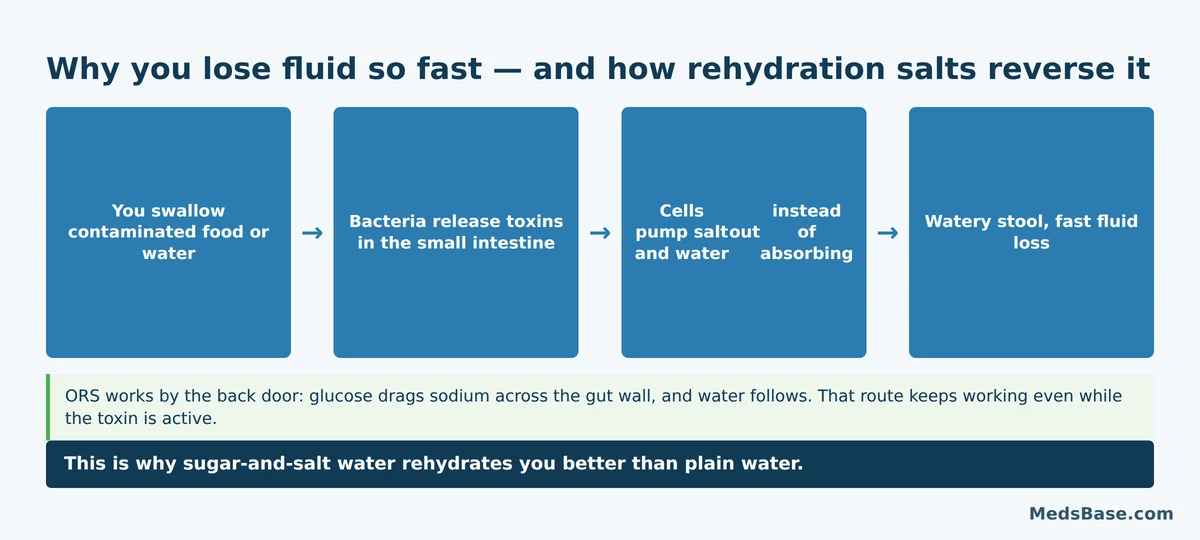
Your small intestine normally runs a brisk two-way trade: it absorbs several litres of fluid a day and secretes some back. Enterotoxigenic E. coli does not damage the gut lining or invade it. It simply releases a toxin that flips a switch on the intestinal cells, and they start pumping chloride — and therefore sodium and water — out into the gut instead of pulling it in.
Think of a boat where someone has reversed the bilge pump. The hull is fine. The pump is just running the wrong way, and it is running fast.
That is why the illness is so watery, why it comes on so abruptly, and why dehydration — not the infection itself — is what actually makes most people feel dreadful.
The practical consequence for you is direct: because the gut lining is usually intact, the absorption machinery still works. You just have to use a route the toxin has not switched off. That is exactly what rehydration salts do.
Step One of Travelers Diarrhea Treatment: Rehydration
The World Health Organization puts rehydration first among the key measures to treat diarrhoea, and it is not being conservative for the sake of it. Oral rehydration salts are a mixture of clean water, salt and sugar, absorbed in the small intestine to replace the water and electrolytes lost in the stool.
The sugar is the part people skip, and skipping it is the mistake. Glucose is not there for taste. When glucose is absorbed, it drags sodium across the intestinal wall with it, and water follows the sodium. Without glucose, oral rehydration solution simply would not work. That co-transport route keeps functioning regardless of what is causing the diarrhoea — which is why the same sachets work for a toxin-driven illness and a viral one.
WHO and UNICEF recommend a reduced-osmolarity formula:
| Component | Concentration |
|---|---|
| Sodium | 75 mmol/L |
| Chloride | 65 mmol/L |
| Glucose (anhydrous) | 75 mmol/L |
| Potassium | 20 mmol/L |
| Citrate | 10 mmol/L |
| Total osmolarity | 245 mOsm/L |
That reduced-osmolarity formula replaced the older, saltier standard solution for good reason. Compared with the previous 311 mOsm/L version, it cut the need for unscheduled intravenous fluids by 33%, reduced stool output by about 20% and reduced vomiting by about 30%. Those trials were done in children with acute non-cholera diarrhoea rather than adult travellers, so read them as strong support for the formula rather than as a direct measurement of what happens to you.
In plain terms: buy the sachets, use the sachets, and do not substitute a sports drink, which is typically too sugary and too low in sodium to do the same job.
Loperamide in Travelers Diarrhea Treatment: Useful, Until It Isn’t
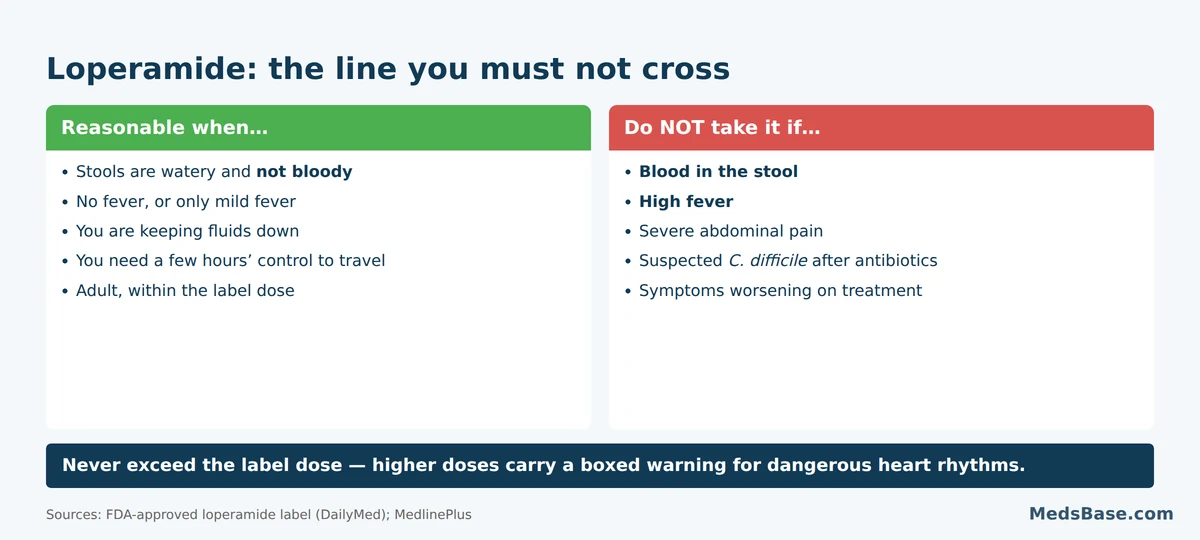
Time to resolve the loop from the intro. Loperamide slows the gut, giving you control back within one to two hours. For watery, non-bloody diarrhoea it is a reasonable and effective choice, and combining it with an antibiotic works better than either alone in the right patient.
And there is a hard line it must not cross.
Its own label is blunt about this. Loperamide is contraindicated in acute dysentery — defined on the label as diarrhoea with blood in the stools and high fever — as well as in bacterial enterocolitis caused by invasive organisms including Salmonella, Shigella and Campylobacter, in Clostridioides difficile colitis following antibiotics, and in acute ulcerative colitis.
The logic is uncomfortable but simple: if the problem is an invasive organism damaging your intestinal wall, slowing the gut keeps that organism and its toxins sitting against the damaged tissue for longer.
MedlinePlus tells patients to stop and call a doctor immediately if fever, stomach pain or swelling, or bloody stools develop while taking it, and to avoid it entirely if there is fever, blood or mucus in the stool, or black stools.
There is a second boundary, about dose rather than diagnosis. The label carries a boxed warning for Torsades de Pointes, cardiac arrest and death reported with higher-than-recommended doses. Staying inside the label dose is not a formality.
| Symptom or situation | Loperamide? | Why | What to do instead |
|---|---|---|---|
| Watery stools, no fever | Reasonable | No sign of invasive infection | Use with rehydration; stay within the label dose |
| Blood in the stool | No | Contraindicated — suggests invasive disease | Seek medical care; antibiotics may be needed |
| High fever with diarrhoea | No | Contraindicated | Seek medical care |
| Symptoms worsening on treatment | Stop | Guidelines caution against continuing | Reassess with a clinician |
| Recent antibiotics, now severe diarrhoea | No | Possible C. difficile | Medical assessment |
| Child under 12 | No | Not suitable without medical advice | Rehydration; seek advice |
Antibiotics in Travelers Diarrhea Treatment: The Hidden Cost
Antibiotics work. That is not in question, and the evidence is old and solid. A Cochrane review of 20 trials found that antibiotics substantially increased the number of people cured by 72 hours — an odds ratio of 5.90 with a confidence interval of 4.06 to 8.57.
The same review found something the marketing-shaped articles leave out. People taking antibiotics reported more side effects than those taking placebo, at an odds ratio of 2.37 (95% CI 1.50 to 3.75). Benefit and harm, in the same paper, from the same trials.
And then there is the cost that does not show up as a side effect at all.
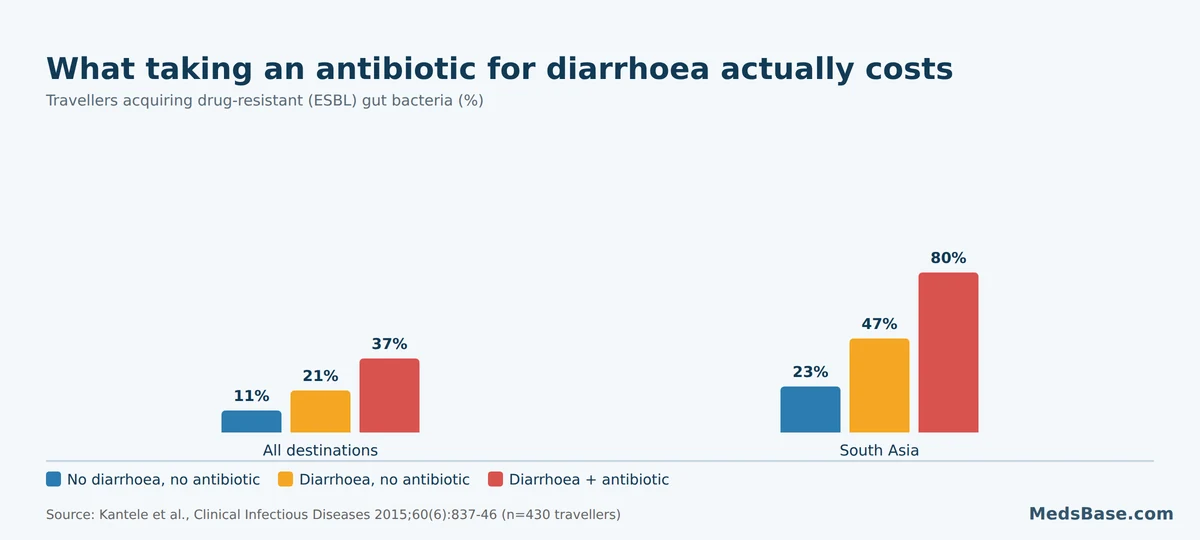
A study of 430 travellers sampled stool before and after trips outside Scandinavia and looked for ESBL-producing Enterobacteriaceae — gut bacteria resistant to a broad class of antibiotics. Overall, 21% came home colonised. Broken down by what happened on the trip:
| Group | Acquired resistant gut bacteria | South Asia only |
|---|---|---|
| No diarrhoea, no antibiotic | 11% | 23% |
| Diarrhoea, no antibiotic | 21% | 47% |
| Diarrhoea and antibiotic | 37% | 80% |
What this means for you: taking an antibiotic for a mild or moderate bout roughly tripled the chance of carrying drug-resistant bacteria home, and in South Asia four out of five people who did so were colonised. The authors’ own conclusion is unusually direct for a research paper — travellers to high-risk regions “should be advised against taking antibiotics for mild or moderate” travellers’ diarrhoea.
That colonisation is usually silent. It matters later, if you or someone close to you needs an antibiotic for something serious.
So when is it worth it? An expert panel put it plainly: azithromycin should be the first-line agent in dysentery and in watery diarrhoea with more than mild fever, because fluoroquinolone-resistant Campylobacter is common — reaching 70–80% in Campylobacter from Nepal and Thailand. The same guidelines state that antimicrobial prophylaxis should not be used routinely in travellers.
Geography drives the choice. Ciprofloxacin has been the standard for self-treatment except in South and Southeast Asia, where azithromycin is preferred. In one Thailand trial, a single 1 g dose of azithromycin cured 96% of travellers by 72 hours versus 71% for three days of levofloxacin — and eradicated the organism in 96–100% of cases versus 38%.
Rifaximin is the third option and has a specific boundary: it stays in the gut and matches fluoroquinolones only in non-invasive disease. Against invasive pathogens it fails to achieve wellness in up to 50% of people treated.
| Study | Year | Finding | Source |
|---|---|---|---|
| Cochrane review, 20 trials | 2000 | Cure by 72 h markedly increased (OR 5.90, 95% CI 4.06–8.57); side effects also increased (OR 2.37, 95% CI 1.50–3.75) | Cochrane CD002242 (PMID 10908534) |
| Prospective cohort, 430 travellers | 2015 | Resistant-bacteria acquisition 11% / 21% / 37% by exposure group; 80% in antibiotic-treated South Asia travellers | Clin Infect Dis 60(6):837–846 (PMID 25613287) |
| Randomised trial, Thailand | 2007 | Single-dose azithromycin cured 96% by 72 h vs 71% for 3-day levofloxacin (P=0.002) | Clin Infect Dis 44(3):338–346 (PMID 17205438) |
| Meta-analysis, 6 studies | 2015 | Travellers’ diarrhoea more than tripled post-infectious IBS risk (RR 3.35, 95% CI 2.22–5.05); 5.4% vs 1.4% | Aliment Pharmacol Ther 41(11):1029–1037 (PMID 25871571) |
One honest caveat on the Cochrane review: it was published in 2000 and predates current resistance patterns, so treat its effect size as the direction of travel rather than today’s precise number.
Travelers Diarrhea Treatment Options Compared
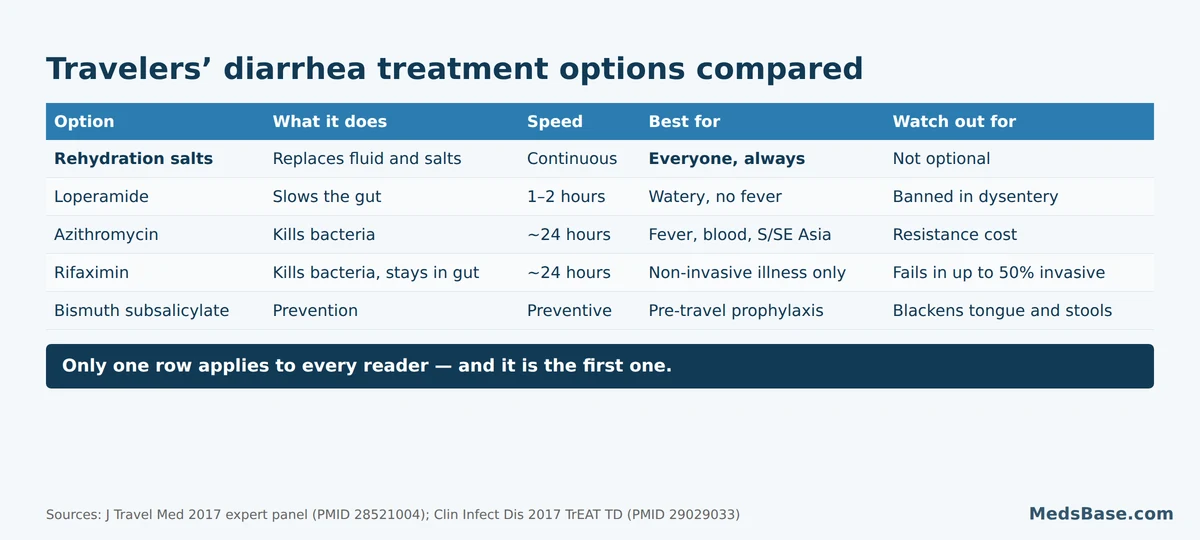
| Option | What it does | How fast | Best suited to | Main drawback |
|---|---|---|---|---|
| Oral rehydration salts | Replaces fluid and electrolytes | Continuous | Everyone, every case | None — it is the foundation |
| Loperamide | Slows gut transit | 1–2 hours | Watery diarrhoea without fever or blood | Contraindicated in dysentery; dose limits matter |
| Azithromycin | Kills bacteria | Around 24 hours | Fever, blood, or travel in South/Southeast Asia | Resistance cost; nausea shortly after the first dose |
| Ciprofloxacin | Kills bacteria | Around 24 hours | Regions without high Campylobacter resistance | Boxed warnings; ineffective where resistance is high |
| Rifaximin | Kills bacteria, stays in the gut | Around 24 hours | Non-invasive watery illness only | Fails in up to 50% of invasive infections |
| Bismuth subsalicylate | Prevention | Preventive | Pre-travel prophylaxis in selected travellers | Blackens tongue and stools; frequent dosing |
Which one fits which situation? For most readers, travelers diarrhea treatment is a two-item list rather than a five-item one. If your stools are watery and you have no fever and no blood, rehydration plus loperamide covers the great majority of cases, and the antibiotic can stay in the bag. If you have fever, blood, or severe abdominal pain, loperamide comes off the table and an antibiotic — usually azithromycin — moves onto it. If you are unsure which category you are in, that uncertainty is itself the signal to get advice rather than to guess.
When Travelers Diarrhea Treatment Should Stop Being Self-Treatment
The NHS lists the symptoms that need a call to a clinician rather than another tablet:
- Bloody diarrhoea or bleeding from the bottom
- Persistent vomiting with an inability to keep fluid down
- Continuing signs of dehydration despite using rehydration sachets
- Diarrhoea lasting more than 7 days, or vomiting more than 2 days
- In a child under 5, signs of dehydration such as fewer wet nappies
Urgent, same-hour care is warranted for vomiting blood or something resembling ground coffee, blue, grey or blotchy skin or lips, a stiff neck with pain on looking at bright lights, or confusion.
There is also an aftermath worth knowing about. A meta-analysis of six studies found that travellers’ diarrhoea more than tripled the risk of developing post-infectious irritable bowel syndrome — a relative risk of 3.35, with the condition appearing in 5.4% of people who had travellers’ diarrhoea versus 1.4% of healthy travellers. If your gut is still unsettled well after the infection cleared, that is a recognised outcome rather than something you imagined, and what long-term gut symptoms look like is a reasonable next read.
Preparing Before You Travel
Good travelers diarrhea treatment mostly happens before you leave, in what you decide to carry.
- Pack rehydration sachets. They weigh nothing, they are the one thing every case needs, and they are hardest to find exactly when you need them most.
- Decide about a standby antibiotic with a clinician, not with a stranger’s advice. Whether you carry one at all depends on your destination, your health and how far you will be from care.
- Match the drug to the region. Azithromycin is preferred for South and Southeast Asia because of fluoroquinolone-resistant Campylobacter.
- Consider bismuth subsalicylate only if prophylaxis genuinely fits your trip. In a randomised trial, diarrhoea occurred in 14% of students taking two tablets four times daily versus 40% on placebo — a 65% protection rate. It also blackens your tongue and stools, and requires dosing four times a day.
- Do not take routine preventive antibiotics. The expert guidance is explicit that prophylactic antimicrobials should not be used routinely.
- Keep the basics. Hand hygiene, bottled or treated water, and caution with raw or reheated food still reduce risk, even though they do not eliminate it.
- Reaching for the antibiotic first and the rehydration salts second — that is the wrong order
- Taking loperamide with bloody stools or a high fever
- Exceeding the label dose of loperamide because the standard dose “isn’t working”
- Replacing rehydration salts with a sports drink
- Carrying a fluoroquinolone to a region where resistance makes it close to useless
- Assuming that because you feel better, you are rehydrated
If you want to sort this before you fly, what to pack before you go covers the specifics, and our wider travel health range has the rest of the kit — no prescription needed to order. Worth reading alongside it: how to carry medicines across borders without trouble.
- How to carry medicines across borders without trouble — customs, documentation and packing
- How food poisoning differs — the overlapping illness people confuse this with
- What long-term gut symptoms look like — when the gut stays unsettled afterwards
Frequently Asked Questions
Q: How long does travelers’ diarrhea last?
A: Untreated, it typically lasts three days or more. Most cases resolve on their own, which is why travelers diarrhea treatment for a mild bout can be rehydration alone. An appropriate antibiotic shortens it considerably — a Cochrane review found cure by 72 hours was markedly more likely with antibiotics — but shortening a three-day illness is not always worth the trade-offs, which is why the decision depends on your symptoms rather than your impatience.
Q: Should I take antibiotics for travelers’ diarrhea?
A: Not for a mild or moderate watery bout. Research found travellers who took antibiotics for diarrhoea acquired drug-resistant gut bacteria at 37% versus 11% in those who took none, rising to 80% in South Asia, and the study authors advise against antibiotics for mild-to-moderate illness. Antibiotics are appropriate when there is fever, blood in the stool, or severe symptoms.
Q: Is loperamide safe for travelers’ diarrhea?
A: As part of travelers diarrhea treatment for watery diarrhoea without fever or blood, yes, within the label dose. It is contraindicated in acute dysentery — blood in the stools with high fever — and in infections caused by invasive organisms such as Salmonella, Shigella and Campylobacter. Doses above the label maximum carry a boxed warning for dangerous heart-rhythm disturbances.
Q: What should I drink for travelers diarrhea treatment?
A: Oral rehydration solution made with the WHO/UNICEF reduced-osmolarity formula. The glucose in it is essential — it drives sodium and water absorption across the intestinal wall, and without it the solution would be ineffective. Sports drinks are generally too sugary and too low in sodium to do the same job, though any safe fluid is better than none.
Q: When should I see a doctor for travelers’ diarrhea?
A: Seek care for bloody diarrhoea, persistent vomiting with an inability to keep fluids down, ongoing dehydration despite rehydration sachets, or diarrhoea lasting more than seven days. Get urgent help for confusion, a stiff neck with light sensitivity, blue or blotchy lips or skin, or vomit resembling ground coffee.
Q: Can I prevent travelers’ diarrhea with antibiotics?
A: Routine preventive antibiotics are not recommended. Expert guidelines state that antimicrobial prophylaxis should not be used routinely in travellers, and a clinical review restricts it to those at risk of severe complications. Bismuth subsalicylate has trial evidence for prevention — around 65% protection at the higher dose — but requires four-times-daily dosing.
Q: Why am I still unwell weeks after the infection cleared?
A: You may have post-infectious irritable bowel syndrome. A meta-analysis of six studies found travellers’ diarrhoea more than tripled the risk, with the condition affecting 5.4% of people afterwards compared with 1.4% of healthy travellers. It is a recognised consequence, not something you are imagining, and it is worth raising with a clinician.
Q: Does travelers diarrhea treatment differ for children?
A: Yes, substantially. Rehydration matters even more because children dehydrate faster, and loperamide is not suitable for children under 12 without medical advice. Antibiotic choices and doses differ too. Any child with signs of dehydration, such as fewer wet nappies, needs medical assessment rather than self-treatment.
The Bottom Line
Good travelers diarrhea treatment is mostly an exercise in doing the boring thing first and resisting the interesting one. Rehydration salts are the treatment. Loperamide is a useful comfort measure with a hard boundary you can check in seconds — blood or high fever means it comes off the table. The antibiotic is genuinely valuable for a minority of cases and genuinely costly for the majority, and the evidence for that cost is stronger than most people realise.
Where the evidence is thin, it is worth saying so. The Cochrane review predates current resistance patterns, the rehydration trials were done in children, and no study can tell you what your particular unidentified organism is doing. Symptom-based decisions are the best tool available, not a perfect one.
Your one immediate action: put rehydration sachets in your bag today, before anything else. They are the only item on this page that every reader needs.
Wondering about the other summer infection where the rules run in exactly the opposite direction — where delaying the antibiotic is the dangerous choice? Read our guide to the summer lung infection with the opposite rulebook. And if your gut has not settled weeks later, what long-term gut symptoms look like is the natural next question.

Written by
Sophie ChenPharmaceutical Content Researcher · 8 years experience
Sophie Chen is a pharmaceutical content researcher with 8 years covering generic medication access and clinical pharmacology. She specialises in international regulatory frameworks, bioequivalence standards, and patient-facing education on therapeutic drug classes. She is not a clinician.