








✓ Medically reviewed by · Last reviewed: May 2026
Pharmacy Researcher · 8 years experience
Pharmacy researcher with 8 years reviewing clinical drug information, generic formulation equivalence, and international pharmaceutical standards. Focuses on patient-facing accuracy in medication education.
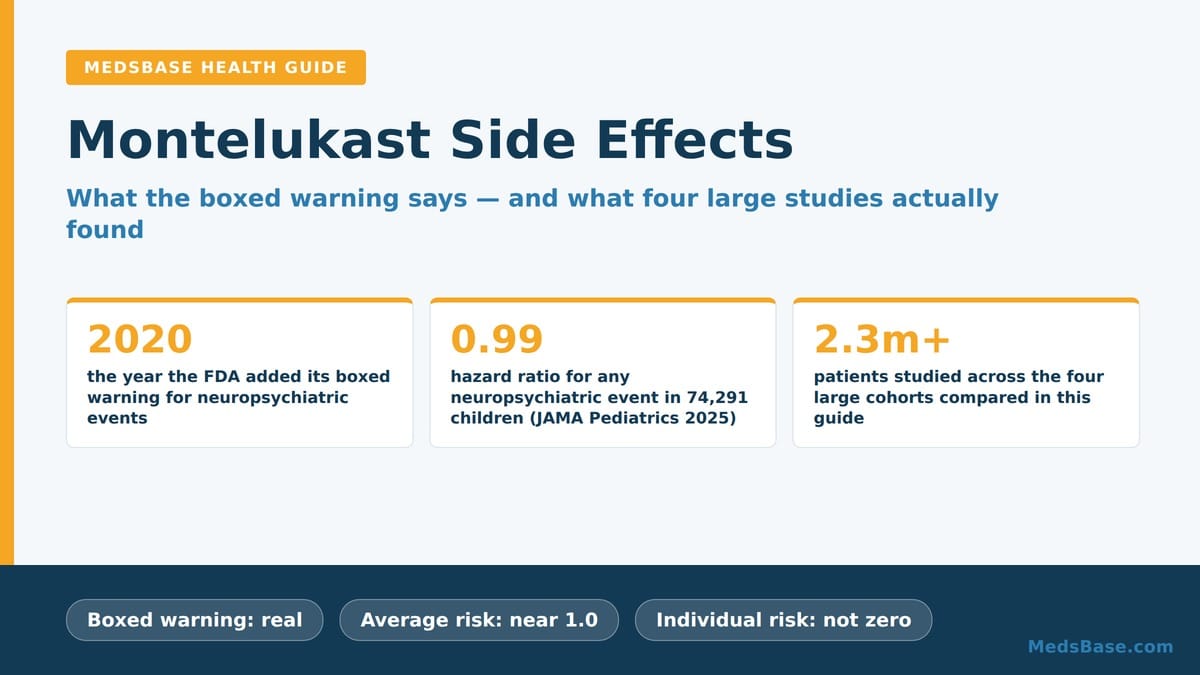
# Montelukast Side Effects: 8 Facts Behind the Boxed Warning
Most people believe a boxed warning means a drug has been proven dangerous. The research tells a more complicated story — and in the case of montelukast, understanding that difference may be the most useful thing you read today.
Montelukast side effects sit at the centre of one of the strangest evidence situations in respiratory medicine. The US regulator added its most serious form of warning to this medicine in 2020, citing neuropsychiatric events. Since then, three of the largest studies ever conducted on the question have reported hazard ratios sitting almost exactly on 1.0 — statistical language for “no measurable difference”. Meanwhile another large study did find a small increase.
By the end of this article you will know how both of those things can be true at once, which montelukast side effects are genuinely common, the specific signs worth watching in the first month, and when to stop watching and pick up the phone. One of the four studies below is the one that changes how you should read the other three — we will get to why.
- The boxed warning covering serious montelukast side effects is real and the regulator published its
- Four large studies produced effect estimates from 0.96 to 1.11. Only one of them excluded “no difference”,
- The most common montelukast side effects are dull rather than dramatic — headache and stomach upset lead
- For allergic rhinitis the regulator changed the indication itself, not just the warning. Very few
- There is one group for whom extra vigilance is genuinely justified, and it is not the group most people
- What montelukast is and who takes it
- How it works — and why the brain came into it
- The most common montelukast side effects
- The boxed warning: what it says and why it exists
- What the research found about montelukast side effects
- Montelukast vs the alternatives
- How to use it sensibly — a four-week watch plan
- Frequently asked questions
- The bottom line
What Is Montelukast?
inflammation, used for persistent asthma and allergic rhinitis. The most common montelukast side effects are
headache and stomach upset. It carries a boxed warning for serious neuropsychiatric events, and for allergic
rhinitis it is now reserved for patients who cannot tolerate or do not respond to alternatives.
Montelukast belongs to a class called leukotriene receptor antagonist medicines. You take it by mouth once a day, usually in the evening, which is a large part of its appeal — inhaler technique is genuinely difficult, and a tablet removes that problem for you entirely.
You will be prescribed it for one of two purposes. In asthma treatment it works as a preventer, reducing the background inflammation that makes your airways twitchy, rather than opening them during an attack. It does not replace your reliever inhaler and it will not help you during an acute attack. In allergic rhinitis — hay fever and its year-round equivalent — it reduces your nasal symptoms. Whichever applies to you, it is worth knowing that no other leukotriene receptor antagonist is in common use, so montelukast safety questions are effectively questions about the whole class.
Here is the detail that gets lost. When the regulator added the boxed warning in 2020, it did something else at the same time that most patients are never told about, and it applies only to one of those two uses. We will come back to it in the warning section.
MedsBase stocks montelukast as Montair, produced by a WHO-GMP-certified manufacturer, and no prescription is needed to order — though as this article argues at some length, this is a medicine to start with a plan rather than casually.
How Montelukast Works — And Why the Brain Entered the Picture
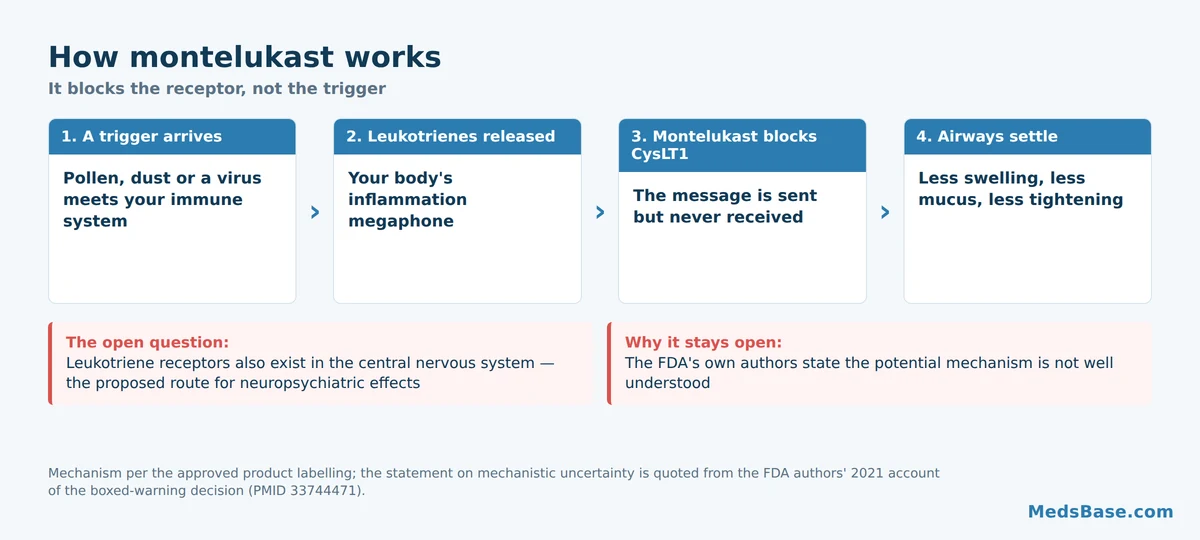
When your immune system meets a trigger — pollen, dust, a virus — it releases signalling chemicals called leukotrienes. Think of them as your body’s inflammation megaphone. They make your airway walls swell, they drive mucus production, and they tighten the smooth muscle wrapped around your airways.
Montelukast does not stop your body producing leukotrienes. It blocks the receptor they plug into, so the message is broadcast but your airways never receive it. Less swelling, less mucus, less tightening — which is why you may notice the benefit building over days rather than arriving in an hour.
So where does the brain come in?
Leukotriene receptors are not confined to your lungs. They are also present in your central nervous system. That anatomical fact is the proposed route by which a medicine aimed at your airways might produce mood or behaviour effects — and you deserve precision here, because it is a plausible mechanism, not a demonstrated one. The FDA authors themselves noted in 2021 that the potential mechanism is not well understood, which is the single most important sentence you will read about montelukast safety.
So what does this mean for you? It means nobody — regulator, researcher or pharmacist — can tell you with certainty whether a mood change you notice during treatment was caused by the drug. What they can tell you is what you should watch for and what you should do about it, which is the practical half of your question and the half this article spends most of its length on.
The Most Common Montelukast Side Effects
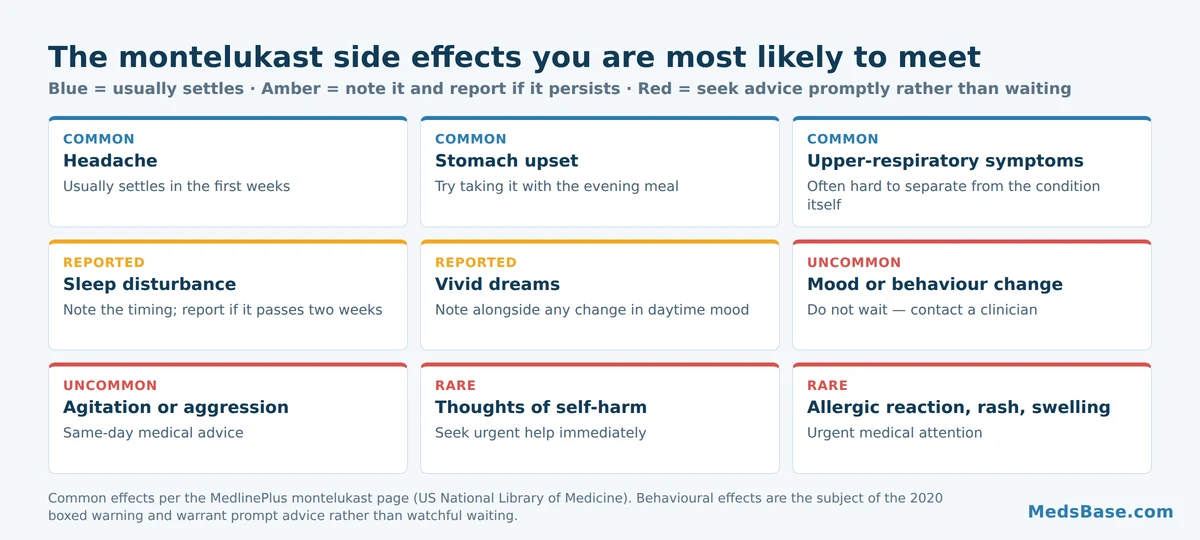
Before the serious discussion, the ordinary one. The great majority of montelukast side effects you might actually meet are mild, common to many medicines, and settle on their own without you doing anything.
| Side effect | Frequency | Severity | What to do |
|---|---|---|---|
| Headache | Common | Mild | Usually settles in the first weeks; report if persistent |
| Stomach pain, nausea, indigestion | Common | Mild | Take with the evening meal if it helps |
| Upper-respiratory symptoms | Common | Mild | Often hard to separate from the underlying condition |
| Sleep disturbances, vivid dreams | Reported | Mild–moderate | Note the timing; report if it persists past two weeks |
| Mood or behaviour change, irritability | Reported, uncommon | Potentially serious | Do not wait — contact a clinician |
| Agitation, aggression, depressed mood | Reported, uncommon | Serious | Same-day medical advice |
| Suicidal thoughts or behaviour | Rare | Emergency | Seek urgent help immediately |
| Allergic reaction, rash, swelling | Rare | Serious | Urgent medical attention |
The MedlinePlus montelukast page from the US National Library of Medicine carries the full list in plain language and is a reliable reference to keep open.
The pattern worth internalising: the common montelukast side effects are boring, and the serious ones are behavioural. That asymmetry is exactly why your watch plan later in this article focuses on behaviour rather than on physical symptoms — you will notice a headache without being told to look for it. You may not notice a gradual change in mood in someone you live with, and neither will they.
Take Daniel, 9, as an illustration. He started montelukast in September and his hay-fever symptoms improved within a fortnight. In October his parents noticed he had become unusually short-tempered in the evenings and was waking at night. Neither of those things is dramatic in isolation, and both have a hundred ordinary explanations in a nine-year-old in a new school year. What made it worth a phone call was the timing and the fact that both started together. That is the level of vigilance this medicine asks for — not alarm, but attention.
The Boxed Warning: What It Says and Why It Exists
A boxed warning is the strongest warning a medicine’s labelling can carry, and if you have read your leaflet you have already met it. Montelukast has carried one since March 2020.
The label wording is unambiguous. Under the heading “SERIOUS NEUROPSYCHIATRIC EVENTS”, the approved Structured Product Label states that serious neuropsychiatric events have been reported in patients taking montelukast, and it instructs prescribers to reserve use of montelukast for patients with allergic rhinitis who have an inadequate response or intolerance to alternative therapies.
Read that second half again, because it is the part almost nobody quotes back to you. For allergic rhinitis, the regulator did not simply add a warning — it narrowed the indication. Montelukast became a second-line option for your hay fever. The asthma indication was left unchanged.
Why the difference? The FDA authors published their reasoning openly in a 2021 peer-reviewed paper. Their account is worth your time because it explains the whole shape of this controversy, and because it tells you how seriously to take the box on your leaflet:
- The agency became aware of postmarketing reports of neuropsychiatric events as far back as 2007.
- Over the following years it repeatedly reviewed trial safety data, postmarketing reports and published
literature, producing successive labelling updates and public communications.
- Concern persisted — specifically that prescribers and patients were not aware of the risk.
- The agency ran a new observational study in its Sentinel database and held a public advisory committee
meeting in September 2019.
- It then required the boxed warning and the allergic-rhinitis restriction. Explicitly on
benefit-risk grounds, the asthma indication was not changed.
That last bullet is your key to reading this whole situation correctly. A regulator that believed montelukast was straightforwardly dangerous would have restricted both indications. It restricted the one where you have abundant, well-tolerated alternatives — antihistamines and nasal steroids — and left alone the one where taking your option away could leave you worse off than the risk it removed.
A boxed warning is a communication decision as much as a risk verdict. In this case, the FDA’s own account says the driver was that people did not know about a possible risk, not that the risk had been newly quantified.
What the Research Actually Found About Montelukast Side Effects
Here is where it gets interesting — and where almost every consumer article you will find on this topic stops short.
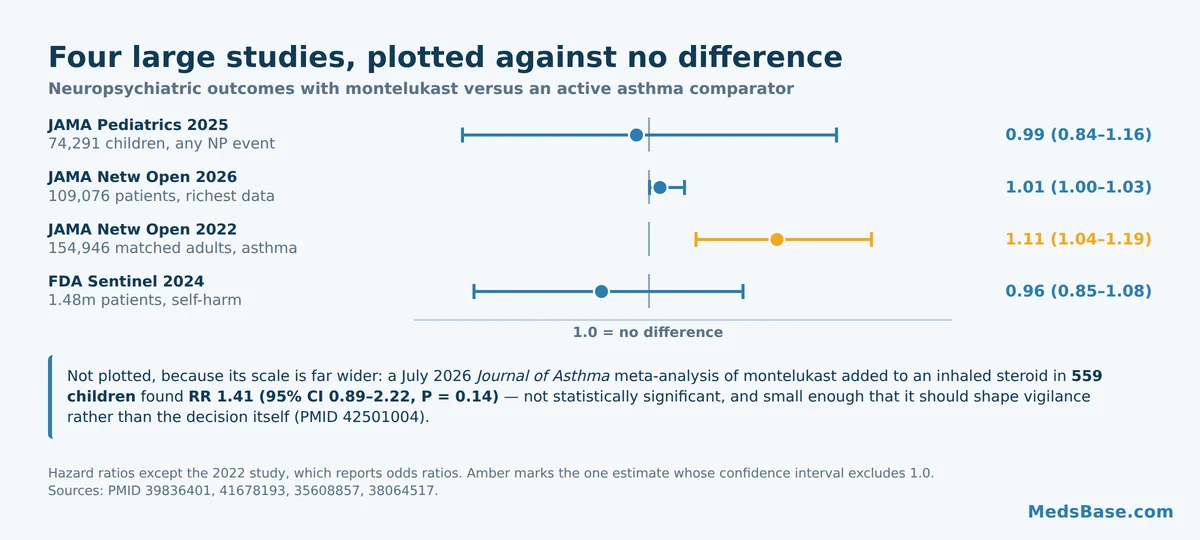
Since the warning, several very large studies have tested your question directly. Each compares montelukast against an active comparator — another asthma treatment — rather than against nothing, which matters enormously to how you should read them. Comparing asthma patients to healthy people would confound the result immediately, because asthma itself is associated with anxiety and sleep problems.
| Study | Year | Population | Finding |
|---|---|---|---|
| JAMA Pediatrics (Swedish national registers) | 2025 | 74,291 children aged 6–17, montelukast vs long-acting beta-agonists | Any neuropsychiatric event: HR 0.99 (95% CI 0.84–1.16) |
| JAMA Network Open (FDA co-authored) | 2026 | 109,076 patients aged 6–80, montelukast vs inhaled corticosteroids | Richest analysis, using claims plus structured and unstructured records: HR 1.01 (95% CI 1.00–1.03) |
| JAMA Network Open (TriNetX) | 2022 | 154,946 propensity-matched adults aged 15–64 | Asthma: OR 1.11 (95% CI 1.04–1.19); allergic rhinitis: OR 1.07 (1.01–1.14) |
| FDA Sentinel System | 2024 | 752,230 montelukast vs 724,855 inhaled-corticosteroid users | Intentional self-harm: HR 0.96 (95% CI 0.85–1.08) |
Let us take those honestly, one at a time, because each answers a slightly different version of your question.
The nationwide Swedish cohort of 74,291 children is the one to read if you are a parent. Incidence rates were 2.39 per 100 patient-years among montelukast users and 2.41 among comparator users — practically identical. Individual outcomes showed no substantial differences either, though the confidence intervals for the rarest outcomes were wide, which the authors acknowledge and which you should factor into how much reassurance you take from it.
The FDA-co-authored study of 109,076 patients is methodologically the most interesting, and it is the one that changes how you should read the others. Its whole purpose was to test whether previous studies had been missing events recorded only in free-text clinical notes rather than in structured billing data. The answer: adding richer data found far more events in both groups — and the hazard ratio moved toward 1.0, from 1.08 with claims alone to 1.01 with everything. Put plainly for you: the better the data got, the smaller the apparent difference became. That is the opposite of what you would expect if a real effect were being hidden by poor measurement.
The 2022 propensity-matched study is the outlier, and you deserve to have it presented seriously rather than explained away. In more than 154,000 matched adults it found modestly increased odds of a new neuropsychiatric diagnosis — 11% higher in asthma patients, 7% higher in allergic rhinitis patients. Its authors concluded that clinicians should consider monitoring for mental-health symptoms during treatment, particularly in people with a history of mental-health or sleep problems. If that describes you or your child, this is the study that should shape your plan.
The 2024 FDA Sentinel analysis looked specifically at intentional self-harm across nearly 1.5 million patients and found no association (HR 0.96). Its authors were careful to add that their result cannot exclude other idiosyncratic neuropsychiatric reactions — an important piece of intellectual honesty, and the reason this article will not tell you the question is closed when it is not.
Finally, a systematic review and meta-analysis published in the Journal of Asthma on 25 July 2026 asked a narrower question: does adding montelukast to an inhaled corticosteroid increase neuropsychiatric events in children compared with the inhaled steroid alone? Across six studies and 559 children it found event rates of 12.1% versus 8.6%, a pooled risk ratio of 1.41 (95% CI 0.89–2.22, P = 0.14) — an absolute difference of about 3.5%, or roughly 35 additional events per 1,000 children, with a confidence interval that comfortably includes no effect. The authors describe considerable statistical uncertainty and call for prospective validation. With 559 children in total, that study is small enough that it should shape your vigilance, not your decision.
What this means for you: across studies totalling well over two million patients, the average effect of montelukast on neuropsychiatric outcomes is somewhere between “none” and “small”. That is genuinely reassuring at population level, and it is reasonable for you to take real comfort from it. It is not the same as a guarantee for you personally, and the 2022 study plus the persistence of postmarketing reports means your sensible posture is neither dismissal nor fear — it is informed vigilance for your first few weeks, which is exactly what the plan below gives you.
Montelukast vs Alternatives: What Else Is There?
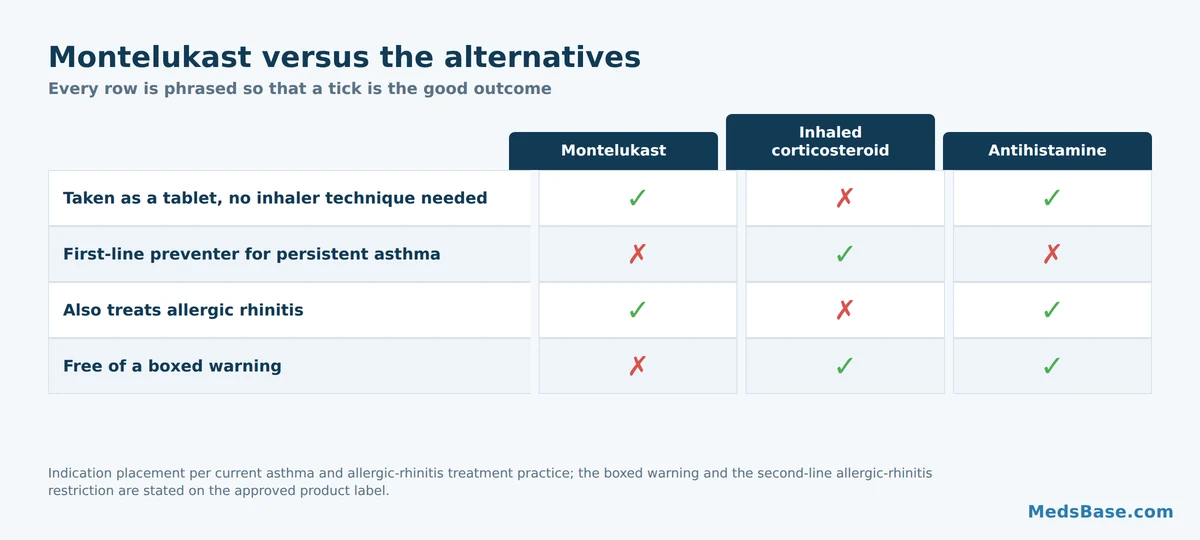
| Option | What it does | Best suited to | Trade-off |
|---|---|---|---|
| Montelukast | Oral tablet, blocks leukotriene receptors | Add-on for persistent asthma; second-line for allergic rhinitis | Boxed warning; not a reliever |
| Inhaled corticosteroids | Direct anti-inflammatory in the airway | First-line preventer for persistent asthma | Requires inhaler technique; local side effects |
| Antihistamines | Block histamine | Allergic rhinitis, first-line | Limited benefit for asthma itself |
| Intranasal corticosteroid | Local anti-inflammatory in the nose | Allergic rhinitis, first-line | Nasal irritation; needs consistent daily use |
| Combination inhaler | Steroid plus long-acting bronchodilator | Asthma not controlled on a steroid alone | More complex regimen |
Which one fits your situation? If you have persistent asthma, guidelines put inhaled corticosteroids first and montelukast is generally an add-on rather than a replacement — a distinction worth being firm about with you, because swapping your inhaler for a tablet because tablets are easier is a genuine safety risk. If your issue is allergic rhinitis, the regulator has effectively already answered for you: try antihistamines and nasal steroids first, and reserve montelukast for when you cannot tolerate them or do not respond.
If inhaler technique is your actual barrier, that is a solvable problem and worth solving before you change drug class. Our guide to how inhaled preventers compare covers the device differences that make one inhaler workable for you when another is not.
How to Use Montelukast Sensibly — A Four-Week Watch Plan
If you or your child are starting montelukast, this is what informed vigilance looks like in your week. It takes almost no effort and it resolves your anxiety, because you are doing something rather than worrying. Think of it as your personal montelukast safety check rather than a medical procedure.
- Write the start date down. Everything below depends on being able to link a change to a timeline. A
note on your phone is enough.
- Ask one person who knows the patient well to watch too. Mood changes are easier to see from outside
than inside — this is the single highest-value step, and it costs nothing.
- Note the baseline. Before or on day one: how is sleep, mood, temper and concentration right now? Two
lines. Without a baseline you cannot tell whether anything changed.
- Take it consistently, in the evening, unless advised otherwise.
- Check in at week one and week four. Look for the four montelukast side effects that matter here: sleep
disturbances, mood change, unusual irritability or aggression, and anything the person themselves says feels different.
- Escalate on behaviour, not on headaches. Any new agitation, depressed mood, aggression or talk of
self-harm is a same-day call, not a wait-and-see.
- Do not stop abruptly on your own if montelukast is treating asthma. Uncontrolled asthma carries its
own serious risks. Ask first — the safe sequence is to arrange the replacement before withdrawing the current preventer.
Mistakes to avoid
- Treating montelukast as a reliever. It will not help during an attack, and expecting it to is dangerous.
- Stopping an inhaled steroid because the tablet seems to be working. They do different jobs.
- Dismissing behaviour changes as coincidence because the studies are reassuring. Population averages do not
describe individuals — that is precisely the error this article is written to prevent.
- Panicking at a headache in week one. It is the single most common side effect and usually settles.
- Assuming the boxed warning means the medicine was withdrawn or is unsafe for everyone. It was not, and it
is not.
For anyone reviewing their options with a clinician, the asthma and COPD treatment options catalogue shows what is available in each class, which makes that conversation more concrete.
- Best asthma inhalers compared — the preventer and reliever
- Levothyroxine not working — a different medicine, the
Frequently Asked Questions
Q: Does montelukast cause behaviour changes in children?
A: It can in some children, but the largest studies do not find it happening more often than with comparison asthma treatments. A nationwide Swedish study of 74,291 children found a hazard ratio of 0.99 for any neuropsychiatric event — essentially identical rates. That population finding does not rule out individual reactions, which is why the boxed warning exists and why watching for changes in the first weeks is sensible. Report any new irritability, aggression or mood change rather than waiting.
Q: What are the most common montelukast side effects?
A: Among the montelukast side effects reported, headache and abdominal or stomach discomfort lead the list, followed by upper-respiratory symptoms that are often hard to distinguish from the condition being treated. Sleep disturbances and vivid dreams are also reported. Most are mild and settle within the first few weeks. The uncommon but important ones are behavioural — mood change, agitation, aggression — and these warrant prompt medical advice rather than watchful waiting.
Q: Why does montelukast have a boxed warning?
A: Because the FDA received postmarketing reports of serious neuropsychiatric events starting in 2007 and concluded, after a 2019 advisory committee meeting, that prescribers and patients were insufficiently aware of the possible risk. The label now instructs that montelukast be reserved for allergic rhinitis patients who have an inadequate response or intolerance to alternatives. Notably, the asthma indication was left unchanged on benefit-risk grounds.
Q: Is montelukast safe for children?
A: It is approved for children and widely used, and the largest paediatric study to date found no increase in neuropsychiatric events versus another asthma medicine. A July 2026 meta-analysis of montelukast added to inhaled steroids in 559 children found a non-significant risk ratio of 1.41 with wide uncertainty. The practical answer: reasonable to use when indicated, with a parent actively watching mood, sleep and behaviour for the first month.
Q: How long do montelukast side effects last?
A: Mild effects such as headache or stomach upset typically settle within the first two to four weeks as the body adjusts. Sleep disturbances often follow the same pattern. Neuropsychiatric symptoms are different: they should not be waited out. If mood, behaviour or sleep changes appear and persist beyond a few days, that is a reason to contact a clinician rather than to keep going and hope it resolves.
Q: Should you stop montelukast if side effects appear?
A: Not on your own, and not abruptly, if it is treating asthma — stopping a preventer without a replacement can leave asthma uncontrolled, which carries its own serious risk. The right sequence is to report the symptom, agree a plan, and have the alternative in place before withdrawing. The exception is any emergency symptom, including thoughts of self-harm, which needs urgent help immediately rather than a scheduled appointment.
Q: Can adults get neuropsychiatric side effects from montelukast, or is it only children?
A: Adults too. The 2022 propensity-matched study that found a modest increase in new neuropsychiatric diagnoses studied adults aged 15 to 64, not children, and its authors specifically flagged people with a history of mental-health or sleep problems as warranting monitoring. The common assumption that this is a paediatric-only concern is not supported by the evidence.
Q: Does montelukast work as well as an inhaler for asthma?
A: For most people with persistent asthma, inhaled corticosteroids remain the first-line preventer and montelukast is generally an add-on rather than a substitute. Its real advantage is practicality — a once-daily tablet with no technique to master, which genuinely matters for people who cannot use an inhaler reliably. Swapping an effective inhaler for a tablet purely for convenience is a decision to make with a clinician, not alone.
The Bottom Line on Montelukast Side Effects
Montelukast side effects come in two very different categories, and conflating them is what makes this topic so confusing. The common ones — headache, stomach upset, disturbed sleep — are mild and usually temporary. The rare ones are behavioural, they are the reason for the boxed warning, and they deserve genuine attention even though the largest studies have not found them occurring more often than with comparison treatments.
The balanced verdict: this is an effective, convenient medicine with a real but small and still-uncertain neuropsychiatric signal. The regulator’s own response tells you how to weigh it — restrict it where good alternatives exist, keep it where removing it would cost patients more than it saves them. That is a proportionate judgement, and it is a reasonable one to adopt yourself.
Your one immediate action: if you or your child are on montelukast or about to start, write down today’s date and two lines describing current sleep, mood and temper. That baseline takes thirty seconds and it is the difference between “something feels off” and a specific, actionable observation your clinician can work with.
What to read next:
- Wondering whether an inhaled preventer would suit better, and which device is realistically usable?
Best asthma inhalers compared walks through the classes.
- Curious how a medicine can quietly under-deliver even when you take it correctly?
Levothyroxine not working covers the supply-chain side of that question.
advice. Asthma is a potentially serious condition and treatment decisions should be made with a qualified doctor or pharmacist who knows your history. Never stop a preventer medicine without arranging a replacement first. If you or someone you care for experiences thoughts of self-harm, agitation or a sudden change in mood, seek urgent medical help immediately.*

Written by
Sophie ChenPharmaceutical Content Researcher · 8 years experience
Sophie Chen is a pharmaceutical content researcher with 8 years covering generic medication access and clinical pharmacology. She specialises in international regulatory frameworks, bioequivalence standards, and patient-facing education on therapeutic drug classes. She is not a clinician.