








✓ Medically reviewed by · Last reviewed: May 2026
Pharmacy Researcher · 8 years experience
Pharmacy researcher with 8 years reviewing clinical drug information, generic formulation equivalence, and international pharmaceutical standards. Focuses on patient-facing accuracy in medication education.
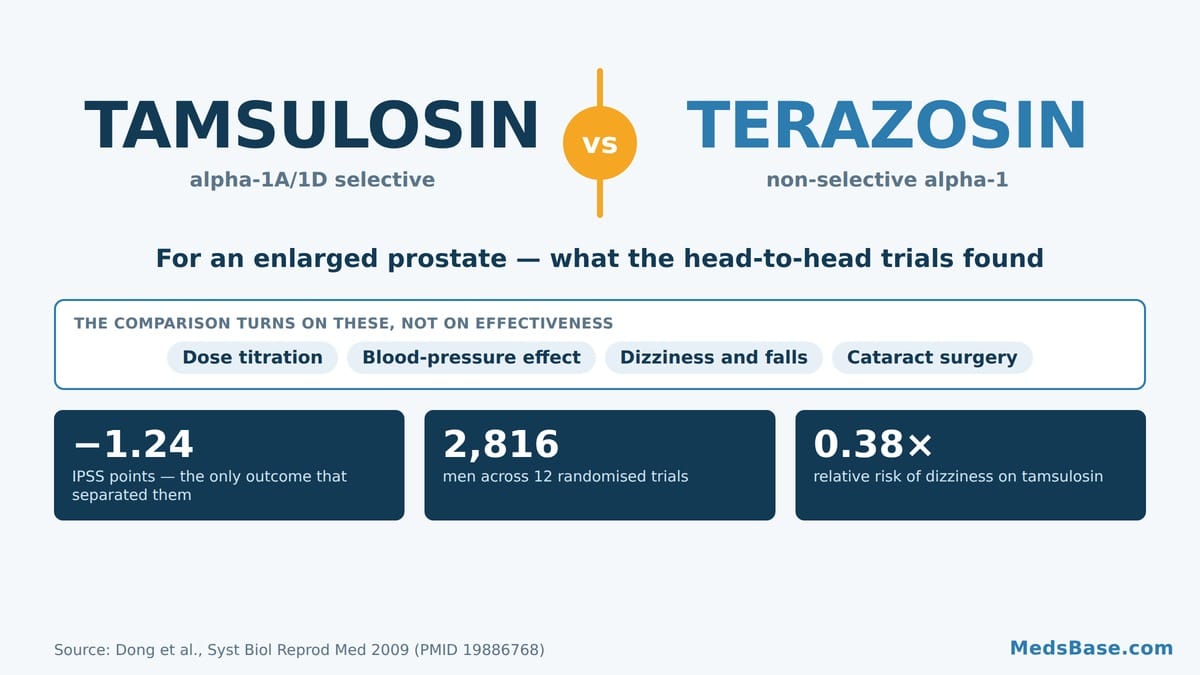
Most comparisons of these two drugs end the same way: tamsulosin wins, terazosin is the old one, next question. That conclusion is not exactly wrong, but it answers a question almost nobody is actually asking — and it hides the findings that would genuinely help you choose.
Here is what the head-to-head evidence really shows. When researchers pooled 12 randomised trials covering 2,816 men, tamsulosin vs terazosin produced no significant difference in peak urine flow, average flow, residual volume, prostate volume or quality of life. Five outcomes, five ties. The symptom-score advantage that gets quoted everywhere is real, but it is small — and the genuine separation between these two drugs is somewhere else entirely.
By the end of this article you will know which of the two fits your situation, what the first two weeks feel like on each, and the single question about your eyes that you must answer before starting one of them. That last one catches people out, and we will come to it.
- On five of six efficacy measures in the tamsulosin vs terazosin trials, the two drugs tied. The tie is the finding, not the footnote.
- Where they separate is tolerability — and the gap there is far larger than the efficacy gap.
- Terazosin lowers blood pressure. For most men that is a nuisance; for one specific group it is the reason to choose it.
- One of these two carries the highest measured risk of a specific cataract-surgery complication of any drug in its class — details in the safety section.
- Nearly half of all falls on this class of medicine happen on a single, predictable day. Knowing which day makes them largely avoidable.
- The Short Answer
- How These Two Alpha-Blockers Work
- Key Uses — And Who Each One Suits
- Side Effects, Safety and Dosing
- What the Research Says
- Which One Fits Which Situation
- How to Use Them — Practical Guidance
- Frequently Asked Questions
- The Bottom Line
Tamsulosin vs Terazosin: The Short Answer
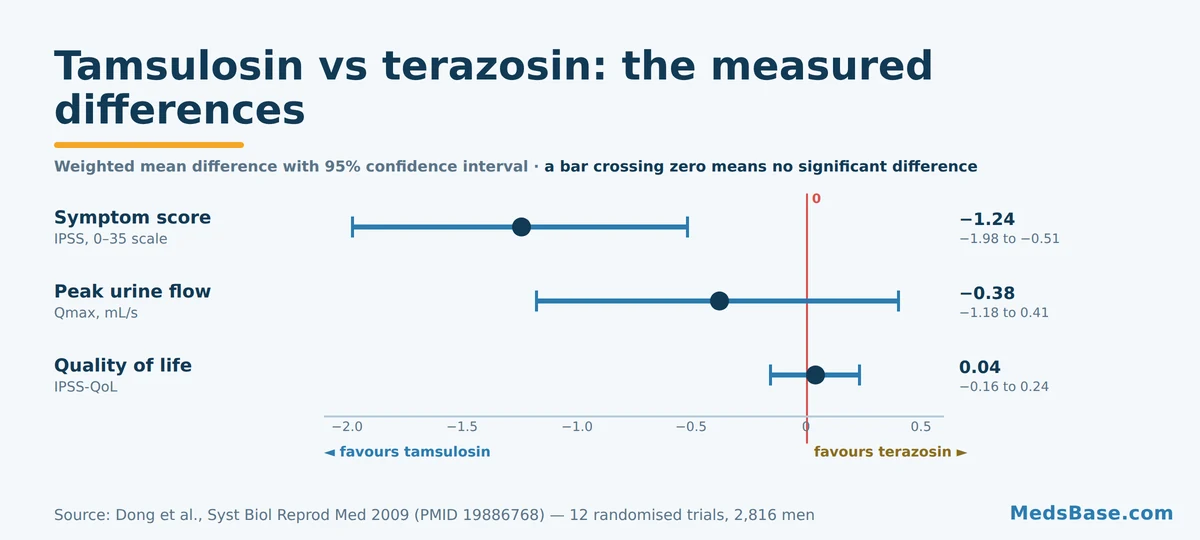
A systematic review of 12 trials and 2,816 men compared the two directly. Tamsulosin came out ahead on the International Prostate Symptom Score, with a weighted mean difference of −1.24 (95% confidence interval −1.98 to −0.51). The IPSS runs from 0 to 35, so a difference of 1.24 points is genuine but modest — noticeable in a trial, often invisible to an individual man.
On everything else, the two drugs were indistinguishable: quality of life (weighted mean difference 0.04, 95% CI −0.16 to 0.24), peak urine flow (−0.38, 95% CI −1.18 to 0.41), average flow, residual volume and prostate volume all showed no significant difference.
That pattern is the real story. If you are choosing between them expecting one to unblock you meaningfully better than the other, the evidence does not support that expectation. What the evidence does support is a clear difference in how the two feel to take.
How These Two Alpha-Blockers Work
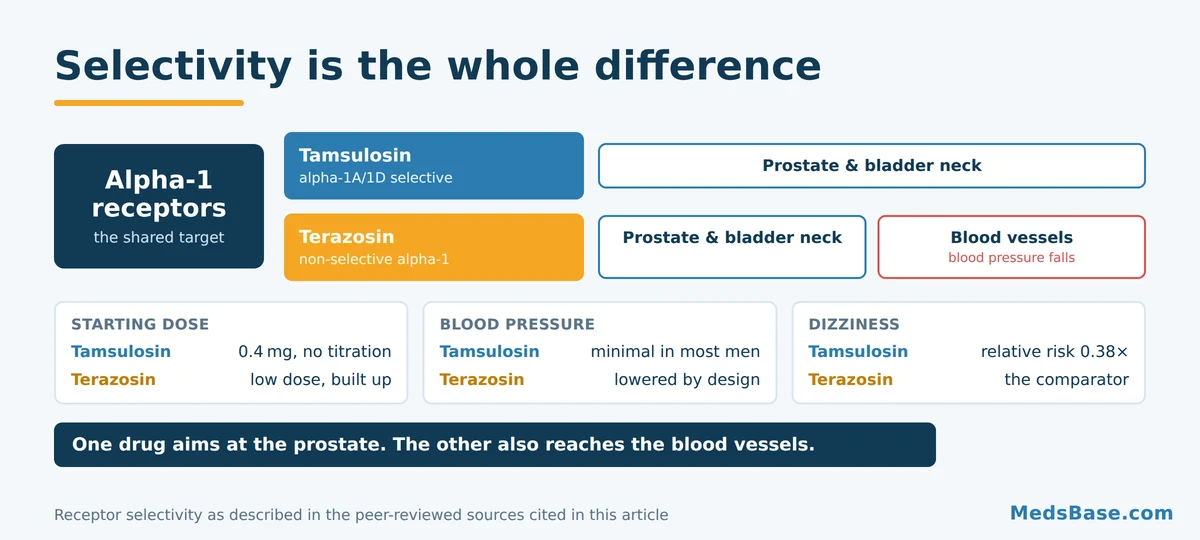
Picture the outlet of your bladder as a doorway with a ring of muscle around it. In benign prostatic hyperplasia the prostate presses on that doorway, and the muscle ring itself is held partly tense by alpha-1 receptors. Alpha-blockers release that tension. They do not shrink the prostate — they widen the doorway around it.
The difference between the two drugs is aim.
- Tamsulosin is selective for the alpha-1A and alpha-1D receptor subtypes, which are concentrated in the prostate and bladder neck. It targets the doorway and largely leaves everything else alone.
- Terazosin blocks alpha-1 receptors without that subtype selectivity. It relaxes the doorway just as effectively — and it also relaxes the smooth muscle in your blood vessels, which lowers blood pressure.
Every meaningful difference in the tamsulosin vs terazosin comparison flows from that one design distinction. The dizziness, the need to build the dose up slowly, the blood-pressure effect, the falls — all of it traces back to terazosin acting on vessels that tamsulosin mostly leaves alone.
Neither drug shrinks the prostate. That job belongs to a different class — finasteride and dutasteride — which is why combination products exist. If your prostate is large and your symptoms are progressing, an alpha-blocker alone may not be the whole answer, and that is a conversation for a clinician rather than a comparison article.
Tamsulosin vs Terazosin: Key Uses and Who Each One Suits
Relieving urinary symptoms
This is the shared job: hesitancy, a weak stream, incomplete emptying, and the night-time trips that wear people down more than any other symptom. Both drugs do it, and both do it fast by the standards of prostate medicine — men typically notice a change within days, and the honest assessment point is around four to six weeks.
If you are taking the straightforward route with fewer adjustment problems, tamsulosin 0.4 mg is the standard starting point, and Urimax Capsule is that strength. No prescription is needed to order from MedsBase, though whether an alpha-blocker is right for you at all is worth confirming with a clinician first — see the safety note below on why.
Treating urinary symptoms and high blood pressure together
Here the older drug earns its place. A man with untreated or poorly controlled hypertension who also has an enlarged prostate can, in principle, address both with one medicine. Terazosin’s titration schedule — starting low at bedtime and building up — exists precisely because that blood-pressure effect needs managing.
This is not a reason to use terazosin as a blood-pressure drug on its own; other classes are preferred first-line for hypertension. But when both problems are present, the overlap is a genuine advantage rather than a compromise, and Hytrin comes in the 1 mg, 2 mg and 5 mg strengths that make a proper titration possible.
What neither is for
Neither drug treats prostate cancer, neither shrinks the gland, and neither should be used to postpone assessment.
Tamsulosin vs Terazosin: Side Effects, Safety and Dosing
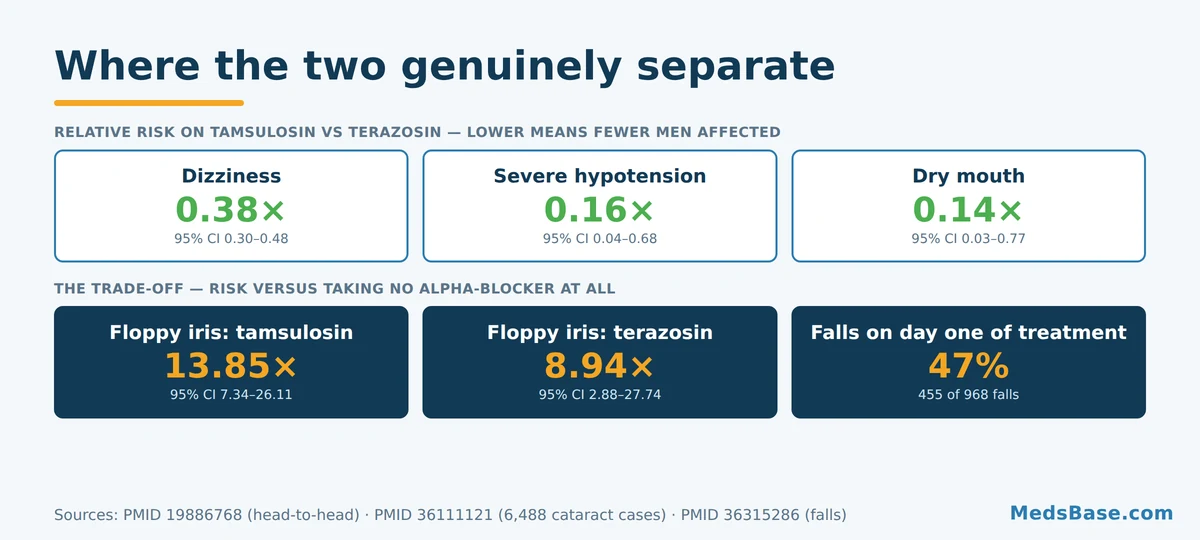
This is where the two drugs genuinely diverge, and the effect sizes are far larger than anything on the efficacy side.
| Side effect | Relative risk on tamsulosin vs terazosin | What it means | What to do |
|---|---|---|---|
| Dizziness | 0.38 (95% CI 0.30–0.48) | Roughly a third as many men affected on tamsulosin | If dizzy on terazosin, the dose or the drug can change |
| Severe hypotension | 0.16 (95% CI 0.04–0.68) | Substantially less common on tamsulosin | Stand up slowly, especially in the first fortnight |
| Dry mouth | 0.14 (95% CI 0.03–0.77) | Much less common on tamsulosin | Usually settles; sip water rather than switching |
| Retrograde ejaculation | More common on tamsulosin | Semen passes into the bladder; harmless but startling | Not dangerous — but ask if it matters to you before starting |
| Nasal congestion | Reported on both | Vessel relaxation in the nose | Usually mild and tolerable |
| Floppy iris during cataract surgery | Higher on tamsulosin | Complicates eye surgery | Tell any eye surgeon you take it, even years later |
Two of these deserve proper treatment rather than a table row.
The eye issue — this is the open loop from the introduction. Intraoperative floppy iris syndrome makes cataract surgery technically harder and raises complication risk. A network meta-analysis of 6,488 cataract cases across 25 prospective studies measured the risk against men taking no alpha-blocker at all, and the ranking is unambiguous: tamsulosin 13.85 times the risk (95% CI 7.34–26.11), terazosin 8.94 times (95% CI 2.88–27.74), alfuzosin 7.73 and doxazosin 3.88. Every drug in the class raises it. Tamsulosin raises it most.
Read that carefully, because it is easy to over-react to. This is not a reason to avoid tamsulosin — it is a reason to tell your ophthalmologist. Surgeons who know in advance can adapt their technique, and the complication is largely manageable when anticipated. The problem is the man who does not mention a tablet he takes for his waterworks to a doctor operating on his eye. Note also that terazosin’s confidence interval is very wide (2.88 to 27.74), meaning the true difference between the two drugs here is far less certain than the point estimates suggest.
The falls issue, and the one useful detail. Alpha-blockers as a class increase fall risk — a nationwide cohort that tracked when the falls happen found an odds ratio of 1.80 (95% CI 1.62–2.00) versus unexposed men. But the striking finding is the timing: of 968 falls in the exposed group, 455 — that is 47% — occurred on the first day of taking the medicine. The same study found fall risk was significantly higher in summer (odds ratio 1.23, 95% CI 1.03–1.47), when dehydration compounds the blood-pressure effect.
Here’s what that means for you: nearly half the risk of this entire drug class is concentrated in a single, entirely predictable 24-hour window. Take the first dose at bedtime, do not drive that evening, get up slowly overnight, and make sure someone knows you have started. That one precaution addresses the largest share of the danger.
On the class as a whole: prazosin, an older alpha-blocker in the same quinazoline family as terazosin, accounted for three of the 22 nitrosamine-related drug recalls initiated in 2026. If you have seen that in the news and wondered whether it says anything about the class, our explainer on what a nitrosamine impurity recall actually means covers it — the short version is that it is a manufacturing-batch issue, not a property of the drug.
What the Research Says About Tamsulosin vs Terazosin
| Study | Year | Design | Key finding |
|---|---|---|---|
| Head-to-head systematic review | 2009 | 12 RCTs, 2,816 men | Tamsulosin better on IPSS (WMD −1.24); no significant difference on QoL, peak flow, average flow, residual or prostate volume |
| Same review, tolerability | 2009 | Pooled adverse events | Tamsulosin: dizziness RR 0.38, severe hypotension RR 0.16, dry mouth RR 0.14 |
| Cochrane review of terazosin | 2002 | 17 studies, 5,151 men | Terazosin improved symptom scores 37% vs 15% on placebo; IPSS improvement 40%, similar to tamsulosin’s 43% |
| Alpha-blocker network meta-analysis (PMID 38750153) | 2024 | 22 studies, 3,371 patients, 6 drugs | Tamsulosin 0.4 mg ranked highest probability for symptom score, residual volume and flow rate |
| Doxazosin vs tamsulosin network meta-analysis (PMID 41495543) | 2026 | 40 publications, 12,201 participants | Doxazosin GITS 4 mg gave the largest IPSS improvement (−10.07); no difference on flow or residual volume |
| Floppy iris network meta-analysis | 2022 | 25 prospective studies, 6,488 cases | Tamsulosin highest IFIS risk in the class (RR 13.85); terazosin 8.94 |
| National fall-risk cohort | 2022 | Nationwide population cohort | Fall odds ratio 1.80; 47% of falls on the first day of treatment |
Three things are worth drawing out of that table, because together they change how the tamsulosin vs terazosin question should be framed.
First, terazosin’s own evidence is strong even though it is old. An older Cochrane review of terazosin pooled 17 studies covering 5,151 men and found symptom scores improving 37% versus 15% on placebo, peak urine flow improving 22% versus 11%, and — the line most relevant here — a pooled IPSS improvement of 40%, against 43% for tamsulosin. A three-percentage-point gap, from a review published in 2002. That review is genuinely dated, and an attempted update was later withdrawn, so it should be read as historical evidence rather than current guidance. But it is the largest terazosin-specific synthesis available, and it agrees with the head-to-head data.
Second, the newest evidence complicates the “tamsulosin is best” story rather than confirming it. The 2024 network meta-analysis of six alpha-blockers ranked tamsulosin 0.4 mg highest for symptom score, residual volume and flow — but ranked doxazosin 8 mg highest for quality of life. The 2026 network meta-analysis of 40 publications and 12,201 participants went further, finding doxazosin in its slow-release formulation gave a larger IPSS improvement than most tamsulosin doses. That 2026 analysis includes an author affiliated with a pharmaceutical manufacturer, which is disclosed in the paper and is worth knowing when weighing it. The 2024 analysis also carries a published erratum. Neither point invalidates the work; both are the kind of context an honest summary includes.
Third, and most usefully: the whole class works, and the differences between its members are small. Guidelines have said for years that alpha-blockers have broadly similar efficacy at appropriate doses and differ mainly in tolerability. Every dataset in that table is consistent with exactly that.
What this means for you: stop looking for the most effective alpha-blocker. Start looking for the one whose side-effect profile fits your body and your other conditions. That is the decision the evidence can actually help you make.
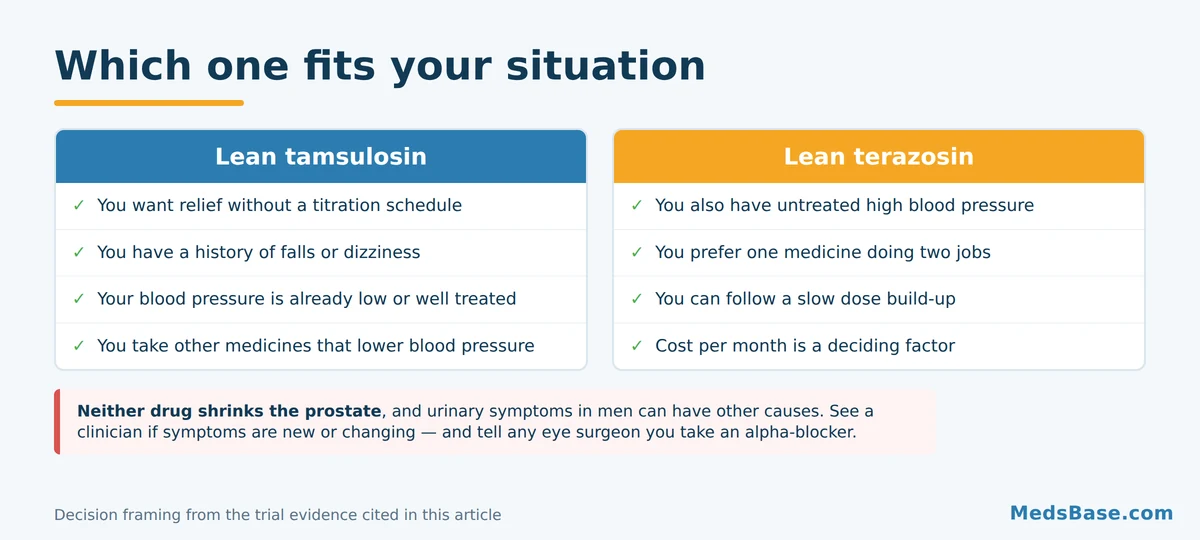
Tamsulosin vs Terazosin: Which One Fits Which Situation
| Tamsulosin | Terazosin | |
|---|---|---|
| Receptor targeting | Selective (alpha-1A/1D) | Non-selective alpha-1 |
| Starting dose | 0.4 mg, no titration needed | Low dose at bedtime, titrated upward |
| Effect on blood pressure | Minimal in most men | Lowers it — by design |
| Dizziness | Substantially less common | More common |
| Time to notice a change | Days | Days, once titrated |
| Shrinks the prostate? | No | No |
| Best suited to | Most men, especially those at risk of falls | Men who also need blood pressure treated |
The verdict on tamsulosin vs terazosin, plainly. For the average man with an enlarged prostate and no other relevant condition, tamsulosin is the more comfortable choice — not because it works better, but because it is easier to tolerate and needs no titration. For a man whose blood pressure also needs treating, terazosin does two jobs and that overlap is worth having. For a man with cataract surgery on the horizon, the choice matters much less than telling the surgeon.
And if neither suits you, the alpha-blocker class is not the only option. How tadalafil compares as a prostate treatment covers a completely different mechanism that some men find preferable, particularly where erectile function is also a consideration.
Tamsulosin vs Terazosin: Practical Guidance for Taking Them
- Take the first dose at bedtime — this applies to both drugs and is the single highest-value precaution, given that 47% of falls on this class happen on day one.
- For terazosin, respect the titration. The step-up schedule exists to let your circulation adapt. Jumping ahead is how men end up dizzy and abandon a drug that would have suited them.
- Stand up slowly for the first two weeks, particularly overnight and particularly in hot weather, when the summer fall-risk signal is strongest.
- Take tamsulosin consistently in relation to food — roughly half an hour after the same meal each day, which keeps absorption steady.
- Re-assess at four to six weeks. If symptoms have not shifted at all by then, the answer is a different drug or a different mechanism, not more patience.
- Tell every clinician you take it — especially any ophthalmologist, and especially before cataract surgery, even if you stopped the drug years ago.
- Stopping after three days because of dizziness on terazosin. That is exactly what the titration schedule is designed to prevent, and the dizziness usually settles.
- Expecting the prostate to shrink. Neither drug does this. If gland size is the issue, a different class is needed.
- Not mentioning it to an eye surgeon. The most avoidable complication in this entire article.
- Treating symptoms without ever being assessed. Alpha-blockers relieve the symptoms of an enlarged prostate — and of other conditions that need finding.
- Doubling up after a missed dose. Take the next one as scheduled; the blood-pressure effect is dose-related.
Something clinicians see constantly: men who tried an alpha-blocker years ago, felt dizzy in week one, stopped, and concluded the whole class was unusable. In a large proportion of those cases the drug was terazosin, taken in the morning, without titration. The same man on tamsulosin at bedtime often has no trouble at all. If that is your history, it is worth revisiting rather than writing off.
For a plain-language reference on dosing and cautions, the MedlinePlus tamsulosin page is a reliable neutral source. And if you want to see what else exists for this condition, including combination products that pair an alpha-blocker with a prostate-shrinking drug, you can browse the full BPH treatment range.
- How tadalafil compares as a prostate treatment — a different mechanism for the same problem.
- The full BPH treatment range — including combination options.
- What a nitrosamine impurity recall actually means — context on the 2026 alpha-blocker recall headlines.
Frequently Asked Questions
Q: Which is better, tamsulosin or terazosin?
A: In the tamsulosin vs terazosin comparison, most men do better on tamsulosin — but for tolerability rather than effectiveness. A systematic review of 12 trials and 2,816 men found tamsulosin better on symptom score by a weighted mean difference of just 1.24 points on a 35-point scale, with no significant difference in quality of life, peak urine flow, average flow, residual volume or prostate volume. Where tamsulosin clearly wins is side effects: roughly a third as much dizziness and substantially less low blood pressure.
Q: Does terazosin lower blood pressure?
A: Yes, and by design — it was developed as a blood-pressure medicine before its urinary benefits were recognised. It blocks alpha-1 receptors without subtype selectivity, so it relaxes blood vessels as well as the bladder neck. That is why it needs a titration schedule and why it can suit a man who has both an enlarged prostate and untreated hypertension. Tamsulosin’s receptor selectivity means it has minimal blood-pressure effect in most men.
Q: Why do alpha-blockers cause dizziness?
A: Because relaxing smooth muscle in blood vessels lowers blood pressure, particularly on standing. The effect is strongest when the drug is new to your system, which is why nearly half of all falls on this class happen on the very first day of treatment. Taking the first dose at bedtime and standing up slowly for the first fortnight addresses most of that risk.
Q: Can you switch from terazosin to tamsulosin?
A: Switching in either direction between tamsulosin vs terazosin is common and generally straightforward, but it should be done with a clinician’s input rather than independently, because it changes your blood-pressure picture. If you were taking terazosin partly for hypertension, moving to tamsulosin removes that effect and your blood pressure may need managing another way. If you stopped terazosin because of dizziness, tamsulosin is often tolerated well.
Q: How long do alpha-blockers take to work for BPH?
A: Faster than most prostate medicines. Many men notice a change in urinary flow within days of an effective dose, and the standard point to judge properly is four to six weeks. Terazosin takes slightly longer in practice, not because it is weaker but because the dose has to be built up. If nothing has changed by six weeks at a full dose, that usually indicates a different treatment is needed.
Q: Do alpha-blockers shrink the prostate?
A: No. Alpha-blockers relax the muscle around the bladder outlet, which widens the channel without changing the size of the gland. The drugs that shrink the prostate are the 5-alpha-reductase inhibitors, finasteride and dutasteride, which work over months rather than days. Combination products exist that pair the two mechanisms, which is why men with larger prostates are sometimes offered both.
Q: Is it safe to take tamsulosin before cataract surgery?
A: It is manageable, but your eye surgeon must be told. A network meta-analysis of 6,488 cataract cases found tamsulosin carries the highest risk of intraoperative floppy iris syndrome of any alpha-blocker, at 13.85 times the risk in men taking none, with terazosin at 8.94 times. Surgeons who know in advance can adapt their technique. Stopping the drug shortly before surgery does not reliably remove the risk, so disclosure matters more than discontinuation.
Q: Can I take either one if I have low blood pressure already?
A: Both need caution, but tamsulosin is generally the safer of the two in that situation because its receptor selectivity limits its effect on blood vessels. Pooled data show severe hypotension occurring at roughly a sixth the rate of terazosin. If you already have low blood pressure, a history of fainting, or you take other medicines that lower it, this is a decision to make with a clinician rather than alone.
The Bottom Line on Tamsulosin vs Terazosin
The honest verdict on tamsulosin vs terazosin is not the one most articles give you. These two drugs relieve the symptoms of an enlarged prostate to a very similar degree — five of six efficacy outcomes showed no significant difference across 12 trials and 2,816 men, and the sixth showed a gap of 1.24 points on a 35-point scale. If you are hoping one will unblock you dramatically better than the other, the evidence does not offer that.
What the evidence does offer is a clean tolerability decision. Tamsulosin causes far less dizziness and far less low blood pressure, and needs no titration, which makes it the more comfortable default for most men — particularly older men and anyone at risk of falls. Terazosin lowers blood pressure, which makes it the better choice for the specific man who needs that too. And whichever you take, tell your eye surgeon.
Your immediate action: if you are starting either drug, take the first dose at bedtime and plan not to drive that evening. Nearly half the fall risk of this entire drug class sits in that single day, and that one change removes most of it.
Wondering whether a completely different mechanism might suit you better? Read how tadalafil compares as a prostate treatment. And if you want to see the combination options that pair an alpha-blocker with a prostate-shrinking drug, the full BPH treatment range sets them out together.

Written by
Sophie ChenPharmaceutical Content Researcher · 8 years experience
Sophie Chen is a pharmaceutical content researcher with 8 years covering generic medication access and clinical pharmacology. She specialises in international regulatory frameworks, bioequivalence standards, and patient-facing education on therapeutic drug classes. She is not a clinician.