








✓ Medically reviewed by · Last reviewed: May 2026
Pharmacy Researcher · 8 years experience
Pharmacy researcher with 8 years reviewing clinical drug information, generic formulation equivalence, and international pharmaceutical standards. Focuses on patient-facing accuracy in medication education.
You have been feeling full after three mouthfuls, queasy by mid-afternoon, and vaguely nauseated most mornings for a month. A clinician mentions a drug to speed up your stomach, and two names come up. You look them up and find one carries a warning in a black box about a movement disorder, and the other is not approved in the United States at all. Neither of those facts tells you which one to take.
So let us settle what the evidence actually shows about domperidone vs metoclopramide. The short answer is going to surprise you: in the only head-to-head trial ever conducted, they worked equally well. The decision has almost nothing to do with which one is more effective.
What it does have to do with is which of two very different risks applies to your body. One of these drugs poses a question about your brain; the other poses a question about your heart. By the end of this article you will know which question is yours — and there is a third option in the alternatives section that suits a surprising number of people better than either.
- The single double-blind head-to-head trial of domperidone vs metoclopramide found them equally effective — the efficacy debate is thinner than the internet suggests
- Metoclopramide caused drowsiness in 49% of patients at four weeks against 29% on domperidone, in that same trial
- One drug carries a boxed warning and a hard duration ceiling; the other carries a cardiac signal
- A large network meta-analysis ranked one of them second out of every gastroparesis drug tested — but ranked few drugs as effective at all
- The reason domperidone is unavailable in US pharmacies is not the reason most people assume
- For one very common cause of nausea today, neither drug is the right answer — see the uses section
Domperidone vs Metoclopramide: the Short Answer
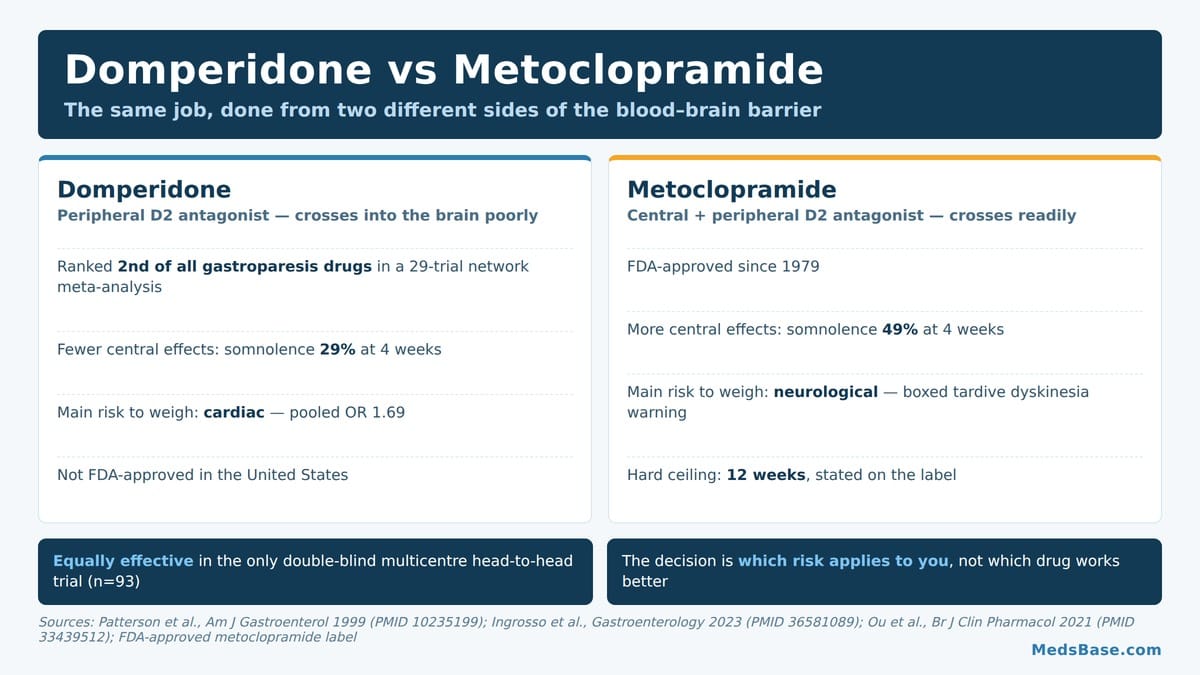
Domperidone and metoclopramide are both dopamine D2 receptor antagonists that speed up stomach emptying and reduce nausea. In the only double-blind head-to-head trial, they relieved symptoms equally well. They differ mainly in safety: metoclopramide crosses into the brain and carries a boxed warning for tardive dyskinesia, while domperidone stays largely in the periphery but is associated with an increased risk of serious heart-rhythm events.
That paragraph is the honest summary of domperidone vs metoclopramide, and it is worth sitting with, because a lot of writing on this subject implies a clear winner. The published evidence does not support one.
Here is the asymmetry that actually matters. If you are young, have a healthy heart, no relevant electrolyte problems and no interacting medicines, the cardiac question that hangs over domperidone is small — and the neurological question hanging over metoclopramide is the one you should weigh. If you are older, have heart disease, take medicines that affect heart rhythm, or have electrolyte disturbances, the calculus reverses.
Same two drugs. Opposite answers. The variable is you, not the drug.
Domperidone vs Metoclopramide: How Each One Works
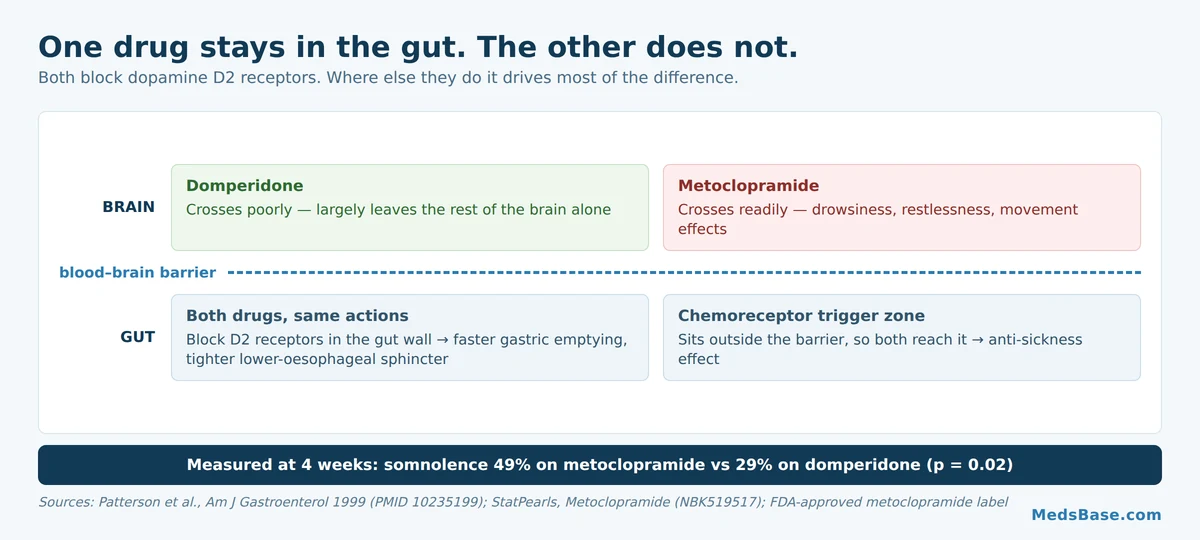
Both drugs block dopamine D2 receptors. Doing that in the gut wall speeds up the rhythmic contractions that move food out of the stomach and tightens the valve between the stomach and the oesophagus. Doing it in the brain’s chemoreceptor trigger zone — the area that senses circulating nasties and triggers vomiting — suppresses nausea.
Picture your stomach as a mixing bowl with a valve at the bottom. In delayed gastric emptying, that valve opens sluggishly and the bowl stays full, which is why you feel full after a few mouthfuls and queasy hours after eating. Both drugs prompt the bowl to empty on schedule.
The difference is not what they do. It is where else they do it.
Metoclopramide crosses the blood–brain barrier readily. That gives it a broader anti-sickness effect, and it is also the direct source of its drowsiness, restlessness and — with prolonged use — movement disorders. Domperidone crosses poorly, so it reaches the gut and the trigger zone (which sits outside the barrier) while largely leaving the rest of the brain alone.
The blood–brain barrier is doing most of the work in this comparison. Keep that image and the rest of the article follows from it.
When a Prokinetic Is the Right Tool — and When It Is Not
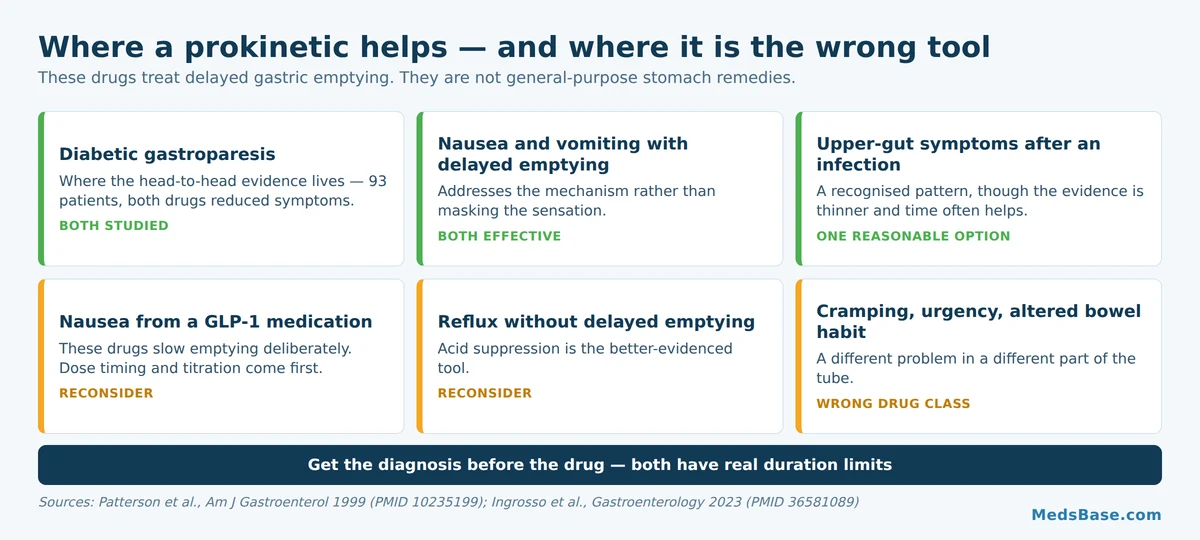
Diabetic gastroparesis
This is where the head-to-head evidence lives. The trial enrolled 93 insulin-dependent diabetes patients with at least three months of gastroparesis symptoms, and assessed nausea, vomiting, bloating and early satiety. Both drugs reduced symptoms.
Persistent nausea and vomiting with delayed emptying
Where the stomach is genuinely emptying too slowly, both drugs address the mechanism rather than masking the sensation.
Upper-gut symptoms after a gut infection
Early fullness, nausea and epigastric pain that persist after gastroenteritis are a recognised pattern. A prokinetic is one reasonable option, though the evidence here is thinner than for diabetic gastroparesis and the picture often improves with time alone.
Where these drugs are the wrong tool
Nausea from a GLP-1 medication. Semaglutide and its relatives slow gastric emptying deliberately — that is part of how they work. Adding a prokinetic to fight a drug’s intended mechanism is rarely the right first move; dose timing and titration usually are. If this is your situation, our guide to when nausea is coming from a GLP-1 medication addresses it directly.
Reflux without delayed emptying. Acid suppression is the better-evidenced tool.
Lower-gut symptoms. Cramping, urgency and altered bowel habit are a different problem in a different part of the tube.
Domperidone vs Metoclopramide: Side Effects and Warnings
Time to resolve the loop from the introduction: the two questions, one about your brain and one about your heart.
Metoclopramide: the neurological question
The FDA-approved label opens with a boxed warning headed WARNING: TARDIVE DYSKINESIA, stating that metoclopramide “can cause tardive dyskinesia (TD), a potentially irreversible serious movement disorder”. Tardive dyskinesia produces involuntary movements, typically of the face and tongue, and the word that matters in that sentence is irreversible — unlike most drug side effects, it may persist after the drug is stopped.
The label converts that into a hard operational rule. In symptomatic, documented gastro-oesophageal reflux, “the maximum duration of treatment is 12 weeks”. In diabetic gastroparesis, prescribers are told to avoid a total treatment duration longer than 12 weeks, and to monitor routinely for signs of TD if longer use is unavoidable. Risk rises with duration and cumulative dose, and the label also directs immediate discontinuation if signs of TD appear.
This is the clearest thing in the entire comparison: metoclopramide has a formal, numeric ceiling, and it is 12 weeks. The boxed warning on the metoclopramide label is not a formality to scroll past.
Domperidone: the cardiac question
Domperidone’s problem is quieter and statistical rather than dramatic. A meta-analysis of observational studies pooling eight studies and 480,395 people found domperidone associated with an increased risk of the composite of sudden cardiac death or ventricular arrhythmia compared with non-use, at an adjusted odds ratio of 1.69 (95% CI 1.46 to 1.95). Restricted to the higher-quality studies, the estimate held at 1.60 (95% CI 1.30 to 1.97).
Three honest caveats belong with that number. These were observational studies, not randomised trials — of the eight, three carried a moderate risk of bias, four serious and one critical, with an overall GRADE rating of moderate. An odds ratio of 1.69 applied to a rare event still produces a rare event. And the authors themselves note that comparisons against an active comparator, and in younger populations, are still needed.
| Side effect | Drug | Frequency | Severity | What to do |
|---|---|---|---|---|
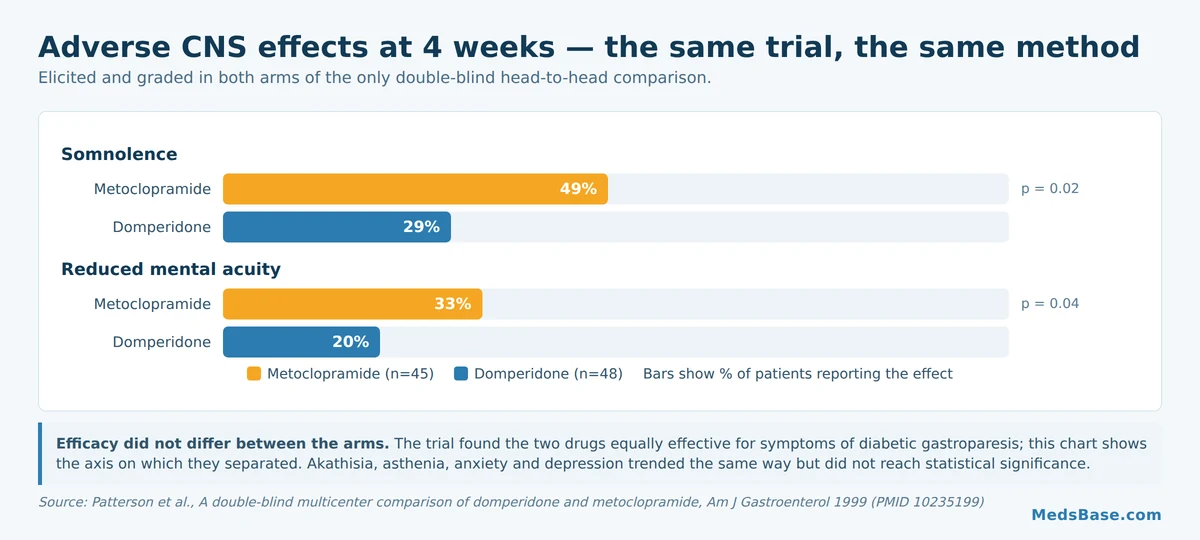
| Drowsiness / somnolence | Both; markedly more with metoclopramide | 49% vs 29% at 4 weeks in the head-to-head trial | Mild to moderate | Avoid driving until you know your response; report if persistent |
| Reduced mental acuity | Both; more with metoclopramide | 33% vs 20% at 4 weeks | Mild to moderate | A common reason people stop metoclopramide |
| Restlessness (akathisia), dystonic reactions | Mainly metoclopramide | Uncommon | Moderate to serious | Seek medical advice promptly — acute reactions are treatable |
| Tardive dyskinesia | Metoclopramide | Uncommon, rises with duration and cumulative dose | Serious, potentially irreversible | Stop immediately and seek advice at the first sign of involuntary movement |
| Serious ventricular arrhythmia / sudden cardiac death | Domperidone | Rare; pooled OR 1.69 vs non-use | Serious | Avoid with cardiac disease, QT-prolonging drugs or electrolyte disturbance |
| Raised prolactin — breast tenderness, milk secretion, menstrual change | Both | Uncommon | Mild to moderate | Reversible on stopping; discuss with a clinician |
| Headache, dry mouth, abdominal cramps | Both | Common | Mild | Usually settles; take with the recommended timing |
MedlinePlus on metoclopramide sets out the warning signs to act on in plain language, and it is worth reading before starting rather than after.
What the Research Says About Domperidone vs Metoclopramide
| Study | Year | Finding | Source |
|---|---|---|---|
| Patterson et al., double-blind multicentre comparison (Am J Gastroenterol) | 1999 | 93 insulin-dependent diabetes patients (48 domperidone, 45 metoclopramide). “Domperidone and metoclopramide were equally effective in alleviating symptoms of diabetic gastroparesis.” CNS effects more severe and more common with metoclopramide: somnolence 49% vs 29% (p = 0.02), reduced mental acuity 33% vs 20% (p = 0.04) | PMID 10235199 |
| Ingrosso et al., network meta-analysis of gastroparesis drugs (Gastroenterology) | 2023 | 29 RCTs, 3,772 patients. Clebopride ranked first (RR 0.30; 95% CI 0.16–0.57), domperidone second (RR 0.68; 95% CI 0.48–0.98). No other drug was superior to placebo. Oral dopamine antagonists were one of only two efficacious classes | PMID 36581089 |
| Same review, individual symptoms | 2023 | Oral metoclopramide ranked first for nausea (RR 0.46; 95% CI 0.21–1.00), fullness and bloating — but explicitly “based on only 1 small trial” | PMID 36581089 |
| Ou et al., meta-analysis of observational studies (Br J Clin Pharmacol) | 2021 | 8 studies, 480,395 people. Domperidone associated with sudden cardiac death or ventricular arrhythmia, adjusted OR 1.69 (95% CI 1.46–1.95); 1.60 (1.30–1.97) in higher-quality studies. Overall GRADE: moderate | PMID 33439512 |
| FDA-approved metoclopramide prescribing information (via DailyMed) | current | Boxed warning for tardive dyskinesia; maximum 12 weeks in documented reflux; avoid exceeding 12 weeks in diabetic gastroparesis | DailyMed SPL c143e210 |
What this means for you: the research on domperidone vs metoclopramide says two things, and they pull in different directions.
A 2023 network meta-analysis of 29 randomised trials is the strongest efficacy evidence available, and it placed domperidone second among all drugs tested for gastroparesis, with oral dopamine antagonists one of only two classes that beat placebo. That is a genuine point in domperidone’s favour.
But read the same paper’s caution: the authors conclude that confidence in the evidence was “low to moderate for most comparisons” and that there is “an unmet need for efficacious therapies for gastroparesis”. And metoclopramide’s first-place ranking for nausea specifically rests, in the review’s own words, on one small trial — which is exactly the kind of finding that looks impressive in a summary and evaporates on inspection.
So the fair reading of the only double-blind multicentre head-to-head trial plus the network evidence is this: both work, domperidone has a slight edge in the indirect ranking, and no one has run the trial that would settle it directly since 1999.
Take Elena, 52 — an illustrative example, not a real patient. She has type 1 diabetes and six months of early fullness and morning nausea. Started on metoclopramide, her symptoms improved, but by week three she described feeling “underwater” all day and stopped driving to work. That is not an unusual story — it is close to the trial’s 33% mental-acuity figure in narrative form. Her situation, with no cardiac history, is the profile where the peripheral drug’s trade-off looks more attractive. A reader the same age with atrial fibrillation and a QT-prolonging medicine would be looking at the opposite conclusion.
Domperidone vs Metoclopramide vs the Alternatives
| Domperidone | Metoclopramide | Treat the underlying cause | Diet and timing changes | |
|---|---|---|---|---|
| Speeds gastric emptying | Yes | Yes | Depends on cause | Modestly |
| Crosses into the brain | Poorly | Readily | — | — |
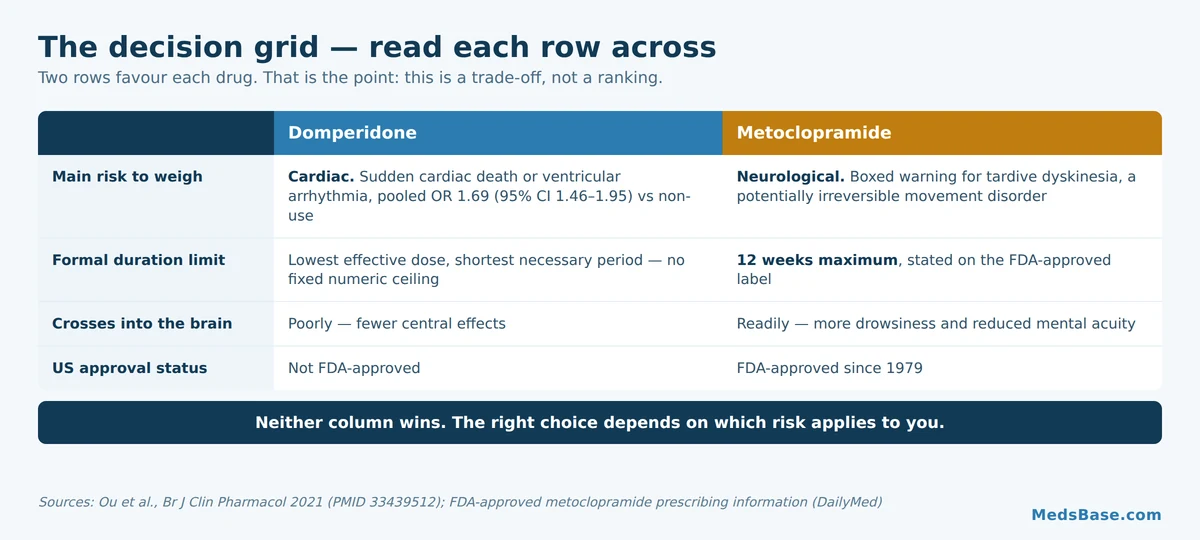
| Main risk to weigh | Cardiac: sudden cardiac death / ventricular arrhythmia, pooled OR 1.69 | Neurological: boxed tardive dyskinesia warning | — | None |
| Formal duration limit | Lowest effective dose, shortest time; not indefinite | 12 weeks maximum, stated on the label | — | Indefinite |
| US approval status | Not FDA-approved | FDA-approved since 1979 | — | — |
| Best role | Where CNS effects must be avoided and the heart is healthy | Where cardiac risk is the greater concern, short course | Diabetes control, medication review, post-infectious recovery | The foundation under any drug choice |
Which one fits which situation. In a straight domperidone vs metoclopramide choice, if your heart is healthy and you cannot tolerate feeling foggy, the peripheral drug’s profile fits better. If you have cardiac disease, a long QT interval, electrolyte problems or QT-prolonging medicines, the neurological risk of a short, monitored metoclopramide course may be the safer of the two — and “short” is doing real work in that sentence.
If neither profile is comfortable, the third option is the one people skip: address what is causing the delay. In diabetic gastroparesis, glucose control affects gastric emptying directly. Medication review matters too — opioids, some antidepressants and GLP-1 agonists all slow the stomach, and stopping the culprit beats adding a second drug to fight it. Smaller, lower-fat, lower-fibre meals, eaten more often and not lying down afterwards, are unglamorous and genuinely effective.
And if the symptoms are cramping, urgency or altered bowel habit rather than fullness and nausea, you may be treating the wrong organ — if your symptoms are lower down, that guide is the better starting point.
Practical Guidance on Dosing and Timing
- Get the diagnosis before the drug. Both are for delayed emptying and nausea. Neither is a general-purpose stomach remedy, and both have limits that only make sense against a diagnosis.
- Take prokinetics 15–30 minutes before meals. They work by moving a meal along, so they need to be present when the meal arrives. This is the most commonly missed detail.
- Start at the lowest effective dose. Both are typically 10 mg per dose in adults, up to three or four times daily depending on the product and the indication. Follow the specific product’s guidance.
- Fix a review date at the start. For metoclopramide, the 12-week ceiling is the outer boundary. For domperidone, the principle is the lowest effective dose for the shortest necessary period.
- Know your stop signals. For metoclopramide: any involuntary movement of the face, tongue or limbs, or marked restlessness. For domperidone: palpitations, fainting or an irregular heartbeat.
- Review the rest of your medicine list. Interactions matter here more than usual — QT-prolonging drugs and strong CYP3A4 inhibitors with domperidone, antipsychotics with metoclopramide.
Mistakes to avoid
- Taking either after meals. Too late to help that meal.
- Treating the 12-week limit as a soft suggestion. It is on the label because of an irreversible outcome.
- Combining the two. Both block the same receptors; you multiply the side effects without a corresponding gain.
- Continuing indefinitely because it helps. That is precisely the pattern the duration limits exist to prevent.
- Ignoring new heart symptoms on domperidone, or new movements on metoclopramide.
- Using a prokinetic to override a GLP-1’s intended effect rather than adjusting the GLP-1 with your prescriber.
If you and a clinician have settled on a direction, the domperidone option we stock is domperidone 10 mg and the metoclopramide option is metoclopramide 10 mg. Both are supplied from a WHO-GMP-certified manufacturer. Worldwide Shipping is available.
- When nausea is coming from a GLP-1 medication — why a prokinetic is usually the wrong response to it
- If your symptoms are lower down — the lower-gut pattern that gets mistaken for a stomach problem
- Acid reflux medications compared — when acid, not emptying, is the real issue
Frequently Asked Questions
Q: Which is safer, domperidone or metoclopramide?
A: In a domperidone vs metoclopramide safety comparison, neither is universally safer — they carry different risks. Metoclopramide crosses into the brain and has a boxed warning for tardive dyskinesia, a potentially irreversible movement disorder, plus a 12-week ceiling. Domperidone largely avoids the brain but is associated with sudden cardiac death and ventricular arrhythmia at a pooled odds ratio of 1.69 versus non-use. Which is safer depends on whether your heart or your neurological risk is the greater concern.
Q: Does domperidone work better than metoclopramide?
A: The only double-blind multicentre head-to-head trial found them equally effective for symptoms of diabetic gastroparesis. A 2023 network meta-analysis ranked domperidone second among all gastroparesis drugs tested and found no other drug beyond two classes superior to placebo, which is a modest indirect edge — but indirect comparisons are weaker evidence than a direct trial, and the authors rated confidence as low to moderate.
Q: How long can you take metoclopramide?
A: The FDA-approved label sets a maximum of 12 weeks for symptomatic, documented gastro-oesophageal reflux, and directs prescribers to avoid exceeding 12 weeks total in diabetic gastroparesis, with routine monitoring if longer use is unavoidable. The limit exists because tardive dyskinesia risk rises with duration and cumulative dose and may be irreversible. Treat it as a boundary, not a guideline.
Q: Why is domperidone not approved in the US?
A: Not for the reason most people assume. Domperidone was never granted FDA marketing approval in the United States, and concerns about cardiac arrhythmia are part of the picture — but it remains authorised and widely used in many other countries, where regulators responded by restricting dose and duration rather than withdrawing it. Approval status reflects a specific regulatory history, not a global verdict that the drug is unusable.
Q: Can you take domperidone and metoclopramide together?
A: No. Both are dopamine D2 receptor antagonists, so combining them compounds the same receptor blockade — raising the risk of movement effects and hormonal side effects without adding meaningful benefit. If one is not controlling your symptoms, the answer is a review of the diagnosis and the rest of your medicine list, not a second drug from the same class.
Q: What is the best prokinetic for gastroparesis?
A: The honest answer is that the evidence does not identify a clear best. A network meta-analysis of 29 randomised trials found only two drug classes superior to placebo and concluded there is an unmet need for effective gastroparesis therapies. Domperidone ranked second overall among individual drugs. Choice usually comes down to your cardiac and neurological risk profile, and to what is available where you live.
Q: Do these drugs stop nausea straight away?
A: They begin working within an hour or so of a dose, but symptom relief in gastroparesis is usually gradual over days rather than immediate. The head-to-head trial assessed symptoms at two and four weeks, which reflects how these drugs are actually judged. If you need something for a single acute episode, a different class of anti-sickness medicine is generally more appropriate.
Q: Will either affect my hormones?
A: Both can raise prolactin by blocking dopamine, which normally suppresses it. That can cause breast tenderness, milk secretion or menstrual changes, and it can happen with either drug — domperidone is not exempt, because the pituitary sits outside the blood–brain barrier. It is reversible on stopping, but worth raising with a clinician rather than tolerating.
The Bottom Line
The domperidone vs metoclopramide question does not have a universal answer, and any source that gives you one confidently is overselling the evidence. The single direct trial found them equally effective. The best indirect evidence gives domperidone a modest edge while cautioning that confidence is low to moderate. What genuinely separates them is that one carries a boxed warning about an irreversible neurological outcome and a firm 12-week ceiling, while the other carries a moderate-quality signal for serious heart-rhythm events.
The balanced verdict: if your heart is healthy and mental fog is intolerable, the peripheral drug fits better. If you have cardiac disease or take QT-prolonging medicines, a short and monitored course of the other is the more defensible choice. And for a large group of people, the most useful move is not choosing between them at all, but treating what is slowing the stomach in the first place.
One thing to do today: write down two facts before your next appointment — every medicine you take that could slow gastric emptying or affect heart rhythm, and how long your symptoms have been running. Those two lists decide this question faster than any article can.
Wondering whether your nausea is coming from a medication rather than your stomach? When nausea is coming from a GLP-1 medication is the next question worth answering. Not sure your symptoms are an upper-gut problem at all? If your symptoms are lower down covers the pattern that most often gets mistaken for one. And when you have a direction, browse gastro health treatments.
Medical disclaimer: This article is general information and does not replace individual medical advice. Both drugs discussed here have significant contraindications, interactions and duration limits, and the right choice depends on your cardiac history, neurological history, other medicines and diagnosis. Speak to a doctor or pharmacist before starting, changing or stopping either, and seek urgent advice for involuntary movements, fainting, palpitations or an irregular heartbeat.

Written by
Sophie ChenPharmaceutical Content Researcher · 8 years experience
Sophie Chen is a pharmaceutical content researcher with 8 years covering generic medication access and clinical pharmacology. She specialises in international regulatory frameworks, bioequivalence standards, and patient-facing education on therapeutic drug classes. She is not a clinician.