








✓ Medically reviewed by · Last reviewed: May 2026
Pharmacy Researcher · 8 years experience
Pharmacy researcher with 8 years reviewing clinical drug information, generic formulation equivalence, and international pharmaceutical standards. Focuses on patient-facing accuracy in medication education.
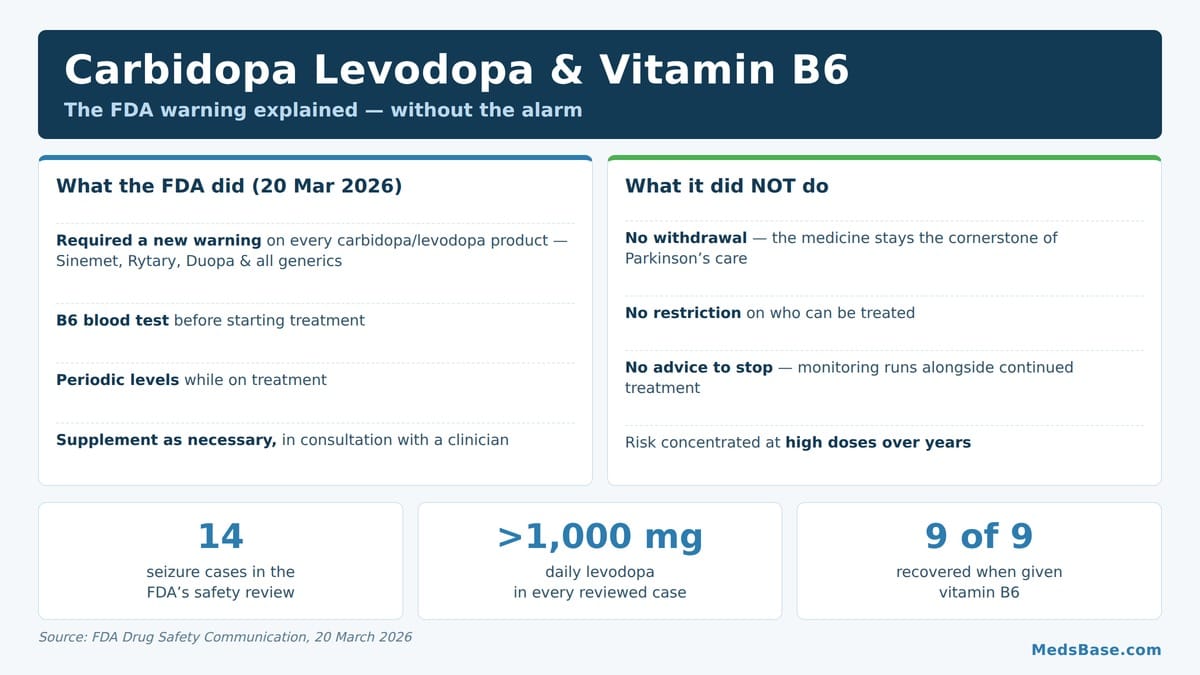
Nine patients. Nine complete recoveries — from seizures that had shrugged off standard anti-seizure medicines. The treatment that worked was not a new drug. It was vitamin B6. That result sits at the centre of the FDA’s new carbidopa levodopa vitamin B6 warning, announced on 20 March 2026, and it is the reason every family managing Parkinson’s disease should spend ten minutes understanding what changed.
Here is what you will know by the end of this article: what the FDA actually found (the real numbers, not the scary paraphrase), which patients the risk concentrates in, the six symptoms worth reporting, and the exact monitoring conversation to have at the next neurology appointment.
Two things early, because they frame everything else. First: the FDA did not withdraw, restrict, or advise anyone to stop carbidopa/levodopa — it added a warning and a monitoring recommendation. Second — and this is the strangest part of the story — the drug’s own label has said for decades that vitamin B6 is safe to take alongside it. That old sentence and this new warning are connected, and we will untangle them in the mechanism section.
- The FDA now requires every carbidopa/levodopa product — including Sinemet and its generics — to warn about vitamin B6 deficiency and related seizures
- 14 seizure cases were reviewed; every single one involved levodopa doses above 1,000 mg per day — dose matters, and we break down why
- Nine of nine patients given vitamin B6 recovered from their seizures — most after standard anti-seizure drugs had failed
- Deficiency built up slowly: between roughly 2 and 11 years of treatment before it surfaced
- A simple blood test is now the FDA’s answer — but there is one supplement mistake that can cause the very nerve damage you’re trying to avoid
- Nobody should stop or change their Parkinson’s medicine over this — the safety section explains what to do instead
What Is the Carbidopa Levodopa Vitamin B6 Warning?
The carbidopa levodopa vitamin B6 warning is a labeling change the FDA required on 20 March 2026: all products containing carbidopa/levodopa must now state that they can cause vitamin B6 (pyridoxine) deficiency, and that this deficiency can lead to seizures. The FDA also directs clinicians to check B6 levels before and during treatment.
Carbidopa/levodopa is the cornerstone medicine for Parkinson’s disease, and has been for half a century. Levodopa is converted into dopamine in the brain, replacing what the disease takes away; carbidopa’s job is to stop that conversion happening too early, outside the brain, so more levodopa arrives where it is needed. MedlinePlus explains levodopa and carbidopa in more depth, and if you want the disease-level picture first, start with our plain-language guide to Parkinson’s disease.
The new warning applies to the whole product family. In the FDA’s Drug Safety Communication, the named brands are Crexont, Dhivy, Duopa, Rytary, Sinemet and Sinemet CR, plus Stalevo (which adds entacapone) and Vyalev — and the requirement covers every generic equivalent of these, which is what most people worldwide actually take.
Why act now, on a 50-year-old medicine? Because the FDA’s safety review concluded — for the first time — that there is “reasonable evidence of a causal association” between these products and vitamin B6 deficiency-associated seizures. Not a coincidence, not a disease effect: the medicine itself.
So what does a Parkinson’s drug have to do with a B vitamin? This is where the story gets genuinely interesting.
How Can a Parkinson’s Medicine Drain a Vitamin? (The Pyridoxine Paradox)
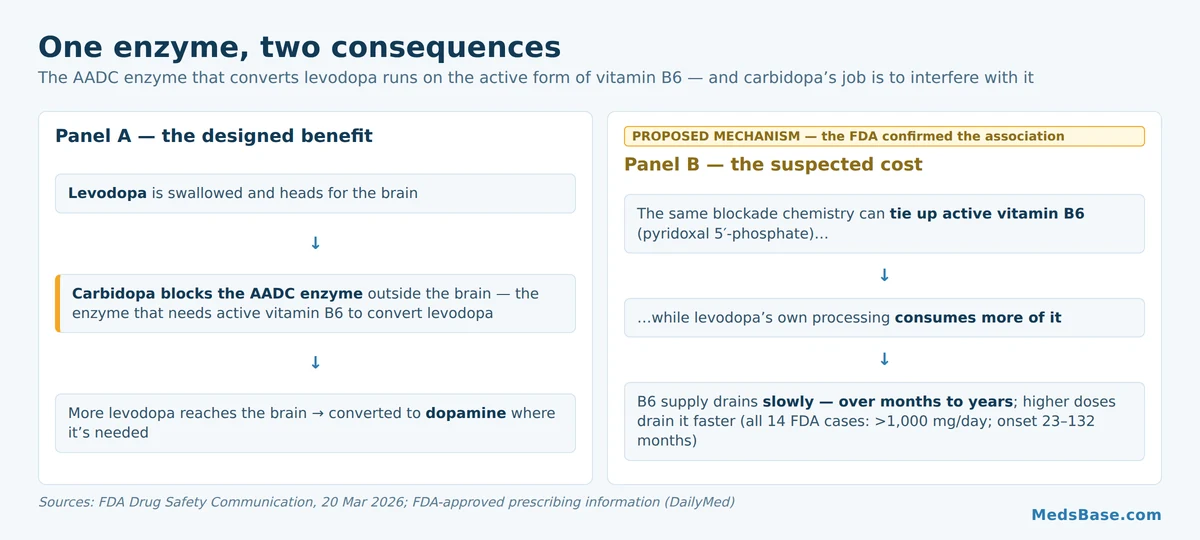
Think of vitamin B6 as a master key that dozens of your body’s enzymes need before they can work. One of those enzymes — the one that converts levodopa into dopamine — is central to this whole story.
Here is the paradox promised in the introduction. If you read the FDA-approved prescribing information for generic carbidopa/levodopa, you will find a decades-old sentence saying that pyridoxine (vitamin B6), in oral doses of 10 to 25 mg, can reverse the effects of levodopa — because extra B6 speeds up that conversion enzyme outside the brain, burning your dose before it arrives. The label then adds: carbidopa inhibits this action of pyridoxine, so the combination can safely be taken with B6 supplements.
Read that again, slowly. Carbidopa’s entire job is to interfere with an enzyme that runs on vitamin B6.
The very mechanism that makes the drug work is the leading suspect for how it depletes the vitamin. Researchers propose that carbidopa doesn’t just block the enzyme — it can chemically tie up the active form of B6 itself (pyridoxal 5′-phosphate), while levodopa’s own processing consumes more of it. The FDA’s communication confirms the association and the dose-dependence; the precise mechanism is still being worked out, and it is honest to say so. What no one disputes is the direction of the finding: more drug, over more years, means more pressure on your B6 supply.
What does this mean for you? If you or your parent takes a modest dose — say 300–600 mg of levodopa daily — nothing in the FDA’s case series describes you. The warning still applies, monitoring still makes sense, but the documented danger zone starts above 1,000 mg per day. Translate the science into one sentence: the higher the daily dose and the longer the years on it, the stronger the case for checking a B6 level.
Vitamin B6 Deficiency Symptoms to Watch For
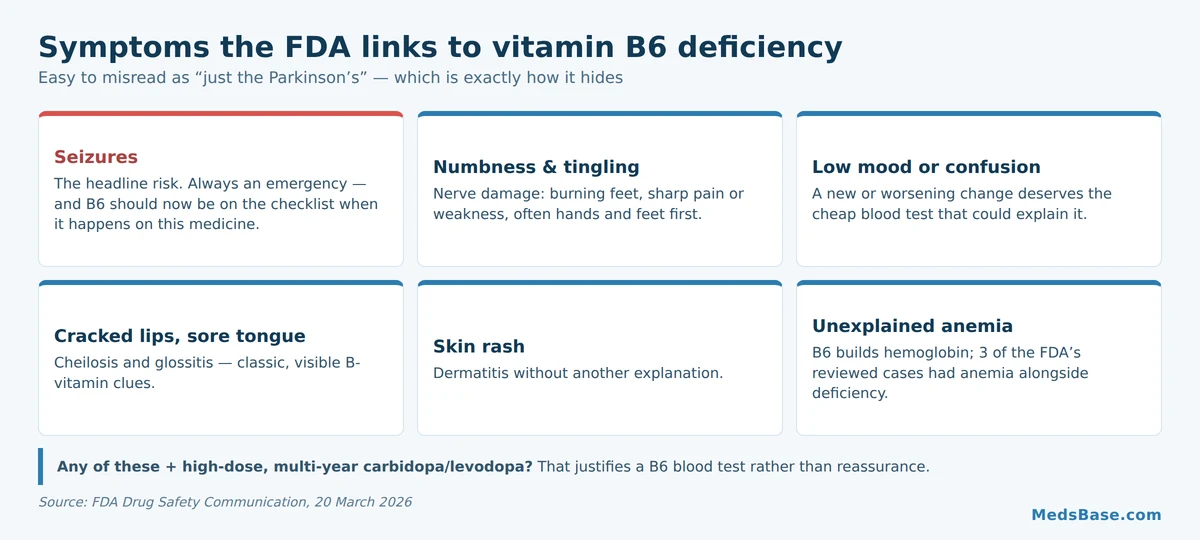
Vitamin B6 deficiency is genuinely uncommon in the general population — your body needs only small amounts, and normal diets supply them. That is precisely why nobody thinks of it. In a long-term levodopa household, it belongs on the watch list.
The FDA’s communication lists the symptoms below. None of them is unique to B6 deficiency — each has a dozen possible causes — but in combination with high-dose, multi-year carbidopa/levodopa, they justify a blood test rather than reassurance.
Nerve symptoms: numbness, tingling, burning
B6 is essential to nerve function. Deficiency classically shows up as numbness, tingling, sharp pain or weakness — often in the feet and hands first. In a Parkinson’s context this is easy to misattribute to the disease itself, which is exactly how it hides.
Mood and thinking changes
Depression and confusion appear on the FDA’s list. Again — both are common in Parkinson’s disease anyway. The point is not to panic over low mood; it is that a new or worsening change deserves the cheap blood test that could explain it.
Mouth and skin signs
Inflammation of the lips (cheilosis), a sore or inflamed tongue (glossitis), and dermatitis — skin rashes without another explanation. These are the classic textbook signs of B-vitamin deficiency and are often the most visible early clues.
Unexplained anemia
In the FDA’s reviewed seizure cases, three patients had microcytic or normocytic anemia alongside their deficiency — B6 is needed to build hemoglobin. An unexplained anemia result in a long-term levodopa user is a clue worth following.
Seizures — the headline risk
The reason this warning exists. The reported seizures typically began as focal-onset seizures that then generalized, and — the detail that should reassure rather than frighten you — they responded to vitamin B6 when standard anti-seizure drugs failed. A seizure is always an emergency; the message here is that clinicians now know to check B6 in this situation, and families can prompt them.
What the FDA Found — the Case Numbers Behind the Warning
Headlines said “Parkinson’s drug linked to seizures.” Here is what the FDA’s safety review actually contains — the numbers are less frightening and more useful.
| FDA finding | Detail |
|---|---|
| Seizure cases identified | 14 (13 reported to FDA’s adverse-event system, 1 from medical literature) |
| Levodopa dose involved | Above 1,000 mg/day in all reviewed cases |
| Faster onset | Doses >1,500 mg/day were associated with a shorter time to deficiency |
| Time from starting to trouble | 23 to 132 months (~2 to 11 years) |
| Seizure pattern | Typically focal onset with secondary generalization; some progressed to status epilepticus |
| Response to vitamin B6 | 9 of 9 supplemented patients had their seizures resolve — most after standard anti-seizure drugs had failed |
| Deaths | 2 — both with documented low B6 and poorly controlled seizures |
| Supporting evidence in cases | Elevated homocysteine (4 cases), anemia (3), neuropsychiatric symptoms (4) |
Now the promised blood-test detail from the fatal cases: both deaths occurred in patients with documented low vitamin B6 whose seizures were never brought under control. The tragedy in those two reports is not that a treatment failed — it is that the treatable cause was found too late. That is the entire argument for the FDA’s monitoring recommendation, and it is why this article keeps repeating one boring instruction: ask for the blood test.
Perspective matters, and the FDA itself provides it. Fourteen cases sit against millions of patient-years of carbidopa/levodopa use worldwide — though the agency notes there are “likely additional cases” it does not know about, since adverse-event reporting always undercounts. Interestingly, the review found no cases linked to the carbidopa/levodopa/entacapone combination or the injectable product — possibly reflecting lower usage and more recent approvals — yet the FDA applied the warning to all of them, because the biology is shared. That is a regulator being appropriately cautious, not evidence of a new emergency.
One more detail worth knowing: the FDA notes that some anti-seizure medicines can themselves further worsen a vitamin B6 deficiency — part of why, in the reported cases, the answer turned out to be the vitamin rather than another anticonvulsant.
Nothing in the FDA’s review supports stopping carbidopa/levodopa. Stopping Parkinson’s medication abruptly carries its own serious risks. The FDA’s own guidance is the opposite of alarm: evaluate levels, supplement as necessary in consultation with a clinician — a plan built around continuing treatment, not ending it.
What Does the Research Say?
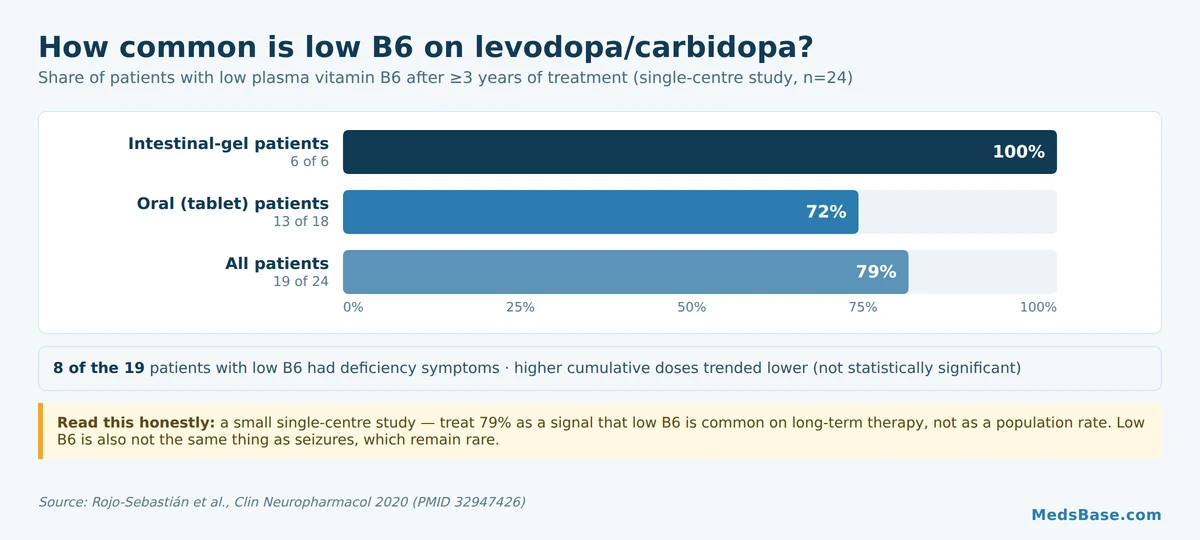
The FDA’s case series answers “can this happen?” A separate question matters more to most families: “how often is B6 actually low in people like us?” The honest answer: the best available study is small — but its signal is loud.
| Study | Year | Finding | Source |
|---|---|---|---|
| FDA safety review (basis of the warning) | 2026 | 14 seizure cases, all >1,000 mg/day levodopa; 9/9 resolved with B6; causal association concluded | FDA Drug Safety Communication, 20 Mar 2026 |
| Cross-sectional study, 24 PD patients on levodopa/carbidopa ≥3 years | 2020 | 19 of 24 patients (79%) had low plasma B6 — including all 6 receiving it by intestinal gel and 13 of 18 on tablets; 8 of the 19 had deficiency symptoms | Rojo-Sebastián et al., Clin Neuropharmacol (PMID 32947426) |
| Published case reports (seizures, anemia) | 2022–2026 | Individual reports of refractory seizures and transfusion-dependent anemia attributed to B6 deficiency on carbidopa/levodopa — the literature trail that preceded the FDA action | Case literature, PubMed-indexed |
A 2020 study in Clinical Neuropharmacology deserves the spotlight because it measured what the case reports could not: prevalence. Among 24 patients treated for three or more years, 79% had low plasma B6. Patients on higher cumulative doses trended lower, and the intestinal-gel route — which delivers the highest, steadiest doses — went 6 for 6. Twenty-four patients is a small, single-centre sample and low plasma B6 is not the same thing as seizures; treat the 79% as a signal, not a population rate.
What this means for you: low B6 on long-term therapy appears to be common; the catastrophic outcome — seizures — appears to be rare. A common, silent, cheap-to-detect deficiency with a rare but severe endpoint is close to the textbook case for routine monitoring. That is exactly where the FDA landed.
Should You Take a B6 Supplement? Options Compared
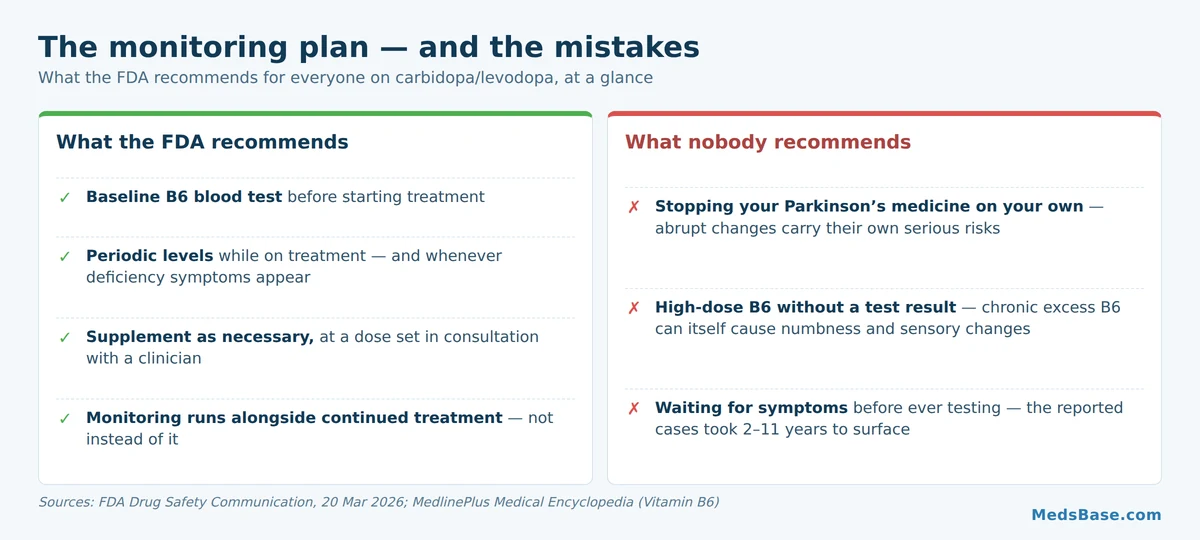
The tempting shortcut after reading all this: buy a B6 bottle today and skip the doctor. Here’s the catch — vitamin B6 is the one common vitamin where too much causes the same nerve damage you are trying to prevent. High-dose B6 taken long-term is itself a documented cause of peripheral neuropathy. The FDA’s advice is deliberately test-first, and the old label’s 10–25 mg reversal warning is one more reason not to freelance: your B6 strategy and your levodopa strategy interact, in both directions — even though the combination product is designed to tolerate supplementation.
| Approach | What it looks like | Strengths | Watch-outs | Verdict |
|---|---|---|---|---|
| Food-first | Poultry, tuna and salmon, chickpeas, bananas, fortified cereals | Safe at any intake; no interaction concerns | Cannot correct an established deficiency driven by a drug mechanism | Right for everyone, sufficient for no one at high risk |
| Test, then supplement (FDA’s approach) | Baseline B6 blood test periodic re-checks supplement to sufficient levels if low, at a dose your clinician sets | Treats what is actually there; the 9/9 seizure-resolution cases show correction works | Needs a proactive request — this warning is new and not every clinic has a routine yet | The right default for long-term users |
| Blind high-dose supplementation | Daily high-dose B6 “just in case” | None over testing | Chronic high-dose B6 can itself cause sensory neuropathy; doses are not clinician-matched | Avoid |
| Do nothing, wait for symptoms | — | — | The FDA cases surfaced as seizures, after years of silence | Avoid |
The verdict in one line: eat normally, test proactively, supplement only to a measured need, and let your neurologist set the dose. MedlinePlus’s vitamin B6 overview covers food sources and what the vitamin does if you want the background.
Illustrative scenario (not a real patient): Maria’s father has taken carbidopa/levodopa for eight years, now at 1,200 mg of levodopa daily. He has burning feet at night — attributed, for two years, to “just the Parkinson’s.” After the March warning, Maria asks his neurologist for a B6 level at the next routine visit. It comes back low; a prescribed supplement dose follows; three months later the burning has eased and his Parkinson’s regimen never changed. Nothing dramatic happened — which is the point of monitoring.
How to Act on the Warning — Practical Steps
Pharmacists commonly see families respond to a safety headline in one of two ways: quietly stopping a medicine, or anxiously doing nothing. Both are wrong here, and both are avoidable with a 15-minute plan.
- Write down the current regimen. Total daily levodopa milligrams, formulation (immediate-release, controlled-release, gel), and how many years since starting. This single piece of paper makes the risk conversation concrete.
- Note any symptoms from the list above — nerve symptoms, mood or thinking changes, mouth/skin signs, unexplained fatigue. Include things previously filed under “just the Parkinson’s.”
- Ask one question at the next appointment: “Given the March FDA warning, should we check a vitamin B6 level?” For high-dose, long-duration patients the answer will usually be yes — the FDA now directs clinicians to evaluate B6 before starting treatment and periodically during it.
- If the level is low, supplement exactly as prescribed — dose and duration set by the clinician, with a re-check to confirm correction. Supplementation is designed to run alongside treatment: the FDA’s monitoring schedule assumes you stay on your medicine while levels are corrected, in consultation with your clinician.
- Keep the medicine going throughout. Continuity matters in Parkinson’s care — running out mid-plan is its own risk. For established regimens, MedsBase stocks immediate-release carbidopa/levodopa (Syndopa) and the controlled-release version (Syndopa CR), sourced from a WHO-GMP-certified manufacturer, with no prescription needed to order — while every dose decision stays where it belongs, with the treating neurologist.
Mistakes to avoid:
- Stopping or reducing carbidopa/levodopa on your own because of this warning — nothing in the FDA’s action calls for it, and abrupt changes to Parkinson’s therapy carry their own serious risks
- Starting high-dose B6 without a blood test — excess B6 causes its own neuropathy
- Dismissing new numbness or mood change as “just the disease” without the one test that could explain it
- Assuming a normal result years ago still holds — the reported cases took 2 to 11 years to surface
- Everything you want to know about Parkinson’s disease — the condition-level companion to this drug-level article
- What to do if your medication is recalled — the calm-checklist approach, applied to recalls
- Grapefruit and other everyday drug interactions — more things that quietly change how your medicines behave
Frequently Asked Questions
Q: Can carbidopa levodopa cause vitamin B6 deficiency?
A: Yes — the FDA concluded in March 2026 that there is reasonable evidence of a causal association, and now requires every carbidopa/levodopa product to carry a warning about vitamin B6 deficiency and associated seizures. The documented cases involved levodopa doses above 1,000 mg per day taken for roughly two to eleven years, so risk concentrates in high-dose, long-term treatment.
Q: Should I take vitamin B6 with carbidopa levodopa?
A: Only after a blood test, and only at a dose your clinician sets. The FDA recommends checking B6 levels before and during treatment and supplementing as necessary in consultation with a health care professional — the monitoring plan runs alongside continued treatment, not instead of it. Blind high-dose B6 is the wrong move: chronic excess B6 can itself cause nerve damage, and the drug and vitamin interact in both directions.
Q: What are the symptoms of vitamin B6 deficiency?
A: The FDA’s warning lists seizures plus depression, confusion, inflammation of the lips (cheilosis), a sore tongue (glossitis), skin rashes, anemia, and nerve damage causing numbness, tingling, sharp pain or weakness. In long-term levodopa users these are easy to misread as disease progression, which is why a blood test — not symptom-watching alone — is the FDA’s answer.
Q: Can Parkinson’s medication cause seizures?
A: Indirectly, through vitamin B6 deficiency — that is exactly what the new warning covers. The FDA reviewed 14 such cases; seizures typically began focally and then generalized, and often resisted standard anti-seizure drugs. The striking finding: all nine patients who received vitamin B6 supplementation recovered. A first seizure is always an emergency — and B6 should now be on the checklist when it happens on this medicine.
Q: How is vitamin B6 deficiency diagnosed?
A: With a blood test measuring B6 (typically as pyridoxal 5′-phosphate, the active form). The FDA directs clinicians to evaluate levels before starting carbidopa/levodopa and periodically during treatment. Supporting clues in the reviewed cases included elevated homocysteine and unexplained anemia. It is among the cheaper, simpler tests in the workup — the barrier is remembering to ask, not the test itself.
Q: Does Sinemet deplete vitamins?
A: Sinemet is a brand of carbidopa/levodopa, so the new FDA warning applies to it and to Sinemet CR by name, along with Crexont, Dhivy, Duopa, Rytary, Stalevo, Vyalev and all generic equivalents. The documented concern is specifically vitamin B6. If you take any product in this family at higher doses long-term, the monitoring advice in this article applies regardless of the brand on the box.
Q: Do I need a prescription to buy carbidopa levodopa?
A: MedsBase supplies carbidopa/levodopa (as Syndopa and Syndopa CR) with no prescription needed to order. That said, this is a medicine whose dosing genuinely requires a neurologist’s ongoing supervision — the FDA warning this article covers is a monitoring issue discovered precisely because dose size and duration matter. Order without a prescription; dose with a doctor.
The Bottom Line
The carbidopa levodopa vitamin B6 warning is that rare thing in drug safety: a finding with a built-in solution. A 50-year-old cornerstone medicine turns out to quietly drain a vitamin in some high-dose, long-term users; the failure mode is severe but rare; the detection is a routine blood test; the fix — in every documented case where it was tried — was the vitamin itself. No withdrawal, no panic, no treatment change required.
The balanced verdict: keep taking the medicine, take the monitoring seriously, and let the dose numbers calibrate your urgency — above 1,000 mg of levodopa a day for multiple years, be proactive; below it, fold this into routine reviews.
One thing to do today: write down the total daily levodopa dose and the year treatment started, and put “ask about a B6 level” on the agenda for the next appointment.
Want the wider context on the condition itself? Our plain-language guide to Parkinson’s disease is the natural companion read. And if this article’s calm-checklist approach to a scary headline was useful, what to do if your medication is recalled applies the same method to the other safety alert every household eventually meets.

Written by
Sophie ChenPharmaceutical Content Researcher · 8 years experience
Sophie Chen is a pharmaceutical content researcher with 8 years covering generic medication access and clinical pharmacology. She specialises in international regulatory frameworks, bioequivalence standards, and patient-facing education on therapeutic drug classes. She is not a clinician.