








✓ Medically reviewed by · Last reviewed: May 2026
Pharmacy Researcher · 8 years experience
Pharmacy researcher with 8 years reviewing clinical drug information, generic formulation equivalence, and international pharmaceutical standards. Focuses on patient-facing accuracy in medication education.
Leptin resistance is the biological reason most diets ultimately fail. When your brain stops responding to this critical fat-regulating hormone, it fights to regain every pound you lose — increasing hunger, slowing metabolism, and driving weight regain. But research shows that specific dietary, exercise, and sleep strategies can restore leptin sensitivity and make weight loss sustainable. Here are 7 science-backed ways to reset your body’s master fat-regulation switch.
[Key Takeaways]
- Leptin is your body’s natural “fullness” hormone — it tells your brain you have enough energy stored. When the brain stops hearing that signal, you feel hungry even with ample fat stores.
- Leptin resistance is the biological reason most diets fail: your brain literally thinks you are starving and fights to regain lost weight by increasing hunger and slowing metabolism.
- Sleep deprivation — even a single night of 4–5 hours — reduces leptin levels by roughly 18%, according to research published in the Annals of Internal Medicine.
- The most effective intervention is not calorie counting but improving leptin sensitivity — and the evidence points to specific dietary patterns, exercise types, and sleep habits that reset the signaling pathway.
- Fructose, particularly from added sugars and processed foods, induces leptin resistance independently of weight gain in animal models. Cutting added sugar may improve brain leptin sensitivity within weeks.
- GLP-1 medications like semaglutide partly work through leptin pathway restoration — understanding this connection helps explain why weight loss drugs work better for some people than others.
Table of Contents
- What Is Leptin and Why Does It Matter for Weight Loss?
- How Leptin Resistance Develops
- The Science: What Research Actually Tells Us
- Why Your Diet Keeps Failing (It Is Not Willpower)
- 7 Evidence-Backed Ways to Reverse Leptin Resistance
- Leptin, GLP-1 Medications, and the Future of Weight Loss
- Frequently Asked Questions
- The Bottom Line
What Is Leptin and Why Does It Matter for Weight Loss?
Most people believe losing weight is simply about willpower — eat less, move more, done. The research says otherwise. Your body has a hormonal system that actively defends its fat stores, and the master switch in that system is a hormone called leptin.
Leptin is a hormone produced by your fat cells. Its job is simple in concept: it travels through your bloodstream to your brain, specifically to the hypothalamus, and delivers a status report. “We have enough energy stored,” says the leptin signal when fat stores are adequate. The brain responds by dialing down hunger and dialing up metabolism.
When you lose weight, fat cells shrink and leptin levels drop. The brain interprets this as starvation and launches a counter-offensive: hunger surges, metabolism slows, and energy expenditure drops. The brain is not being stubborn — it is executing a survival program that evolved over millions of years when food scarcity, not abundance, was the norm.
This is why 80–95% of people who lose significant weight regain it within 1–5 years, according to a meta-analysis published in the American Journal of Clinical Nutrition. Their brains are fighting to restore the body’s previous weight — a phenomenon called “metabolic adaptation” or “the set point.”
The leptin system was discovered in 1994 by Jeffrey Friedman’s laboratory at Rockefeller University, using a strain of genetically obese mice. These mice lacked the gene for leptin and became massively obese because their brains never received the “stop eating” signal. When researchers injected them with leptin, the mice dramatically reduced their food intake and lost weight within weeks. The finding was hailed as a potential obesity cure. But the human story turned out to be far more complicated — because most people with obesity are not leptin-deficient. They are leptin-resistant.
[Quick Answer Box] Leptin is the hormone that tells your brain when you have eaten enough. In leptin resistance — which affects an estimated 80–90% of people with obesity — the brain stops responding to this signal. The result: persistent hunger despite adequate energy stores, a slower metabolism, and weight regain after dieting. Restoring leptin sensitivity is the biological key to sustainable weight loss.
How Leptin Resistance Develops
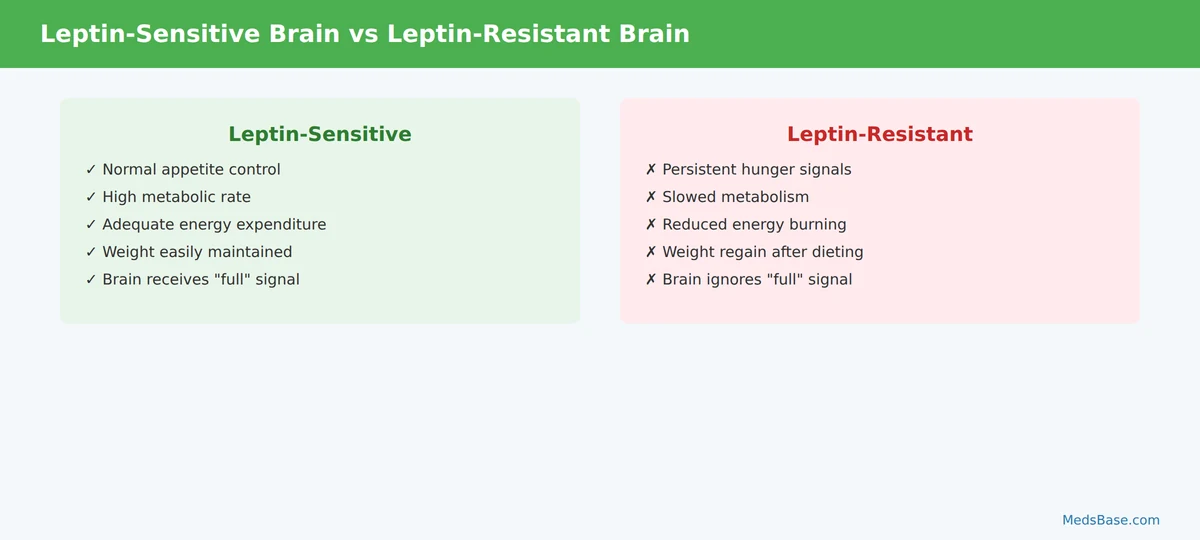
Think of leptin resistance like insulin resistance — a concept you may already be familiar with. In type 2 diabetes, the pancreas produces plenty of insulin, but cells stop responding to it. In leptin resistance, fat cells produce plenty of leptin, but the hypothalamus stops responding to it.
The Vicious Cycle
Here is where it gets interesting. As body fat increases, leptin levels rise proportionally — more fat cells, more leptin. The brain should interpret this flood of leptin as “stop eating, we are overflowing with energy.” Instead, in leptin-resistant individuals, the brain’s leptin receptors become desensitized. The hypothalamus acts as though leptin levels are low, even while they are astronomically high in the bloodstream.
The mechanisms of this desensitization are now understood at a molecular level:
- Impaired transport across the blood-brain barrier. Leptin must cross into the brain via a saturable transport system. When blood leptin levels are chronically elevated, the transporters become saturated, and less leptin reaches the hypothalamus. The brain is essentially blind to the signal.
- SOCS3 upregulation. Suppressor of cytokine signaling 3 (SOCS3) is a protein that blocks leptin receptor signaling inside hypothalamic neurons. High-fat diets and chronic inflammation increase SOCS3 levels, directly inhibiting leptin’s ability to suppress appetite.
- Endoplasmic reticulum (ER) stress. Leptin-resistant neurons show signs of ER stress, a cellular dysfunction that impairs proper protein folding and signaling. High circulating triglycerides and free fatty acids — common in obesity — trigger this ER stress response in hypothalamic neurons.
- Inflammation. High-fat diets induce low-grade inflammation in the hypothalamus itself. Pro-inflammatory cytokines (signaling molecules) released by activated microglia (the brain’s immune cells) interfere with leptin receptor signaling. This means the inflammation caused by excess weight directly damages the brain’s ability to regulate that weight.
[Research Spotlight] A pivotal 2012 study published in The Journal of Clinical Investigation demonstrated that hypothalamic inflammation and leptin resistance develop within 1–3 days of starting a high-fat diet in rodents — before any measurable weight gain occurs. This suggests leptin resistance is a cause, not just a consequence, of obesity. The researchers found that the inflammation specifically targeted the arcuate nucleus of the hypothalamus, the brain region richest in leptin receptors.
Amplification Through Triglycerides
Triglycerides — the main form of fat in the bloodstream — physically block leptin transport across the blood-brain barrier. The triglyceride molecule is too large to cross easily on its own but competes with leptin for access to the transport system. High triglyceride levels, common in obesity, insulin resistance, and high-sugar diets, effectively clog the leptin highway into the brain.
But there is a catch. This is not a one-way street. As triglycerides drop (through weight loss, reduced sugar intake, or fasting), leptin transport improves, and the brain begins receiving the signal again. This is one reason why even modest weight loss can produce outsized improvements in appetite regulation — you are not just losing fat; you are restoring the brain’s ability to hear the leptin signal.
Leptin Resistance Research: What Studies Actually Tell Us
| Study | Year | Finding | Source |
|---|---|---|---|
| Zhang et al. (leptin discovery) | 1994 | Positional cloning of the ob gene; leptin identified as the satiety hormone | Nature |
| Considine et al. | 1996 | Serum leptin correlates with BMI; humans are leptin-resistant, not deficient | NEJM |
| Thaler et al. | 2012 | Hypothalamic inflammation develops within 1–3 days of high-fat feeding | J Clin Invest |
| Spiegel et al. | 2004 | Sleep restriction (4h/night) reduces leptin by 18% and increases ghrelin by 28% | Ann Intern Med |
| de Git & Adan | 2015 | Review: leptin resistance mechanisms (BBB transport, SOCS3, ER stress, inflammation) | Eur J Pharmacol |
| Izquierdo et al. | 2019 | Fructose induces leptin resistance independent of weight gain in animals | Mol Metab |
What this means for you: Leptin resistance is not a personality flaw or a lack of willpower — it is a measurable, biological dysfunction with identified molecular pathways. And because those pathways are identified, they are also targetable. Every intervention in the next section has a mechanistic rationale backed by peer-reviewed research.
Why Your Diet Keeps Failing (It Is Not Willpower)
Most diet advice lands in the same place: eat fewer calories than you burn. The advice is technically correct in the same way that “to win a race, run faster than everyone else” is technically correct — it describes the outcome, not the method.
When a leptin-resistant person restricts calories, several things happen simultaneously:
- Leptin drops further. Even though it was already not working well, the absolute drop in circulating leptin signals an emergency to the hypothalamus. The brain responds by increasing hunger hormones (ghrelin) and decreasing satiety hormones (PYY, CCK).
- Metabolic rate drops. Resting energy expenditure can fall by 15–25% — significantly more than can be explained by the loss of metabolically active tissue. This is the brain actively reducing calorie burning to conserve energy stores.
- The brain changes how it perceives food. Functional MRI studies show that after weight loss, the brain’s reward centers light up more intensely in response to food images, while the prefrontal cortex (responsible for self-control) shows reduced activity. The person is not weaker — their brain has been remodeled by the weight loss to want food more and resist it less.
- Muscle efficiency increases. Skeletal muscle becomes more efficient after weight loss — it burns fewer calories to perform the same work. This is evolutionarily brilliant (conserving energy during famine) and metabolically devastating for someone trying to maintain weight loss.
This is the biological reality that explains the statistic that opened this article: 80–95% of people who lose substantial weight will regain it. They are not failing at willpower. Their brains and bodies are executing a flawless survival program. Understanding this is not an excuse — it is the foundation for building a strategy that actually works with your biology rather than against it.
Take Sarah, a hypothetical 38-year-old who lost 40 pounds through calorie restriction. Her leptin levels dropped by roughly 50% during the weight loss. Her resting metabolic rate fell by 300 calories per day — not because she lost muscle, but because her brain’s hypothalamus reduced sympathetic nervous system output. She now burns fewer calories at rest, feels hungrier, and her brain’s reward system responds more strongly to food cues. Nine months later, she has regained 25 pounds and blames herself for lacking discipline. Sarah’s experience is not an anomaly — it is the predicted outcome of the leptin system functioning exactly as evolution designed it to.
[Related Reading module]- Insulin Resistance: The Silent Killer Sabotaging Your Health
- PCOS and Heart Disease: What Every Woman Needs to Know [Today’s Post 1]
- MedsBase weight management options
7 Evidence-Backed Ways to Reverse Leptin Resistance
1. Reduce Fructose and Added Sugar
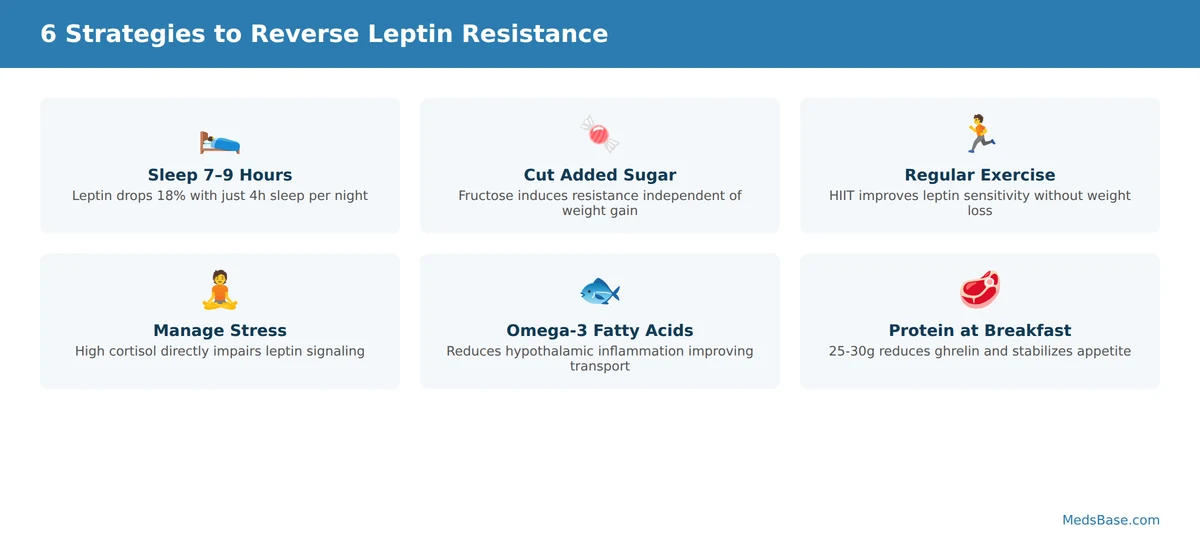
Fructose, especially in the form of high-fructose corn syrup and added sugars, is uniquely effective at inducing leptin resistance. Unlike glucose, which is metabolized by nearly every cell in the body, fructose is processed almost exclusively by the liver. High fructose intake triggers de novo lipogenesis (fat creation) in the liver, raises triglycerides, and promotes hypothalamic inflammation — all of which impair leptin signaling.
A 2019 study in Molecular Metabolism found that fructose induced leptin resistance in animal models independently of weight gain. In other words, fructose damaged the leptin system even when the animals did not get fat. The practical implication: cutting added sugar may improve leptin sensitivity before you lose a single pound.
What to do: Limit added sugar to less than 25 grams per day for women and 36 grams for men (American Heart Association guidelines). Avoid sugary beverages entirely — liquid fructose is absorbed more rapidly and has a more pronounced effect on liver fat and triglycerides than solid-food sugar.
2. Prioritize Sleep
Sleep deprivation is a fast, reliable way to suppress leptin. A classic study by Spiegel and colleagues, published in Annals of Internal Medicine, restricted healthy young men to 4 hours of sleep per night for two nights. The result: leptin levels dropped by 18%, ghrelin (the hunger hormone) rose by 28%, and self-reported hunger and appetite — particularly for calorie-dense, carbohydrate-rich foods — increased by 24% and 33% respectively.
Subsequent research has confirmed this pattern. Chronic sleep deprivation (less than 6 hours per night) is associated with higher BMI, higher rates of obesity, and poorer leptin sensitivity in large epidemiological studies. The mechanism involves cortisol elevation and sympathetic nervous system activation, both of which directly impair leptin receptor signaling.
What to do: Aim for 7–9 hours of sleep per night. Treat sleep as a non-negotiable component of your weight management strategy — not an afterthought.
3. Eat More Protein and Fiber at Breakfast
A high-protein, high-fiber breakfast increases post-meal satiety hormones (PYY, GLP-1) and reduces ghrelin more effectively than a high-carbohydrate breakfast. While this does not directly fix leptin receptor signaling, it reduces the hunger drive that leptin resistance creates, making the rest of the day’s food choices easier.
Protein also has the highest thermic effect of food — roughly 20–30% of protein calories are burned during digestion, compared to 5–10% for carbohydrates and 0–3% for fat. This small but consistent metabolic boost adds up over weeks and months.
What to do: Aim for 25–30 grams of protein at breakfast (e.g., two eggs + Greek yogurt, or a protein smoothie with whey or plant protein) along with 5+ grams of fiber from whole fruits, vegetables, or whole grains.
4. Exercise — Especially High-Intensity Intervals
Exercise improves leptin sensitivity through multiple mechanisms. It reduces circulating triglycerides (clearing the “clogged highway” into the brain), reduces systemic and hypothalamic inflammation, and increases the expression of leptin receptors in the hypothalamus.
A 2017 systematic review in Sports Medicine found that exercise training — particularly high-intensity interval training — improved leptin sensitivity even without significant weight loss. The effect was most pronounced in individuals with the highest baseline leptin levels (the most leptin-resistant).
Resistance training adds an additional benefit: it increases lean muscle mass, which raises resting metabolic rate. This partially counteracts the metabolic slowdown triggered by calorie restriction.
What to do: Aim for a combination: 2–3 sessions of resistance training per week (all major muscle groups) plus 150 minutes of moderate-to-vigorous activity, including some higher-intensity intervals.
5. Manage Chronic Stress
Chronic stress elevates cortisol, and cortisol has a direct relationship with leptin. Elevated cortisol increases appetite (particularly for calorie-dense foods), promotes visceral fat storage, and may directly impair leptin receptor signaling in the hypothalamus.
A 2018 study in Psychoneuroendocrinology found that women with high perceived stress had significantly higher leptin levels (indicating resistance) compared to low-stress controls, even after adjusting for BMI and age. The relationship was dose-dependent: more stress, more leptin resistance.
What to do: Incorporate daily stress-reduction practices. Even 10 minutes of mindfulness meditation, deep breathing, or a walk outdoors can measurably lower cortisol within weeks. These are not “soft” interventions — they have a measurable biological effect on the leptin system.
6. Include Omega-3 Fatty Acids
Omega-3 fatty acids (EPA and DHA, found in fatty fish, fish oil, and algae-based supplements) are anti-inflammatory and specifically reduce hypothalamic inflammation in animal models of diet-induced obesity. They also improve leptin transport across the blood-brain barrier by reducing circulating triglyceride levels.
A 2013 study in the Journal of Nutritional Biochemistry demonstrated that omega-3 supplementation restored leptin sensitivity in the hypothalami of high-fat-diet-fed rats, independent of weight changes. Human data are more limited but supportive: omega-3 intake is associated with lower leptin levels and better appetite regulation in cross-sectional studies.
What to do: Eat fatty fish (salmon, mackerel, sardines) 2–3 times per week, or consider a high-quality fish oil or algae-based omega-3 supplement providing at least 1,000 mg combined EPA + DHA daily.
7. Avoid Extreme Calorie Restriction
Very-low-calorie diets (below 1,200 calories per day for most women) trigger the most dramatic leptin drop. This is the body’s famine alarm at full volume. While rapid initial weight loss is possible, the metabolic counter-response — suppressed leptin, elevated ghrelin, reduced metabolic rate — makes long-term maintenance nearly impossible.
Moderate calorie deficits (500–750 calories below maintenance) produce more gradual leptin changes and allow the brain to adapt to a new set point over time. Intermittent fasting and time-restricted eating have shown promise in some studies for preserving leptin sensitivity during weight loss, possibly because the fasting periods allow leptin levels to temporarily recover.
What to do: Aim for a gentle deficit — lose no more than 1–2 pounds per week. If you hit a plateau, maintain your current weight for 2–4 weeks before attempting further loss. This “diet break” allows leptin levels to partially recover, reducing the metabolic adaptation that stalls further progress.
Leptin, GLP-1 Medications, and the Future of Weight Loss
GLP-1 receptor agonists — semaglutide (Ozempic, Wegovy), tirzepatide (Mounjaro, Zepbound), and liraglutide (Saxenda) — have transformed obesity treatment. Part of their effectiveness may come from interactions with the leptin system.
GLP-1 neurons in the brainstem project to the same hypothalamic regions where leptin acts. Animal research suggests that GLP-1 receptor activation can partially bypass leptin resistance, allowing appetite suppression and metabolic effects even when leptin signaling is impaired. Some studies also indicate that GLP-1 agonists reduce hypothalamic inflammation, which may indirectly restore leptin sensitivity.
This helps explain why GLP-1 medications work for people who have failed every diet: they act downstream of where the leptin signal gets blocked. If you are considering GLP-1 therapy, discuss it with a doctor who understands both the cardiometabolic and weight-management aspects. MedsBase carries a range of weight management options — consult your doctor about what may be appropriate for you.
Leptin itself as a drug has been a disappointment. Recombinant leptin (metreleptin) is FDA-approved only for a rare condition called generalized lipodystrophy, where patients have almost no body fat and therefore almost no leptin. In common obesity, where leptin levels are already sky-high, injecting more leptin is like adding water to a flooded basement — the problem is not the amount, it is the drainage.
The more promising frontier is combination therapy. Early clinical trials are testing whether drugs that improve leptin sensitivity — by reducing hypothalamic inflammation, enhancing leptin transport, or inhibiting SOCS3 — could work synergistically with GLP-1 agonists to produce more durable weight loss with fewer side effects. If successful, these combinations would represent the first treatments that address the root cause of weight regain rather than simply suppressing appetite during active treatment.
Frequently Asked Questions
Q: Can I take leptin supplements to lose weight?
A: Leptin supplements sold online are generally ineffective. Leptin is a protein hormone — it is broken down in the stomach like any other protein if taken orally. Injectable leptin (metreleptin) is only FDA-approved for a rare genetic condition called generalized lipodystrophy, where patients lack body fat and produce almost no leptin. People with common obesity already have high leptin levels — their problem is resistance, not deficiency.
Q: How do I know if I have leptin resistance?
A: There is no standard clinical test for leptin resistance. High fasting leptin levels (above ~15–20 ng/mL in most labs) combined with obesity, high triglycerides, and a history of failed diet attempts are suggestive. Some functional medicine practitioners test serum leptin, but it is not part of routine care. The diagnosis is usually clinical: if you have obesity, particularly with central fat distribution and strong food cravings, you almost certainly have some degree of leptin resistance.
Q: Will weight loss reverse leptin resistance?
A: Partially. Weight loss reduces circulating leptin levels and can improve leptin transport across the blood-brain barrier. However, studies of formerly obese individuals show that some degree of leptin signaling impairment may persist long-term, contributing to the high rate of weight regain. This is why lifestyle interventions that specifically target leptin sensitivity — sleep, reduced sugar, exercise, stress management — remain important even after successful weight loss.
Q: Does leptin resistance cause insulin resistance, or vice versa?
A: They are bidirectionally linked. Leptin resistance promotes insulin resistance through hypothalamic inflammation and impaired glucose regulation. Insulin resistance promotes leptin resistance through elevated triglycerides and systemic inflammation. Breaking this cycle usually requires addressing both simultaneously — the strategies in this article (reduced sugar, exercise, improved sleep, stress management) improve both leptin and insulin sensitivity.
Q: How long does it take to reverse leptin resistance?
A: Some improvements in leptin sensitivity can occur within days — sleep restoration, for example, can raise leptin levels within 48 hours. More substantial reversal, including reduced inflammation and improved transport, typically takes weeks to months of consistent dietary and lifestyle changes. There is no “quick fix” — leptin resistance developed over years and will not reverse in a weekend.
Q: Are certain diets better for leptin sensitivity than others?
A: The strongest evidence supports dietary patterns that are low in added sugars (especially fructose), moderate in carbohydrates from whole-food sources, adequate in protein, and rich in omega-3 fatty acids. The Mediterranean diet and similar whole-food-based eating patterns hit these targets naturally. Very-low-carbohydrate (ketogenic) diets may improve leptin sensitivity by lowering triglycerides, but the evidence is mixed and long-term data are limited.
Q: Does leptin affect anything besides appetite?
A: Yes. Leptin receptors are found in many tissues beyond the hypothalamus, including the immune system (where leptin supports T-cell function), bone (where it regulates bone density), and the reproductive system (where it signals adequate energy stores for fertility). This is why women with very low body fat often stop menstruating — their leptin levels have dropped below the threshold needed to signal “enough energy for reproduction.”
The Bottom Line
Leptin resistance is not a character flaw. It is a biological condition with identified molecular mechanisms — and it is one of the primary reasons that diets fail and weight is regained. Understanding your leptin system does not make weight loss easy, but it makes it possible to stop fighting your own biology and start working with it.
Your immediate action items:
- Cut added sugar, especially fructose. This is the single dietary change with the strongest evidence for improving leptin sensitivity.
- Protect your sleep. Sleep is a leptin-enhancing treatment you get for free every night. Seven hours minimum.
- Moderate exercise with some intensity. Combine steady-state activity with muscle-building resistance work and brief high-intensity intervals.
If your body has been fighting your weight-loss efforts, leptin resistance is likely part of the explanation. The seven strategies in this article give you a science-backed starting point — not for another crash diet, but for a genuinely different approach.
What to read next:
- PCOS and Heart Disease: What Every Woman Needs to Know — Our other post today explores how metabolic dysfunction elevates cardiovascular risk in women.
- Insulin Resistance: The Silent Killer Sabotaging Your Health — The companion condition to leptin resistance and the mechanism behind metabolic syndrome.
Medical Disclaimer: This article is for informational purposes only and does not constitute medical advice. Always consult your doctor or a qualified healthcare professional before starting, stopping, or changing any medication or weight-loss program. Obesity is a complex medical condition requiring individualized care.

Written by
Sophie ChenPharmaceutical Content Researcher · 8 years experience
Sophie Chen is a pharmaceutical content researcher with 8 years covering generic medication access and clinical pharmacology. She specialises in international regulatory frameworks, bioequivalence standards, and patient-facing education on therapeutic drug classes. She is not a clinician.