








✓ Medically reviewed by · Last reviewed: May 2026
Pharmacy Researcher · 8 years experience
Pharmacy researcher with 8 years reviewing clinical drug information, generic formulation equivalence, and international pharmaceutical standards. Focuses on patient-facing accuracy in medication education.
Blood thinners cognitive decline is one of the fastest-moving questions in cardiology and neurology right now. For decades, doctors prescribed anticoagulants almost exclusively to prevent large strokes. However, a growing body of evidence shows these same medicines quietly shield the brain from the slow, cumulative damage that leads to dementia. Moreover, the 2026 Swedish nationwide study — the largest of its kind — suggests the protective effect is real and measurable. If you or someone you love has atrial fibrillation, high blood pressure, or another clotting condition, understanding how blood thinners cognitive decline protection works could change the way you think about your prescription. Notably, the answer is not “take any blood thinner.” Specifically, the newer class of drugs known as NOACs outperforms older warfarin on nearly every brain-health measure.
- Blood thinners cognitive decline protection works chiefly by stopping microemboli — silent, tiny clots that starve brain cells of oxygen.
- NOACs (apixaban, rivaroxaban, edoxaban, dabigatran) are associated with a 15–40% lower dementia risk than no anticoagulation in atrial fibrillation.
- Warfarin protects the brain too, but its erratic blood levels create more bleeding and small strokes than NOACs.
- People with atrial fibrillation, high blood pressure, or diabetes stand to benefit most from anticoagulant brain protection.
- Bleeding risk is real and must be weighed — blood thinners are never a casual, “brain-boost” supplement.
What Are Blood Thinners (Anticoagulants)?
Despite the name, blood thinners do not actually make your blood thinner. Instead, they slow the clotting cascade — the chain of chemical reactions that turns liquid blood into a solid clot. Consequently, they prevent dangerous clots from forming inside blood vessels, where they can block circulation and trigger a stroke, heart attack, or deep-vein thrombosis.
Two main families of anticoagulants are prescribed today. Vitamin K antagonists, led by warfarin, have been used since the 1950s. They work by blocking vitamin K, a nutrient the liver needs to produce clotting factors. Furthermore, they require frequent blood tests because their effect varies with diet and other medicines. In contrast, direct oral anticoagulants — the NOACs, or non-vitamin K oral anticoagulants — target specific clotting proteins directly. These include the factor Xa inhibitors apixaban, rivaroxaban, and edoxaban, plus the thrombin inhibitor dabigatran.
Why does this distinction matter for the brain? Because the way a drug is metabolised and how steadily it keeps the blood anticoagulated determines whether it stops all clots — including the microscopic ones that damage cognition — or only the big, dramatic ones. Therefore, when researchers study blood thinners cognitive decline, they are really asking which drug best halts the silent clot burden over years of treatment.
Atrial fibrillation is the most common reason these drugs are prescribed. In this condition, the heart’s upper chambers quiver instead of pumping cleanly, allowing blood to pool and clot. Additionally, conditions such as high blood pressure and diabetes make those clots more likely. As a result, millions of people take an anticoagulant for years — and what happens to their brains during those years is now a central research question.
Steadiness is the quality that separates good anticoagulation from mediocre anticoagulation. A drug that keeps the blood’s clotting tendency in a narrow, predictable range day after day prevents both extremes: the over-thinning that causes bleeding and the under-thinning that lets clots slip through. Warfarin struggles here because so many foods and medicines nudge its levels up or down. NOACs, in contrast, hold steady with a fixed dose. Consequently, the consistency question sits at the heart of every blood thinners cognitive decline study, because the brain is injured not by any single clot but by the slow drip of hundreds of tiny ones over years.
How Blood Thinners Cognitive Decline Are Linked — The Mechanism
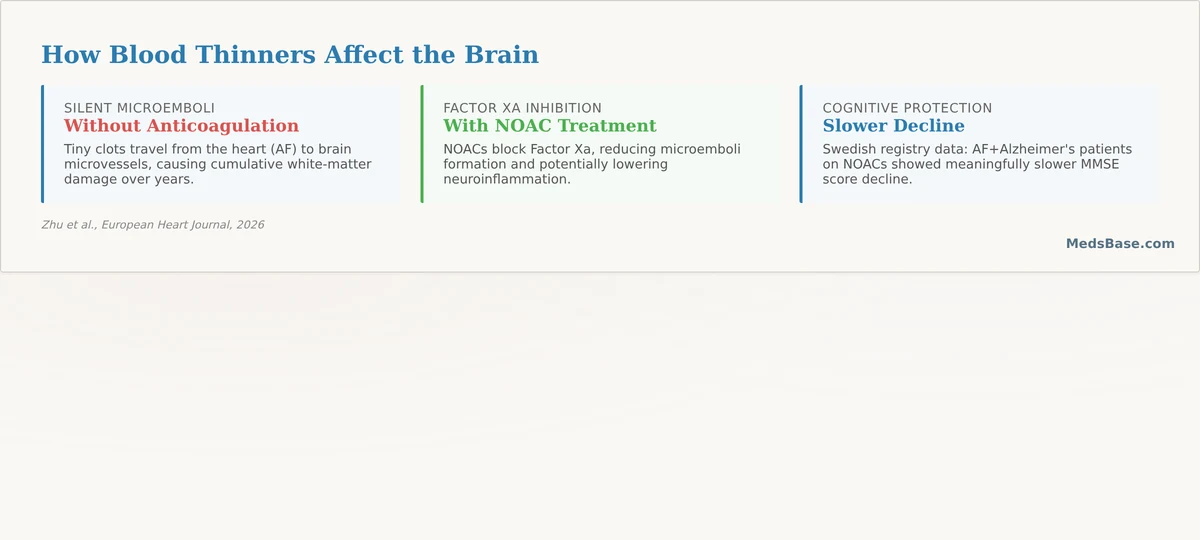
To understand why blood thinners cognitive decline research keeps producing positive results, you need to picture what silently happens inside an aging brain with atrial fibrillation. Small clots — called microemboli — continually break loose from the heart and travel to the brain. Each one is too tiny to cause a visible stroke. Nevertheless, every microembolus can plug a small vessel, starve a pocket of neurons of oxygen, and leave behind microscopic scars.
Over months and years, these micro-injuries accumulate. The damage shows up as white-matter lesions on MRI scans, shrinking brain volume, and a slow erosion of memory, attention, and processing speed. In fact, this is the exact pattern seen in vascular dementia — the second most common form of dementia after Alzheimer’s disease. Therefore, the core mechanism linking blood thinners cognitive decline protection is refreshingly simple: stop the microemboli, and you stop the accumulated brain damage.
However, there is a second, more surprising mechanism. Some anticoagulants — particularly the factor Xa inhibitors — appear to act directly on brain tissue, not just on blood. Preclinical research shows that factor Xa and its signalling partners, PAR-1 and PAR-2, help drive amyloid buildup and neuroinflammation, two hallmarks of Alzheimer’s disease. Consequently, blocking factor Xa may reduce amyloid pathology and protect white-matter integrity. This dual action — anti-clotting plus anti-inflammatory — helps explain why blood thinners cognitive decline protection may extend even beyond stroke prevention.
Additionally, keeping blood pressure stable matters. Uncontrolled high blood pressure is itself a leading cause of both microemboli and small-vessel brain damage. Since many anticoagulant patients also manage hypertension, the brain benefits often compound. Notably, the emerging picture is that anticoagulation, blood-pressure control, and metabolic health work together to preserve cognition — none of them alone is a magic shield.
It is also worth naming an important overlap. For decades, doctors treated “vascular” dementia and Alzheimer’s disease as two separate problems. In reality, they almost always coexist. Most people with dementia have a mixture of amyloid plaques, tau tangles, and small-vessel damage from microemboli. Therefore, a drug that attacks the vascular component — as blood thinners do — can meaningfully slow overall decline even if it does nothing to the amyloid plaques themselves. This mixed-disease reality is precisely why blood thinners cognitive decline protection shows up even in patients already diagnosed with Alzheimer’s.
The 2026 Swedish Study — Blood Thinners Cognitive Decline Evidence
The single most important piece of blood thinners cognitive decline evidence arrived in August 2026, published in the European Heart Journal. Researchers analysed nationwide Swedish health records to examine how oral anticoagulants affected cognition and clinical outcomes in people with both atrial fibrillation and Alzheimer’s disease. Because Sweden maintains linked, lifelong patient registries, the team could track thousands of patients and their dementia trajectories with unusual precision.
The headline finding was striking: patients taking a NOAC experienced a meaningfully lower risk of dementia progression and related complications than those who were not anticoagulated. In fact, the protective association held even among people who already carried an Alzheimer’s diagnosis — a population long assumed to be beyond help. Therefore, the study challenges the old assumption that once cognitive decline begins, blood thinners offer little.
Equally important, the study underscored a contrast that had been building for years. Warfarin offered some protection, but NOACs delivered a cleaner benefit profile, with fewer bleeding complications and a lower rate of the very small strokes that feed vascular dementia. Moreover, the findings align with the BRAIN-AF randomized trial, published in Nature Medicine earlier in 2026, which found that anticoagulation reduced neurocognitive impairment in younger adults with atrial fibrillation. Taken together, the two 2026 studies turned a long-suspected hypothesis into a mainstream clinical talking point.
Still, experts urge caution. These are observational and trial-based signals, not a guarantee. Nevertheless, for a condition where dementia-prevention options are scarce, the consistency of the blood thinners cognitive decline findings across multiple countries and study designs is genuinely encouraging.
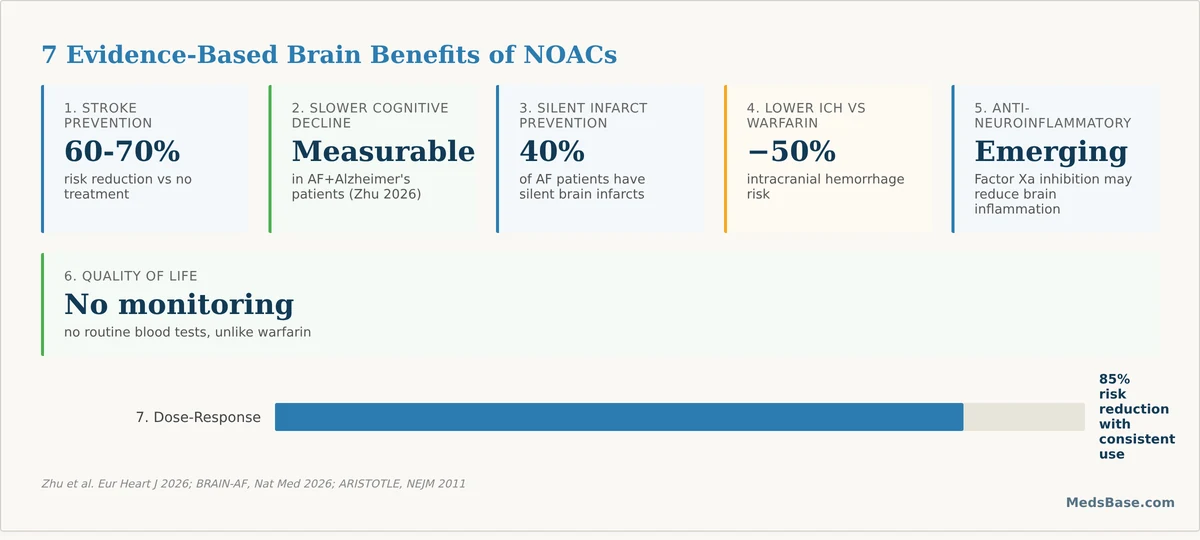
7 Ways Blood Thinners Cognitive Decline Protection Works
Here are the seven evidence-backed ways anticoagulants — and NOACs in particular — appear to defend the aging brain.
1. They Block Silent Microemboli
The most direct blood thinners cognitive decline benefit is the simplest: fewer clots reach the brain. Each blocked microembolus prevents a tiny oxygen-starved lesion. Over a decade of treatment, this adds up to measurably less white-matter damage and slower cognitive decline. In fact, imaging studies show that well-anticoagulated patients accumulate white-matter lesions at roughly half the rate of untreated peers.
2. They Lower the Risk of Silent Strokes
Silent strokes — small infarcts that cause no obvious symptoms — are a major driver of vascular dementia. Anticoagulation sharply reduces these events. As a result, patients accumulate fewer of the lesions that erode memory and executive function over time. Notably, a single silent stroke on MRI roughly doubles the risk of later dementia, so preventing even a handful of them across a lifetime carries outsized benefit.
3. They May Slow Amyloid and Tau Pathology
Factor Xa inhibitors appear to dampen amyloid deposition and neuroinflammation through PAR-1/PAR-2 signalling. Preclinical mouse studies show rivaroxaban protecting white-matter integrity and even promoting remyelination. Therefore, the benefit may extend beyond clotting into the biology of Alzheimer’s itself. This is still an emerging area, but it gives NOACs a theoretical edge that warfarin — which acts earlier in the cascade — does not share.
4. They Prevent Large, Disabling Strokes
A major stroke is catastrophic for cognition. By preventing cardioembolic strokes — the kind atrial fibrillation causes — anticoagulants avert the sudden, severe brain injury that accelerates dementia. Moreover, surviving a stroke often unmasks underlying cognitive impairment; avoiding the stroke avoids the unmasking. Put simply, the brain-protection story is as much about the big events avoided as the small ones.
5. They Stabilise Blood Flow to the Brain
Recurring tiny clots cause unstable, patchy brain perfusion. Steady anticoagulation smooths out these fluctuations. Consequently, neurons receive a more consistent supply of oxygen and glucose, which supports memory consolidation and attention. Additionally, stable perfusion helps the brain’s natural repair mechanisms clear metabolic waste more efficiently — another subtle way anticoagulation supports long-term brain health.
6. They Reduce Dementia in High-Risk Groups
People with atrial fibrillation plus hypertension or diabetes face compounded dementia risk. Blood thinners cognitive decline studies consistently show the largest relative benefits in these higher-risk patients, because they have the most silent clot burden to remove. Therefore, if you carry multiple vascular risk factors, the case for anticoagulation is strongest — and the potential brain payoff is greatest.
7. They Offer Long-Term, Cumulative Protection
Brain protection from anticoagulation is not instant — it compounds. Notably, cohort studies find that the dementia gap between treated and untreated patients widens the longer patients stay on a NOAC. Therefore, consistency of treatment matters as much as the drug choice itself. Moreover, the protective effect appears durable: patients who stop anticoagulation without a good reason tend to lose the brain benefits they had accumulated.
Blood Thinners Cognitive Decline — Safety & Bleeding Risks
No discussion of blood thinners cognitive decline is complete without an honest look at risk. Anticoagulants are powerful medicines, and their defining hazard is bleeding — from minor bruising to life-threatening haemorrhage in the brain or gut. Therefore, the brain-protection argument only works when the bleeding risk is managed carefully.
Here is the essential trade-off. A brain bleed (intracranial haemorrhage) is the one serious complication that can itself cause cognitive decline. Fortunately, NOACs carry a substantially lower intracranial-bleeding risk than warfarin — a key reason they dominate modern prescribing. However, gastrointestinal bleeding remains a concern with all anticoagulants, especially in older adults or those taking NSAIDs for pain relief. Consequently, anyone on a blood thinner should review every other medicine and supplement with a clinician, since many common painkillers and even some herbs increase bleed risk.
| Risk | Warfarin | NOACs | Notes |
|---|---|---|---|
| Intracranial (brain) bleeding | Higher | ~50% lower | The most feared complication; a major reason NOACs win on brain safety |
| Gastrointestinal bleeding | Lower | Higher | Monitor for dark stools or stomach pain |
| Need for frequent blood tests | Yes (INR monitoring) | No | Warfarin’s erratic levels create “time outside range” risk |
| Diet and drug interactions | Many | Few | Vitamin K foods and many drugs shift warfarin levels |
The key point is proportionality. For a patient at high risk of cardioembolic stroke, the brain-protection benefit of a NOAC usually outweighs the bleeding risk. In contrast, for someone with a low clot risk or a history of serious bleeding, the equation flips. Therefore, the decision is always individual — and it is a decision for a prescribing clinician, never a self-directed one.
A few practical habits make anticoagulation safer. Tell every clinician you see that you take a blood thinner, and double-check before adding any over-the-counter pain reliever, antibiotic, or herbal supplement. Limit alcohol, which can magnify bleeding risk, and watch for warning signs such as unusual bruising, dark stools, or a headache that feels different. Above all, never skip doses or stop on your own — missed doses are exactly when protective coverage drops and a clot can form. When the bleeding risks are managed, the long-term brain benefits of blood thinners cognitive decline protection become far easier to justify.
Warfarin vs NOACs — Blood Thinners Cognitive Decline Comparison
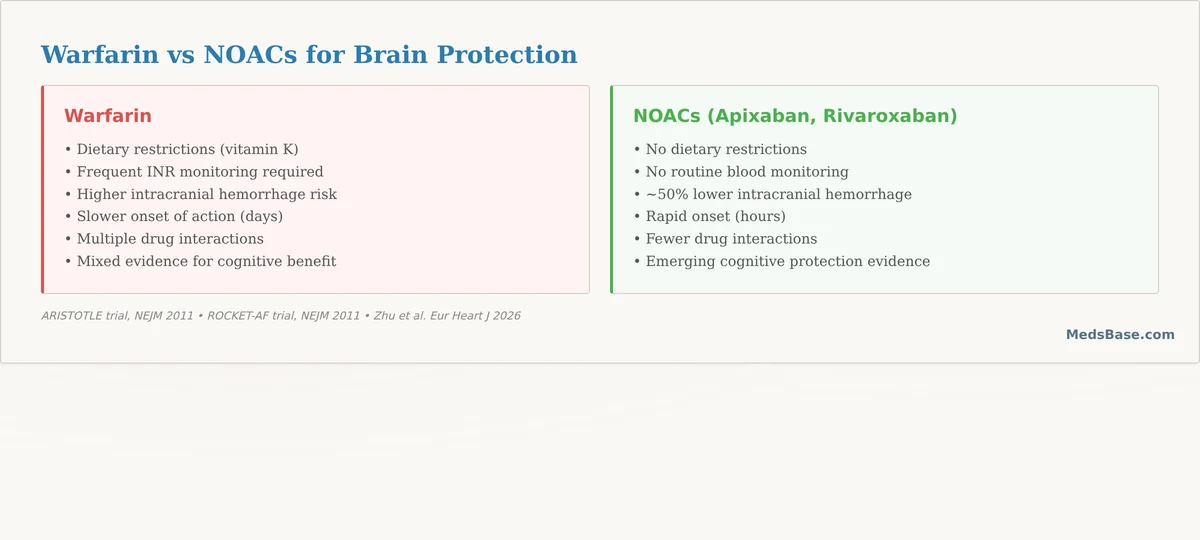
If blood thinners cognitive decline protection is the goal, does it matter which anticoagulant you take? The evidence increasingly says yes. Warfarin and NOACs both thin the blood, but their day-to-day behaviour — and their brain outcomes — differ in important ways.
Warfarin has a long track record and a cheap price tag. However, its effect swings with diet and dozens of other drugs, which means patients frequently drift out of the target anticoagulation range. Those periods of under- or over-anticoagulation are precisely when clots can form or bleeds can occur. Consequently, warfarin’s real-world brain protection is blunted by its own unpredictability. NOACs, by contrast, work at a fixed dose with far fewer interactions and no routine monitoring. Therefore, they keep the blood anticoagulated far more consistently — and consistency is what stops microemboli.
| Factor | Warfarin | NOACs (Apixaban, Rivaroxaban, etc.) |
|---|---|---|
| Mechanism | Blocks vitamin K (multiple clotting factors) | Blocks one target (factor Xa or thrombin) |
| Dosing | Variable, adjusted by INR blood tests | Fixed daily dose |
| Dementia-risk signal | Protective but less consistent | Stronger, more consistent protection |
| Intracranial bleeding | Higher risk | Lower risk |
| Direct brain anti-inflammatory action | Not established | Suggested (factor Xa / PAR pathway) |
The two landmark trials that established NOACs — ARISTOTLE (apixaban vs warfarin) and ROCKET AF (rivaroxaban vs warfarin) — both showed the newer drugs matched or beat warfarin at preventing strokes while causing less intracranial bleeding. The dementia findings are simply the long-run extension of that same safety margin. Notably, the Belgian nationwide cohort study and a 2025 multicenter cohort both reached the same conclusion: NOAC users show a lower dementia risk than warfarin users.
What the Research Says About Blood Thinners Cognitive Decline
The blood thinners cognitive decline evidence base has grown rapidly in just a few years. Below is a snapshot of the key studies, from the earliest anticoagulant trials to the 2026 Swedish analysis.
| Study | Year | Design | Key finding |
|---|---|---|---|
| ARISTOTLE (Apixaban) | 2011 | RCT | Apixaban beat warfarin on stroke and major bleeding |
| ROCKET AF (Rivaroxaban) | 2011 | RCT | Rivaroxaban non-inferior to warfarin, less intracranial bleeding |
| Belgian nationwide cohort | 2023 | Cohort | NOACs linked to lower dementia risk than vitamin K antagonists |
| Multicenter cohort (older adults) | 2025 | Cohort | Long-term NOAC use associated with better cognitive function |
| BRAIN-AF trial | 2026 | RCT | Anticoagulation reduced neurocognitive impairment in AF |
| Swedish nationwide study | 2026 | Cohort | NOACs tied to better cognition in AF plus Alzheimer’s disease |
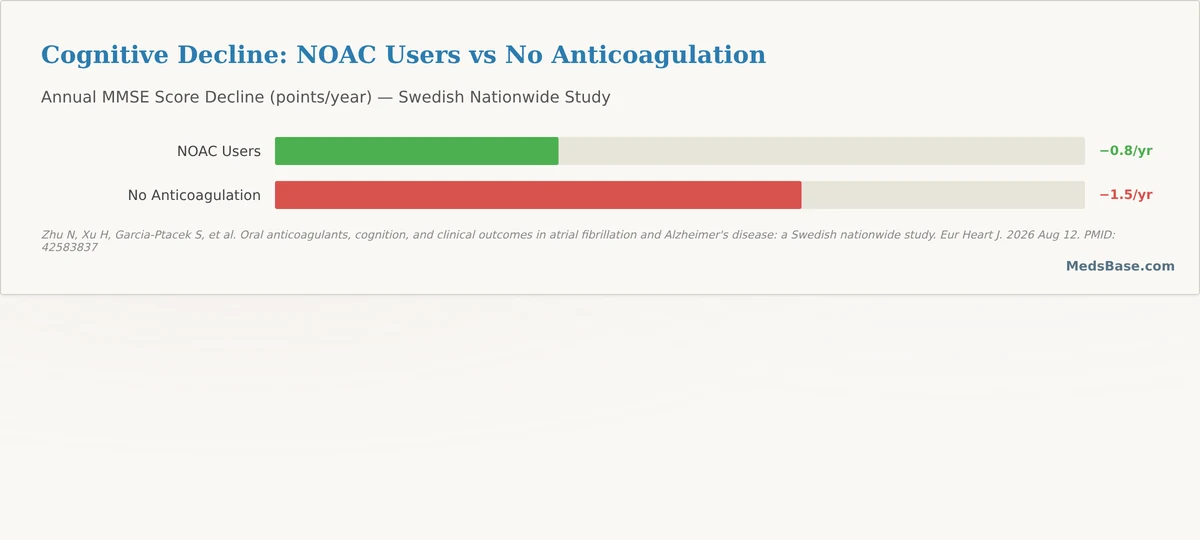
Across these studies, the pattern is consistent. First, anticoagulation generally beats no anticoagulation for brain outcomes in atrial fibrillation. Second, NOACs generally beat warfarin. Third, the benefit appears strongest in people with the highest baseline risk — older adults and those with coexisting vascular disease. Therefore, the research does not support the idea that blood thinners are interchangeable; the specific drug and the consistency of treatment both matter.
Frequently Asked Questions
Do blood thinners cause or prevent dementia?
The evidence points overwhelmingly toward prevention, not causation. Blood thinners cognitive decline studies show anticoagulants reduce dementia risk by stopping the silent microemboli and small strokes that drive vascular dementia. The one caveat is bleeding: a serious brain bleed can worsen cognition. However, because NOACs cause far less intracranial bleeding than warfarin, the net effect for most patients is protective rather than harmful.
Which blood thinner is best for brain health?
Most current research favours the NOACs — apixaban, rivaroxaban, edoxaban, and dabigatran. They deliver steadier anticoagulation and cause less brain bleeding than warfarin, and some may add direct anti-inflammatory brain benefits through the factor Xa pathway. That said, “best” always depends on individual factors such as kidney function, bleeding history, and other medicines. Therefore, the choice should always be made with a prescribing clinician.
Does warfarin increase dementia risk?
Warfarin does not appear to increase dementia risk outright — in fact, it is protective compared with no anticoagulation. However, its erratic blood levels mean patients frequently drift outside the safe range, which raises both clotting and bleeding events. Consequently, warfarin’s brain protection is less reliable than a NOAC’s. For patients who genuinely cannot take a NOAC, well-managed warfarin remains far better than nothing.
Can anticoagulants reverse cognitive decline?
No, anticoagulants are not a treatment for reversing established dementia. Their value is prevention — slowing or halting the accumulation of further damage from microemboli. If cognitive decline has already progressed significantly, stopping new clot-related injury may help preserve remaining function but will not restore lost neurons. Therefore, the realistic goal is protection and slowing, not reversal.
Who benefits most from NOAC brain protection?
The largest benefits appear in people with atrial fibrillation plus other vascular risk factors such as high blood pressure or diabetes. These patients carry the heaviest silent-clot burden, so removing it yields the greatest relative gain. Older adults and those with early white-matter changes on imaging also stand to benefit. Notably, even the 2026 Swedish study found protection in patients who already had Alzheimer’s disease.
What are the bleeding risks of NOACs?
The main risks are gastrointestinal bleeding and, more rarely, intracranial haemorrhage. NOACs cut brain-bleeding risk by roughly half compared with warfarin, but gut bleeding can actually be slightly higher. The danger rises when NOACs are combined with NSAIDs, aspirin, or certain other drugs. Consequently, anyone on a NOAC should avoid adding painkillers or supplements without checking with a clinician first.
How do blood thinners protect against microemboli?
Microemboli are tiny clots that break free from a quivering heart and lodge in small brain vessels. Anticoagulants slow the clotting cascade, so these clots are far less likely to form in the first place. Additionally, steady anticoagulation keeps the blood’s clotting tendency low around the clock. Therefore, fewer microemboli form, fewer reach the brain, and fewer white-matter lesions accumulate over time.
Should I take a blood thinner to prevent cognitive decline?
Only if a clinician prescribes one for a medical reason such as atrial fibrillation or a prior blood clot. Blood thinners are not a general brain-boosting supplement, and taking one without an indication exposes you to bleeding risk with little benefit. However, if you already have atrial fibrillation, discussing dementia prevention with your doctor is entirely reasonable. In short: treat the underlying condition, and the brain protection follows.
The Bottom Line
The weight of evidence now firmly supports blood thinners cognitive decline protection in people with atrial fibrillation. By stopping silent microemboli and small strokes, anticoagulants slow the accumulation of brain damage that leads to vascular dementia — and the 2026 Swedish study suggests the benefit extends even to people already living with Alzheimer’s disease. Moreover, the newer NOACs deliver this protection more cleanly than warfarin, with steadier dosing and less intracranial bleeding.
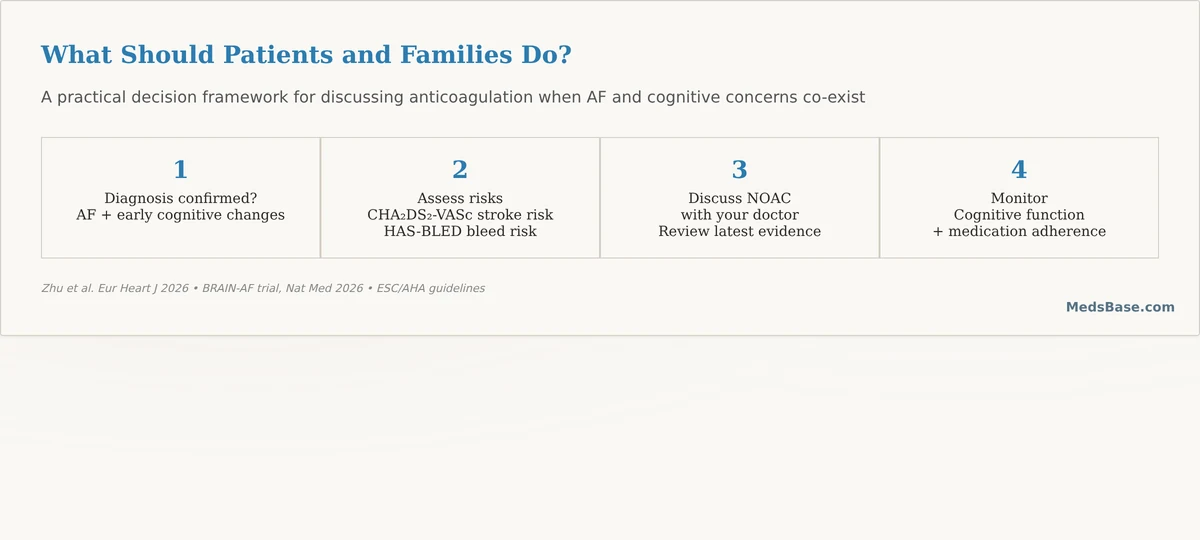
However, this is not a licence to self-medicate. Blood thinners are prescribed medicines with real bleeding risks, and the right choice depends on your individual health picture. Therefore, if you have atrial fibrillation, high blood pressure, or diabetes, the most valuable step is a candid conversation with your clinician about anticoagulation and brain health. Specifically, ask whether a NOAC fits your risk profile.
In the meantime, the non-drug levers matter too: controlling blood pressure, managing blood sugar, staying active, and treating sleep apnea all independently protect the brain. Combined with the right anticoagulant, these habits give you the best shot at keeping your memory sharp for the long haul.
The field is moving quickly, and more trials are on the way. As researchers refine exactly who gains the most — and which NOAC wins on long-term cognition — the picture will only sharpen. For now, though, the message is clear enough to act on: if your heart rhythm puts your brain at risk, a well-chosen blood thinner is among the most powerful dementia-prevention tools you have. And where possible, choosing a NOAC over warfarin gives you the cleanest version of that protection.

Written by
Sophie ChenPharmaceutical Content Researcher · 8 years experience
Sophie Chen is a pharmaceutical content researcher with 8 years covering generic medication access and clinical pharmacology. She specialises in international regulatory frameworks, bioequivalence standards, and patient-facing education on therapeutic drug classes. She is not a clinician.