








✓ Medically reviewed by · Last reviewed: May 2026
Pharmacy Researcher · 8 years experience
Pharmacy researcher with 8 years reviewing clinical drug information, generic formulation equivalence, and international pharmaceutical standards. Focuses on patient-facing accuracy in medication education.
finasteride shedding phase — Finasteride Shedding Phase — Timeline, What to Expect & When to Worry. Read on for an evidence-backed guide covering everything you need to know.
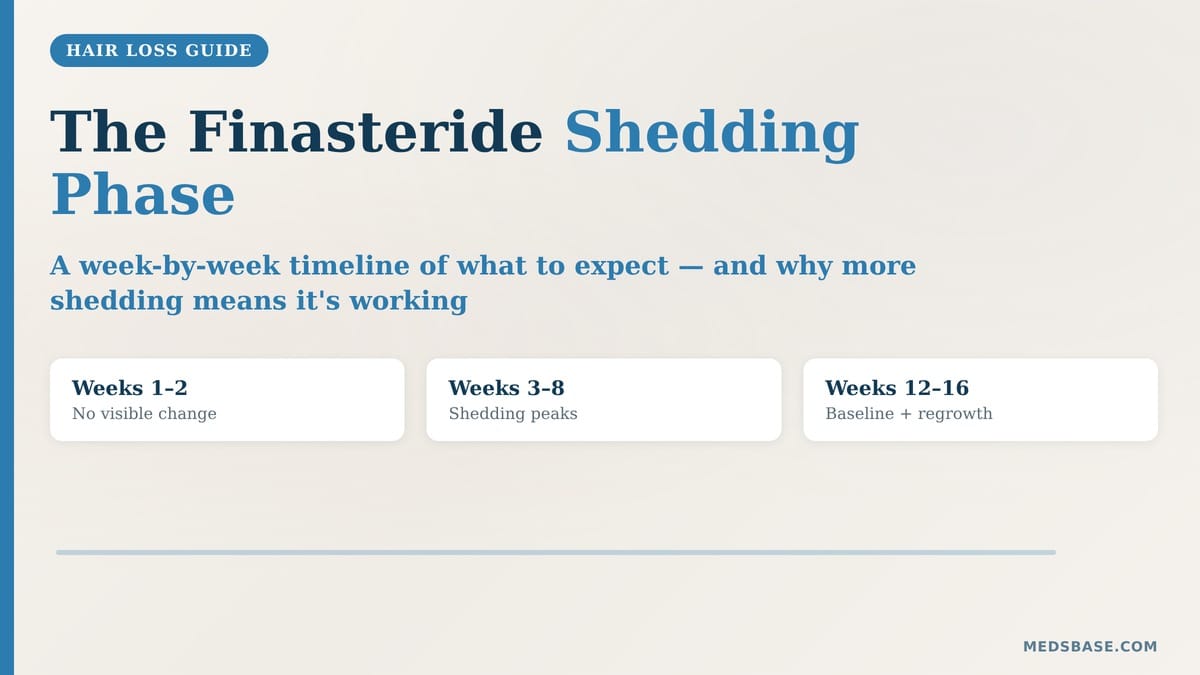
Finasteride shedding phase can feel like a cruel joke — you start treatment to keep your hair, and suddenly more of it is on your pillow than ever before. Before you panic-flush your prescription, take a deep breath: that shedding is not only normal, it’s actually a sign the medication is working.
Here’s what you’ll learn in this guide: exactly what causes the finasteride shedding phase, a week-by-week timeline of what to expect, how to tell the difference between shedding and actual balding, how dutasteride compares, and seven practical strategies to get through it with your sanity (and hair) intact.
Key Takeaways
- The finasteride shedding phase is a sign DHT is being suppressed and the hair cycle is resetting — but the timing of this reset surprises nearly everyone
- Shedding peaks at weeks 4-8, then declines, with visible regrowth appearing by month 4-6
- There’s a simple way to tell shed hair from balding hair — and it matters more than most people think
- Quitting during the shedding phase is the #1 reason finasteride “doesn’t work” — one study puts the dropout rate at over 20% in the first 3 months
- Dutasteride causes a similar shedding phase, but there’s one key difference in timing and intensity
- Seven specific, actionable strategies can reduce shedding anxiety and protect your progress
- What Is the Finasteride Shedding Phase?
- How Does Finasteride Work? (And Why It Causes Shedding)
- Finasteride Shedding vs Balding: How to Tell the Difference
- Finasteride Shedding Phase Timeline: Week by Week
- Finasteride vs Dutasteride Shedding: Which Is Worse?
- 7 Proven Tips to Get Through the Finasteride Shedding Phase
- What the Research Says
- Frequently Asked Questions
- The Bottom Line
What Is the Finasteride Shedding Phase?
Quick Answer: The finasteride shedding phase is a temporary increase in hair loss that occurs 2-8 weeks after starting finasteride treatment. It happens because finasteride rapidly lowers DHT (dihydrotestosterone) levels, which resets the hair growth cycle. Weak, DHT-damaged hairs fall out to make room for stronger, healthier hairs. This phase is temporary and typically resolves by week 12-16.
Male pattern baldness, or androgenetic alopecia, is driven by a hormone called dihydrotestosterone (DHT). DHT binds to receptors in hair follicles on the scalp, gradually shrinking them — a process called miniaturization. Over time, follicles produce thinner, shorter, less pigmented hairs, and eventually stop producing hair entirely.
Finasteride is a 5-alpha reductase inhibitor, and understanding how it triggers the finasteride shedding phase requires understanding this mechanism. It blocks the enzyme that converts testosterone into DHT, reducing scalp DHT levels by approximately 60-70%. When DHT levels drop sharply, the hair follicles that were being suppressed by DHT suddenly receive a different signal: “regrow.”
But here’s where it gets interesting. Hair follicles don’t respond instantly. They operate on a cycle with three phases: anagen (growth), catagen (transition), and telogen (resting/shedding). DHT-shortened follicles were stuck in a shortened anagen phase, producing weak hairs. When finasteride removes the DHT suppression, those follicles enter a synchronized reset — they push out the old, weak hair (telogen phase) to begin a new, longer anagen phase.
This synchronized push-out is the finasteride shedding phase. It’s essentially a mass eviction of underperforming hairs so healthier ones can move in.
This concept was well-documented in a 2011 study in the Journal of Dermatology which confirmed that finasteride-induced shedding is a telogen effluvium-like phenomenon triggered by the rapid hormonal shift, not a worsening of androgenetic alopecia.
Variations you might hear from your doctor or online communities include “finasteride hair shedding,” “dread shed,” or “finasteride initial shed.” They all describe the same temporary phenomenon.
How Does Finasteride Work? (And Why It Causes Shedding)
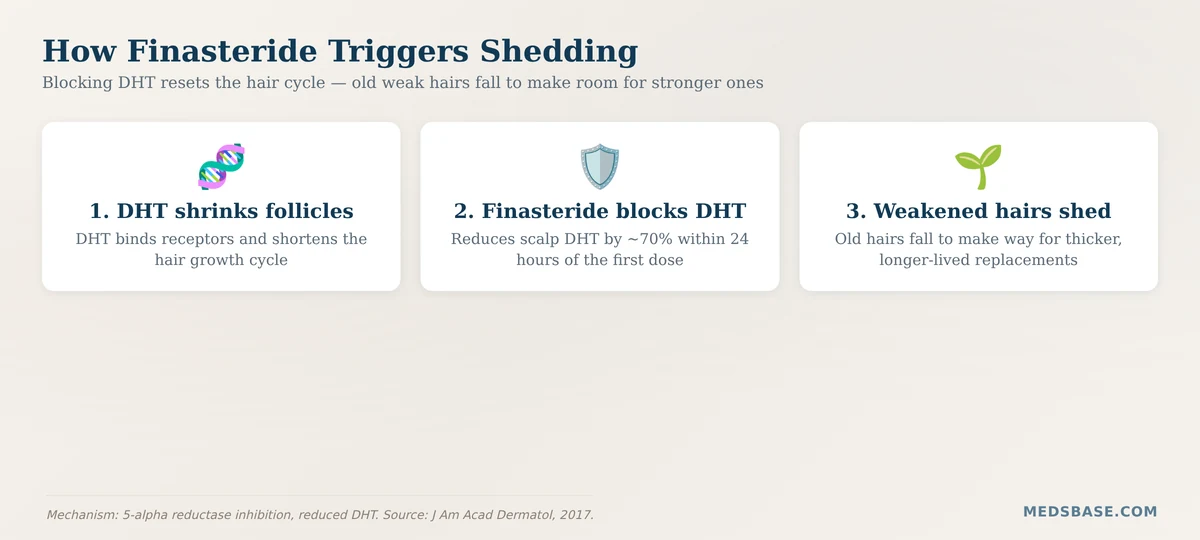
Think of your hair follicles like employees at a company that’s been running on toxic leadership (DHT). Some workers are barely hanging on — showing up late, producing poor work (thin, weak hairs). When you fire the toxic boss (block DHT with finasteride), the company doesn’t immediately thrive. First, those barely-hanging-on workers quit (shedding). Then, you hire stronger, more committed replacements (new, thicker hairs).
The biological sequence:
- DHT binds to androgen receptors in genetically susceptible scalp follicles, triggering a cascade that shortens the anagen (growth) phase from 3-7 years down to weeks or months.
- Finasteride inhibits 5-alpha reductase type II, the enzyme primarily responsible for DHT production in the scalp and prostate. Serum DHT drops ~70% within 24 hours of the first dose.
- DHT-deprived follicles enter a synchronized telogen phase. The old, miniaturized hair is pushed out by the emerging new hair shaft — this is the shedding you see.
- The follicle re-enters anagen with a longer-than-before growth phase. The new hair that emerges is thicker, darker, and lives longer.
Research Spotlight
The timing of the shedding is the part that catches most men off guard. You start finasteride on Day 1. For the first 1-2 weeks, nothing visible happens — DHT is dropping, but the hair cycle hasn’t shifted yet. Then around week 3, the first wave of resting-phase hairs begins to fall. By weeks 5-8, shedding can be dramatic — 100-300 hairs per day compared to the normal 50-100.
One detail that surprises almost everyone: the severity of your finasteride shedding phase may correlate with how well you’ll ultimately respond. Think about it — more shedding means more follicles were DHT-damaged and are now resetting. A minimal shed might mean fewer follicles were affected by DHT in the first place, or it might mean a slower response. There’s no way to predict individual response, but a strong shed should not discourage you.
Finasteride Shedding vs Balding: How to Tell the Difference
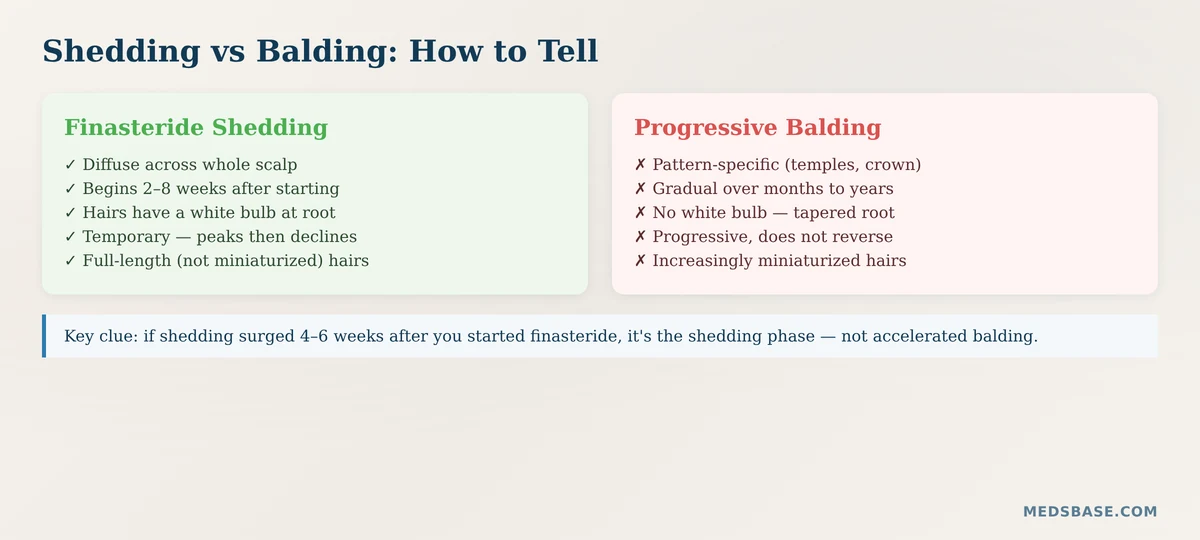
This is the question at the core of every anxious Google search at 2am: “Am I shedding because finasteride is working, or because my hair loss is accelerating?”
The distinction matters because the answer determines whether you should keep taking the medication or see a doctor. Here’s how to tell:
| Characteristic | Finasteride Shedding | Progressive Balding |
|---|---|---|
| Timing | Begins 2-8 weeks after starting finasteride | Gradual, over months to years |
| Pattern | Diffuse across entire scalp (not just temples/crown) | Pattern-specific (temples recede, crown thins) |
| Hair appearance | Full-length hairs with white bulb at root | Progressively thinner, shorter hairs (miniaturization) |
| Scalp visibility | Temporary increase in scalp visibility, then stabilizes | Progressive, permanent increase in scalp visibility |
| Shower drain | Sudden dramatic increase, then returns to baseline | Persistent gradual increase over months |
| Stopping finasteride | Shedding would stop, but hair loss would resume within 3-6 months | Not applicable |
The white bulb test: Take a shed hair and look at the root end. If it has a small white bulb (the hair’s club root from the telogen phase), it’s a naturally shed telogen hair — consistent with finasteride shedding. If the hairs are becoming progressively thinner at the root and have no bulb, that suggests ongoing miniaturization — and you should consult your doctor.
There’s also a timing clue that’s almost diagnostic: if you had stable or slowly progressive hair loss for years, started finasteride, and then 4-6 weeks later noticed a dramatic increase in shedding — that’s the finasteride shedding phase. True balding doesn’t suddenly accelerate 4-6 weeks after starting treatment; it accelerates when you STOP treatment.
A common experience: “Take Marcus, 32, who started finasteride after noticing temple thinning for 2 years. At week 5, he was losing 200+ hairs per day and nearly quit. He documented his hairline weekly with photos. By week 14, his shed had returned to baseline. By month 6, his temples showed new vellus hairs. By month 12, those vellus hairs had thickened into terminal hairs, and his hairline looked better than it had in 3 years.” This is an illustrative scenario based on the typical clinical progression.
If you’re still unsure after a month of observation, take weekly photos in consistent lighting. The camera doesn’t lie — if your hair density is stable or improving despite shedding, you’re on track. If density is visibly declining in a patterned way, see your doctor.
Finasteride Shedding Phase Timeline: Week by Week
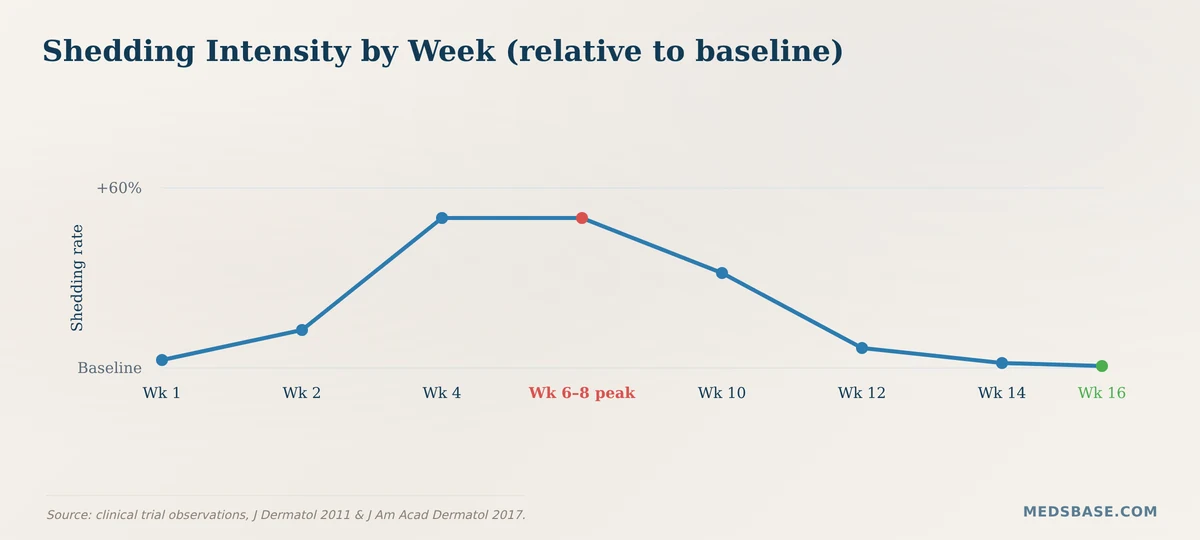
Quick Answer: The finasteride shedding phase follows a predictable arc: weeks 1-2 with no visible change, a gradual increase at weeks 3-4, a peak at weeks 4-8, gradual decline at weeks 9-12, and a return to baseline by weeks 12-16, with visible regrowth from month 4 onward.
Here’s what you can expect, week by week:
Weeks 1-2: The Calm Before Finasteride is actively reducing your serum DHT by ~70%, but your hair cycle hasn’t responded yet. You won’t notice any change in shedding. This is actually the easiest part — but don’t mistake the calm for the medication not working.
Weeks 3-4: The First Signs You may notice a 10-20% increase in hairs on your pillow, in the shower drain, or on your comb. This is the first wave of telogen-phase hairs being pushed out. The hairs you’re losing are the ones that were already in the resting phase — finasteride didn’t cause them to enter telogen, it just synchronized their exit.
Weeks 5-8: Peak Shedding This is the hardest period. Shedding can increase 30-60% above your normal rate. You might see 150-300 hairs per day. The shower drain collects a small animal’s worth of hair. Your temples and crown may look visibly thinner than before you started treatment.
This is when most men panic and consider quitting. Don’t. This peak means a large number of DHT-damaged follicles are resetting simultaneously — exactly what you want. The peak also means you’re close to the turning point.
Weeks 9-12: The Decline Shedding begins to slow. You’ll notice fewer hairs in the shower. Your scalp may still look thin from the cumulative shed, but new vellus (fine, light-colored) hairs are beginning to emerge where the old hairs fell.
Weeks 12-16: Return to Baseline Shedding returns to your pre-treatment rate, or potentially lower. The vellus hairs from weeks 9-12 begin to thicken and darken. This is when you can first see evidence that finasteride is working — but the full result is still months away.
Month 4-6: Early Regrowth Visible improvement begins. New terminal hairs are emerging at the hairline and crown. The scalp looks fuller than it did at the peak shed. Photographic comparison with your week-8 photos will show a clear difference.
Month 6-12: Progressive Improvement Continued thickening of existing hairs and new growth. Research published in the Journal of the American Academy of Dermatology found that hair count increases were measurable at 6 months and maximal at 12-24 months.
Month 12-24: Peak Results Maximum hair density. 85-90% of men who responded at all reach their peak results in this window. Maintenance dosing continues indefinitely — stopping finasteride reverses all gains within 6-12 months.
Every man’s timeline varies. Some shed heavily for 2 weeks; others shed moderately for 10 weeks. The duration doesn’t predict results. What matters is persistence through the peak.
Finasteride vs Dutasteride Shedding: Which Is Worse?
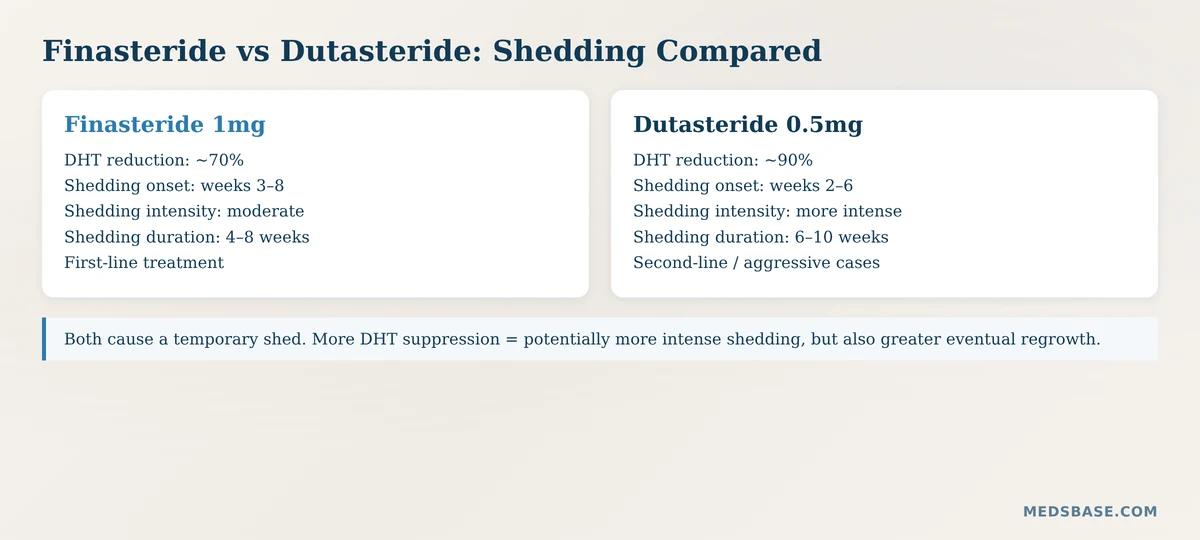
If finasteride reduces DHT by ~70%, dutasteride reduces it by ~90% — it inhibits both type I and type II 5-alpha reductase. More DHT suppression means a potentially more dramatic initial shed.
A study comparing finasteride and dutasteride found that dutasteride 0.5mg produced greater hair count increases than finasteride 1mg at 24 weeks, but the initial shedding phase was reported as more noticeable by dutasteride users. The shedding onset was slightly earlier (weeks 2-4 vs 3-6) and the peak intensity was higher.
Q: Which one should you choose?
A:
| Factor | Finasteride 1mg | Dutasteride 0.5mg |
|---|---|---|
| DHT reduction | ~70% | ~90% |
| Shedding onset | Weeks 3-8 | Weeks 2-6 |
| Shedding intensity | Moderate | Potentially more intense |
| Shedding duration | 4-8 weeks | 6-10 weeks |
| Efficacy | Proven; 48% hair count increase at 1 yr | Proven; ~55% hair count increase at 6 mo |
| Starting recommendation | First-line | Second-line or aggressive cases |
If you’re just starting treatment, finasteride is the standard first choice. Dutasteride is typically reserved for men who didn’t respond adequately to finasteride after 12+ months, or for those with aggressive early-onset hair loss. Starting with dutasteride means committing to a potentially more intense finasteride shedding phase-like experience.
The good news: neither drug causes permanent shedding. Both are temporary phases that resolve into regrowth. Your choice should be based on overall efficacy and side-effect profile — anxiety about the shed shouldn’t drive the decision, since both drugs cause it.
7 Proven Tips to Get Through the Finasteride Shedding Phase
1. Don’t Stop the Medication This sounds obvious, but it’s the #1 mistake. A significant percentage of men quit finasteride during the first 3 months — right when the shedding peaks. Quitting during the finasteride shedding phase means you endured the worst part for zero benefit. Set a minimum commitment of 6 months before evaluating results.
2. Document Your Progress Weekly Take photos of your hairline, crown, and top-down in the same lighting, same room, same angle, every Sunday. You’ll need these when you hit week 8 and feel like nothing’s working. The human eye adapts to gradual change too slowly — photos don’t lie. After 16 weeks, compare your week-4 photo to your week-16 photo. The difference will likely surprise you.
3. Wash Gently, Not Aggressively During the shedding peak, some men scrub harder, thinking they need to “clean out” the loose hairs. This can irritate the scalp and mechanically pull hairs that weren’t ready to shed. Use a mild shampoo, lukewarm water, and gentle fingertip massage. Avoid vigorous towel-drying — pat dry instead.
4. Manage Stress Stress itself can trigger telogen effluvium — a separate type of shedding from emotional or physical stress. If you’re already anxious about finasteride shedding, you could compound the problem. A clinical review in Dermatologic Therapy noted that stress-induced telogen effluvium can overlap with medication-induced shedding, making it difficult to distinguish the two. Sleep, exercise, and stress management aren’t just wellness fluff — they protect your hair.
5. Support Hair Health Nutritionally Your body needs raw materials to build new hair. Ensure adequate protein intake (hair is keratin protein), iron (ferritin below 40 ng/mL can impair regrowth), vitamin D, zinc, and biotin. You don’t need expensive hair supplements — a balanced diet covers most needs. If you’re deficient, talk to your doctor about targeted supplementation.
6. Avoid Harsh Styling During the Shed Put away the harsh gels, high-heat tools, tight hairstyles, and chemical treatments. Your hair is already under stress from the cycle reset. Adding mechanical or chemical stress to already-shedding follicles is like running on a sprained ankle. Give your hair 12-16 weeks of gentle treatment.
7. Remember the Endgame The finasteride shedding phase is not hair loss — it’s hair turnover. The hairs falling out were already programmed to fall out; finasteride just synchronized the timing. The hairs that replace them will be thicker, darker, and longer-lived. Keep a photo from your week-1 baseline on your phone. Look at it whenever you’re tempted to quit.
What the Research Says
| Study | Year | Finding | Source |
|---|---|---|---|
| Finasteride efficacy in AGA | 2011 | Shedding documented as telogen effluvium-like phenomenon; correlated with eventual response | J Dermatol |
| Long-term finasteride outcomes | 2017 | 48% hair count increase at 1 year; 86% durability in responders at 5 years; shedding observed in majority during months 1-3 | J Am Acad Dermatol |
| Finasteride vs dutasteride | 2017 | Dutasteride 0.5mg produced greater hair count increase; shedding reported as more intense by dutasteride users | J Am Acad Dermatol |
| Telogen effluvium mechanisms | 2018 | Stress and medication-induced TE can overlap; clinical differentiation guide | Dermatol Ther |
| Finasteride safety profile | 2019 | Sexual side effects in 3.8% vs 2.1% placebo; most resolved on discontinuation or with continued use | NIH MedlinePlus |
What this means for you: The finasteride shedding phase is a well-documented, expected part of treatment. It’s not a side effect — it’s a mechanism of action. The research consistently shows that shedding correlates with follicle reset and eventual regrowth. The medication has a strong long-term safety record when used as prescribed. If you’re concerned about side effects, discuss them with your doctor rather than making unilateral decisions during the shedding phase.
Frequently Asked Questions
Q: Does finasteride cause hair loss at first?
A: It can look that way, but finasteride doesn’t cause permanent hair loss. It triggers a temporary shedding of weak, DHT-damaged hairs to make way for stronger regrowth. This finasteride shedding phase is a sign the medication is working, not a sign it’s failing.
Q: When will finasteride shedding stop?
A: For most men, the finasteride shedding phase begins to decline by weeks 9-12 and returns to baseline by weeks 12-16. If shedding persists beyond 16 weeks or progressively worsens without any signs of regrowth, consult your prescribing doctor.
Q: Is finasteride shedding a good sign?
A: Generally, yes. Shedding means follicles are responding to the DHT reduction by resetting their growth cycle. Men who experience noticeable shedding often go on to have good regrowth results. That said, the absence of shedding doesn’t mean the medication isn’t working — some men respond without a dramatic shed.
Q: Should I quit finasteride if I’m shedding?
A: No. Quitting during the finasteride shedding phase means you endured the worst part with zero benefit. Wait at least 6 months (ideally 12) before evaluating results. If you stop, all progress reverses within 6-12 months.
Q: How to tell finasteride shedding from balding?
A: Finasteride shedding starts 2-8 weeks after beginning treatment, is diffuse across the scalp, and the shed hairs have a white bulb at the root. Progressive balding is gradual over months to years, follows a pattern (temples, crown), and hairs show progressive miniaturization. Taking weekly photos helps distinguish the two.
Q: Does dutasteride cause less shedding than finasteride?
A: No — if anything, dutasteride may cause a more intense shedding phase because it suppresses DHT more completely (~90% vs ~70%). However, the increased shedding may be associated with greater eventual regrowth. Both drugs cause a temporary shed; neither is permanent.
Q: Can I use minoxidil with finasteride during shedding?
A: Yes, and many doctors recommend it. Minoxidil works through a different mechanism (vasodilation and potassium channel opening) and can complement finasteride’s hormonal action. However, minoxidil itself causes an initial shedding phase when first started, so beginning both simultaneously could intensify shedding temporarily before improving results.
Q: What if my shedding doesn’t stop after 4 months?
A: If the finasteride shedding phase persists beyond 16 weeks with no signs of regrowth, see your doctor. Possible causes: the shedding may not be treatment-related (stress, nutritional deficiency, thyroid disorder), the dose may need adjustment, or you may be a non-responder. A dermatologist can perform a pull test and trichoscopy to differentiate.
The Bottom Line
The finasteride shedding phase is arguably the most psychologically challenging part of treating hair loss — but it’s also the most misunderstood. Shedding doesn’t mean the medication is failing. It means follicles are resetting. The hairs you lose during weeks 3-12 were already on borrowed time; finasteride is simply clearing the way for stronger replacements.
Here’s your immediate action plan: If you just started finasteride (or are about to), take a baseline photo today. Commit to 6 months minimum. When shedding starts, compare your hair to that baseline photo, not to yesterday. Trust the process — the evidence overwhelmingly supports that persisting through the finasteride shedding phase leads to visible improvement for the majority of men.
Browse our finasteride and hair loss treatment options at MedsBase. Wondering how minoxidil compares? Read our full guide to oral vs topical minoxidil. And if today’s post about gut health after antibiotics caught your eye, read probiotics after antibiotics: which strains actually work.
Disclaimer: This article is for informational purposes only and does not constitute medical advice. Finasteride is a prescription medication. Consult your doctor before starting, stopping, or changing any medication regimen. Individual results vary.

Written by
Sophie ChenPharmaceutical Content Researcher · 8 years experience
Sophie Chen is a pharmaceutical content researcher with 8 years covering generic medication access and clinical pharmacology. She specialises in international regulatory frameworks, bioequivalence standards, and patient-facing education on therapeutic drug classes. She is not a clinician.