








✓ Medically reviewed by · Last reviewed: May 2026
Pharmacy Researcher · 8 years experience
Pharmacy researcher with 8 years reviewing clinical drug information, generic formulation equivalence, and international pharmaceutical standards. Focuses on patient-facing accuracy in medication education.
continuous ketone monitoring — Continuous Ketone Monitoring: 7 Proven Benefits for Diabetes. Read on for an evidence-backed guide covering everything you need to know.
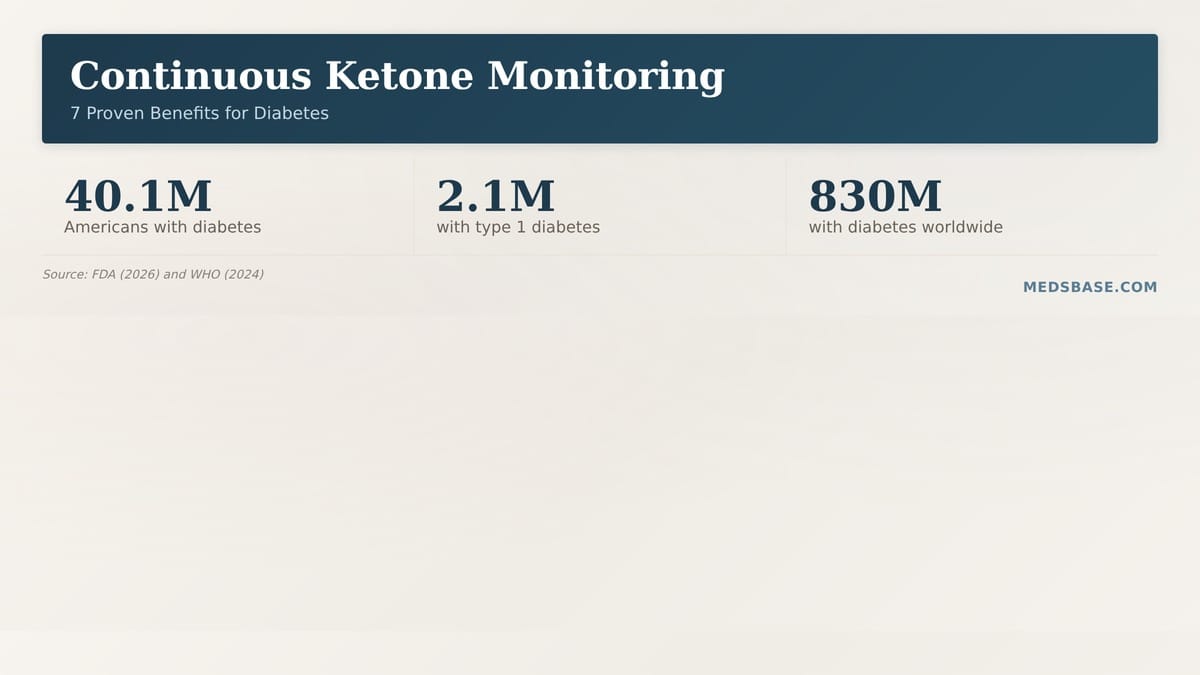
A small patch worn on the skin could now be the difference between catching a dangerous rise in ketones early — and finding out in an emergency room. On August 25, 2026, the U.S. Food and Drug Administration authorized the first wearable device that continuously monitors both ketones and blood sugar in a single unit, a step the agency itself described as a “breakthrough for the safety of children and adults living with diabetes.” If you or someone you love manages diabetes, continuous ketone monitoring is about to change the conversation around one of the condition’s scariest complications.
By the end of this guide you will know exactly what continuous ketone monitoring is, what ketones signal in your body, the warning signs it can flag early, who benefits most, and how the technology compares with the finger-prick and urine-strip tests you may already use. You will also know where continuous ketone monitoring fits alongside diabetes medication — because a sensor is a safety net, not a substitute for treatment.
Key Takeaways
- Continuous ketone monitoring is the first technology to watch ketones and glucose together, around the clock — previously you could only take a single snapshot with a strip or meter
- Ketones are the clue, not the disease: they rise when your body burns fat for fuel, and a rapid rise is the early signature of diabetic ketoacidosis (DKA), a life-threatening emergency
- The device reads the fluid beneath your skin every minute and can alert you the moment ketones climb — often before symptoms even appear
- Continuous ketone monitoring is most valuable for people with type 1 diabetes, but it is increasingly relevant for type 2 diabetes treated with insulin
- A sensor does not replace medication — it makes your treatment safer by telling you, in real time, when something is going wrong
- What Is Continuous Ketone Monitoring?
- How Does Continuous Ketone Monitoring Work?
- Continuous Ketone Monitoring: Who It’s For
- Safety: DKA & What Continuous Ketone Monitoring Flags
- What the Research Says
- Continuous Ketone Monitoring vs Traditional Ketone Tests
- How to Use Continuous Ketone Monitoring
- Related Reading
- Frequently Asked Questions
- The Bottom Line
What Is Continuous Ketone Monitoring?
Continuous ketone monitoring is a wearable technology that measures the level of ketones in your body continuously — minute by minute, day and night — rather than at a single point in time like a traditional test strip. In the newly authorized device, a single sensor placed on the skin measures ketones and glucose together, sending both readings wirelessly to a smartphone so you can see not only your current levels but whether they are rising or falling.
To understand why that matters, you have to understand what ketones are. Ketones are acids your liver produces when it breaks down fat for energy. Normally, your body runs on glucose (sugar) for fuel. But when insulin is low or your cells cannot use glucose properly, your body switches to burning fat, and ketones appear in the blood. A small amount is harmless — many people produce ketones during fasting or a very low-carbohydrate diet. The danger comes when ketones build up fast, because in high concentrations they make the blood acidic.
The FDA’s August 2026 announcement authorized the Libre Duo 10 Day Continuous Dual Glucose Ketone Monitoring System for people aged 2 years and older living with diabetes. The agency noted that, until now, people who needed to check ketones had to do so separately, using tests that could only provide one measurement at a time and could not tell users whether ketones were trending up or down.
Continuous ketone monitoring closes a real gap. A urine strip or a blood ketone meter tells you where you are right now. It does not tell you whether the reading was lower an hour ago and climbing — and that trend is often the single most important piece of information.
How Does Continuous Ketone Monitoring Work?
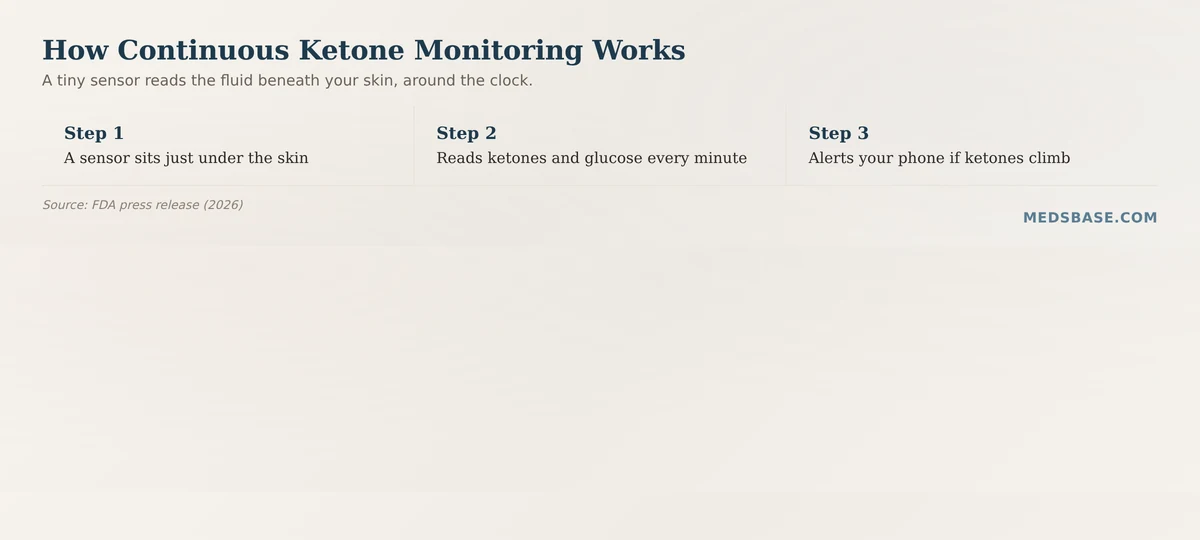
Continuous ketone monitoring works by reading the fluid just beneath the surface of your skin, called interstitial fluid. A tiny sensor sits in this fluid and measures the concentration of ketones — specifically a ketone called beta-hydroxybutyrate, which is the main ketone the body produces during DKA, as MedlinePlus explains — alongside glucose.
Here is the process in plain terms. The sensor uses a small filament that rests in the interstitial fluid under the skin. It takes a reading every minute, day and night. Those readings are transmitted wirelessly to a compatible smartphone, where you can see your current ketone and glucose levels and whether each is trending up, down, or holding steady. The device can also send an automatic alert if ketones cross a threshold you and your care team have set.
A useful analogy: think of a single strip test as a single photograph, and continuous ketone monitoring as a live video feed. A photograph can capture a moment; a video tells you the direction of travel. For a condition like DKA, where ketones can climb quickly over hours, the direction matters as much as the number.
The FDA release states that the authorization was based on six clinical studies enrolling more than 600 participants aged 2 and older, and that the device accurately tracked clinically meaningful differences in ketone levels across its 10-day wear period — including identifying elevated ketones before the onset of diabetic ketoacidosis.
Clinical insight: Healthcare teams have long wished for exactly this tool. The classic frustration with ketone monitoring is that patients test once, see a “normal” reading, and relax — while ketones continue climbing silently. Continuous ketone monitoring removes that false reassurance by showing the trend, which is why endocrinologists see it as a meaningful safety upgrade rather than a gadget.
Continuous Ketone Monitoring: Who It’s For
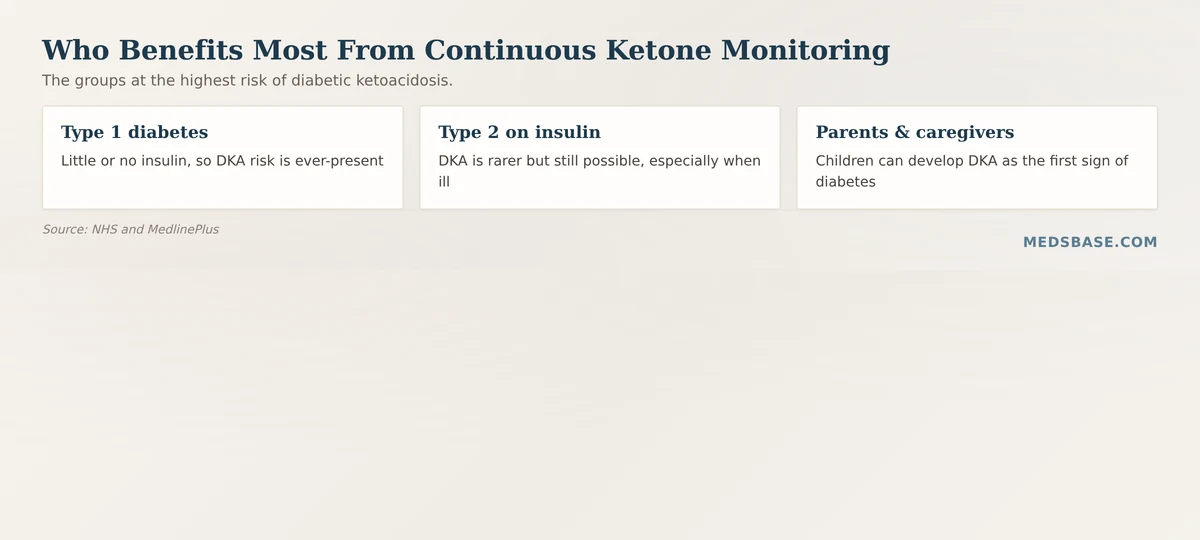
Continuous ketone monitoring is designed for people living with diabetes, and its biggest impact is for the groups at the highest risk of diabetic ketoacidosis. The FDA release notes that roughly 40.1 million Americans live with diabetes, and an estimated 2.1 million have type 1 diabetes.
People with type 1 diabetes stand to benefit most. In type 1 diabetes the body makes little or no insulin, so the risk of DKA is ever-present — triggered by missed insulin doses, illness, infection, or a pump malfunction. For this group, continuous ketone monitoring is a genuine early-warning system.
People with type 2 diabetes treated with insulin also benefit. Although DKA is less common in type 2 diabetes, it can still happen, particularly during severe illness or when insulin is withheld. Continuous ketone monitoring adds a safety layer for anyone whose treatment depends on insulin balance.
The third group is parents and caregivers of children with diabetes. DKA is sometimes the very first sign of undiagnosed type 1 diabetes in a child, and the NHS warns that this is a key group to watch. A sensor that alerts a parent the moment ketones begin to climb can mean the difference between a phone call to the doctor and a trip to A&E.
- For: anyone with type 1 diabetes; people with type 2 diabetes on insulin; parents and caregivers of children with diabetes; people prone to recurrent DKA.
- For: people who want an early, trend-based warning rather than a single snapshot.
- Avoid / hold off: people who prefer finger-prick tests and are not comfortable with a smartphone-connected device; anyone who cannot keep a sensor adhered for the wear period. The device is a monitoring tool — it does not replace insulin or other diabetes medication, and it is not a substitute for medical advice.
- Always: interpret ketone readings in the context of glucose and symptoms, and confirm high readings with your care team.
If you manage type 2 diabetes with oral medication such as metformin, continuous ketone monitoring may be less of a daily necessity — but it still has a place during illness or if you are at risk. Managing your blood sugar well remains the foundation, which is why understanding your medication options matters. Browse the MedsBase diabetes medication range to see the treatments that form that foundation.
Safety: DKA & What Continuous Ketone Monitoring Flags
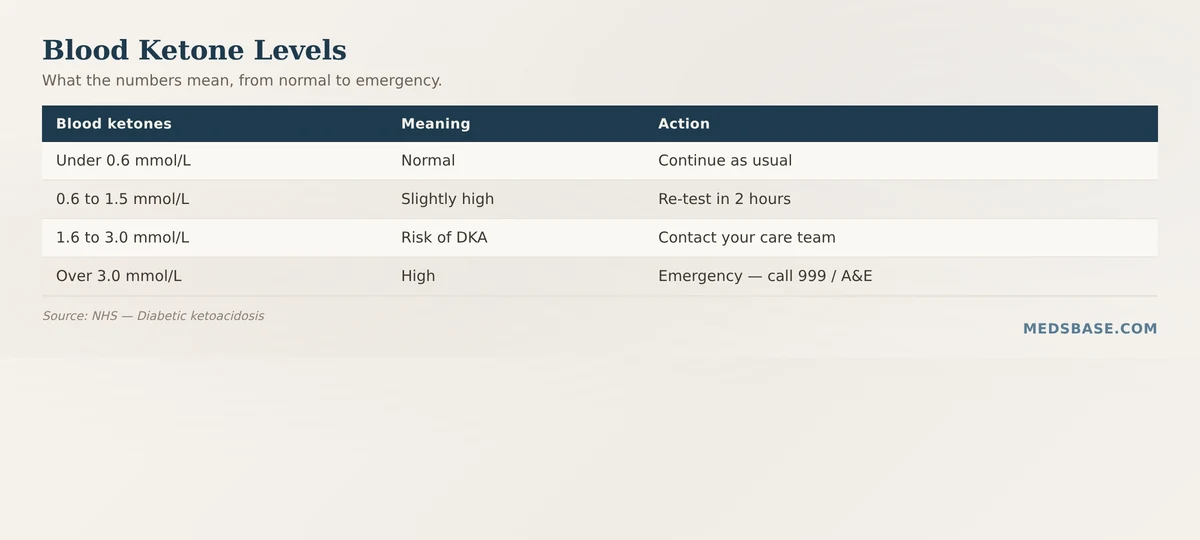
The whole point of continuous ketone monitoring is to flag the early climb toward diabetic ketoacidosis. DKA is a serious, potentially life-threatening condition in which a lack of insulin causes ketones to build up in the blood, making it acidic. The NHS describes it as needing urgent hospital treatment, and MedlinePlus adds that if untreated it can lead to severe illness or death.
Knowing the numbers makes the sensor meaningful. The NHS lists these blood-ketone thresholds:
| Ketone level (blood) | Meaning | What to do |
|---|---|---|
| Under 0.6 mmol/L | Normal | Keep going as usual |
| 0.6 to 1.5 mmol/L | Slightly high | Test again in 2 hours |
| 1.6 to 3.0 mmol/L | Risk of DKA | Contact your diabetes care team |
| Over 3.0 mmol/L | High — possible DKA | Call 999 or go to A&E |
The symptoms DKA produces develop over about 24 hours but can arrive faster. The NHS lists feeling very thirsty, needing to pee more often, stomach pain, feeling or being sick, deep breathing, fruity-smelling breath, and feeling tired, sleepy, or confused. MedlinePlus adds decreased alertness, flushed face, and nausea and vomiting.
Here is where continuous ketone monitoring earns its keep. Many of these symptoms overlap with ordinary illness — a stomach bug can look a lot like early DKA. A sensor that shows ketones climbing sharply removes the guesswork, giving you a specific, actionable number rather than a vague “something feels off.”
- If your sensor alerts you to rising ketones, check your glucose too
- Follow your sick-day rules, and do not stop taking insulin
- Contact your care team if ketones are 1.6–3.0 mmol/L even without symptoms
- Seek emergency care if ketones exceed 3.0 mmol/L or if symptoms appear
- Treat the cause — illness, missed insulin, or a pump issue — not just the number
Mistakes to avoid:
- Ignoring a rising trend because the current number is still “normal”
- Stopping insulin when you are not eating — this is a common trigger for DKA
- Treating a sensor alert as a replacement for contacting your care team
What the Research Says
The evidence base for continuous ketone monitoring is still young, but the regulatory data is concrete. The FDA press release confirms that the authorization rested on six clinical studies with more than 600 participants, and that the device “accurately tracked clinically meaningful differences in ketone levels across its 10-day wear period, including identifying elevated ketone levels before the onset of diabetic ketoacidosis.”
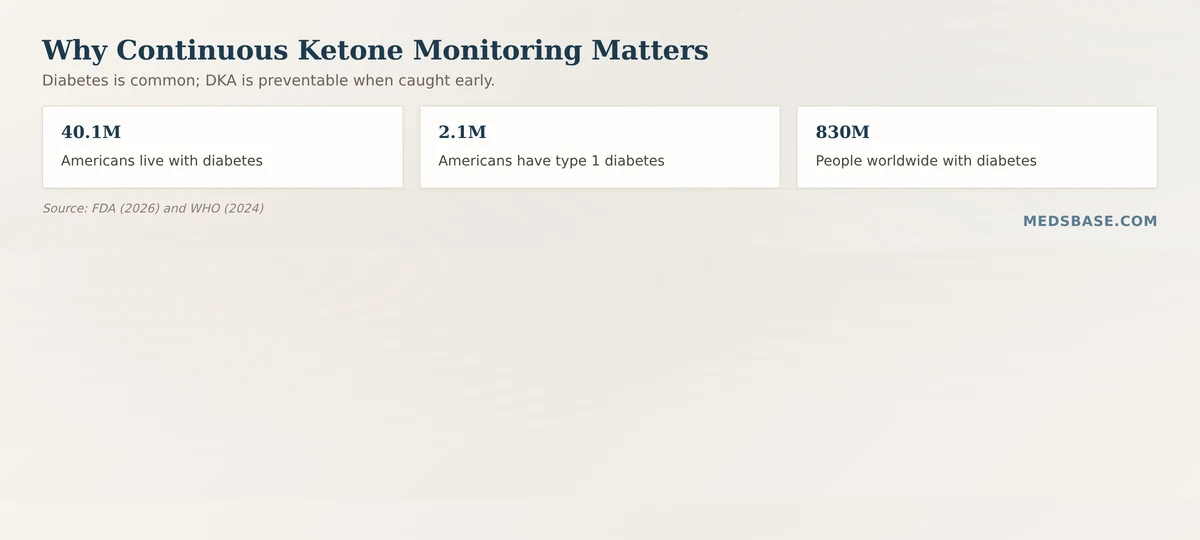
The scale of the problem the device addresses is well documented. The WHO diabetes fact sheet reports that the number of people living with diabetes worldwide rose from 200 million in 1990 to 830 million in 2022, and that diabetes can lead to blindness, kidney failure, heart attacks, stroke, and lower-limb amputation. The FDA release cites CDC figures of 40.1 million Americans living with diabetes and 2.1 million with type 1 diabetes.
| Source | Year | Key finding |
|---|---|---|
| FDA press release | 2026 | First device to continuously monitor ketones + glucose; 6 studies, 600+ participants; detected rising ketones before DKA |
| WHO fact sheet | 2024 | 830 million people with diabetes worldwide (2022); >95% of cases are type 2 |
| NHS DKA page | 2023 | Blood ketone thresholds: <0.6 normal, 0.6–1.5 slightly high, 1.6–3.0 DKA risk, >3.0 emergency |
| MedlinePlus DKA | 2025 | Beta-hydroxybutyrate is the main ketone measured; DKA is life-threatening if untreated |
What this means for you: the numbers tell a consistent story — diabetes is common, DKA is preventable when caught early, and the historical weakness has always been that ketone testing was intermittent. Continuous ketone monitoring is the first consumer tool designed specifically to close that gap, and the regulatory evidence says it does so reliably.
Continuous Ketone Monitoring vs Traditional Ketone Tests
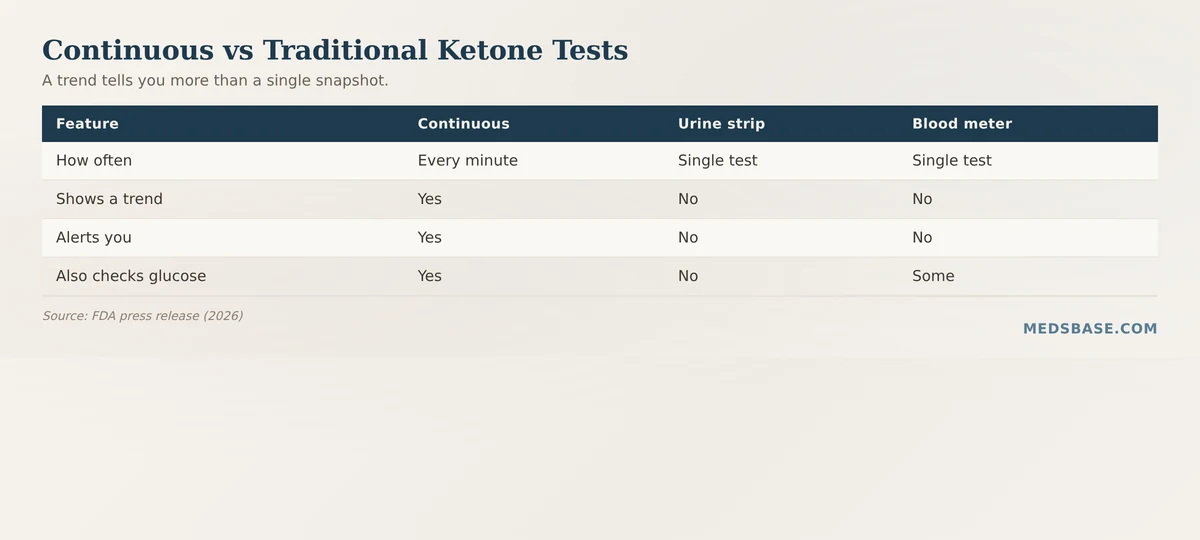
You may already test ketones with urine strips or a blood ketone meter. Continuous ketone monitoring does not make those tools obsolete, but it changes what they can do for you.
| Feature | Continuous ketone monitoring | Urine strip | Blood ketone meter |
|---|---|---|---|
| How often | Every minute | Single test | Single test |
| Shows a trend | Yes | No | No |
| Body fluid | Interstitial fluid | Urine | Blood |
| Alerts you | Yes | No | No |
| Also measures glucose | Yes (new device) | No | Some meters |
Urine strips are cheap and easy, but they have a delay — they reflect what your body was doing hours earlier, and they can lag behind blood changes. A blood ketone meter is more accurate and more current, but it is still a single snapshot and requires a separate finger-prick test on top of glucose testing.
The standout advantage of continuous ketone monitoring is the trend. Two people can each record a reading of 1.2 mmol/L; one has been stable for hours, the other was 0.4 an hour ago. Only continuous ketone monitoring tells you which one you are. For a complication that can escalate within hours, that distinction is everything.
The trade-offs are practical: continuous ketone monitoring requires wearing a sensor, pairing it with a smartphone, and managing cost and adhesion. For everyday low-risk management, a traditional test may be perfectly adequate. The right choice depends on your individual risk — and your care team is best placed to help you decide.
How to Use Continuous Ketone Monitoring
Getting the most out of continuous ketone monitoring is less about the device and more about the routine around it.
- Place the sensor correctly. Apply it to clean, dry skin on a recommended site (typically the upper arm), and avoid areas with lotion, scars, or tight clothing that could dislodge it.
- Pair it with your phone. Follow the app’s setup so readings flow continuously and alerts reach you when they matter — including overnight.
- Set thresholds with your care team. Use the NHS ranges as a starting point, but confirm the alert levels that are right for you.
- Act on trends, not just numbers. A climbing trend toward 1.5 mmol/L may warrant a call sooner than a flat 1.5 reading.
- Interpret ketones in context. Always weigh the ketone reading against your glucose and how you feel, as the FDA advises.
Mistakes to avoid:
- Setting alerts too low and becoming desensitized to them
- Treating a sensor as a reason to relax on insulin or medication
- Ignoring a rising trend because the current number looks “fine”
Continuous ketone monitoring works best as one layer of a broader plan. The foundation is still your treatment — insulin for type 1 diabetes, and for many people with type 2 diabetes, oral medication such as metformin alongside diet and activity. If you are reviewing your options, MedsBase stocks metformin (Metford) and a range of other diabetes medications to support that foundation.
Frequently Asked Questions
Q: What are ketones?
A: Ketones are acids your liver makes when it breaks down fat for energy instead of glucose. Small amounts are normal during fasting or a low-carb diet, but a rapid buildup makes the blood acidic — which is what happens in diabetic ketoacidosis. MedlinePlus explains that the main ketone measured in DKA is beta-hydroxybutyrate.
Q: What is diabetic ketoacidosis (DKA)?
A: DKA is a serious, potentially life-threatening condition caused by a lack of insulin, which lets ketones build up in the blood. The NHS describes it as needing urgent hospital treatment. Symptoms include extreme thirst, frequent urination, stomach pain, deep breathing, and fruity-smelling breath.
Q: What is a normal ketone level?
A: A blood ketone level under 0.6 mmol/L is normal, according to the NHS. A level of 0.6–1.5 mmol/L is slightly high and worth re-testing in two hours; 1.6–3.0 mmol/L signals a risk of DKA; above 3.0 mmol/L is an emergency.
Q: Can you monitor ketones continuously?
A: Yes — for the first time. The FDA authorized a device in August 2026 that continuously monitors ketones and glucose together, reading the fluid beneath the skin every minute. Before this, ketone testing was limited to single-snapshot urine strips or blood meters.
Q: What are the symptoms of DKA?
A: The NHS lists feeling very thirsty, needing to pee more, stomach pain, feeling or being sick, deep breathing, fruity-smelling breath, and feeling sleepy or confused. MedlinePlus adds decreased alertness and flushed face.
Q: Does continuous ketone monitoring replace my diabetes medication?
A: No. It is a monitoring and safety tool, not a treatment. It tells you when something is going wrong so you can act — but the foundation of care remains your insulin or oral medication such as metformin, your diet, and your care team’s guidance.
Q: Who should use continuous ketone monitoring?
A: It is most valuable for people with type 1 diabetes, people with type 2 diabetes on insulin, and parents or caregivers of children with diabetes — the groups at highest risk of DKA. Your care team can help you decide whether the added early warning is worth it for your situation.
The Bottom Line
Continuous ketone monitoring is a genuine step forward, not a gadget. For the first time, people with diabetes can see ketones and glucose together, in real time, with an alert when ketones begin to climb toward a dangerous zone. That is a meaningful upgrade over the single-snapshot tests that have defined ketone monitoring for decades.
The honest caveat is that a sensor is only as good as the response it prompts. Continuous ketone monitoring does not replace insulin, medication, or good judgment — it makes all three work better by giving you information earlier. For anyone who has ever wondered “am I fine, or is this something serious?”, that early information is worth a great deal.
If you or someone you care for lives with diabetes, the most useful next step is a conversation with your care team about whether continuous ketone monitoring fits your situation. And while you are building that plan, make sure the treatment foundation is solid — browse MedsBase’s diabetes medications to understand your options. Wondering how this fits with the broader picture of blood sugar and hormones? Read our guide to diabetes and menopause.

Written by
Sophie ChenPharmaceutical Content Researcher · 8 years experience
Sophie Chen is a pharmaceutical content researcher with 8 years covering generic medication access and clinical pharmacology. She specialises in international regulatory frameworks, bioequivalence standards, and patient-facing education on therapeutic drug classes. She is not a clinician.