








✓ Medically reviewed by · Last reviewed: May 2026
Pharmacy Researcher · 8 years experience
Pharmacy researcher with 8 years reviewing clinical drug information, generic formulation equivalence, and international pharmaceutical standards. Focuses on patient-facing accuracy in medication education.
seborrheic dermatitis — Seborrheic Dermatitis: 7 Proven Ways to Treat Flaky, Itchy Skin. Read on for an evidence-backed guide covering everything you need to know.
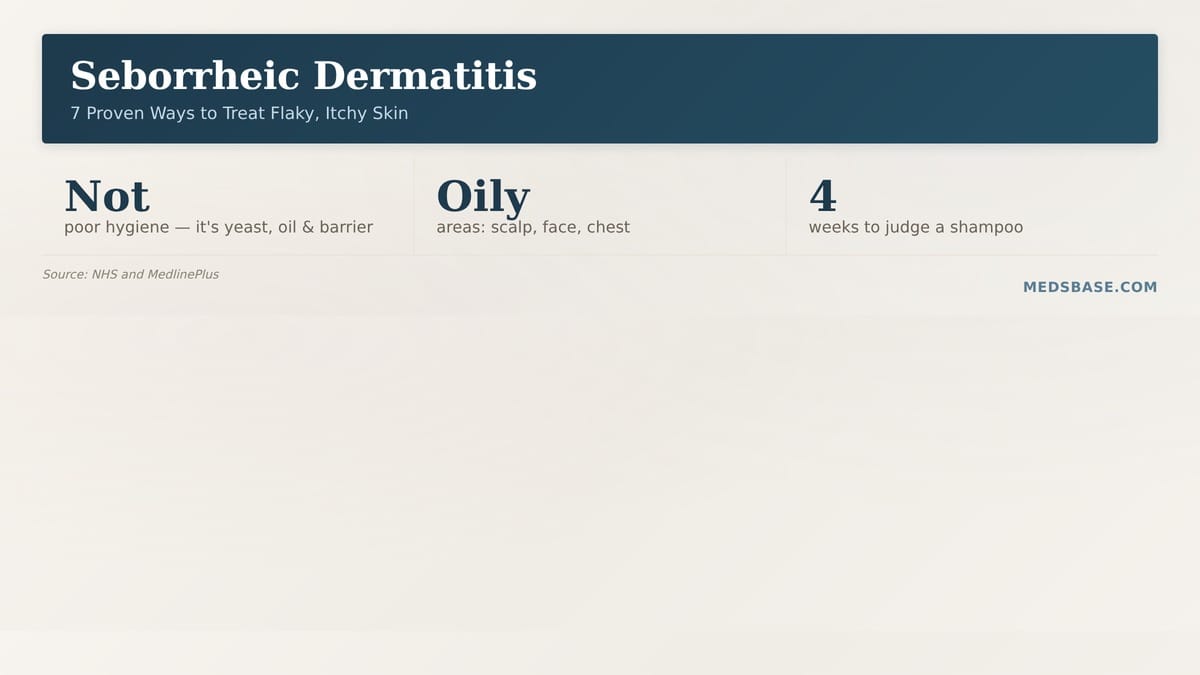
The flakes keep coming back no matter how often you wash, and somewhere along the way you have started to wonder if it is your fault. It is not. Seborrheic dermatitis is a chronic, inflammatory skin condition — not a sign of poor hygiene — and it affects the oilier parts of your body, from the scalp and eyebrows to the sides of the nose and the middle of the chest. Once you understand what is actually driving it, treating seborrheic dermatitis becomes a manageable routine rather than a guessing game.
By the end of this guide you will know what seborrheic dermatitis really is, why it happens, which over-the-counter ingredients actually work, when to move to prescription-strength treatment, and the exact point at which you should see a doctor. You will also learn why the right antifungal shampoo — the kind MedsBase stocks — is often the single most effective first step.
Key Takeaways
- Seborrheic dermatitis is caused by a yeast called Malassezia, excess oil, and a weakened skin barrier working together — not by poor hygiene
- It is chronic and comes and goes, but it is very controllable with the right routine
- Over-the-counter shampoos with ketoconazole, zinc pyrithione, salicylic acid, or coal tar are the proven first line — and they need up to 4 weeks to show their effect
- When OTC options fall short, prescription-strength ketoconazole, ciclopirox, or a corticosteroid is the next step
- One habit surprises most people: you have to keep treating it even after the flakes clear, because the underlying tendency never fully goes away
- What Is Seborrheic Dermatitis?
- What Causes Seborrheic Dermatitis?
- Recognizing Seborrheic Dermatitis
- Seborrheic Dermatitis Treatment Options
- How to Use Seborrheic Dermatitis Treatment
- Seborrheic Dermatitis vs Other Skin Conditions
- What the Research Says
- Related Reading
- Frequently Asked Questions
- The Bottom Line
What Is Seborrheic Dermatitis?
Seborrheic dermatitis is a common inflammatory skin condition that causes flaky, white-to-yellowish scales to form on oily areas of the body, with or without redness. MedlinePlus describes it as forming where the skin is oily or greasy — most often the scalp, eyebrows, eyelids, the creases of the nose, behind and inside the ears, and the middle of the chest.
When the same condition affects an infant’s scalp, it is called cradle cap. In adults, it is the condition behind many stubborn cases of what people casually call dandruff. The NHS notes that dandruff itself is common and harmless, but that scaly, itchy, and red patches on the scalp, face, and other areas can point to seborrheic dermatitis rather than simple dandruff.
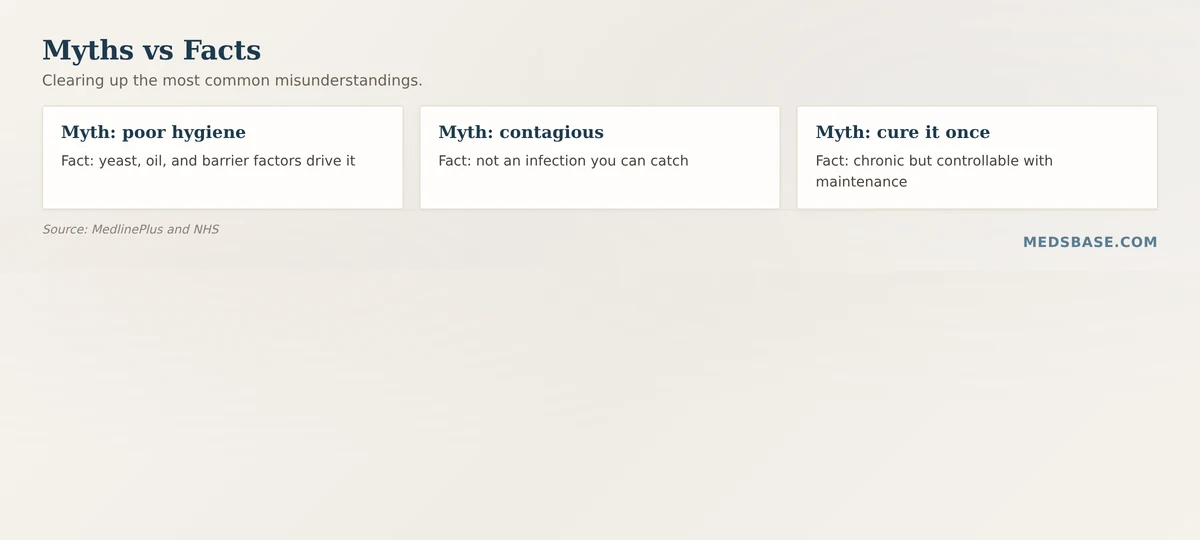
The crucial point is the word chronic. Seborrheic dermatitis comes and goes. It may flare with stress or cold weather, improve in summer, and then return. Understanding that it is a tendency you manage rather than an infection you eliminate is the single most useful mindset shift for living with it.
What Causes Seborrheic Dermatitis?
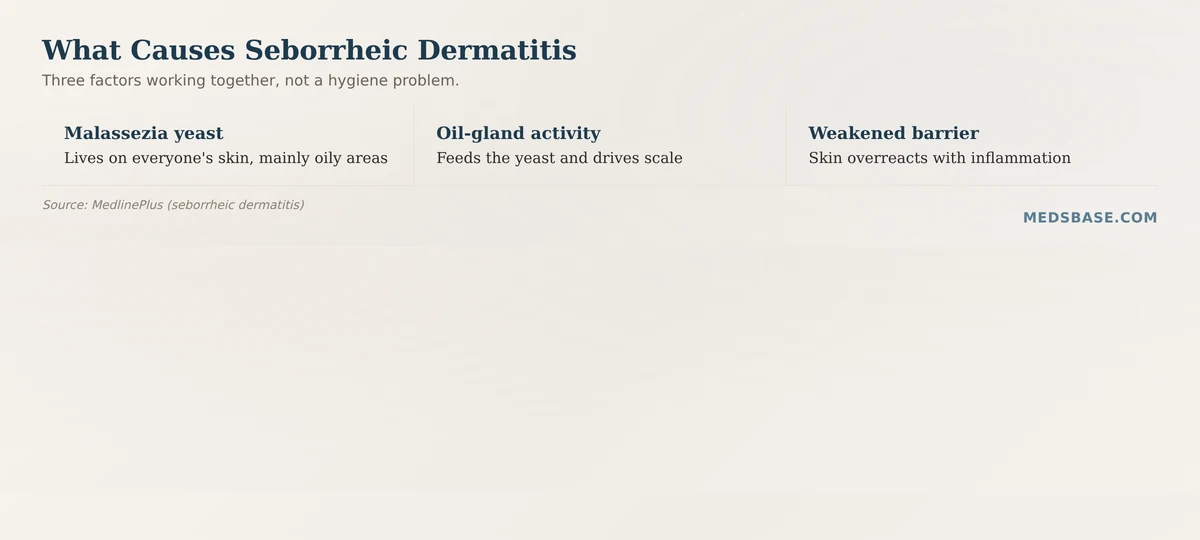
The exact cause of seborrheic dermatitis is unknown, but the picture is clear enough to be useful. MedlinePlus explains that it likely results from a combination of factors: oil-gland activity, a yeast called Malassezia that lives on everyone’s skin, changes in the skin’s barrier function, and your genes.
Malassezia is the key player people find surprising. This yeast naturally lives on the skin, mainly in areas with more oil glands. It is not an infection you caught and it is not contagious — it is part of the normal skin ecosystem. In people with seborrheic dermatitis, the skin seems to overreact to this yeast, producing inflammation, itching, and flaking. Think of it less like a germ you need to kill and more like a neighbour your skin happens to be allergic to.
The NHS adds that stress and cold weather can make the problem worse, and lists seborrheic dermatitis as a specific cause of dandruff that is not down to hygiene. Risk factors MedlinePlus identifies include stress or fatigue, weather extremes, oily skin or acne, heavy alcohol use, obesity, and certain nervous-system disorders including Parkinson disease, traumatic brain injury, or stroke, as well as HIV/AIDS.
So the honest summary is this: seborrheic dermatitis is not something you did. It is a combination of your skin type, your immune system’s response to a normal skin yeast, and your genes — with stress and weather as amplifiers.
Recognizing Seborrheic Dermatitis
Knowing what seborrheic dermatitis looks like helps you separate it from ordinary dandruff and from conditions that need different treatment.
The signature signs, per MedlinePlus, are skin lesions with scales, plaques over larger areas, greasy or oily patches, and skin scales that are either white and flaking or yellowish, oily, and sticky — along with itching that can worsen if the area becomes infected. Mild redness is common.
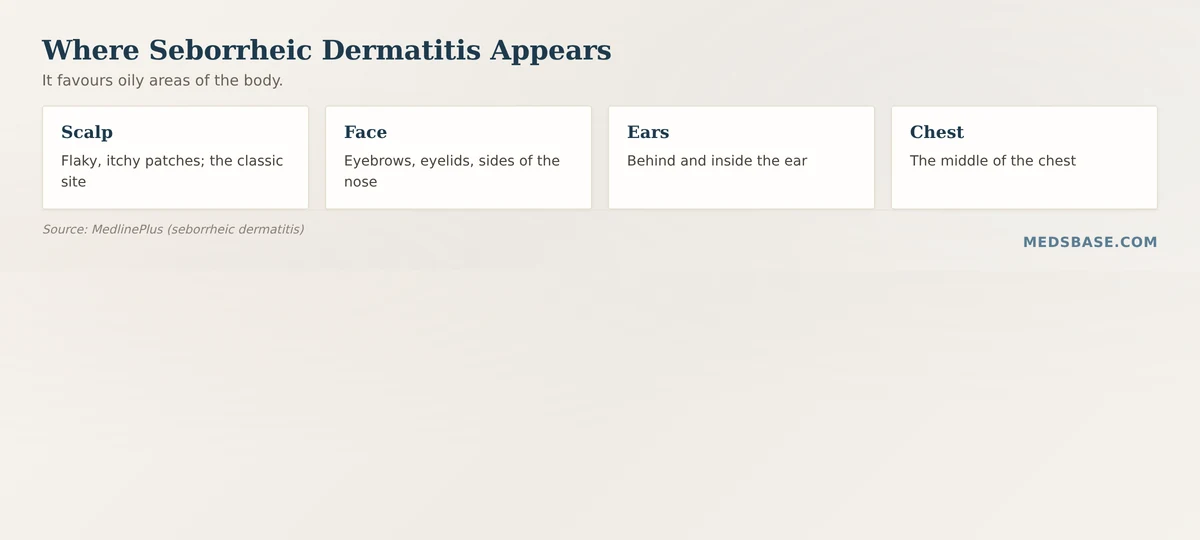
Where it appears is just as telling. Seborrheic dermatitis favours oily zones: the scalp, eyebrows, eyelids, the creases at the sides of the nose, the lips, behind the ears, in the outer ear, and the middle of the chest. If your flakes are confined to a dry scalp, it may simply be ordinary dandruff; if you are also seeing greasy, red, or itchy patches on your face and chest, seborrheic dermatitis is the more likely explanation.
- For: anyone with persistent flaking and itching on the scalp, face, or chest; people whose “dandruff” does not fully clear with a basic shampoo; parents of infants with cradle cap.
- For: people who want a clear, evidence-based routine rather than trial-and-error.
- Avoid / hold off: treating with multiple strong products at once, which can worsen irritation; assuming a red, painful, or pus-draining patch is just seborrheic dermatitis without a medical check.
- Always: see a doctor if symptoms do not respond to an over-the-counter shampoo after about 4 weeks, or if patches drain fluid, crust, or become very red and painful.
The good news is that diagnosis is usually straightforward and based on appearance and location — MedlinePlus notes that a skin biopsy is rarely needed.
A final point worth knowing is that seborrheic dermatitis is not a sign of an unclean scalp, and no amount of washing alone will clear it if the underlying inflammation is untreated. In fact, the pattern is the reverse of the hygiene myth: the condition is driven by yeast and oil, so over-washing with harsh products can strip the skin and make it angrier. This reframing matters because it changes what you do — you stop blaming your habits and start treating the inflammation, which is where the medicated shampoos come in.
Seborrheic Dermatitis Treatment Options
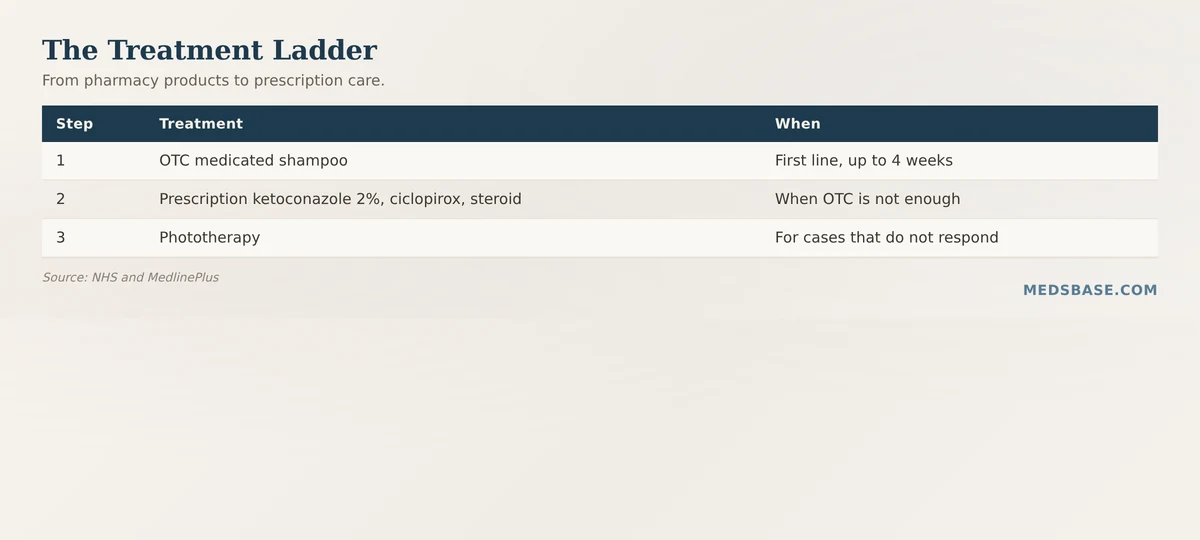
Treatment for seborrheic dermatitis is a ladder, and most people find relief on the first rung. The key is choosing the right ingredient and using it consistently.
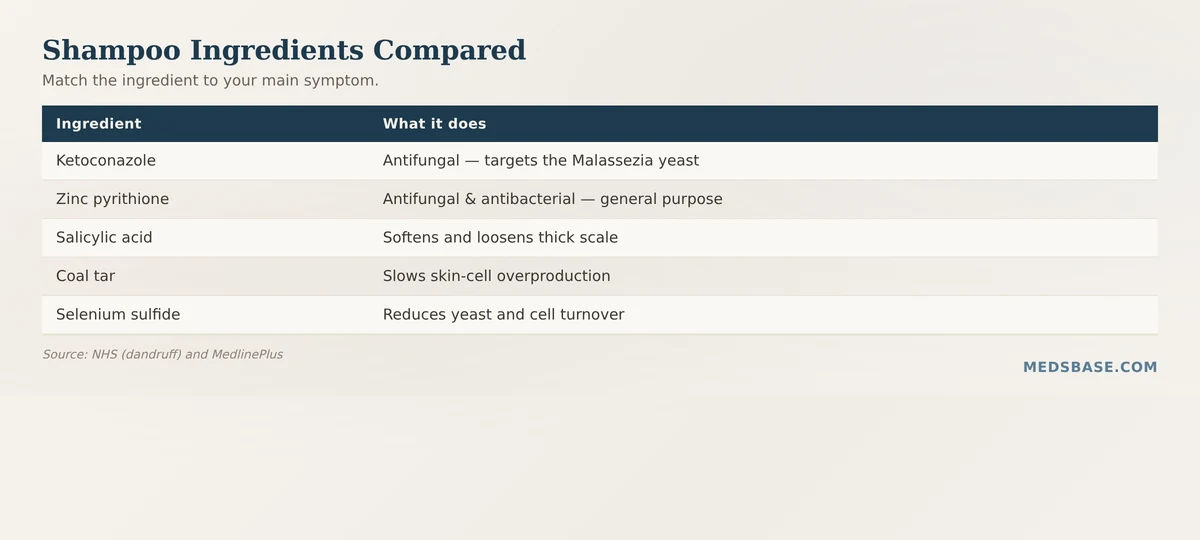
Over-the-counter medicated shampoos. This is the proven first line. The NHS recommends looking for a shampoo containing one or more of these ingredients: zinc pyrithione, ketoconazole, coal tar, or salicylic acid. MedlinePlus adds selenium sulfide and resorcinol to the list. Each ingredient works a little differently — some reduce the Malassezia yeast, others soften and remove scale, others slow skin-cell turnover.
Ketoconazole is the antifungal workhorse. Because Malassezia is a yeast, an antifungal like ketoconazole directly targets one of the root causes. This is why it is so often the ingredient dermatologists reach for first, and why a 2% ketoconazole shampoo such as Nizral is a mainstay of seborrheic dermatitis treatment. You can see ketoconazole options at MedsBase — and the wider antifungal range — to find the formulation that fits.
The other ingredients deserve a word too, because they work differently and one may suit your skin better than another. Zinc pyrithione has both antifungal and antibacterial properties and is one of the most common anti-dandruff ingredients, making it a good general-purpose starting point. Salicylic acid does not kill yeast — it softens and loosens scale so the flakes can be washed away, which makes it useful when thick, stubborn scale is the main problem. Coal tar slows the overproduction of skin cells and is a long-standing treatment, though its smell and potential to stain put some people off. Selenium sulfide also reduces the yeast and slows cell turnover. Understanding this helps you match the ingredient to your main symptom: thick scale suggests salicylic acid, while a yeast-driven itch and redness point toward an antifungal like ketoconazole.
Prescription-strength treatment. For more persistent cases, MedlinePlus notes that a healthcare provider may prescribe a shampoo, cream, ointment, or lotion containing a stronger dose of those medicines, or containing ketoconazole, ciclopirox, sodium sulfacetamide, a corticosteroid, or the immune-modulating agents tacrolimus or pimecrolimus.
Phototherapy. In cases that do not respond, MedlinePlus explains that phototherapy — carefully controlled exposure to ultraviolet light — may be used, and that ordinary sunlight can improve the condition in some people.
The honest note is that no single product works for everyone, and you may need to try more than one ingredient to find the one your skin responds to. Consistency, not just the product, is what makes seborrheic dermatitis treatment stick.
How to Use Seborrheic Dermatitis Treatment
Getting the routine right matters as much as the product. Here is a practical sequence that works for most people.
- Pick one medicated shampoo with a proven ingredient — ketoconazole, zinc pyrithione, salicylic acid, or coal tar. Start with a single product rather than rotating several at once.
- Use it as directed. Apply to the affected areas, leave it on for the time the label recommends (often a few minutes), and rinse. Letting the active ingredient sit is what lets it work.
- Give it up to 4 weeks. The NHS advises using the shampoo for up to 4 weeks to see if your seborrheic dermatitis improves, and notes you might need to try more than one type to find what works.
- Treat the face and chest too. If seborrheic dermatitis affects your eyebrows or nose creases, the same medicated ingredient may be available as a cream or wash — ask a pharmacist.
- Keep treating after it clears. This is the step most people skip. Because the tendency is chronic, many people need ongoing, less-frequent maintenance (for example, a couple of times a week) to stop flares returning.
- Escalate if needed. If there is no improvement after a month of consistent use, see a doctor for a prescription-strength option.
Mistakes to avoid:
- Stopping treatment the moment flakes disappear, then being surprised when they return
- Scrubbing aggressively — this irritates the skin barrier and can make seborrheic dermatitis worse
- Assuming it is “just dandruff” when red, itchy patches are also on the face or chest
Clinical insight: Pharmacists commonly see two patterns that keep people stuck. The first is not leaving the shampoo on long enough for the ingredient to act. The second is giving up after one product. Seborrheic dermatitis responds well to treatment, but it rewards patience and consistency — which is why a clear routine beats a cupboard full of half-used products.
One more practical note: facial seborrheic dermatitis deserves special care. The skin on the face is thinner and more sensitive than the scalp, so you should not simply use a strong scalp product on the face without checking. A pharmacist can recommend a facial-safe antifungal cream or a milder formulation for the eyebrows and nose creases, and a doctor can prescribe a gentle ketoconazole cream or a short course of a low-strength corticosteroid for stubborn areas. The principle is the same as the scalp — treat consistently and gently — but the products should be chosen for the face specifically.
Seborrheic Dermatitis vs Other Skin Conditions
Because flaky skin has many causes, it helps to see how seborrheic dermatitis sits alongside the conditions it is often confused with.
| Feature | Seborrheic dermatitis | Ordinary dandruff | Atopic eczema | Psoriasis |
|---|---|---|---|---|
| Location | Oily areas: scalp, face, chest | Scalp only | Flexural areas, often dry | Scalp, knees, elbows |
| Scale | Greasy, yellowish or white | White, dry flakes | Dry, red, very itchy | Silvery, thick scales |
| Key driver | Malassezia + oil + barrier | Mild Malassezia response | Allergy/barrier tendency | Immune-mediated |
| Contagious | No | No | No | No |
The NHS dandruff page helpfully separates these: seborrheic dermatitis shows as scaly, itchy, red patches on the scalp, face, and other areas; eczema is dry, red, flaky, and very itchy; and psoriasis shows as red, flaky, crusty patches covered with silvery scales. Getting the right label is what points you to the right treatment — an antifungal makes sense for seborrheic dermatitis but not for psoriasis, which needs a different approach.
What the Research Says
The evidence base for seborrheic dermatitis treatment is built on decades of consistent clinical guidance, and the authority sources align closely.
| Source | Key finding |
|---|---|
| NHS (dandruff) | Anti-dandruff shampoos with zinc pyrithione, ketoconazole, coal tar, or salicylic acid; allow up to 4 weeks; try more than one type if needed |
| MedlinePlus (seborrheic dermatitis) | Cause is multifactorial (Malassezia, oil, barrier, genes); OTC and prescription ketoconazole, ciclopirox, corticosteroids, and calcineurin inhibitors are standard |
| MedlinePlus (scalp conditions topic) | Seborrheic dermatitis, dandruff, and cradle cap are related scalp conditions with distinct presentations |
What this means for you: the science is reassuringly consistent. The Malassezia yeast is a real, documented driver, and antifungal ingredients like ketoconazole target it directly. The reason treatment sometimes feels hit-and-miss is not that the condition is mysterious — it is that finding the right ingredient and using it consistently takes patience. The research says the toolkit works; the routine is up to you.
There is honest uncertainty too: because seborrheic dermatitis is chronic, no treatment removes the tendency permanently, and severity varies from person to person. That is not a failure of treatment — it is the nature of a chronic inflammatory condition, and it is why maintenance matters.
Lifestyle and Triggers: Managing Seborrheic Dermatitis Flares
Medication is only half of seborrheic dermatitis treatment. The other half is understanding what tips your skin into a flare and managing those triggers — because the condition itself never fully goes away.
Manage stress. Stress and fatigue are among the most commonly reported triggers, and the relationship is not just in your head. The immune system and the skin are linked through inflammation, and stress can raise the inflammatory signals that make seborrheic dermatitis worse. Regular sleep, movement, and whatever genuinely lowers your stress level are legitimate parts of treatment.
Watch the weather. Cold, dry winter air and sudden weather extremes can provoke flares, while many people notice improvement in summer — likely helped by sunlight and humidity. This is not a reason to overdo sun exposure, but it does explain why your skin behaves differently across seasons.
Keep the skin clean, but gently. Because the Malassezia yeast feeds on the oils in your skin, washing away excess oil helps — but harsh scrubbing irritates the barrier and backfires. Use a gentle cleanser and your medicated treatment, not an aggressive scrub. This is the line between “clean” and “irritated.”
Be mindful of alcohol and skin products. MedlinePlus lists heavy alcohol use and lotions that contain alcohol among the risk factors, alongside oily skin and conditions such as acne. If you notice a pattern between certain products or habits and your flares, adjusting them is a reasonable, low-cost experiment.
Know the difference between treating and maintaining. This is the habit that separates people who stay clear from people who stay stuck. During a flare you treat more frequently; once the skin settles you shift to a lighter maintenance routine — for many people, using the medicated shampoo once or twice a week. Stopping entirely usually invites the next flare.
The reassuring through-line is that seborrheic dermatitis is not a condition that spirals out of control without warning. It is a condition with identifiable triggers and a predictable rhythm, and once you learn your own pattern, managing it becomes far less mysterious — and far less frustrating.
Frequently Asked Questions
Q: What is seborrheic dermatitis?
A: Seborrheic dermatitis is a common, chronic inflammatory skin condition that causes flaky, white-to-yellowish scales on oily areas like the scalp, face, and chest, with or without redness. It is the condition behind many stubborn cases of dandruff and, in infants, is called cradle cap.
Q: What causes seborrheic dermatitis?
A: It results from a combination of factors, according to MedlinePlus: oil-gland activity, a yeast called Malassezia that lives on the skin, changes in the skin barrier, and genetics. Stress, weather, and certain underlying conditions can make it worse.
Q: Is seborrheic dermatitis contagious?
A: No. Seborrheic dermatitis is not an infection you can catch or pass on. The Malassezia yeast involved lives on everyone’s skin; the condition arises from how your skin and immune system respond to it, not from contact with another person.
Q: Is seborrheic dermatitis a fungus?
A: It is not a simple fungal infection, but a yeast called Malassezia plays a central role. That is why antifungal ingredients like ketoconazole are effective — they reduce the yeast that drives the inflammation, even though the condition is not “caught” like ringworm.
Q: How do you treat seborrheic dermatitis on the face?
A: Mild facial seborrheic dermatitis can often be managed with a medicated shampoo used on the affected areas or a ketoconazole or antifungal cream. MedlinePlus notes that prescription creams or lotions — including ketoconazole, ciclopirox, a corticosteroid, or tacrolimus/pimecrolimus — are used for more persistent cases.
Q: What shampoo is best for seborrheic dermatitis?
A: The best starting point is an over-the-counter shampoo containing ketoconazole, zinc pyrithione, salicylic acid, or coal tar. The NHS advises trying it for up to 4 weeks, and trying more than one ingredient if the first does not work. Ketoconazole is a common first choice because it targets the yeast directly.
Q: When should I see a doctor for seborrheic dermatitis?
A: See a doctor if symptoms do not improve after about 4 weeks of consistent over-the-counter treatment, if the scalp is very red or swollen, or if patches drain fluid, form crusts, or become very painful — these can signal infection or a different condition needing different care.
Q: Does seborrheic dermatitis cause hair loss?
A: Seborrheic dermatitis itself does not directly damage hair follicles, but it can be indirectly linked to temporary hair shedding. When the scalp is inflamed and intensely itchy, scratching can traumatise the hair, and heavy, greasy scale can make hair look thinner. Once the inflammation is controlled, any associated shedding usually settles. If you are losing hair in patches or worried about thinning, a doctor can distinguish seborrheic dermatitis from other scalp conditions.
Q: Can seborrheic dermatitis affect the ears and eyelids?
A: Yes. Seborrheic dermatitis commonly affects the outer ear, inside the ear canal, and the eyelids, in addition to the scalp, eyebrows, and nose creases. These delicate areas should be treated gently with a product chosen for that location — and because the eyelids are so sensitive, it is especially worth asking a pharmacist or doctor before applying anything there.
The Bottom Line
Seborrheic dermatitis is a chronic but highly controllable condition, and the moment you stop treating it as a hygiene failure and start treating it as an inflammatory tendency, the path forward gets clear: a proven antifungal ingredient like ketoconazole, used consistently, for up to a month, with maintenance afterward. Most people get real relief without ever needing a prescription — and for those who do, effective prescription options exist.
Your next step is concrete: choose one medicated shampoo with a proven ingredient and commit to the full 4-week trial. If you are weighing options, the ketoconazole route is the one most directly aimed at the root cause, and you can browse the antifungal range at MedsBase to see what is available. Wondering how this fits with the wider picture of skin and immune health? Read our guide to dermatomyositis treatment — a very different condition that shows just how much the immune system shapes the skin.

Written by
Sophie ChenPharmaceutical Content Researcher · 8 years experience
Sophie Chen is a pharmaceutical content researcher with 8 years covering generic medication access and clinical pharmacology. She specialises in international regulatory frameworks, bioequivalence standards, and patient-facing education on therapeutic drug classes. She is not a clinician.