








✓ Medically reviewed by · Last reviewed: May 2026
Pharmacy Researcher · 8 years experience
Pharmacy researcher with 8 years reviewing clinical drug information, generic formulation equivalence, and international pharmaceutical standards. Focuses on patient-facing accuracy in medication education.
mupirocin vs fusidic acid — Mupirocin vs Fusidic Acid: 7 Proven Differences Compared. Read on for an evidence-backed guide covering everything you need to know.
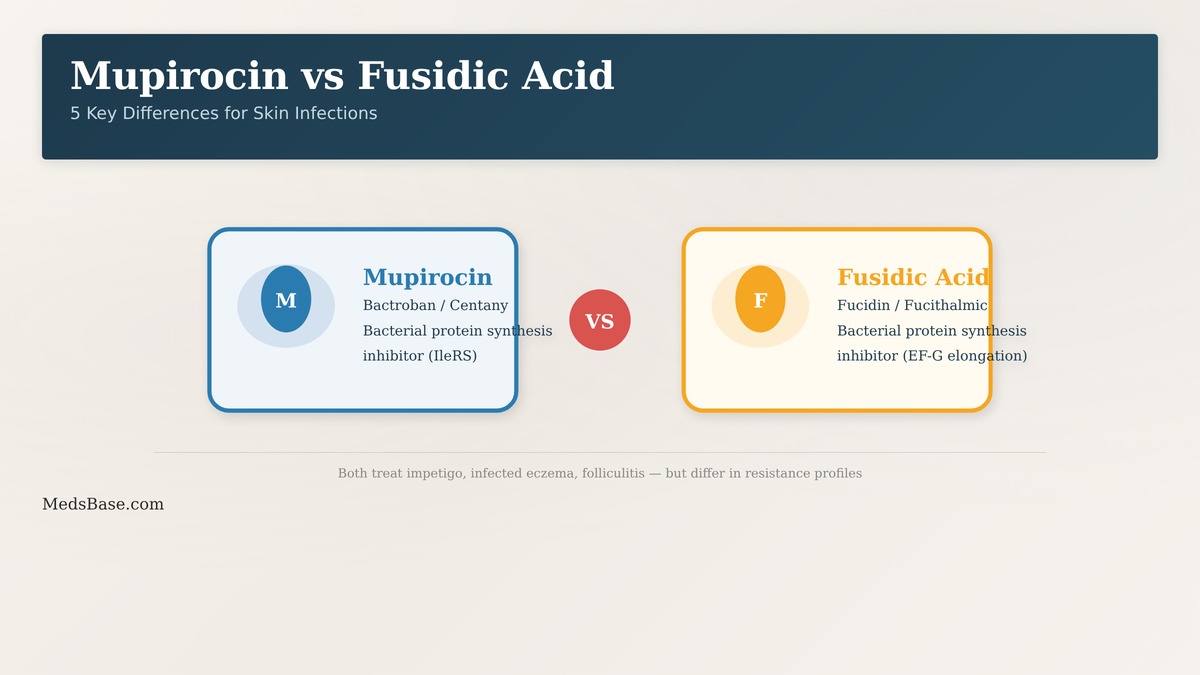
There is a persistent belief that any topical antibiotic cream is interchangeable—that one tube from the pharmacy works the same as another, and the only real difference is the brand name on the packaging. When it comes to mupirocin vs fusidic acid, holding onto that assumption could leave you with a skin infection that refuses to heal, a wasted course of treatment, and a longer window for bacteria to spread to other parts of your body or to family members. These two topical antibiotics attack bacteria through completely different biological mechanisms, cover distinct spectra of pathogens, and carry very different resistance profiles depending on where you live. Understanding the mupirocin vs fusidic acid decision matters whether you are treating your child’s impetigo, managing a flare of infected eczema, dealing with recurrent folliculitis, or trying to prevent a post-surgical staph infection.
📚 Key Takeaways
- Mupirocin vs fusidic acid is not a coin toss—each targets a different bacterial enzyme: mupirocin blocks isoleucyl tRNA synthetase; fusidic acid blocks elongation factor G (EF-G).
- Clinical cure rates for impetigo are virtually identical between the two (RR 1.03, 95% CI 0.95–1.11 per the Cochrane systematic review of 68 trials).
- Fusidic acid resistance exceeds 50% in some European countries; mupirocin resistance remains below 5% in most regions outside high-use hospital settings.
- Mupirocin is the first-line agent for MRSA decolonization—fusidic acid has no role here.
- The right choice depends on your specific infection type, geographic region, and whether you need nasal carriage clearance.
📄 Table of Contents
- What Is Mupirocin vs Fusidic Acid?
- How Mupirocin vs Fusidic Acid Work
- What Is Mupirocin vs Fusidic Acid Used For?
- Mupirocin vs Fusidic Acid — Clinical Effectiveness
- Mupirocin vs Fusidic Acid — Side-by-Side Comparison
- Mupirocin vs Fusidic Acid — Side Effects and Safety
- Antibiotic Resistance — Mupirocin vs Fusidic Acid
- How to Use Topical Antibiotics Correctly
- Frequently Asked Questions
- The Bottom Line
Mupirocin vs Fusidic Acid: 7 Proven Differences That Guide Your Skin Infection Treatment
What Is Mupirocin vs Fusidic Acid?
Before comparing mupirocin vs fusidic acid on clinical grounds, it helps to know what each molecule actually is. Both are topical antibiotics—meaning they are applied directly to the skin rather than swallowed—but their chemical origins, age, and global availability differ significantly.
Mupirocin (Bactroban)
Mupirocin ointment is a naturally derived antibiotic first isolated in 1971 from the fermentation broth of Pseudomonas fluorescens. Its active component is pseudomonic acid A, a molecule with a distinctive structure that includes a fatty acid tail attached to a monic acid core. Mupirocin is available as a 2% topical ointment (in a polyethylene glycol base) and a 2% nasal ointment (in a paraffin base). It was first approved for clinical use in the mid-1980s and is marketed globally under the brand name Bactroban, with generic versions widely available. Because its mechanism of action is unique among clinically used antibiotics, cross-resistance with other antibiotic classes is extremely rare—a feature that has made mupirocin the cornerstone of MRSA decolonization protocols worldwide.
Fusidic Acid (Fucidin)
Fusidic acid cream is a steroid-like antibiotic first isolated in 1962 from the fungus Fusidium coccineum. Its tetracyclic structure resembles that of steroid hormones, though it has no hormonal activity. Fusidic acid is available as a 2% cream or ointment, and in some countries as an oral or intravenous formulation for serious systemic staphylococcal infections. It is marketed primarily under the brand name Fucidin and is especially popular in Europe, the Middle East, and parts of Asia. Unlike mupirocin, fusidic acid is not FDA-approved in the United States for topical use—which creates an interesting geographic split in how clinicians approach the mupirocin vs fusidic acid question: in the US, mupirocin dominates; in Europe, both are commonly prescribed.
| Feature | Mupirocin | Fusidic Acid |
|---|---|---|
| Origin | Pseudomonas fluorescens (bacterial fermentation) | Fusidium coccineum (fungal fermentation) |
| Year discovered | 1971 | 1962 |
| Drug class | Pseudomonic acid derivative | Fusidane (steroid-like antibiotic) |
| Common formulations | 2% topical ointment, 2% nasal ointment | 2% cream, 2% ointment, oral tablets, IV (outside US) |
| US FDA approval | Yes (topical and nasal) | No (not marketed in the US) |
| Primary brand name | Bactroban | Fucidin |
How Mupirocin vs Fusidic Acid Work
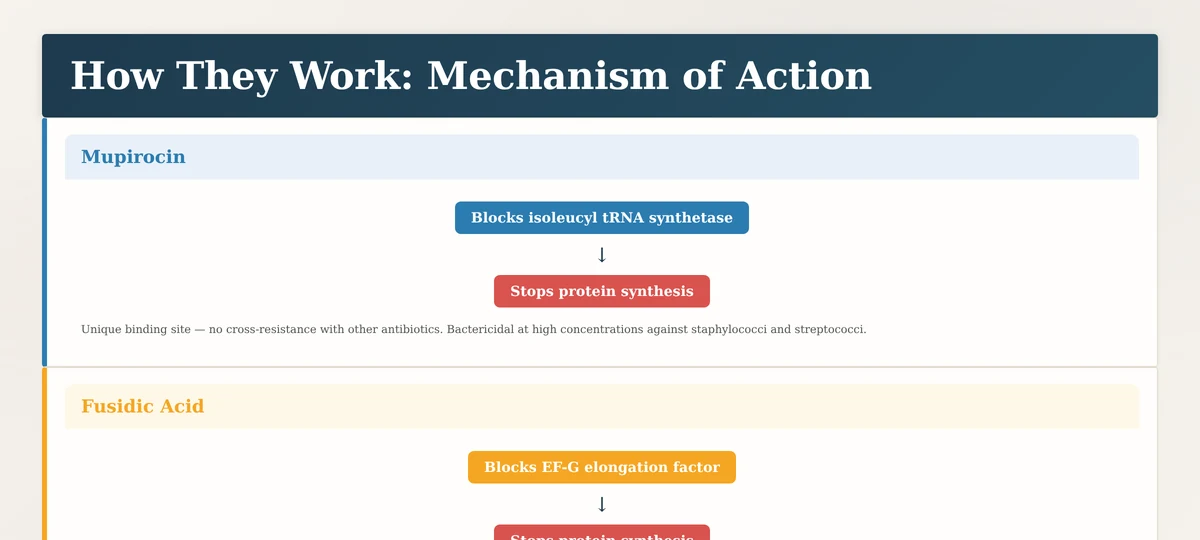
How mupirocin vs fusidic acid work: each targets a different step in bacterial protein synthesis.
If you look at the chemical structures of these two molecules side by side, they have almost nothing in common—and neither do their mechanisms of action. The mupirocin vs fusidic acid distinction starts at the molecular level, with each drug binding to a completely different target inside the bacterial cell. Understanding this difference explains why resistance develops differently for each, why they cover slightly different organisms, and why one works for nasal decolonization while the other does not.
Mupirocin: The Isoleucine Blocker
Mupirocin ointment works by selectively and reversibly binding to bacterial isoleucyl transfer-RNA (tRNA) synthetase—the enzyme responsible for attaching the amino acid isoleucine to its corresponding tRNA molecule during protein synthesis. When mupirocin occupies the enzyme’s active site, the bacterium cannot incorporate isoleucine into any new protein it tries to build. Without functional proteins, the bacterium cannot maintain its cell wall, replicate its DNA, or carry out any metabolic process. Within a few hours, protein synthesis grinds to a halt and the bacterial cell dies. Importantly, mupirocin has a much lower affinity for mammalian isoleucyl tRNA synthetase, which explains its excellent safety profile when applied to human skin—it selectively inhibits the bacterial version of the enzyme while leaving human cells untouched.
Fusidic Acid: The EF-G Freezer
Fusidic acid cream takes aim at a completely different stage of protein synthesis. It binds to elongation factor G (EF-G)—a protein that acts as a molecular motor on the bacterial ribosome. During normal protein synthesis, EF-G uses energy from GTP to physically push the growing protein chain and the messenger RNA through the ribosome by one codon position (the “translocation” step). Fusidic acid locks EF-G in place on the ribosome after GTP has been consumed, freezing the translocation machinery mid-cycle. The ribosome stalls, the incomplete protein cannot be released, and—just as with mupirocin—the bacterium eventually dies from the shutdown of essential protein production. Fusidic acid also inhibits EF-G in the mitochondria of human cells at very high concentrations, though this is not clinically relevant at the doses used in topical application.
🔬 Research Spotlight: Bacterial Protein Synthesis Inhibition
Protein synthesis is one of the most conserved biological processes across all life forms, yet bacteria and human cells build proteins using structurally distinct ribosomes. This difference is the therapeutic window that makes antibiotics like mupirocin and fusidic acid possible. Mupirocin exploits the structural difference between bacterial and mammalian isoleucyl tRNA synthetases (the bacterial enzyme has a unique hydrophobic pocket that mupirocin’s fatty acid tail fits into). Fusidic acid exploits the fact that bacterial EF-G undergoes a conformational change during translocation that exposes a binding site absent from the human equivalent (eEF2). Both drugs are classic examples of “selective toxicity”—the principle that an effective antibiotic must harm the pathogen substantially more than it harms the host.
Sources: PubMed — mupirocin mechanism and resistance review; PMC — fusidic acid mechanism and resistance
What Is Mupirocin vs Fusidic Acid Used For?
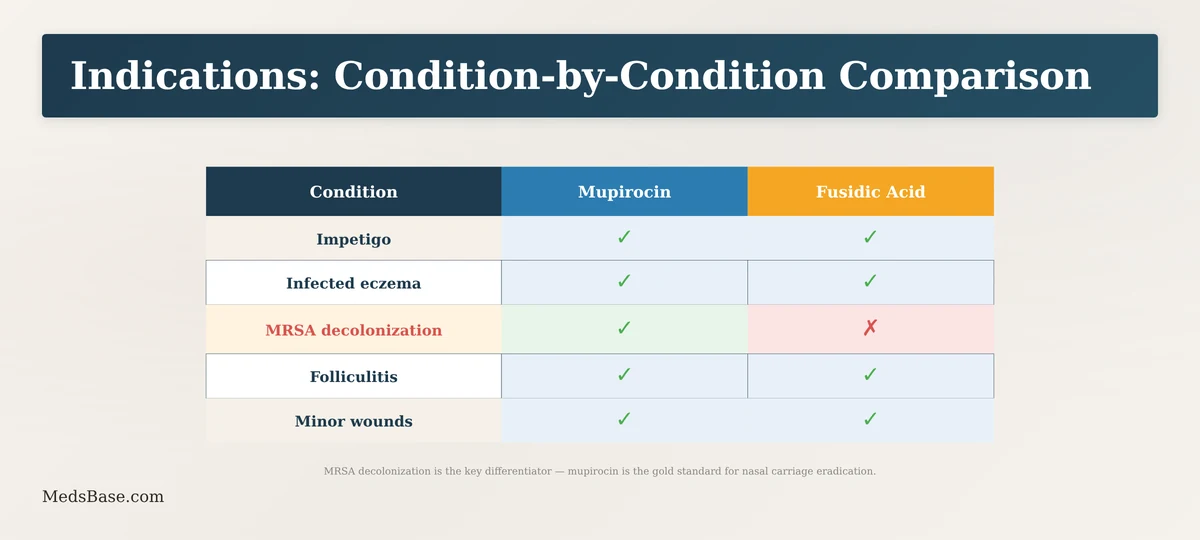
Approved indications for mupirocin vs fusidic acid — which antibiotic is right for each type of skin infection.
Both drugs treat superficial skin infections caused by Staphylococcus aureus and Streptococcus pyogenes, and the mupirocin vs fusidic acid question often arises because their approved indications overlap heavily. But the overlap is not complete—there is one very important indication where mupirocin has no competition from fusidic acid at all.
Impetigo Treatment
Impetigo is the most common bacterial skin infection in children and the most studied indication in the mupirocin vs fusidic acid literature. Both drugs are supported by level-1 evidence: the 2012 Cochrane systematic review pooled data from four head-to-head trials with 440 participants and found no statistically significant difference in cure rates between the two (risk ratio 1.03, 95% CI 0.95–1.11). The NHS guidance on impetigo lists hydrogen peroxide cream and antibiotic creams (including both mupirocin and fusidic acid) as first-line topical impetigo treatment options. Clinically, either drug will clear most cases within 7–10 days when applied correctly.
Infected Eczema
When atopic dermatitis (eczema) becomes secondarily infected—usually with S. aureus—topical antibiotics are often prescribed alongside the patient’s usual emollients and topical steroids. Both mupirocin and fusidic acid are effective here, and the mupirocin vs fusidic acid choice typically comes down to local resistance patterns (discussed below) and availability. A key clinical pearl: if the infected eczema is widespread, oral antibiotics may be needed. Topical antibiotics are best suited for localized patches of infected eczema. Browse eczema treatment options at MedsBase.
Folliculitis
Folliculitis—inflammation of hair follicles, often caused by Staphylococcus aureus—is another superficial skin infection where the mupirocin vs fusidic acid comparison is clinically relevant. Both are effective for superficial bacterial folliculitis. For deeper or recurrent folliculitis, however, topical treatment alone may be insufficient, and a course of oral antibiotics may be warranted. If folliculitis keeps returning, consider whether you might be a nasal carrier of S. aureus—which brings us to the indication where mupirocin stands alone.
Minor Wounds and Superficial Skin Infections
For minor cuts, abrasions, and suture lines that show early signs of bacterial infection, both mupirocin and fusidic acid are reasonable prophylactic or early-treatment choices. The mupirocin vs fusidic acid decision here often defaults to whatever the clinician has most experience with, though mupirocin’s broader gram-positive coverage (see spectrum comparison below) sometimes gives it an edge when the specific pathogen is unknown. For any skin infection treatment, wounds should be cleaned with soap and water before applying the topical antibiotic cream.
MRSA Decolonization — Mupirocin’s Unique Role
This is the indication where the mupirocin vs fusidic acid question has a clear, unambiguous answer: only mupirocin is recommended for MRSA decolonization. Fusidic acid has essentially no role here. The standard decolonization protocol (often called the “MRSA bundle”) involves applying mupirocin ointment to both nostrils twice daily for 5–10 days, combined with chlorhexidine body washes. This regimen reduces nasal carriage of methicillin-resistant Staphylococcus aureus by approximately 80–90% in the short term. MRSA decolonization is performed before certain surgeries (especially cardiac and orthopedic procedures), in patients with recurrent MRSA skin infections, and in outbreak settings such as nursing homes and intensive care units. The reason mupirocin works intranasally while fusidic acid does not is partly pharmacologic (mupirocin’s paraffin-based nasal formulation achieves high local concentrations) and partly microbiologic (mupirocin retains activity against most MRSA strains, whereas many MRSA isolates are also resistant to fusidic acid).
Secondary Bacterial Skin Infections
When a primary skin condition (eczema, psoriasis, a burn, an insect bite, a surgical wound) develops a superimposed bacterial skin infection, both mupirocin and fusidic acid are used. Clinical judgment guides treatment: localized infections typically respond to either agent; more extensive or deeper infections may require oral therapy. The mupirocin vs fusidic acid choice for secondary infections should account for the likelihood of S. aureus (both cover it), Streptococcus pyogenes (both cover it), and any local resistance data.
✅ Who Is This For? / Who Should Avoid It?
Who should consider using these topical antibiotics:
- Children and adults with localized, non-bullous impetigo (fewer than 5–6 lesions)
- Patients with small patches of infected eczema that are not improving with emollients alone
- Individuals with superficial bacterial folliculitis
- Patients undergoing elective surgery who test positive for nasal MRSA carriage (mupirocin only)
- Anyone with a minor wound showing early signs of localized infection (redness, mild pus, no spreading cellulitis)
Who should seek medical advice before using, or avoid altogether:
- Pregnant or breastfeeding women (both are generally considered safe topically, but discuss with a doctor)
- Anyone with a known allergy to mupirocin, fusidic acid, or the base ingredients (polyethylene glycol for mupirocin ointment; cetyl alcohol/parabens in some fusidic acid formulations)
- People with extensive skin infections (>5–6 impetigo lesions, or large body surface area involvement)—oral antibiotics are usually needed
- Patients with signs of systemic infection (fever, chills, spreading redness, swollen lymph nodes)—seek urgent medical care
- Anyone with a deep or puncture wound—topical antibiotics cannot reach deep tissue
- Infants under 2 months with any skin infection—requires pediatric assessment
Mupirocin vs Fusidic Acid — Clinical Effectiveness
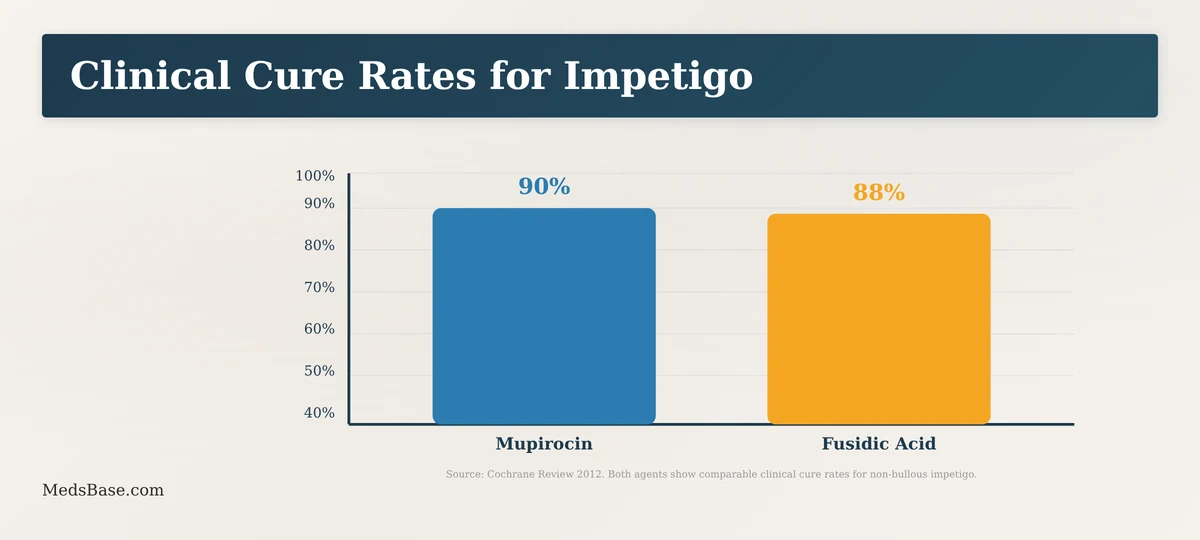
Clinical cure rates for mupirocin vs fusidic acid in treating impetigo — virtually identical based on Cochrane systematic review.
When researchers have put the mupirocin vs fusidic acid question to the test in randomized controlled trials, the answer has been remarkably consistent: for the most common indication—impetigo—they are clinically equivalent. The 2012 Cochrane systematic review pooled four head-to-head trials and found no statistically significant difference (risk ratio 1.03, 95% CI 0.95–1.11), meaning mupirocin might be 3% more effective or fusidic acid might be 5% more effective—the data cannot distinguish between them at a clinically meaningful level. Both achieve clinical cure rates of approximately 85–95% for impetigo when used correctly for 7–10 days.
What the aggregate data masks, however, is regional variation driven by resistance. In countries where fusidic acid resistance exceeds 20–30% (discussed in the resistance section below), mupirocin may be the empirically superior choice simply because there is a higher probability the infecting strain will still be susceptible to it. Conversely, in regions where fusidic acid resistance remains low (below 5–10%), the two are interchangeable from a purely clinical standpoint, and the mupirocin vs fusidic acid choice can be guided by cost, availability, and patient preference.
Research Summary: Key Studies Comparing Mupirocin vs Fusidic Acid
| Study | Year | Key Finding | Source |
|---|---|---|---|
| Koning et al. (Cochrane Review) | 2012 | Pooled 4 RCTs (440 patients): no significant difference in cure rates between mupirocin and fusidic acid for impetigo (RR 1.03, 95% CI 0.95–1.11). Both superior to placebo and oral erythromycin. | Cochrane |
| Wilkinson et al. | 1988 | Head-to-head trial: clinical cure rates of 95% (mupirocin) vs 93% (sodium fusidate) for impetigo. Both well tolerated with minimal side effects. | PubMed |
| Morley et al. | 1994 | Double-blind RCT: confirmed comparable efficacy. Bacterial eradication rates were 91% (mupirocin) and 88% (fusidic acid) at end of treatment. | PubMed |
| Williamson et al. (Resistance Review) | 2011 | Comprehensive review of fusidic acid resistance patterns: resistance rates ranging from <1% (UK, pre-2000) to >50% (Greece, 2000s). Topical use is the primary driver of resistance emergence. | PMC |
| Patel et al. (MRSA Decolonization) | 2009 | Mupirocin-based decolonization reduced MRSA carriage by 80–90% in the short term. High-level mupirocin resistance is rare (<5% in community settings) but rising in hospitals with heavy use. | PubMed |
Mupirocin vs Fusidic Acid — Side-by-Side Comparison
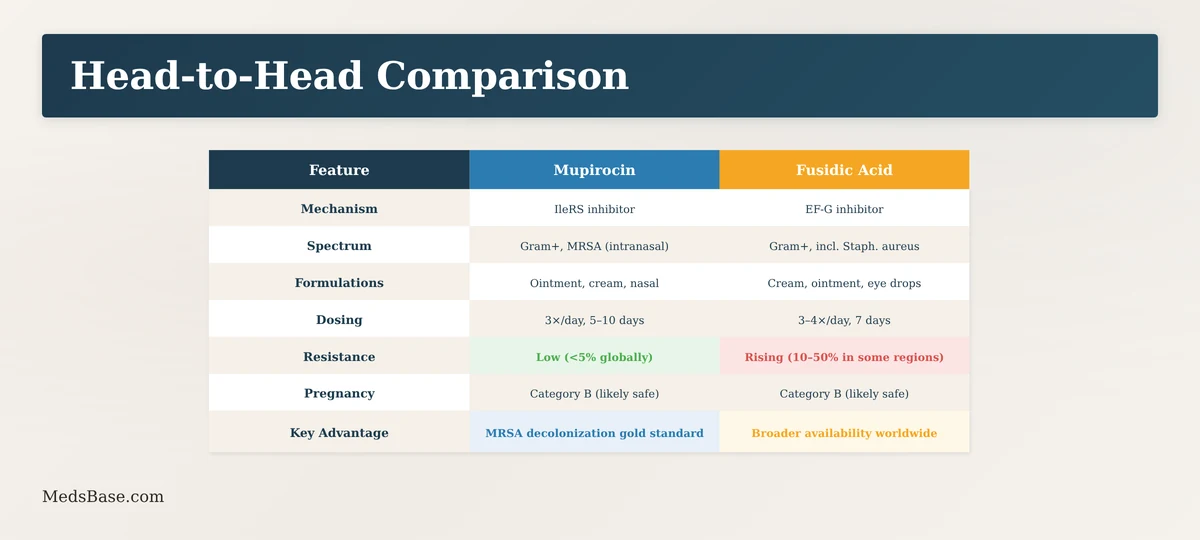
Complete side-by-side comparison of mupirocin vs fusidic acid across mechanism, spectrum, resistance, and safety.
When physicians and pharmacists weigh the mupirocin vs fusidic acid decision for a specific patient, they use a mental checklist similar to the table below. This is the comparison you need if you are deciding which one to use for yourself or your child.
| Criterion | Mupirocin | Fusidic Acid |
|---|---|---|
| Mechanism of action | Inhibits isoleucyl tRNA synthetase | Inhibits elongation factor G (EF-G) |
| Antibacterial spectrum | Gram-positive (staphylococci, streptococci); limited gram-negative activity against Haemophilus influenzae, Neisseria spp. | Gram-positive (staphylococci, including MRSA in some strains; streptococci; Corynebacterium spp.) |
| Key organisms covered | S. aureus (including most MRSA), S. pyogenes, S. epidermidis | S. aureus (MSSA and some MRSA), S. pyogenes, Corynebacterium spp., Clostridium spp. |
| Available formulations | 2% topical ointment; 2% nasal ointment | 2% cream; 2% ointment; oral tablets (250 mg, 500 mg); IV (outside US) |
| Typical dosing frequency | 3 times daily (skin); 2–3 times daily (nasal) | 3–4 times daily (skin) |
| Treatment duration | 7–10 days (skin); 5–10 days (nasal decolonization) | 7–10 days |
| Resistance — Europe | Generally <5% (community); up to 15–30% in some hospitals | Widely variable: <2% (UK, Scandinavia) to >50% (Greece, some Eastern European countries) |
| Resistance — US | <5% (community); 5–15% (hospital, varies by unit) | Not applicable (fusidic acid not marketed in the US) |
| Pregnancy category | Category B (US) — generally considered safe for topical use in pregnancy | No formal FDA category; limited data suggest minimal systemic absorption with topical use; generally considered acceptable when benefit outweighs risk |
| Unique advantage | MRSA nasal decolonization; unique mechanism means no cross-resistance with other antibiotic classes | Excellent tissue penetration (oral/IV forms); steroid-like structure enables deep skin penetration; oral option exists for severe infections |
Mupirocin vs Fusidic Acid — Side Effects and Safety
The side effect profiles of both drugs are remarkably benign—one of the major advantages of topical over oral antibiotics. When researchers compare mupirocin vs fusidic acid on tolerability, both come out well ahead of oral alternatives like erythromycin, which causes gastrointestinal side effects (nausea, diarrhea, abdominal pain) in up to 30% of patients. The Cochrane review found that reported adverse effects for both topical agents were mild and infrequent, typically limited to local skin reactions that resolved upon discontinuation.
Mupirocin Side Effects
| Side Effect | Frequency | Notes |
|---|---|---|
| Burning or stinging at application site | 1–3% | Usually mild and transient; typically resolves within minutes |
| Itching (pruritus) | 1–2% | Rarely requires discontinuation; distinguish from the itch of the underlying skin condition |
| Erythema (redness) | <1% | May be difficult to distinguish from the underlying infection |
| Dryness or peeling | <1% | Polyethylene glycol base can be drying with prolonged use |
| Allergic contact dermatitis | Rare | Discontinue and seek medical advice if rash spreads or worsens |
Fusidic Acid Side Effects
| Side Effect | Frequency | Notes |
|---|---|---|
| Mild irritation at application site | 1–3% | Similar to mupirocin; usually self-limiting |
| Contact dermatitis | <1% | May be due to the active ingredient or excipients (cetyl alcohol, parabens) |
| Rash or urticaria (hives) | Rare | Discontinue if hives develop; may indicate hypersensitivity |
Systemic Safety Considerations
Neither mupirocin nor fusidic acid is appreciably absorbed through intact skin in amounts that would cause systemic toxicity. Mupirocin applied to broken skin is rapidly metabolized to inactive monic acid and excreted renally—even with extensive application, systemic levels remain well below toxic thresholds. Fusidic acid demonstrates similarly low systemic absorption from topical application, though the oral and IV formulations (not available in the US) require monitoring of liver function with prolonged use. For the vast majority of patients using either topical antibiotic cream for a standard 7–10 day course on a limited area of skin, systemic side effects are essentially a non-issue. This is one of the strongest arguments for choosing a topical over an oral antibiotic when the infection is truly localized and superficial.
Safety note: Both mupirocin and fusidic acid are for external use only. Avoid contact with eyes, inside the nose (except the specifically formulated mupirocin nasal ointment), and mucous membranes. Do not cover treated skin with an occlusive dressing unless directed by a physician. If symptoms do not improve after 7 days, or if they worsen at any point, seek medical review.
Antibiotic Resistance — Mupirocin vs Fusidic Acid
This is the section where the mupirocin vs fusidic acid comparison diverges most sharply, and the implications for real-world treatment decisions are significant. Both antibiotics have resistance problems, but the scale, geography, and clinical consequences are different for each.
Fusidic Acid Resistance: A European Concern
Fusidic acid resistance in Staphylococcus aureus has been rising steadily across Europe for two decades, driven primarily by widespread topical use in primary care. Resistance rates are strikingly variable by country, as documented in the comparative review of topical antibiotics for skin infections: countries with high topical fusidic acid prescribing (Greece, parts of Eastern Europe, some Middle Eastern nations) report resistance rates exceeding 50% in some surveillance studies, while countries with more restricted use (the Netherlands, Scandinavia) have kept rates below 2–5%. The UK sits somewhere in between, with resistance rates of approximately 10–15% reported in community S. aureus isolates in recent years—up from <1% in the early 1990s. The mechanism is usually a chromosomal mutation in the fusA gene (encoding EF-G), though plasmid-mediated resistance (via the fusB determinant) is also described.
The clinical implication: in a country with >20% fusidic acid resistance, roughly 1 in 5 patients prescribed fusidic acid empirically may be receiving a drug to which their infecting strain is resistant. In that scenario, mupirocin becomes the rational first choice—not because it is intrinsically “stronger,” but because the probability of the bacterium still being susceptible is higher.
Mupirocin Resistance: Low but Rising in Hospitals
Mupirocin resistance has historically been very low in community settings (<5% globally), which is one reason it remains the go-to agent for MRSA decolonization. However, heavy use in hospitals—particularly in intensive care units and surgical wards with decolonization protocols—has created selective pressure. Two levels of resistance exist: low-level resistance (MIC 8–256 μg/mL), caused by mutations in the native ileS gene, and high-level resistance (MIC ≥512 μg/mL), caused by acquisition of the mupA gene (which encodes an alternative isoleucyl tRNA synthetase that mupirocin cannot bind). High-level resistance is the clinically significant form because it renders the drug completely ineffective. In most community settings, high-level mupirocin resistance remains below 3–5%, but rates of 10–30% have been documented in hospitals with heavy decolonization use.
When considering mupirocin vs fusidic acid through the lens of resistance, the practical takeaway is: in the community setting, mupirocin has the more favorable resistance profile in most regions, but neither drug is immune to resistance—and overuse of either will accelerate the problem. This is precisely why organizations like the World Health Organization emphasize that topical antibiotics should only be used for confirmed or strongly suspected bacterial infections, never as a preventative measure for clean wounds or as a substitute for good wound hygiene.
Antibiotic Resistance Rates: Mupirocin vs Fusidic Acid by Region
| Region | Mupirocin Resistance | Fusidic Acid Resistance |
|---|---|---|
| Northern Europe (NL, Scandinavia) | <2% | <3% |
| United Kingdom | 2–5% | 10–15% |
| Southern Europe (Greece, Italy) | 3–8% (community) | 20–50%+ |
| United States (community) | <5% | N/A (not marketed) |
| United States (hospital ICUs) | 5–15% | N/A (not marketed) |
| Middle East / Parts of Asia | Variable; 2–10% reported | Variable; 10–50%+ reported |
How to Use Topical Antibiotics Correctly
Even the most effective topical antibiotic cream will fail if it is not applied properly. Misuse—applying too little, stopping too early, contaminating the tube, or using the wrong product for the wrong condition—is the leading cause of treatment failure, and it also drives antibiotic resistance. When weighing mupirocin vs fusidic acid, the application technique matters just as much as the drug choice, so whether you are using mupirocin ointment or a fusidic acid cream, the following principles apply.
Step-by-Step Application
- Wash your hands thoroughly with soap and water before and after applying the antibiotic. This prevents you from introducing new bacteria into the wound and from spreading the infection to other parts of your body or to other people.
- Clean the affected area gently with warm water and mild soap. Pat dry with a clean towel or disposable paper towel. Do not scrub—the goal is to remove crusts and debris, not to damage healing skin.
- Apply a thin layer of the topical antibiotic cream or ointment to cover the affected area completely. A pea-sized amount is usually sufficient for a lesion the size of a coin. Using more does not improve results and wastes the product.
- Wash your hands again after application unless the treated area is on your hands (in which case, wash the unaffected hand only).
- Cover if necessary: For impetigo sores that are oozing or in areas that are likely to be touched (hands, face), a loose, non-occlusive dressing can help prevent spread. Do not use tight or waterproof dressings unless directed by a doctor.
Mistakes to Avoid
The mupirocin vs fusidic acid distinction becomes irrelevant if you make any of the following common errors when using either topical antibiotic cream. These mistakes are the leading reasons treatment fails even when the right drug is selected.
| Mistake | Why It Matters |
|---|---|
| Stopping treatment as soon as the skin looks better | Visible improvement often occurs before all bacteria are eradicated. Stopping early allows surviving bacteria—potentially the most resistant ones—to regrow. Always complete the full 7–10 day course unless a doctor advises otherwise. |
| Applying the cream with unwashed fingers | Your hands carry bacteria. Touching an open sore with unwashed hands can introduce new pathogens or spread the existing infection to the tube itself, contaminating it for future use. |
| Using the same tube for multiple family members | Topical antibiotics should be prescribed for a single patient. Sharing a tube between family members risks cross-contamination and spreads resistant bacteria. Each person should have their own prescription and their own tube. |
| Applying a topical antibiotic to a viral or fungal rash | Cold sores (herpes), fungal infections (ringworm, athlete’s foot), and viral rashes do not respond to antibacterial agents. Using antibiotics for these conditions contributes to resistance with zero benefit. |
| Using an old tube from a previous infection | Expired antibiotics may have degraded potency. More importantly, the infection may involve a different bacterial species or strain. Always get a fresh prescription for each new infection. |
| Ignoring hygiene measures | Antibiotics treat the infection; they do not prevent reinfection. Wash towels, bedding, and clothing at high temperature. Keep nails short and clean. Avoid sharing personal items. Impetigo remains contagious for 48 hours after starting treatment (NHS). |
For those who need to purchase mupirocin or another topical antibiotic cream for a skin infection treatment, see the range of options available at MedsBase antibiotics category. No prescription is needed, and products are sourced from WHO-GMP-certified manufacturers.
Frequently Asked Questions
Can I use mupirocin and fusidic acid together?
There is no established clinical benefit to using mupirocin and fusidic acid simultaneously on the same lesion. Both drugs target bacterial protein synthesis—albeit at different steps—and combining them has not been shown to produce a synergistic or additive effect in clinical trials. In fact, using two antibiotics at once increases the selective pressure for resistance without improving cure rates. If one agent is not working after 5–7 days of correct use, the appropriate next step is to see a doctor for a culture and sensitivity test, not to layer on a second antibiotic.
Which is stronger, mupirocin or fusidic acid?
In terms of clinical cure rates for impetigo and other superficial skin infections, neither antibiotic is meaningfully “stronger”—they are clinically equivalent. The 2012 Cochrane review found no statistically significant difference in efficacy between the two. What makes one a better choice than the other is not intrinsic potency, but context: the specific type of infection, local antibiotic resistance patterns, whether nasal decolonization is needed (mupirocin only), and product availability in your country. A more useful question than “which is stronger?” is “which is more likely to still be active against the Staphylococcus aureus circulating in my region?”
Is mupirocin better than fusidic acid for impetigo?
For uncomplicated impetigo, the two are equally effective—this is one of the most robust findings in the mupirocin vs fusidic acid literature. The advantage of mupirocin in impetigo arises only in secondary scenarios: if you live in a region with high fusidic acid resistance, or if the impetigo is recurrent and you may be a nasal carrier of S. aureus (in which case mupirocin nasal ointment becomes relevant). For a one-off case of localized impetigo in a country where both are available and fusidic acid resistance is low, either choice is well supported by evidence.
How long does it take for mupirocin ointment to work?
Most patients notice visible improvement (reduced redness, less oozing, crusting beginning to heal) within 48–72 hours of starting mupirocin ointment. This rapid onset is part of why the mupirocin vs fusidic acid comparison often comes down to convenience rather than efficacy—both work quickly when the organism is susceptible. Complete clinical resolution typically occurs within 7–10 days. If there is no improvement at all after 5 days of consistent application, the infecting strain may be resistant, the diagnosis may be incorrect (the lesion may not be bacterial), or there may be an underlying condition (such as untreated eczema) perpetuating the infection. In any of these cases, seek a medical review rather than continuing the same treatment.
Can fusidic acid treat MRSA?
Some MRSA strains remain susceptible to fusidic acid cream, particularly community-acquired MRSA (CA-MRSA) isolates. However, fusidic acid is not recommended for MRSA decolonization or for treating known MRSA infections, for two reasons: first, a significant proportion of MRSA strains are already resistant to fusidic acid, and second, using fusidic acid in this context risks selecting for further resistance in these already hard-to-treat organisms. Since MRSA is, by definition, a methicillin-resistant form of staphylococcus aureus, choosing an antibiotic with reliable anti-staph activity is critical. Mupirocin remains the topical agent of choice for MRSA-related indications, specifically nasal decolonization. For an active MRSA skin infection (as opposed to carriage), systemic antibiotics—not topical ones—are typically required.
Why is fusidic acid not available in the United States?
Fusidic acid was never submitted for FDA approval as a topical agent in the United States, largely for historical and commercial reasons rather than safety or efficacy concerns. The drug was developed and marketed primarily by Leo Pharma (a Danish company) in Europe and other regions, and the US market for topical antibiotics was already well served by mupirocin (Bactroban), bacitracin, and neomycin-containing combinations by the time fusidic acid could have entered. There has been periodic interest in introducing fusidic acid to the US market—particularly for systemic use against MRSA—but as of 2026, it remains unavailable. This geographic quirk is one reason the mupirocin vs fusidic acid debate plays out very differently in Europe (where clinicians actively choose between the two) than in the US (where mupirocin is the default and fusidic acid is not an option).
Can I buy mupirocin ointment without a prescription?
Availability varies by country. In the United States, mupirocin is a prescription-only medication. In the United Kingdom, fusidic acid was reclassified and can be supplied by pharmacists for impetigo without a GP prescription (under a Patient Group Direction), and mupirocin remains prescription-only. At MedsBase, mupirocin ointment is available without a prescription—no prescription is needed. Products are sourced directly from WHO-GMP-certified manufacturers. Browse the antibiotics category to see available options. Worldwide shipping is available.
The Bottom Line
The mupirocin vs fusidic acid question does not have a single, universally correct answer—and that is precisely the point. These are two effective topical antibiotics that happen to work through entirely different mechanisms, carry different resistance profiles across different parts of the world, and serve overlapping—but not identical—clinical roles. Making the right choice means matching the drug to the situation.
Choose mupirocin if: you need MRSA nasal decolonization (this is mupirocin’s unique, unchallenged indication); you live in a region with high fusidic acid resistance (>15–20%); you are in the United States (where fusidic acid is not available); you want the topical antibiotic with the most favorable overall resistance profile in community settings; or you have recurrent staphylococcal infections and may need to address nasal carriage as part of a comprehensive management plan.
Choose fusidic acid if: you live in a region with low fusidic acid resistance (<5–10%) and both drugs are equally available; you prefer a cream formulation over an ointment (fusidic acid cream may be more cosmetically acceptable for facial use); or the cost and availability in your country favor fusidic acid over mupirocin. In many European settings, the mupirocin vs fusidic acid decision will be made by your prescriber based on local formulary preferences rather than any clinical superiority of one drug over the other.
Neither drug is a good choice if: the infection is extensive (more than 5–6 lesions or covering a large body surface area)—oral antibiotics are usually needed; the infection is deep (abscess, cellulitis, surgical site infection)—topical antibiotics cannot penetrate adequately; there are signs of systemic illness (fever, chills, malaise)—seek urgent medical attention; or the “infection” is actually a viral or fungal condition that will not respond to any antibacterial agent.
The most important takeaway from the evidence on mupirocin vs fusidic acid is not which drug is “better”—it is that a correctly diagnosed, localized bacterial skin infection treated with the appropriate topical antibiotic cream for a full 7–10 day course has an excellent chance of complete resolution, regardless of which of these two agents you use. The failure points are almost never about the drug itself, but about incorrect diagnosis, premature discontinuation, poor application technique, or using an antibiotic against a strain that has already developed resistance. Get the basics right, and either mupirocin or fusidic acid will serve you well.
Next steps: If you need a skin infection treatment, compare the options at MedsBase skin care. If your infection is related to underlying eczema, read our guide to eczema and psoriasis treatment options for strategies to manage both the underlying condition and secondary infections.
—

Written by
Sophie ChenPharmaceutical Content Researcher · 8 years experience
Sophie Chen is a pharmaceutical content researcher with 8 years covering generic medication access and clinical pharmacology. She specialises in international regulatory frameworks, bioequivalence standards, and patient-facing education on therapeutic drug classes. She is not a clinician.