








✓ Medically reviewed by · Last reviewed: May 2026
Pharmacy Researcher · 8 years experience
Pharmacy researcher with 8 years reviewing clinical drug information, generic formulation equivalence, and international pharmaceutical standards. Focuses on patient-facing accuracy in medication education.
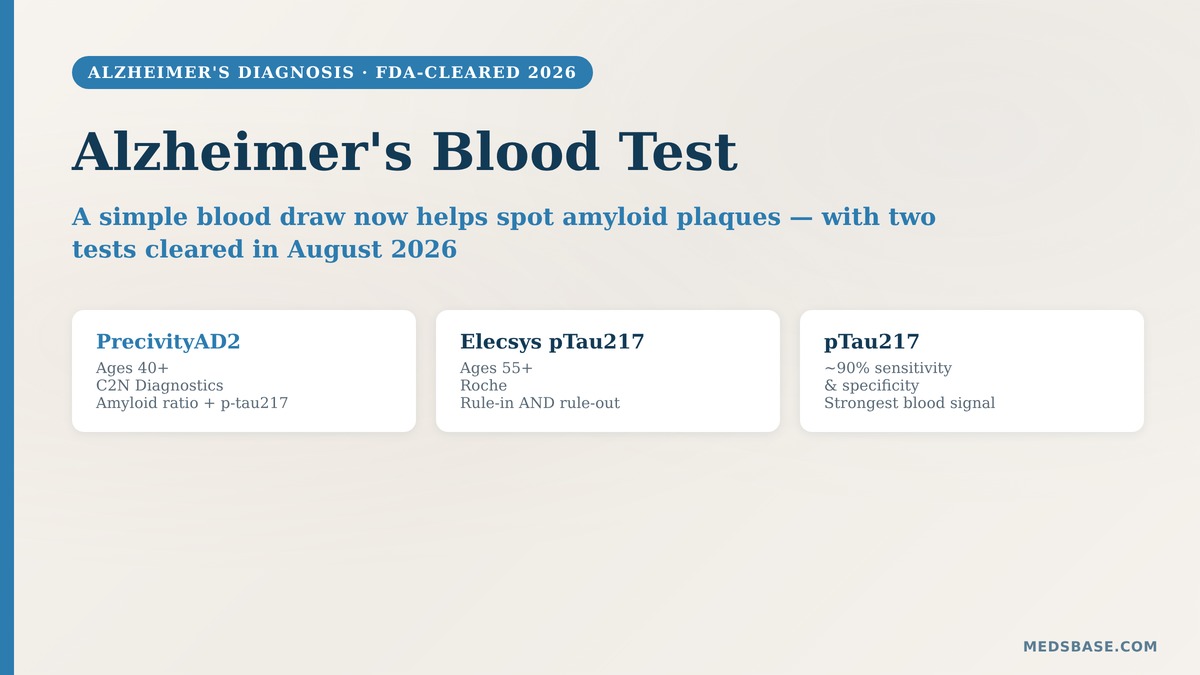
Alzheimer’s blood test — Alzheimer’s blood test — the newly FDA-cleared blood tests (PrecivityAD2 + Elecsys pTau217) and what they mean for you. Read on for an evidence-backed guide covering everything you need to know.
# Alzheimer’s Blood Test: 7 Verified Facts About the New FDA-Cleared Tests
Here’s a sentence that would have sounded like science fiction just a decade ago: a single blood draw can now help your doctor estimate whether memory problems are being driven by Alzheimer’s disease — no spinal tap, no waiting months for a PET scan. In August 2026, the U.S. Food and Drug Administration cleared two new Alzheimer’s blood test options. One is the first ever cleared for adults as young as 40.
By the end of this article, you’ll know exactly what these Alzheimer’s blood tests measure, how accurate they really are, who qualifies for one, and — crucially — what a positive result does and doesn’t mean for the person you love.
- Two Alzheimer’s blood tests earned FDA clearance in August 2026 — one cleared for ages 40+
- They measure pTau217, a protein linked to the amyloid plaques behind Alzheimer’s
- A blood test rules amyloid in or out — but it is not a stand-alone diagnosis
- One surprising limitation explains why your doctor still won’t rely on blood alone — we’ll cover it below
What Is an Alzheimer’s Blood Test?
An Alzheimer’s blood test is a diagnostic blood draw that measures proteins in your bloodstream that reflect the health of the brain. Specifically, the newly cleared tests look for phosphorylated tau at position 217 — shortened to pTau217 — a biomarker strongly associated with the amyloid plaques that are a hallmark of Alzheimer’s disease.
Quick Answer: An Alzheimer’s blood test measures pTau217 (and sometimes other proteins) in your blood to help estimate whether amyloid plaques are building up in your brain. It supports — but does not replace — a full clinical diagnosis.
For decades, confirming amyloid in the brain meant either a lumbar puncture (spinal tap) to sample cerebrospinal fluid, or a PET brain scan that can take weeks to schedule and may not be covered by insurance. A blood draw changes that equation. Two tests made headlines in 2026.
What Is Alzheimer’s Disease? (for context)
Alzheimer’s disease is the most common cause of dementia, a progressive condition that erodes memory, thinking, and ultimately the ability to carry out daily tasks. It is driven by two abnormal protein deposits: beta-amyloid plaques that form between nerve cells, and tau tangles that build up inside them. Doctors have long been able to suspect Alzheimer’s from symptoms alone, but confirming the underlying biology required those invasive or expensive tests — until now.
For the full clinical picture of symptoms, stages, and treatment, read our Everything You Need to Know About Alzheimer’s Disease guide.
How Does an Alzheimer’s Blood Test Work?
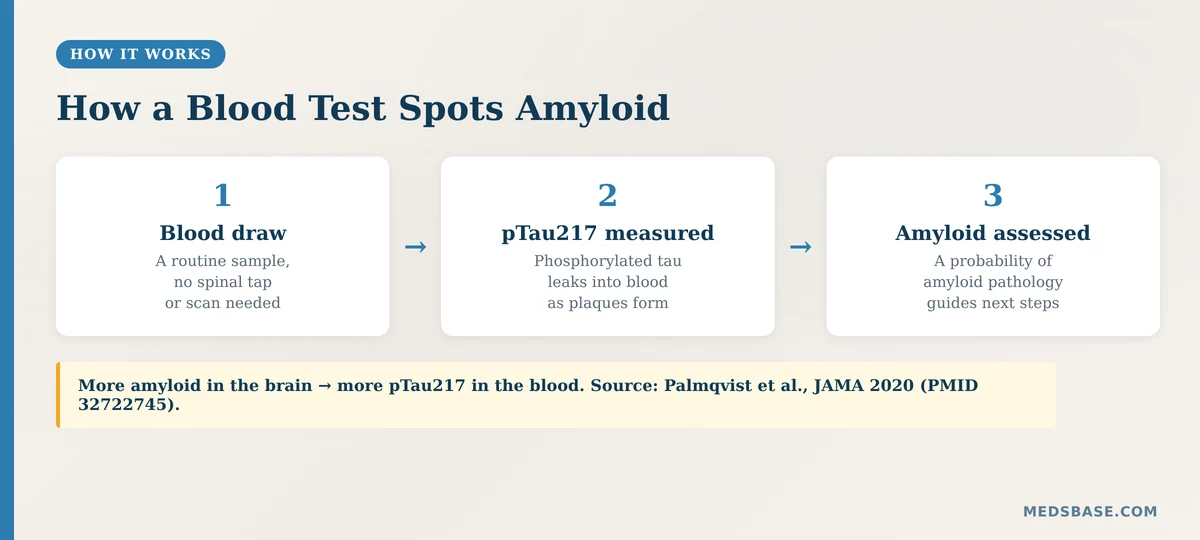
Here’s the analogy that makes it click. Think of amyloid plaques as a slow leak in a roof. You can only confirm the leak by climbing up and looking — or, until recently, by cutting a hole in your ceiling to peek. A pTau217 blood test is like a water meter in the wall: it detects the downstream sign of the leak from ground level.
When amyloid plaques begin forming, they trigger changes in how tau protein behaves. Bundles of phosphorylated tau — especially pTau217 — leak into the bloodstream in measurable amounts. The more amyloid in the brain, the more pTau217 tends to show up in the blood.
So what does a blood test actually tell your doctor? It returns a measure of pTau217 that, combined with your age and APOE status, produces a probability that you have amyloid pathology. That probability is then interpreted alongside everything else — your memory complaints, your cognitive testing, your history.
Here’s a practical way to picture it. A pTau217 result is rarely reported as a simple “positive” or “negative.” More often it lands somewhere on a continuum — low, intermediate, or high likelihood of amyloid. The intermediate zone is where clinical judgment does the heaviest lifting, which is exactly why the test is meant to be read by a professional, not delivered to you as a raw number.
Who Qualifies for an Alzheimer’s Blood Test?
Not everyone needs one, and the FDA clearances deliberately scope who the tests are for.
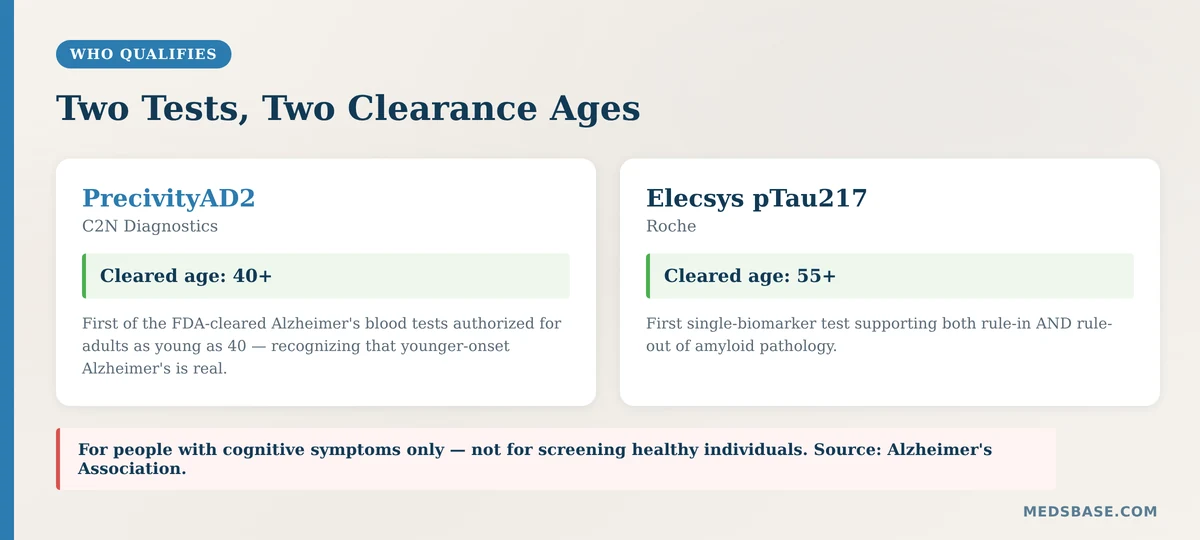
Quick Answer: Both newly cleared Alzheimer’s blood tests are for people who already show signs, symptoms, or complaints of cognitive impairment — not for widespread screening of healthy people.
Here’s where the two tests differ:
| Test | Manufacturer | Cleared age | Biomarker | Key capability |
|---|---|---|---|---|
| PrecivityAD2 | C2N Diagnostics | 40 and older | Amyloid (p-tau217 + amyloid ratio) | First cleared for patients as young as 40 |
| Elecsys pTau217 | Roche | 55 and older | pTau217 (single biomarker) | Rule-in AND rule-out of amyloid |
The C2N Diagnostics PrecivityAD2 — cleared August 20, 2026 — is the third blood-based biomarker test the FDA has cleared for Alzheimer’s, and the first authorized for use in adults as young as 40, according to the Alzheimer’s Association. The Elecsys pTau217, from Roche, cleared four days later and was described by its maker as the first FDA-cleared single-biomarker test supporting both rule-in and rule-out.
The “younger-onset Alzheimer’s” point matters more than it might seem. Alzheimer’s is not only a disease of old age. The Alzheimer’s Association notes that extending clearance down to age 40 “recognizes that younger-onset Alzheimer’s is a reality for many families.”
How Accurate Is an Alzheimer’s Blood Test?
Accuracy is the question everyone actually asks, so let’s be precise about what these tests can and cannot claim.
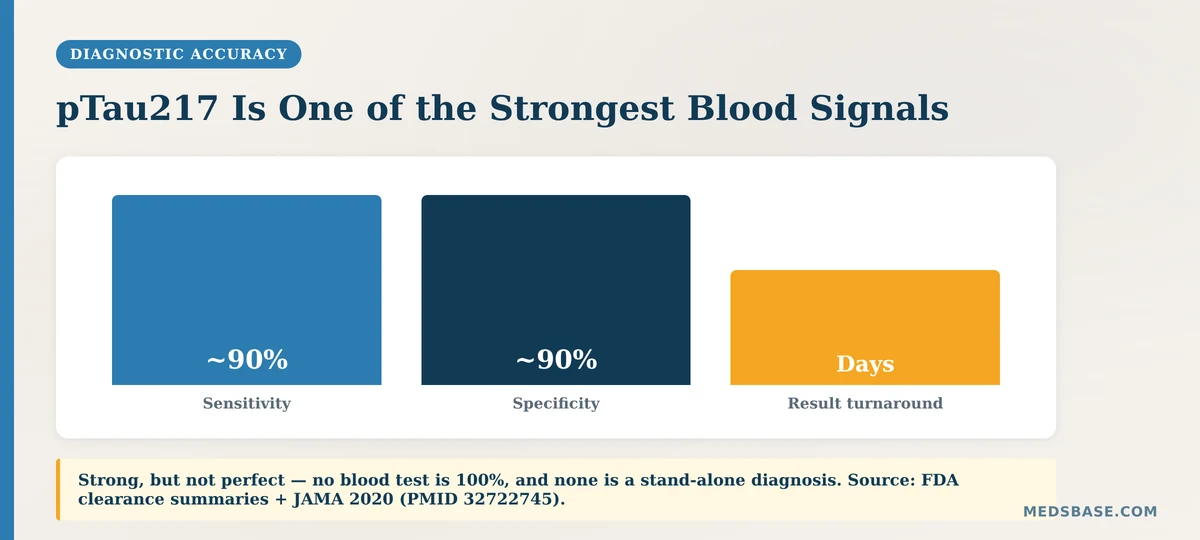
Quick Answer: pTau217 blood tests show high accuracy for detecting amyloid pathology — generally in the region of 90% sensitivity and specificity in studies — but no blood test is 100%, and none is a stand-alone diagnosis.
The blood biomarker pTau217 has repeatedly emerged as one of the strongest blood signals of Alzheimer’s-related brain changes. A landmark 2020 study published in JAMA found plasma p-tau217 could discriminate Alzheimer’s disease from other neurodegenerative disorders with high accuracy. More recent validation studies have reported sensitivity and specificity for pTau217 at or above 90% for identifying elevated amyloid. Different studies land at slightly different figures depending on the population tested and the cut-off used, which is exactly why you should treat any single headline number with care.
What “accurate” means in practice, for you: if the test comes back positive, there’s a strong probability you have amyloid plaques, but your doctor will still weigh that result against your symptoms. If it comes back negative, it strongly argues against amyloid-driven Alzheimer’s — which helps your doctor pivot to investigating other causes of memory problems, like thyroid issues, vitamin deficiencies, or medication side effects.
A finding worth repeating: a negative result is not a dead end. It’s one of the fastest, least invasive ways to redirect a memory workup toward causes that genuinely improve with treatment.
Alzheimer’s Blood Test vs Brain Scans and Spinal Taps
You may be wondering how a blood draw stacks up against the “gold standard” tests. Here’s the honest comparison.
| Method | What it shows | Invasiveness | Speed | Cost / coverage |
|---|---|---|---|---|
| Alzheimer’s blood test (pTau217) | Probability of amyloid | Simple blood draw | Days | Lower; coverage growing |
| PET amyloid scan | Direct image of amyloid plaques | None (IV tracer) | Weeks to schedule | High; frequent insurance friction |
| Cerebrospinal fluid (spinal tap) | Direct measure of amyloid & tau in CSF | Lumbar puncture | Days | Moderate; invasiveness deters many |
Blood tests won’t fully replace PET scans or spinal taps — at least not yet. But they change when a specialist referral is even needed. A strong blood result can justify moving quickly to a confirmatory scan or a specialist who manages Alzheimer’s treatments. A clean result can spare you an invasive procedure entirely.
One nuance people miss: the FDA cleared these tests to be used alongside a clinical assessment — “not instead of one.” The Alzheimer’s Association is explicit on this point: “there is no single, stand-alone test to diagnose Alzheimer’s disease today — including this newly cleared test.”
What a Positive Result Really Means
This is the section that separates a genuinely useful guide from a news summary. Let’s walk through the two outcomes clearly.
If your Alzheimer’s blood test is positive: it means amyloid pathology is likely present — not a definitive diagnosis on its own, and not a guarantee of the specific symptoms you’re experiencing. Your doctor will combine the blood result with cognitive testing and imaging to reach a diagnosis. A finding of amyloid also opens the door to a conversation about the disease-modifying therapies that are now approved, which work best earlier in the disease course.
If your Alzheimer’s blood test is negative: it strongly suggests your cognitive symptoms are not being driven by amyloid-heavy Alzheimer’s. That’s genuinely good news — it redirects the diagnostic energy toward reversible or treatable causes, from medication side effects to sleep problems to vascular issues.
One surprising caveat most articles skip: a person can have amyloid plaques and not have noticeable symptoms — a state researchers call preclinical Alzheimer’s. That’s precisely why the tests are restricted to people with cognitive symptoms. A positive blood test in a symptom-free person would cause more anxiety than clarity. Another reason your doctor still leans on clinical judgment is that some older adults carry amyloid without ever progressing to dementia in their lifetime.
Here’s where a prevention angle becomes useful. While you can’t change your amyloid biology yet, you can act on modifiable risk factors that research ties to cognitive decline. Blood pressure control is one of the strongest levers — high blood pressure in midlife is linked to elevated Alzheimer’s risk, as we explain in this guide.
How to Prepare for Your Alzheimer’s Blood Test
If your doctor orders one, preparation is refreshingly simple. Most pTau217 blood tests do not require fasting, though you should always follow your clinic’s specific instructions. Bring your medication list, because certain drugs can influence cognition and your doctor will want the full picture. Write down when your memory concerns started and what specifically has been slipping — concrete examples (misplacing keys daily, repeating questions, getting lost driving a familiar route) help your clinician interpret the result far better than “I’ve been a bit forgetful.”
It also helps to bring a second set of ears. A spouse, adult child, or friend can fill in gaps you may not notice yourself and can jot down the doctor’s answers so nothing is lost in the emotion of the moment. And if you’ve had recent bloodwork, thyroid tests, or vitamin-B12 levels checked, bring those results along — they give your clinician instant context for ruling out the reversible causes a negative blood test points toward.
Finally, go in knowing the emotional range of the outcome. A negative result is a chance to investigate reversible causes. A positive result is a starting point for planning, not a verdict. Either way, you’ll leave with more clarity than you had.
Frequently Asked Questions
Q: Can a blood test detect Alzheimer’s?
A: A blood test can detect the biology associated with Alzheimer’s — specifically pTau217, a marker of amyloid plaque buildup. It cannot, on its own, diagnose Alzheimer’s disease. Diagnosis still requires a doctor’s clinical assessment. Think of the blood test as a powerful clue, not a verdict.
Q: How accurate is an Alzheimer’s blood test?
A: Clinical studies generally report pTau217 blood tests identifying amyloid pathology with roughly 90% sensitivity and specificity — strong, but not perfect. Accuracy varies by population and test cut-off, which is why a doctor interprets the number in context rather than treating it as a binary answer.
Q: At what age can you take an Alzheimer’s blood test?
A: The PrecivityAD2 test is FDA-cleared for adults 40 and older with signs of cognitive impairment; the Elecsys pTau217 test is cleared for adults 55 and older. Both require that you already have memory or thinking complaints — neither is approved for screening healthy people.
Q: Does Medicare cover Alzheimer’s blood tests?
A: Coverage is evolving. Diagnostic blood tests ordered by a clinician for a patient with cognitive symptoms are increasingly reimbursed, but confirm with your specific insurer and plan. Coverage is generally strongest when the test is ordered as part of a documented diagnostic workup rather than on a purely elective basis.
Q: What is the pTau217 blood test?
A: The pTau217 blood test measures phosphorylated tau at position 217, a protein that builds up in the blood as amyloid plaques form in the brain. It is the biomarker behind both of the newly cleared Alzheimer’s blood tests and is widely considered the strongest blood-based signal of Alzheimer’s biology available today.
Q: Can an Alzheimer’s blood test replace a spinal tap?
A: In many cases it can reduce — but not always eliminate — the need for a spinal tap. A definitive or high-confidence blood result often lets doctors defer or skip the more invasive cerebrospinal-fluid analysis. In ambiguous cases, a PET scan or spinal tap may still be recommended for confirmation.
Q: What should I do if I get a positive Alzheimer’s blood test?
A: Take it to a specialist. A positive result means amyloid is likely present, and the next step is a full evaluation — cognitive testing, imaging, and a discussion of disease-modifying treatment options. It is a starting point for care planning, not a sentence. If you have hormonal or medication questions alongside a memory workup, read how menopause-related hormones interact with Alzheimer’s risk here.
The Bottom Line
The Alzheimer’s blood test is a genuine breakthrough, but the accurate summary is a balanced one: it makes earlier, less invasive testing possible — and it works best as one input in a careful clinical assessment, not as a magic yes/no answer.
Your immediate action: if you or someone you love has active memory or thinking concerns, ask a doctor whether a pTau217 blood test is appropriate — and mention the age-40 clearance if the person is younger than you’d expect. If symptoms are absent, hold off; these tests are not yet for reassurance-style screening.
Wondering about the broader picture of risk and prevention? Read our full guides:
- Everything You Need to Know About Alzheimer’s Disease
- Your Alzheimer’s Risk Could Be 42% Higher if You Leave High Blood Pressure Untreated

Written by
Sophie ChenPharmaceutical Content Researcher · 8 years experience
Sophie Chen is a pharmaceutical content researcher with 8 years covering generic medication access and clinical pharmacology. She specialises in international regulatory frameworks, bioequivalence standards, and patient-facing education on therapeutic drug classes. She is not a clinician.