








✓ Medically reviewed by · Last reviewed: May 2026
Pharmacy Researcher · 8 years experience
Pharmacy researcher with 8 years reviewing clinical drug information, generic formulation equivalence, and international pharmaceutical standards. Focuses on patient-facing accuracy in medication education.
doxycycline vs minocycline for acne — Doxycycline vs Minocycline for Acne: 7 Proven Differences to Help You Choose. Read on for an evidence-backed guide covering everything you need to know.
Key Takeaways
Both doxycycline and minocycline are highly effective for moderate to severe inflammatory acne — they reduce inflammatory lesions by approximately 50-70% over 12 weeks, with no consistent efficacy difference between them in head-to-head studies.
The side-effect profiles diverge in critical ways — doxycycline carries a high risk of photosensitivity (severe sunburn in as little as 15-30 minutes for susceptible users), while minocycline’s standout risks are vestibular effects (dizziness in 10-15% of users) and, with prolonged use, blue-grey skin hyperpigmentation.
Your lifestyle should drive the choice more than the acne type — outdoor workers, athletes, and people living in sunny climates should strongly prefer minocycline; people with inner-ear conditions, balance disorders, or darker skin tones should strongly prefer doxycycline.
Neither should be used for more than 12 weeks — the AAD guidelines and global antibiotic-resistance data both recommend limiting oral antibiotic courses to 12 weeks maximum, transitioning to topical maintenance (retinoids, benzoyl peroxide) thereafter.
One patient profile that surprises many dermatologists: minocycline’s hyperpigmentation risk is highest in Fitzpatrick skin types IV-VI — the very patients who are also most prone to post-inflammatory hyperpigmentation from acne itself. This makes doxycycline the safer first-line oral antibiotic for patients with darker skin tones.
- What Are Doxycycline and Minocycline?
- Efficacy: Does One Work Better for Acne?
- Side Effects: The Differences That Matter Most
- Which Acne Type Responds Better to Each Antibiotic?
- How Long Until You See Results?
- The Gut Microbiome: Why 12 Weeks Is the Limit
- How Oral Antibiotics Fit Into Your Acne Treatment Plan
- Doxycycline vs Minocycline for Acne: The 7 Differences Decision Table
- When Antibiotics Aren’t Enough: Escalation Options
- Frequently Asked Questions
- The Bottom Line
What Are Doxycycline and Minocycline?
Doxycycline vs minocycline for acne — if your dermatologist has offered you an oral antibiotic, these are the two names you’ll hear most often. Both belong to the tetracycline class of antibiotics and have been mainstays of acne treatment for decades. But knowing they’re “antibiotics” doesn’t help you choose between them.
Doxycycline vs minocycline for acne — both drugs work against acne through two mechanisms: (1) they kill Cutibacterium acnes (the bacteria that colonises blocked pores and drives inflammation), and (2) they have direct anti-inflammatory effects — reducing the redness and swelling of acne lesions independent of their antibacterial action. This dual mechanism explains why they work even when bacterial resistance is present — the anti-inflammatory effect persists.
Doxycycline vs minocycline for acne — the key structural difference: minocycline is more lipophilic (fat-soluble) than doxycycline. This means it penetrates tissues better — including the sebaceous glands where acne forms — but it also crosses into the central nervous system more readily, which contributes to its vestibular (dizziness) side effects. Doxycycline, being less lipophilic, stays more in the bloodstream and GI tract — which explains its more prominent GI side effects and lower CNS penetration.
Quick Answer: Doxycycline and minocycline are tetracycline-class antibiotics prescribed for moderate to severe inflammatory acne. Both reduce C. acnes bacteria and directly suppress inflammation. While their acne-clearing efficacy is comparable, their side-effect profiles and suitability for different lifestyles and skin types differ substantially — making the choice personal rather than purely clinical.
Both doxycycline and minocycline are available without a prescription through the MedsBase acne category — browse our full range of acne treatment options including oral antibiotics, topical retinoids, and combination therapies.
Efficacy: Which Is More Effective — Doxycycline vs Minocycline for Acne?
This is the question most people ask first when weighing doxycycline vs minocycline for acne — and the answer is more nuanced than a simple “yes” or “no.”
Doxycycline vs minocycline for acne — the Cochrane systematic review of minocycline for acne vulgaris (the gold standard in evidence synthesis) found that minocycline is effective for inflammatory acne but did not demonstrate consistent superiority over other tetracyclines, including doxycycline. Most head-to-head trials of doxycycline vs minocycline for acne find no statistically significant difference in acne lesion reduction between the two drugs at 12 weeks.
Doxycycline vs minocycline for acne — however, there are subtle differences that matter:
Inflammatory lesion reduction: Both reduce inflammatory lesions (papules, pustules) by approximately 50-70% at 12 weeks. No consistent winner.
Non-inflammatory lesions: Both have a more modest effect on comedones (blackheads, whiteheads), reducing them by approximately 20-40%. Neither is a first-line comedone treatment — that’s what topical retinoids are for.
Nodulocystic acne: Some studies suggest minocycline may have a slight edge for deeper, nodular lesions — possibly due to its higher lipophilicity and better tissue penetration. However, this advantage is small (perhaps 5-10% better response in one small trial) and not consistently replicated.
Antibiotic resistance: Here the data favours doxycycline — but with a major caveat. Global surveillance data from 2020-2025 shows C. acnes resistance to tetracyclines ranging from 10-40% depending on geographic region, with minocycline resistance typically running 3-8% lower than doxycycline resistance in the same populations. However, the clinical significance of this is questionable: as noted, the anti-inflammatory effect of tetracyclines operates independently of their antibacterial action, meaning even resistant strains may still respond clinically.
The bottom line on efficacy: For most patients with moderate inflammatory acne, doxycycline and minocycline are comparably effective. If one doesn’t work (true treatment failure — not just slow response), the other probably won’t either — you may need a different treatment class entirely. The choice between them should be driven by side-effect profile, lifestyle, and skin type — not by chasing a marginal efficacy difference that the evidence doesn’t support.
Side Effects: The Critical Doxycycline vs Minocycline for Acne Differences
This is where doxycycline vs minocycline for acne diverges most sharply — and where your personal circumstances should drive the decision. Choosing doxycycline vs minocycline for acne based on efficacy alone misses the point; side-effect compatibility is what determines whether you’ll actually stay on the medication for the full 12-week course.
Doxycycline’s Standout Risk: Photosensitivity
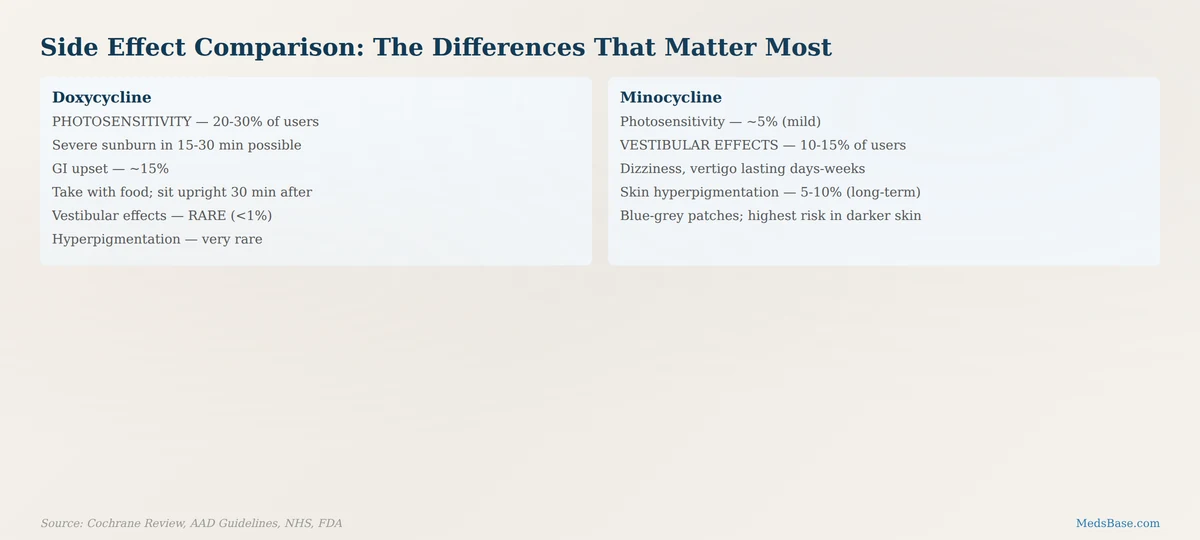
Doxycycline vs minocycline for acne — doxycycline is one of the most photosensitising oral medications in clinical use. Approximately 20-30% of users experience some degree of exaggerated sun sensitivity, and in susceptible individuals, as little as 15-30 minutes of direct UV exposure can cause severe, blistering sunburn.
This is not an allergic reaction — it’s a phototoxic reaction where UV light activates the doxycycline molecule in the skin, causing direct cellular damage. It looks and feels like a very severe sunburn and can occur even through car windows, on cloudy days, and with SPF protection (though high-SPF sunscreen significantly reduces — but doesn’t eliminate — the risk).
If you work outdoors, play outdoor sports, live in a sunny climate, or have a vacation planned during your treatment course, minocycline is almost certainly the better choice in the doxycycline vs minocycline for acne decision — its photosensitivity risk is approximately 5% and typically mild.
Minocycline’s Standout Risk: Vestibular Effects
Minocycline can cause dizziness, vertigo, light-headedness, and a sensation of being “off-balance” in approximately 10-15% of users. This typically begins within the first 2 weeks of treatment and can last for days to weeks. For most people, it’s mild and tolerable; for some, it’s disabling.
The mechanism involves minocycline’s higher lipid solubility, which allows it to cross the blood-brain barrier and affect the vestibular system. Women appear to be slightly more susceptible than men (approximately 15% vs 10% in some studies), though the reason is unclear.
Critical practical point: If you drive for a living, operate heavy machinery, or have a history of vertigo or inner-ear disorders, doxycycline is the safer first choice. The dizziness from minocycline typically resolves within days of stopping the medication, but those days can be dangerous if your job or daily activities require full balance and spatial awareness.
Minocycline’s Other Standout Risk: Hyperpigmentation
With prolonged use (typically >6-12 months, though case reports exist for shorter courses), minocycline can cause blue-grey or slate-grey pigmentation of the skin. This most commonly appears on the face (especially acne-scarred areas), the shins, and the forearms. Three types exist, with Type II (occurring in previously inflamed skin) being most relevant to acne patients.
The critical demographic point: hyperpigmentation from minocycline occurs most frequently and is most cosmetically noticeable in patients with Fitzpatrick skin types IV-VI — the same skin types most prone to post-inflammatory hyperpigmentation from acne itself. For patients with darker skin tones, this makes doxycycline the strongly preferred first-line oral antibiotic — you don’t want to treat one pigment problem by potentially causing another.
The pigmentation is usually (but not always) reversible upon stopping the medication, fading over months to years.
Shared Side Effects (Both Drugs):
- GI upset (nausea, diarrhoea, abdominal pain): ~10-15% for both. Taking with food helps (unlike older tetracyclines, both can be taken with meals).
- Oesophageal irritation: More common with doxycycline (~10%). The fix: take with a full glass of water and stay upright for 30 minutes afterward.
- Vaginal yeast infections: ~5-10% for both (antibiotics disrupt normal flora).
- Rare but serious: intracranial hypertension (pseudotumor cerebri), drug-induced lupus (minocycline > doxycycline, ~1 in 10,000-50,000), and severe cutaneous adverse reactions (very rare).
Which Acne Type Responds Better to Each Antibiotic?
While efficacy is broadly comparable, certain acne presentations may favour one antibiotic over the other:
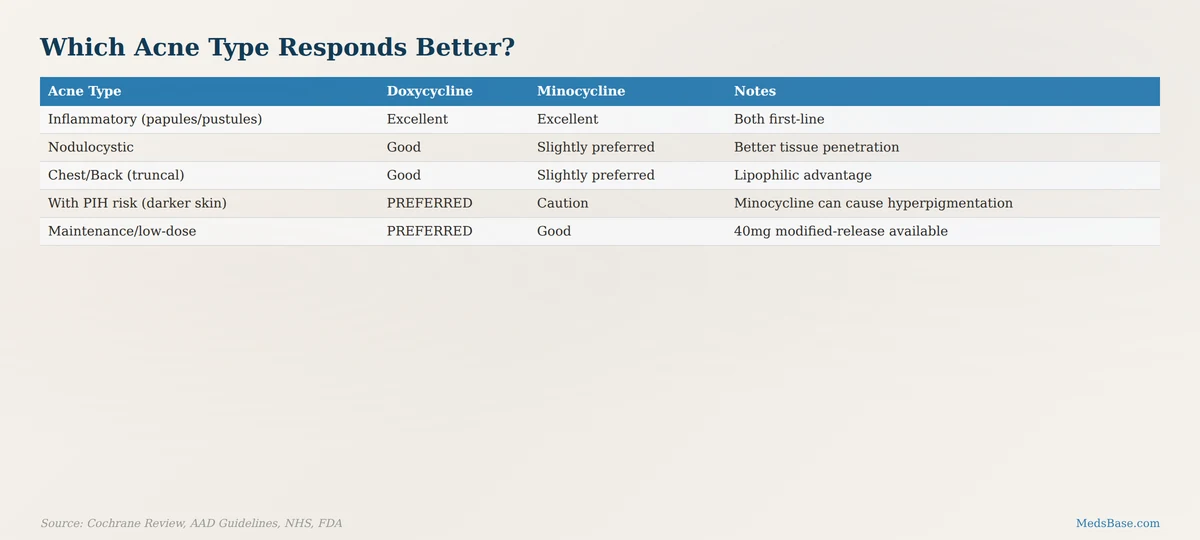
Inflammatory Acne (Papules and Pustules): Both are excellent. This is the classic indication for oral antibiotics in acne. When someone says “antibiotics for acne,” this is what they mean — red, inflamed bumps that haven’t responded to topical treatment alone.
Nodulocystic Acne: Minocycline may have a slight advantage for deep, tender nodules — several small studies have noted faster resolution of nodular lesions with minocycline, possibly due to better tissue penetration. However, isotretinoin (Accutane), not oral antibiotics, remains the definitive treatment for severe nodulocystic acne. If you have multiple deep nodules, antibiotics are a bridge, not a destination.
Truncal Acne (Chest and Back): Minocycline’s better tissue penetration may give it an edge for acne on the thicker skin of the chest and back. One small comparative study found minocycline cleared truncal lesions faster than doxycycline, though the difference narrowed by week 12.
Hormonal Acne (Jawline, Chin, Cyclical Flares): Neither antibiotic directly addresses the hormonal driver — androgens stimulating sebum production. For hormonal acne, oral antibiotics are best used as a short-term bridge while hormonal therapy (combined oral contraceptive, spironolactone) takes effect. Both doxycycline and minocycline serve this bridging role equally well.
Acne with Post-Inflammatory Hyperpigmentation: Here, the calculus shifts. For patients with darker skin tones (Fitzpatrick IV-VI) — who are both most prone to PIH and most at risk for minocycline-induced hyperpigmentation — doxycycline is generally preferred. You don’t want to trade one type of pigmentation for another. If photosensitivity is also a concern, discuss the trade-offs with your dermatologist — there is no perfect answer, only the least-bad option for your specific circumstances.
Read about MedsBase’s complete acne treatment range
How Long Until You See Results?
Patience is the hardest part of acne treatment. For both sides of the doxycycline vs minocycline for acne equation, the timeline is similar:
Week 0-2: You’ll probably notice nothing yet — or possibly mild GI side effects as your body adjusts. Acne doesn’t improve in the first two weeks, and may temporarily worsen in some people (though this “purging” is more typical of retinoids than antibiotics). If you’re on minocycline, these are the weeks when vestibular side effects typically appear — if dizziness occurs, it usually starts within the first 5-14 days.
Week 2-4: First visible improvement. Existing inflamed lesions start calming down (less red, less tender). New breakouts still occur but may be smaller and resolve faster. This is the point where patients typically say “I think it’s working — maybe?”
Week 4-8: The most noticeable improvement period. New inflammatory lesions are significantly fewer. Existing ones are resolving. Your skin looks calmer overall. By week 6-8, most patients have a 40-60% reduction in inflammatory lesions. This is also when your dermatologist will typically add or adjust your topical regimen (retinoid, benzoyl peroxide) as the foundation for maintenance.
Week 8-12: Maximum antibiotic benefit. If you haven’t achieved satisfactory improvement by week 12, continuing the same antibiotic is unlikely to help — you may need a different treatment approach. The 12-week mark is also when the clock runs out on antibiotic duration, per AAD guidelines (see next section).
What to Expect When Starting Oral Antibiotics: Your dermatologist should prescribe a topical regimen alongside the antibiotic — typically a topical retinoid (tretinoin, adapalene, tazarotene) plus benzoyl peroxide. The topical retinoid addresses comedones (which antibiotics don’t) and builds the maintenance foundation; the benzoyl peroxide reduces the development of antibiotic resistance. Never use an oral antibiotic as monotherapy — it will work temporarily, set you up for resistance, and leave you with nothing when you stop.
Explore MedsBase Skin Care products
The Gut Microbiome: Why 12 Weeks Is the Limit
Here’s the conversation about doxycycline vs minocycline for acne that dermatologists are having more and more: neither drug is selective for C. acnes. Both suppress a broad range of bacteria throughout the body — including the gut microbiome, which plays a critical role in immune function, metabolism, and even mental health. In the doxycycline vs minocycline for acne analysis, gut impact is not a differentiating factor — both carry the same gut-microbiome concerns and the same 12-week limit.
Research on the gut microbiome and oral antibiotics shows:
- Gut bacterial diversity decreases measurably within days of starting either doxycycline or minocycline.
- Recovery of diversity begins within 2-4 weeks of stopping a short course (≤12 weeks).
- Prolonged use (>12 weeks) is associated with slower recovery and a higher likelihood of permanent shifts in gut microbiota composition.
- The relationship between antibiotic use duration and resistance development is dose- and duration-dependent: longer courses = higher resistance risk.
This is why the American Academy of Dermatology, the European Academy of Dermatology, and the Global Alliance to Improve Outcomes in Acne all recommend limiting oral antibiotic courses to 12 weeks maximum, always in combination with topical therapy (benzoyl peroxide + topical retinoid) that takes over as the antibiotic is withdrawn.
Practical implications for your choice: Both doxycycline and minocycline affect the gut microbiome similarly — this is not a differentiating factor between them. The differentiating factor is whether you commit to a defined, time-limited course (good) or allow the prescription to drift into indefinite use (bad). Set a 12-week stop date on your calendar the day you start.
How Oral Antibiotics Fit Into Your Acne Treatment Plan
Oral antibiotics are not a stand-alone treatment. They are one piece of a multi-modal strategy:
The standard regimen (what dermatologists actually prescribe):
- Oral antibiotic (doxycycline or minocycline) — 12-week course, reassess at week 12.
- Topical retinoid (tretinoin, adapalene, tazarotene) — started simultaneously, continued indefinitely as maintenance.
- Benzoyl peroxide (2.5-10% wash or leave-on) — started simultaneously, continued indefinitely to prevent antibiotic resistance.
- Maybe: azelaic acid for post-inflammatory hyperpigmentation, clindamycin topical for additional antibacterial coverage (short-term bridge), or hormonal therapy (OCP/spironolactone) for hormonally driven acne.
The transition plan (what happens at 12 weeks):
- Stop the oral antibiotic.
- Continue the topical retinoid and benzoyl peroxide (these are your long-term maintenance).
- If acne flares after stopping the antibiotic, you haven’t “failed” — you need to revisit the topical regimen or consider escalation (see next section). Going back on antibiotics is a short-term fix that creates a long-term problem.
Read next: Tretinoin vs Adapalene — Which Topical Retinoid?
Doxycycline vs Minocycline for Acne: The 7 Differences Decision Table
| Difference | Doxycycline | Minocycline | Who It Matters For |
|---|---|---|---|
| 1. Photosensitivity | HIGH — 20-30% of users. Severe sunburn in 15-30 min possible. | LOW — ~5%. Mild, rare. | Outdoor workers, athletes, sunny-climate residents prefer minocycline |
| 2. Vestibular Side Effects | RARE — <1% | MODERATE — 10-15%. Dizziness, vertigo. | Drivers, machine operators, vertigo history prefer doxycycline |
| 3. Hyperpigmentation Risk | RARE — isolated case reports | MODERATE — 5-10% with prolonged use (>6mo). Blue-grey patches. | Fitzpatrick IV-VI (darker skin tones) prefer doxycycline |
| 4. GI Tolerance | MODERATE — 15% GI upset. Oesophageal irritation if taken without water. | MODERATE — similar GI upset rate. No oesophageal risk. | History of reflux or oesophagitis prefer minocycline |
| 5. Dosing Convenience | 50-100mg once or twice daily. 40mg modified-release available (lower side-effect profile). | 50-100mg once or twice daily. Extended-release formulation available (lower vestibular risk). | Modified/extended-release formulations reduce side effects for both — ask your dermatologist |
| 6. Drug-Induced Lupus Risk | Very rare (<1 in 50,000) | Rare (~1 in 10,000-50,000). Reversible on stopping. | History of autoimmune disease discuss with rheumatologist before starting either |
| 7. Cost (Generic) | $ (typically lower cost) | $-$$ (slightly higher, depending on market) | Budget-conscious doxycycline typically cheaper |
When Antibiotics Aren’t Enough: Escalation Options
If you’ve completed a 12-week course of doxycycline or minocycline and your acne hasn’t responded adequately, or if it returns after stopping, the next step is NOT another antibiotic course. Here are the escalation pathways:
For persistent inflammatory acne in women: Hormonal therapy — combined oral contraceptives (certain formulations are FDA-approved for acne) or spironolactone (an androgen blocker, highly effective for hormonal-pattern acne). Spironolactone is used off-label for acne but has a strong evidence base and a better long-term safety profile than indefinite antibiotics.
For moderate persistent acne: Isotretinoin (oral retinoid, formerly Accutane) at low-dose (10-20mg/day). This is a fundamentally different approach — isotretinoin addresses all four pathogenic factors in acne (sebum production, follicular hyperkeratinisation, C. acnes, and inflammation) and offers the possibility of long-term remission. Low-dose regimens have a much better side-effect profile than the traditional high-dose courses.
For mild persistent acne: Intensify your topical regimen. Prescription-strength retinoids (tretinoin 0.05-0.1%, tazarotene 0.1%), higher-concentration benzoyl peroxide, combination products (adapalene + benzoyl peroxide, tretinoin + clindamycin), and procedural adjuncts (chemical peels, light-based therapies).
Related Reading
- Tretinoin vs Adapalene for Acne
- Female Pattern Hair Loss Treatment (covers spironolactone — shared acne context)
- Acne Treatment — MedsBase Product Range
Frequently Asked Questions
Q: Which is better for acne, doxycycline or minocycline?
A:
A: Neither is consistently “better” — in the doxycycline vs minocycline for acne comparison, they are comparably effective for inflammatory acne, each reducing lesions by approximately 50-70% over 12 weeks. When choosing between doxycycline vs minocycline for acne, the decision should be driven by side-effect considerations: if you spend significant time outdoors or have darker skin (Fitzpatrick IV-VI), doxycycline is generally preferred (lower hyperpigmentation risk). If you live in a sunny climate, work outdoors, or are an athlete, minocycline is preferred (lower photosensitivity risk). If you drive professionally or have vertigo history, doxycycline is preferred. A good dermatologist personalises the doxycycline vs minocycline for acne choice based on your lifestyle and skin type, not on a marginal and unproven efficacy difference.
Q: How bad is doxycycline sun sensitivity for acne patients?
A:
A: It can be severe. An estimated 20-30% of doxycycline users experience exaggerated sun sensitivity, with susceptible individuals developing severe, blistering sunburn in as little as 15-30 minutes of direct sun exposure. This is a phototoxic reaction — it is not an allergy and is not prevented by antihistamines. High-SPF broad-spectrum sunscreen (SPF50+) significantly reduces but does not eliminate the risk. If you work outdoors, play outdoor sports, or live in a sunny climate, discuss the photosensitivity risk with your dermatologist before accepting a doxycycline prescription — minocycline may be the safer choice for your lifestyle.
Q: How common is dizziness with minocycline for acne?
A:
A: Vestibular side effects (dizziness, vertigo, light-headedness, unsteadiness) affect approximately 10-15% of minocycline users. It typically begins within the first 5-14 days of treatment, can last for days to weeks, and is usually dose-dependent (higher doses = higher risk). Women may be slightly more susceptible than men. Extended-release minocycline formulations have a lower incidence of vestibular effects than immediate-release. The dizziness resolves within days of stopping the medication for virtually everyone. If you experience it, contact your dermatologist — switching to doxycycline is the standard response and usually solves the problem.
Q: Can I take doxycycline or minocycline for more than 12 weeks for acne?
A:
A: It’s not recommended. The American Academy of Dermatology, European guidelines, and the Global Alliance all recommend limiting oral antibiotic courses for acne to 12 weeks maximum. Exceeding this duration increases the risk of antibiotic resistance (both in C. acnes and in your general bacterial flora), prolongs gut microbiome disruption, and increases the risk of cumulative side effects (especially minocycline hyperpigmentation, which is strongly duration-dependent). If your acne returns after a 12-week antibiotic course, the answer is not a second course — it’s revisiting your topical maintenance regimen (retinoid + benzoyl peroxide) or considering escalation to hormonal therapy or isotretinoin.
Q: Does doxycycline or minocycline cause antibiotic resistance?
A:
A: Both can. All antibiotics exert selective pressure for resistance. Global surveillance data shows C. acnes resistance to tetracyclines ranging from 10-40% depending on geographic region, with minocycline resistance typically running a few percentage points lower than doxycycline. This is one reason the 12-week limit exists and why benzoyl peroxide (which does not induce resistance and actually reduces resistant C. acnes populations) is always prescribed alongside oral antibiotics. The key protective measure you can take: use the antibiotic for the shortest effective duration, always with benzoyl peroxide, and transition to topical maintenance as planned.
Q: Can minocycline cause permanent skin discolouration?
A:
A: Minocycline-associated hyperpigmentation (blue-grey or slate-grey patches, most commonly on the face, shins, or forearms) resolves in most — but not all — patients after stopping the medication. Fading typically takes months to years. In a minority of cases, particularly Type II (occurring in areas of previous inflammation) and Type III (sun-exposed skin), the pigmentation may be very slow to fade or persist permanently. The risk is strongly duration-dependent (longer courses = higher risk), and is highest in patients with Fitzpatrick skin types IV-VI. This is why patients with darker skin tones should strongly consider doxycycline as the first-line oral antibiotic — the hyperpigmentation risk from minocycline directly compounds the post-inflammatory hyperpigmentation they’re already managing from acne itself.
Q: How long does doxycycline vs minocycline for acne take to work?
A:
A: Neither works quickly. First visible improvement typically appears at 2-4 weeks (reduced inflammation in existing lesions), with the most noticeable improvement between weeks 4-8. Maximum antibiotic benefit is reached at 8-12 weeks. If you have not achieved satisfactory improvement by week 12, continuing the same antibiotic is unlikely to help. This slow onset is one reason oral antibiotics are always paired with topical treatments — the topicals start working immediately (even if the visible effect is slower) and provide the long-term maintenance the antibiotics cannot.
Q: Can I buy doxycycline or minocycline for acne without a prescription?
A:
A: MedsBase.com offers a range of acne treatment medications — including doxycycline and minocycline — without a prescription. While a prescription is not required to order, consulting a healthcare professional about your specific acne type, severity, and treatment history is always recommended to ensure you choose the right medication and use it appropriately. All MedsBase products are sourced from WHO-GMP-certified manufacturers, ensuring the quality and authenticity you expect from a trusted provider.
The Bottom Line
In the doxycycline vs minocycline for acne decision, efficacy is not the tiebreaker. Both work. The tiebreaker is you — your lifestyle, your skin type, your medical history, and your willingness to tolerate specific side effects. The doxycycline vs minocycline for acne choice ultimately comes down to matching the right side-effect profile to the right patient.
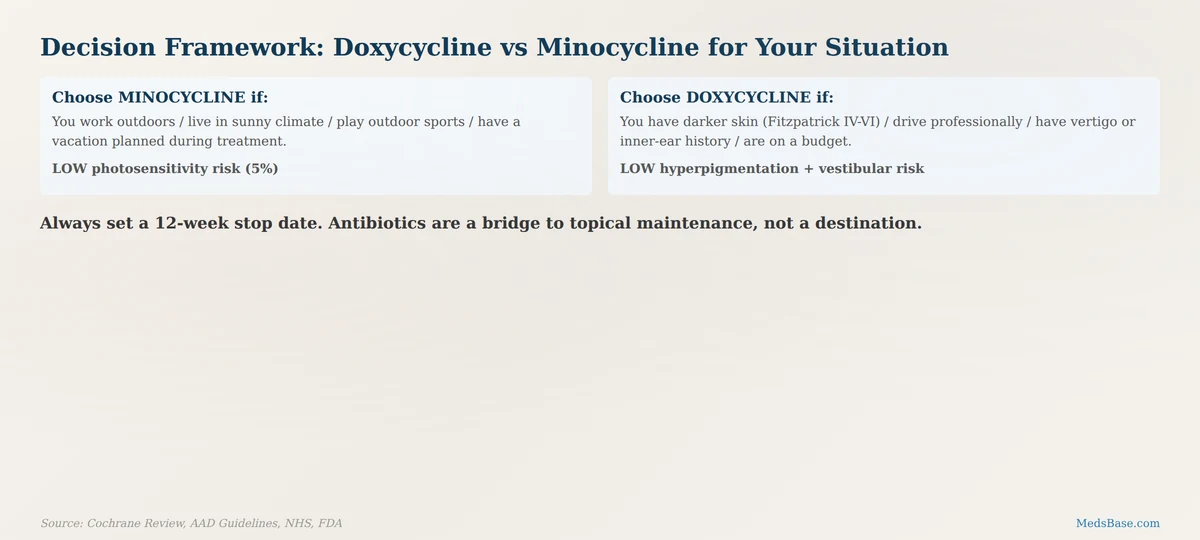
If you work outdoors or live somewhere sunny: minocycline. If you have darker skin or a history of hyperpigmentation: doxycycline. If you drive for a living or have vertigo: doxycycline. If you have severe acid reflux: minocycline. If cost is a concern: doxycycline is typically cheaper. Every doxycycline vs minocycline for acne comparison ultimately resolves to these personal factors, not a universal “better” answer.
And regardless of which you choose: set a 12-week stop date, always use it alongside benzoyl peroxide and a topical retinoid, and never let the prescription drift into indefinite use. Antibiotics are a bridge, not a destination — the destination is long-term topical maintenance, with oral antibiotics as the tool that gets you there.
Your immediate action: If you’re being offered an oral antibiotic for acne, ask your dermatologist two questions: “Based on my skin type and lifestyle, which would you recommend — doxycycline or minocycline?” and “What’s our 12-week transition plan to topical maintenance?” These two questions demonstrate that you understand the evidence — and they lead to better treatment outcomes than passively accepting whichever prescription pad is closest.
What to read next:
- Wondering which topical retinoid pairs best with oral antibiotics? Read Tretinoin vs Adapalene for Acne
- Considering stronger options for persistent acne? Read Isotretinoin vs Tretinoin
Medical Disclaimer: This article is for informational purposes only and does not constitute medical advice. Acne treatment, including oral antibiotics, should be managed in consultation with a dermatologist or qualified healthcare professional. Never self-diagnose severe or treatment-resistant acne — some conditions (including acne fulminans and gram-negative folliculitis) require specialist management.

Written by
Sophie ChenPharmaceutical Content Researcher · 8 years experience
Sophie Chen is a pharmaceutical content researcher with 8 years covering generic medication access and clinical pharmacology. She specialises in international regulatory frameworks, bioequivalence standards, and patient-facing education on therapeutic drug classes. She is not a clinician.