








✓ Medically reviewed by · Last reviewed: May 2026
Pharmacy Researcher · 8 years experience
Pharmacy researcher with 8 years reviewing clinical drug information, generic formulation equivalence, and international pharmaceutical standards. Focuses on patient-facing accuracy in medication education.
pulmonary embolism warning signs — Pulmonary Embolism Warning Signs: 7 Symptoms You Should Never Ignore. Read on for an evidence-backed guide covering everything you need to know.
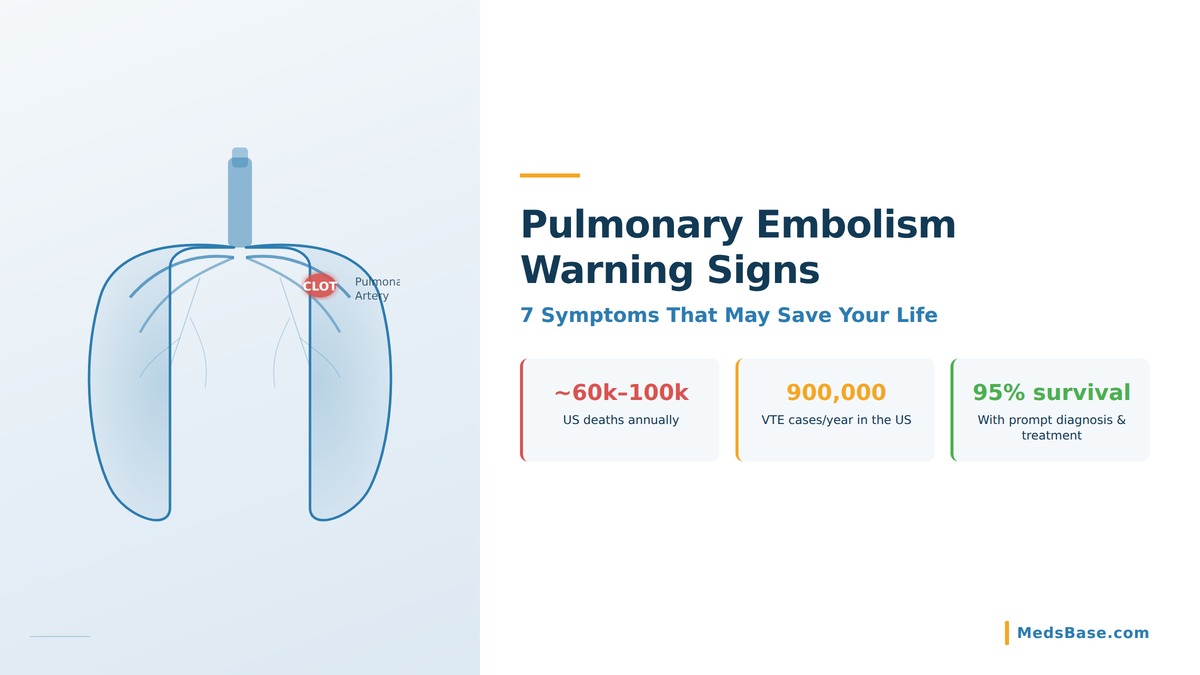
Every year, roughly 60,000 to 100,000 Americans die from a pulmonary embolism — more than breast cancer, HIV, and motor vehicle accidents combined. Yet most people cannot name a single pulmonary embolism warning sign. In the last 24 hours alone, over half a million people searched for information about blood clots in the lungs, driven by news that a high-profile athlete was diagnosed with one. If you are among them, you are right to be concerned — and you are also in the right place to get the full picture.
By the end of this article, you will know exactly what pulmonary embolism warning signs to watch for, who is at highest risk, how doctors diagnose and treat it, and what you can do starting today to lower your own risk. One of the most surprising risk factors — something millions of people do every day without thinking — will come up in the risk factors section.
Key Takeaways: Pulmonary Embolism Warning Signs
- Sudden shortness of breath is the most common pulmonary embolism warning sign — but it rarely appears alone and the full story involves several overlapping symptoms you will learn to recognize below.
- A deep vein thrombosis (DVT) in your leg is the source of most pulmonary embolisms — knowing the leg symptoms is half the battle.
- Anticoagulants are highly effective when started early — but the type your doctor chooses depends on factors most patients never hear about until it is too late.
- One combination of risk factors multiplies your danger far more than either factor alone — and it is more common than you think. We detail it in the risk factors section.
- Prevention is straightforward and evidence-based — seven practical strategies that anyone can start today, no prescription required.
What Is a Pulmonary Embolism? — Pulmonary embolism warning signs Explained
A pulmonary embolism (PE) is a sudden blockage in one of the pulmonary arteries in your lungs — the vessels that carry blood from your heart to your lungs to pick up oxygen. In more than 90% of cases, the blockage comes from a blood clot that formed somewhere else in your body, typically in the deep veins of your legs, broke free, and traveled through your bloodstream until it lodged in the narrower vessels of your lungs. According to the CDC, venous thromboembolism — the combined category of deep vein thrombosis (DVT) and pulmonary embolism — affects an estimated 900,000 Americans each year, and roughly one-third of pulmonary embolisms are fatal within the first hour if untreated.
The reason pulmonary embolism is so dangerous is that the clot does not just block blood flow to a section of your lung — it also forces the right side of your heart to pump against suddenly increased resistance. This is called right ventricular strain, and it is the mechanism that turns a survivable clot into a cardiac arrest. Understanding the pulmonary embolism warning signs early — sometimes hours before the crisis — is what separates people who walk out of the hospital from those who never make it there.
Quick Answer: A pulmonary embolism is a blood clot that travels to your lungs and blocks blood flow. It most commonly starts as a deep vein thrombosis in the leg. Pulmonary embolism warning signs include sudden shortness of breath, sharp chest pain that worsens with breathing, and coughing up blood — but early symptoms can be subtle and easily mistaken for anxiety, a pulled muscle, or indigestion. When caught early and treated with anticoagulants, the survival rate exceeds 95%.
How Does a Pulmonary Embolism Develop? — Pulmonary embolism warning signs Explained
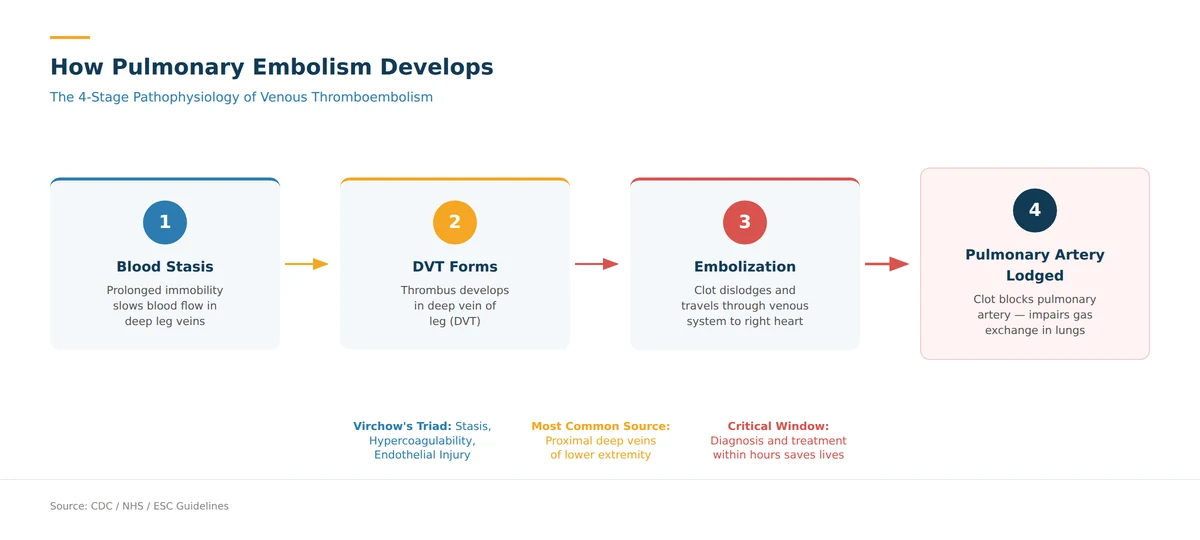
Here is where it gets interesting. A pulmonary embolism does not start in the lungs — it starts somewhere else, usually deep inside the veins of your legs or pelvis. Understanding this journey makes the pulmonary embolism warning signs in your legs just as important as the ones in your chest.
The process follows three stages, a sequence first described by the German physician Rudolf Virchow in 1856 and still used today:
Stage 1: Stasis (blood flow slows down). When you sit still for hours — during a long-haul flight, recovering from surgery, or even at your desk for a full workday — blood pools in the deep veins of your calves. Without the muscle contractions that normally squeeze blood upward, the flow stagnates.
Stage 2: Clot formation (a deep vein thrombosis develops). In stagnant blood, clotting factors concentrate and a fibrin mesh begins to form. Platelets stick to the mesh, red blood cells get trapped, and a thrombus — a blood clot — takes shape against the vein wall. At this point, you may notice calf pain, swelling, warmth, or redness in one leg — all classic DVT pulmonary embolism warning signs in the making.
Stage 3: Embolization (the clot breaks free). The thrombus, or a piece of it, detaches from the vein wall and enters the bloodstream. It travels through progressively larger veins — from the calf to the thigh, into the inferior vena cava, through the right atrium and right ventricle of the heart, and finally into the pulmonary arteries. When the clot reaches a vessel too narrow to pass through, it lodges there and blocks blood flow. This is the moment acute pulmonary embolism warning signs begin.
Research Spotlight: Why Some Clots Kill and Others Don’t
The 2019 European Society of Cardiology guidelines on pulmonary embolism, based on a comprehensive review of the evidence, classify PE into three risk categories: low-risk (no right ventricular dysfunction, normal blood pressure — mortality under 1%), intermediate-risk (right ventricular strain but stable blood pressure — mortality 3–15%), and high-risk (cardiac arrest or shock — mortality over 50%). The difference between the low-risk patient who recovers fully and the high-risk patient who does not is often measured in hours — which is why pulmonary embolism warning signs demand immediate attention.
So what does this mean for you? The pulmonary embolism warning signs you feel are not random — they map directly onto this three-stage process. Leg symptoms come first (sometimes days or weeks before), chest symptoms follow when the clot reaches your lungs, and in the worst cases, cardiac symptoms come last when your heart begins to fail against the obstruction. Recognizing the full timeline, not just the dramatic chest symptoms, saves lives.
Who Is at Risk? The Full Risk Factor Picture
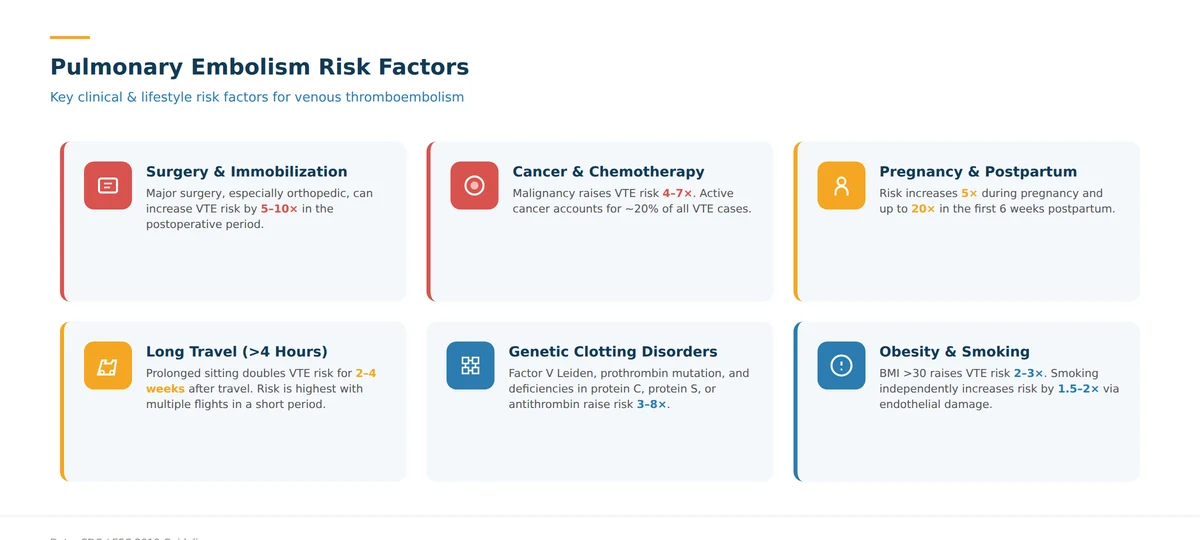
Roughly half of all pulmonary embolisms occur in people with no identifiable risk factors — a detail that makes pulmonary embolism warning signs relevant to everyone. But for the other half, specific factors dramatically raise the odds. And here is the detail that surprises most people: when two or more risk factors combine, your risk does not just add together — it multiplies.
Major Risk Factors for Pulmonary Embolism
| Risk Factor | Approximate Risk Increase | Why It Matters |
|---|---|---|
| Major surgery (especially hip/knee replacement or abdominal) | 10–40× in the first 6 weeks | Immobilization + surgical trauma triggers clotting cascade |
| Active cancer or chemotherapy | 4–7× baseline | Tumors release pro-coagulant substances; chemo damages vessel walls |
| Pregnancy and the postpartum period | 4–5× during pregnancy, 20× in the 6 weeks after delivery | Hormonal changes + pelvic vein compression + delivery trauma |
| Prolonged immobilization (hospitalization, paralysis, bed rest >3 days) | 5–10× | Blood stasis in deep veins |
| Long-haul travel (>4 hours sitting) | 2–4× in the following 2 weeks | Same mechanism as hospitalization but shorter duration |
| Previous DVT or PE | 10–20× recurrence risk | Underlying clotting tendency often persists |
| Genetic clotting disorders (Factor V Leiden, prothrombin mutation) | 2–8× depending on the mutation | Inherited tendency toward hypercoagulability |
| Hormonal contraception or hormone replacement therapy | 2–6× (estrogen-containing) | Estrogen increases clotting factor production in the liver |
| Obesity (BMI >30) | 2–3× | Chronic inflammation + impaired fibrinolysis + venous stasis |
| Smoking | 1.5–2× | Endothelial damage + increased platelet aggregation |
But there is a catch: the combination that catches most people off guard. A long-haul flight alone raises your risk modestly. Major surgery alone raises it substantially. But take a long-haul flight within six weeks of surgery — or add oral contraception to either scenario — and the risk multiplies far beyond what either factor would suggest alone. CDC surveillance data consistently shows that the highest-risk individuals are those with three or more overlapping factors, and they are often the least aware of it.
Who should be especially vigilant about pulmonary embolism warning signs? If you have had a recent surgery, are taking estrogen-containing medication, have a personal or family history of blood clots, are pregnant or recently gave birth, have active cancer, or are over 60 — you should know these symptoms cold. And if you have two or more of these factors, the urgency doubles.
7 Pulmonary Embolism Warning Signs — What to Look For
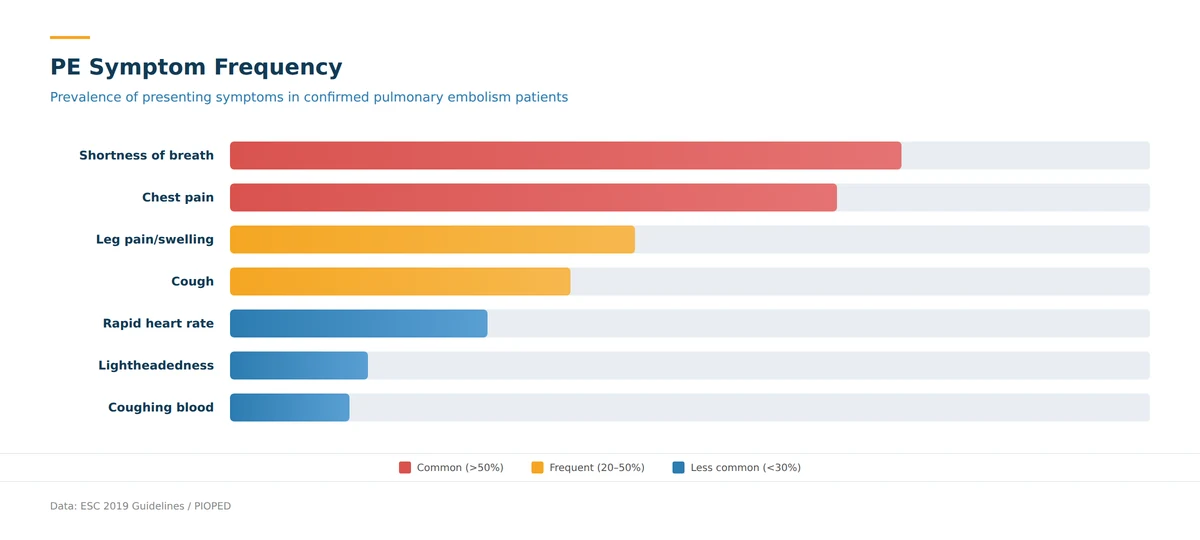
Now for the section you came for. These seven pulmonary embolism warning signs are drawn from the published clinical literature and the ESC guidelines, but here is what most lists will not tell you: almost nobody experiences all of them, and the pattern differs depending on the size and location of the clot. A small PE in a peripheral lung artery might produce only one subtle symptom; a large “saddle” PE straddling the main pulmonary artery can cause all seven simultaneously — and kill within minutes.
1. Sudden Shortness of Breath (Dyspnea) — 73% of cases
This is the single most common pulmonary embolism warning sign, appearing in roughly three out of every four cases. The key word is “sudden.” It is not the gradual breathlessness you get from climbing stairs when you are out of shape — it is a sharp, unprovoked inability to catch your breath that may occur at rest or with minimal exertion. Patients often describe it as feeling like they cannot get enough air no matter how deeply they breathe. If you find yourself suddenly gasping while sitting still or during a light walk that normally causes no trouble, do not dismiss it as anxiety or being “just out of shape.” This is a red flag.
2. Sharp Chest Pain (Pleuritic Pain) — 66% of cases
This pain has a distinctive quality: it gets worse when you take a deep breath, cough, or bend over. The medical term is pleuritic chest pain, and it happens because the blocked artery causes inflammation in the pleura — the membrane surrounding the lung — which rubs painfully against the chest wall with every breath. Unlike a heart attack, which often feels like pressure or squeezing in the center of the chest, PE-related chest pain tends to be sharp, stabbing, and located on one side — and it syncs with your breathing. This is one of the pulmonary embolism warning signs that is most commonly mistaken for a pulled muscle or costochondritis.
3. Cough (Dry or with Blood) — 37% (dry) / 13% (blood-tinged)
A persistent cough that appears out of nowhere — especially when paired with shortness of breath — should never be ignored. In some cases, the cough brings up blood-tinged sputum, a symptom called hemoptysis. This happens because the blocked artery causes a small area of lung tissue to become inflamed and bleed. Even a dry, nagging cough that does not improve is a pulmonary embolism warning sign worth investigating, particularly if it has no other explanation like a cold or allergies.
4. Leg Pain, Swelling, or Redness — 44% of cases (when DVT precedes PE)
This is the warning sign that appears first — sometimes days before the chest symptoms — and it is the one most often missed. A DVT typically causes unilateral pain (only one leg is affected), swelling that does not pit when you press it, warmth over the affected vein, and sometimes a visible red or discolored streak along the inner calf or thigh. If you have one leg that is suddenly more swollen or painful than the other — especially after travel, surgery, or prolonged sitting — that leg is telling you something. Treating DVT before it becomes a PE is, in effect, treating the pulmonary embolism warning signs before they escalate to your lungs.
5. Rapid or Irregular Heart Rate (Tachycardia) — 28% of cases
Your heart compensates for the blocked lung artery by beating faster to try to maintain oxygen delivery. A heart rate above 100 beats per minute at rest — especially one that does not slow down when you lie still and breathe deeply — is a classic sign. Some patients also report palpitations, a pounding sensation, or an irregular rhythm. The heart is working against higher resistance than it was designed for, and it is signaling distress.
6. Lightheadedness, Dizziness, or Fainting (Syncope) — 15% of cases
When a pulmonary embolism is large enough to significantly reduce blood flow through the lungs, less oxygenated blood reaches your brain. This can cause lightheadedness, a feeling of being about to pass out, or — in more severe cases — actual fainting. Syncope (fainting) as a pulmonary embolism warning sign is particularly alarming because it indicates that the clot burden is substantial and the heart’s ability to compensate is failing. Any unexplained fainting episode warrants immediate medical evaluation.
7. Cyanosis (Bluish Skin or Lips) and Clammy Skin
In severe cases, when oxygen levels in the blood drop dangerously low, the skin — especially around the lips, fingertips, and nail beds — may take on a bluish tint. This is a late sign and a medical emergency. Clammy, cool, or sweaty skin often accompanies it as the body diverts blood flow away from the skin to preserve vital organs. If you or someone near you shows these signs alongside any of the symptoms above, call emergency services immediately.
Quick Answer — How do you know if it is a pulmonary embolism? The pulmonary embolism warning signs that most reliably distinguish PE from other conditions are the combination of sudden shortness of breath with pleuritic chest pain (pain that worsens with breathing), especially when accompanied by risk factors like recent travel, surgery, or leg symptoms. However, no single symptom rules PE in or out — diagnosis requires medical evaluation with CT pulmonary angiography or a ventilation-perfusion scan.
How Is Pulmonary Embolism Diagnosed?
Recognizing pulmonary embolism warning signs is step one. Step two is getting the right diagnosis quickly. Emergency departments and hospitals use a systematic approach that begins with clinical probability scoring — not because doctors guess, but because the tools that confirm PE (CT scans with contrast dye) carry their own risks and are not used indiscriminately.
The Diagnostic Pathway
Step 1: Clinical probability scoring. Your doctor will use either the Wells criteria or the revised Geneva score — structured checklists that weigh your symptoms, heart rate, and risk factors to estimate the pre-test probability of PE. A large 2019 cohort study published in the Annals of Internal Medicine validated that these tools, combined with D-dimer testing, can safely rule out PE in roughly 30% of suspected cases without any imaging at all.
Step 2: D-dimer blood test. D-dimer is a protein fragment produced when a blood clot breaks down. A negative D-dimer test, combined with a low clinical probability score, effectively rules out PE — no CT scan needed. But here is what most patients are not told: D-dimer can be elevated for many reasons other than PE (pregnancy, surgery, cancer, infection, inflammation, even age), so a positive result on its own does not confirm anything. It simply tells the doctor to proceed to imaging.
Step 3: CT pulmonary angiography (CTPA). This is the gold-standard imaging test. Contrast dye is injected into a vein, and a CT scanner captures detailed images of the pulmonary arteries as the dye flows through them. A clot appears as a dark filling defect — a gap in the bright white dye column. CTPA can detect clots down to the subsegmental level (the smallest visible branches) and also provides information about right ventricular strain, which determines risk category and guides treatment intensity.
Step 4: Additional testing for high-risk patients. In patients with large PEs or signs of right ventricular dysfunction, doctors may also perform an echocardiogram (heart ultrasound) to assess the strain on the right ventricle, and blood tests including troponin and BNP — markers of heart muscle stress that help determine whether more aggressive treatment (beyond anticoagulants alone) is needed.
How Is Pulmonary Embolism Treated? Anticoagulants and Beyond
Once pulmonary embolism warning signs have led to a confirmed diagnosis, treatment begins immediately — and in the vast majority of cases, it centers on anticoagulant medications, commonly called blood thinners. These drugs do not dissolve existing clots (your body does that on its own over weeks to months), but they prevent the clot from growing larger and stop new clots from forming while your body’s natural fibrinolytic system clears the existing one.
Anticoagulant Options at a Glance
| Drug Class | Example Medications | How It Works | Monitoring Required? |
|---|---|---|---|
| Direct Oral Anticoagulants (DOACs) | Apixaban (Eliquis), Rivaroxaban (Xarelto), Edoxaban (Lixiana) | Directly inhibit Factor Xa (apixaban, rivaroxaban, edoxaban) or thrombin (dabigatran) | No routine monitoring |
| Warfarin | Coumadin, Jantoven | Inhibits vitamin K-dependent clotting factors (II, VII, IX, X) | Regular INR blood tests required |
| Low Molecular Weight Heparin (LMWH) | Enoxaparin (Lovenox) | Activates antithrombin III, which inactivates Factor Xa and thrombin | Anti-Xa monitoring in specific cases (pregnancy, renal impairment, obesity) |
| Unfractionated Heparin | Heparin IV infusion | Same mechanism as LMWH but shorter-acting | aPTT monitoring, typically in hospital only |
A 2023 systematic review of direct oral anticoagulants for venous thromboembolism confirmed that DOACs are at least as effective as warfarin at preventing recurrent clots, with a significantly lower risk of major bleeding — particularly intracranial hemorrhage. This is why current guidelines from the ESC recommend DOACs as the first-line option for most patients with PE. The older approach — starting with heparin injections and bridging to warfarin — is now reserved for specific situations: patients with active cancer, those who are pregnant, those with severe kidney disease, or those with antiphospholipid syndrome.
The 2019 ESC guidelines recommend at least three months of anticoagulation after a first provoked PE (one with a clear trigger like surgery), and often extended or indefinite therapy for unprovoked PE or recurrent events, with periodic reassessment of the risk-benefit balance.
MedsBase stocks several generic anticoagulant medications used in pulmonary embolism treatment — including apixaban and rivaroxaban. You can browse the full range of blood thinners available, with no prescription needed to order from MedsBase.com.
When Anticoagulants Are Not Enough
In high-risk PE — where the patient arrives in shock or cardiac arrest — more aggressive interventions become necessary. These include systemic thrombolysis (“clot-busting” drugs like alteplase), catheter-directed thrombolysis (delivering the drug directly into the clot), or surgical embolectomy (physically removing the clot). These are hospital-only interventions for the most severe cases, and they carry substantial bleeding risks — which is why prompt recognition of pulmonary embolism warning signs, before the patient reaches this stage, is so critical.
How to Reduce Your Risk — 7 Evidence-Based Strategies
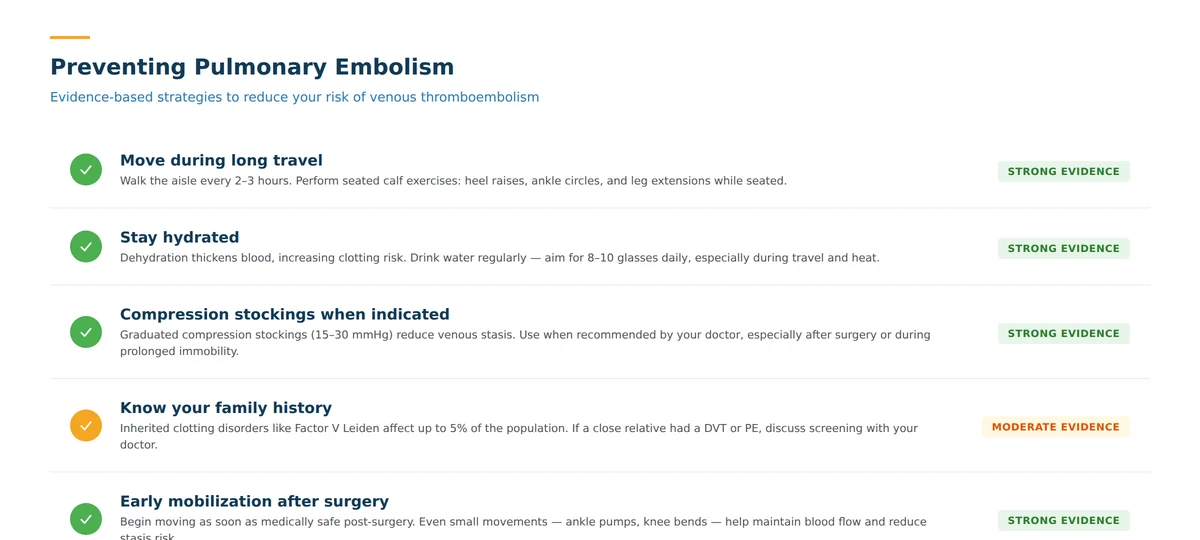
Preventing a pulmonary embolism is far easier — and far safer — than treating one. Every one of these seven strategies is backed by clinical evidence, and most require no prescription or medical supervision at all.
- Move your legs during long periods of sitting. During flights longer than four hours, get up and walk the aisle every hour. At a desk, do ankle circles, calf raises, and leg extensions every 30 minutes. The calf muscle pump is your built-in anti-clot mechanism — use it.
- Stay well-hydrated, especially during travel. Dehydration thickens your blood slightly, increasing clotting tendency. Water is all you need — skip the alcohol and limit caffeine on long flights.
- Consider compression stockings for high-risk travel. Graduated compression stockings (15–30 mmHg) reduce venous stasis in the legs. They are particularly recommended for people with a history of DVT, recent surgery, or multiple risk factors who need to fly.
- Know your family history. If a parent or sibling had an unprovoked blood clot before age 50, discuss thrombophilia screening with your doctor. Genetic clotting disorders like Factor V Leiden are common (present in roughly 5% of Caucasians) and knowing you carry one changes your prevention calculus.
- Mobilize early after surgery. Post-surgical protocols now emphasize early ambulation — getting out of bed and walking, even briefly, within 24 hours when safe. This alone has reduced post-operative PE rates dramatically.
- Maintain a healthy weight and avoid smoking. Both obesity and smoking independently damage the endothelium (the inner lining of blood vessels) and promote a pro-thrombotic state. Weight loss and smoking cessation reduce your baseline PE risk substantially over time.
- Recognize and report pulmonary embolism warning signs early. The single most effective prevention strategy is early detection. If you notice unilateral leg swelling or pain — especially after travel, surgery, or prolonged bed rest — seek evaluation immediately. Treating a DVT with anticoagulants almost always prevents PE entirely. Time is the variable you control.
Wondering how staying active reduces your risk across multiple cardiovascular and inflammatory conditions? Read our companion guide on exercise and autoimmune disease — the principles of safe, consistent movement apply broadly.
Related Reading
- Warfarin vs NOACs — Which Blood Thinner Is Right for You? — Compare the traditional anticoagulant with the newer direct oral options.
- Blood Thinners and Cognitive Decline — What the Research Really Shows — Does long-term anticoagulant use affect brain health?
- Browse MedsBase blood thinner options — generic apixaban, rivaroxaban, and more available.
Frequently Asked Questions
Q: How do you know if you have a pulmonary embolism?
A: The most reliable indicators are sudden, unexplained shortness of breath paired with sharp chest pain that worsens when you breathe deeply — especially if you have risk factors like recent surgery, travel, or a personal history of blood clots. However, pulmonary embolism warning signs vary widely, and only medical evaluation with a CT scan or D-dimer test can confirm the diagnosis. If you suspect PE, seek emergency care — do not try to self-diagnose.
Q: Can a pulmonary embolism go away on its own?
A: Small, subsegmental pulmonary embolisms can sometimes resolve without treatment as the body’s natural fibrinolytic system slowly breaks down the clot — but this is not something to gamble on. Even small clots can grow, new clots can form, and the underlying clotting tendency does not disappear. Anticoagulant treatment dramatically reduces the risk of recurrence and death, and current guidelines recommend treatment even for small, incidentally discovered PEs in most patients.
Q: What is the survival rate of a pulmonary embolism?
A: With prompt diagnosis and treatment, the survival rate exceeds 95%. Without treatment, the mortality rate rises sharply — CDC data estimates that roughly 25% of people with PE die before the diagnosis is even made, often because pulmonary embolism warning signs were missed or dismissed. The takeaway is not that PE is uniformly fatal — it is that early recognition of pulmonary embolism warning signs is the difference between a 95% survival rate and a much grimmer one.
Q: What does a pulmonary embolism feel like?
A: Most patients describe a sudden inability to catch their breath — as if the air has been knocked out of them — combined with a sharp, stabbing pain in the chest that gets worse with every breath. Some also feel their heart racing, a sense of impending doom or anxiety, and lightheadedness. The sensation is often described as distinctly different from a heart attack, asthma attack, or panic attack, though it can mimic all three. If you have leg pain or swelling in one leg alongside these chest symptoms, the pulmonary embolism warning signs picture becomes much clearer.
Q: How long can you have a pulmonary embolism without knowing?
A: Small pulmonary embolisms can be present for days or even weeks with minimal symptoms — sometimes just mild breathlessness, a slight cough, or fatigue that is easily attributed to something else. This is called a subacute PE, and it is one reason pulmonary embolism warning signs are regularly missed. The danger is that a small, undetected clot can seed additional clots, or a new clot can form and add to the total burden. Any persistent unexplained respiratory symptoms — even mild ones — deserve evaluation, especially in the presence of risk factors.
Q: Who is at high risk for pulmonary embolism?
A: The highest-risk groups are those with three or more of the following: recent major surgery (especially orthopedic or abdominal), active cancer, pregnancy or recent childbirth, prolonged immobility, previous DVT or PE, known genetic clotting disorders, estrogen-containing medications, obesity, and smoking. But roughly half of all PEs occur in people with no identifiable risk factors, which is why universal awareness of pulmonary embolism warning signs matters. Even young, fit, otherwise healthy individuals can develop PE — the recent high-profile case making headlines is a stark reminder of this fact.
Q: What is the connection between DVT and pulmonary embolism warning signs?
A: A DVT is the direct precursor to most pulmonary embolisms — the clot forms in a deep leg vein, breaks off, and travels to the lungs. This means DVT symptoms (one-sided leg pain, swelling, warmth, redness) are, in effect, early pulmonary embolism warning signs. If you recognize and treat DVT with anticoagulants promptly, you almost always prevent PE entirely. The leg symptoms usually precede the chest symptoms by hours to days — this is your earliest and most actionable window of opportunity.
The Bottom Line
Pulmonary embolism kills tens of thousands of people every year — but it does not have to. The pulmonary embolism warning signs covered in this guide are your early-warning system: sudden shortness of breath, sharp chest pain that worsens with breathing, coughing up blood, one-sided leg pain or swelling, rapid heart rate, lightheadedness, and — in severe cases — bluish skin. Know them. Recognize the patterns. And understand that the combination of symptoms matters more than any single one.
Your immediate action: if you have risk factors for PE (recent surgery, travel, pregnancy, cancer, clotting history, estrogen-containing medication), write down these seven pulmonary embolism warning signs and keep them somewhere visible — on your phone, in your travel bag, or stuck to your fridge. The people who survive PE are the ones who recognize the symptoms and seek help without hesitation.
If you are managing a blood clot or are on anticoagulant therapy, MedsBase stocks generic DOACs including apixaban and rivaroxaban at significant savings compared to brand-name prices — no prescription needed. Browse the blood thinner options to see what is available.
What to read next: Curious about how the different blood thinner options compare head-to-head? Read our detailed guide — Warfarin vs NOACs: Which Blood Thinner Is Right for You? If you are interested in how chronic conditions like autoimmune disease interact with cardiovascular risk and exercise, read our article on exercising safely with autoimmune disease for the latest evidence-based strategies.

Written by
Sophie ChenPharmaceutical Content Researcher · 8 years experience
Sophie Chen is a pharmaceutical content researcher with 8 years covering generic medication access and clinical pharmacology. She specialises in international regulatory frameworks, bioequivalence standards, and patient-facing education on therapeutic drug classes. She is not a clinician.