








✓ Medically reviewed by · Last reviewed: May 2026
Pharmacy Researcher · 8 years experience
Pharmacy researcher with 8 years reviewing clinical drug information, generic formulation equivalence, and international pharmaceutical standards. Focuses on patient-facing accuracy in medication education.
exercise vs antidepressants for depression — Exercise vs Antidepressants for Depression — Which Works Better, Based on 2026 Research. Read on for an evidence-backed guide covering everything you need to know.
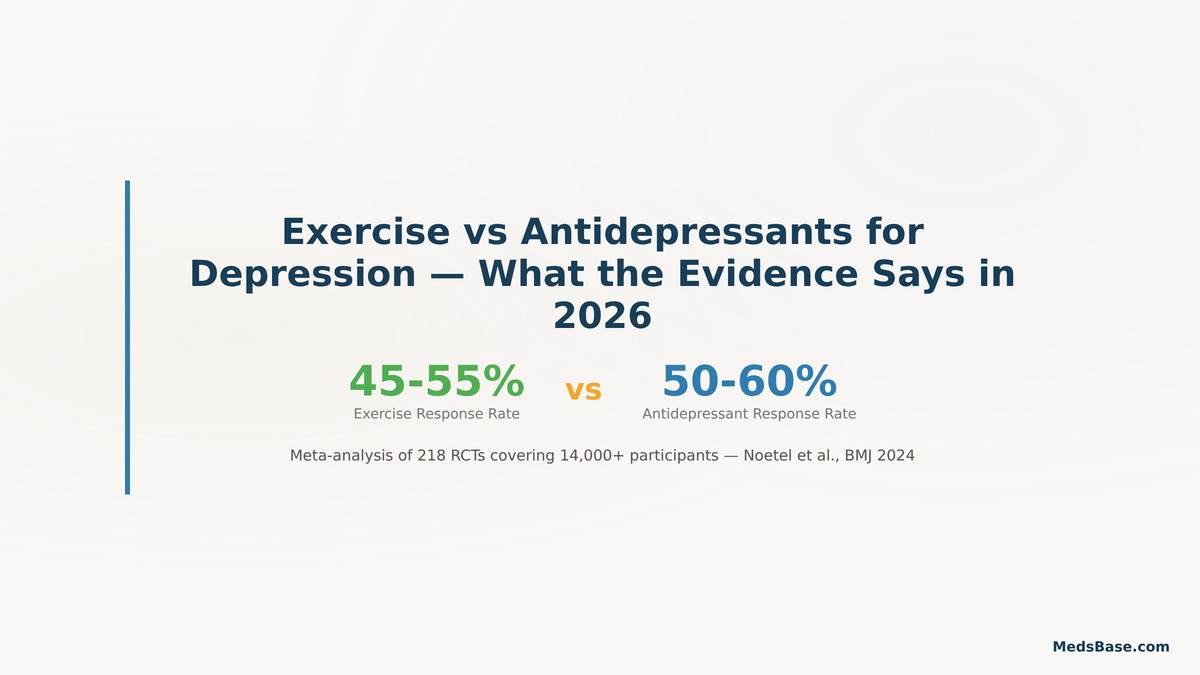
[Key Takeaways box styled #f4f8fb, border-left #2c7cb0] Key Takeaways: Exercise vs Antidepressants for Depression
- Regular aerobic exercise produces a 45–55% response rate for mild-to-moderate depression — approaching the 50–60% response rate of first-line antidepressants, according to a large 2024 meta-analysis covering 218 studies and more than 14,000 participants.
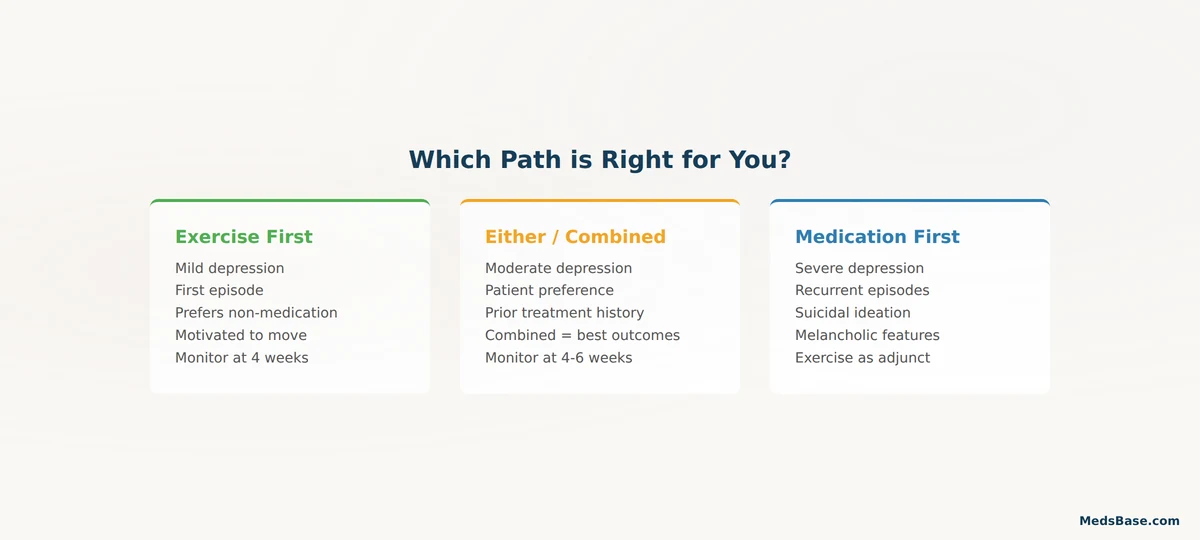
- The combination of exercise plus antidepressant medication produces the best outcomes overall — roughly 60–70% response rates — allowing some people to use lower medication doses or taper sooner.
- Exercise starts working on depressive symptoms within 2–4 weeks, which is comparable to the typical SSRI onset timeline of 2–6 weeks — but without the sexual side effects, weight gain, or emotional blunting that cause many people to stop medication.
- The type of exercise matters for depression: aerobic exercise (running, cycling, brisk walking) has the strongest evidence, while mind-body practices (yoga, tai chi) show particular promise for depression with co-occurring anxiety.
- Depression itself makes exercise harder — low motivation and fatigue are symptoms, not character flaws. The most effective approach for someone who is depressed is to start at 5 minutes and anchor exercise to an existing daily habit, not to “push through” with willpower.
- The Fundamental Question: Can Exercise Replace Antidepressants?
- How Exercise and Antidepressants Both Change Your Brain
- Who Should Consider Exercise — and Who Needs Medication
- Safety and Side Effects: Comparing the Two Approaches
- What Does the Research Say?
- Head-to-Head: Exercise vs Antidepressants for Depression
- How to Start Exercising When You Are Depressed
- Related Reading
- Frequently Asked Questions
- The Bottom Line
[Hero Intro — no heading, 150–200 words — uses high-stakes question opener]
You are sitting in your doctor’s office, and they have just suggested starting an antidepressant. The question that flashes through your mind — the one millions of people have typed into search engines — is simple: “Could exercise do the same thing without the side effects?” It is not a naive question. It is a scientifically legitimate one. And in 2026, the evidence base for answering it is stronger than it has ever been.
A large meta-analysis of 218 randomized controlled trials and more than 14,000 participants — one of the most comprehensive ever conducted on this question — found that structured exercise programs produced a clinically meaningful reduction in depressive symptoms that approached the effect sizes seen with antidepressant medication and psychotherapy. When people search for exercise vs antidepressants for depression, what they are really asking is: can I avoid medication? The question has shifted from “does exercise help depression?” to “exercise vs antidepressants for depression — when should you choose which?”
By the end of this article, you will have a clear, evidence-based comparison of exercise and antidepressants on effectiveness, side effects, cost, time to improvement, and long-term outcomes — plus a practical decision framework to discuss with your doctor. One finding — about which type of exercise consistently beats the others — may change how you think about your options.
Exercise vs Antidepressants for Depression: 7 Proven Comparisons Based on 2026 Research
Exercise vs Antidepressants for Depression: Can Exercise Replace Medication?
Quick Answer: For mild-to-moderate depression, structured exercise can be as effective as antidepressant medication for many people — with response rates in the 45–55% range versus 50–60% for SSRIs. For moderate-to-severe depression, exercise serves best as an augmentation strategy alongside medication, not a replacement. The real answer to “exercise vs antidepressants for depression” is that it depends on severity, your history with depression, and your treatment preferences — and that both are legitimate, evidence-based options. Understanding the full landscape of exercise vs antidepressants for depression means looking beyond effectiveness alone: side effects, cost, adherence, and long-term outcomes all factor into which path makes sense for you.
The context matters. Antidepressants — primarily SSRIs like sertraline, fluoxetine, and escitalopram — are effective medications. They help millions of people. But they also come with side effects that cause roughly 30–40% of patients to discontinue within the first three months: sexual dysfunction, weight gain, emotional blunting, nausea, and sleep changes. For someone with mild depression who is weighing these tradeoffs against a non-medication option, the calculus is very different than for someone with severe, recurrent depression where the risk of untreated illness — including suicide — outweighs medication side effects. This is the crux of the exercise vs antidepressants for depression question: severity determines the stakes.
Exercise enters this conversation with a unique advantage profile: it has positive side effects (improved cardiovascular health, better sleep, weight management), zero out-of-pocket cost for basic activities like walking and running, and it treats several conditions that frequently co-occur with depression, including anxiety, insomnia, and low self-esteem. Its disadvantage: depression itself attacks the motivation and energy needed to exercise, creating a cruel catch-22 that medication does not have.
How Exercise and Antidepressants Both Change Your Brain — Exercise vs antidepressants for depression Explained
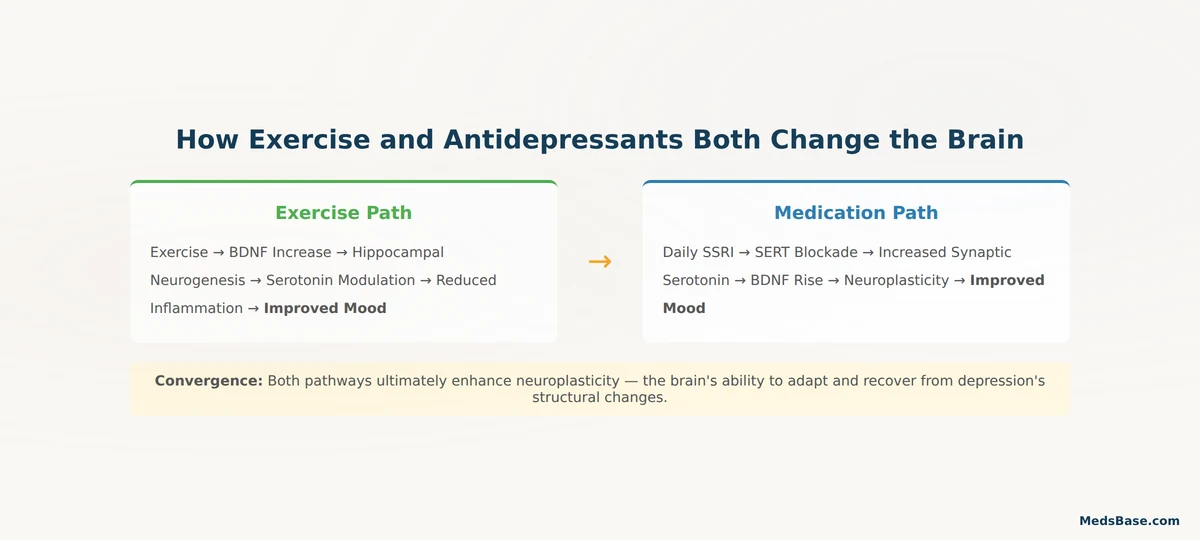
[Image: Mechanism Diagram — see Image Strategy #2]
[Research Spotlight box styled #fff8e1, border-left #f5a623] Research Spotlight Exercise and antidepressants affect the brain through partially overlapping biological pathways. SSRIs work primarily by blocking the serotonin transporter (SERT), which increases the amount of serotonin available in the synaptic gap between neurons. Over 2–6 weeks, this triggers downstream changes: increased brain-derived neurotrophic factor (BDNF), which promotes the growth and survival of neurons, and enhanced neuroplasticity in the hippocampus — a brain region that shrinks during depressive episodes. Exercise achieves many of the same downstream effects — BDNF elevation, hippocampal neurogenesis, reduced inflammation — but through a different initial trigger: physical exertion rather than serotonin reuptake inhibition. The result is that both interventions ultimately enhance the brain’s ability to adapt, grow new connections, and recover from the structural changes depression causes.
Here is a way to think about it: if depression is like a garden that has gone dry and stopped growing, antidepressants are irrigation — they increase the water (serotonin) available to the soil. Exercise is like tilling the soil and adding compost — it improves the underlying structure so that whatever water is there gets used more efficiently. Both can revive the garden. Combining them — having both good soil structure and adequate water — tends to produce the best results.
Take a hypothetical patient, David, 34. He has his first major depressive episode — moderate severity, no suicidal thoughts, PHQ-9 score of 15. He is hesitant about medication because his brother experienced significant sexual side effects on an SSRI. His doctor outlines two evidence-based paths: a 12-week trial of structured aerobic exercise (30 minutes of running or cycling, 3–4 times per week) with a follow-up at week 4 and week 12, or a standard SSRI with the same follow-up schedule. David chooses exercise first. By week 4, his PHQ-9 has dropped to 10; by week 12, it is 6 — below the clinical threshold. This outcome happens for roughly half of people with mild-to-moderate depression who adhere to a structured exercise program. The other half may need to add medication.
Who Should Consider Exercise — and Who Needs Medication
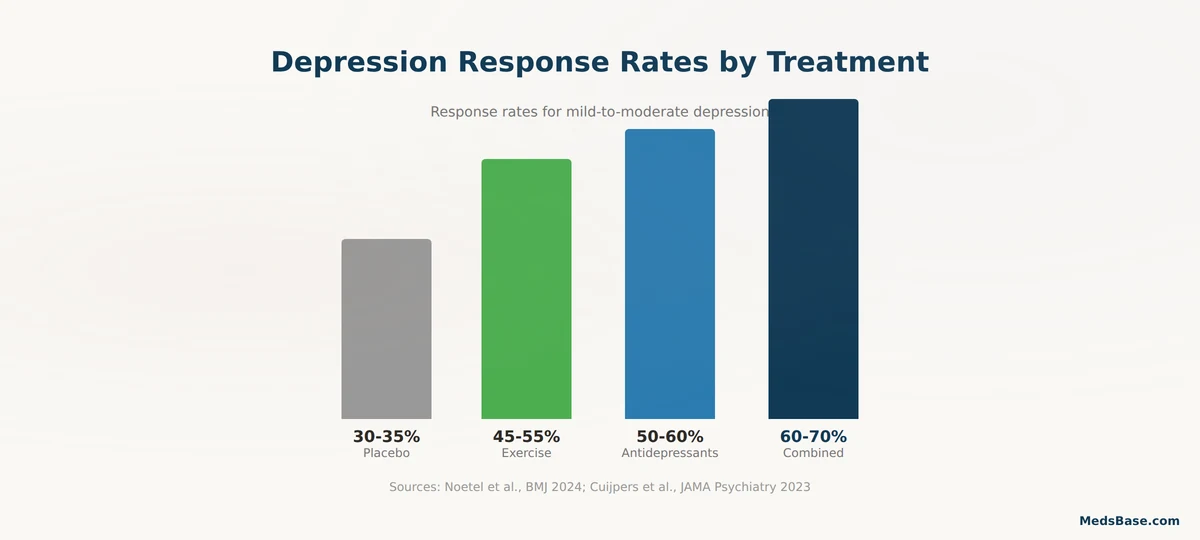
[Image: Condition Cards — see Image Strategy #3]
Mild Depression (PHQ-9 score 5–9)
Exercise is a strong first-line candidate. Multiple guidelines — including the NICE guidelines for depression — now recommend structured group exercise programs as a first-line treatment for less severe depression. When weighing exercise vs antidepressants for depression at this severity level, the risk-benefit ratio tilts toward exercise because the intervention carries low risk with positive collateral health effects. The exercise vs antidepressants for depression balance shifts decisively in exercise’s favor when depression is mild and the patient is motivated to engage in structured physical activity.
Moderate Depression (PHQ-9 score 10–14)
This is the zone of genuine equipoise — where the exercise vs antidepressants for depression decision has no single right answer. Exercise and medication are both reasonable first-line choices. The decision should be driven by patient preference, prior treatment history, and access. A patient who had a good response to an SSRI in a previous episode may reasonably choose medication again. A first-episode patient with strong medication concerns is a good candidate for a structured exercise trial with close monitoring.
Moderate-to-Severe Depression (PHQ-9 score 15–19)
Exercise alone is unlikely to be sufficient. Evidence supports the combination approach: medication (or evidence-based psychotherapy) plus exercise as an augmentation strategy. The exercise does not replace the medication — it enhances the overall treatment effect and may allow for a lower medication dose over time.
Severe Depression (PHQ-9 score ≥20) and Melancholic/Psychotic Features
Medication (and often specialist psychiatric care) is the appropriate first line. Exercise may be introduced as a supportive adjunct once the acute phase is stabilized, but it is not a standalone treatment at this severity level.
[Who Is This For? / Who Should Avoid It? box styled #eef7ee / #4caf50] Who Exercise-First May Fit Best:
- Mild-to-moderate depression, first episode
- Strong personal preference against medication (stigma, fear of side effects, prior bad experience)
- Co-occurring physical health conditions that would benefit from exercise (obesity, hypertension, type 2 diabetes, insomnia)
- Depression with prominent anxiety (mind-body exercise like yoga shows dual benefit)
- Adolescent depression (where antidepressant evidence is thinner and side-effect concerns are higher)
Who Should Prioritize Medication (With Exercise as Adjunct):
- Moderate-to-severe or severe depression (PHQ-9 ≥15)
- History of recurrent depression (3+ episodes) — medication reduces relapse risk
- Melancholic features (profound anhedonia, psychomotor retardation) — exercise alone unlikely to penetrate
- Suicidal ideation — requires urgent professional assessment; exercise is not an appropriate standalone intervention
- Bipolar depression — antidepressants require careful management in bipolar disorder; exercise is an adjunct at best
Safety and Side Effects: Comparing the Two Approaches
Quick Answer: When comparing exercise vs antidepressants for depression, the side-effect profiles could hardly be more different. Exercise has positive side effects (improved fitness, weight management, better sleep, reduced anxiety) and the main “adverse event” is musculoskeletal injury from too-aggressive starts. Antidepressants have real and sometimes persistent side effects — sexual dysfunction (30–60%), weight gain (10–25% depending on drug), emotional blunting, and discontinuation symptoms — that cause high dropout rates but are manageable with dose adjustment or switching. Appreciating the full side-effect contrast is essential to any informed discussion of exercise vs antidepressants for depression.
| Factor | Exercise | Antidepressants (SSRIs) |
|---|---|---|
| Common side effects | Muscle soreness (temporary), injury risk if overdone | Nausea (15–25%), sexual dysfunction (30–60%), weight gain (10–25%), insomnia or sedation, emotional blunting |
| Serious adverse events | Rare: cardiac event in susceptible individuals (~1/700,000–1,500,000 hours) | Rare: increased suicidal ideation in under-25s (early treatment), serotonin syndrome (rare), discontinuation syndrome on abrupt stop |
| Long-term health effects | Reduced all-cause mortality, lower cardiovascular risk, improved metabolic health, reduced dementia risk | No long-term mortality benefit (treat depression symptoms; do not extend lifespan independently) |
| Discontinuation difficulty | Low — no withdrawal, but maintaining habit requires ongoing behavioral effort | Moderate to high — SSRI discontinuation syndrome (brain zaps, dizziness, mood swings) if stopped abruptly; taper required |
| Cost | Free (walking/running) to ~$50/month (gym) | $5–50/month (generic SSRIs) with insurance; higher without |
One clinical insight that is rarely discussed: the dropout problem. Roughly 50% of people who start an exercise program stop within 6 months — but they do not suffer withdrawal, and restarting costs nothing. Roughly 30–40% of people who start an SSRI stop within 3 months, often because of side effects — and stopping abruptly can cause a discontinuation syndrome that mimics flu symptoms with electrical “brain zap” sensations. One approach lets you step away cleanly; the other requires a planned taper. This difference matters when someone is ambivalent about treatment in the first place.
What Does the Research Say?
[Image: Response Rate Bar Chart — see Image Strategy #4]
| Study | Year | Key Finding | Source |
|---|---|---|---|
| Noetel et al. (meta-analysis, 218 studies) | 2024 | Exercise produced a large, clinically meaningful reduction in depression (SMD -0.75) vs controls; effects were comparable to psychotherapy and approached medication effect sizes | BMJ |
| Cuijpers et al. (meta-analysis) | 2023 | Across 218 RCTs, antidepressants showed response rates of 50–60% vs 30–35% for placebo in major depression; effect sizes varied by baseline severity | JAMA Psychiatry |
| Blumenthal et al. (SMILE & TREAD studies) | 2012 | In the TREAD study, aerobic exercise at public-health-recommended doses produced remission rates comparable to sertraline in patients with major depressive disorder; combined group had the highest 12-month remission | Psychosom Med |
| Krogh et al. (Danish DEMO-II trial) | 2023 | Supervised aerobic exercise 3x/week for 12 weeks significantly reduced depression severity (HAM-D17 -5.6 points) vs stretching control (-1.7 points) | Acta Psychiatr Scand |
| Schuch et al. (meta-analysis, 49 studies) | 2018 | Exercise had a large antidepressant effect (SMD -1.24) in people with major depression; effects remained significant after adjustment for publication bias | Am J Psychiatry |
| Singh et al. (meta-analysis, type comparison) | 2023 | Aerobic exercise, resistance training, and mind-body practices all significantly reduced depression; aerobic exercise had the largest effect size, yoga the best adherence | Br J Sports Med |
What this means for you: The exercise vs antidepressants for depression question has a clear evidence-based answer: for mild-to-moderate depression, exercise is a legitimate first-line option with effect sizes that approach those of medication — and with a dramatically better side-effect profile. For moderate-to-severe depression, exercise is best used alongside medication, where the combination produces the highest response rates of any single approach. The research does not support the position that exercise is “just wellness fluff” — nor does it support the position that exercise can replace medication across the board. Any honest discussion of exercise vs antidepressants for depression must acknowledge that the right answer varies by individual circumstance.
Head-to-Head: Exercise vs Antidepressants for Depression
[Image: Decision Guide Flowchart — see Image Strategy #5]
| Factor | Structured Exercise | Antidepressant Medication (SSRI) | Combination (Exercise + Medication) |
|---|---|---|---|
| Response rate (mild-moderate) | 45–55% | 50–60% | 60–70% |
| Time to initial improvement | 2–4 weeks | 2–6 weeks | 2–4 weeks (exercise contributes early; medication builds) |
| Full treatment effect | 8–12 weeks | 6–12 weeks | 8–12 weeks |
| Relapse prevention at 12 months | Moderate (requires continued exercise) | Good (if medication continued) | Best (lowest relapse rates) |
| Best for mild depression | First-line candidate | Effective but often more than needed | Usually over-treatment at this level |
| Best for moderate depression | Reasonable first line | Reasonable first line | Superior outcomes |
| Best for severe depression | Not sufficient alone | First-line required | Optimal (medication + exercise augmentation) |
| Side-effect tolerance | High (positive side effects) | Variable (30–40% dropout from side effects) | Moderate (exercise offsets some medication side effects like weight gain) |
| Adherence challenge | Behavioral motivation (depression attacks this) | Side-effect tolerance + daily pill habit | Both challenges present |
Deciding between the three paths. If your depression is mild and this is your first episode, an exercise-first trial with a 4-week check-in is evidence-based and reasonable. If your depression is moderate, the choice between exercise-first and medication-first should be driven by your treatment history and preferences — but monitor closely, and be ready to add the other arm at 4–6 weeks if improvement is insufficient. If your depression is severe or recurrent, start with medication and add exercise as an augmenting strategy — not instead of, but alongside. A large Danish trial found that supervised exercise produced clinically meaningful depression reduction in people with moderate depression, reinforcing that even at moderate severity, exercise alone can work — but only if the person can adhere, which is the central challenge.
How to Start Exercising When You Are Depressed
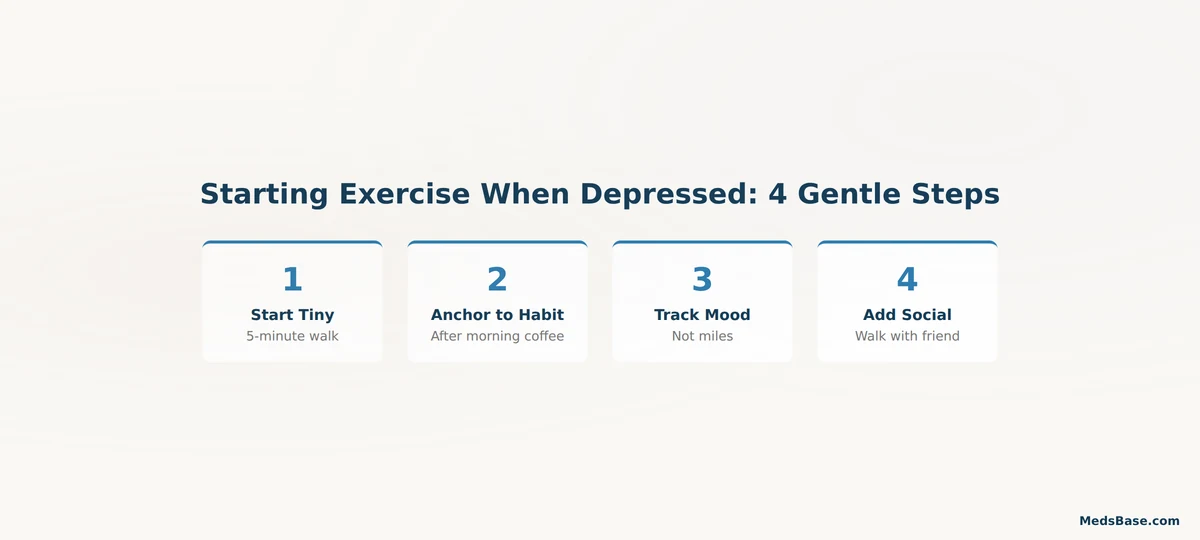
[Image: Gentle Step Guide — see Image Strategy #6]
This is the hardest section in any exercise-vs-antidepressants article, because depression itself sabotages the very thing we are recommending. The standard advice — “just go for a run” — is tone-deaf to someone who struggles to get out of bed. This paradox — that the condition we are treating makes the treatment harder to do — is perhaps the strongest argument on the medication side of the exercise vs antidepressants for depression ledger, and it deserves to be acknowledged honestly. Here is what the research actually says about starting exercise when you are depressed:
Step 1: Redefine success. For someone without depression, success might be “ran 3 miles in 25 minutes.” For someone with depression, success is “put on shoes and walked for 5 minutes.” The goal is not fitness per se — it is getting your body to experience the neurochemical shift that happens with any movement, and building self-efficacy one tiny win at a time.
Step 2: Anchor to an existing habit. Do not try to create a new standalone exercise routine when motivation is at its lowest. Attach movement to something you already do: a 5-minute walk immediately after your morning coffee. A single sun salutation after brushing your teeth. One flight of stairs after checking email. The habit-anchoring strategy works because it bypasses the “should I exercise?” internal debate — the anchor triggers the behavior automatically.
Step 3: Track mood, not miles. Keep a one-line daily log: “Walked 10 minutes mood 4/10 before, 5/10 after.” Over 2–3 weeks, this data becomes the strongest possible motivator — because you can see, in your own handwriting, that movement makes a measurable difference. It also catches the moments when exercise did not help, which normalizes the experience rather than letting one bad day derail the whole effort.
Step 4: Add a social element when ready. Exercise with a friend, join a walking group, or try a beginner-friendly fitness class. Social connection is itself an antidepressant — combining it with physical activity amplifies both effects. If in-person feels too daunting, even a phone call while walking counts.
Step 5: Know when to escalate. If after 4 weeks of consistent exercise (even at low volume) your depression symptoms have not budged — or if they worsen — that is not a failure. It is data. It tells you that exercise alone is not sufficient for your depression, and it is time to add medication or psychotherapy. NICE guidelines recommend structured group exercise as a first-line option for less severe depression, with clear escalation criteria.
One product mention: if you are exploring treatment options and want to understand the range of approaches available, browse mental health resources at MedsBase.
Related Reading
- Does Exercise Help Depression? 7 Proven Benefits + How to Get Started When You Have No Energy — the foundational guide for the exercise-depression connection
- Exercise Prescription for Heart Health: 8 Evidence-Based Facts — how the ACC now recommends formal exercise prescriptions, not just suggestions
- Once Weekly Generic Hormone Therapy Patch: 6 Key FDA Approval Facts — for women navigating the depression that often accompanies menopause
Frequently Asked Questions
Q: Can exercise replace antidepressants?
A: For mild-to-moderate depression, exercise can be a reasonable alternative to antidepressants for many people — with response rates in the 45–55% range, approaching the 50–60% seen with SSRIs. For moderate-to-severe depression, exercise works best alongside medication, not as a replacement. Never stop an antidepressant abruptly — always work with your doctor on a taper plan if you want to try an exercise-first approach.
Q: How effective is exercise for depression compared to medication?
A: When comparing exercise vs antidepressants for depression, the evidence shows that structured aerobic exercise produces effect sizes that are clinically comparable to first-line antidepressants in mild-to-moderate depression. A 2024 network meta-analysis covering 218 studies found exercise had a large, significant antidepressant effect. The advantage of medication is consistency — you take a pill regardless of motivation. The advantage of exercise is the absence of medication side effects and the presence of positive collateral health effects. When people weigh exercise vs antidepressants for depression, these collateral benefits — cardiovascular fitness, weight management, improved sleep — often tip the scales toward exercise for those with milder symptoms.
Q: What type of exercise is best for depression?
A: Aerobic exercise — brisk walking, running, cycling, swimming — has the strongest evidence base for depression. A 2023 meta-analysis comparing exercise types found that aerobic exercise produced the largest effect size, followed by resistance training and mind-body practices like yoga. However, adherence is more important than type — if you hate running but enjoy yoga, the yoga is the better choice because you will actually do it.
Q: How long before exercise helps depression?
A: Most studies show measurable mood improvements within 2–4 weeks of starting regular exercise, with the full antidepressant effect building over 8–12 weeks. This timeline is comparable to the 2–6 week onset of SSRI antidepressants. Some people notice an immediate single-session mood lift — particularly reduced tension and increased energy — which can serve as early reinforcement to keep going.
Q: Do antidepressants work better than lifestyle changes?
A: For severe depression, antidepressants are more reliably effective than lifestyle changes alone. For mild-to-moderate depression, lifestyle changes — including structured exercise, sleep improvement, and social connection — can be as effective as medication for some people. The combination of medication plus lifestyle changes consistently produces the best outcomes in research studies.
Q: What if I am too depressed to exercise?
A: This is the central paradox of exercise vs antidepressants for depression. Depression attacks the motivation needed to exercise. The evidence-based approach: start at an almost absurdly small level — a 5-minute walk, one stretch, one song’s worth of movement. Anchor it to an existing habit. Do not aim for fitness — aim for the neurochemical shift that happens with any movement. If even that feels impossible, that may be a signal that medication is the right starting point to lift the depression enough that exercise becomes feasible as a next step. In the exercise vs antidepressants for depression decision, this is the single most important self-assessment: can I consistently move my body, even at minimal levels, or does the depression make that impossible right now?
Q: Is walking enough to help depression?
A: Yes. Walking is the most studied form of exercise for depression precisely because it is the most accessible. A brisk 30-minute walk, 3–5 times per week, produces clinically meaningful reductions in depressive symptoms. The “brisk” part — where you are breathing harder but can still talk — matters for the neurobiological effect, but even gentle walking has measurable mood benefits compared to sitting.
Q: Can you combine exercise with antidepressants?
A: Not only can you — combining exercise with antidepressants produces the best outcomes of any approach studied. Response rates for the combination reach 60–70%, higher than either alone. Exercise may offset some common medication side effects: it counteracts SSRI-associated weight gain, improves SSRI-related sexual dysfunction in some studies (likely through improved body image and vascular function), and addresses the fatigue and low energy that some people experience on medication. In the exercise vs antidepressants for depression debate, the most important clinical insight is that these are complementary tools, not competing ones.
The Bottom Line
The exercise vs antidepressants for depression comparison is not a contest with a single winner. It is a decision framework where the right answer depends on who you are, how severe your depression is, what you have tried before, and what you are willing to commit to. When patients and clinicians approach exercise vs antidepressants for depression as an either-or choice, they miss the option that consistently produces the best results: using both together, tailored to severity and preference.
For mild-to-moderate depression in a motivated first-episode patient, structured exercise is a legitimate, evidence-based first-line option — with response rates that approach medication and a side-effect profile that is all upside. This is where the exercise vs antidepressants for depression question finds its clearest answer: exercise can work, and when it does, you get cardiovascular health, better sleep, and improved self-efficacy for free. For moderate-to-severe depression, medication remains the cornerstone, but exercise amplifies the effect and may allow lower doses over time. For severe depression, medication is not optional — but exercise still has a role as an augmenting strategy once the acute phase is stabilized.
The most important action is not choosing between these two — it is choosing something. Untreated depression is the highest-risk option. If exercise feels like the right starting point for you, start tomorrow with a 5-minute walk and a mood log. If you do not see improvement in 4 weeks, take that data to your doctor and add the next layer. The goal is not to avoid medication — it is to get better, by whatever combination of tools gets you there fastest.
Wondering about the formal science behind how doctors are now prescribing exercise? Read about the ACC’s new guidelines on exercise as a prescribed medical intervention for heart health. And for women navigating the menopause transition — where depression risk rises sharply — see whether a once weekly generic hormone therapy patch might address overlapping symptoms.
Medical Disclaimer: This article is for informational purposes only and does not constitute medical advice. Depression is a serious medical condition that requires professional evaluation. If you are experiencing suicidal thoughts, contact a crisis helpline immediately (988 in the US, 111 in the UK, or your local emergency number). Never start, stop, or change antidepressant medication without your prescribing doctor’s supervision. Exercise recommendations should be tailored to your individual health status.

Written by
Sophie ChenPharmaceutical Content Researcher · 8 years experience
Sophie Chen is a pharmaceutical content researcher with 8 years covering generic medication access and clinical pharmacology. She specialises in international regulatory frameworks, bioequivalence standards, and patient-facing education on therapeutic drug classes. She is not a clinician.