








✓ Medically reviewed by · Last reviewed: May 2026
Pharmacy Researcher · 8 years experience
Pharmacy researcher with 8 years reviewing clinical drug information, generic formulation equivalence, and international pharmaceutical standards. Focuses on patient-facing accuracy in medication education.
amoxicillin vs doxycycline — Amoxicillin vs Doxycycline — how these two widely-prescribed antibiotics compare in uses, safety, interactions, and which fits which situation. Read on for an evidence-backed guide covering everything you need to know.
They’re both antibiotics. They both come in capsules. And from the outside, a prescription for one can look a lot like a prescription for the other. But amoxicillin vs doxycycline is not a coin-flip situation — these two medicines belong to different classes, cover different infections, and carry safety rules that pull in opposite directions on some of the things patients care about most.
Giving a pregnant woman doxycycline can be a problem; giving amoxicillin typically is not. Having a glass of milk near your doxycycline is fine; taking antacids alongside it is not. By the end of this comparison, you’ll know the seven differences that actually decide which one gets prescribed — and which one fits your own situation.
Key Takeaways
- Amoxicillin (a penicillin) and doxycycline (a tetracycline) work through completely different mechanisms
- They treat overlapping but not identical infections — doxycycline covers ticks and malaria; amoxicillin is a mainstay for ear, sinus, and H. pylori
- Pregnancy, age, allergies, and the sun all flip the recommendation in different directions
- Neither is “stronger” — they’re strong in different settings
- The practical dosing instructions (food, timing, water) differ enough to matter daily
- What Are Amoxicillin and Doxycycline?
- How They Work (Very Different Mechanisms)
- What They Treat
- Side Effects & Safety Compared
- What Does the Research Say?
- Side-by-Side Comparison Table
- How to Take Each One
- Frequently Asked Questions
- The Bottom Line
What Are Amoxicillin and Doxycycline?
Amoxicillin is a penicillin-like antibiotic — a member of the beta-lactam family, which has been in clinical use for decades and remains a first-choice treatment for many common bacterial infections. It works well against Streptococcus, certain E. coli, and H. pylori, among others. It’s typically taken every 8 or 12 hours with food, and it’s safe in pregnancy (under medical guidance).
Doxycycline is a tetracycline antibiotic — a different family entirely, distinguished by its ability to treat not just routine bacterial infections but also tick-borne diseases like Lyme, and to prevent malaria. It also has an anti-inflammatory effect at low doses, giving it a second life in dermatology (acne, rosacea). It’s typically taken once or twice a day with a full glass of water.
Quick Answer: amoxicillin is a penicillin-class antibiotic, first-line for ear/sinus/respiratory infections and safe in pregnancy; doxycycline is a tetracycline, used for a broader set including tick-borne disease, acne, and malaria prevention, with specific age and pregnancy restrictions.
How They Work
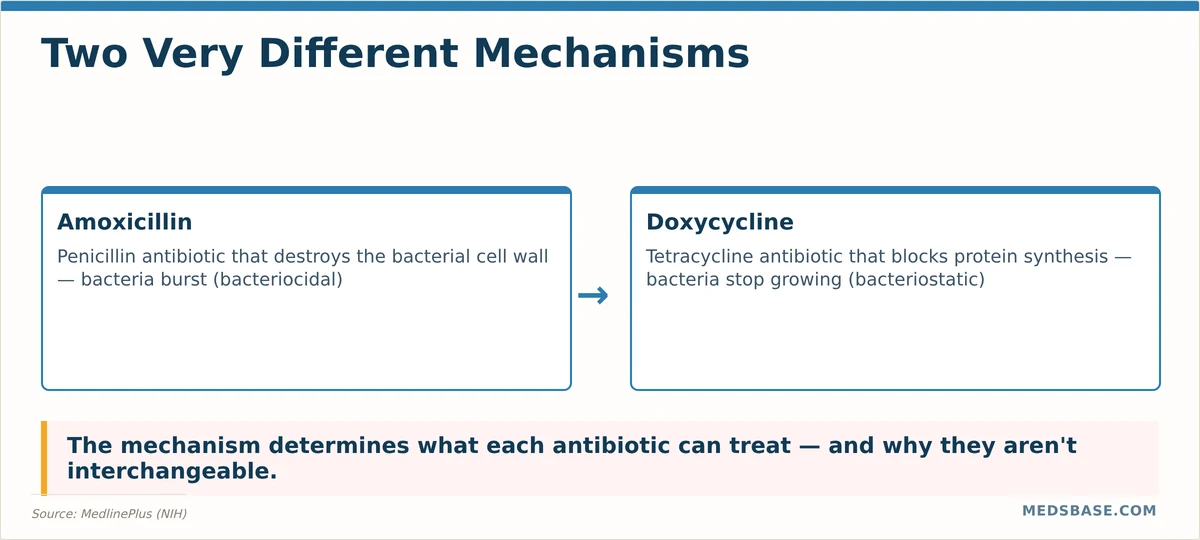
Here’s where they differ at the molecular level — and it’s not academic; it affects what they treat.
Amoxicillin attacks the cell wall of actively growing bacteria. It prevents bacteria from building the rigid outer shell they need to survive, so they literally burst. Because it kills bacteria outright, it’s called a bacteriocidal antibiotic.
Doxycycline takes a different route. It gets inside the bacterial cell and jams the protein synthesis machinery — the ribosomes. Without new proteins, bacteria can’t grow or divide. Because it stops growth rather than killing, it’s bacteriostatic.
The practical difference: amoxicillin’s cell-wall attack works best on actively-dividing bacteria with cell walls sensitive to penicillin-class drugs. Doxycycline’s protein-synthesis block works on a broader set of organisms, including some that live inside human cells (like the bacteria behind Lyme disease).
What They Treat
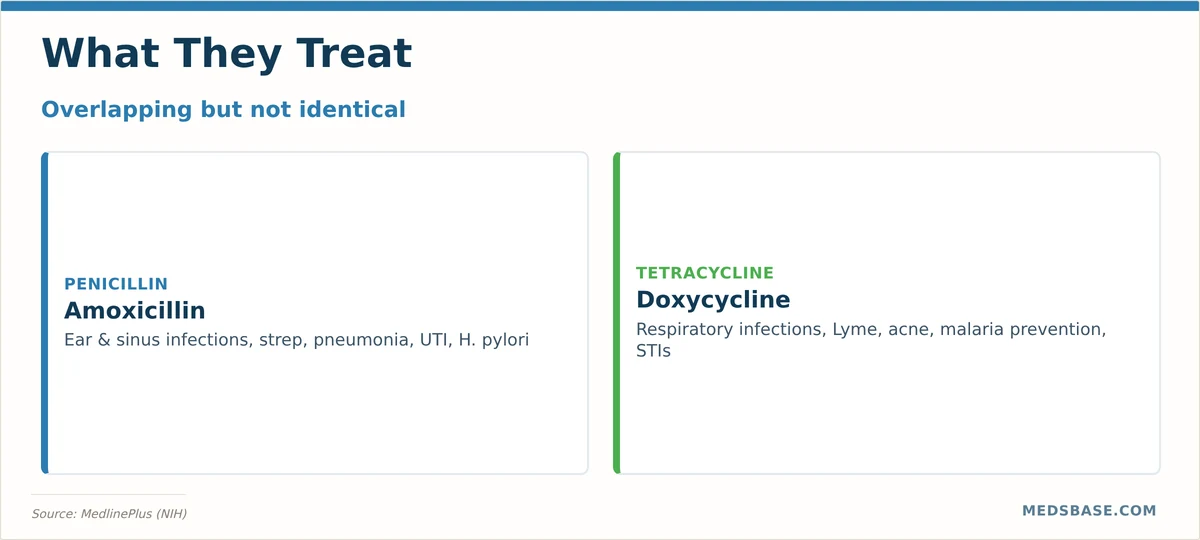
There’s some overlap — both handle certain respiratory infections — but the differences are what drive prescribing decisions.
Amoxicillin is commonly used for:
- Pneumonia and other lower respiratory infections
- Ear and sinus infections
- Strep throat (group A Streptococcus)
- Urinary tract infections
- H. pylori eradication (combined with other medicines)
- Lyme disease (in certain circumstances)
Doxycycline is commonly used for:
- Respiratory infections (especially when penicillin allergy rules out amoxicillin)
- Acne and rosacea (at low, anti-inflammatory doses)
- Lyme disease and tick-borne infections
- Malaria prevention
- Certain sexually transmitted infections
- Skin and soft-tissue infections
- Most adults and children with common bacterial ear, sinus, or respiratory infections
- Pregnant women needing antibiotic treatment
- People needing H. pylori eradication therapy
- Anyone with a penicillin allergy
- People with mononucleosis (amoxicillin frequently causes a rash in mono patients)
- Those with history of severe allergic reactions to any beta-lactam antibiotic
- Adults with acne or rosacea
- Travelers to malaria-endemic areas
- People with tick-bite exposure or Lyme disease
- Patients with penicillin allergy who need a respiratory antibiotic
- Pregnant women (can harm the fetus)
- Children under 8 (risk of permanent tooth staining and bone-growth effects)
- People with lupus or a history of intracranial hypertension
- Anyone about to spend lots of time in the sun without protection
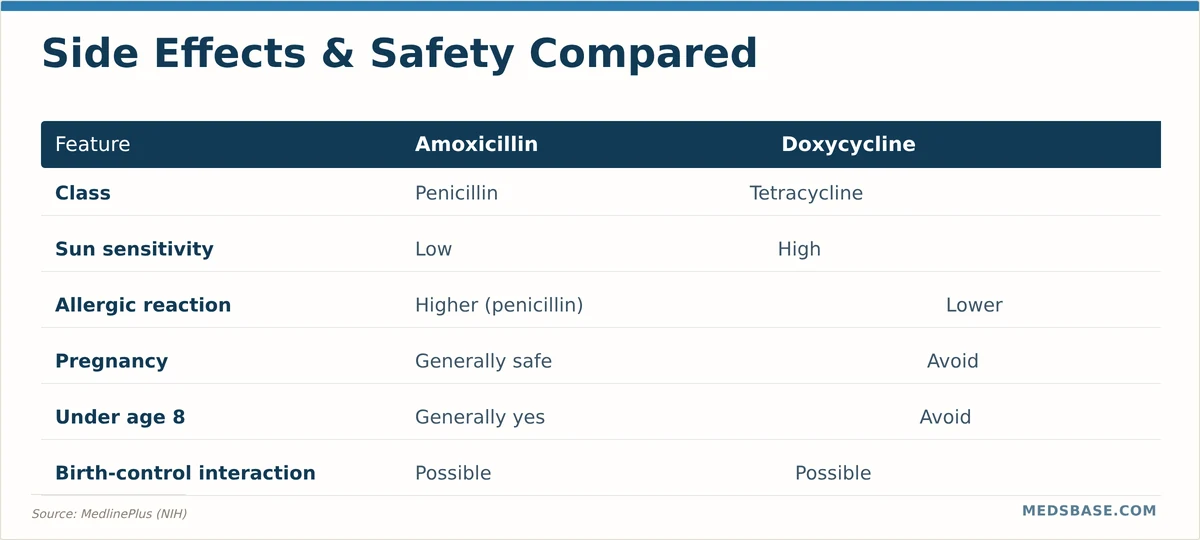
Side Effects & Safety Compared
Neither drug is risk-free, but the risk profiles are quite different.
| Feature | Amoxicillin | Doxycycline |
|---|---|---|
| Common GI side effects | Nausea, vomiting, diarrhea | Nausea, vomiting, diarrhea |
| Sun sensitivity | Low | High — requires sun protection |
| Allergic reaction risk | Higher (penicillin allergy; rash) | Lower, but rash/blistering possible |
| Tooth discoloration | Temporary (reversible) | Permanent in children under 8 |
| Pregnancy | Generally safe | Avoid — can harm fetus |
| Birth-control interaction | May reduce effectiveness | May reduce effectiveness |
| Severe diarrhea (C. diff) | Possible | Possible |
Both antibiotics carry a risk of Clostridium difficile-associated diarrhea, which can start weeks after you finish the course. Watery or bloody stools with stomach cramps should prompt an immediate call to your doctor, regardless of which antibiotic you’re on.
What this means for you: if you’re a woman of childbearing age, have an upcoming beach holiday, are allergic to penicillin, or have a child under 8 — the choice between amoxicillin vs doxycycline will often be made on safety rather than simply on “which works better.”
A Realistic Scenario (Illustrative Only)
Consider two patients with what looks like the same cough. Priya, 34 and pregnant, is given amoxicillin for a bacterial chest infection — safe in pregnancy, a penicillin-class standby. Her brother Rohan, 28, has a documented penicillin allergy, so his doctor reaches for doxycycline instead, and reminds him to wear sunscreen because he works outdoors.
Same symptom, two different antibiotics, two different sets of safety instructions. Neither prescription is “wrong” — each was matched to the patient in front of them. This is the reality behind the comparison: the right antibiotic is the one that fits your allergies, age, pregnancy status, and lifestyle, not a single “best” choice.
Pharmacists see this matching logic daily, and it’s worth internalizing: antibiotic selection is a personalized decision. That’s why copying a friend’s leftover antibiotic — or assuming your previous prescription will work this time — is a genuine risk, not a shortcut.
What Does the Research Say?
The evidence for both antibiotics is extensive and spans decades. The key point isn’t that one is “better” — it’s that they’re optimized for different situations, and the trend in antibiotic prescribing is toward narrower-spectrum choices whenever possible.
| Study / Source | Finding | Source |
|---|---|---|
| MedlinePlus (NIH) — Amoxicillin | First-line penicillin antibiotic for respiratory, ear, sinus, UTI, and H. pylori infections | MedlinePlus |
| MedlinePlus (NIH) — Doxycycline | Tetracycline used for bacterial, tick-borne, and malarial infections, plus acne and rosacea | MedlinePlus |
| Dermatol Ther 2016 — oral antibiotics | Oral antibiotics remain a mainstay of acne treatment, with a shift toward lower anti-inflammatory dosing (doxycycline’s niche) | PMID 27306750 |
What this means for you: neither antibiotic is a blunt instrument anymore — the prescribing decision has become more precise over time, and the question “which one?” increasingly depends on your specific infection, allergy profile, age, pregnancy status, and lifestyle.
Side-by-Side Comparison
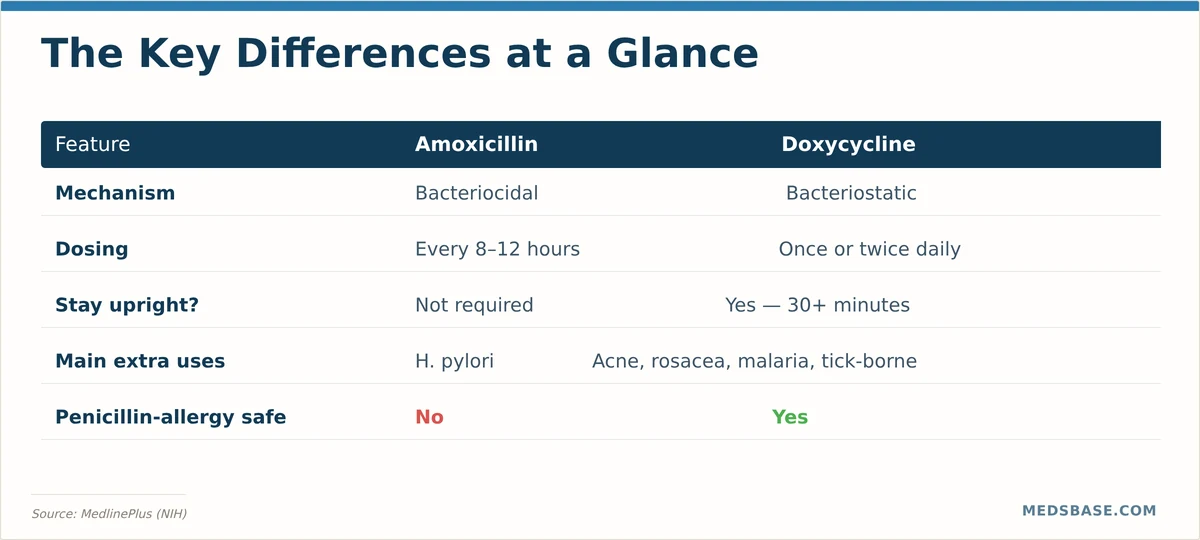
| Feature | Amoxicillin | Doxycycline |
|---|---|---|
| Antibiotic class | Penicillin (beta-lactam) | Tetracycline |
| Mechanism | Bacteriocidal — destroys cell wall | Bacteriostatic — blocks protein synthesis |
| Typical dosing frequency | Every 8 or 12 hours | Once or twice daily |
| Take with food | Yes | Yes (if needed); full glass of water is key |
| Stay upright after? | Not required | Yes — avoid lying down for 30+ minutes |
| Sun sensitivity | Low | High |
| Safe in pregnancy | Yes (under guidance) | No |
| Safe under age 8 | Generally yes | No (teeth and bone risk) |
| Penicillin-allergy safe | No | Yes |
| Main additional uses | H. pylori | Acne, rosacea, malaria, tick-borne disease |
| Birth-control interaction | Possible | Possible |
How to Take Each One
Amoxicillin
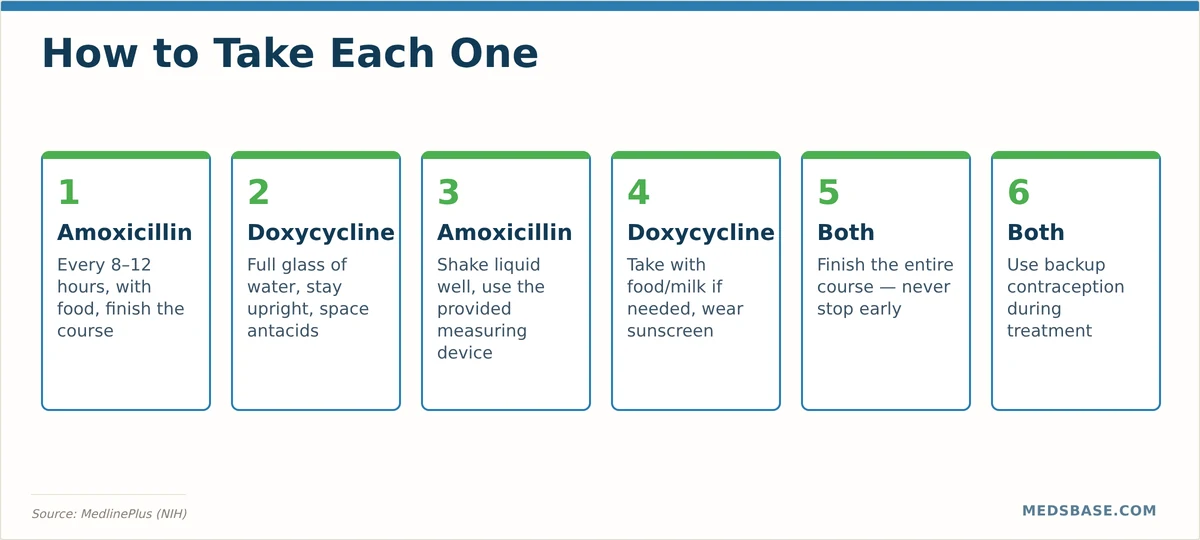
- Take at evenly-spaced intervals as directed (typically every 8 or 12 hours)
- Can take with food to reduce stomach upset
- Finish the entire prescription even if you feel better
- The liquid form: shake well, use the marked measuring device provided
- Amoxicillin may reduce the effectiveness of hormonal contraceptives — use a backup method during treatment
Doxycycline
- Swallow with a full glass of water — this is not optional; it prevents throat irritation
- Stay upright for at least 30 minutes after each dose
- Take with food or milk if your stomach is upset
- Space antacids, calcium, and magnesium products 1–2 hours apart
- Wear sunscreen and protective clothing during the entire course
- Finish the entire prescription even if you feel better
- Do not use in children under 8 unless directed by a physician in specific circumstances
When you need clearly-labelled antibiotic options, browse our antibiotics range — every product lists its active ingredient and strength. For a deeper dive on the tetracycline side of the comparison, read our full doxycycline guide.
Frequently Asked Questions
Q: Amoxicillin vs doxycycline — which is better?
A: Neither is universally better. The answer depends on your specific infection, whether you’re allergic to penicillin, whether you’re pregnant, your age, and your lifestyle. Amoxicillin is a first-line penicillin for ear, sinus, and strep infections; doxycycline covers tick-borne disease, malaria prevention, acne, and respiratory infections in penicillin-allergic patients.
Q: Can you take amoxicillin and doxycycline together?
A: Not typically, and never without explicit medical direction. Amoxicillin and doxycycline are rarely combined because they work through different mechanisms that can sometimes interfere with each other, and using two antibiotics together is generally reserved for specific, serious infections that require dual coverage.
Q: Is doxycycline stronger than amoxicillin?
A: Not in a simple “stronger” sense. Doxycycline has a broader spectrum against some organisms, including the intracellular bacteria behind Lyme disease, and it has the added anti-inflammatory effect useful for acne. But against the bacteria amoxicillin targets (like Streptococcus), amoxicillin is often the sharper tool. “Stronger” doesn’t apply — the right question is “which one matches this infection and this patient.”
Q: What’s the difference between amoxicillin and doxycycline?
A: Amoxicillin is a penicillin antibiotic that disrupts bacterial cell walls and kills bacteria outright; doxycycline is a tetracycline that blocks protein synthesis and stops bacteria from growing. Amoxicillin is generally safe in pregnancy; doxycycline is not. Doxycycline causes sun sensitivity; amoxicillin rarely does. They also cover different sets of bacteria.
Q: Do amoxicillin and doxycycline treat the same things?
A: They overlap on some respiratory infections, but each has exclusive uses. Doxycycline uniquely covers malaria prevention, tick-borne diseases, acne, and rosacea. Amoxicillin is uniquely a first-choice for strep throat, H. pylori, and many ear and sinus infections.
Q: Can you take doxycycline if you are allergic to penicillin?
A: Yes. Doxycycline is in the tetracycline class, which is chemically unrelated to penicillins. It’s one of the antibiotics commonly chosen when a patient has a documented penicillin allergy and needs a respiratory or skin-infection antibiotic.
Q: Which is safer in pregnancy, amoxicillin or doxycycline?
A: Amoxicillin is generally considered safe in pregnancy under medical guidance. Doxycycline is avoided in pregnancy because it can harm the developing fetus, affecting tooth and bone development. If you’re pregnant and need an antibiotic, your doctor will almost always steer toward a pregnancy-safe option like amoxicillin.
Q: Do amoxicillin and doxycycline cause the same side effects?
A: They share some common GI effects like nausea and diarrhea, but they diverge in important ways. Doxycycline notably causes sun sensitivity and can permanently stain teeth in children under 8, while amoxicillin is more likely to cause an allergic rash and interacts with mononucleosis. Both can rarely cause a serious antibiotic-associated diarrhea (C. diff).
The Bottom Line
Amoxicillin vs doxycycline comes down to a handful of specific, practical factors: what you’re treating, whether you’re pregnant, how old you are, whether you’re allergic to penicillin, and whether you’ll be in the sun. Neither is universally safer or more effective — they’re safe and effective in different settings.
Your immediate next step: if you’re deciding which antibiotic to take, bring the specific questions above to your doctor — pregnancy status, allergy history, travel plans, and age — and the choice will narrow itself quickly. If you’re comparing for your own understanding, browse our antibiotics range and check our full doxycycline guide for dive-deep detail on the tetracycline side.
What to read next: For more depth on the tetracycline side of this comparison, see our full doxycycline guide. And for a common concern that follows any antibiotic course, read why antibiotics can trigger yeast infections — what to expect and how to handle it.

Written by
Sophie ChenPharmaceutical Content Researcher · 8 years experience
Sophie Chen is a pharmaceutical content researcher with 8 years covering generic medication access and clinical pharmacology. She specialises in international regulatory frameworks, bioequivalence standards, and patient-facing education on therapeutic drug classes. She is not a clinician.