








✓ Medically reviewed by · Last reviewed: May 2026
Pharmacy Researcher · 8 years experience
Pharmacy researcher with 8 years reviewing clinical drug information, generic formulation equivalence, and international pharmaceutical standards. Focuses on patient-facing accuracy in medication education.
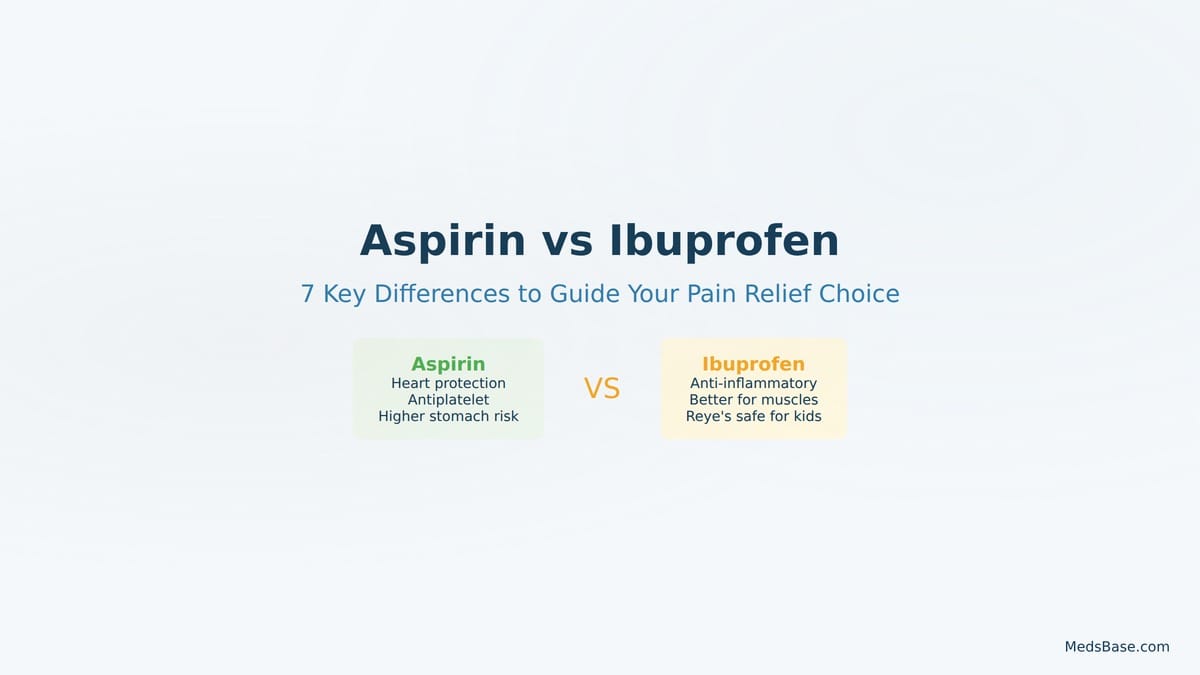
aspirin vs ibuprofen — Aspirin vs Ibuprofen — 7 Key Differences to Guide Your Pain Relief Choice. Read on for an evidence-backed guide covering everything you need to know.
You’ve got a pounding headache and two bottles in the medicine cabinet: aspirin and ibuprofen. You reach for one — but do you actually know which one is the right choice for this specific pain? More importantly, do you know which one your stomach, your heart, or your other medications would prefer you chose?
Aspirin vs ibuprofen — most people don’t. And in many cases, it doesn’t matter — both work. But for a significant number of people, in the aspirin vs ibuprofen decision, the choice between aspirin vs ibuprofen carries real consequences: stomach bleeding, reduced heart protection, or an accidental interaction with another medication. This guide gives you the information you need to make that choice confidently — and know when to ask a healthcare provider instead of guessing.
Key Takeaways
Aspirin vs ibuprofen — aspirin and ibuprofen are both NSAIDs (nonsteroidal anti-inflammatory drugs) — but aspirin has a unique, permanent antiplatelet effect that ibuprofen lacks. Aspirin is the better choice when heart protection matters — it’s the standard for cardiovascular prevention at low doses. Ibuprofen is generally preferred for muscle and joint pain because it has stronger anti-inflammatory effects at standard OTC doses. Aspirin carries a higher risk of stomach bleeding — and that risk increases with age, dose, and duration of use. Never give aspirin to children or teenagers with viral illnesses — it can trigger Reye’s syndrome, a rare but life-threatening condition. Taking ibuprofen can interfere with aspirin’s heart-protective effect if taken too close together — timing matters more than most people realise. If you have stomach ulcers, kidney disease, or take blood thinners, the aspirin vs ibuprofen decision is NOT yours to make — consult your doctor.
- What Are Aspirin and Ibuprofen?
- How Aspirin and Ibuprofen Work in the Body
- Aspirin vs Ibuprofen: 7 Key Differences
- Safety and Side Effects: Aspirin vs Ibuprofen
- How to Choose: Aspirin or Ibuprofen?
- Dosage and How to Take Aspirin vs Ibuprofen
- Frequently Asked Questions
- The Bottom Line
Aspirin vs Ibuprofen — 7 Key Differences to Guide Your Pain Relief Choice
What Are Aspirin and Ibuprofen?
Aspirin vs ibuprofen — aspirin is the oldest NSAID — synthesised in 1897 and in widespread use for over a century. It’s available over the counter in doses ranging from 75 mg (low-dose cardiovascular prevention) to 500 mg (pain relief). At low doses, aspirin’s primary clinical value is its antiplatelet effect: it “thins” the blood by permanently inactivating platelets’ ability to aggregate. This makes it a cornerstone of heart attack and stroke prevention.
Aspirin vs ibuprofen — ibuprofen was developed later (1960s) and is now one of the most widely used pain relievers worldwide. It’s available OTC in 200 mg and 400 mg doses, with prescription-strength formulations going up to 800 mg. Ibuprofen is generally preferred for inflammatory pain — muscle strains, arthritis, dental pain, menstrual cramps — because it produces a stronger anti-inflammatory response at standard doses compared to aspirin.
A Cochrane review comparing oral NSAIDs for acute pain evaluated dozens of clinical trials and found that both aspirin and ibuprofen are effective for acute pain — but ibuprofen at 400 mg consistently outperformed aspirin 600–650 mg in terms of the number of patients achieving at least 50% pain relief.
Aspirin vs ibuprofen — however — and this is critical — the Cochrane review evaluated pain relief, not safety. The choice between these two drugs isn’t just about which works better. It’s about which is safer for you, given your individual health profile.
How Aspirin and Ibuprofen Work in the Body
To understand the aspirin vs ibuprofen decision aspirin vs ibuprofen decision, you need to understand one enzyme family: COX. There are two main types:
- COX-1 is the “housekeeping” enzyme — it’s always active and produces prostaglandins that protect the stomach lining, support kidney function, and help platelets clot.
- COX-2 is the “on-demand” enzyme — it ramps up production at sites of injury or inflammation, generating prostaglandins that cause pain, swelling, and fever.
NSAIDs block COX enzymes, reducing prostaglandin production — which is how they relieve pain and reduce inflammation. But here’s where aspirin and ibuprofen diverge:
Aspirin binds irreversibly. It permanently acetylates (attaches an acetyl group to) COX enzymes, inactivating them for the life of the cell. This is particularly important for platelets — which lack a nucleus and cannot synthesise new COX enzymes. Once aspirin inactivates a platelet’s COX-1, that platelet cannot produce thromboxane A2 (a clotting promoter) for its entire 7–10 day lifespan. This is why a single low-dose aspirin provides lasting antiplatelet protection.
Ibuprofen binds reversibly. It occupies the COX active site temporarily, competing with the body’s natural substrate (arachidonic acid). When ibuprofen levels in the blood drop, COX function returns. This reversible binding is why ibuprofen’s effects last 4–6 hours (matching its half-life), and why its antiplatelet effect is transient and clinically insignificant.
This mechanistic difference — irreversible vs reversible COX inhibition — is the single most important concept in understanding aspirin vs ibuprofen. It explains nearly every clinical difference between them: aspirin’s unique role in cardiovascular prevention, aspirin’s higher stomach bleeding risk (because it permanently inactivates the COX-1 that protects the gastric lining), and the potential interaction when you take both drugs together.
Aspirin vs Ibuprofen: 7 Key Differences
Difference 1: Mechanism and Duration
| Feature | Aspirin | Ibuprofen |
|---|---|---|
| COX binding | Irreversible (permanent inactivation) | Reversible (temporary blockade) |
| Duration of antiplatelet effect | 7–10 days (platelet lifespan) | ~6 hours (transient) |
| Onset of pain relief | 30–60 minutes | 20–30 minutes |
| Duration of pain relief | 4–6 hours | 4–6 hours |
The practical answer to the aspirin vs ibuprofen question takeaway: if you miss a day of low-dose aspirin, you still have some antiplatelet protection from the previous dose. Miss a dose of ibuprofen, and your pain and inflammation return within hours.
Difference 2: Heart Protection
This is the most clinically significant difference — and the one most people don’t fully understand.
Aspirin has a unique, evidence-supported role in cardiovascular prevention. At low doses (75–100 mg daily), aspirin reduces the risk of heart attack and stroke in people with established cardiovascular disease by approximately 25% — a benefit driven entirely by its irreversible antiplatelet effect. A study on low-dose aspirin for cardiovascular prevention confirmed that the benefit is clearest in secondary prevention (people who have already had a heart attack or stroke) and more nuanced in primary prevention (people without known cardiovascular disease).
Ibuprofen does not provide cardiovascular protection. Its antiplatelet effect is too weak and too transient to be clinically meaningful. In fact, a study on cardiovascular risks of NSAIDs found that high-dose ibuprofen (≥2,400 mg/day) was associated with a modestly increased cardiovascular risk — similar to other non-aspirin NSAIDs.
And there’s an important interaction: if you take both aspirin and ibuprofen, the ibuprofen can interfere with aspirin’s antiplatelet effect. Specifically, ibuprofen occupies the COX-1 binding site and prevents aspirin from acetylating it — if taken beforehand. The FDA recommends taking ibuprofen at least 30 minutes after immediate-release aspirin or at least 8 hours before aspirin to minimise this interaction.
Difference 3: Stomach Safety
| Risk Factor | Aspirin | Ibuprofen |
|---|---|---|
| Stomach bleeding risk at OTC doses | Higher | Moderate |
| Risk increases with… | Age >60, dose, duration, alcohol, history of ulcers | Age >60, higher doses, duration, history of ulcers |
| Mechanism of GI damage | Irreversible COX-1 inhibition permanent loss of gastric protection | Reversible COX-1 inhibition temporary loss, less cumulative damage |
The FDA drug safety communication on NSAID risks states that all NSAIDs — including both aspirin and ibuprofen — increase the risk of serious gastrointestinal events including bleeding, ulceration, and perforation. However, aspirin’s irreversible binding means gastric COX-1 remains inactive for the life of the stomach lining cells, making cumulative damage more likely with regular use.
Practical guidance: Always take either medication with food. If you need regular pain relief and have stomach concerns, ibuprofen is generally preferred over aspirin at OTC doses — but neither is risk-free. If you have a history of stomach ulcers, consult a doctor before taking any NSAID.
Difference 4: Anti-inflammatory Strength
At standard OTC doses, ibuprofen provides stronger anti-inflammatory relief than aspirin. A typical 400 mg dose of ibuprofen produces more COX-2 inhibition — and therefore more anti-inflammatory effect — than a 600 mg aspirin dose.
This is why ibuprofen is the go-to for muscle strains, joint pain, dental procedures, and menstrual cramps — conditions where inflammation is the primary driver of discomfort. Aspirin still relieves pain, but its anti-inflammatory effect at OTC doses is milder.
Difference 5: Fever Reduction
Both aspirin and ibuprofen are effective antipyretics (fever reducers). Ibuprofen tends to work slightly faster and last slightly longer for fever in children and adults — but the critical clinical difference is age:
Never give aspirin to children or teenagers (under 16) with a fever or viral illness. Aspirin use during viral illness has been linked to Reye’s syndrome — a rare but devastating condition that causes brain swelling and liver damage. The association is strong enough that aspirin is contraindicated for fever in children in most countries. Ibuprofen, by contrast, is safe for children as young as 6 months at weight-appropriate doses.
The MedlinePlus summary on aspirin carries a prominent warning about Reye’s syndrome and paediatric use — a reminder that this isn’t a theoretical risk.
Difference 6: Dosing Flexibility
| Medication | Typical OTC Dose | Max OTC Daily Dose | Prescription Doses |
|---|---|---|---|
| Aspirin (pain) | 300–600 mg every 4–6 hours | 4,000 mg/day | Rarely used for pain at prescription level |
| Aspirin (cardiovascular) | 75–100 mg once daily | 325 mg/day (higher for acute events) | N/A (OTC for low-dose prevention) |
| Ibuprofen | 200–400 mg every 4–6 hours | 1,200 mg/day (OTC) | Up to 3,200 mg/day (prescription only) |
The key point: ibuprofen’s OTC ceiling (1,200 mg/day) is well below its prescription ceiling (up to 3,200 mg/day), meaning there’s significant room for dose escalation under medical supervision if OTC doses don’t provide adequate relief. Aspirin is rarely dose-escalated for pain management in modern practice — if 600 mg isn’t enough, clinicians typically switch to a different analgesic rather than increasing the aspirin dose.
Difference 7: Drug Interactions
Both aspirin and ibuprofen interact with other medications, but the specific interactions differ:
Aspirin-specific interactions to know:
- Warfarin and other anticoagulants — increased bleeding risk (additive antiplatelet effect)
- Methotrexate — aspirin reduces renal clearance, increasing methotrexate toxicity
- ACE inhibitors and ARBs (blood pressure medications) — may reduce their effectiveness
- Ibuprofen — may block aspirin’s antiplatelet effect if timing is wrong
Ibuprofen-specific interactions to know:
- Lithium — ibuprofen increases lithium levels
- Methotrexate — similar interaction to aspirin
- SSRIs (antidepressants) — additive bleeding risk
- Aspirin — as noted above, timing-dependent interaction
If you take any regular prescription medication, the aspirin vs ibuprofen choice may be largely made for you by these interaction profiles. Check with your pharmacist or doctor — do not guess.
Safety and Side Effects: Aspirin vs Ibuprofen
| Side Effect | Aspirin | Ibuprofen | Severity / Action |
|---|---|---|---|
| Stomach upset/nausea | Common | Common | Mild — take with food |
| Heartburn | Common | Less common | Mild — antacid may help |
| Stomach bleeding/ulcers | Higher risk | Moderate risk | Serious — stop and seek medical attention if you notice black stools, blood in vomit, or severe stomach pain |
| Kidney effects | Risk increases with long-term use, dehydration, or pre-existing kidney disease | Same risk profile | Serious — avoid NSAIDs if you have known kidney disease without medical consultation |
| Cardiovascular effects | Protective at low dose (75–100mg); neutral at OTC pain doses | Possible slight risk increase at high doses (≥2,400mg/day) with long-term use | Discuss with your doctor if you have known cardiovascular disease |
| Reye’s syndrome | Rare but life-threatening — linked to aspirin use in children/teens with viral illness | Not associated | Never give aspirin to children <16 with fever or viral symptoms |
| Allergic reaction | Possible — and more common in people with asthma or nasal polyps | Possible — similar cross-reactivity risk | Stop immediately and seek medical care if you develop rash, swelling, or breathing difficulty |
| Tinnitus (ringing in ears) | Possible at high doses (salicylism) | Rare | Reduce dose or discontinue — usually reversible |
How to Choose: Aspirin or Ibuprofen?
Here’s the practical decision framework — simplified but evidence-based.
Choose ibuprofen if:
- You have muscle pain, joint pain, back pain, or menstrual cramps (stronger anti-inflammatory effect)
- You want faster onset (ibuprofen typically works within 20–30 minutes)
- You have a headache or dental pain (ibuprofen consistently outperforms aspirin in acute pain studies)
- You have a sensitive stomach and are choosing between the two (ibuprofen’s reversible binding means less cumulative gastric damage)
- The patient is a child (never aspirin for under-16s)
- You only need occasional, as-needed pain relief
Choose aspirin if:
- You also need cardiovascular protection (low-dose aspirin for established heart disease or stroke history — discuss with your doctor)
- You are treating a fever as an adult (both work; choose based on other factors)
- You specifically prefer aspirin based on past experience and have no contraindications
- Ibuprofen is not available and you need acute pain relief
When neither is ideal — consult a healthcare provider:
- You take blood thinners (warfarin, apixaban, rivaroxaban, clopidogrel)
- You have a history of stomach ulcers or GI bleeding
- You have kidney disease or liver disease
- You’re pregnant (paracetamol/acetaminophen is generally first-line in pregnancy)
- You need daily pain relief for more than a few days
- You’re unsure about interactions with your regular medications
Dosage and How to Take Aspirin vs Ibuprofen
Aspirin for pain (adults):
- Dose: 300–600 mg every 4–6 hours as needed
- Maximum: 4,000 mg in 24 hours
- Take with a full glass of water and food
- Do not lie down for 10 minutes after taking it
Aspirin for heart protection (adults):
- Dose: 75–100 mg once daily (low dose)
- This is not for pain — it’s for antiplatelet protection
- Only take for cardiovascular prevention if prescribed by a doctor
Ibuprofen (adults):
- Dose: 200–400 mg every 4–6 hours as needed
- Maximum OTC: 1,200 mg in 24 hours
- Take with food or milk
- If taking with low-dose aspirin for heart protection: take ibuprofen at least 30 minutes after aspirin (immediate-release) or 8 hours before aspirin
Critical safety rules for both:
- Use the lowest effective dose for the shortest time needed
- Do not combine aspirin and ibuprofen (or any two NSAIDs) unless specifically directed by a doctor
- If pain persists beyond 3 days (for fever) or 10 days (for pain), consult a healthcare provider
- Never give aspirin to anyone under 16 years with fever or suspected viral illness
- Stop and seek medical attention for signs of stomach bleeding: black/tarry stools, blood in vomit, severe stomach pain
Related Reading
Aleve vs Ibuprofen — Another common NSAID comparison: how does naproxen stack up? Diet for Asthma Management — Inflammation affects your lungs, too — how food choices influence respiratory health UTI Prevention Strategies — Pain during urination? It could signal a UTI
Frequently Asked Questions
Q: Which is better aspirin or ibuprofen?
A: Neither is universally “better” — the right choice depends on your specific situation. For most acute pain (headaches, muscle aches, menstrual cramps), ibuprofen is the preferred first-line choice because it provides stronger anti-inflammatory relief at standard OTC doses and carries a slightly lower stomach bleeding risk. Aspirin is preferred when cardiovascular protection is also needed (at low doses, prescribed for heart attack and stroke prevention) — but for pure pain relief, ibuprofen generally outperforms aspirin. If you have stomach issues, kidney concerns, or take blood thinners, neither may be ideal — consult your doctor.
Q: Can I take aspirin and ibuprofen together?
A: No — combining aspirin and ibuprofen (or any two NSAIDs) is generally not recommended. Taking them together increases the risk of stomach bleeding and other side effects additively, without providing meaningfully better pain relief. There’s also a specific interaction: ibuprofen can interfere with low-dose aspirin’s heart-protective antiplatelet effect if the timing is wrong. If you take daily low-dose aspirin for cardiovascular protection and need occasional ibuprofen for pain, the FDA recommends taking ibuprofen at least 30 minutes after immediate-release aspirin or at least 8 hours before your aspirin dose.
Q: Is aspirin safer than ibuprofen?
A: No — aspirin is generally not safer than ibuprofen, and in some respects (stomach bleeding risk, Reye’s syndrome risk in children), it’s the less safe option. Aspirin’s irreversible COX-1 inhibition means its gastric effects are more cumulative — regular aspirin use, even at low doses, carries a measurable increase in gastrointestinal bleeding risk. Ibuprofen’s reversible binding gives the stomach lining time to recover between doses, making it somewhat gentler on the stomach at standard OTC doses. However, at high doses (≥2,400 mg/day), ibuprofen has been associated with a modest increase in cardiovascular risk. The safest NSAID is the one used at the lowest effective dose for the shortest time possible — and for many people, paracetamol is actually the safest first-line pain relief option.
Q: Does aspirin thin the blood more than ibuprofen?
A: Yes — and this is aspirin’s most clinically important difference from ibuprofen. Aspirin permanently inactivates platelet COX-1, preventing those platelets from producing thromboxane A2 (a clotting promoter) for their entire 7–10 day lifespan. This produces a clinically significant antiplatelet effect at low doses (75–100 mg daily), which is why aspirin is used for cardiovascular prevention. Ibuprofen’s antiplatelet effect is transient (lasting only while the drug is in the bloodstream, ~6 hours) and is not clinically meaningful. If you’re taking aspirin for its blood-thinning effect and need pain relief, discuss your options with your doctor — ibuprofen may interfere with aspirin’s antiplatelet action.
Q: Which is better for headaches — aspirin or ibuprofen?
A: Ibuprofen is generally preferred for tension-type headaches and migraines. Clinical trials consistently show that ibuprofen 400 mg outperforms aspirin 600–1,000 mg for headache relief — faster onset, better pain reduction at 2 hours, and fewer patients needing a second dose. The 2023 Cochrane review of oral NSAIDs for acute pain ranked ibuprofen 400 mg as one of the most effective single-dose analgesics available OTC. That said, individual responses vary — if aspirin has worked well for your headaches in the past and you have no contraindications, it remains a reasonable choice.
Q: Can I take aspirin on an empty stomach?
A: It’s not recommended. Taking aspirin on an empty stomach significantly increases the risk of gastric irritation and stomach damage. Aspirin is acidic and directly irritates the stomach lining even before its systemic COX-1 inhibition further reduces gastric protection. Always take aspirin with food and a full glass of water to buffer its effects on the stomach. Ibuprofen should also be taken with food for the same reasons, though it’s somewhat less directly irritating than aspirin.
Q: Why can’t children take aspirin?
A: Aspirin use in children and teenagers (under 16) with viral illnesses — particularly influenza and chickenpox — has been linked to Reye’s syndrome, a rare but devastating condition causing acute brain swelling and liver failure. The association was first recognised in the 1980s, and the incidence of Reye’s syndrome dropped dramatically after aspirin warnings were introduced. The exact mechanism isn’t fully understood, but the association is strong enough that aspirin is contraindicated for fever or viral symptoms in children in virtually all countries. Ibuprofen and paracetamol are safe alternatives for paediatric pain and fever. Note: there are rare paediatric conditions (Kawasaki disease, certain rheumatologic disorders) where aspirin is used under specialist supervision — this is entirely different from giving aspirin for a fever at home.
The Bottom Line
The aspirin vs ibuprofen decision is more nuanced than most people realise — but it doesn’t have to be complicated. For most acute pain in otherwise healthy adults, ibuprofen is the evidence-based first choice: it works faster, provides stronger anti-inflammatory relief, and is somewhat gentler on the stomach at OTC doses. Aspirin earns its place for one specific, powerful reason — its irreversible antiplatelet effect makes it the standard for cardiovascular prevention at low doses.
Three things to remember: first, timing matters — if you take daily low-dose aspirin, space ibuprofen at least 30 minutes after (or 8 hours before) your aspirin. Second, never give aspirin to a child or teenager with a fever — the Reye’s syndrome risk is small but devastating. Third, if you have a medical condition or take regular medication, the choice isn’t yours to make alone — ask your pharmacist or doctor before reaching for either bottle.
The right answer to the aspirin vs ibuprofen question pain reliever is the one that relieves your pain effectively without creating new problems. Understanding these 7 differences helps you make that choice with confidence — and know exactly when to seek professional guidance instead.
Browse affordable pain relief medications at MedsBase or read our comparison of Aleve vs Ibuprofen — because the NSAID family has several members, and each has a distinct profile worth understanding.
Reviewed by Sophie Chen, PharmD • Last updated: 2026-08-23

Written by
Sophie ChenPharmaceutical Content Researcher · 8 years experience
Sophie Chen is a pharmaceutical content researcher with 8 years covering generic medication access and clinical pharmacology. She specialises in international regulatory frameworks, bioequivalence standards, and patient-facing education on therapeutic drug classes. She is not a clinician.