








✓ Medically reviewed by · Last reviewed: May 2026
Pharmacy Researcher · 8 years experience
Pharmacy researcher with 8 years reviewing clinical drug information, generic formulation equivalence, and international pharmaceutical standards. Focuses on patient-facing accuracy in medication education.
beta blockers vs calcium channel blockers — Beta Blockers vs Calcium Channel Blockers — Which Blood Pressure Medication Is Right for You?. Read on for an evidence-backed guide covering everything you need to know.
Key Takeaways
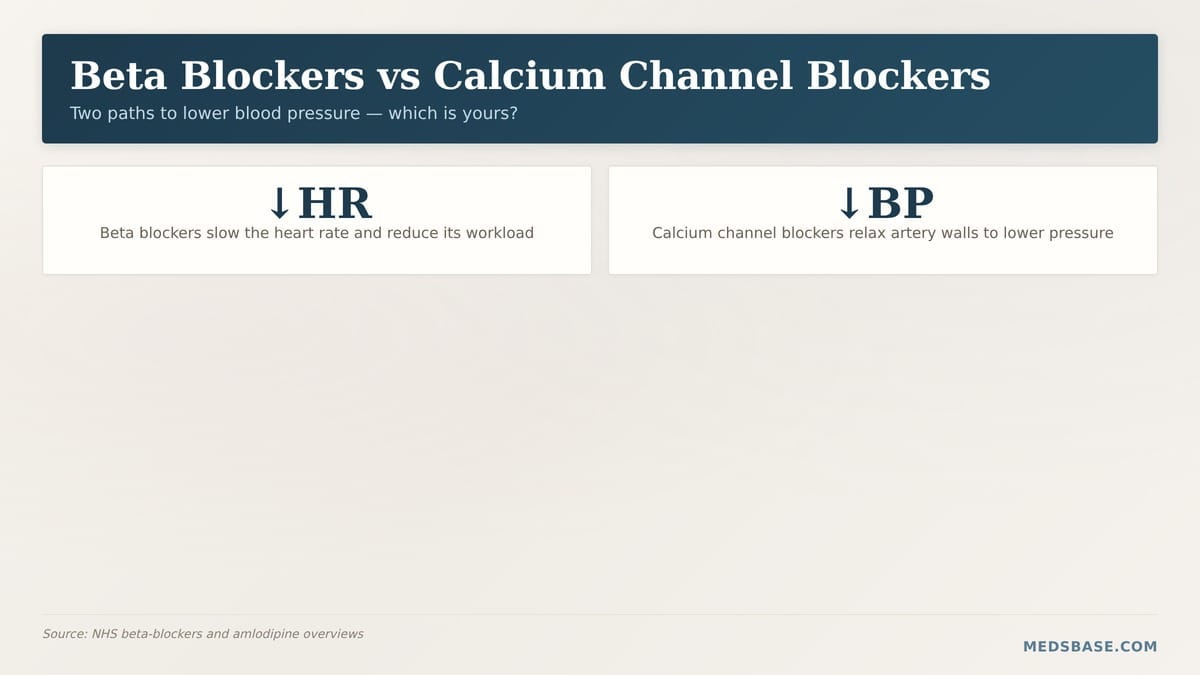
- Both drug classes lower blood pressure reliably — but they do it through entirely different parts of the cardiovascular system, and that difference decides almost everything else.
- Calcium channel blockers are the usual first choice for uncomplicated high blood pressure — especially for people over 55 and Black patients, while beta blockers are reserved for specific situations.
- Beta blockers are not “obsolete” — they are still the go-to when you also have angina, a previous heart attack, heart failure, or an irregular heartbeat.
- Ankle swelling is the most common reason people stop amlodipine — and there is a surprisingly simple explanation for why it happens.
- One combination is risky enough that doctors avoid it — pairing certain calcium channel blockers with beta blockers can slow your heart to dangerous levels.
- Cost is a near-tie — both classes are available as cheap generics, so price rarely has to be the deciding factor.
- Beta Blockers at a Glance — How They Lower Blood Pressure
- Calcium Channel Blockers at a Glance — A Different Approach
- Beta Blockers vs Calcium Channel Blockers: Head-to-Head Comparison
- Choosing Based on Your Health Profile
- Side Effects — What to Expect and What to Watch For
- Drug Interactions You Need to Know About
- What the Research Says — Clinical Trial Summary
- Generics vs Brands — What You’ll Pay
- Related Reading
- Frequently Asked Questions
- The Bottom Line
You have just been handed a prescription for blood pressure medication. The pharmacist mentions there are two main options your doctor might consider — and you are told you might have a say in which one you take. Now you are sitting with a leaflet in one hand and a search bar in the other, trying to figure out the difference between beta blockers vs calcium channel blockers, and whether one is safer, gentler, or more effective for someone like you.
It is a fair question to ask, and a more useful one than “which is better?” The honest answer is that the two classes are not rivals so much as tools with different jobs. One slows your heart down; the other relaxes your blood vessels. For uncomplicated high blood pressure, one is now the clear first choice. But if you also live with angina, a past heart attack, an irregular heartbeat, or migraines, the answer flips.
By the end of this guide you will know exactly how each class works, which patient profiles each one suits, the one side effect that surprises almost everyone, the drug combination doctors specifically avoid, and what the landmark trials actually showed. You will be able to walk into your next appointment as an informed partner rather than a passive recipient.
Here is the first open loop: one of these classes quietly fell out of favour as a first-line blood pressure drug — not because it stopped working, but because a major trial exposed a weakness nobody had fully measured before. We will get to that in the research section.
Beta Blockers at a Glance — How They Lower Blood Pressure
Quick Answer: Beta blockers are a class of medication that lower blood pressure by blocking adrenaline’s effect on the heart. This slows your heart rate and reduces the force of each contraction, so your heart pumps less blood with each beat — and pressure in your arteries falls as a result.
To picture how this works, think of your heart as a pump with a throttle. Your body’s stress hormones — adrenaline and noradrenaline — are constantly nudging that throttle higher, speeding up the pump and pushing blood out harder. Beta blockers step in front of those hormones and block the receptors they would normally grab onto. With fewer of those receptors activated, the throttle eases: your heart beats more slowly, squeezes less forcefully, and your blood pressure comes down. They also dial back renin release from the kidneys, which further reduces pressure.
The most commonly prescribed beta blockers include:
- Atenolol — beta-1 selective, taken once daily
- Bisoprolol — beta-1 selective, once daily
- Metoprolol — beta-1 selective (immediate-release twice daily, or extended-release once daily)
- Carvedilol — non-selective with additional blood-vessel-relaxing action, twice daily
- Propranolol — non-selective, the oldest of the class
You will notice the split between “beta-1 selective” and “non-selective.” Beta-1 receptors sit mainly in the heart, while beta-2 receptors sit mainly in the lungs and blood vessels. The selective drugs aim for the heart while sparing the lungs — which matters a great deal if you have asthma or COPD, a point we will return to in the health-profile section.
Calcium Channel Blockers at a Glance — A Different Approach
Quick Answer: Calcium channel blockers (CCBs) lower blood pressure by blocking calcium from entering the muscle cells that line your arteries. With less calcium available, those muscles relax and the arteries widen, letting blood flow through more easily — and pressure drops.
Here the analogy is a hose, not a throttle. Your arteries are surrounded by rings of smooth muscle. Calcium is the signal that tells those muscles to tighten; when the muscle tightens, the vessel narrows and pressure rises. Calcium channel blockers block the tiny “doorways” (L-type calcium channels) that calcium uses to enter those muscle cells. No calcium inside, no tightening — the artery stays relaxed and open.
The class splits into two subtypes that behave quite differently:
Dihydropyridines (DHP) — the vessel relaxers. These target blood vessels almost exclusively. They are the ones most often prescribed for straightforward high blood pressure, and amlodipine is the best-known example.
- Amlodipine — the most-prescribed CCB worldwide
- Nifedipine (extended-release)
- Felodipine
- Lercanidipine
Non-dihydropyridines (non-DHP) — the heart calmers. These also slow the heart and are used more for angina and rhythm problems.
- Diltiazem
- Verapamil
That distinction matters more than you might expect. The DHP drugs relax arteries but can trigger a reflex — the body notices the drop in pressure and nudges the heart to beat a little faster, which is why ankle swelling and flushing show up with amlodipine. The non-DHP drugs avoid that by also slowing the heart, but that same heart-slowing effect is exactly why they must be used carefully alongside beta blockers.
Beta Blockers vs Calcium Channel Blockers: Head-to-Head Comparison
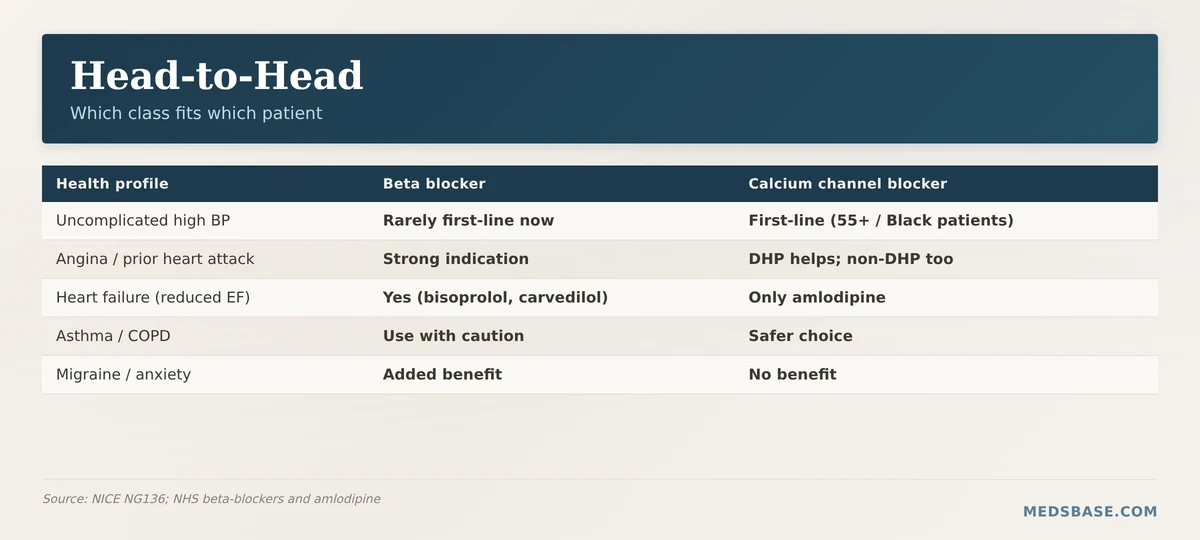
Here is the side-by-side you came for, condensed into one table:
| Drug Class | How It Works | Best For | Common Side Effects | Typical Dosing | Cost Range |
|---|---|---|---|---|---|
| Beta blockers | Block adrenaline receptors slower heart rate, less forceful beats, lower renin | Angina, post-heart-attack, heart failure, AF rate control, migraine, anxiety | Fatigue, cold hands/feet, slow heart rate, vivid dreams, erectile dysfunction | Atenolol 25–100 mg daily; bisoprolol 2.5–10 mg daily; metoprolol 25–100 mg (SR/XL once daily) | $10–$30/month generic |
| Calcium channel blockers (DHP) | Block calcium entry into artery muscle widened vessels | Uncomplicated hypertension, older adults, Black patients, isolated systolic hypertension | Ankle swelling, flushing, headache, palpitations | Amlodipine 2.5–10 mg daily; nifedipine ER 30–90 mg daily | $10–$30/month generic |
| Calcium channel blockers (non-DHP) | Block calcium entry into heart + vessels slower heart rate + vasodilation | Angina, atrial fibrillation rate control | Constipation (verapamil), slow heart rate, heart block | Diltiazem 120–360 mg daily; verapamil SR 120–480 mg daily | $15–$35/month generic |
But which one works better? For lowering blood pressure alone, the answer is: they are close, with a slight edge to calcium channel blockers for cardiovascular outcomes — but neither is “better” in a vacuum. The real question is which one is better for the specific collection of conditions you happen to have. A beta blocker is the wrong first choice for uncomplicated high blood pressure in an otherwise healthy 65-year-old, but it is exactly the right choice for the same 65-year-old who has also had a heart attack and lives with angina. The table above is the map; your health profile is the destination.
Choosing Based on Your Health Profile

This is the section where the two classes genuinely separate. The right choice rarely depends on the drugs themselves — it depends on what else is going on in your body.
If You Have Diabetes
Beta blockers can blunt the warning signs of low blood sugar — the racing heart, the tremors, the sweating — making a hypoglycaemic episode harder to feel coming. They can also slightly raise blood sugar and make insulin resistance marginally worse. For these reasons, most guidelines steer away from beta blockers as a first choice in diabetes when a simpler option exists. Calcium channel blockers, which have no meaningful effect on blood sugar or on hypoglycaemia awareness, are usually the cleaner pick here.
If You Have Asthma or COPD
This is where the selective/non-selective split becomes critical. Non-selective beta blockers like propranolol block beta-2 receptors in the lungs and can trigger bronchospasm — tightening your airways when you can least afford it. Even “cardioselective” drugs like atenolol and bisoprolol lose their selectivity at higher doses. If you have significant asthma, most doctors avoid beta blockers for blood pressure altogether and reach for a calcium channel blocker instead, which is neutral for the lungs.
If You Have Heart Failure
Here the script flips. Three specific beta blockers — carvedilol, bisoprolol, and extended-release metoprolol succinate — are among the most proven, life-extending treatments for heart failure with reduced ejection fraction. They are first-line for that condition, not an afterthought. Meanwhile, the non-DHP calcium channel blockers (diltiazem and, especially, verapamil) can worsen heart failure with reduced ejection fraction and are generally avoided. If heart failure is in your picture, beta blockers win this round decisively.
If You’re Over 60
For an older adult with otherwise uncomplicated high blood pressure, a calcium channel blocker — usually amlodipine — is the standard first choice in UK and international guidance. Beta blockers, once used almost reflexively, are now reserved for people over 60 mainly when there is a specific additional reason, like angina or a rhythm problem. Age alone points toward a CCB.
If You Have Migraines or Anxiety
This is where beta blockers quietly shine. Propranolol and metoprolol are established preventive treatments for migraine, and beta blockers are commonly used to ease the physical symptoms of anxiety — the racing heart and tremor — without sedation. If you are treating both high blood pressure and frequent migraines, a single beta blocker may do two jobs at once. No calcium channel blocker has that kind of dual-purpose record.
Who is this for? / Who should avoid it? A beta blocker makes the most sense if you have high blood pressure plus angina, a prior heart attack, heart failure with reduced ejection fraction, an irregular heartbeat, or migraines. You should be cautious about — or avoid — a beta blocker if you have significant asthma, COPD, a very slow resting heart rate, or diabetes where low-blood-sugar episodes are frequent. A calcium channel blocker (especially amlodipine) is the natural fit for uncomplicated high blood pressure, for older adults, and for Black patients, where they are particularly effective. You should avoid the non-DHP type if you have heart failure with reduced ejection fraction or certain heart rhythm problems.
If you are at the stage of comparing your options, it helps to see what is actually available in each class. MedsBase stocks a range of high blood pressure medications across both classes — including amlodipine and several beta blockers — so you can see the options that map to whatever class you and your doctor settle on. This is the first of only a few times we will mention products in this guide, because the deciding conversation should always happen with your prescriber first.
Side Effects — What to Expect and What to Watch For
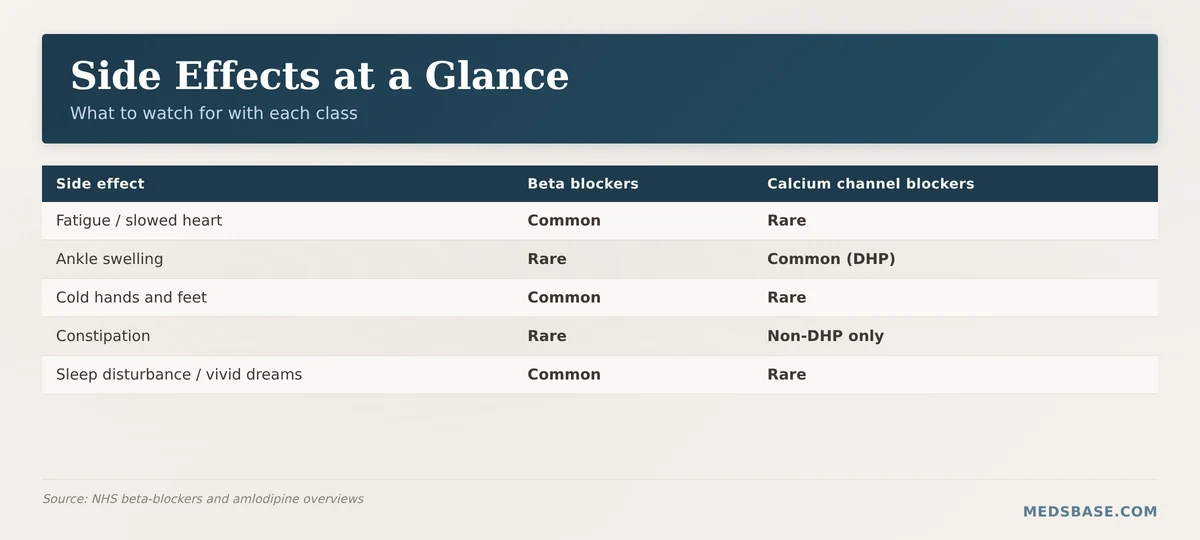
Here is the side effect that surprises almost everyone: the most common complaint with amlodipine is not dizziness or headache — it is swollen ankles. Patients often assume something is wrong with their kidneys or heart when their ankles puff up, but it is usually a straightforward, dose-related effect of the drug itself. The DHP calcium channel blockers widen small arteries more than they widen veins, so a little fluid pools in the lower legs by gravity. It is uncomfortable and cosmetically annoying, and it is the single biggest reason people stop taking amlodipine. It is rarely dangerous.
Beta blockers, by contrast, tend to produce a more diffuse sense of being “slowed down” — fatigue, cold hands and feet, a lower resting heart rate, and sometimes vivid dreams or a dulling of energy during exercise. Some men also report erectile dysfunction, which can quietly undermine adherence.
| Side Effect | Beta Blockers | Calcium Channel Blockers | What to Do |
|---|---|---|---|
| Fatigue / low energy | Common | Uncommon | Report to your doctor; may improve with a lower dose or a switch |
| Ankle swelling | Rare | Common (DHP type) | Elevate legs, reduce salt; a lower dose or a non-DHP often helps |
| Cold hands and feet | Common | Rare | Keep extremities warm; mention if bothersome |
| Slow heart rate | Common (dose-related) | Uncommon (non-DHP only) | Your doctor monitors pulse; may lower the dose |
| Flushing / headache | Uncommon | Common (DHP type) | Usually fades within weeks of starting |
| Constipation | Uncommon | Common (verapamil) | Increase fibre and fluids; may switch to another CCB |
| Vivid dreams / insomnia | Occasional | Rare | Take the dose in the morning; discuss with your doctor |
| Erectile dysfunction | Occasional | Rare | Do not stop on your own; ask about alternatives |
| Worsening of asthma | Risk in non-selective | Rare | Avoid non-selective beta blockers if you have asthma |
| Masked low-blood-sugar symptoms | Risk in diabetes | Rare | Monitor blood sugar closely; may prefer a CCB |
The honest framing: both classes are well-tolerated by most people. Neither is “the one with all the side effects.” The difference is which side effects you are more likely to get, and which you would personally find least liveable. If you are on your feet all day, ankle swelling may be a deal-breaker. If you are a runner, the fatigue and sluggish heart-rate response of a beta blocker may bother you more. This is a conversation worth having out loud with your prescriber.
Drug Interactions You Need to Know About
Blood pressure medications rarely travel alone — many people taking them also take something else. Two interactions in particular matter here.
Beta blocker + non-DHP calcium channel blocker. This is the combination doctors specifically avoid, and it is the resolution to the open loop planted earlier. Both drugs slow the heart’s electrical conduction, and when you add a beta blocker to verapamil or diltiazem, the combined effect can push your heart rate dangerously low or even cause heart block — a situation where the electrical signals between the heart’s chambers falter. This combination is occasionally used under specialist supervision for specific angina cases, but never casually. If your doctor prescribes both, they will be monitoring you closely, and you should never combine them on your own.
Beta blocker + certain heart or asthma medicines, and NSAIDs. Non-steroidal anti-inflammatory drugs like ibuprofen and naproxen can blunt the blood-pressure-lowering effect of many antihypertensives and are worth discussing if you take them regularly. Beta blockers can also interact with some diabetes medications, some antidepressants, and medicines for an irregular heartbeat.
Grapefruit and CCBs. Grapefruit juice interferes with the enzyme that breaks down several calcium channel blockers — most notably felodipine and nifedipine — raising their levels in the blood and amplifying side effects. Amlodipine is only modestly affected, but the safest habit is to ask your pharmacist about grapefruit when you start any CCB.
The practical rule is short: tell your doctor and pharmacist about everything you take — including over-the-counter painkillers, herbal remedies, and supplements — before you start or change any blood pressure medication.
What the Research Says — Clinical Trial Summary
Now to the open loop from the introduction: why did beta blockers slide down the blood pressure ladder? The answer is the ASCOT-BPLA trial, published in The Lancet in 2005, and its findings reshaped prescribing worldwide.
ASCOT compared an amlodipine-based regimen against an atenolol-based regimen in nearly 20,000 people with high blood pressure and additional risk factors. The calcium channel blocker arm came out ahead on strokes, cardiovascular events, and — in a striking finding — total mortality. The trial was stopped early because the atenolol arm was faring clearly worse. That single study, along with others, convinced guideline writers that beta blockers — atenolol in particular — should no longer be a routine first choice for uncomplicated high blood pressure.
| Study | Year | Finding | Source |
|---|---|---|---|
| ASCOT-BPLA | 2005 | Amlodipine-based regimen beat atenolol-based regimen on stroke, cardiovascular events, and mortality | Lancet |
| NORDIL | 2000 | Diltiazem matched diuretic/beta-blocker therapy overall, with fewer strokes | Lancet |
| INVEST | 2003 | Verapamil strategy matched atenolol strategy in patients with coronary disease and hypertension | JAMA |
| NICE NG136 | 2019 (updated) | CCB first-line for ≥55 or Black patients; beta blockers reserved for compelling indications | NICE |
| 2017 ACC/AHA Guideline | 2017 | All four major classes acceptable first-line; beta blockers used when a specific indication exists | AHA |
What this means for you: the research did not conclude that beta blockers are ineffective — they lower blood pressure very well. It concluded that for routine, uncomplicated high blood pressure, calcium channel blockers (and certain other classes) offer better cardiovascular protection with fewer of the metabolic downsides. Beta blockers remain indispensable when a specific condition — angina, a prior heart attack, heart failure, or an arrhythmia — is also on your list. The evidence is really about matching the drug to the patient, not ranking one class above another.
Generics vs Brands — What You’ll Pay
Cost rarely has to be the deciding factor in the beta blockers vs calcium channel blockers question, because both classes are mature, widely available as generics, and inexpensive in most countries.
Amlodipine — the most common calcium channel blocker — is one of the cheapest blood pressure medicines on any formulary, typically a low single-digit dollar amount per month with insurance and roughly $10 to $30 a month even paying cash in many markets. The beta blockers sit in a similar band: atenolol and metoprolol are among the cheapest drugs in medicine, with bisoprolol and carvedilol only slightly more. Diltiazem and verapamil, the non-DHP calcium channel blockers, are usually a touch pricier but still well within reach.
The brands you may have heard of — Norvasc (amlodipine), Tenormin (atenolol), Lopressor/Toprol-XL (metoprolol), Coreg (carvedilol), Cardizem (diltiazem), Calan/Isoptin (verapamil), Inderal (propranolol) — are all available as low-cost generics, and the generic versions are therapeutically equivalent to their branded counterparts.
One honest note on price: because these medicines are so inexpensive, the bigger cost variable is often whether you are buying from a source you trust. If you are exploring your options, you can browse the MedsBase high blood pressure category to see the blood pressure medications we carry — including both beta blockers and calcium channel blockers — all sourced from WHO-GMP-certified manufacturers, with no prescription needed to order.
Related Reading
- ACE Inhibitors vs ARBs: 5 Essential Differences — the other great blood pressure debate. If you now understand beta blockers and CCBs, see how the two “-pril” and “-sartan” classes compare, and where they sit in the same treatment ladder.
- Best Blood Pressure Medications — medication is only half the story. Our guide covers 10 evidence-backed options across every class so you can compare what is available.
- Belly Fat vs BMI for Heart Disease Risk — the metric that matters more than the scale. If high blood pressure is your concern, understand which body measurement actually predicts your heart risk best.
Frequently Asked Questions
Q: Which is better for high blood pressure — beta blockers or calcium channel blockers?
A: For uncomplicated high blood pressure, calcium channel blockers (especially amlodipine) are the usual first choice, particularly for people over 55 and Black patients. Beta blockers remain the better pick when you also have angina, a previous heart attack, heart failure, an irregular heartbeat, or migraines. Neither is universally “better” — the answer depends on your other health conditions.
Q: Are beta blockers still used for high blood pressure?
A: Yes, but more selectively than in the past. After the ASCOT trial and others showed better cardiovascular outcomes with alternatives, beta blockers were moved down the ladder for routine, uncomplicated hypertension. They are still used first-line when a compelling indication exists — angina, a prior heart attack, heart failure with reduced ejection fraction, or an arrhythmia — and remain excellent drugs in those settings.
Q: What is the first-line medication for high blood pressure?
A: It depends on your age and background. Under UK NICE guidance, people under 55 who are not of Black family origin usually start with an ACE inhibitor or ARB; those 55 and older, or Black patients of any age, usually start with a calcium channel blocker. Beta blockers are generally reserved for specific additional indications rather than used routinely first.
Q: Can you take a beta blocker and a calcium channel blocker together?
A: Sometimes, but with caution. A beta blocker combined with a dihydropyridine CCB like amlodipine is a well-accepted combination for resistant hypertension or angina. However, combining a beta blocker with a non-dihydropyridine CCB — diltiazem or verapamil — can dangerously slow your heart and is generally avoided outside specialist care. Always let your doctor decide any combination.
Q: Is amlodipine a beta blocker or a calcium channel blocker?
A: Amlodipine is a calcium channel blocker — specifically a dihydropyridine — not a beta blocker. It works by blocking calcium entry into artery muscle, which relaxes blood vessels and lowers blood pressure, rather than by slowing the heart like a beta blocker. This distinction is one of the most common points of confusion patients have.
Q: Why do calcium channel blockers cause ankle swelling?
A: Dihydropyridine calcium channel blockers like amlodipine widen small arteries more than veins, which allows fluid to pool in the lower legs under gravity, producing ankle swelling. It is dose-related and generally harmless, though uncomfortable. Lowering the dose, reducing dietary salt, or switching to a non-dihydropyridine CCB or a different class often resolves it.
Q: Do beta blockers cause weight gain?
A: Some people gain a small amount of weight on older beta blockers, partly through a mild slowing of metabolism and fluid changes, but the effect is modest and not universal. Newer, more cardioselective agents like bisoprolol and metoprolol are less associated with this. If weight changes concern you, raise it with your doctor — there are usually alternatives.
Q: Can I stop my blood pressure medication once my readings improve?
A: Do not stop any blood pressure medication on your own. Stopping a beta blocker abruptly can trigger a rebound — a sudden spike in heart rate and blood pressure — and stopping a calcium channel blocker can cause blood pressure to climb back. If your readings are consistently good, that often means the medication is working; any change in dose should be planned with your prescriber.
The Bottom Line
Here is the verdict in one sentence: beta blockers vs calcium channel blockers is not a contest with a universal winner — it is a matching exercise. For straightforward high blood pressure, a calcium channel blocker is usually the first choice and the better fit. For high blood pressure that comes with angina, a prior heart attack, heart failure, an irregular heartbeat, or migraines, a beta blocker is frequently the more precise tool. Both classes work; the difference is which one aligns with the body it is going into.
Your immediate action step: bring the right question to your next appointment. Instead of asking “is my blood pressure medicine good?” ask, “given my asthma / diabetes / heart history, is a beta blocker or a calcium channel blocker the better match for me — and why did you choose this one?” That single reframing moves the conversation from a one-way instruction to a real decision you understand.
When you are ready to look at your options, you can browse the high blood pressure category at MedsBase to compare what is available. And if you want to complete the picture, our guide to ACE inhibitors vs ARBs covers the other two major blood pressure classes, while our best blood pressure medications guide walks through 10 evidence-backed options.
Medical Disclaimer: This article is for informational purposes only and does not constitute medical advice. Never start, stop, or change any blood pressure medication without direct supervision from your prescribing healthcare provider. Hypertension management requires individualised assessment, monitoring, and — in the case of beta blockers — a carefully supervised plan for any dose change.

Written by
Sophie ChenPharmaceutical Content Researcher · 8 years experience
Sophie Chen is a pharmaceutical content researcher with 8 years covering generic medication access and clinical pharmacology. She specialises in international regulatory frameworks, bioequivalence standards, and patient-facing education on therapeutic drug classes. She is not a clinician.