








✓ Medically reviewed by · Last reviewed: May 2026
Pharmacy Researcher · 8 years experience
Pharmacy researcher with 8 years reviewing clinical drug information, generic formulation equivalence, and international pharmaceutical standards. Focuses on patient-facing accuracy in medication education.
dapoxetine vs paroxetine — Dapoxetine vs Paroxetine for Premature Ejaculation: Which One Actually Works Better?. Read on for an evidence-backed guide covering everything you need to know.
Key Takeaways
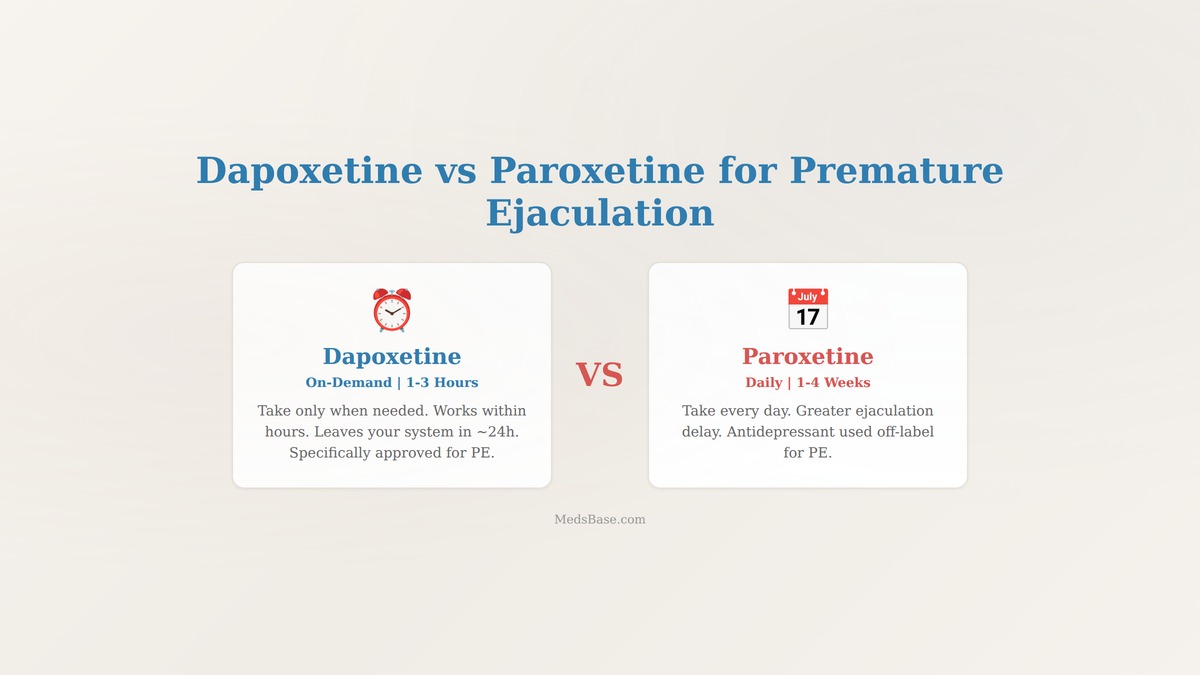
- Dapoxetine is the only medication specifically approved for premature ejaculation — paroxetine is an antidepressant whose ejaculation-delaying effect was discovered as a side effect.
- Dapoxetine works on demand within 1-3 hours; paroxetine needs 1-4 weeks of daily use — the choice of dapoxetine vs paroxetine is partly a lifestyle decision.
- Paroxetine produces greater ejaculation delay (4-8× baseline vs 2.5-3.5× for dapoxetine) — but at the cost of more side effects.
- Dapoxetine leaves your system in ~24 hours; paroxetine causes withdrawal symptoms if stopped abruptly — one of the most under-discussed differences in dapoxetine vs paroxetine.
- Dapoxetine has a lower side effect burden — especially sexual side effects, which matters when the goal is better sexual function.
- If you have both PE and erectile dysfunction, dapoxetine combination products may serve both needs — a paroxetine-only approach leaves ED unaddressed.
Table of Contents
- What Is Premature Ejaculation — and Where Do Medications Fit In?
- Dapoxetine vs Paroxetine: How Does Each Medication Work?
- Effectiveness: What the Studies Show
- Speed of Onset: On-Demand vs Daily
- Side Effects: What to Expect From Each Medication
- Dapoxetine vs Paroxetine: Full Head-to-Head Comparison
- Who Should Choose Which?
- How to Use Dapoxetine vs Paroxetine
- Frequently Asked Questions
- The Bottom Line
Dapoxetine vs Paroxetine for Premature Ejaculation: Which One Actually Works Better?
You’ve tried the exercises. Maybe you’ve tried the delay sprays. And you’re still finishing sooner than you — or your partner — want. So now you’re looking at medication, and two names keep coming up: dapoxetine and paroxetine. The question of dapoxetine vs paroxetine is one of the most common searches among men researching premature ejaculation treatment, and for good reason — these two medications represent fundamentally different approaches to the same problem.
One is an on-demand pill you take an hour before sex, specifically designed for premature ejaculation. The other is a daily antidepressant that was found — almost by accident — to dramatically delay ejaculation. Both work. But the experience of taking them, the speed of results, and the side effects you’ll deal with are worlds apart.
By the end of this article, you’ll know exactly how dapoxetine vs paroxetine stack up on the metrics that matter: how much longer you’ll last, how fast each one kicks in, what side effects to expect, which one fits your lifestyle, and — if you have coexisting erectile dysfunction — which combination approach makes sense. Let’s start with the context that makes this comparison meaningful.
What Is Premature Ejaculation — and Where Do Medications Fit In?
Paroxetine produces greater ejaculation delay but dapoxetine works on the very first dose.
Quick Answer: Premature ejaculation (PE) is defined as ejaculation that always or nearly always occurs within about one minute of vaginal penetration, with an inability to delay ejaculation, and causes personal distress. It affects roughly 20-30% of men at some point in their lives, making it the most common male sexual dysfunction.
PE has two subtypes: lifelong (primary) — present since first sexual experiences — and acquired (secondary) — developing after a period of normal ejaculatory control. Lifelong PE has a strong biological basis involving serotonin neurotransmission in the brain and spinal cord, which is why medications that affect serotonin can be so effective.
Treatment typically follows a stepwise approach. Behavioral techniques (start-stop, squeeze, Kegel exercises) are tried first. Topical anesthetics (lidocaine/prilocaine sprays) come next for some men. When those aren’t enough — or when a man wants a more reliable, less interruptive solution — pharmacological treatment enters the picture. That’s where the dapoxetine vs paroxetine decision lives.
For a deeper look at all treatment approaches, read our complete guide to premature ejaculation treatment. And if you’re new to dapoxetine specifically, our complete guide to dapoxetine covers dosing, timing, and what to expect in detail.
Dapoxetine vs Paroxetine: How Does Each Medication Work?
Dapoxetine carries fewer sexual side effects; paroxetine has broader systemic side effects.
Both dapoxetine and paroxetine are serotonin reuptake inhibitors — they increase serotonin activity in the brain and spinal cord, which raises the threshold for ejaculation. But the similarities largely end there. Here’s where the dapoxetine vs paroxetine comparison gets interesting.
Dapoxetine: The Purpose-Built PE Drug
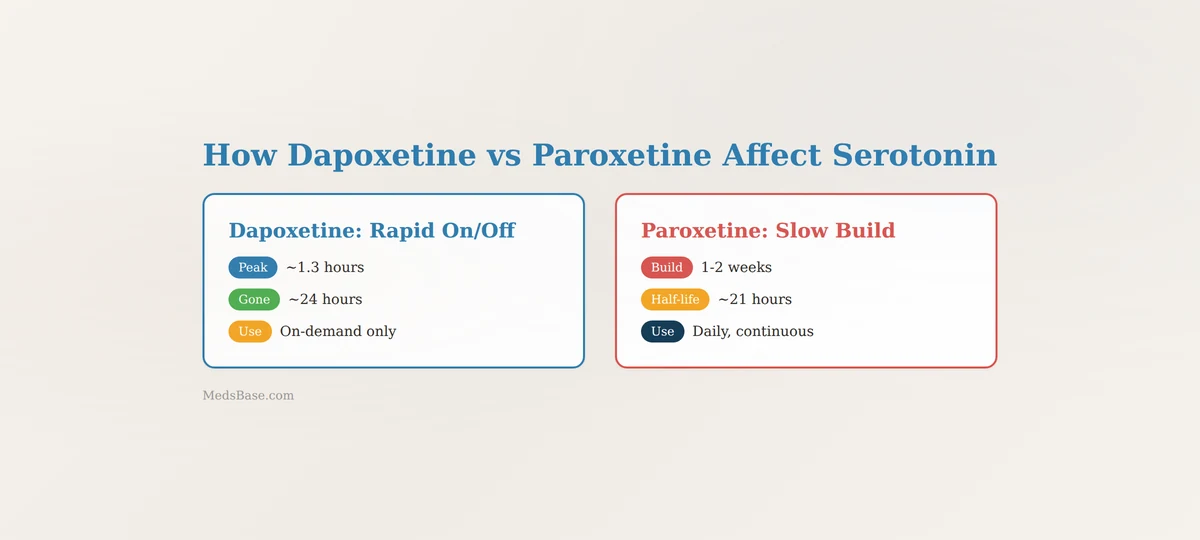
Dapoxetine was developed specifically for premature ejaculation. It is a short-acting selective serotonin reuptake inhibitor (SSRI) with an unusually fast pharmacokinetic profile: it reaches peak blood concentration in approximately 1.3 hours and is nearly completely eliminated within 24 hours. This rapid-on, rapid-off design means you take it only when needed — typically 1-3 hours before anticipated sexual activity — and it doesn’t accumulate in your system with infrequent use.
The pharmacokinetic profile of dapoxetine is what makes the on-demand approach possible. Most SSRIs take weeks to reach steady-state concentration in the blood and weeks to clear when stopped. Dapoxetine was engineered to break both rules — and that engineering is the fundamental difference in any dapoxetine vs paroxetine comparison.
Paroxetine: The Antidepressant That Happens to Delay Ejaculation
Paroxetine was developed and approved for depression, anxiety disorders, and other psychiatric conditions. Its ejaculation-delaying effect was observed as a side effect in clinical trials — and it turned out to be the most potent ejaculation-delaying SSRI in the class. Paroxetine is a long-acting SSRI with a half-life of approximately 21 hours. It takes 1-2 weeks to reach steady-state blood levels, and because it powerfully inhibits the CYP2D6 liver enzyme (more than any other SSRI), it lingers in the body and interacts with many other medications.
Unlike dapoxetine, paroxetine must be taken every day, whether or not sexual activity is planned. Its ejaculation-delaying effect builds gradually over 1-4 weeks and persists as long as you continue taking it. But when you stop — especially if you stop abruptly — the withdrawal can be unpleasant. That’s the trade-off embedded in the dapoxetine vs paroxetine equation.
Research Spotlight
A Cochrane systematic review of pharmacological interventions for premature ejaculation found strong evidence that SSRIs — including both dapoxetine and daily paroxetine — significantly increase ejaculation latency compared to placebo. However, the review noted meaningful differences in side effect profiles: dapoxetine caused fewer and shorter-lasting adverse events, while paroxetine produced greater ejaculation delay but at the cost of more systemic side effects. The review concluded that “clinicians should discuss the different treatment options available with their patients, as it will likely help to improve compliance and adherence to treatment.”
Effectiveness: What the Studies Show
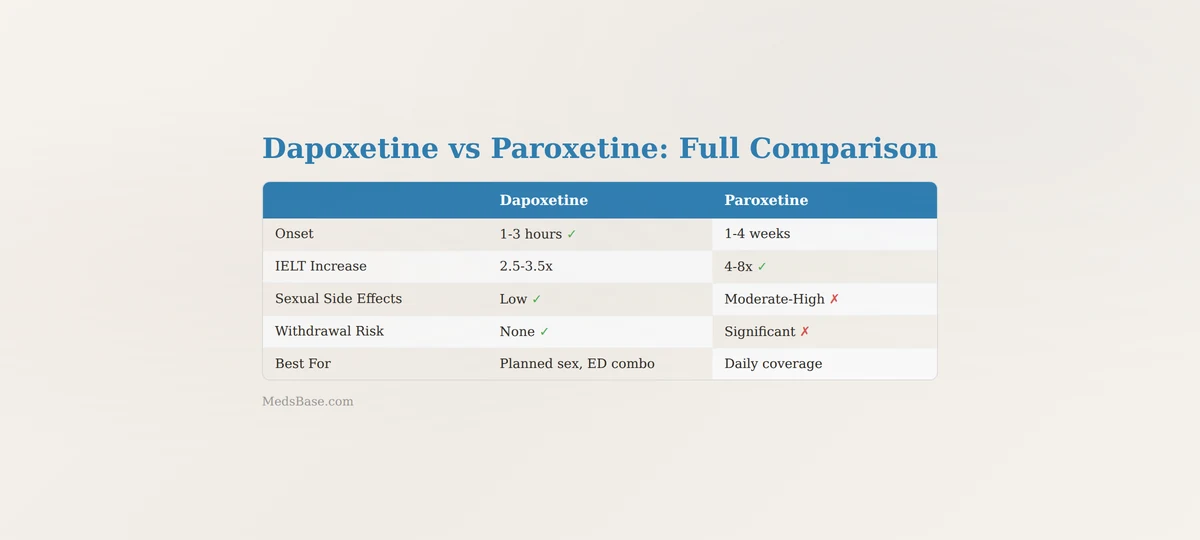
Dapoxetine suits on-demand use with minimal side effects; paroxetine offers greater delay for daily use.
When men compare dapoxetine vs paroxetine, the bottom-line question is nearly always the same: “Which one will make me last longer?” Here’s what the data says.
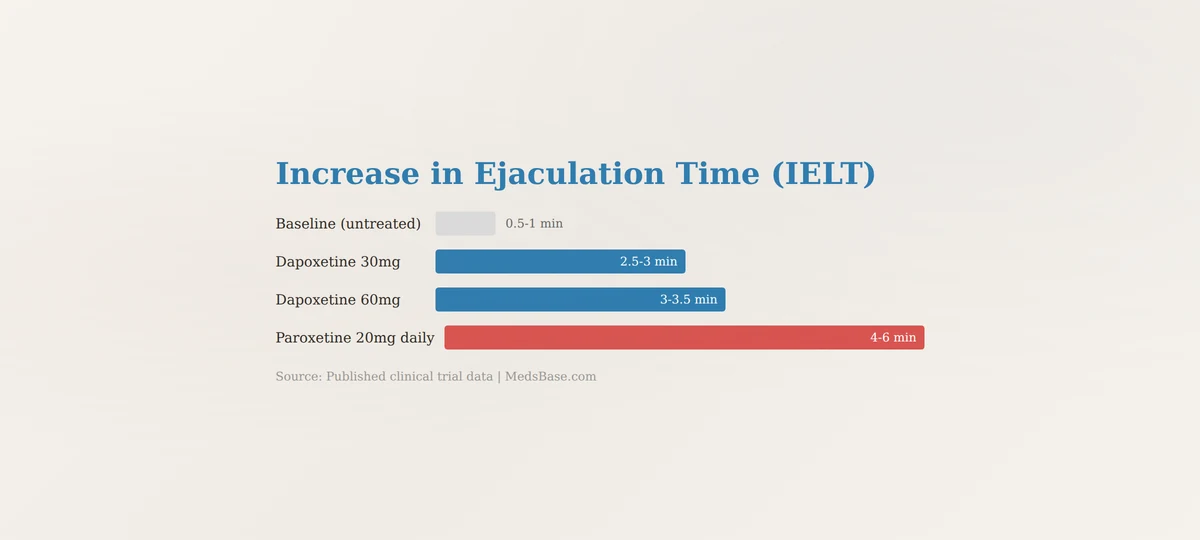
The standard measure in PE research is IELT — intravaginal ejaculation latency time, or the time from penetration to ejaculation. Baseline IELT in men with lifelong PE typically ranges from 20-60 seconds.
| Medication | Dose | IELT Increase | Fold Increase | Patient Satisfaction |
|---|---|---|---|---|
| Dapoxetine (on-demand) | 30 mg | ~2.5-3.0 min | 2.5-3× | ~60-65% |
| Dapoxetine (on-demand) | 60 mg | ~3.0-3.5 min | 3.0-3.5× | ~65-70% |
| Paroxetine (daily) | 20 mg | ~4.0-6.0 min | 4-8× | ~65-75% |
| Placebo | — | ~0.5-1.0 min | ~1.5× | ~20-30% |
Data synthesized from phase III dapoxetine trials and published paroxetine PE studies. Note: head-to-head trials are limited; these figures come from separate studies with different populations and should not be interpreted as directly comparative in a statistical sense.
A meta-analysis of dapoxetine clinical trials involving over 6,000 men confirmed that both the 30 mg and 60 mg doses significantly increased IELT and improved patient-reported outcomes including control over ejaculation and sexual satisfaction, with the 60 mg dose showing marginally greater efficacy at the cost of slightly higher side effect rates.
What the numbers don’t show: The dapoxetine vs paroxetine effectiveness comparison isn’t just about the final number. It’s about when that improvement happens. Dapoxetine’s benefit is immediate but modest; paroxetine’s benefit is larger but delayed. For a man who has sex twice a week and wants control now, dapoxetine’s profile fits. For a man who has sex unpredictably and doesn’t mind planning ahead, paroxetine may deliver better results.
Speed of Onset: The On-Demand Advantage
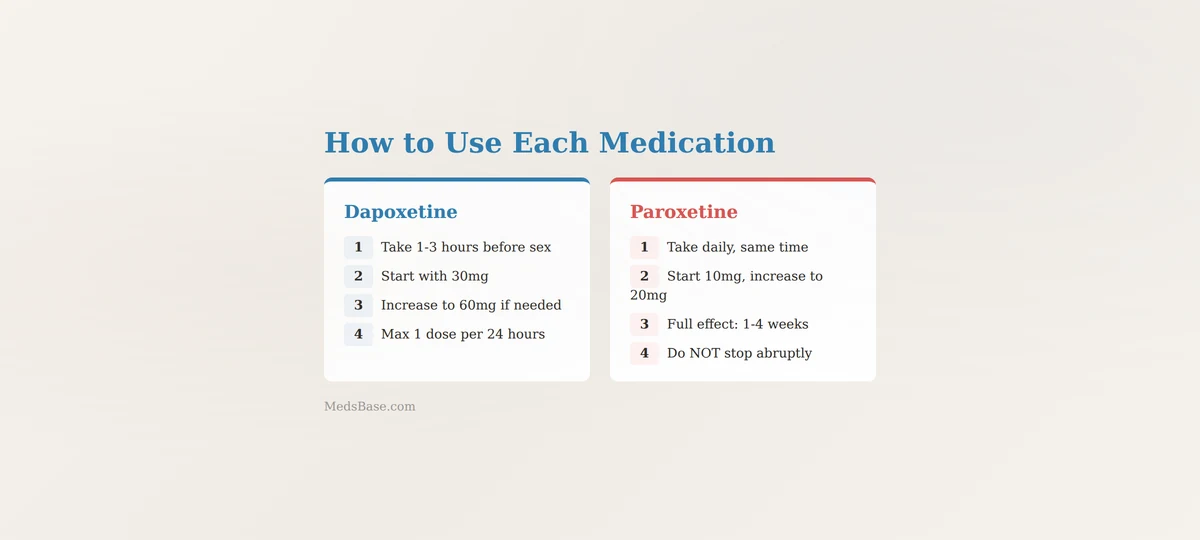
Dapoxetine is taken 1-3 hours before sex; paroxetine requires consistent daily dosing.
Perhaps the single biggest difference in the dapoxetine vs paroxetine comparison is how fast each one works — and this factor alone often determines which medication a man chooses.
Dapoxetine Onset: 1-3 Hours
Take dapoxetine 1-3 hours before you plan to have sex, and it’s active when you need it. The effect peaks around the time of peak blood concentration (~1.3 hours after dosing) and lasts for several hours. If you don’t have sex that night, the drug clears your system and there’s no lingering effect. This flexibility is the core value proposition of dapoxetine.
Paroxetine Onset: 1-4 Weeks
Paroxetine must build up in your system before its ejaculation-delaying effect kicks in. Most men notice some improvement after 1-2 weeks of daily use, with full effect at 3-4 weeks. This means you’re committing to daily medication for at least a month before you can evaluate whether it works for you. And because paroxetine has a withdrawal syndrome, you can’t simply stop — you’ll need to taper off under medical supervision.
The practical implication: With dapoxetine, every dose is a “trial” — you can use it once and decide if it works. With paroxetine, you’re making a multi-week commitment before you can assess the benefit. For some men, that commitment is worth it for potentially greater ejaculation delay. For others, the on-demand flexibility of dapoxetine better matches their life.
Side Effects: What to Expect From Each Medication
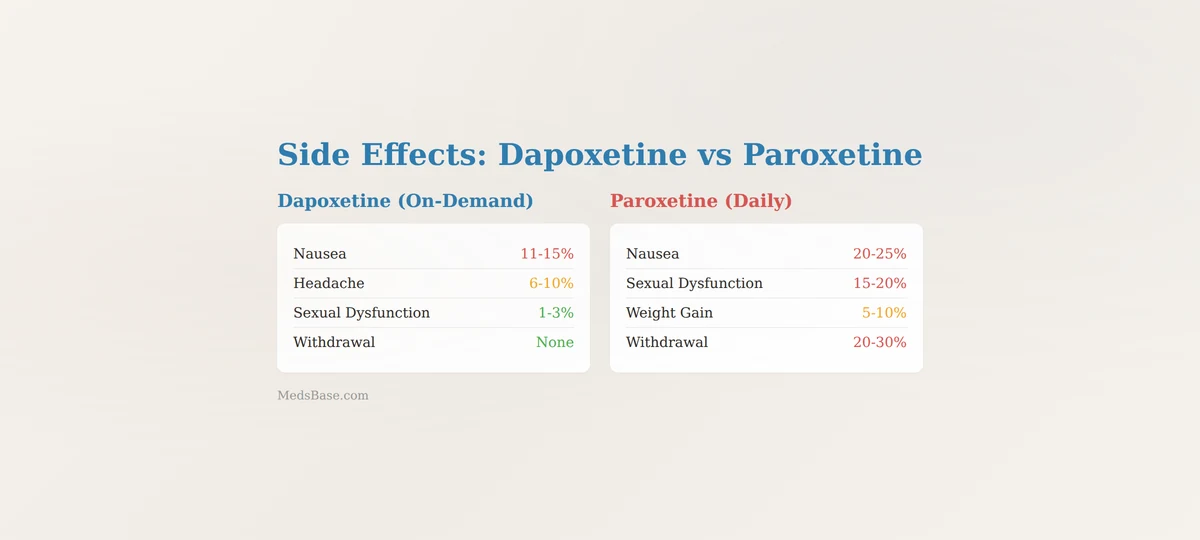
Here’s where it gets interesting — and where one fact often surprises men researching dapoxetine vs paroxetine: paroxetine, despite being the medication that produces more ejaculation delay, also causes more sexual side effects. This seeming paradox — a drug that helps with one sexual problem while potentially causing others — is important to understand.
| Side Effect | Dapoxetine (30-60 mg) | Paroxetine (20 mg daily) |
|---|---|---|
| Nausea | 11-15% (usually mild, resolves in 1-2 hours) | 20-25% (may persist early in treatment) |
| Headache | 6-10% | 15-18% |
| Dizziness | 5-9% | 10-14% |
| Diarrhea | 4-7% | 10-15% |
| Erectile dysfunction | 1-3% (rare with on-demand use) | 10-20% (significant risk with daily use) |
| Decreased libido | 1-2% | 10-15% |
| Delayed ejaculation (beyond desired) | 1-2% | 5-10% (anejaculation possible) |
| Weight gain | Not reported | 5-10% (gradual, over months) |
| Withdrawal syndrome on stopping | Not reported (no accumulation) | 20-30% (dizziness, brain zaps, flu-like) |
| Emotional blunting | Rare (no chronic exposure) | 10-20% (with longer-term use) |
The key insight: Dapoxetine’s side effects are shorter in duration (hours, not days) and fewer in number because the drug doesn’t accumulate. Paroxetine’s side effects reflect its chronic, systemic exposure. The ED and libido risks of paroxetine are especially notable — in some men, paroxetine solves PE but creates a new problem. If you already have some degree of erectile dysfunction alongside PE, dapoxetine — especially in combination products that also contain sildenafil or tadalafil — may serve both issues simultaneously. Browse our sildenafil-dapoxetine combination products if this applies to you.
Dapoxetine vs Paroxetine: Full Head-to-Head Comparison
| Factor | Dapoxetine | Paroxetine |
|---|---|---|
| Drug class | Short-acting SSRI (purpose-built for PE) | Standard SSRI (antidepressant; PE is off-label use) |
| Regulatory status | Approved for PE in 60+ countries (not FDA-approved in the US) | Approved for depression/anxiety; used off-label for PE |
| Dosing | On-demand: 30-60 mg, 1-3 hours before sex | Daily: 10-20 mg, same time each day |
| Onset of PE effect | First dose (1-3 hours) | 1-4 weeks of daily use |
| IELT improvement | 2.5-3.5× baseline | 4-8× baseline |
| Duration of action | A few hours after each dose | 24/7 coverage as long as taken daily |
| Elimination half-life | ~18-19 hours (initial phase) | ~21 hours (accumulates significantly) |
| Common side effects | Nausea, headache, dizziness (mild, short-lived) | Nausea, drowsiness, sexual dysfunction, weight gain, withdrawal syndrome |
| ED / libido impact | Minimal with intermittent use (1-3%) | Significant: ED 10-20%, libido loss 10-15% |
| Drug interactions | Moderate (CYP3A4, PDE5 inhibitors OK with caution) | Extensive (potent CYP2D6 inhibitor; many drug interactions) |
| Combination with ED meds | Common — many fixed-dose combo products exist (with sildenafil/tadalafil) | Possible with caution — no fixed-dose combos available |
| Cost (approximate, monthly) | ~$30-60 for 10 doses (as-needed) | ~$10-30 for 30 tablets (daily) |
| Best for | Men wanting on-demand control; infrequent or planned sex; those concerned about daily side effects; coexisting ED | Men wanting continuous, no-planning-needed coverage; those who have failed dapoxetine; those comfortable with daily medication |
Who Should Choose Which?
Dapoxetine May Be Better For You If:
- You don’t want to take medication every day — you only want treatment when you need it
- You’re concerned about sexual side effects (ED, low libido) from chronic SSRI use
- You have coexisting erectile dysfunction — dapoxetine combination products with sildenafil or tadalafil may address both
- You don’t want to deal with SSRI withdrawal if you decide to stop
- You have infrequent or planned sexual activity
- You’re taking other medications — dapoxetine has fewer drug interactions than paroxetine
Paroxetine May Be Better For You If:
- You want 24/7 coverage — you don’t want to plan medication around sex
- You’ve tried on-demand dapoxetine and it wasn’t effective enough
- You have predictable, frequent sexual activity and don’t mind taking a daily pill
- You also have anxiety or depression — paroxetine may address both (but only under psychiatric care)
- You’ve used SSRIs before and tolerated them well
Who Should Avoid Each Medication
Avoid dapoxetine if: you have significant heart disease (heart failure, conduction abnormalities), severe liver impairment, or are taking MAOIs, thioridazine, or other SSRIs/SNRIs concurrently. Dapoxetine can cause orthostatic hypotension — use caution if you have low blood pressure or take blood pressure medications.
Avoid paroxetine if: you have a history of mania or bipolar disorder, you’re taking MAOIs, tamoxifen (paroxetine blocks its activation), or medications metabolized by CYP2D6. Paroxetine is one of the most problematic SSRIs for drug interactions. If you’re considering pregnancy with a partner, note that paroxetine carries a pregnancy category D warning — discuss with your doctor.
How to Use Dapoxetine vs Paroxetine
Taking Dapoxetine
- Start with 30 mg, not 60 mg. Most men respond adequately at the lower dose, and side effects are dose-dependent.
- Take it 1-3 hours before sex with a full glass of water. Food does not significantly affect absorption.
- Do not take more than one dose in 24 hours. Dapoxetine is designed for infrequent, intermittent use.
- Evaluate after 4-6 doses (or about one month of use). If the 30 mg dose is well-tolerated but not effective enough, discuss increasing to 60 mg with your doctor.
- Watch for orthostatic effects. Stand up slowly for the first few hours after taking dapoxetine — a minority of men experience a blood pressure drop with dizziness.
- Limit alcohol. Combining dapoxetine with alcohol increases the risk of dizziness and orthostatic hypotension.
Taking Paroxetine
- Start with 10 mg daily for the first 1-2 weeks to minimize initial nausea and drowsiness, then increase to 20 mg daily.
- Take it at the same time every day — morning with food if it causes nausea, or at bedtime if it makes you drowsy.
- Expect 1-4 weeks before noticing significant ejaculation delay. Don’t judge effectiveness in the first few days.
- Never stop paroxetine abruptly. Withdrawal symptoms (dizziness, “brain zaps,” irritability, flu-like symptoms) affect roughly 1 in 3 people. Taper by 10 mg per week or slower under medical supervision.
- Monitor for sexual side effects. If you develop ED or lose libido, discuss alternatives with your doctor — these side effects can persist in some men even after stopping.
Ready to explore treatment options? Browse the dapoxetine products available at MedsBase, including standalone dapoxetine tablets and combination products for men with both PE and ED.
Related Reading
- Sildenafil + Dapoxetine Combos Compared — if you have both PE and ED
- Premature Ejaculation Exercises: Start-Stop, Squeeze and Kegels — non-medication approaches that can complement either drug
- ED Pills: Sildenafil, Tadalafil, Vardenafil & Dapoxetine Compared — broader comparison of all erectile and ejaculatory medications
Frequently Asked Questions
Which is better, dapoxetine or paroxetine for premature ejaculation?
It depends on your priorities. In the dapoxetine vs paroxetine comparison, paroxetine produces greater ejaculation delay (4-8× baseline vs 2.5-3.5× for dapoxetine), but dapoxetine works on demand within hours, has fewer and shorter-lasting side effects, carries minimal risk of sexual dysfunction, and does not cause withdrawal when stopped. For men who want on-demand control and are concerned about daily side effects, dapoxetine is often the better first choice. For men who want continuous coverage and are comfortable with daily medication, paroxetine may deliver better numeric results. Many men start with dapoxetine and only consider paroxetine if the on-demand approach isn’t sufficient.
How fast does dapoxetine work for premature ejaculation?
Dapoxetine works within 1-3 hours of taking the first dose. Peak blood concentration occurs approximately 1.3 hours after ingestion, and the ejaculation-delaying effect is present on the very first use — unlike daily SSRIs like paroxetine, which require 1-4 weeks to build up. This rapid onset is dapoxetine’s defining advantage in the dapoxetine vs paroxetine comparison.
Does paroxetine cause sexual side effects?
Yes — and this is one of the most important considerations in the dapoxetine vs paroxetine discussion. Daily paroxetine causes erectile dysfunction in 10-20% of men and decreased libido in 10-15%. This means a medication taken to improve sexual function can paradoxically impair it. Dapoxetine, taken intermittently, carries a much lower risk of sexual side effects (1-3% for ED). If preserving erectile function and libido is a priority, dapoxetine has a clear edge.
Can I take dapoxetine every day?
Dapoxetine is designed and studied for on-demand use, not daily dosing. There is no evidence base for daily dapoxetine, and doing so would likely increase side effects without providing additional benefit. If you want daily, continuous PE coverage, paroxetine is the evidence-supported daily option. The dapoxetine vs paroxetine choice partly reflects this dosing philosophy difference: dapoxetine for when you need it, paroxetine for always-ready coverage.
What is the success rate of dapoxetine for premature ejaculation?
In pooled clinical trial data, approximately 60-70% of men report meaningful improvement in ejaculatory control with dapoxetine, with IELT increasing from roughly 30-60 seconds at baseline to 2.5-3.5 minutes. About 65-70% of men and their partners report satisfaction with treatment. The 30 mg dose works for most responders; the 60 mg dose provides a modest additional benefit for partial responders who tolerate the lower dose well.
Why isn’t dapoxetine FDA-approved in the United States?
Dapoxetine was submitted for FDA approval multiple times but has not been approved in the US, primarily due to concerns about the risk-benefit ratio — specifically, the risk of syncope (fainting) related to orthostatic hypotension in a small subset of users. Dapoxetine is approved and widely prescribed in over 60 countries, including across Europe, Asia, and Latin America. The drug has a well-characterized safety profile when used as directed, and the syncope risk is low (~0.1-0.3% in clinical trials) and largely avoidable by staying hydrated, limiting alcohol, and standing up slowly after taking the medication.
Can I switch from paroxetine to dapoxetine?
Yes, but the transition requires planning. Because paroxetine has a strong withdrawal syndrome, you must taper off paroxetine gradually under medical supervision — do not stop abruptly. Once you have tapered off paroxetine and it has fully cleared your system (typically 1-2 weeks after the last dose, given its 21-hour half-life), you can begin using dapoxetine on-demand. Never take dapoxetine while paroxetine is still in your system without specific medical guidance, as combining two SSRIs increases the risk of serotonin syndrome.
Is paroxetine prescribed specifically for PE, or is it always off-label?
Paroxetine for premature ejaculation is almost always an off-label use. Paroxetine was developed and approved for depression, anxiety, OCD, and PTSD — not for PE. The ejaculation-delaying effect was observed as a side effect and subsequently studied for PE treatment. Many doctors prescribe it off-label for PE, and clinical guidelines support its use, but it was never submitted for or granted a PE-specific indication. Dapoxetine, by contrast, is the only medication specifically developed and approved for the treatment of premature ejaculation.
The Bottom Line
The dapoxetine vs paroxetine decision ultimately comes down to three things: how fast you want results, how you feel about daily medication, and how much you value avoiding sexual side effects.
Dapoxetine wins on speed (works in hours, not weeks), convenience (take it only when you need it), and side effect burden (shorter, fewer, and far less likely to cause ED or libido loss). Paroxetine wins on raw ejaculation-delay numbers (4-8× baseline vs 2.5-3.5×) and the benefit of 24/7 readiness without planning. If you have coexisting erectile dysfunction, dapoxetine — especially in combination products — can address both problems with one medication.
What to do next: If you’re leaning toward dapoxetine, start with 30 mg on-demand and evaluate after 4-6 uses. If on-demand treatment fits your life, this is likely the better first choice for most men. If dapoxetine doesn’t provide enough delay, or if you prefer daily medication, paroxetine at 10-20 mg daily under medical supervision is a well-studied alternative — but go in with your eyes open about the side effect and withdrawal profile.
Wondering if non-medication approaches could work instead? Check out our guide to premature ejaculation exercises — behavioral techniques can be effective alone or combined with medication. Or, if you’re also dealing with erectile dysfunction, explore our comprehensive ED pills comparison to find the right approach for both conditions.
Last updated: September 4, 2026. Reviewed by a clinical pharmacist. This article is for educational purposes only and does not constitute medical advice. Both dapoxetine and paroxetine are prescription medications — always consult a healthcare provider before starting, switching, or stopping any treatment for premature ejaculation.

Written by
Sophie ChenPharmaceutical Content Researcher · 8 years experience
Sophie Chen is a pharmaceutical content researcher with 8 years covering generic medication access and clinical pharmacology. She specialises in international regulatory frameworks, bioequivalence standards, and patient-facing education on therapeutic drug classes. She is not a clinician.