








✓ Medically reviewed by · Last reviewed: May 2026
Pharmacy Researcher · 8 years experience
Pharmacy researcher with 8 years reviewing clinical drug information, generic formulation equivalence, and international pharmaceutical standards. Focuses on patient-facing accuracy in medication education.
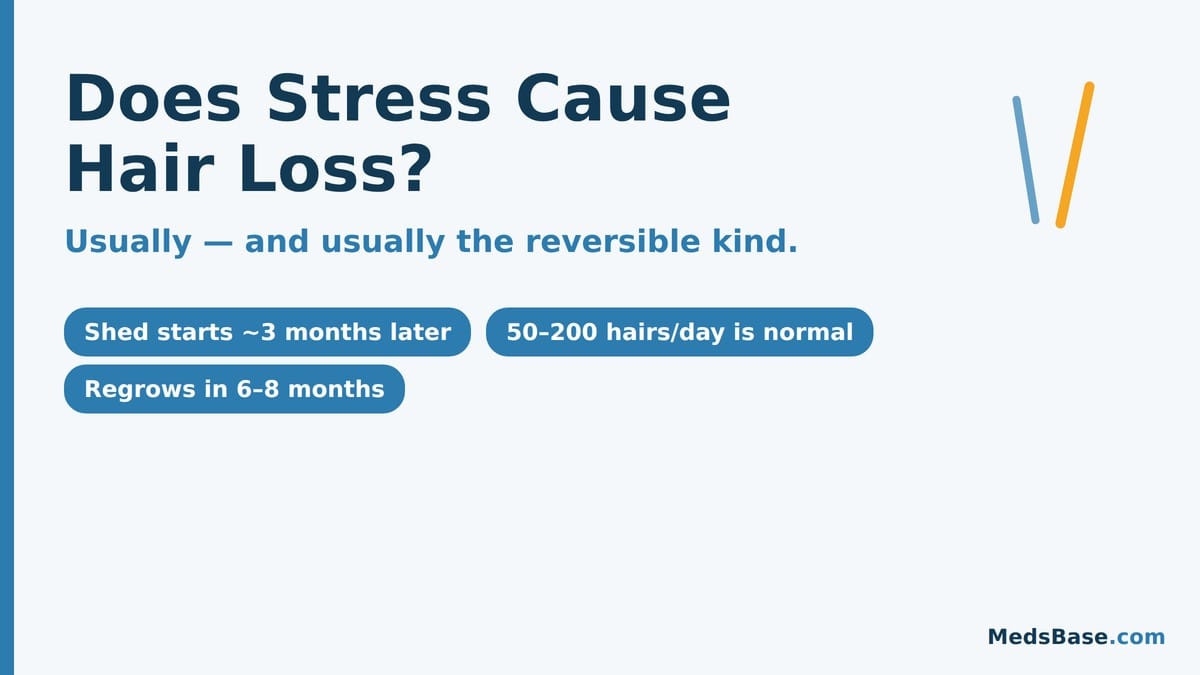
You wash your hair, look down, and there it is — a startling clump circling the drain. It’s been happening for a couple of weeks now, and your brush fills up faster than it used to. If you’ve been through a rough stretch lately, one anxious thought takes over: is the stress doing this? And more importantly, does stress cause hair loss that actually grows back?
Short answer: yes, stress can cause hair loss — but usually the temporary, reversible kind. By the end of this guide you’ll know the exact biological reason, why the shed shows up months after the stress, how to tell it apart from genetic hair loss, and the reassuring timeline for regrowth. There’s also one number that tells you when shedding is still normal — we’ll get to it.
- Stress-related shedding is real, but it’s usually telogen effluvium — the reversible kind, not permanent balding.
- The shed lags the stressor by about 3 months, which is why most people blame the wrong week.
- Losing 50–200 hairs a day is normal — the number that tells you when to relax.
- It looks nothing like genetic hair loss — and that difference decides how you treat it.
- Regrowth usually happens on its own; treating the cause beats reaching for the wrong product.
What Is Telogen Effluvium — the “Stress Shed”?
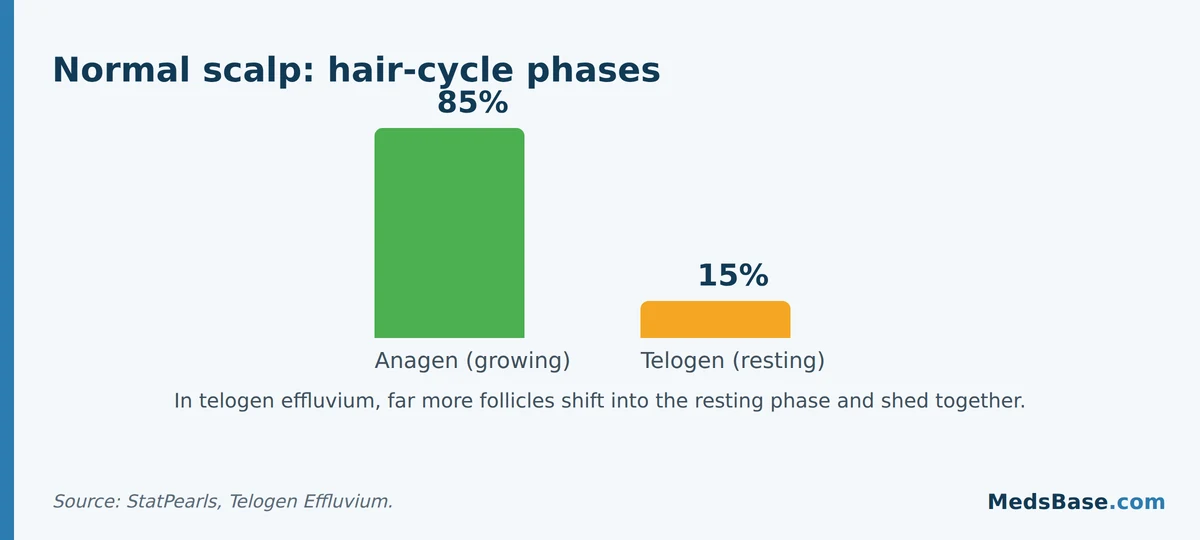
Telogen effluvium is the medical name for a temporary, widespread increase in hair shedding. Each follicle on your scalp cycles between a long growing phase (anagen) and a short resting phase (telogen). Normally, about 85% of your follicles are actively growing and roughly 15% are resting. A big stressor can knock that balance sideways, shoving an abnormal number of follicles into the resting phase early.
Those resting hairs don’t fall out immediately. They cling on for weeks, then release more or less together — which is why the shedding looks so alarming when it finally arrives. Crucially, this is a shift in timing, not a permanent loss of follicles. The follicles are still alive and capable of growing new hair.
So when people ask “does stress cause hair loss,” the honest answer is that stress rarely destroys hair — it reschedules it. And rescheduled hair usually comes back.
It helps to know what telogen effluvium is not. It does not create bald patches, it does not touch your hairline in a receding pattern, and it does not scar the scalp. Those features point to entirely different conditions. Telogen effluvium is the great diffuse thinner — your whole head sheds more, your ponytail feels thinner, your part looks a little wider — but the coverage stays even. That evenness is one of the most useful clues you have, and we will use it later to separate a stress shed from genetic loss.
How Stress Actually Triggers Hair Loss
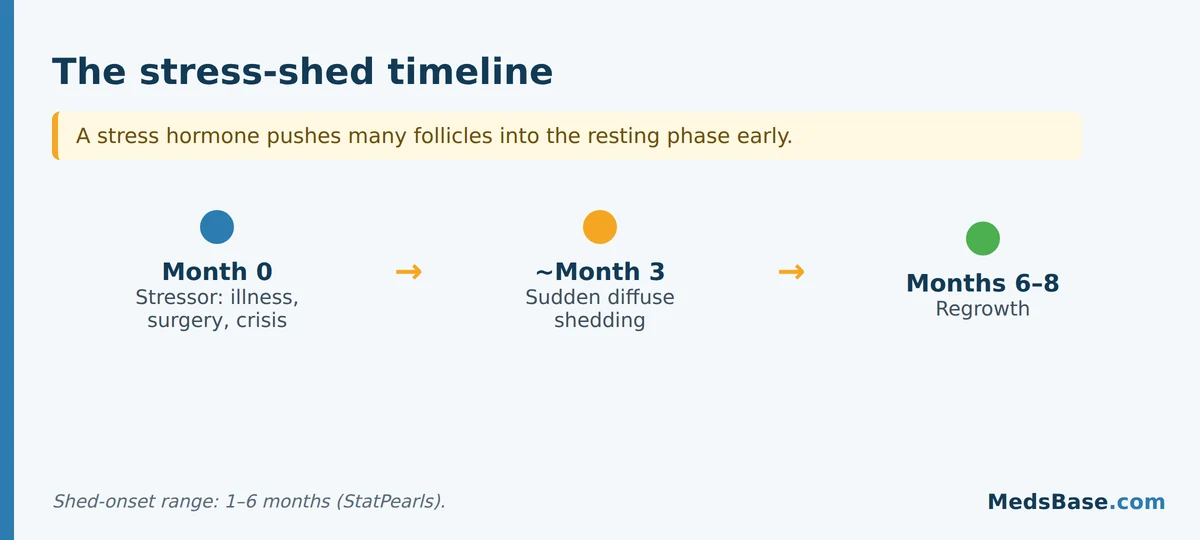
Picture your follicles as a stadium crowd. On a normal day, most people (follicles) are standing and cheering (growing), while a small section sits and rests. A sudden shock — like the lights cutting out — makes a huge chunk of the crowd sit down at once. Weeks later, they all get up and leave together. That synchronized exit is your shed.
The biological trigger is the body’s stress response. When you’re under sustained strain, stress hormones rise, and research suggests they signal follicles to stay in their resting phase instead of cycling back into growth. In a widely cited mouse study published in Nature, the stress hormone corticosterone kept hair-follicle stem cells dormant by suppressing a specific growth signal; removing that hormone let the follicles cycle and grow again.
This delay explains a lot of confusion. The stressful event — an illness, a loss, a major life upheaval — has often passed by the time the hair falls. You feel fine again, so the shedding seems to come from nowhere.
Understanding that lag is genuinely calming. The shed is not a sign that something is currently wrong with you; it is the follicles catching up on an event that has already passed. That is also why chasing the shed with new products rarely helps — you are reacting to old news.
Types & Triggers: Is It Really Stress, or Something Else?
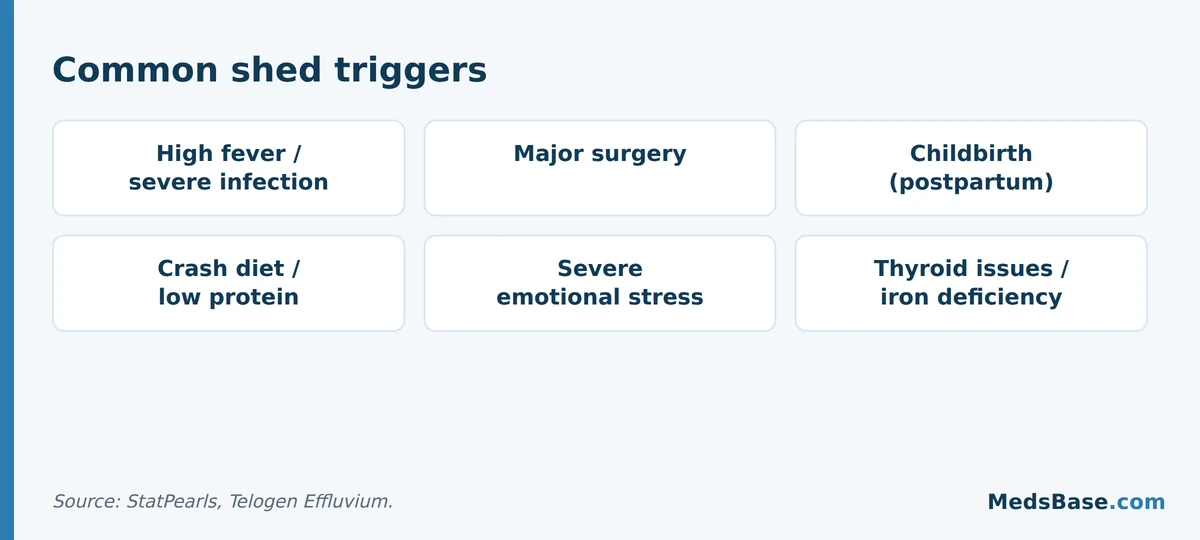
Here’s where people go wrong: they assume “stress” means only emotional stress. Your follicles don’t distinguish between a broken heart and a broken bone — any big physical shock counts too.
Common triggers of a telogen shed
According to StatPearls, typical triggers include acute febrile illness, severe infection, major surgery, severe trauma, postpartum hormonal changes, hypothyroidism, sudden discontinuation of estrogen-containing medications, crash dieting, low protein intake, and iron deficiency. Severe emotional stress sits on that list — but it has plenty of company.
That crash-dieting entry matters more than ever. Rapid weight loss is a recognised shed trigger, and with more people losing weight quickly on GLP-1 medications, some notice extra shedding along the way. If that’s you, our guide to semaglutide for knee osteoarthritis touches on why protecting your body during fast weight loss matters — the same principle applies to your hair.
Nutrition sits behind several of these triggers, which is easy to overlook. Your follicles are among the most metabolically demanding tissues in the body, and they get de-prioritised the moment your system senses scarcity. Skimp on protein, run your iron stores low, or slash calories too fast, and the body quietly pulls resources away from “growing hair” — a non-essential task when survival mode kicks in. That is why a stressful period paired with poor eating can hit harder than stress alone: two triggers stacking on the same follicles.
There is also a hormonal version of this story. After childbirth, the sudden drop in pregnancy hormones sends a large share of follicles into the resting phase at once, producing the very common postpartum shed a few months after delivery. It feels alarming to new parents, but it follows the same reassuring rules as any other telogen effluvium — diffuse, triggered, and usually temporary.
- Likely a reversible stress shed: diffuse thinning all over the scalp; started 1–3 months after an illness, birth, surgery, crash diet, or major stress; no bald patches; hairline intact.
- See a clinician instead: patchy or circular bald spots; a receding hairline or thinning crown that’s slowly worsened over years; shedding lasting well beyond 6–9 months; scalp pain, redness, or scarring. These point to something other than a simple stress shed.
If you’re worried it might be the start of pattern loss rather than a stress shed, it’s worth browsing our hair-loss range to understand the options — but read the next two sections first, because the treatments are genuinely different.
Is It Reversible? Timeline & When to Worry
This is the reassuring part, and it’s the open loop from the intro: how much shedding is actually normal, and when does it cross into a problem?
MedlinePlus notes that losing roughly 50 to 200 hairs a day is normal. A telogen shed pushes you well above that — in a marked case, physical or emotional stress may cause one-half to three-quarters of scalp hair to shed. It looks catastrophic, but shedding decreases over 6 to 8 months, and hair usually grows back once the underlying cause resolves.
| Sign | What It Means | What To Do |
|---|---|---|
| Losing ~50–200 hairs/day | Normal shedding | Nothing — this is baseline |
| Sudden diffuse increase 1–3 months after a trigger | Likely telogen effluvium | Treat the cause; expect recovery over months |
| Shedding easing by month 6–8 | Normal recovery course | Be patient; regrowth is underway |
| Patchy bald spots or a scarred scalp | Not a simple stress shed | See a doctor or dermatologist |
| Shedding persisting beyond ~9 months | Possible chronic cause | Get checked for thyroid, iron, or other issues |
The bottom line here: a stress shed feels dramatic precisely because it’s synchronized, but drama isn’t the same as danger. The follicles are resting, not dying.
What Does the Research Say About Stress and Hair Loss?
Let’s separate what’s proven from what’s promising.
| Source | Focus | Finding | Takeaway |
|---|---|---|---|
| StatPearls (Telogen Effluvium) | Clinical overview | ~85% follicles growing / 15% resting normally; shed begins 1–6 months post-trigger; self-limited | Stress shed is real and usually reversible |
| Nature 2021 (mouse study) | Mechanism | Stress hormone kept follicle stem cells in a prolonged resting phase | Plausible biology for why stress delays regrowth |
| MedlinePlus (Hair loss) | Consumer health | 50–200 hairs/day normal; recovery over 6–8 months | Most stress shedding resolves on its own |
What this means for you: the evidence strongly supports that stress-related shedding is genuine, diffuse, and temporary. The precise hormone pathway is best evidenced in animals, so anyone promising a “stress hair-loss cure” pill is overreaching. Where the science is honest, so should the expectations be — treat the trigger, give it months, and let biology do the regrowing.
It is also worth naming a vicious cycle the research hints at. Shedding is itself stressful, and that anxiety can keep your stress hormones elevated, which may prolong the very process you are worried about. People check the drain daily, count hairs, and spiral — and the worry becomes part of the problem. Breaking that loop is not just good for your mood; calming the stress response is a legitimate part of letting the follicles recover. Reassurance, in this condition, is close to a treatment.
One more honest caveat: telogen effluvium can occasionally become chronic, dragging on for many months when a trigger never fully resolves — persistent illness, ongoing severe stress, an untreated thyroid problem, or long-standing iron deficiency. Chronic shedding is less about “new” hair loss and more about a trigger that keeps re-firing. That is precisely the situation where a clinician’s help pays off, because fixing the root cause is what finally lets the shed settle.
Stress Shedding vs Genetic Hair Loss
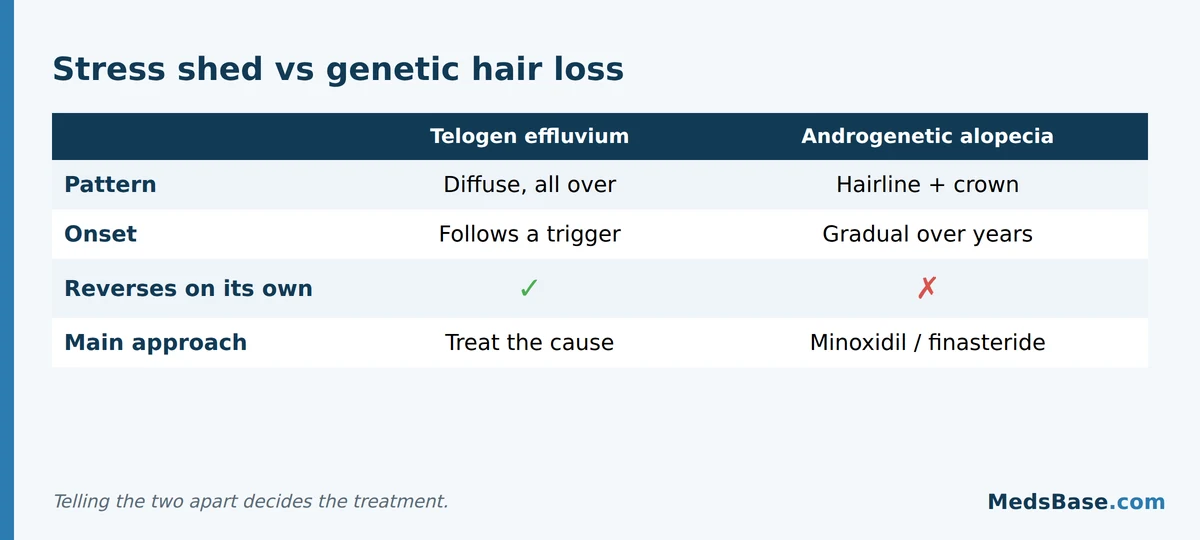
This comparison is where a lot of money gets wasted, because the two conditions look and behave differently — and respond to different treatments.
| Feature | Telogen effluvium (stress shed) | Androgenetic alopecia (pattern loss) |
|---|---|---|
| Pattern | Diffuse, all over the scalp | Receding hairline, thinning crown |
| Onset | Follows a trigger by 1–3 months | Gradual over years |
| Reverses on its own | Usually yes | No |
| Main approach | Treat the cause; wait | Minoxidil, finasteride, ongoing therapy |
Which is which for you? If your part looks wider all over and it started after a rough season, it’s probably a stress shed that will recover. If your hairline has crept back or your crown has thinned slowly for years, that’s pattern loss — and that’s where treatments like minoxidil earn their keep. Our guide to the best hair-loss treatments covers the pattern-loss options in depth.
Here’s the honest nuance most product pages won’t tell you: minoxidil is designed for pattern hair loss, not for switching off an active stress shed. Using it won’t stop telogen effluvium — the shed ends when the trigger resolves.
How to Recover From Stress-Related Hair Loss — Practical Guidance
You can’t rush a telogen shed, but you can remove the obstacles to regrowth and avoid making it worse.
- Fix the underlying trigger. Address the illness, correct low iron or thyroid issues, ease the crash diet, or get support for ongoing stress. The shed ends when the cause does.
- Feed the follicle. Ensure adequate protein and iron — both appear on the trigger list when they run low. A balanced diet does more here than any single “hair vitamin.”
- Be gentle. Avoid tight styles, harsh heat, and aggressive brushing while shedding is active. You won’t stop the shed, but you’ll spare the hair that’s staying.
- Give it a real timeline. Judge progress at 6–8 months, not two weeks. Regrowth often shows first as short, wispy “baby hairs” along the part.
- Match the treatment to the diagnosis. If it turns out to be pattern loss, that’s when topical minoxidil becomes relevant — and no prescription is needed to order from MedsBase.com. For a pure stress shed, treating the cause matters more than any topical.
If low iron or a thyroid problem is on the table, a simple blood test can settle it — and correcting a genuine deficiency often does more for your hair than any topical or supplement marketed for “thickness.” That is the un-glamorous truth of telogen effluvium recovery: the fixes that work are usually the boring, root-cause ones, not the bottles with the most dramatic labels.
Common mistakes to avoid: blaming only emotional stress and missing a physical trigger; switching products weekly; starting minoxidil expecting it to stop a stress shed; over-supplementing with “hair vitamins” you don’t need (excess of some, like certain forms of selenium, can even worsen shedding); and panicking at the very moment recovery is about to begin.
- Best hair-loss treatments — if it turns out to be pattern loss, not a stress shed.
- Can you prevent hair loss before it’s too late? — spotting the difference early.
- Semaglutide for knee osteoarthritis — why protecting your body during rapid weight loss matters.
Frequently Asked Questions
Q: Does stress cause hair loss, and is it permanent?
A: Stress can cause hair loss, but it’s usually telogen effluvium — a temporary, diffuse shed rather than permanent balding. A stressful event pushes many follicles into their resting phase, and they shed together weeks to months later. Because the follicles are resting rather than dead, hair typically regrows within 6–8 months once the trigger resolves. Persistent or patchy loss is different and warrants a doctor’s assessment.
Q: How long after stress does hair fall out?
A: Usually about three months, though it can range from one to six months. This delay is the hallmark of telogen effluvium and the reason people often blame the wrong period. The stressful event has frequently passed by the time the shedding becomes obvious, which makes the cause easy to overlook until you map the timeline backwards.
Q: How much hair loss is normal per day?
A: Losing roughly 50 to 200 hairs a day is considered normal, according to MedlinePlus. Seeing more than that — especially a sudden, all-over increase — suggests a telogen shed. Counting exact hairs isn’t necessary; the meaningful signal is a clear change from your personal baseline, particularly after an illness, birth, surgery, crash diet, or stressful stretch.
Q: Will stress-related hair loss grow back on its own?
A: In most cases, yes. Telogen effluvium is self-limited, meaning it resolves without specific treatment once the underlying trigger is addressed. Shedding tends to decrease over six to eight months, with regrowth following. The best thing you can do is fix the cause, eat enough protein and iron, and be patient rather than chasing quick fixes.
Q: Can anxiety or emotional stress alone cause it?
A: Yes. Severe emotional stress is a recognised trigger, alongside physical stressors like illness and surgery. Your follicles respond to the body’s overall stress load, not only to physical injury. That said, ongoing anxiety that keeps stress hormones elevated may prolong shedding, so managing the stress itself is part of the recovery — not just waiting it out.
Q: Does minoxidil stop stress hair loss?
A: Not really. Minoxidil is designed for androgenetic (pattern) hair loss, not for switching off an active telogen shed. A stress shed ends when its trigger resolves, so treating the cause matters more. Minoxidil becomes relevant only if the real diagnosis is pattern loss — which is why telling the two apart, as covered above, comes first.
The Bottom Line
So, does stress cause hair loss? Yes — but the version most people experience is telogen effluvium, a diffuse, temporary shed that follows a trigger by about three months and reverses on its own over six to eight months. The follicles are resting, not gone. The real skill is telling a stress shed apart from genetic pattern loss, because only one of them needs ongoing treatment.
One immediate action: map your timeline. Look back three months for an illness, birth, surgery, crash diet, or major stressor. Finding it is reassuring — it means the shed has a cause that’s already fading.
Not sure whether yours is a stress shed or the start of pattern loss? Read the best hair-loss treatments guide and can you prevent hair loss before it’s too late next.

Written by
Sophie ChenPharmaceutical Content Researcher · 8 years experience
Sophie Chen is a pharmaceutical content researcher with 8 years covering generic medication access and clinical pharmacology. She specialises in international regulatory frameworks, bioequivalence standards, and patient-facing education on therapeutic drug classes. She is not a clinician.