








✓ Medically reviewed by · Last reviewed: May 2026
Pharmacy Researcher · 8 years experience
Pharmacy researcher with 8 years reviewing clinical drug information, generic formulation equivalence, and international pharmaceutical standards. Focuses on patient-facing accuracy in medication education.
domperidone for nausea and gastroparesis — Domperidone for Nausea and Gastroparesis: Complete Guide to Uses, Dosage, and Safety. Read on for an evidence-backed guide covering everything you need to know.
Domperidone for nausea and gastroparesis — the nausea hits about thirty minutes after you eat. Every meal. You’ve tried ginger tea, crackers, small portions — nothing works. You lost six pounds last month without trying, and your doctor mentioned the word “gastroparesis.” Then they handed you a prescription for domperidone.
Domperidone for nausea and gastroparesis — but when you Googled it, the first thing that came up was “cardiac risk.” Now you’re standing in front of your medicine cabinet, pill in hand, wondering whether this drug is a solution or a gamble.
That’s the exact right question to ask — and by the end of this guide, you’ll have the complete, evidence-based answer. You’ll know what domperidone does, how it works, who should and shouldn’t take it, what dose is effective, and exactly how to weigh the benefits against the risks. You’ll also know how it stacks up against metoclopramide — the other major prokinetic option — so you can have an informed conversation with your doctor.
Key Takeaways
- Domperidone relieves nausea and speeds stomach emptying by blocking dopamine receptors in the gut — not the brain
- It’s most commonly prescribed for gastroparesis (delayed stomach emptying) and nausea when other treatments haven’t worked
- The cardiac risk is real but manageable — the key is staying under 30mg per day and getting an ECG if you have risk factors
- Domperidone causes far fewer neurological side effects than metoclopramide (no drowsiness, no dystonia) — but requires more cardiac monitoring
- One liver-related warning catches most patients off guard — and it’s the most important one to know before starting
- What Is Domperidone for Nausea and Gastroparesis?
- How Does Domperidone Work?
- What Is Domperidone Used For?
- Domperidone Dosage — How Much and How Often
- Domperidone Cardiac Safety
- Domperidone Side Effects
- Who Should Avoid Domperidone?
- Domperidone vs Alternatives
- How to Take Domperidone — Practical Guidance
- Frequently Asked Questions
- Related Reading
- The Bottom Line
What Is Domperidone for Nausea and Gastroparesis?
Quick Answer: Domperidone is a dopamine antagonist medication that speeds up stomach emptying (prokinetic effect) and suppresses nausea and vomiting (antiemetic effect). It’s primarily used for gastroparesis — a condition where the stomach empties too slowly — and for nausea that doesn’t respond to first-line treatments. Unlike metoclopramide, domperidone does not significantly cross the blood-brain barrier, which means it causes far fewer neurological side effects.
Domperidone was developed in the 1970s and is available as a generic medication under the brand name Motilium (among others). It acts primarily on dopamine D2 receptors in the gut and in the chemoreceptor trigger zone (CTZ) — a region of the brain outside the blood-brain barrier that controls nausea and vomiting.
In many countries, domperidone for nausea and gastroparesis is available by prescription or over-the-counter. It is not FDA-approved in the United States (except through a restricted-access program), which has created a confusing landscape for patients seeking information about its safety and effectiveness. The European Medicines Agency has conducted multiple safety reviews for domperidone for nausea and gastroparesis, most recently in 2014 (with updates through 2023), and has restricted its use to short-term treatment of nausea and vomiting at a maximum dose of 30mg per day for adults.
How Does Domperidone Work? — Domperidone for nausea and gastroparesis Explained
Imagine your stomach as a muscular bag with a valve at the bottom (the pyloric sphincter) that opens to release food into the small intestine. In gastroparesis, that valve doesn’t open properly, and the stomach muscles don’t contract effectively. Food sits in the stomach for hours, causing bloating, nausea, early fullness, and sometimes vomiting. This is the precise problem that domperidone for nausea and gastroparesis addresses.
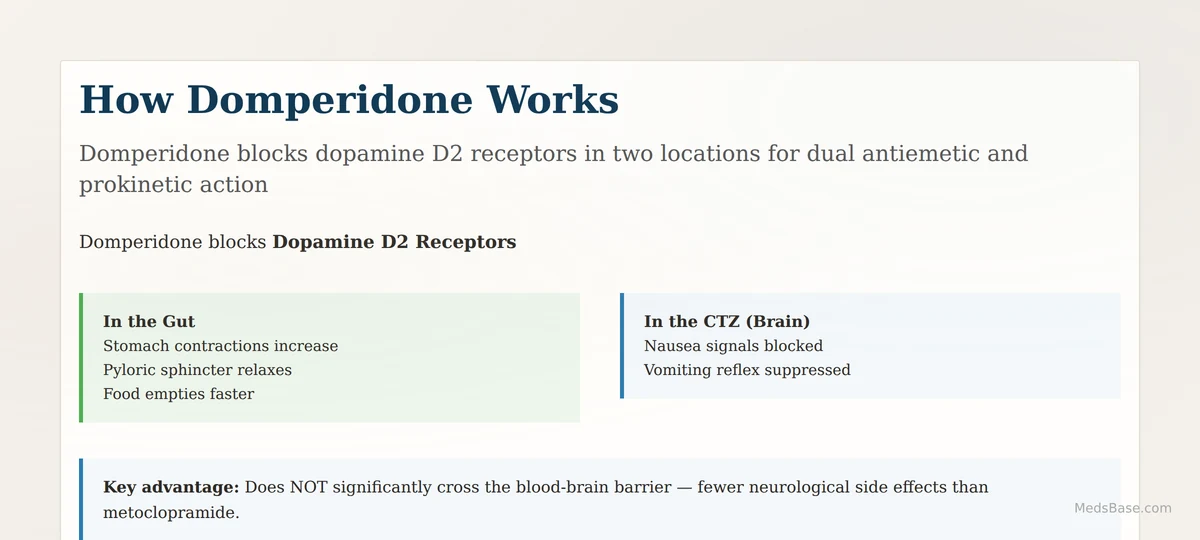
Domperidone works by blocking dopamine D2 receptors — but here’s the clever part: it blocks them primarily in the gut and in the CTZ of the brain (which sits outside the blood-brain barrier). This means it:
- Increases stomach contractions — food moves through faster (the prokinetic effect)
- Relaxes the pyloric sphincter — food exits the stomach more easily
- Blocks nausea signals — the CTZ stops sending “vomit now” messages
The key advantage over metoclopramide is what domperidone does NOT do: it doesn’t cross the blood-brain barrier in significant amounts, so it avoids the dopamine-blocking effects in the brain that cause drowsiness, restlessness, and the rare but serious movement disorders (tardive dyskinesia, acute dystonia) associated with metoclopramide.
Research Spotlight
A 2013 systematic review published in the journal Drugs examined domperidone’s efficacy in gastroparesis and found consistent evidence that it improves gastric emptying and reduces nausea symptoms compared to placebo, with significantly fewer central nervous system side effects than metoclopramide.
What this means for you: Domperidone for nausea and gastroparesis targets the gut more specifically than older prokinetic agents — which is why it remains widely prescribed for gastroparesis despite the cardiac safety concerns that emerged in the 2010s. The benefit-risk balance is favourable when used correctly.
What Is Domperidone Used For?
Domperidone for nausea and gastroparesis represents its primary approved indication, but it has several additional uses:
Primary Indications
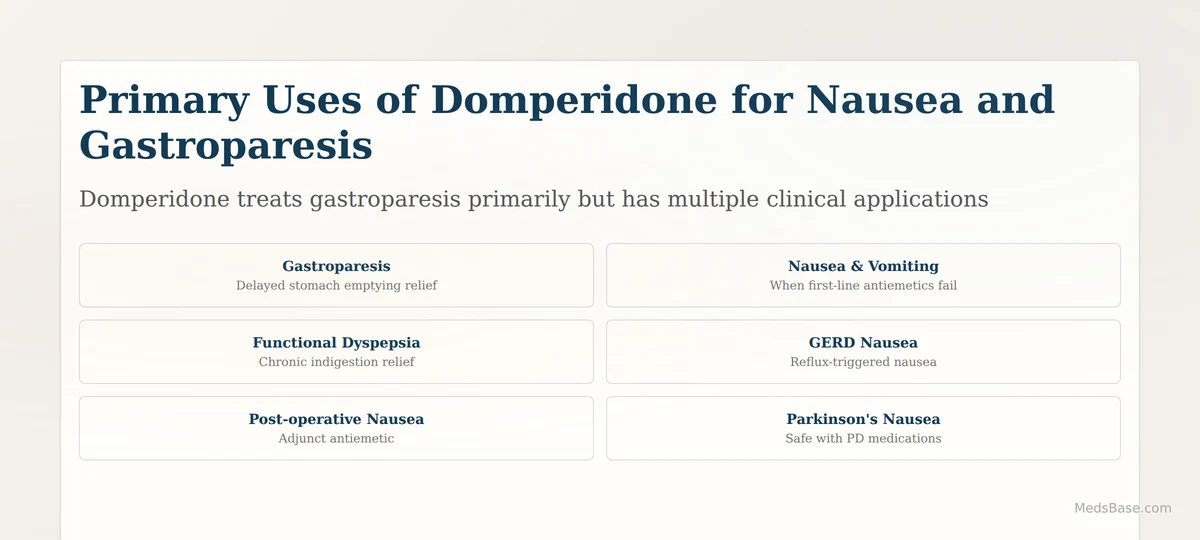
- Gastroparesis — delayed gastric emptying, often in diabetes or after surgery. Domperidone increases the rate at which the stomach empties, reducing bloating, nausea, early satiety, and vomiting.
- Nausea and vomiting — especially when standard antiemetics (antihistamines, ginger, pyridoxine) have not worked.
Off-Label & Secondary Uses
- Functional dyspepsia — chronic indigestion with no clear structural cause; domperidone’s prokinetic action addresses the motility component
- GERD-related nausea — when reflux triggers nausea rather than heartburn
- Post-operative nausea — as an adjunct when standard antiemetics are insufficient
- Chemotherapy-induced nausea — as part of a multi-drug antiemetic regimen (not first-line; used when other agents are inadequate)
- Nausea in Parkinson’s disease — because domperidone doesn’t cross the blood-brain barrier, it can treat nausea caused by dopaminergic Parkinson’s medications without worsening motor symptoms
Who Should Use Domperidone? / Who Should Avoid It?
Good candidate: You have confirmed gastroparesis or chronic nausea that hasn’t responded to first-line treatments (lifestyle changes, antacids, antihistamine antiemetics). You’ve had an ECG to confirm no QT prolongation, you’re not taking other QT-prolonging medications, and you’ll stay within the 30mg/day limit.
NOT a good candidate: You have liver disease (domperidone is extensively metabolised in the liver), existing heart rhythm abnormalities, low potassium or magnesium levels, or you’re taking medications that prolong the QT interval (certain antibiotics, antifungals, antidepressants, and antiarrhythmics).
Domperidone Dosage — How Much and How Often
Quick Answer: The standard adult dose of domperidone for nausea and gastroparesis is 10mg taken three times daily, 15–30 minutes before meals. The absolute maximum is 30mg per day for adults — there is no safe dose above this limit.
| Condition | Typical Adult Dose | Maximum Daily Dose | Duration |
|---|---|---|---|
| Acute nausea/vomiting | 10mg 3× daily | 30mg | Short-term (≤1 week) |
| Gastroparesis | 10mg 3–4× daily | 30–40mg | As directed by physician |
| Functional dyspepsia | 10mg 3× daily | 30mg | Short to medium term |
Timing matters: Domperidone is best absorbed on an empty stomach. Take each dose 15–30 minutes before meals. If you forget a dose, take it as soon as you remember — unless it’s nearly time for the next dose. Never double-dose.
Weight-based dosing for children: Domperidone is sometimes used in children for nausea and vomiting, but only under strict medical supervision. Dosing is weight-based (typically 0.25–0.5mg/kg, 3× daily). The EMA and many national regulators recommend against domperidone in children under 12 years or weighing less than 35kg except in specific, medically supervised circumstances.
What about the 30mg limit? In 2014, the EMA restricted domperidone’s maximum daily dose to 30mg for adults (from the previous 80mg) after a review found that doses above 30mg/day were associated with an increased risk of serious cardiac arrhythmias. This is not an overly cautious guideline — the risk is dose-dependent and well-documented. Never exceed 30mg in 24 hours.
Domperidone Cardiac Safety — The Real Risk
Here’s the cardiac safety section most domperidone articles handle poorly — some minimise the risk, others are so alarmist you’d think the drug causes instant heart attacks. The truth sits between those extremes.
Q: What’s the actual risk?
A:
Domperidone can prolong the QT interval — a measurement on an ECG that reflects the time it takes for the heart’s electrical system to recharge between beats. When the QT interval is prolonged, the risk of a dangerous arrhythmia called torsades de pointes increases.
The key numbers: research suggests the absolute increased risk of serious ventricular arrhythmia with domperidone is approximately 1–4 additional cases per 100,000 person-years of use. The risk is:
- Dose-dependent: Risk increases significantly above 30mg/day
- Age-dependent: Higher in patients over 60
- Interaction-dependent: Much higher when combined with other QT-prolonging drugs
Q: Who needs an ECG before starting?
A:
The EMA and NHS recommend an ECG before starting domperidone if you:
- Are over 60 years old
- Take other medications (many common drugs prolong QT)
- Have a personal or family history of heart rhythm disorders
- Have electrolyte disturbances (low potassium, low magnesium)
- Have liver impairment (reduced drug clearance higher blood levels)
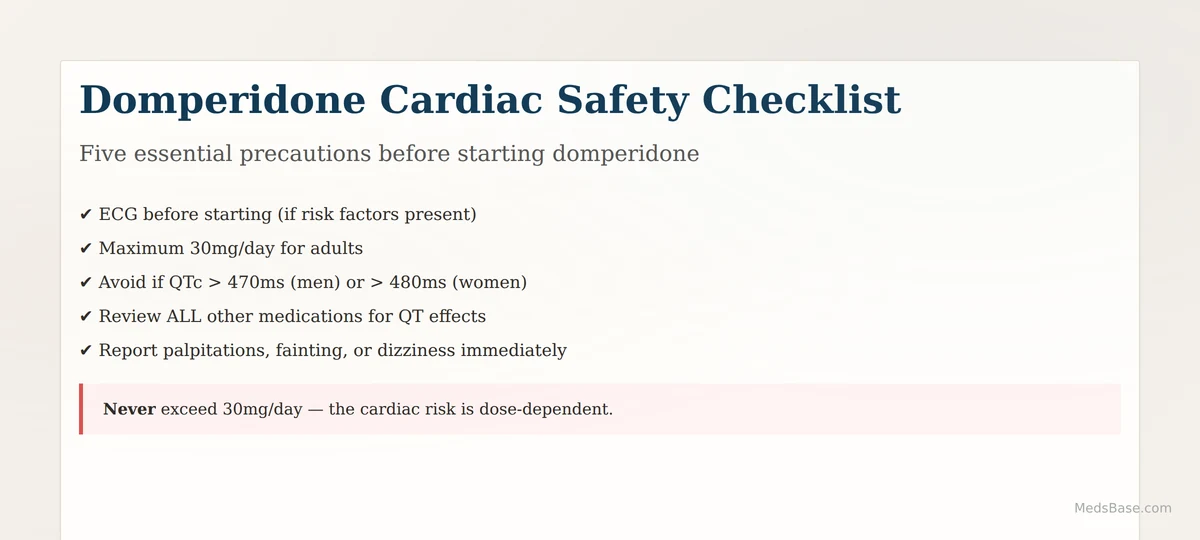
Practical cardiac safety checklist:
- Get an ECG before starting if you have ANY risk factors
- Do not exceed 30mg/day — no exceptions
- Review ALL your other medications with your doctor or pharmacist for QT effects
- Report palpitations, unexplained fainting, or dizziness immediately
- Avoid domperidone during acute illnesses that cause electrolyte loss (severe vomiting, diarrhoea)
The liver factor most patients miss: Domperidone for nausea and gastroparesis is extensively metabolised in the liver via the CYP3A4 enzyme. If your liver function is impaired — even mildly — domperidone can accumulate to dangerous levels because your body can’t clear it fast enough. This is why liver impairment is an absolute contraindication when considering domperidone for nausea and gastroparesis. It’s also why you should never combine domperidone with strong CYP3A4 inhibitors (ketoconazole, clarithromycin, ritonavir, grapefruit juice in large quantities) — these drugs can increase domperidone levels several-fold, dramatically increasing cardiac risk.
Domperidone Side Effects
| Side Effect | Frequency | Severity | What To Do |
|---|---|---|---|
| Dry mouth | Common (up to 10%) | Mild | Increase water intake; sugar-free lozenges |
| Headache | Common (5–10%) | Mild–moderate | Usually transient; simple analgesics if needed |
| Abdominal cramps | Uncommon (1–5%) | Mild | Take with a small amount of food if needed |
| Breast tenderness/enlargement (gynecomastia) | Uncommon (1–5%) | Mild–moderate | Caused by prolactin elevation; reversible on stopping |
| Galactorrhea (milk production) | Uncommon | Mild–moderate | Stop domperidone; resolves within days |
| Diarrhoea | Uncommon | Mild | Hydrate; usually self-limiting |
| QT prolongation / arrhythmia | Rare (<1%) | Serious | STOP immediately; seek medical attention |
| Extrapyramidal symptoms (movement disorders) | Very rare (<<1%) | Serious | Much less common than with metoclopramide |
Prolactin effects: Because domperidone blocks dopamine receptors in the pituitary (which sits outside the blood-brain barrier), it can raise prolactin levels. This causes breast tenderness, breast enlargement (in both men and women), and sometimes milk production. These effects are dose-dependent and always reversible when the drug is stopped.
Who Should Avoid Domperidone?
Absolute Contraindications
- Moderate to severe liver impairment
- Known QTc prolongation (>470ms in men, >480ms in women)
- History of ventricular arrhythmia or torsades de pointes
- Congestive heart failure
- Significant electrolyte disturbances (hypokalemia, hypomagnesemia)
- Concomitant use of QT-prolonging drugs or strong CYP3A4 inhibitors
- Prolactinoma (prolactin-secreting pituitary tumor)
- Known hypersensitivity to domperidone
Relative Contraindications (caution, not absolute prohibition)
- Age over 60 (higher cardiac risk; ECG recommended)
- Mild hepatic impairment (dose reduction may be needed)
- Renal impairment (limited data — use with caution)
- History of breast cancer (theoretical concern with prolactin elevation — discuss with oncologist)
- Pregnancy and breastfeeding (limited safety data — use only if clearly needed and prescribed)
Domperidone vs Alternatives
| Domperidone | Metoclopramide | Erythromycin (low dose) | |
|---|---|---|---|
| Mechanism | D2 antagonist (peripheral) | D2 antagonist (central + peripheral) | Motilin receptor agonist |
| CNS side effects | Minimal | Common — drowsiness, dystonia, TD risk | Minimal |
| Cardiac risk | QT prolongation (dose-dependent) | Lower QT risk | QT prolongation (significant) |
| Max daily dose | 30mg | 30–40mg | 250mg 3–4× daily (short-term only) |
| Best for | Chronic gastroparesis, long-term nausea | Acute nausea, short-term use, migraine | Acute gastroparesis exacerbation (hospital) |
| Duration | Short-to-medium term | Short-term preferred | Short-term only (tachyphylaxis) |
Q: Which fits which situation?
A:
- Chronic gastroparesis with no cardiac risk factors: Domperidone is often preferred because it can be used for weeks to months with fewer neurological side effects than metoclopramide.
- Acute severe nausea (e.g., migraine, post-op): Metoclopramide may be preferred — it works quickly and has shorter-term cardiac monitoring needs.
- Short-term gastroparesis flare in hospital: Low-dose erythromycin is effective for acute flares but loses effectiveness within 2–4 weeks (tachyphylaxis).
- Concern about drug interactions: If you take medications that prolong QT, metoclopramide may be the safer choice — discuss with your doctor.
For a detailed head-to-head comparison, read our Domperidone vs Metoclopramide guide.
How to Take Domperidone — Practical Guidance
Step 1: Confirm the diagnosis and cardiac clearance. Before starting domperidone for nausea and gastroparesis, your doctor should confirm the diagnosis (typically via gastric emptying study) and assess cardiac risk factors. If indicated, get an ECG before the first dose.
Step 2: Start at the standard dose. 10mg three times daily, 15–30 minutes before meals. Do not start at a higher dose — there’s no benefit and the risk increases.
Step 3: Time it consistently. Domperidone is short-acting (half-life ~7–9 hours). Taking it before meals ensures the peak effect coincides with the time your stomach is working hardest. Set alarms if needed.
Step 4: Watch for prolactin effects. Breast tenderness, swelling, or unexpected milk production means your prolactin is elevated. These effects are not dangerous but can be uncomfortable — discuss a dose reduction or alternative with your doctor.
Step 5: Do not stop abruptly. If you’ve been taking domperidone for more than a few weeks, tapering off over several days may prevent rebound nausea. Discuss a stopping plan with your doctor.
Common mistakes to avoid when using domperidone for nausea and gastroparesis:
- Taking more than 30mg/day — “a little extra” is not safe
- Combining with grapefruit juice (inhibits CYP3A4 raises domperidone levels)
- Ignoring palpitations or dizziness — these are warning signs, not acceptable side effects
- Using domperidone for weight loss or lactation induction (off-label misuse — dangerous)
If domperidone is helping and you need a reliable source, browse domperidone products in the MedsBase gastro-health category.
Frequently Asked Questions About Domperidone for Nausea and Gastroparesis
Q: What is domperidone used for?
A:
A: Domperidone for nausea and gastroparesis is primarily used to treat nausea, vomiting, and the symptoms of gastroparesis (delayed stomach emptying). It’s a dopamine antagonist that acts on receptors in the gut and the brain’s chemoreceptor trigger zone. It is also used off-label for functional dyspepsia, GERD-related nausea, and as an adjunct antiemetic in certain clinical settings.
Q: Is domperidone safe for long-term use?
A:
A: Domperidone is generally approved for short-term use (up to one week for acute nausea), but it is often prescribed for longer durations in gastroparesis when the benefits outweigh the risks. Long-term use requires cardiac monitoring — periodic ECGs to check the QTc interval. The longest safe duration is determined on a case-by-case basis by your doctor. Never self-extend a domperidone prescription beyond the duration your doctor specifies.
Q: Does domperidone cause heart problems?
A:
A: Domperidone can prolong the QT interval on an ECG, which increases the risk of a specific heart rhythm disorder called torsades de pointes. This risk is dose-dependent — it increases significantly at doses above 30mg per day. For patients without cardiac risk factors who stay within the 30mg/day limit, the absolute risk is low (estimated at 1–4 additional serious arrhythmia cases per 100,000 person-years). The key to safety is: respect the dose limit, get an ECG if you have risk factors, and report any palpitations or fainting.
Q: What is the correct dosage of domperidone for nausea?
A:
A: The standard adult dose is 10mg taken three times daily, 15–30 minutes before meals. The maximum recommended daily dose is 30mg. Doses above 30mg/day are not recommended because of increased cardiac risk. For children, dosing is weight-based and should only be done under direct medical supervision.
Q: Can domperidone help with gastroparesis?
A:
A: Yes — domperidone for nausea and gastroparesis is one of the most commonly prescribed medication approaches for gastroparesis. By blocking dopamine receptors in the gut, it increases stomach muscle contractions and relaxes the pyloric sphincter, speeding up gastric emptying. Research consistently shows that domperidone for nausea and gastroparesis improves symptoms of bloating, nausea, early satiety, and vomiting in gastroparesis patients.
Q: Domperidone vs metoclopramide — which is safer?
A:
A: Neither is universally “safer” — they have different risk profiles. Domperidone is less likely to cause neurological side effects (drowsiness, restlessness, movement disorders) because it doesn’t significantly cross the blood-brain barrier. Metoclopramide is less likely to cause QT prolongation. The safer choice depends on your individual risk factors — if you have cardiac risk factors, metoclopramide may be preferred; if you need long-term treatment and want to avoid neurological side effects, domperidone may be the better option.
Q: Why is domperidone not FDA-approved in the United States?
A:
A: Domperidone is not FDA-approved for general use in the US due to concerns about cardiac arrhythmias and the availability of alternative treatments. It is available only through an FDA restricted-access investigational new drug (IND) program for specific gastrointestinal conditions. In most other countries (EU, UK, Canada, Australia, India), domperidone is approved and available with appropriate restrictions on dose and duration.
Q: What should I do if I miss a dose of domperidone?
A:
A: Take the missed dose as soon as you remember, unless it’s nearly time for your next scheduled dose. If it’s close to the next dose, skip the missed dose and continue with your regular schedule. Never double-dose to “catch up” — this increases cardiac risk. If you’re missing doses frequently because the dosing schedule is inconvenient, ask your doctor about adjusting the timing rather than changing the dose.
Related Reading
- Domperidone vs Metoclopramide: 7 Proven Safety Facts — A detailed head-to-head comparison of the two major prokinetic options
- Blood Pressure Medication Adherence: 9 Proven Strategies — Today’s companion post on medication consistency
- Travoprost vs Bimatoprost for Glaucoma — Today’s comparison post in the eye care cluster
- Browse the MedsBase Gastro Health category
The Bottom Line
Domperidone for nausea and gastroparesis works — and for many patients, it works better than the alternatives because it treats the symptoms without causing the neurological side effects that make metoclopramide hard to tolerate. But it demands respect. The 30mg/day limit is real, the cardiac monitoring is necessary, and the liver-function dependency is not something you can ignore.
If you’ve been prescribed domperidone, the right approach is not fear and not dismissal — it’s informed caution. Know your ECG results. Respect the dose. Avoid grapefruit juice. Tell your doctor about every other medication and supplement you take. And if you notice palpitations, chest discomfort, or unexplained fainting, stop the medication and seek medical attention immediately.
For the right patient — someone with confirmed gastroparesis or chronic nausea, normal cardiac function, no liver impairment, and no risky drug interactions — domperidone for nausea and gastroparesis can be genuinely life-changing. It’s one of the few medications that directly addresses the motility problem in gastroparesis rather than just masking the nausea.
Your next step: If you’re considering domperidone, book an appointment with your doctor to discuss cardiac screening, the right dose, and whether domperidone — or an alternative — is the best fit for your situation. Bring this article. The more informed you are, the better the conversation.
Wondering how domperidone directly compares to metoclopramide? Read our head-to-head comparison guide. Looking for reliable domperidone products? Browse the MedsBase Gastro Health category.

Written by
Sophie ChenPharmaceutical Content Researcher · 8 years experience
Sophie Chen is a pharmaceutical content researcher with 8 years covering generic medication access and clinical pharmacology. She specialises in international regulatory frameworks, bioequivalence standards, and patient-facing education on therapeutic drug classes. She is not a clinician.