








✓ Medically reviewed by · Last reviewed: May 2026
Pharmacy Researcher · 8 years experience
Pharmacy researcher with 8 years reviewing clinical drug information, generic formulation equivalence, and international pharmaceutical standards. Focuses on patient-facing accuracy in medication education.
# Esomeprazole vs Omeprazole: 7 Proven Differences That Matter
You are standing in front of two boxes. One costs noticeably more and the packaging implies it is the newer, better version. The other has been around for decades and costs a fraction as much. A pharmacist has told you they do “basically the same thing”, which is technically true and completely unhelpful when you are the one paying.
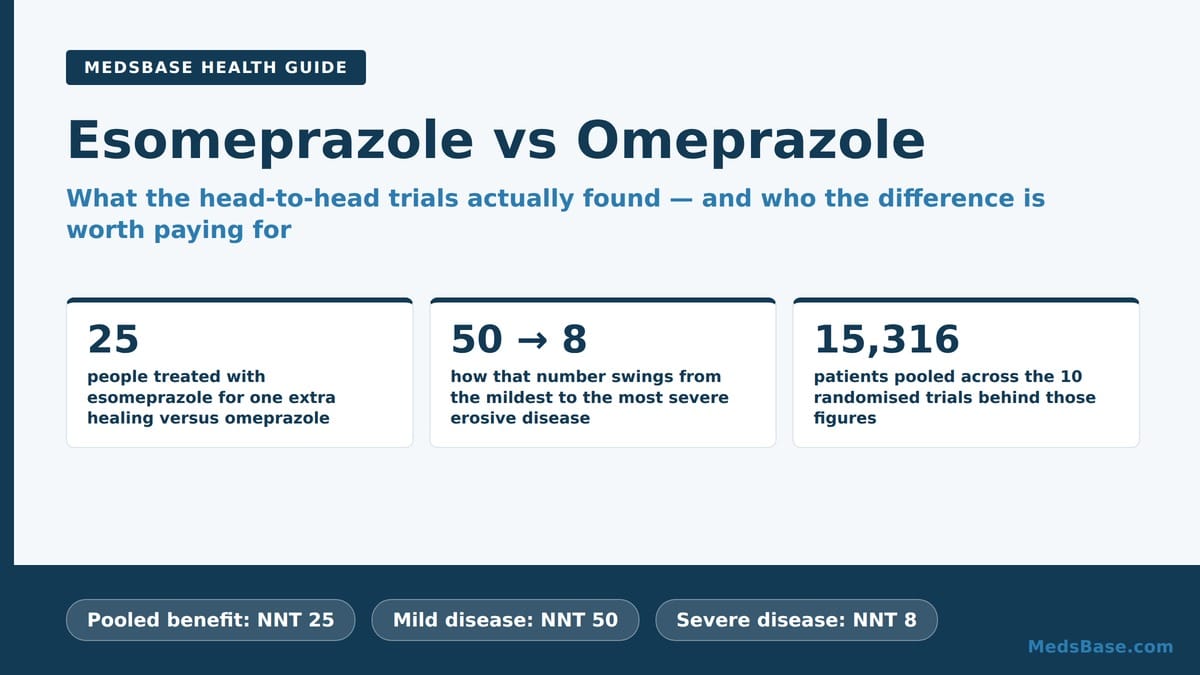
The esomeprazole vs omeprazole question has a genuine, evidence-based answer — it is just more specific than either “they’re identical” or “the newer one is better”. The trials found a real difference in healing rates. They also found that you would need to treat 25 people with the newer drug for one of them to benefit compared with the older one. And that headline number hides something far more useful, which is where this article is going.
By the end you will know exactly which group you fall into, whether the difference is worth paying for in your case, and the one thing that matters more than which of these two you pick. That last point catches almost everybody out.
- The esomeprazole vs omeprazole gap is not a gap between two drugs — esomeprazole is one half of
- Trials do show higher healing rates for esomeprazole in erosive esophagitis. The pooled number needed to
- That 25 is an average concealing a range from 50 to 8, and which end you sit at depends on one thing
- For everyday reflux symptoms without erosive damage, the evidence for choosing one over the other is
- A gene most people have never been tested for affects how you process both drugs — and it affects one of
- The short answer
- How both drugs work — and the isomer story
- What each one treats
- Side effects and safety compared
- What the research says about esomeprazole vs omeprazole
- Esomeprazole vs omeprazole: which should you choose?
- How to take either one properly
- Frequently asked questions
- The bottom line
Esomeprazole vs Omeprazole: The Short Answer
removed. Trials show modestly higher healing rates for esomeprazole in erosive esophagitis, with a pooled
number needed to treat of 25. The advantage is negligible in mild disease and meaningful in severe disease.
Both drugs belong to the same class: the proton pump inhibitor, or PPI. Both reduce your stomach acid by shutting down the pumps that produce it. You take both once daily before a meal. They treat the same conditions, and they share broadly the same side-effect profile. On the surface, the esomeprazole vs omeprazole comparison has very little left in it.
If you want the decision in one line: if your reflux is symptomatic without confirmed erosive damage, the cheaper option is a defensible choice; if you have confirmed moderate-to-severe erosive esophagitis, the evidence favours esomeprazole enough to justify the difference.
Everything below is the reasoning behind that sentence, because a recommendation you cannot check is not worth much.
How Both Drugs Work — And the Isomer Story
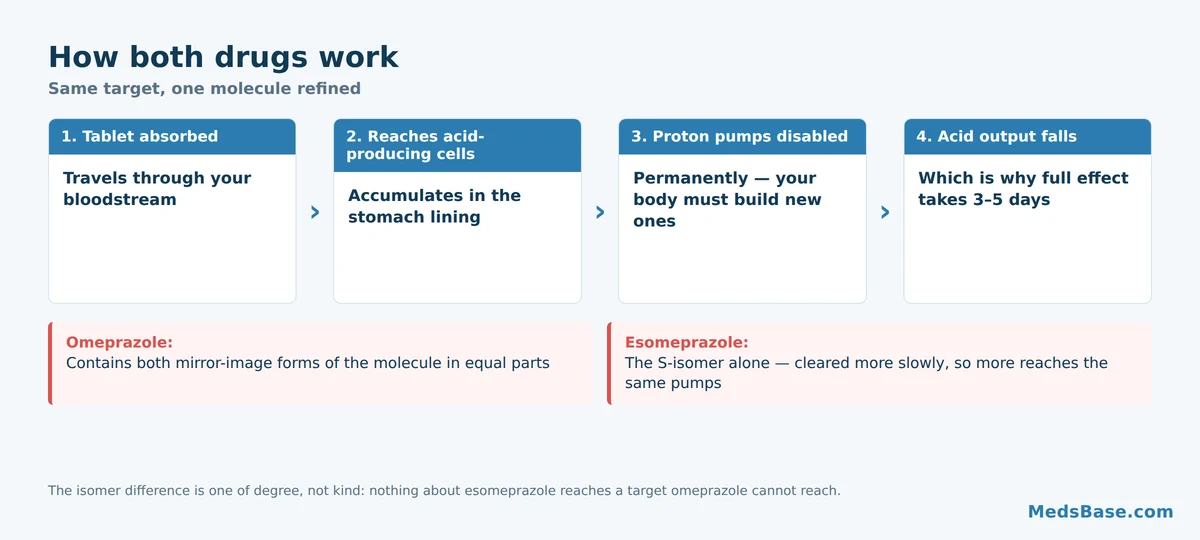
Your stomach lining contains proton pumps — tiny molecular machines that push acid into your stomach. Both drugs travel through your bloodstream, accumulate in your acid-producing cells, and permanently disable the pumps they meet. Your body then has to build new pumps, which takes time. That is why your PPI keeps working long after it has left your bloodstream, and why you need several days of dosing before you feel the full effect.
Now the part that explains the entire esomeprazole vs omeprazole comparison.
Many molecules exist in two mirror-image forms, like your left and right hands. Chemists call them isomers. Omeprazole is a mixture of both forms in equal parts. Esomeprazole is one of them on its own — the S-isomer, which is where the “es-” comes from.
Why bother separating them? Because your liver does not process the two halves at the same rate. The S-isomer is cleared more slowly, so more of it survives to reach your pumps. That is the whole mechanism behind the difference you are being asked to pay for: not a new way of working, but more drug arriving at the same target.
So what does this mean for you? It means the difference between these two drugs is one of degree, not kind. Nothing about esomeprazole reaches a target omeprazole cannot reach.
What Each One Treats
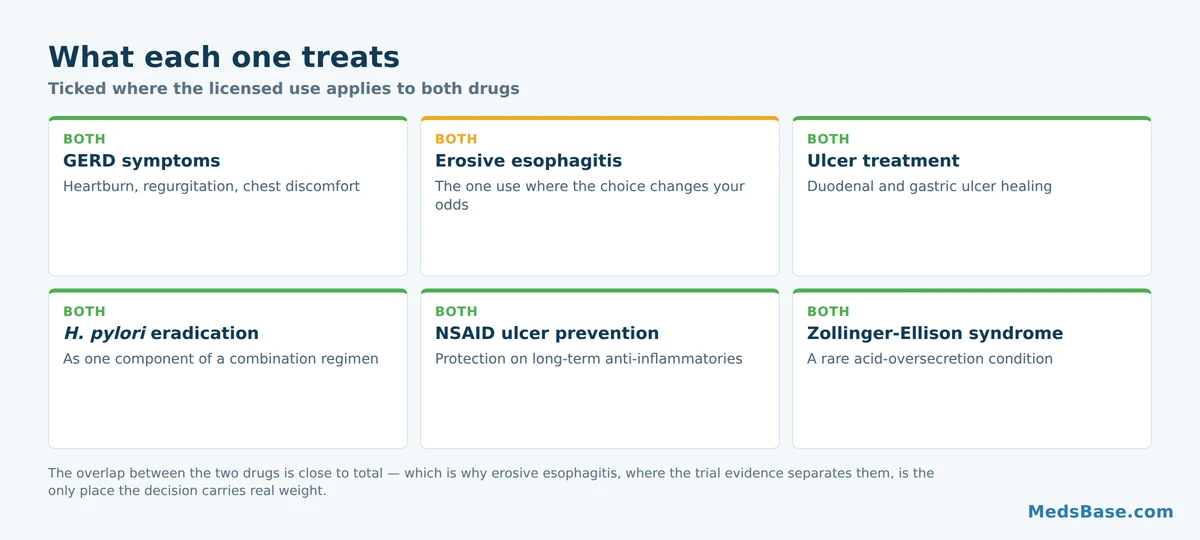
The overlap is close to total. Both are licensed for:
- GERD symptoms — the heartburn, regurgitation and chest discomfort of reflux disease
- Erosive esophagitis — visible damage to the esophageal lining, confirmed at endoscopy. This is the one
condition where the esomeprazole vs omeprazole choice genuinely changes your odds
- Duodenal and gastric ulcer treatment and healing
- ***H. pylori* eradication**, as one component of a combination regimen
- Preventing ulcers in people taking long-term anti-inflammatory painkillers
- Zollinger-Ellison syndrome, a rare acid-oversecretion condition
That last box is the most important paragraph in this article, and it has nothing to do with which of the two drugs you choose.
Side Effects and Safety: Esomeprazole vs Omeprazole
Here is where the comparison gets short, because there is very little to separate them. The 2001 head-to-head trial reported that esomeprazole had a safety profile similar to omeprazole, with headache, diarrhoea and nausea the most common adverse events in both groups. If you were hoping the esomeprazole vs omeprazole decision would spare you side effects, this is the section that will disappoint you.
| Side effect | Frequency | Severity | What to do |
|---|---|---|---|
| Headache | Common, both drugs | Mild | Usually settles; report if persistent |
| Diarrhoea or constipation | Common, both drugs | Mild | Often improves within weeks |
| Nausea, abdominal pain, wind | Common, both drugs | Mild | Take before a meal as directed |
| Low magnesium | Uncommon, long-term use | Moderate–serious | Blood test; may need monitoring on long courses |
| Vitamin B12 malabsorption | Long-term use | Moderate | Worth discussing on multi-year therapy |
| Increased fracture risk | Long-term, high-dose | Serious | Relevant if you already have osteoporosis risk |
| C. difficile and enteric infections | Uncommon | Serious | Report persistent diarrhoea rather than waiting |
| Rebound acid hypersecretion on stopping | Common after long courses | Mild–moderate | Step down gradually rather than stopping abruptly |
The MedlinePlus pages for esomeprazole and omeprazole, both from the US National Library of Medicine, carry the complete lists in plain language.
On safety, the honest verdict is that PPI side effects are a class question, not a brand question. If you are worried about the long-term risks, switching between these two will not help you. Reviewing whether you still need daily acid suppression at all will — and that review is worth more to you than any amount of deliberation between the two brands.
The interactions worth knowing
Two are worth singling out, because they are common and specific.
Clopidogrel. Omeprazole and esomeprazole both inhibit the liver enzyme that activates clopidogrel, a blood thinner. If you take clopidogrel, this is a conversation to have with a clinician — other PPIs interact less.
Levothyroxine and other pH-dependent drugs. PPIs raise your stomach pH, and some medicines need stomach acid to dissolve properly. Levothyroxine is the classic example, and it is a documented cause of a thyroid dose that quietly stops delivering. If you take both, our guide to why a thyroid dose can stop working explains the timing separation that fixes it.
What the Research Says About Esomeprazole vs Omeprazole
This is where the useful numbers live, and where almost every competing page stops at the first row of this table.
| Study | Year | Population | Finding |
|---|---|---|---|
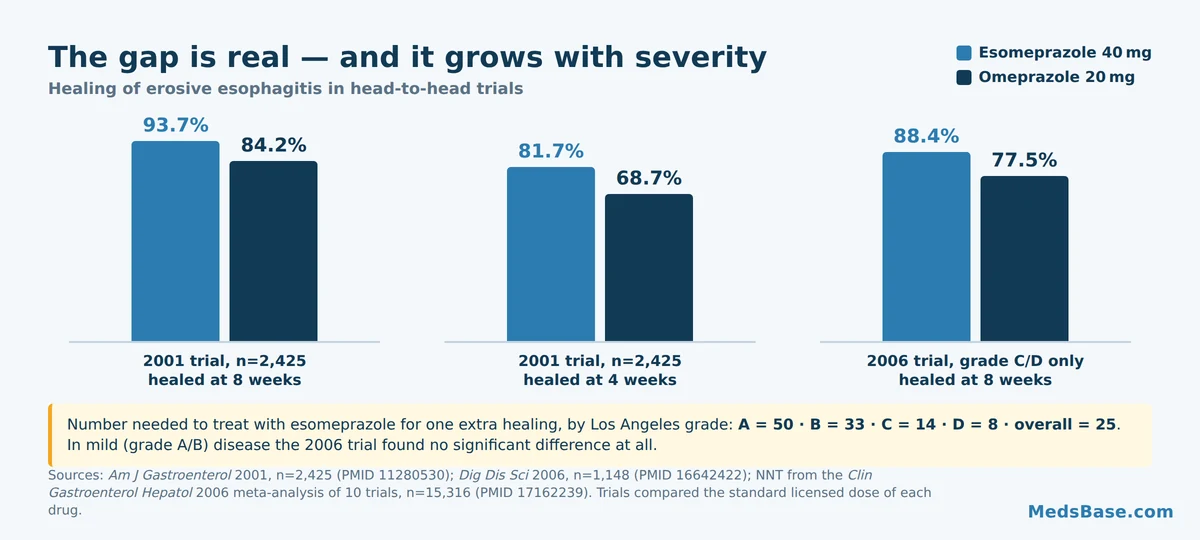
| Am J Gastroenterol randomised trial | 2001 | 2,425 patients with erosive esophagitis, 163 US centres | 8-week healing 93.7% esomeprazole 40 mg vs 84.2% omeprazole 20 mg (p under 0.001); 4-week healing 81.7% vs 68.7% |
| Dig Dis Sci randomised trial | 2006 | 1,148 patients with endoscopically confirmed erosive esophagitis | Overall estimated healing 92.2% vs 89.8%. In moderate-to-severe disease: 88.4% vs 77.5% at 8 weeks (p = 0.007). In mild disease: no significant difference |
| Clin Gastroenterol Hepatol meta-analysis | 2006 | 10 randomised trials, 15,316 patients | Pooled 5% relative increase in healing (RR 1.05, 95% CI 1.02–1.08), absolute risk reduction 4%, NNT 25. By severity: NNT 50 (grade A), 33 (grade B), 14 (grade C), 8 (grade D). Symptom relief at 4 weeks: 8% relative increase (RR 1.08, 95% CI 1.05–1.11) |
| CPIC pharmacogenetics guideline | 2021 | Consortium guideline | Provides CYP2C19 genotype-based PPI dosing recommendations |
Let us read those properly, because the story they tell together is different from the story the first row tells alone.
A 2001 head-to-head trial in 2,425 patients produced the number everybody quotes: 93.7% versus 84.2% healing at eight weeks. That is a genuine, statistically robust difference, and it is the number that built esomeprazole’s reputation.
A 2006 meta-analysis of 15,316 patients across ten trials then asked the question that actually matters to you. Pooling everything, esomeprazole delivered a 5% relative increase in the probability of healing — an absolute risk reduction of 4%, and a number needed to treat of 25. The authors’ own conclusion was that esomeprazole confers a statistically significant but clinically modest overall benefit, negligible in less severe erosive disease and potentially important in more severe disease.
Here is the decomposition, and it is the single most useful thing on this page. The NNT by Los Angeles grade — the standard endoscopic severity scale — runs 50, 33, 14, 8 for grades A through D. Fifty people treated for one extra healing in the mildest disease. Eight in the most severe.
A second 2006 randomised trial in 1,148 patients found exactly the same pattern independently: a clear advantage in grade C or D disease (88.4% versus 77.5%), and no significant difference in grade A or B disease.
What this means for you: if your endoscopy report says grade A or B — or if you have never had an endoscopy because your symptoms did not warrant one — the evidence for paying more is weak. If it says grade C or D, the evidence is good and the choice is easy.
One honest caveat you should weigh. The trials compared esomeprazole 40 mg against omeprazole 20 mg. That is the licensed standard dose of each, so the comparison is clinically fair. But it is not a milligram-for- milligram test of the molecules, and anyone telling you it proves esomeprazole is intrinsically superior is over-reading it.
The gene almost nobody mentions
Both drugs are broken down by a liver enzyme called CYP2C19, and people carry genetic variants that make them fast or slow metabolisers. A rapid metaboliser clears a PPI quickly and may get less acid suppression from a standard dose. This is a recognised enough clinical factor that CPIC — the international pharmacogenetics consortium — published CPIC’s CYP2C19 dosing guideline covering genotype-based PPI dosing.
Testing is not routine in most settings. But if a standard PPI dose has repeatedly failed to control your symptoms and everything else has been ruled out, this is a legitimate question to raise rather than simply escalating the dose again.
Esomeprazole vs Omeprazole: Which Should You Choose?
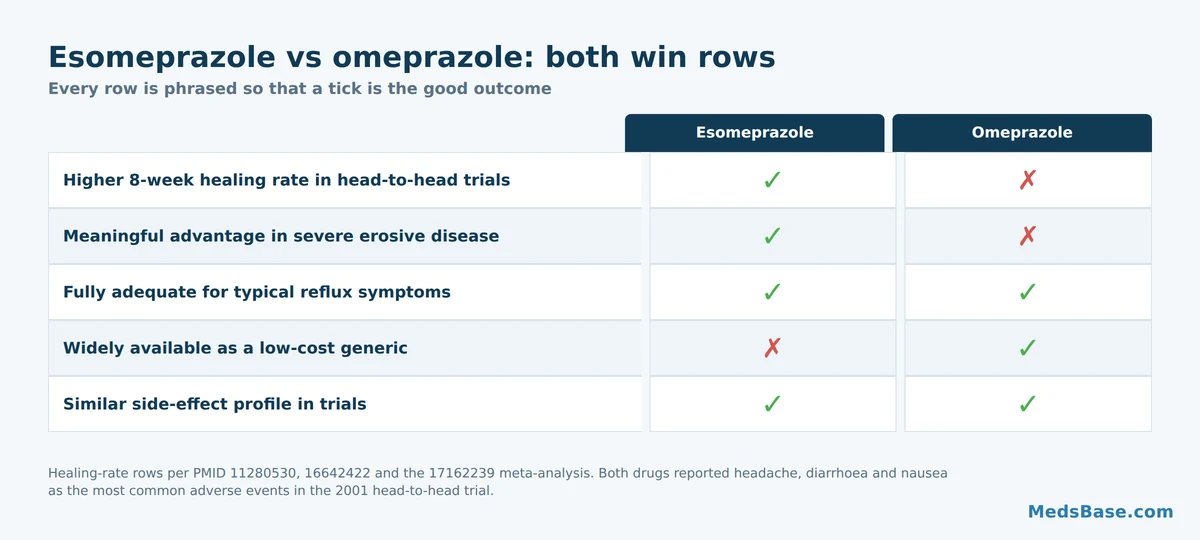
| Your situation | Reasonable choice | Why |
|---|---|---|
| Typical GERD symptoms, no endoscopy, no alarm features | Either — cost is a legitimate deciding factor | Evidence of a meaningful difference in this group is thin |
| Confirmed mild erosive esophagitis (LA grade A–B) | Either | Both 2006 studies found no significant difference in mild disease |
| Confirmed moderate-to-severe erosive esophagitis (grade C–D) | Esomeprazole | NNT falls to 14 and 8; the trial advantage is largest here |
| Symptoms not controlled on standard-dose omeprazole | Discuss switching, and ask about CYP2C19 | Reasonable next step before escalating dose blindly |
| Taking clopidogrel | Discuss with a clinician — neither may be first choice | Both inhibit clopidogrel activation |
| Ulcer prevention on long-term anti-inflammatories | Either | Both are licensed and effective for this |
The verdict. For most people reading this, the two drugs are close enough that price and availability are legitimate deciding factors — and choosing the cheaper one is not settling for less. For the minority with confirmed severe erosive disease, esomeprazole has a real, quantified advantage that justifies preferring it.
MedsBase stocks both from WHO-GMP-certified manufacturers: Nexpro as the esomeprazole option and Omesec as the omeprazole, and no prescription is needed to order either. Which one belongs in your basket should follow the table above rather than the packaging.
If neither is the right class
Worth asking honestly. A PPI is not automatically the answer to reflux.
- If your symptoms are occasional rather than daily, an H2 blocker taken when needed may suit you better.
Our comparison of how a PPI compares with an H2 blocker covers that decision.
- If you have tried PPIs without success, there is now a newer class that blocks acid by a different
mechanism — the newer acid blockers that work differently again explains where they fit.
How to Take Either One Properly
This is the section that matters more than your choice between the two drugs — and it is the point promised in the introduction. Taken incorrectly, the better drug underperforms the worse one taken correctly.
- Take it 30 to 60 minutes before a meal. PPIs only disable pumps that are switched on, and food
switches them on. Taking one on an empty stomach with no meal following wastes a large part of the dose. This is the most common mistake and the most costly.
- Choose the same meal every day. Before breakfast suits most people.
- Swallow capsules whole unless the label explicitly permits opening them. The coating exists to survive
stomach acid.
- Give it several days. Full acid suppression builds over roughly three to five days. Judging on day two
is judging too early.
- Review at four to eight weeks. PPIs are frequently started for a defined course and then continued
indefinitely by inertia. Put a review date in your calendar when you start.
- Step down rather than stopping abruptly after a long course. Rebound acid hypersecretion is real and
is often mistaken for the original problem returning.
- Keep a four-hour gap from levothyroxine, iron and any other pH-dependent medicine.
Mistakes to avoid
- Taking it at bedtime with no meal to follow — a widespread and largely wasted dose.
- Switching brands because symptoms persist, without checking the timing first.
- Staying on a PPI for years without a review because nobody scheduled one.
- Treating alarm symptoms — swallowing difficulty, weight loss, blood — with acid suppression instead of
investigation.
- Assuming the more expensive option must be working better and pushing through side effects because of it.
When you are ready to compare what is actually available, the acid reflux treatment options page lists the PPIs, H2 blockers and combination products side by side — useful once you have settled this question and want to see the full acid reflux treatment picture rather than just two boxes.
- Omeprazole vs famotidine — whether you need daily acid
- Voquezna vs pantoprazole — the newer class, and who it
- Levothyroxine not working — if you take a thyroid
Frequently Asked Questions
Q: Is esomeprazole stronger than omeprazole?
A: In the sense that matters clinically, modestly yes — but far less than the price gap implies. A 2006 meta-analysis of 15,316 patients found esomeprazole produced a 5% relative increase in the probability of healing erosive esophagitis at eight weeks, a number needed to treat of 25. That single figure is the fairest summary of esomeprazole vs omeprazole you will find. Esomeprazole is the S-isomer of omeprazole, cleared more slowly by the liver, so more drug reaches the pumps. It is not a different mechanism.
Q: What is the difference between Nexium and Prilosec?
A: They are the brand names for esomeprazole and omeprazole respectively, so the difference is exactly the one this article covers: esomeprazole is one isomer of the omeprazole molecule. Both work by blocking stomach proton pumps, treat the same conditions and share a similar side-effect profile. The clinical difference is a modest healing-rate advantage that grows with the severity of erosive damage.
Q: Can you switch from omeprazole to esomeprazole?
A: Yes — they are the same class and switching is straightforward, though it is worth doing for a reason rather than reflexively. Before switching because symptoms persist, check the timing first: taking a PPI 30 to 60 minutes before a meal matters more than which of the two you take. If timing is already right and symptoms continue, switching is a reasonable next step to discuss with a clinician.
Q: Which PPI works fastest for heartburn?
A: Neither works quickly enough to be a rescue treatment, which makes speed a poor tiebreaker between them. Both build acid suppression over roughly three to five days of daily dosing, because they disable existing pumps and your body replaces them gradually. For immediate relief you need an antacid or an H2 blocker. Expecting a PPI to settle heartburn within an hour leads people to conclude it has failed when it has simply not started.
Q: Does esomeprazole have fewer side effects than omeprazole?
A: No meaningful difference has been demonstrated. The 2001 head-to-head trial in 2,425 patients reported similar safety profiles, with headache, diarrhoea and nausea most common in both groups. PPI side effects — including the long-term concerns about magnesium, vitamin B12 and fracture risk — are best understood as class effects. Switching between these two to escape side effects is unlikely to help you.
Q: How long should you take a proton pump inhibitor?
A: For as long as there is a defined reason, and no longer — which sounds obvious but is where most prescriptions go wrong. Many courses are started for four to eight weeks and then continued indefinitely because nobody scheduled a review. Set a review date when you start. Long-term use is appropriate for some conditions, but it should be a decision someone actively made rather than something that happened by default.
Q: Do I need an endoscopy to decide between them?
A: Not to decide between them, but the result changes the answer if you already have one. The healing-rate advantage of esomeprazole is negligible in Los Angeles grade A or B disease and largest in grade C or D. If you have never needed an endoscopy, that is reassuring in itself, and it means you fall in the group where the evidence for paying more is weakest.
Q: Can I take a PPI with my other medicines?
A: Usually, but two interactions deserve specific attention. Both drugs inhibit the enzyme that activates clopidogrel, so if you take that blood thinner, ask a clinician about alternatives within the class. And by raising stomach pH, PPIs reduce absorption of medicines that need acid to dissolve — levothyroxine being the classic example, which is why a four-hour separation is standard advice.
The Bottom Line on Esomeprazole vs Omeprazole
The esomeprazole vs omeprazole choice is smaller than the marketing suggests and more specific than “they’re the same”. Esomeprazole is one isomer of omeprazole, it does heal erosive esophagitis in more people, and the pooled number needed to treat is 25. Underneath that average sits the number you should actually use: 50 in the mildest erosive disease, 8 in the most severe.
The balanced verdict: for typical reflux symptoms without confirmed erosive damage, choosing the cheaper drug is an evidence-consistent decision rather than a compromise. For confirmed grade C or D esophagitis, esomeprazole earns its place. And for everyone, how you take it outweighs which one you take — a PPI swallowed at bedtime with no meal to follow will underperform whichever box it came from.
Your one immediate action: check when you take your current PPI relative to your next meal. If the answer is “with food”, “after food”, or “at bedtime”, fix that this week before changing anything else. It is free, and for many people it resolves the problem they were about to switch drugs to solve.
What to read next:
- Not sure you need daily acid suppression at all?
Omeprazole vs famotidine compares daily PPI therapy with taking something only when symptoms arrive.
- Taking a thyroid tablet alongside your PPI? Levothyroxine not working
explains the interaction and the simple timing fix.
advice. Persistent reflux symptoms should be assessed by a qualified doctor or pharmacist, particularly if you have difficulty swallowing, unexplained weight loss, vomiting, or signs of bleeding. Do not start, stop or change any prescribed medicine without professional advice, and tell your clinician about every other medicine you take.*

Written by
Sophie ChenPharmaceutical Content Researcher · 8 years experience
Sophie Chen is a pharmaceutical content researcher with 8 years covering generic medication access and clinical pharmacology. She specialises in international regulatory frameworks, bioequivalence standards, and patient-facing education on therapeutic drug classes. She is not a clinician.