








✓ Medically reviewed by · Last reviewed: May 2026
Pharmacy Researcher · 8 years experience
Pharmacy researcher with 8 years reviewing clinical drug information, generic formulation equivalence, and international pharmaceutical standards. Focuses on patient-facing accuracy in medication education.
Here is the number that surprises most people: the sugar your kidneys pour into your urine on Farxiga adds up to about a can of soda’s worth of calories every single day. Yet the scale rarely moves more than a few pounds. That gap — between a steady daily calorie loss and a stubbornly small weight change — is the whole story of Farxiga weight loss, and it trips up nearly everyone who starts the drug hoping for a slimmer version of Ozempic.
Farxiga (dapagliflozin) does lower body weight. But how much, how fast, and why it stalls are three questions the marketing rarely answers honestly. By the end of this guide you will know the realistic pounds-and-timeline picture, the biology behind the plateau, how Farxiga stacks up against metformin and GLP-1 drugs, and the one everyday habit that quietly cancels the whole effect.
Key takeaways
- Average Farxiga weight loss is roughly 2 kg (about 4–5 lb) — helpful, but far short of GLP-1 results.
- The mechanism is calorie loss through urine — but your appetite fights back, which is why the loss stalls (we explain exactly when in the timeline section).
- About 70% of the drop is fat mass, not just water — though the very first pounds do include fluid.
- Farxiga is FDA-approved for diabetes, heart failure, and kidney disease — not for obesity.
- There is a common daily habit that erases the calorie deficit almost entirely — covered in the practical-guidance section.
- If weight is your main goal, other options remove three-to-eight times more — and we compare them side by side.
What Is Farxiga (Dapagliflozin)?
Farxiga (generic name dapagliflozin; sold as Forxiga outside the United States) is a once-daily tablet in the SGLT2 inhibitor class. It lowers blood sugar by making the kidneys pass excess glucose out in the urine instead of returning it to the bloodstream. Weight loss is a well-documented side effect of that sugar-dumping, not the drug’s primary job.
Before we talk Farxiga weight loss, it helps to know what the drug is actually for. It was first approved in 2014 and has since become one of the most-prescribed diabetes drugs in the world. According to the FDA prescribing information for Farxiga, the medication is cleared to treat type 2 diabetes, to reduce cardiovascular death and hospitalisation in adults with heart failure, and to slow the progression of chronic kidney disease. Notice what is missing from that list: obesity. Farxiga is not approved as a weight-loss medication anywhere.
That distinction matters, because it shapes what you should realistically expect. A drug designed to protect the heart and kidneys that happens to shave off a couple of kilograms is a very different proposition from a drug engineered to suppress appetite and drive double-digit weight loss. Keeping that framing in mind is the single best defence against disappointment.
Dapagliflozin comes in two strengths — 5 mg and 10 mg. The 10 mg dose is the standard for blood-sugar control and is the strength studied in most weight and outcome trials. You can review the Forxiga (dapagliflozin) product page to see both strengths, but read the mechanism section first so you understand what you are actually buying into.
How Does Farxiga Cause Weight Loss?
Farxiga causes weight loss by blocking a protein called SGLT2 in the kidneys. Normally that protein reabsorbs filtered glucose back into your blood. When it is blocked, roughly 70 grams of sugar leave the body in urine each day — carrying about 280 calories with it. Over weeks, that daily calorie drain nudges body weight and fat mass downward.
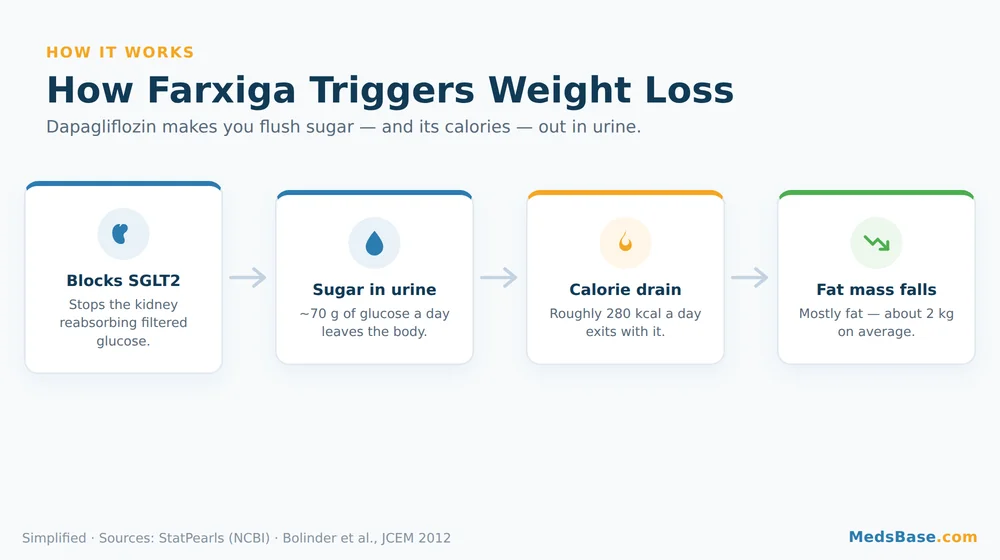
Think of your kidneys as a recycling plant that normally recovers valuable sugar before it goes to waste. Farxiga jams the recycler. The sugar — and the calories locked inside it — ends up in the toilet instead of your tissues. This is why doctors describe SGLT2 inhibitors as producing a “calorie leak.” You are not eating less; you are simply keeping less of what you eat.
That calorie leak is the engine behind Farxiga weight loss, and it explains two things at once. First, why the weight comes off gradually rather than dramatically — 280 calories a day is real, but it is a fraction of what a GLP-1 drug achieves by crushing appetite. Second, why the effect is so consistent across people: everyone who takes the drug and has sugar in their blood will dump some of it, and its calories, every day.
Why the body fights back
Here is where it gets interesting. Your body treats a 280-calorie daily loss as a threat and quietly compensates by making you hungrier. Studies tracking food intake on SGLT2 inhibitors show that people gradually eat a little more — often without noticing — until the extra calories roughly offset what the urine is removing. This appetite rebound is the reason the scale eventually settles, a phenomenon we unpack fully in the timeline section below.
How Much Weight Can You Lose on Farxiga?
Farxiga weight loss averages about 2 to 3 kilograms (4 to 7 pounds) over the first six months, and most people land squarely in that band. Clinical trials consistently land in that range once the results are corrected for placebo. Some individuals lose more, a few lose almost nothing, but the honest average is a modest single-digit number of pounds — not the transformation many people picture.
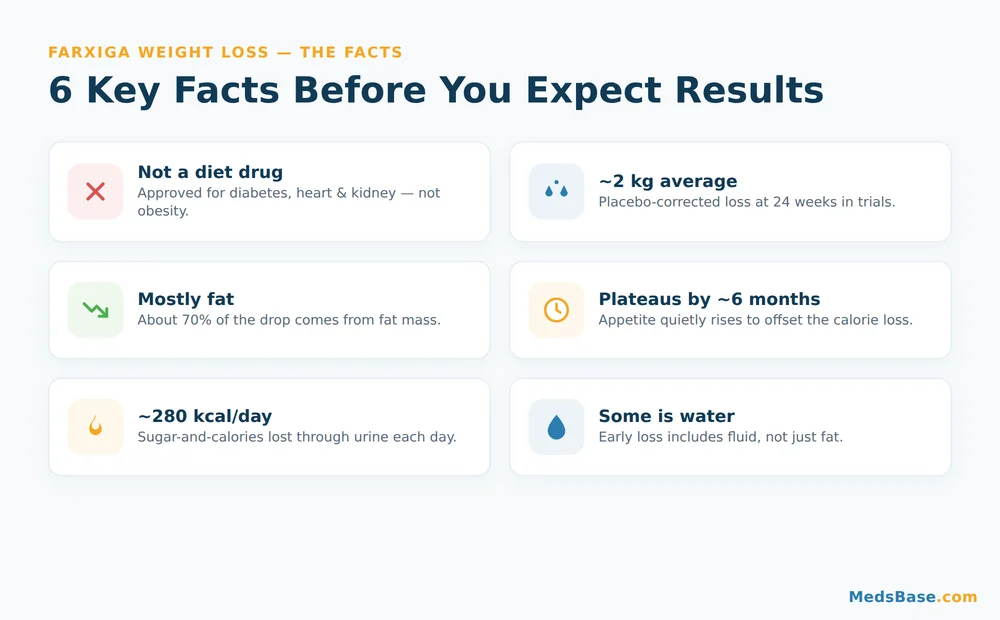
Your own result depends on a handful of factors. People who start with higher blood sugar dump more glucose, so they tend to lose slightly more. People with more weight to begin with often see a larger absolute drop. And crucially, people who do not unconsciously eat back the calories keep more of the loss. That last variable is the difference between a person who loses 5 kg and a person who loses half a kilogram on the exact same dose.
Who is Farxiga weight loss right for?
- A good fit: adults with type 2 diabetes, heart failure, or chronic kidney disease who would welcome a few pounds of fat loss as a bonus to the real cardiometabolic benefits.
- A poor fit: people without diabetes who want Farxiga purely as a diet pill — the weight effect is small, and the drug is not approved for that use.
- Talk to your doctor first if: you have type 1 diabetes, a history of diabetic ketoacidosis, recurrent urinary or genital infections, or very low blood pressure.
It is worth being blunt: if a slimmer body is your only objective, Farxiga is the wrong tool. Its value is that it protects your heart and kidneys while gently trimming fat. If you are weighing options mainly for weight, our roundup of the best weight-loss medications compares the heavy hitters honestly, including where SGLT2 inhibitors sit in the pack.
How Rapid Is Weight Loss With Farxiga? (The Plateau Nobody Warns You About)
Farxiga weight loss is front-loaded: most of it happens in the first three months, then flattens. Trials show the sharpest drop in weeks 4 to 12, a gentler decline through week 24, and very little additional loss after that — even though people keep taking the drug for years. The curve bends and settles near the 2 kg mark.
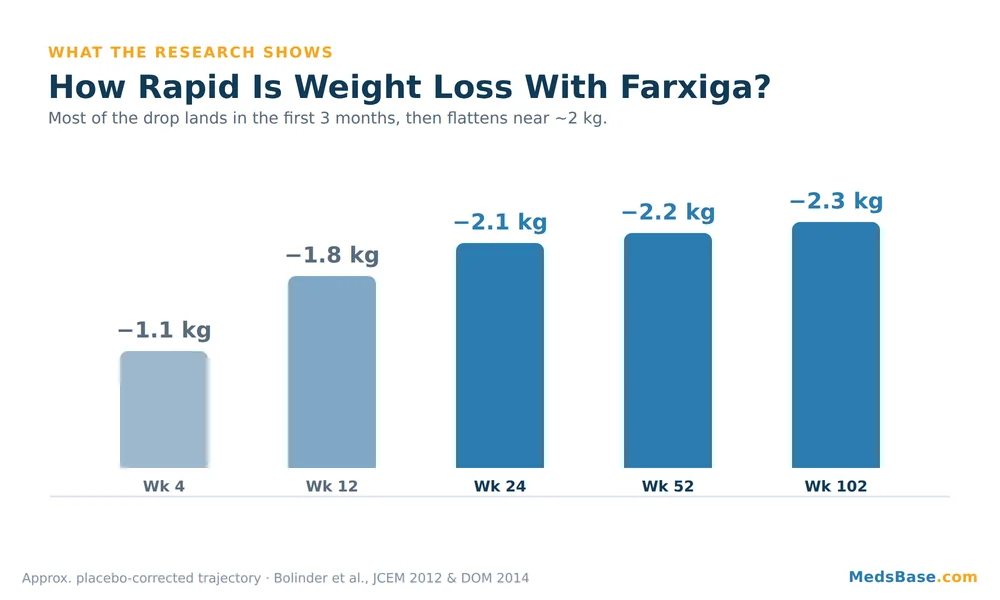
This resolves the loop we opened earlier. The calorie leak never stops — you keep losing 280 calories of sugar a day at month 12 just as you did in week 2. So why does the scale stop moving? Because your appetite has quietly caught up. Research tracking energy intake shows that after a few months, most people are eating just enough extra to match what the urine removes. The deficit closes, and weight holds steady at its new, slightly lower level.
That is not a failure of the drug — it is basic physiology, and it happens with almost every weight intervention. But knowing it protects you from a common trap: people who expected steady loss get discouraged at month four, assume “it stopped working,” and stop taking a medication that is still protecting their heart and kidneys. The weight plateau is not a signal to quit.
The early weeks also come with a caveat. Some of the first pounds you see are water, not fat. SGLT2 inhibitors have a mild diuretic effect, so the initial dip on the scale partly reflects fluid loss. The genuine fat loss — the part that matters for health — accumulates more slowly underneath. This is one reason to judge Farxiga weight loss at three months, not three weeks.
Farxiga Side Effects, Safety & Dosage
The same calorie leak that drives Farxiga weight loss also causes its most common side effects. Farxiga is generally well tolerated, but its mechanism — extra sugar in the urine — creates a predictable set of problems. The sugary urine feeds yeast and bacteria, and the mild fluid loss can affect blood pressure and hydration. The table below summarises what to watch for and how common each issue is.
| Side effect | Frequency | Severity | What to do |
|---|---|---|---|
| Genital yeast infection | Common | Mild | Good hygiene; treat promptly; usually not a reason to stop. |
| Urinary tract infection | Common | Mild–moderate | Stay hydrated; see your provider if symptoms appear. |
| Increased urination / thirst | Common | Mild | Drink to thirst; usually settles within weeks. |
| Dizziness / low blood pressure | Uncommon | Moderate | More likely with diuretics; discuss dose adjustment. |
| Dehydration / kidney strain | Uncommon | Moderate | Pause during vomiting/diarrhoea illness (“sick-day rule”). |
| Diabetic ketoacidosis (DKA) | Rare | Serious | Seek urgent care for nausea, vomiting, deep breathing. |
| Fournier’s gangrene | Very rare | Serious | Emergency care for genital pain, swelling, redness, fever. |
The two most common complaints — genital and urinary infections — are a direct trade-off for the drug’s action. More sugar in the urine means more food for microbes. They are usually easy to treat and rarely serious, but they are the number-one reason people find SGLT2 inhibitors annoying. The rarer risks (ketoacidosis, Fournier’s gangrene) are genuinely uncommon but important to recognise early, which is why they appear on every label.
On dosing: Farxiga is taken once daily, with or without food, at the same time each day. Providers usually start at 10 mg for blood-sugar control. You do not adjust the dose to chase weight loss — a higher dose does not meaningfully increase fat loss, but it can increase side effects. For a full patient-level rundown of dosing and precautions, the MedlinePlus dapagliflozin page and the UK’s NHS dapagliflozin guide are reliable, plain-English references.
What Does the Research Say About Farxiga Weight Loss?
The evidence on Farxiga weight loss is unusually consistent: it produces a small, durable fat-mass reduction that is well documented but modest. The studies below span short-term body-composition scans to multi-year cardiovascular outcome trials. Read them as a set — the direction never changes, only the detail.
| Study | Year | Finding | Source |
|---|---|---|---|
| Bolinder et al., JCEM | 2012 | ~2 kg placebo-corrected loss at 24 weeks; ~71% from fat mass. | PubMed |
| Bolinder et al., 102-week extension | 2014 | Weight and fat-mass reduction sustained over ~2 years. | SGLT2 review |
| DECLARE-TIMI 58 (Wiviott et al., NEJM) | 2019 | Large outcome trial; modest weight benefit alongside cardio-renal protection. | PubMed |
| SGLT2 inhibitor class review (StatPearls) | 2024 | Glycosuria of 20–85 g/day; 80–340 kcal/day energy loss. | NCBI |
What this means for you: the research does not promise a dramatic result, and neither should anyone selling it. What it does support is a reliable, mostly-fat loss of a few pounds that plateaus — delivered as a bonus on top of the drug’s proven heart and kidney protection. Early studies also hint that the fat lost includes visceral fat, the metabolically harmful kind wrapped around the organs, which may matter more for health than the raw number on the scale.
Farxiga Weight Loss vs Alternatives
Put next to dedicated weight-loss drugs, Farxiga weight loss is a lightweight — and that gap is the most important thing on this page to understand. The table below puts its typical weight change next to metformin and the GLP-1 class so you can see the scale of the difference at a glance.
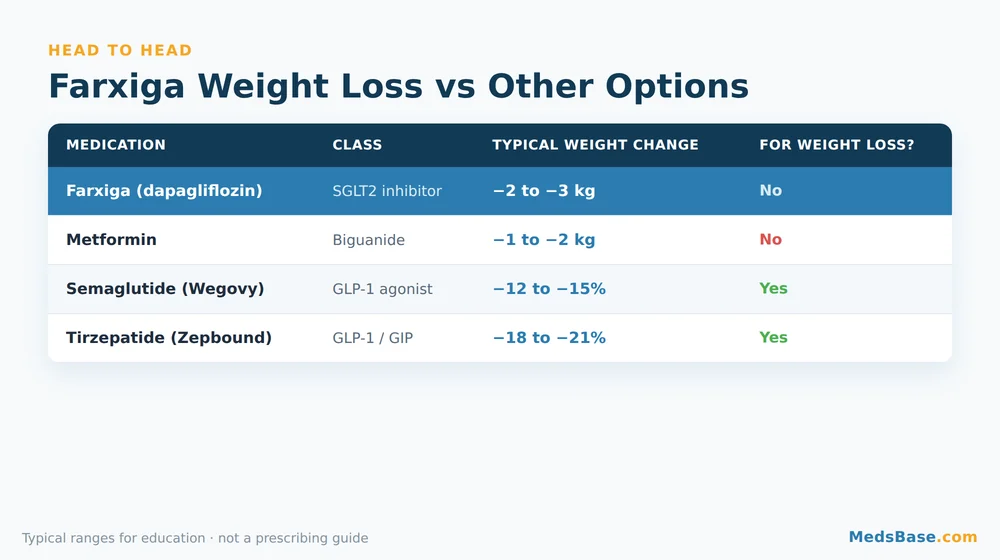
| Medication | Class | Typical weight change | Approved for weight loss? |
|---|---|---|---|
| Farxiga (dapagliflozin) | SGLT2 inhibitor | −2 to −3 kg | No |
| Metformin | Biguanide | −1 to −2 kg | No |
| Semaglutide (Wegovy/Ozempic) | GLP-1 agonist | −12 to −15% of body weight | Yes (Wegovy) |
| Tirzepatide (Zepbound) | GLP-1 / GIP | −18 to −21% of body weight | Yes |
Which one fits which situation? If you have diabetes, heart failure, or kidney disease, Farxiga earns its place on its cardio-renal merits, and the weight loss is a welcome extra. If your primary problem is a fellow SGLT2 inhibitor decision, our Jardiance vs Farxiga comparison breaks down the two most popular options in the class. If your main goal is significant weight loss, a GLP-1 medication is in a different league entirely — our guide to Ozempic alternatives for weight loss walks through those choices.
Metformin deserves a special mention because people often compare it directly with Farxiga. Both are diabetes drugs that produce mild weight loss as a side effect, and both plateau. If that trade-off interests you, our dedicated piece on metformin and weight loss covers who benefits most from that older, cheaper option.
How to Maximize Your Farxiga Weight Loss
You cannot force Farxiga to remove more sugar, but you can stop yourself from cancelling the benefit. The single biggest lever is not eating the lost calories back — because your body will nudge you to do exactly that. The four habits below decide whether your Farxiga weight loss shows up on the scale or quietly disappears.
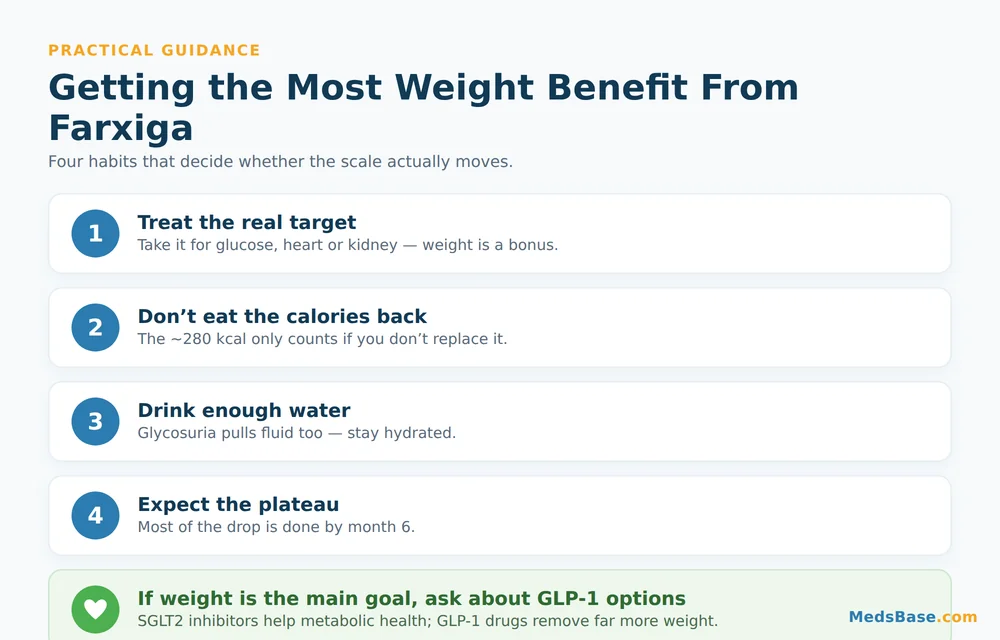
- Treat the real target. Take Farxiga for your blood sugar, heart, or kidneys. Framing it as a diet pill sets you up to quit when the plateau arrives. The weight loss is a bonus, not the mission.
- Don’t eat the calories back. This is the one that matters most. That 280-calorie daily leak only counts if you don’t unconsciously refill it. Being aware of the appetite rebound is half the battle — you can plan for it rather than be blindsided by it.
- Stay hydrated. Farxiga pulls fluid as well as sugar, so drink to thirst. Good hydration also lowers the risk of the urinary side effects and the occasional dizziness.
- Expect the plateau. Judge results at three-to-six months, and don’t panic when the loss stalls. That is the drug working normally, not failing.
A common mistake to avoid: some people crash-diet in the first month to “help” the drug, then rebound hard. Slow and steady wins here. The fat loss Farxiga produces is durable precisely because it is gradual. Pair it with a mild, sustainable calorie reduction rather than an aggressive one.
If you have decided Farxiga is right for you, you can check both strengths on the Forxiga (dapagliflozin) page — but treat the purchase as a diabetes and organ-protection decision first, with weight as the secondary benefit.
Related reading
- Jardiance vs Farxiga: SGLT2 inhibitor head-to-head — if you’re choosing between the two.
- Is there a generic for Jardiance? — cost and availability of the other leading SGLT2 option.
- GLP-1 weight-loss injections: the complete guide — the drug class that actually targets obesity.
Frequently Asked Questions
Q: How rapid is weight loss with Farxiga?
A: Weight loss on Farxiga is front-loaded but gradual. Most people see the fastest change between weeks 4 and 12, a slower decline through month 6, then a plateau. The typical endpoint is around 2 kg (4–5 lb) below baseline. It is not rapid in the way a GLP-1 drug is; think of a steady, gentle slope over three months rather than a dramatic monthly drop, with some early loss reflecting water rather than fat.
Q: How much weight can you lose on Farxiga?
A: On average, about 2 to 3 kilograms (roughly 4 to 7 pounds) over six months, with most of it being body fat. Individual results vary: people with higher starting blood sugar or more weight to lose tend to see a bit more, while those who unconsciously eat back the lost calories may see almost none. Farxiga weight loss is real but modest, and it plateaus rather than continuing indefinitely.
Q: Can you take Farxiga just for weight loss?
A: Farxiga is not approved as a weight-loss drug, and using it purely for that purpose is off-label and generally not recommended. The weight effect is small, and the drug carries side effects such as genital and urinary infections. If weight loss is your goal, medications designed for it — particularly the GLP-1 class — are far more effective. Always discuss any off-label use with a qualified healthcare provider.
Q: Why did my weight loss on Farxiga stop?
A: Because your appetite caught up with the calorie leak. Farxiga keeps removing about 280 calories of sugar a day indefinitely, but after a few months most people unconsciously eat just enough extra to offset it, so weight holds steady. A plateau is the normal end-point of Farxiga weight loss, not a sign the drug has stopped working — it is still protecting your heart and kidneys, so it is not a reason to quit.
Q: Is Farxiga or Ozempic better for weight loss?
A: For weight loss specifically, Ozempic (semaglutide) is far more effective, producing 12–15% body-weight reduction versus Farxiga’s 2–3 kg. They work by completely different mechanisms: Farxiga weight loss comes from flushing calories through urine, while semaglutide suppresses appetite. Farxiga’s advantage is its strong, proven heart and kidney protection. Many people with diabetes end up on both, for different reasons.
Q: Does the weight come back after stopping Farxiga?
A: Often, yes, at least partly. Once you stop, the calorie leak stops, and the fluid your body was shedding returns quickly — so the first pounds can reappear within days. Whether the fat returns depends on your eating and activity. This is another reason to view Farxiga as a long-term metabolic medication rather than a short-term diet aid, and to make any stopping decision with your doctor.
Q: Does Farxiga cause weight loss in everyone?
A: No. While nearly everyone with elevated blood sugar dumps some glucose and its calories, the net weight change varies widely. Some people lose several kilograms; others see the scale barely move because their appetite fully compensates. People with well-controlled or near-normal blood sugar dump less glucose, so they tend to lose less. The average is modest, and “no visible change” is a normal outcome.
Q: What foods help weight loss on Farxiga?
A: There is no special “Farxiga diet,” but the same principles that support any weight loss apply — and they matter more here because of the appetite rebound. Prioritise protein and fibre to stay full, keep hydrated to offset the drug’s fluid loss, and moderate refined carbohydrates. The goal is simply not to eat back the calories Farxiga removes. A registered dietitian can tailor this to your needs.
The Bottom Line
Farxiga weight loss is genuine, mostly fat, and modest — about 2 kg on average, front-loaded into the first three months, then plateauing as appetite catches up. It is a diabetes, heart, and kidney medication that trims a few pounds as a bonus, not a weight-loss drug in disguise. Judge it on that basis and you will not be disappointed; expect a GLP-1-style transformation and you will be. The single action that most changes your result is simple: don’t quietly eat the lost calories back.
If you have diabetes or a cardio-renal reason to take it, Farxiga is an excellent, evidence-backed choice, and you can review both strengths on the Forxiga (dapagliflozin) page. If weight is your real target, look elsewhere first.
Wondering how Farxiga stacks up against the other leading SGLT2 option? Read our Jardiance vs Farxiga head-to-head. Or, if you want to understand the medications that are built for weight loss, start with our best weight-loss medications guide.

Written by
Sophie ChenPharmaceutical Content Researcher · 8 years experience
Sophie Chen is a pharmaceutical content researcher with 8 years covering generic medication access and clinical pharmacology. She specialises in international regulatory frameworks, bioequivalence standards, and patient-facing education on therapeutic drug classes. She is not a clinician.