








✓ Medically reviewed by · Last reviewed: May 2026
Pharmacy Researcher · 8 years experience
Pharmacy researcher with 8 years reviewing clinical drug information, generic formulation equivalence, and international pharmaceutical standards. Focuses on patient-facing accuracy in medication education.
# Levothyroxine Not Working? 7 Reasons Your Thyroid Dose Fails
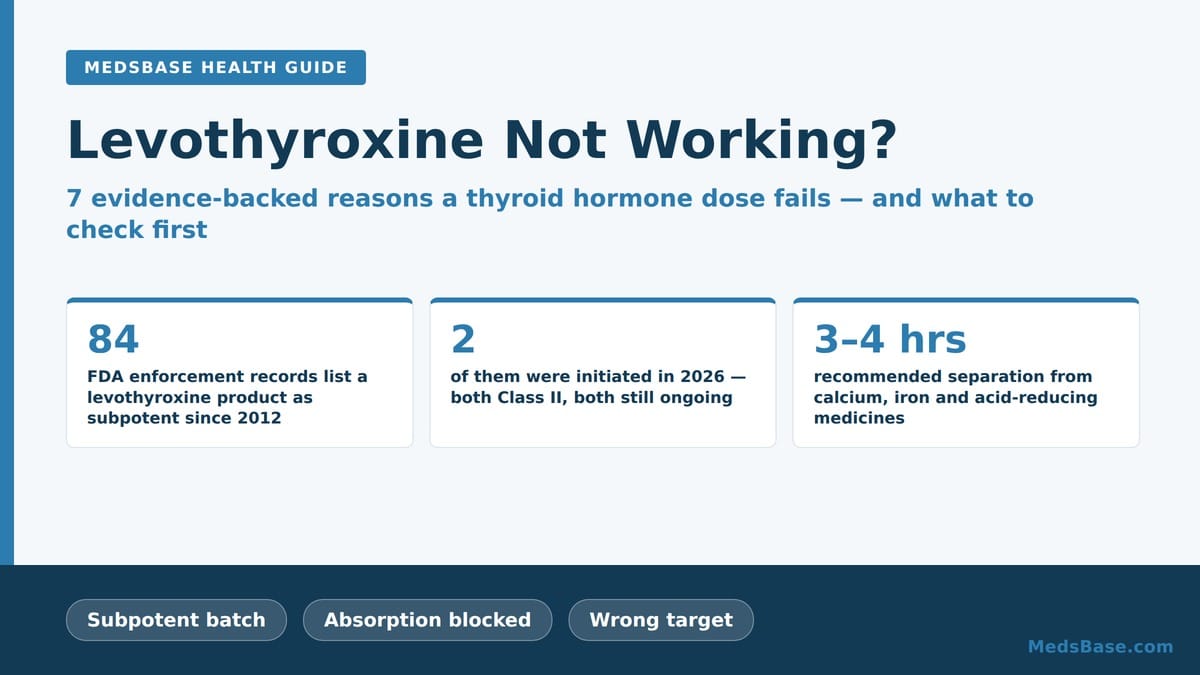
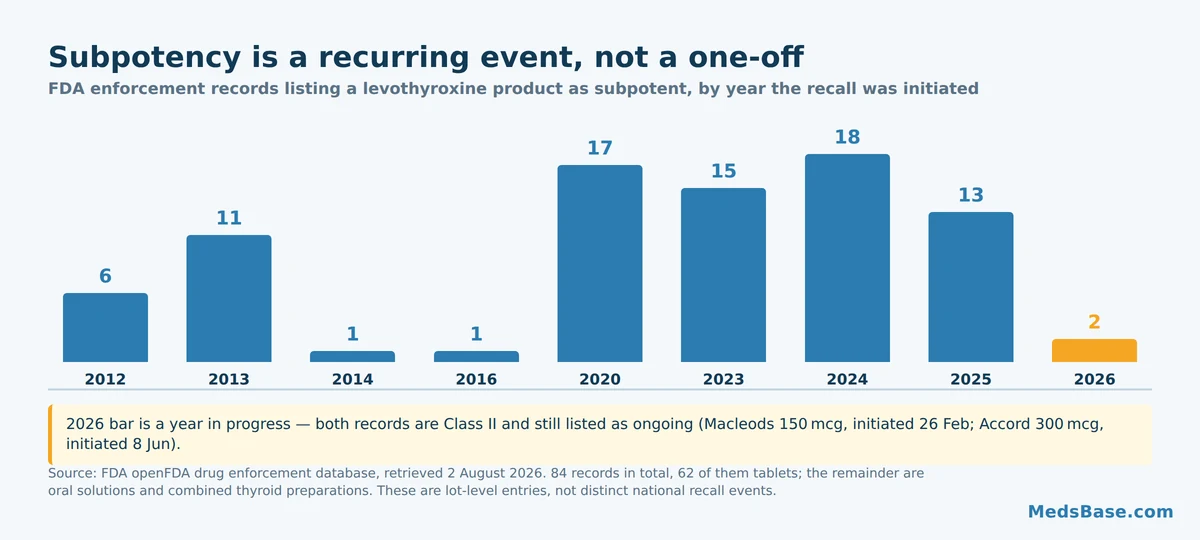
Here is a number that surprises almost everyone who takes thyroid hormone replacement: the FDA’s enforcement database contains 84 separate records of a levothyroxine product being recalled as subpotent since 2012 — 62 of them tablets, and two of them in 2026 alone. Subpotent means the medicine contained less active hormone than the label promised. If you have been telling your doctor that your levothyroxine is not working and quietly wondering whether you are imagining it, that number deserves your attention.
You are not imagining it. There are at least seven well-documented reasons a thyroid dose can fail, and only some of them are about you. By the end of this article you will know which one is most likely yours, what to check first, and the single question to ask at your next appointment that changes the conversation.
One of those seven reasons is the one nobody warns patients about — and it happens at the pharmacy counter, not in your body. We will get to it.
- The tablet itself is a variable: subpotency recalls are a recurring event, not a rarity — and one specific
- Generic levothyroxine substitution happens at the pharmacy counter without your prescriber being told, and
- Absorption is a chain with four break points — one of them is a medicine millions of people take daily
- A single TSH result is close to meaningless on its own. The trend across three tests is the real signal.
- Roughly one group of patients feels unwell on a genuinely correct dose — and for them the answer is not
- What “levothyroxine not working” actually means
- How the drug works — and the four places the chain breaks
- The 7 reasons behind levothyroxine not working
- The side effect of over-correcting
- What the research actually says
- Levothyroxine vs the alternatives
- Your practical six-week reset plan
- Frequently asked questions
- The bottom line
What “Levothyroxine Not Working” Actually Means
taking your prescribed dose. It has three broad causes: the tablet is delivering less hormone than expected,
your body is not absorbing what you take, or the dose is being judged against the wrong target. Each is
checkable.
That definition matters because levothyroxine not working gets used for two very different situations, and they need opposite responses.
The first is a biochemical failure: your TSH levels are still high, meaning your body is asking for more thyroid hormone than it is receiving. Something in the chain between the tablet and your bloodstream has broken.
The second is a symptomatic failure: your TSH is comfortably in range, your free T4 looks fine, and you still feel tired, cold, foggy and heavy. This is the harder conversation, and it is the one where patients most often get dismissed.
Both are real. They just have different fixes, and the first step is knowing which one you are dealing with. If you have a recent blood test, look at the TSH number. If it is above the reference range, you are in the first group. If it is within range and you feel unwell anyway, you are in the second — skip ahead to reason seven, because reasons one through six will not help you.
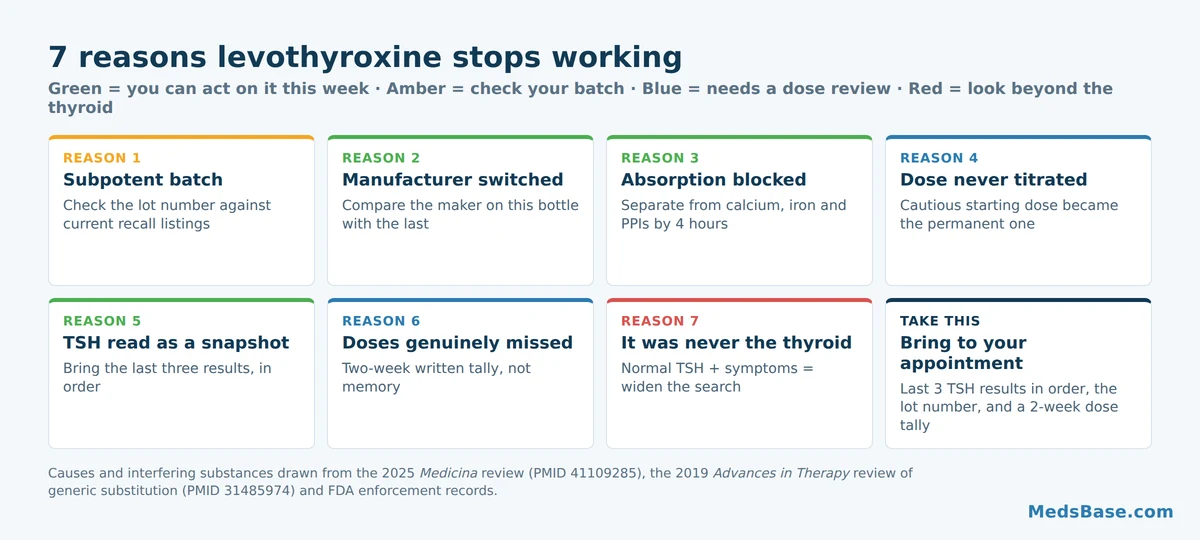
The single most useful thing you can do before your next appointment is find your last three TSH results and write them down in order. Not the most recent one. All three.
How Levothyroxine Works — And Where the Chain Breaks
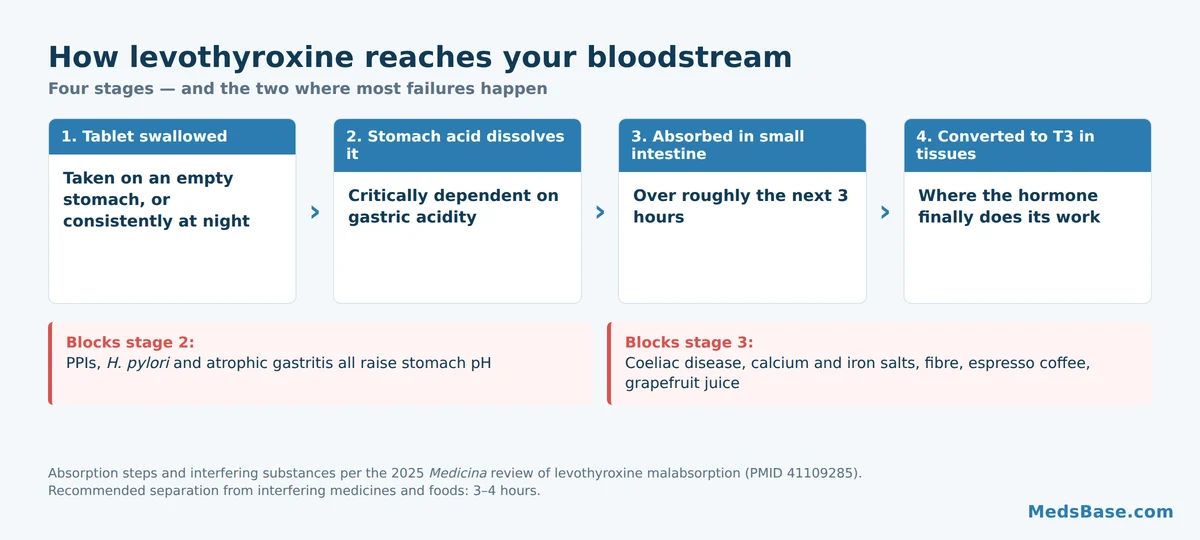
Think of levothyroxine as a slow-release deposit rather than a switch. The tablet contains T4, a storage form of thyroid hormone that your tissues convert into the active form, T3, as they need it. That is why nothing happens on day one, and why the six-week wait before a repeat blood test is not medical foot-dragging — it is how long the deposit takes to reach a steady level.
Here is where it gets interesting. The journey from tablet to bloodstream has four distinct stages, and a 2025 review in Medicina mapped exactly where each one fails.
Stage one — the tablet dissolves. This depends critically on stomach acidity. Less acid means less dissolution.
Stage two — absorption in the small intestine, which happens over roughly the three hours after you swallow the tablet.
Stage three — transport and storage, where the hormone circulates mostly bound to carrier proteins.
Stage four — conversion to T3 inside your tissues, which is where the hormone actually does its work.
Most cases of levothyroxine not working trace back to stages one and two. And that same review names the specific culprits: dietary fibre, espresso coffee and grapefruit juice all interfere with levothyroxine absorption, as do calcium salts, iron salts, and proton pump inhibitors — the heartburn medicines. The recommended fix is separating them from your dose by three to four hours.
So what does this mean for you? It means that if you take a PPI daily, or you have had unexplained gut symptoms, or you drink espresso within an hour of your tablet, you have a plausible mechanical explanation for levothyroxine not working that has nothing to do with your dose being wrong.
7 Reasons Your Levothyroxine Is Not Working
1. The tablets in your bottle are subpotent
This is the one patients are almost never told about, and it is the reason for the number that opened this article.
Levothyroxine is what pharmacologists call a narrow therapeutic index drug. The gap between too little and too much is small, doses are measured in micrograms, and a modest manufacturing drift produces a real clinical effect. Manufacturers run long-term stability testing precisely because tablets can lose potency on the shelf — and when that testing fails, the batch gets recalled.
According to the FDA’s own drug-recall database, levothyroxine subpotency recalls are a recurring feature of the supply chain rather than a freak event. The most recent posted example at the time of writing is a Class II recall initiated on 8 June 2026 by Accord Healthcare covering 300 microgram tablets, with the reason recorded simply as “Subpotent Drug”. A separate Class II subpotency recall was initiated in February 2026 covering 150 microgram tablets from a different manufacturer. Both were still listed as ongoing.
What to do: find the bottle, note the manufacturer name and the lot number printed on the label, and check them against current recall listings. If your batch is affected, that alone can explain months of symptoms. Our guide on what to do when a medicine you take is recalled walks through the steps in order — including the important one, which is not stopping your medicine abruptly.
2. Your pharmacy switched your manufacturer without telling anyone
Here is where it gets uncomfortable.
In many systems a pharmacy can substitute one generic levothyroxine product for another that has been declared bioequivalent. That sounds harmless. But a 2019 review in Advances in Therapy laid out why endocrinology bodies have argued with the standard for years: bioequivalence for levothyroxine has been established using a single dose given to healthy volunteers, measured by serum T4, without reference to TSH.
The review’s authors argue this approach could allow products with clinically meaningful differences in bioavailability to be declared interchangeable. Their conclusion is direct — even small differences between formulations can cause significant changes in TSH levels, and the substitution is often made by the pharmacy without the prescriber’s knowledge. Their practical recommendation: keep patients on the same preparation where possible, and if the preparation does change, recheck TSH and adjust the dose.
(In the interests of transparency: that review discloses funding from a manufacturer of a branded levothyroxine product. The mechanism it describes is well-established and its recommendation matches mainstream endocrine practice, but you should weigh the source.)
What to do: compare the manufacturer name on your current bottle with the previous one. If it changed and your symptoms changed within the following two months, you have found a likely cause of your levothyroxine not working. The fix is not dramatic: pick one product and stay on it. Our full Thyronorm dosing guide covers how the levothyroxine dosage strengths step, which matters when you are trying to land on a stable dose rather than chase one.
3. Something is blocking absorption
We covered the mechanism above. Here is the practical version, because this is the most fixable cause of levothyroxine not working on the whole list.
| Blocker | What it does | Practical fix |
|---|---|---|
| Calcium or iron supplements | Bind levothyroxine in the gut | Separate by 3–4 hours |
| Proton pump inhibitors | Raise stomach pH, impairing dissolution | Separate by 3–4 hours; review whether you still need daily acid suppression |
| Espresso coffee | Interferes with absorption | Wait before your first cup, or move your dose to bedtime |
| High-fibre foods | Interfere with absorption | Keep a consistent gap from your dose |
| Grapefruit juice | Interferes with absorption | Avoid around dosing time |
| H. pylori / atrophic gastritis | Raise stomach pH | Needs investigation and treatment, not a bigger dose |
| Coeliac disease | Reduces the absorbing surface | Needs diagnosis; requirement often falls once treated |
Take Priya, 38, as an illustration. She started an acid-reflux medicine in spring, and by midsummer her fatigue had crept back despite an unchanged thyroid dose. Nothing about her thyroid had changed. The absorption of her tablet had. Once the two medicines were separated by several hours, her next TSH came back lower. That sequence — new medicine, then returning symptoms — is worth checking in your own timeline.
If you are on long-term acid suppression, it is also worth knowing that the different drugs in that class are not interchangeable in strength or duration. Our comparison of how esomeprazole and omeprazole differ explains where that choice actually matters, and where it genuinely does not.
4. Your dose is simply too low
The least glamorous explanation, and still one of the most common — particularly if your weight has changed, if you are pregnant, or if you started on a deliberately cautious dose that was never fully titrated upwards.
Starting low and increasing slowly is correct practice, especially for older adults and anyone with heart disease. The failure mode is not the cautious start. It is the follow-up appointment that never happens, so the cautious starting levothyroxine dosage quietly becomes the permanent one.
What to do: if your TSH has been above range on two consecutive tests and nothing else on this list applies, the answer is probably a dose review rather than a mystery.
5. Your TSH is being read wrong — or read alone
This is the reason that most often turns levothyroxine not working from a solvable problem into a stalemate, and it comes in three flavours.
Timing. TSH varies through the day. A test taken first thing in the morning and one taken mid-afternoon are not strictly comparable, so a single number tells you less than it appears to.
Trend versus snapshot. One TSH result is a photograph. Three results across six months is a film. A value that has climbed from 1.8 to 3.4 to 4.9 is telling you something real even if all three sit inside the laboratory reference range — and it is invisible if you only ever look at the latest number.
The reference range is a population, not you. Reference ranges describe where most healthy people fall. Your own set-point sits somewhere inside that spread, and “inside the range” is not the same as “at your personal optimum”.
Bring the trend, not the number. This is the single change that most often unsticks these conversations, and it costs nothing.
6. The doses are not being taken as prescribed — including when you believe they are
This needs saying carefully, because it is easy to hear as an accusation and that is not the intent.
Levothyroxine is unusually demanding: same time daily, away from food, away from several common supplements, indefinitely. Real life interferes. Missed doses cluster around travel, illness, shift changes and house moves, and most people genuinely under-estimate how many they have missed.
There is also a rarer and more serious version. Endocrinology has a name for hypothyroidism that stays refractory despite escalating doses when there is no absorption problem to find: pseudo-malabsorption. The 2025 Medicina review describes it as a psychiatric rather than gastrointestinal condition, difficult to diagnose, confirmed by a formal levothyroxine absorption test, and complex to manage once identified. It has been documented in the literature — five documented cases were reported in a single 2020 case series of refractory hypothyroidism. The review notes that once adherence is the identified problem, supervised weekly dosing appears to be the most recommended approach.
What to do: before assuming absorption failure, count honestly. A two-week written tally, not a memory.
7. It was never your thyroid
Fatigue, weight change, low mood, cold intolerance and brain fog are the least specific symptoms in medicine. They belong to iron deficiency, vitamin B12 deficiency, sleep apnoea, depression, perimenopause, coeliac disease, chronic infection and simple sleep debt — all of which can coexist with treated hypothyroidism.
When thyroid numbers are genuinely normal and symptoms persist, raising the dose usually converts one problem into two. The more productive move is to widen the investigation. That is a harder conversation than “increase my levothyroxine”, but it is the one that finds answers.
Levothyroxine Safety, Side Effects and Dosage Limits
Because so much of this article is about doses that are too low, the opposite risk deserves equal space. Levothyroxine over-replacement is not benign, and the symptoms of too much are easy to mistake for anxiety or stress. This is the safety loop we opened earlier — here is where it closes.
| Effect of too much levothyroxine | How often | Severity | What to do |
|---|---|---|---|
| Palpitations, racing heart | Common with over-replacement | Moderate | Report promptly; needs a dose review, not tolerance |
| Insomnia, tremor, anxiety | Common with over-replacement | Mild–moderate | Recheck TSH before assuming it is stress |
| Unintended weight loss, heat intolerance | Common with over-replacement | Moderate | Dose review |
| Atrial fibrillation | Uncommon, higher risk in older adults | Serious | Urgent medical assessment |
| Reduced bone density over years | Long-term, with sustained over-replacement | Serious | Discuss monitoring, especially post-menopause |
| Allergic reaction to tablet excipients | Rare | Variable | Medical advice; a different formulation may resolve it |
The pattern to notice: a suppressed TSH with normal-looking symptoms is not a success. It is the state in which the long-term risks accumulate quietly. This is exactly why “just take a bit more and see” is poor practice, however tempting it feels after months of being unwell.
The MedlinePlus levothyroxine page from the US National Library of Medicine is a reliable plain-language reference for the full side-effect list and for the interactions worth knowing.
If your heart rate is consistently raised or irregular, that is a same-week conversation with a clinician, not something to monitor at home.
What Does the Research Say About Levothyroxine Not Working?
| Source | Year | Finding | Where to check |
|---|---|---|---|
| FDA drug enforcement database | 2012–2026 | 84 enforcement records list a levothyroxine product as subpotent (62 of them tablets, the rest oral solution and combined thyroid products); the most recent posted is a Class II recall initiated 8 June 2026 | openFDA enforcement dataset |
| Advances in Therapy review | 2019 | Bioequivalence for levothyroxine is established in healthy volunteers using serum T4 without reference to TSH; even small formulation differences can cause significant TSH changes; substitution often occurs without the prescriber’s knowledge | PMC6822816 |
| Medicina review | 2025 | Maps absorption failure to gastric acidity and small-intestine surface; names PPIs, calcium, iron, fibre, espresso coffee and grapefruit juice as interferers; recommends 3–4 hour separation | PMID 41109285 |
| Acta Endocrinologica case series | 2020 | Five reported cases of refractory hypothyroidism attributed to pseudo-malabsorption | PMID 33363657 |
What this means for you: the research does not say levothyroxine is unreliable. It says levothyroxine is sensitive — to the batch, to the manufacturer, to what else is in your stomach, and to how consistently it is taken. Sensitive drugs reward consistency and punish variability, which is why most reports of levothyroxine not working resolve with a boring fix rather than a clever one.
Two honest caveats. First, the recall figures above are lot-level enforcement records, not distinct recall events, so 84 records does not mean 84 separate national recalls. Second, those 84 records cover every levothyroxine-containing product, not only tablets — 62 are tablets and the remainder are oral solutions and combined thyroid preparations. The pattern across years is the signal; the exact count is a database artefact and should be read as such.
Levothyroxine vs Alternatives: What Else Is There?
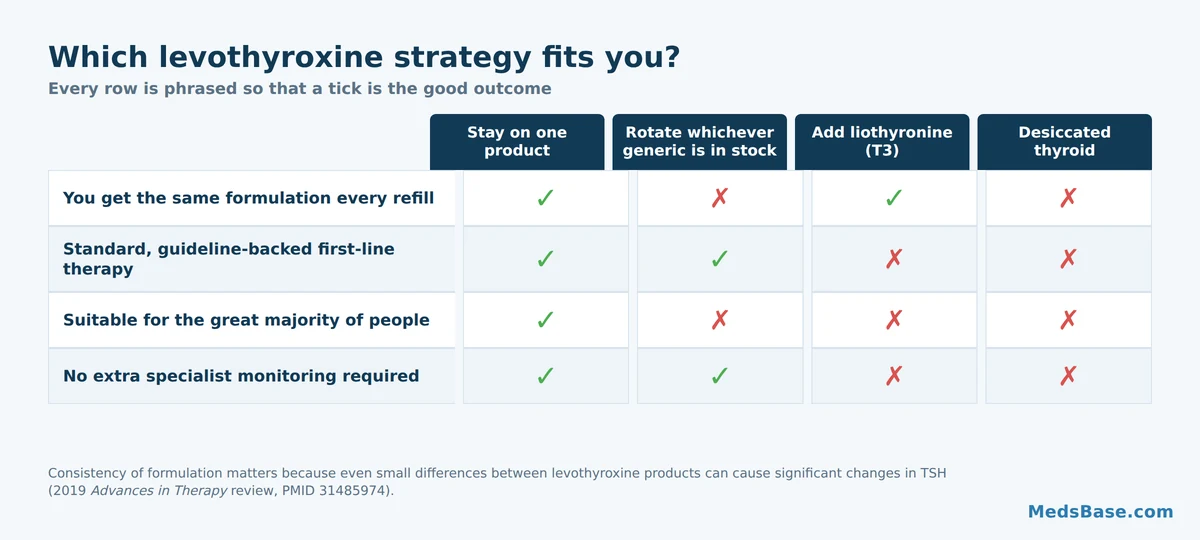
| Option | What it is | Best suited to | Trade-off |
|---|---|---|---|
| Stay on one levothyroxine product | Standard T4 replacement, consistent manufacturer | Almost everyone | Requires a pharmacy that can supply the same product each refill |
| Rotate whichever generic is in stock | Same molecule, different formulation each time | Nobody, by preference | Introduces exactly the variability that makes doses unstable |
| Levothyroxine liquid or soft-gel | Alternative formulations | People with documented absorption problems | Availability and cost vary; needs a clinical reason |
| Adding liothyronine (T3) | Combination therapy | A minority with persistent symptoms on adequate T4 | Requires specialist input; more monitoring; evidence is mixed |
| Natural desiccated thyroid | Animal-derived combined hormone | Rarely first-line | Hormone ratios differ from human physiology; potency consistency is a recognised concern |
Which one fits which situation? If your TSH is above range, the answer to levothyroxine not working is almost never a different class of medicine — it is finding the break in the chain and fixing it. If your TSH is genuinely optimal and symptoms persist despite a full workup, a specialist conversation about combination therapy is reasonable, and that is a decision to make with an endocrinologist rather than alone. For the great majority, the highest-value change is the least exciting one: the same tablet, from the same manufacturer, at the same time, every day.
That is where product consistency actually earns its keep. MedsBase stocks Thyronorm in a full range of microgram strengths from a WHO-GMP-certified manufacturer, and no prescription is needed to order — which for many readers is precisely what makes staying on one consistent product practical rather than theoretical.
How to Fix Levothyroxine Not Working — Your Six-Week Reset
If you do nothing else from this article, do this. It takes six weeks because that is how long the drug needs to settle, and it works because it removes one variable at a time.
- Identify your current product. Write down the manufacturer and lot number from your bottle. Check the
lot against current recall listings.
- Lock the product. Ask your pharmacy to keep supplying the same manufacturer, or source one product you
can stay on consistently. Stop rotating.
- Lock the time. Same time every day. Morning on an empty stomach is standard; bedtime dosing is a
documented alternative that works well for people whose mornings are chaotic. Either is fine — inconsistency is not.
- Enforce the four-hour rule. Calcium, iron, and acid-reducing medicines get a four-hour gap. So does
your first espresso, if you can manage it.
- Track adherence honestly for two weeks. Written tally, not memory.
- Recheck TSH at six weeks — at the same time of day as your previous test.
- Bring the trend. Your last three TSH results in order, plus your two-week adherence tally, plus the
manufacturer change if there was one. This turns “I still feel bad” into a diagnosable pattern.
Mistakes to avoid
- Doubling up after a missed dose without asking — the deposit model means one missed tablet matters less than
you fear, and doubling matters more.
- Changing two things at once. You will not know which one worked.
- Retesting at four weeks and drawing conclusions. The level has not settled.
- Stopping your thyroid medication because it “isn’t doing anything”. Untreated hypothyroidism gets worse,
not neutral.
- Treating a normal-range TSH as proof that nothing is wrong with you. It is proof that the thyroid is not
the thing to keep adjusting.
If your review concludes that a deliberate, one-time product switch is the right move, browse the underactive thyroid treatment options and pick one you can realistically stay on. The goal is stability, not variety.
- Thyronorm (levothyroxine) dosing guide — how the
- Esomeprazole vs omeprazole — if you take a daily acid
Frequently Asked Questions
Q: Why is my levothyroxine not working even though my TSH levels are normal?
A: Because a normal TSH tells you the thyroid axis is adequately replaced — it does not tell you that thyroid hormone was the cause of your symptoms. Fatigue, brain fog, weight change and low mood overlap heavily with iron deficiency, B12 deficiency, sleep apnoea, perimenopause and depression. When the numbers are genuinely optimal and symptoms persist, the productive next step is investigating those alternatives rather than raising the dose, which risks over-replacement without addressing the actual cause.
Q: How long does levothyroxine take to work?
A: Expect early changes over two to three weeks and a settled effect at around six weeks, which is why repeat blood tests are scheduled at that interval. Levothyroxine is a storage hormone your tissues draw on gradually, so it builds to a steady level rather than acting immediately. Judging the dose sooner than six weeks produces misleading results and usually leads to unnecessary adjustments.
Q: Can levothyroxine stop working over time?
A: The molecule does not lose effectiveness, but three things around it change. Your requirement can shift with weight, pregnancy, age or new gut conditions. Your tablets can come from a different manufacturer with slightly different bioavailability. And individual batches can be subpotent — the FDA’s enforcement database records this repeatedly, including a Class II subpotency recall initiated in June 2026. So levothyroxine not working after years of stability is usually one of those three, not tolerance.
Q: What happens if your levothyroxine dose is too low?
A: Hypothyroidism symptoms persist or return: fatigue, cold intolerance, dry skin, constipation, weight gain, low mood and slowed thinking. Your TSH rises because the pituitary is signalling for more hormone. Sustained under-replacement is associated with unfavourable changes in cholesterol and, over time, cardiovascular risk, so it warrants correction rather than acceptance — but the correction should follow a cause, not a guess.
Q: Does coffee affect levothyroxine absorption?
A: Yes. A 2025 review in Medicina lists espresso coffee alongside dietary fibre and grapefruit juice as substances that interfere with levothyroxine absorption. The practical fix is separation rather than abstinence: leave a gap between your tablet and your first cup, or move your dose to bedtime so the two never compete. Consistency matters more than the exact interval you choose.
Q: Should you take levothyroxine at night instead of the morning?
A: Night-time dosing is a legitimate option. The Medicina review notes that taking levothyroxine on an empty stomach enhances absorption but that night-time administration has shown similar results. If your mornings are rushed, or you take calcium or iron with breakfast, bedtime dosing often produces better real-world adherence. Choose one timing and keep it — switching back and forth is what destabilises levels.
Q: Can I switch levothyroxine brands safely?
A: You can, but do it deliberately and once, then recheck. The 2019 Advances in Therapy review concluded that even small differences between formulations can cause significant changes in TSH levels, and recommended that if the preparation changes, TSH should be evaluated and the dose adjusted if necessary. The problem is not switching — it is switching repeatedly and unknowingly, which is what happens when whichever generic is in stock gets dispensed.
Q: What should I bring to my appointment about levothyroxine not working?
A: Four things: your last three TSH results in date order, the manufacturer name and lot number from your current bottle, a two-week written record of doses actually taken, and a list of every supplement and medicine you take within four hours of your tablet. That package answers most of the questions a clinician needs to ask and moves the appointment from “I feel tired” to a specific, testable hypothesis.
The Bottom Line on Levothyroxine Not Working
Levothyroxine not working is rarely a mystery once you look at the whole chain rather than just the dose. In most cases it comes down to something concrete: a batch that was subpotent, a manufacturer that changed without anyone mentioning it, an absorption blocker taken at the wrong time of day, a dose that was started cautiously and never revisited, or a TSH result being read as a snapshot instead of a trend. And for a real minority of people, the thyroid was never the problem — which is frustrating to hear and far more useful than another dose increase.
The balanced verdict: levothyroxine is a genuinely effective thyroid hormone replacement with an unusually demanding set of conditions attached. Meet the conditions and it works well for most people. Vary them and it becomes unpredictable — through no fault of yours.
Your one immediate action: go and look at your tablet bottle. Write down the manufacturer and the lot number. That single piece of information rules a major cause in or out, and almost nobody has it to hand when they need it.
Then, when you are ready to make the process stable rather than variable, look at underactive thyroid treatment options and choose one product you can stay on.
What to read next:
- Wondering whether the acid reducer you take alongside it is part of the problem?
Esomeprazole vs omeprazole explains where the difference between them is real and where it is marketing.
- Want the dosing detail — how the microgram strengths step and where the common titration mistakes happen?
The Thyronorm levothyroxine guide covers it.
advice. Thyroid dosing decisions depend on your test results, your other medicines and your medical history. Do not start, stop or change the dose of any thyroid medication without speaking to a qualified doctor or pharmacist, and seek prompt medical advice for palpitations, an irregular heartbeat or any symptom that worries you.*

Written by
Sophie ChenPharmaceutical Content Researcher · 8 years experience
Sophie Chen is a pharmaceutical content researcher with 8 years covering generic medication access and clinical pharmacology. She specialises in international regulatory frameworks, bioequivalence standards, and patient-facing education on therapeutic drug classes. She is not a clinician.