








✓ Medically reviewed by · Last reviewed: May 2026
Pharmacy Researcher · 8 years experience
Pharmacy researcher with 8 years reviewing clinical drug information, generic formulation equivalence, and international pharmaceutical standards. Focuses on patient-facing accuracy in medication education.

Picture Robert, 62, who’s taken metformin for eight years and manages his diabetes well. Lately his feet tingle, he’s tired in a way sleep won’t fix, and his tongue feels sore. His first thought — and his doctor’s — is that his diabetes is progressing. The real culprit might be sitting in his weekly pill organiser. The link between metformin and vitamin B12 deficiency is well documented, frequently missed, and, once you know the signs, very fixable.
By the end of this guide you’ll know who is genuinely at risk, the symptoms that masquerade as something else, when to ask for a simple blood test, and exactly how low B12 gets corrected. There’s one twist about why this is so easy to miss — we’ll get to it in the symptoms section, and it explains why cases like Robert’s slip through for years.
- Metformin can lower vitamin B12 — regulators say it may affect up to 1 in 10 people who take it long term.
- Risk climbs with higher doses and longer use — one threshold matters more than people realise.
- The early symptoms mimic diabetic nerve damage, which is exactly why the cause gets missed for years.
- A simple, cheap blood test settles it — but guidelines are surprisingly vague on when to run it.
- You almost never need to stop metformin — the fix is usually straightforward, and we’ll show both options.
What Is the Metformin and Vitamin B12 Deficiency Link?
Metformin is the world’s most prescribed type 2 diabetes medicine for good reason — it’s effective, cheap, and safe. But one long-recognised side effect is that it interferes with vitamin B12 absorption. The UK medicines regulator considers B12 deficiency a common side effect of metformin, and a 2022 Drug Safety Update from the UK regulator states it may affect up to 1 in 10 people who take it.
Why should you care about a vitamin? Because B12 isn’t optional. According to what vitamin B12 does in the body from the NIH, it’s essential for healthy nerve function, red blood cell formation, and DNA synthesis. Run low for long enough and the consequences show up as exhaustion, anaemia, and nerve damage — some of it slow to reverse.
Here’s the trap that makes this topic matter so much: the symptoms of low B12 look almost identical to the diabetic complications a metformin user is already braced for. That overlap is the whole reason a fixable problem gets mistaken for an inevitable one.
How Does Metformin Lower B12?
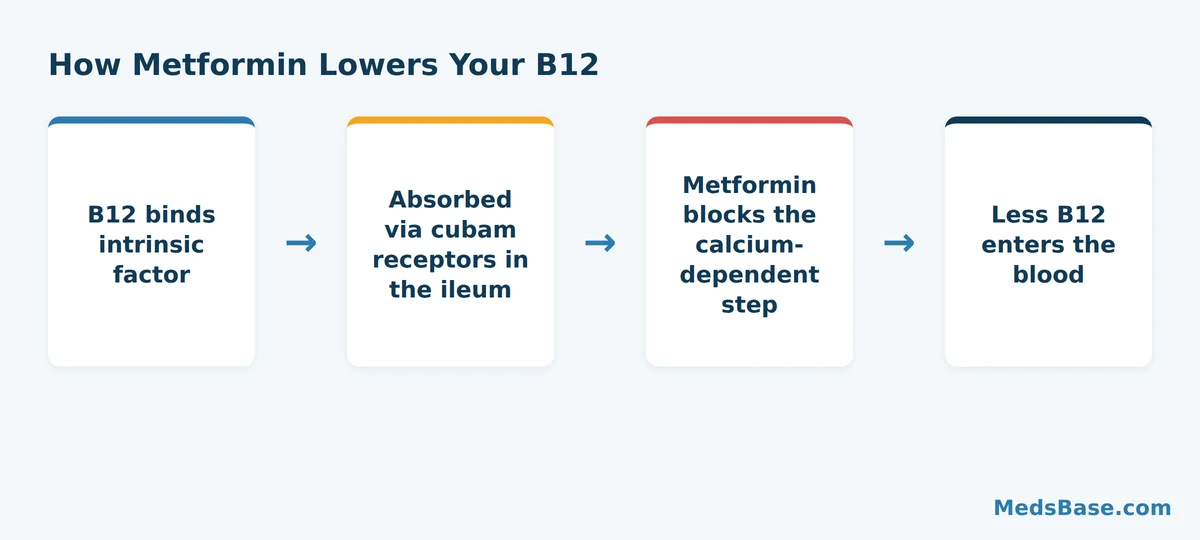
The mechanism is a small hijacking of your gut’s absorption machinery — and understanding it explains why the effect builds slowly.
Normally, the B12 in your food binds to a protein called intrinsic factor, and that pair is absorbed at the very end of your small intestine (the terminal ileum) through docking points called cubam receptors. It’s a calcium-dependent handshake. According to a 2025 review in the World Journal of Diabetes, metformin interferes with this calcium-dependent uptake of the B12–intrinsic-factor complex at the ileum, so less B12 crosses into your bloodstream.
Think of it like a turnstile that needs the right key. B12 arrives with its partner (intrinsic factor) holding the key, but metformin jams the calcium-dependent lock, so fewer travellers get through. Miss a little each day for years, and the reservoir your liver keeps eventually runs down.
Your liver typically stockpiles enough B12 to last a few years, which is both good news and bad news. Good, because a short course of metformin is very unlikely to leave you deficient. Bad, because the buffer masks the problem: by the time blood levels drop and symptoms appear, the drain has usually been running quietly for a long time. That lag is why the deficiency tends to surface in people who’ve been on metformin the longest.
That slow drain is the point: this is not a sudden reaction. It’s a quiet, cumulative shift, which is exactly why it’s tied to how long — and how much — metformin you take.
Who’s Most at Risk?
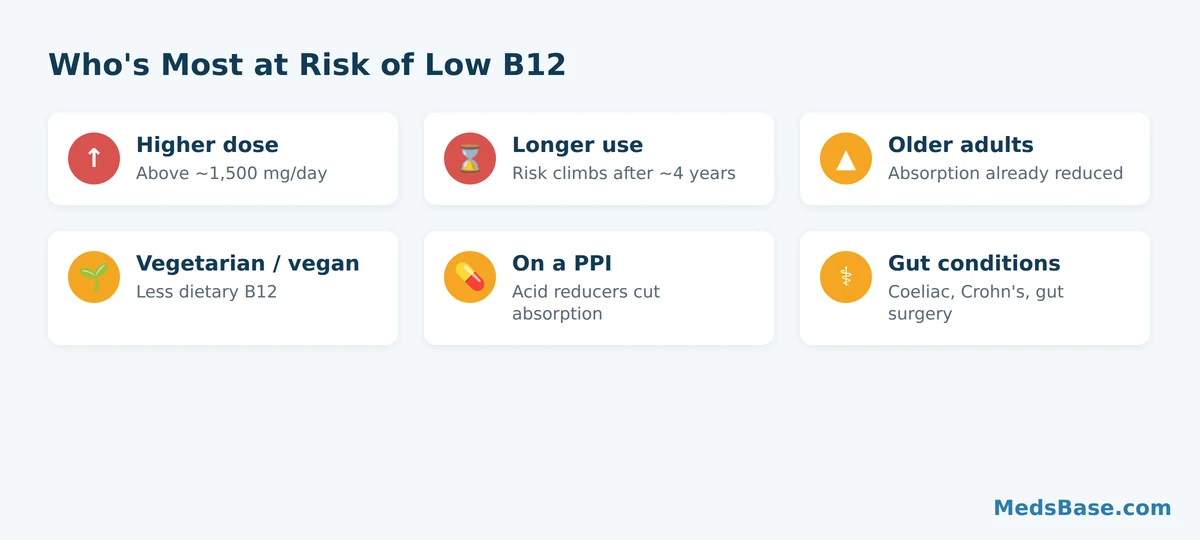
Not every metformin user needs to worry equally. Risk concentrates in a few clear groups, and one factor outweighs the rest.
The single most important driver is dose and duration. The World Journal of Diabetes review notes that higher doses carry greater risk, and that the incidence of deficiency climbs after about four years of use. It points to a practical risk threshold echoed by diabetes standards: people taking more than roughly 1,500 mg a day, or using metformin for more than four to five years, deserve closer attention.
On top of that, the regulator flags several groups who start with less B12 to spare:
- Older adults, whose absorption is already less efficient.
- Vegetarians and vegans, since B12 comes almost entirely from animal foods.
- People on proton pump inhibitors (long-term acid-reducers), which further blunt B12 absorption.
- Anyone with gastrointestinal conditions affecting the gut, or previous gut surgery.
If two or three of those describe you, your risk isn’t hypothetical — it’s the profile most likely to develop a measurable deficiency.
The Symptoms That Hide in Plain Sight
Here’s the resolution to the open loop from the intro — the reason this deficiency is so easily missed.
Low B12 damages nerves, producing numbness and tingling in the hands and feet, fatigue, poor balance, and trouble concentrating. Now read that list again through the eyes of someone with diabetes: those are almost exactly the features of diabetic peripheral neuropathy. As long-term metformin is a recognised cause of B12 deficiency per MedlinePlus, the encyclopedia lists tiredness, lightheadedness, pale skin, plus numbness and tingling of the hands and feet, and problems with balance and concentration.
| Symptom | Also blamed on… | Why it’s missed |
|---|---|---|
| Tingling/numbness in feet | Diabetic neuropathy | Assumed to be the diabetes progressing |
| Persistent fatigue | Diabetes, ageing, poor sleep | Non-specific; rarely triggers a B12 test |
| Sore, smooth tongue (glossitis) | “Just one of those things” | Not linked to diabetes in patients’ minds |
| Poor balance, brain fog | Ageing, blood sugar swings | Attributed to other causes |
| Pale skin, breathlessness on exertion | Being unfit | Anaemia not suspected until bloods are run |
The clinical lesson pharmacists and doctors keep relearning: when a long-term metformin user develops new nerve symptoms, check B12 before assuming the diabetes is to blame. The regulator specifically advises testing when someone presents with new neuropathy or megaloblastic anaemia. Catch it early and much of the nerve damage is reversible; leave it for years and some may not fully recover.
That reversibility window is why timing matters so much. In the early phase, low B12 tends to cause “soft” symptoms — tiredness, mild tingling, a sore tongue — that are easy to shrug off. Left unaddressed, the nerve involvement can deepen into persistent numbness, balance problems, and cognitive fog, and a portion of that later damage may not fully reverse even after B12 is replaced. The gap between “annoying” and “harder to undo” can be months to years, which is exactly the window in which a simple test and a cheap supplement do the most good. In practical terms: the symptom you’re tempted to ignore is the one worth checking.
Worried a nutrient gap is behind your own tiredness? Our overview of B12 injections walks through how repletion feels in practice.
What the Research Shows
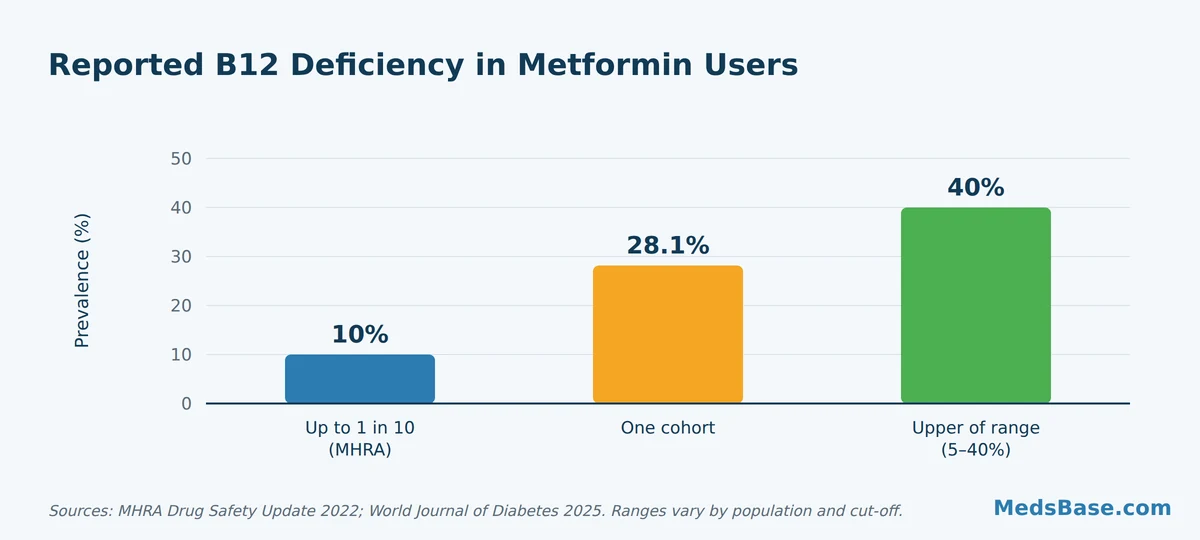
Let’s put numbers on it, because the range tells a story of its own.
Prevalence estimates vary widely depending on who’s studied and how deficiency is defined. The regulator’s figure is “up to 1 in 10.” The World Journal of Diabetes review reports one cohort at 28.1% and an across-studies range of roughly 5% to 40%.
| Source | Year | Finding | Takeaway |
|---|---|---|---|
| MHRA Drug Safety Update | 2022 | B12 deficiency “common”; up to ~1 in 10 long-term users | Regulator-level recognition; test if suspected |
| World Journal of Diabetes review | 2025 | Prevalence 5–40% across studies; 28.1% in one cohort | Real and frequent, not a rarity |
| Same review (dose/duration) | 2025 | Risk rises with dose; incidence climbs after ~4 years | Longer + higher = check sooner |
| Diabetes standards (cited) | — | Watch closely above ~1,500 mg/day or >4–5 years | A concrete threshold to act on |
What this means for you: the wide range (5–40%) isn’t a contradiction — it reflects different populations and cut-offs. Even the low end means a meaningful minority of long-term users are affected, and the higher-risk profiles (bigger doses, longer use, older age) sit toward the top of that range. Research consistently associates metformin with lower B12; it does not mean every user will become deficient. The practical response is simple monitoring, not alarm.
One aside that closes a loop for readers of the trial that put fluvoxamine on the map: metformin was the other arm of that long COVID study — a reminder that a drug can be excellent for its job (diabetes) yet carry unrelated caveats worth knowing.
Why a “normal” B12 result can still mislead
Here’s a subtlety that trips up patients and clinicians alike: a serum B12 test in the “normal” range doesn’t always rule deficiency out. Total serum B12 measures all the vitamin in your blood, but only a fraction is the active form your cells can actually use. Someone can sit in the low-normal zone yet be functionally short.
That’s why borderline results sometimes get followed up with additional markers — such as methylmalonic acid (MMA) or active-B12 (holotranscobalamin) — which reflect what’s happening inside cells more faithfully. You don’t need to memorise the biochemistry. The practical message is simpler: if your symptoms strongly suggest low B12 but your basic test looks borderline, it’s reasonable to ask your clinician whether a confirmatory marker is worthwhile rather than dismissing the possibility outright. Trusting a single borderline number is how fixable cases get missed for another year.
Fixing It: Oral B12 vs Injections
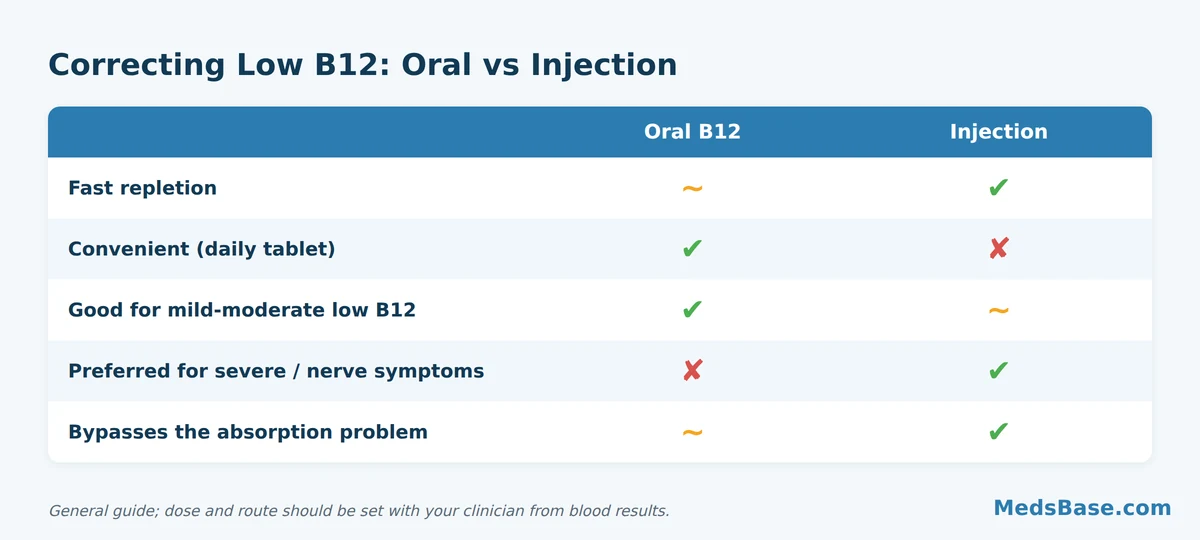
The good news dominates here: correcting low B12 is usually easy, cheap, and doesn’t require abandoning metformin.
The World Journal of Diabetes review describes a standard approach of about 1 mg of vitamin B12 daily, with a follow-up check around three months after starting to confirm levels are recovering. For most people, oral supplementation is enough. Injections are typically reserved for severe deficiency, clear neurological symptoms, or when absorption is badly impaired.
| Option | Speed | Convenience | Best when |
|---|---|---|---|
| Oral B12 (e.g. methylcobalamin/cyanocobalamin) | Steady over weeks | Very high — a daily tablet | Mild–moderate low B12; prevention in at-risk users |
| B12 injections | Fast repletion | Requires administration | Severe deficiency, marked nerve symptoms, poor gut absorption |
Can’t I just eat more B12?
It’s a fair question, and for prevention in low-risk people, a B12-rich diet helps. Vitamin B12 is found almost entirely in animal foods — meat, fish, eggs, and dairy — which is why vegetarians and especially vegans start with less margin. But here’s the catch that makes diet an incomplete fix: the metformin problem is one of absorption, not intake. If your gut is absorbing B12 less efficiently, eating more of it only partly compensates. Supplements at higher doses can partly bypass the bottleneck, which is why supplementation — not just diet — is usually the answer once levels are genuinely low.
If your levels are low, Vitamin B12 supplements are available at MedsBase, and no prescription is needed to order them — though the dose and route are worth confirming with your clinician based on your blood results. For faster repletion in more significant deficiency, B12 injections are the usual step up, because they sidestep the absorption problem entirely.
And to be crystal clear: this is not a reason to stop metformin. The regulator’s advice is to correct B12 while continuing the diabetes treatment. Metformin remains a first-line, life-improving medicine; if you take it, Glycomet SR (metformin) and similar formulations do their job well — the B12 issue is a monitoring task, not a dealbreaker.
A Practical Monitoring Plan
Turn all of this into a short checklist you can actually use.
- Know your risk tier. Long-term use, higher dose, older age, vegetarian/vegan, or on a PPI? You’re in the “monitor” group.
- Ask for a baseline B12 if you’ve been on metformin for years and have never had it checked — a simple serum B12 test, sometimes with additional markers if borderline.
- Re-test if symptoms appear. New tingling, unexplained fatigue, or a sore tongue is a prompt to test, not to assume the worst about your diabetes.
- Supplement if low, at the dose your clinician advises, and re-check at around three months.
- Keep taking your metformin. Correct the B12; don’t sacrifice the diabetes control.
- Recheck periodically if you stay in a high-risk tier, since the drain is ongoing.
Mistakes to avoid: blaming every nerve symptom on diabetes; stopping metformin without medical advice; taking random high-dose supplements without confirming you’re actually low; and skipping the three-month follow-up test that tells you whether the fix is working.
- Curious what repletion feels like? See vitamin B12 injection benefits.
- New to metformin’s other trade-offs? Compare it in Ozempic vs Metformin.
- The long COVID trial where metformin was tested — and its result — in fluvoxamine for long COVID.
Frequently Asked Questions
Q: Does metformin cause vitamin B12 deficiency?
A: It can. Metformin interferes with how your gut absorbs vitamin B12, and over years of use this can lower your blood levels. The UK medicines regulator classes B12 deficiency as a common side effect that may affect up to 1 in 10 long-term users. It doesn’t happen to everyone, but it’s frequent enough that awareness and occasional testing are worthwhile.
Q: How long does it take metformin to lower B12?
A: It’s a slow, cumulative effect rather than a sudden one. Research suggests the incidence of deficiency rises notably after about four years of use, and risk increases with higher doses. That’s why guidance points to closer monitoring for people taking more than roughly 1,500 mg a day or using metformin for more than four to five years.
Q: Should I take a B12 supplement with metformin?
A: If your levels are low or you’re in a high-risk group, supplementation is a sensible, low-cost step — a common approach is around 1 mg of B12 daily, with a follow-up blood test at about three months. If your levels are normal and you’re low-risk, routine supplementation may not be necessary. Confirm the plan with your clinician based on a blood test rather than guessing.
Q: What are the signs of low B12 while on metformin?
A: Watch for tingling or numbness in the hands and feet, persistent fatigue, a sore or smooth tongue, poor balance, brain fog, and pale skin. The tricky part is that these overlap heavily with diabetic nerve damage, so they’re easily misattributed. New nerve symptoms in a long-term metformin user are a good reason to ask for a B12 test.
Q: How often should B12 be tested on metformin?
A: Guidelines are surprisingly vague and don’t fix a universal interval. A reasonable approach is a baseline check for long-term users, testing whenever suspicious symptoms appear, and periodic re-checks for people in higher-risk tiers. If you’ve taken metformin for years and never had B12 measured, that’s worth raising at your next review.
Q: Do I have to stop metformin if my B12 is low?
A: Almost never. The standard advice is to correct the B12 — usually with supplements — while continuing metformin. Metformin is a first-line diabetes medicine with major benefits, and stopping it to fix a vitamin gap would trade a big benefit for a small, correctable problem. Never stop it on your own; adjust the plan with your doctor.
The Bottom Line
The verdict is refreshingly clear: metformin and vitamin B12 deficiency is a real, common, and easily managed pairing. Metformin quietly reduces B12 absorption over years, the symptoms hide behind diabetic complications, and the fix is usually a cheap daily supplement plus a follow-up test — all while you keep taking the medicine that’s helping your diabetes.
Your one immediate action: if you’ve taken metformin for several years and never had your B12 checked, ask for that simple test at your next appointment — especially if you’re tired, tingling, or in one of the higher-risk groups.
Want to go deeper? Read next: what B12 injections actually do and when they’re needed, and — if you take metformin — why it appeared in a surprising long COVID trial as the arm that didn’t work. Knowing about this link doesn’t make metformin a villain. It makes you the kind of patient who catches the fixable thing early.

Written by
Sophie ChenPharmaceutical Content Researcher · 8 years experience
Sophie Chen is a pharmaceutical content researcher with 8 years covering generic medication access and clinical pharmacology. She specialises in international regulatory frameworks, bioequivalence standards, and patient-facing education on therapeutic drug classes. She is not a clinician.