








✓ Medically reviewed by · Last reviewed: May 2026
Pharmacy Researcher · 8 years experience
Pharmacy researcher with 8 years reviewing clinical drug information, generic formulation equivalence, and international pharmaceutical standards. Focuses on patient-facing accuracy in medication education.
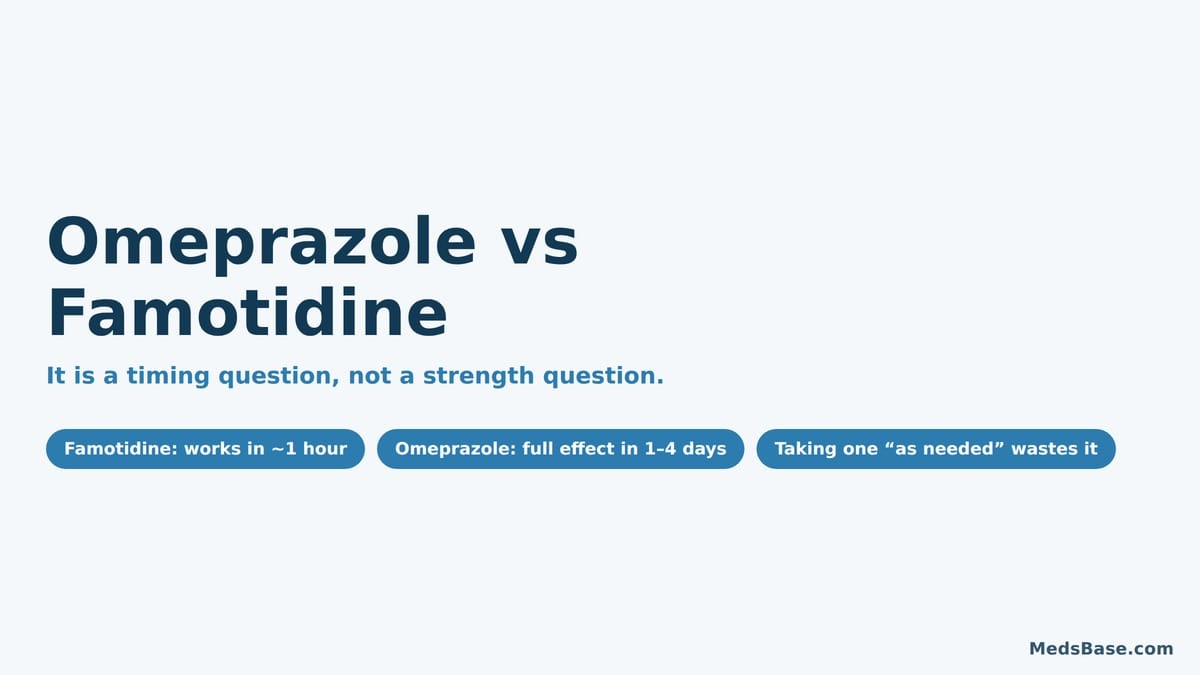
Most people believe omeprazole is simply the stronger version of famotidine, and that picking the stronger one is therefore the smarter move. The research says the comparison is not really about strength at all. In the one trial that put them directly head to head, omeprazole was no better than famotidine on day one — and then pulled clearly ahead on every day after that.
That is the whole story of omeprazole vs famotidine in a sentence, and it has a practical edge to it. If you are taking omeprazole for the occasional bad night, you are using a drug that had barely started working. If you are taking famotidine every day for months, you are using one whose effect quietly fades. By the end of this you will know which pattern of symptoms points to which drug, when each should be taken, and what happens when you try to stop — a detail that explains why so many people believe they are stuck on these tablets for good.
- The omeprazole vs famotidine choice turns on one thing: one works within about an hour, the other needs days of daily dosing before it reaches full effect
- Taking a proton pump inhibitor “as needed” for a bad evening is close to taking nothing — and the reason is mechanical
- Over weeks, the PPI advantage for healing is large; on day one it essentially vanishes
- Famotidine’s effect declines with continued daily use, and there is a name for that
- Stopping a PPI can create the very symptom you took it for — one trial found it in people who never had heartburn to begin with
- The frightening long-term safety headlines come almost entirely from one type of study, and a very large randomised trial tells a calmer story
- Omeprazole vs famotidine: what each one is
- How they work — a messenger and a pump
- The timing difference that decides everything
- Which controls acid better?
- Safety, side effects and long-term risks
- Omeprazole vs famotidine: which should you choose?
- Stopping: the rebound nobody warns you about
- Frequently asked questions
- The bottom line
Omeprazole vs Famotidine: What Each One Actually Is
Both reduce stomach acid. They do it in completely different ways, on completely different timescales, and that is the only thing you really need to hold on to when weighing omeprazole vs famotidine.
The NHS describes omeprazole as a medicine for heartburn and indigestion that reduces the amount of acid your stomach makes. It belongs to a class called proton pump inhibitors, usually shortened to PPIs.
MedlinePlus classes famotidine in a group called H2 blockers, and describes it working “by decreasing the amount of acid made in the stomach.” Its full name is a histamine-2 receptor antagonist.
One footnote explains why famotidine, and not something else, is the H2 blocker you see everywhere. For decades the market leader was ranitidine. In 2020 the FDA requested that all prescription and over-the-counter ranitidine products be withdrawn, after determining that an impurity called NDMA — a probable human carcinogen — increases in the product over time and at higher storage temperatures. FDA testing did not find NDMA in famotidine. Famotidine inherited the category by default.
Omeprazole vs Famotidine: A Messenger and a Pump
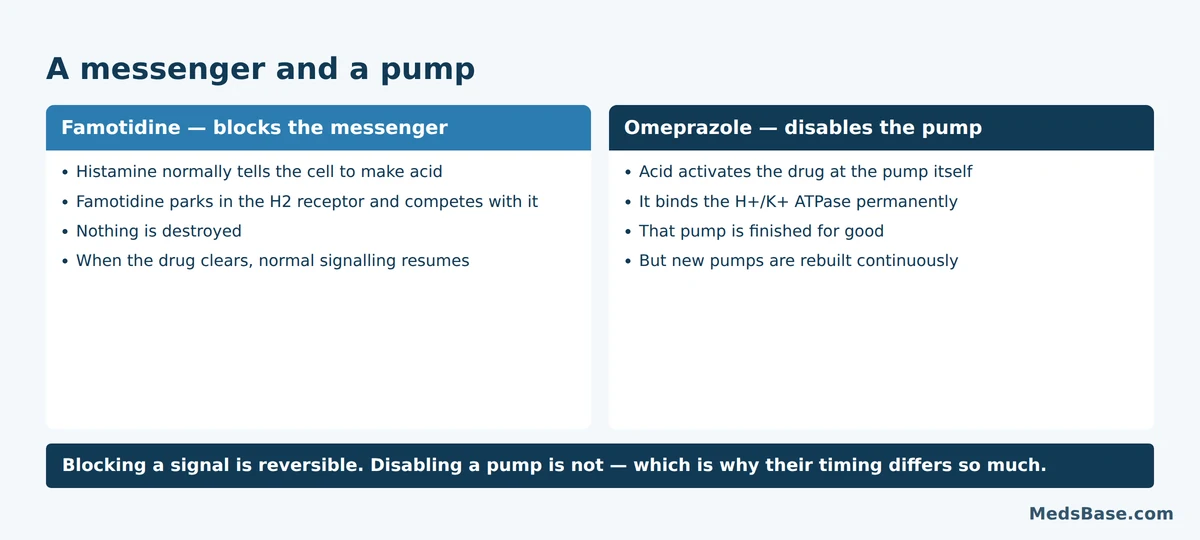
Picture the acid-producing cells in your stomach lining as small factories, each covered in pumps that push acid out.
Famotidine intercepts a messenger. Histamine is one of the signals that tells those factories to switch their pumps on. Famotidine is a competitive inhibitor of the histamine H2 receptor — it parks in the receptor so histamine cannot deliver its message. Nothing is destroyed. When the drug clears, the receptor is free again and normal signalling resumes.
Omeprazole disables the pumps themselves. It suppresses acid secretion by specifically inhibiting the H+/K+ ATPase enzyme system at the secretory surface of the stomach’s parietal cells — the acid pump itself. It is a prodrug activated by acid, which then binds covalently to the pump. That bond does not let go.
Here is the consequence that matters, and it is the key to the entire comparison. A dose of omeprazole can only disable pumps that are switched on and actively secreting at that moment. Dormant pumps are untouched. Your body also builds new pumps continuously. So a single dose knocks out a fraction of the total, the next dose knocks out more of what remains, and full acid control accumulates over several days.
That is why omeprazole is a course, not a rescue remedy — and why famotidine is the reverse.
Omeprazole vs Famotidine: The Timing Difference That Decides Everything
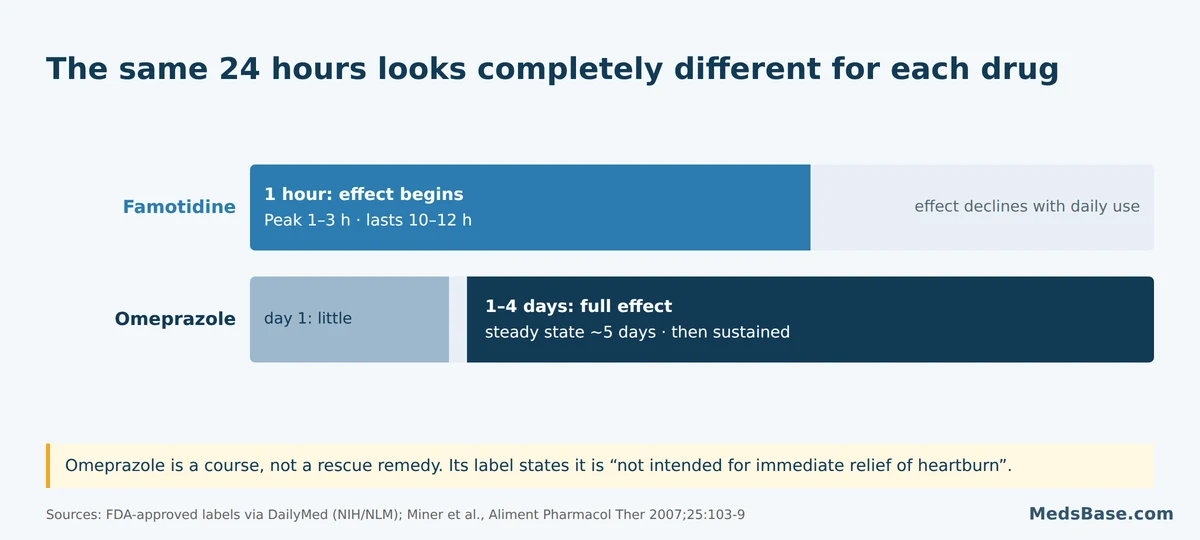
Time to put numbers on it.
For famotidine, its approved label puts numbers on it precisely: the antisecretory effect occurred within one hour, the maximum effect occurred within one to three hours, and the duration of inhibition for 20 mg and 40 mg doses was 10 to 12 hours. A single evening dose inhibited night-time acid secretion by 86% at 20 mg and 94% at 40 mg. The label also notes acid suppression falling to 25–30% by 8–10 hours after a dose, and adds that “there was no cumulative effect with repeated doses.”
For omeprazole, the over-the-counter label is unusually direct. It states the product is “not intended for immediate relief of heartburn” and that it “may take 1 to 4 days for full effect.” It directs you to take one tablet with water before eating in the morning, every day for 14 days.
| Famotidine | Omeprazole | |
|---|---|---|
| Class | H2 blocker | Proton pump inhibitor |
| Effect begins | Within 1 hour | Builds over days |
| Maximum effect | 1–3 hours | 1–4 days; steady state around 5 days |
| Duration per dose | 10–12 hours | Acid inhibition persists well beyond the dose |
| Suits | Occasional, unpredictable symptoms | Frequent, predictable symptoms |
| Effect over weeks of use | Declines (tolerance) | Increases, then sustains |
| Best taken | When symptoms strike, or 15–60 minutes before a trigger meal | Before a meal, same time daily |
Prescription omeprazole is taken before a meal, and that instruction is not arbitrary. Since the drug only disables pumps that are actively working, taking it before food — when a meal is about to switch the pumps on — is what lets it reach the most targets.
What this means for you, concretely: if you have been taking omeprazole at bedtime, or only on evenings when you expect trouble, you have probably been getting a fraction of what the drug can do. Move it to before breakfast and take it daily for the length of the course.
Which Controls Acid Better? Omeprazole vs Famotidine on the Evidence
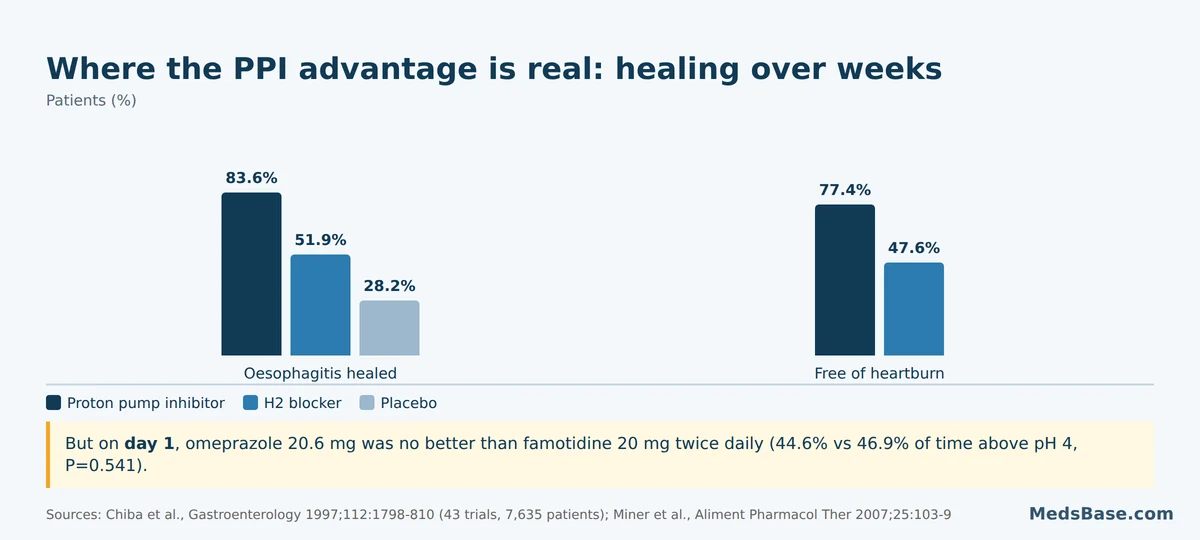
Two separate questions hide inside omeprazole vs famotidine: which suppresses acid better on a given day, and which heals damage better over weeks.
A crossover trial put them head to head over 14 days, monitoring stomach pH in adults with frequent heartburn on days 0, 1, 3, 7 and 14. On day 1, the percentage of time the stomach stayed above pH 4 was 44.6% for omeprazole magnesium 20.6 mg once daily, 36.7% for famotidine 10 mg twice daily, and 46.9% for famotidine 20 mg twice daily — statistically indistinguishable from omeprazole (P = 0.541). On every subsequent measurement day, omeprazole was superior (P less than 0.001).
The authors noted something else in the same data: after day 1, omeprazole showed “an increasing and sustained effect in contrast to a decreasing effect for famotidine, consistent with H2RA tolerance.”
Read that twice, because it is the practical heart of this comparison. Famotidine’s performance drops the longer you take it every day. Omeprazole’s climbs. Two drugs measured in the same people, moving in opposite directions.
Over weeks, the healing evidence is one-sided. A meta-analysis of 43 trials covering 7,635 patients with erosive reflux disease found oesophagitis healed in 83.6% on a PPI versus 51.9% on an H2 blocker and 28.2% on placebo, with the heartburn-free proportion at 77.4% versus 47.6%. PPIs also healed roughly twice as fast — 11.7% per week against 5.9%.
| Study | Year | Finding | Source |
|---|---|---|---|
| Crossover pH trial, 31 subjects | 2007 | Day 1: omeprazole 44.6% vs famotidine 20 mg 46.9% time above pH 4 — no difference (P=0.541). Superior thereafter; famotidine’s effect declined | Aliment Pharmacol Ther 25(1):103–109 (PMID 17229225) |
| Meta-analysis, 43 trials, 7,635 patients | 1997 | Oesophagitis healing 83.6% (PPI) vs 51.9% (H2 blocker) vs 28.2% (placebo); healing roughly twice as fast | Gastroenterology 112(6):1798–1810 (PMID 9178669) |
| Randomised trial, 120 volunteers | 2009 | After 8 weeks of PPI then withdrawal, 44% reported acid-related symptoms vs 15% on placebo (P less than 0.001) | Gastroenterology 137(1):80–87 (PMID 19362552) |
| Randomised trial, 17,598 participants | 2019 | Over a median 3 years, no significant excess of pneumonia, fracture, kidney disease, dementia, cancer or death; only enteric infections differed | Gastroenterology 157(3):682–691 (PMID 31152740) |
What this means for you: if your oesophagus is inflamed and needs to heal, the PPI is clearly the better tool. If you simply want an uncomfortable evening to stop, famotidine at an adequate dose does about as well on the night in question — and does it faster.
One honest caveat on the healing meta-analysis: it was published in 1997. It remains the most-cited head-to-head comparison of its kind, but it is nearly three decades old, and no equivalent modern replacement was found.
Safety, Side Effects and the Long-Term Question
Safety is where the internet gets loud, and where omeprazole vs famotidine is most often decided on fear rather than evidence. It is worth separating what is established from what is merely suggested.
| Concern | Which drug | What the evidence actually shows | What to do |
|---|---|---|---|
| Headache, nausea, wind, diarrhoea | Both | Common, usually mild and settling | Continue; review if persistent |
| Low magnesium | Omeprazole | Label reports it with long-term use, in most cases after a year of therapy; can cause serious effects including seizures and arrhythmias | Discuss testing on long-term use |
| Vitamin B12 absorption | Omeprazole | Label notes use beyond about 3 years may lead to malabsorption | Discuss on very long-term use |
| Fracture risk | Omeprazole | MedlinePlus says people taking PPIs “may be more likely” to fracture wrist, hip or spine — observational, hedged | Weigh against benefit; not a reason to stop abruptly |
| Enteric infection | Omeprazole | The randomised trial found a small real increase: 1.4% vs 1.0% | Reasonable awareness, not alarm |
| Confusion, delirium | Famotidine | Reported in elderly patients and those with moderate-severe renal impairment | Dose reduction; discuss with a clinician |
| Drug interactions | Omeprazole more than famotidine | Omeprazole cuts clopidogrel active metabolite by 41–46%; famotidine is only a weak CYP1A2 inhibitor | Tell your pharmacist everything you take |
The long-term PPI headlines deserve a paragraph of their own, because the framing is usually wrong. Most of those associations — dementia, kidney disease, fractures, pneumonia — come from observational studies, which can show that two things occur together but cannot establish that one causes the other. People who take acid suppressants long-term differ from people who do not in many ways.
A randomised trial of 17,598 people, followed for a median of three years across more than 53,000 patient-years, was designed specifically to test those signals. It found no statistically significant difference between the PPI group and placebo for pneumonia, fractures, chronic kidney disease, dementia, cancer or death. The single exception was enteric infections, at 1.4% versus 1.0%.
Two caveats keep that honest: the drug studied was pantoprazole rather than omeprazole, and three years is not a lifetime. But it is by far the strongest evidence available, and it points away from the scarier headlines rather than toward them.
Omeprazole vs Famotidine: Which Should You Choose?
| Your situation | Better fit | Why |
|---|---|---|
| Heartburn a few times a month, unpredictable | Famotidine | Works within an hour; no benefit from daily dosing |
| Heartburn most days for weeks | Omeprazole | Builds to full effect and sustains it |
| One specific trigger meal coming up | Famotidine | Can be taken 15–60 minutes beforehand |
| Diagnosed erosive oesophagitis | Omeprazole | Healing 83.6% vs 51.9% |
| Taking clopidogrel | Famotidine | Avoids the CYP2C19 interaction |
| Elderly with reduced kidney function | Omeprazole, cautiously | Famotidine’s CNS effects concentrate in this group; dose adjustment needed either way |
| Night-time symptoms despite a daily PPI | Add-on discussion | An H2 blocker at bedtime helps at first, but tolerance blunts it within a week |
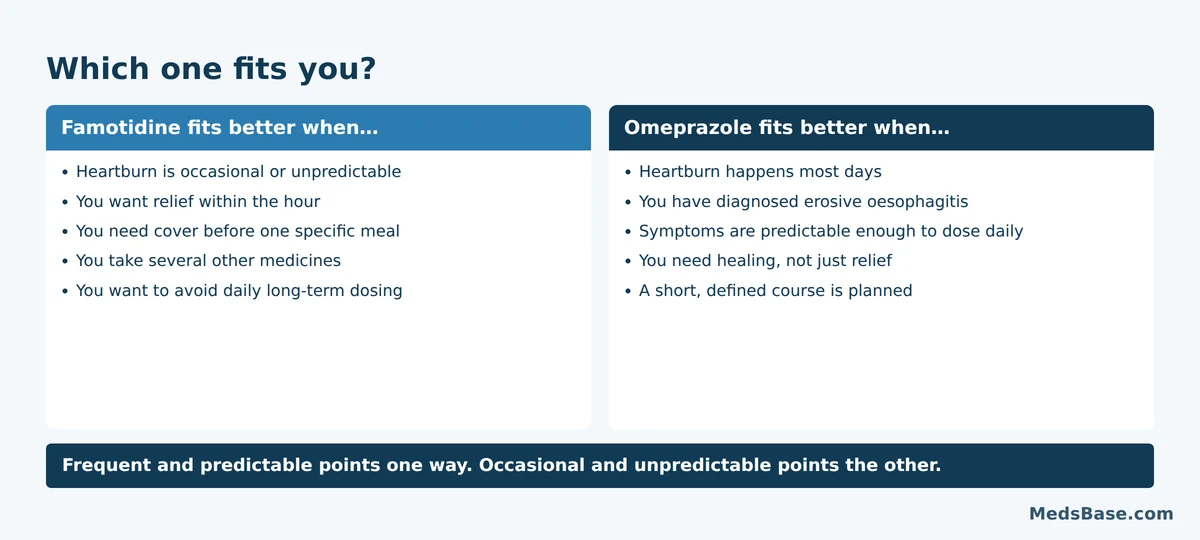
The verdict: in omeprazole vs famotidine, frequency decides it. Occasional and unpredictable points to famotidine. Frequent and predictable points to omeprazole. Reaching for the “stronger” drug for a once-a-fortnight problem is the single most common mistake here, and it is a mistake in both directions — you get little benefit on the night, and you take on a daily medicine you did not need.
That night-time row deserves one clarification, because it is a genuinely useful piece of nuance. A 1998 study showed a bedtime H2 blocker was far better than an extra PPI dose at controlling overnight acid — reducing time below pH 4 from 48% to around 5–6%, where a third PPI dose only reached 31%. But a follow-up study found the benefit was present only on the first day of combination therapy and had disappeared by one week, because of H2 blocker tolerance. Useful for a few bad nights; not a long-term strategy.
If neither drug is fitting your pattern, how the full range of acid reducers compares covers antacids, alginates and the rest, and how the newer acid blockers differ again covers what came after PPIs. MedsBase stocks both drugs discussed here — you can browse what we stock in the acid reflux category, no prescription needed to order.
Stopping: The Rebound Nobody Warns You About
Time to resolve the last loop, and it is the section most likely to change what you do.
A randomised trial in 120 healthy volunteers — people without reflux disease — gave one group eight weeks of a PPI followed by four weeks of placebo, and the other group twelve weeks of placebo throughout. In the four weeks after the PPI stopped, 44% of the PPI group reported at least one clinically relevant acid-related symptom, against 15% of the placebo group.
Read that again: nearly half of people who had no acid problem at all developed heartburn, regurgitation or indigestion after coming off a proton pump inhibitor.
The mechanism is rebound acid hypersecretion. Suppress acid for weeks and the stomach compensates by increasing its acid-producing capacity. Remove the suppression and that extra capacity is briefly unopposed.
Why this matters so much: if you stop a PPI, feel heartburn a few days later, and conclude the medicine was treating a real ongoing problem, you may be misreading a temporary withdrawal effect as proof of dependence. That is exactly how short courses turn into indefinite ones.
An evidence-based de-prescribing guideline recommends reducing the dose, stopping, or moving to on-demand dosing in adults who have completed at least four weeks of PPI treatment for heartburn or mild-to-moderate reflux and whose symptoms have resolved. Its exclusions are important and should not be glossed over: the recommendation does not apply to people who have or have had Barrett’s oesophagus, severe grade C or D oesophagitis, or a documented history of bleeding gastrointestinal ulcers.
- Taking omeprazole only on bad evenings — the mechanism means you get a fraction of the effect
- Taking omeprazole after food rather than before it
- Judging a PPI’s worth on day one
- Taking famotidine daily for months and assuming the effect holds — it declines
- Stopping a long PPI course abruptly and reading the rebound as proof you need it forever
- Treating alarm symptoms — weight loss, difficulty swallowing, black stools — with either drug instead of getting them investigated
- How the full range of acid reducers compares — antacids, alginates, H2 blockers and PPIs side by side
- How the newer acid blockers differ again — what arrived after the PPI
- Our wider gut health guides — the rest of the digestive library
Frequently Asked Questions
Q: Is omeprazole stronger than famotidine?
A: Over weeks, yes — PPIs healed oesophagitis in 83.6% of patients versus 51.9% for H2 blockers in a 43-trial meta-analysis. On a single day, no. A head-to-head trial found omeprazole 20.6 mg controlled acid no better than famotidine 20 mg twice daily on day one. In the omeprazole vs famotidine comparison, “stronger” depends entirely on the timescale you are asking about.
Q: How long does omeprazole take to work?
A: Its label states it is not intended for immediate relief of heartburn and may take one to four days for full effect, with acid suppression generally reaching steady state around five days. This is because each dose only disables acid pumps that are actively working at that moment, and your body continuously builds new ones. Take it daily before a meal rather than as needed.
Q: Can I take omeprazole and famotidine together?
A: They are sometimes combined, most often as a bedtime H2 blocker added to a daily PPI for night-time symptoms. Evidence supports it in the short term — one study cut overnight time below pH 4 from 48% to around 5–6% — but a follow-up found the benefit gone within a week because of tolerance. Discuss it with a pharmacist or doctor rather than combining them on your own.
Q: Why does my heartburn come back after stopping omeprazole?
A: Probably rebound acid hypersecretion. In a randomised trial, 44% of healthy volunteers with no prior reflux developed acid-related symptoms after stopping an eight-week PPI course, versus 15% on placebo. Your stomach compensates for prolonged acid suppression, and that compensation is briefly unmasked when you stop. It is usually temporary, and tapering rather than stopping abruptly can help.
Q: Which is safer long term, omeprazole or famotidine?
A: On long-term safety, omeprazole vs famotidine is closer than the headlines suggest. Famotidine has a narrower interaction profile and its main concern — confusion and related effects in elderly or renally impaired patients — is well defined. The alarming long-term PPI associations come mostly from observational studies; a randomised trial of 17,598 people over a median three years found no significant excess of pneumonia, fracture, kidney disease, dementia, cancer or death. Neither drug is meant for indefinite use without review.
Q: When should I take famotidine?
A: For relief, when symptoms appear — it begins working within about an hour and peaks at one to three hours. To prevent symptoms, the over-the-counter label directs taking it 15 to 60 minutes before food or drink that triggers heartburn. Its effect lasts 10 to 12 hours, so a single evening dose covers the night.
Q: Why did ranitidine disappear and famotidine did not?
A: In 2020 the FDA requested withdrawal of all ranitidine products after determining that NDMA, a probable human carcinogen, increases in the product over time and at higher storage temperatures. The FDA stated its testing had not found NDMA in famotidine, cimetidine, esomeprazole, lansoprazole or omeprazole. Famotidine became the default H2 blocker as a result.
Q: Do I still need a doctor if these work?
A: Yes, if symptoms are frequent, persistent, or have lasted more than a couple of weeks. Both drugs relieve symptoms without addressing why the acid is causing trouble, and they can mask conditions that need investigating. Difficulty swallowing, unexplained weight loss, persistent vomiting or black or bloody stools always need medical assessment.
The Bottom Line
The omeprazole vs famotidine decision is not a contest between a strong drug and a weak one. It is a match between a drug’s timing and your symptom pattern. Famotidine works within the hour, lasts through the night, and fades if you lean on it every day for weeks. Omeprazole does little on day one, reaches full effect after several days of dosing before a meal, and is clearly the better healer over a course.
Where the evidence is thin, it is worth naming: the definitive healing meta-analysis is from 1997, the largest randomised safety trial used a different PPI, and the rebound study was done in healthy volunteers rather than in reflux patients. None of that undermines the practical guidance, but it should temper how confidently anyone states it.
Your one immediate action: check when you take your current tablet. If you are on omeprazole and taking it at night or only when symptoms flare, moving it to before breakfast, every day, may be the only change you need.
Wondering whether something newer has replaced the PPI altogether? Read how the newer acid blockers differ again. And if your gut trouble started on a trip rather than at the dinner table, the travel illness that upends your gut for a week is a very different problem with a very different fix.

Written by
Sophie ChenPharmaceutical Content Researcher · 8 years experience
Sophie Chen is a pharmaceutical content researcher with 8 years covering generic medication access and clinical pharmacology. She specialises in international regulatory frameworks, bioequivalence standards, and patient-facing education on therapeutic drug classes. She is not a clinician.