








✓ Medically reviewed by · Last reviewed: May 2026
Pharmacy Researcher · 8 years experience
Pharmacy researcher with 8 years reviewing clinical drug information, generic formulation equivalence, and international pharmaceutical standards. Focuses on patient-facing accuracy in medication education.
raloxifene vs bisphosphonates — Raloxifene vs Bisphosphonates: 7 Essential Differences for Bone Health. Read on for an evidence-backed guide covering everything you need to know.
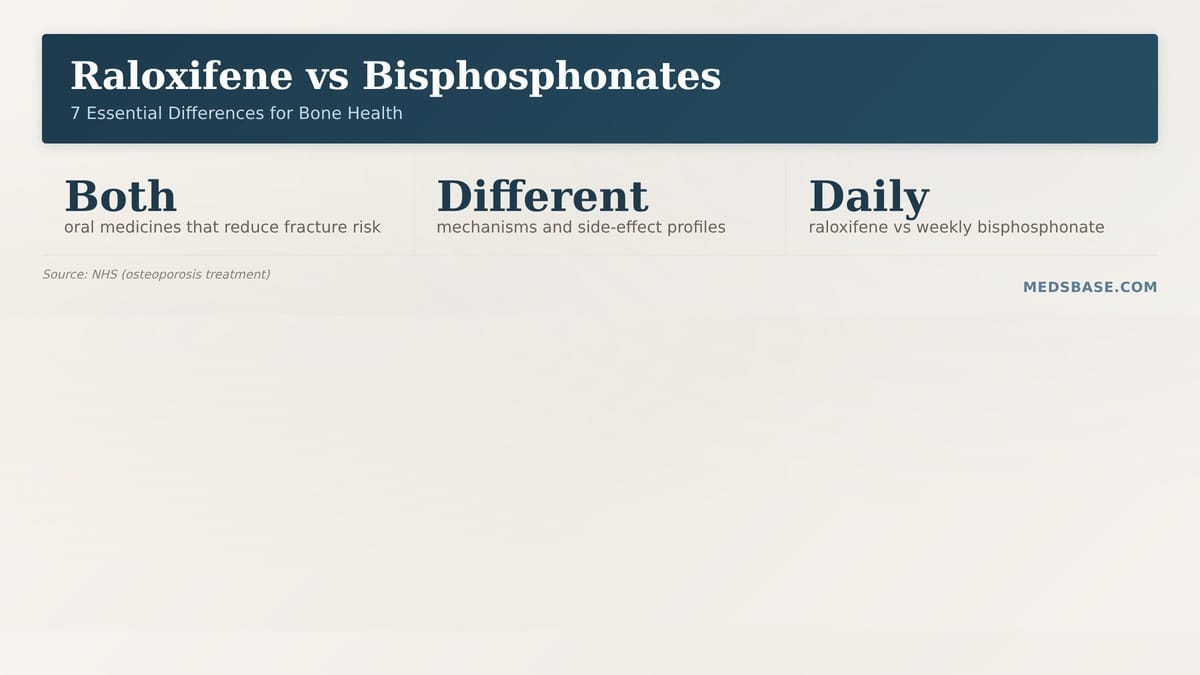
If you have been told your bones are thinning, you have probably come across two of the most common oral options — raloxifene and bisphosphonates — and wondered which one is right for you. The comparison of raloxifene vs bisphosphonates is one of the most useful decisions a postmenopausal woman with osteoporosis will make, because the two medicines protect bone in completely different ways and feel very different day to day. Understanding raloxifene vs bisphosphonates clearly is the best preparation for a productive conversation with your doctor.
By the end of this guide you will know how raloxifene vs bisphosphonates each work, how they differ in side effects and dosing rules, which kind of fracture risk each is best known for reducing, and a straightforward way to think about which one fits your situation. You will also see where each medicine is available at MedsBase, so you can weigh your options with real information in hand.
Key Takeaways
- Raloxifene vs bisphosphonates is less a contest than a fit question — both reduce fracture risk, but through different mechanisms
- Bisphosphonates slow bone breakdown and are the most widely used first choice, with strict dosing rules (empty stomach, plain water, stay upright)
- Raloxifene acts like oestrogen on bone and is the only SERM for osteoporosis, but it is only for postmenopausal women and carries a blood-clot risk
- The side-effect profiles are almost opposites: bisphosphonates bother the food pipe and stomach; raloxifene can cause hot flushes and leg cramps
- One question changes the decision instantly: if you have stomach or oesophagus problems, raloxifene may be the gentler option — but only your doctor can weigh the trade-offs
- What Is Raloxifene vs Bisphosphonates?
- How Raloxifene vs Bisphosphonates Work
- Side Effects: Raloxifene vs Bisphosphonates
- How to Take Raloxifene vs Bisphosphonates
- Raloxifene vs Bisphosphonates: Which Fits You
- What the Research Says
- Related Reading
- Frequently Asked Questions
- The Bottom Line
What Is Raloxifene vs Bisphosphonates?
Raloxifene vs bisphosphonates is a comparison between two oral medicines used to treat and prevent osteoporosis, the condition in which bones become weak and more likely to fracture. Both are taken to reduce the risk of broken bones, but they belong to entirely different drug classes and suit different people.
Bisphosphonates are the most commonly used first-line osteoporosis medicines. The NHS explains that they slow the rate at which bone is broken down in the body, which maintains bone density and reduces fracture risk. Common examples include alendronic acid, ibandronic acid, risedronate, and zoledronic acid.
Raloxifene belongs to a different class called selective oestrogen receptor modulators, or SERMs. The NHS notes that SERMs have a similar effect on bone to the hormone oestrogen — they help maintain bone density and reduce the risk of fracture, particularly of the spine. Crucially, raloxifene is the only SERM available for treating osteoporosis, and it is only recommended for women after the menopause.
The context for both is the same silent disease. MedlinePlus describes osteoporosis as a condition in which bones weaken and are more likely to fracture, most often affecting the hip, spine, and wrist — and it is more common in women, especially after menopause. That is exactly the population at the centre of the raloxifene vs bisphosphonates decision.
How Raloxifene vs Bisphosphonates Work
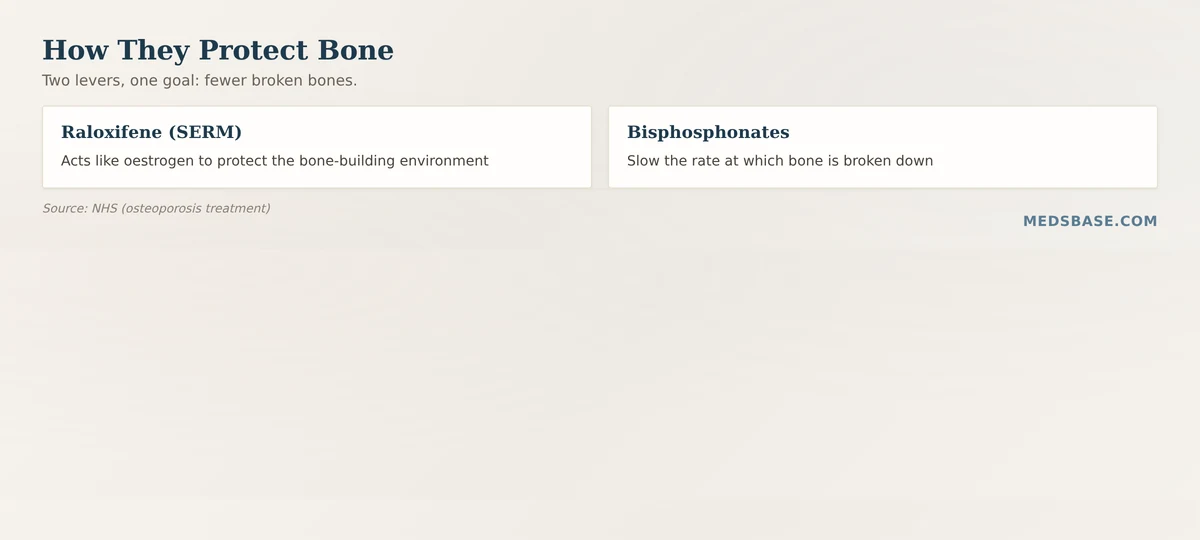
To appreciate raloxifene vs bisphosphonates, you need to understand that bone is living tissue that your body is constantly breaking down and rebuilding. Osteoporosis develops when more bone is broken down than replaced. The two medicines intervene on opposite sides of that balance.
Bisphosphonates work on the “breakdown” side. The NHS explains that they slow the rate at which bone is broken down. Think of bone as a bank account where deposits and withdrawals happen continuously; a bisphosphonate slows the withdrawals, so the balance stops shrinking. Alendronic acid, the most common example, is the medicine behind the weekly tablet many people recognise.
Raloxifene works on the “protection” side in a more hormonal way. The NHS notes that SERMs have a similar effect on bone to oestrogen. After menopause, falling oestrogen levels are a major driver of bone loss; raloxifene mimics oestrogen’s bone-protecting effect without being oestrogen itself. This is why raloxifene is specifically a postmenopausal medicine, and why it has the unusual effect of protecting bone while actually opposing oestrogen in some other tissues.
So the short version: raloxifene vs bisphosphonates is “protect the bone-building environment” versus “slow the bone-tearing-down.” Different levers, same goal — fewer broken bones.
It also helps to understand why both medicines are slow workers. Bone remodelling is a slow process measured in months, not days, so neither option produces a quick, dramatic change you can feel. The NHS notes that bisphosphonates usually take 6 to 12 months to work and may be needed for 5 years or longer. That timescale is not a sign the medicine is failing — it is how bone biology works. The payoff accumulates quietly: it is the fracture that never happens, years down the line, rather than a sensation you notice in week two.
This slowness has a practical consequence. Because you cannot “feel” the medicine working, the temptation to skip doses or stop early is real. With a weekly bisphosphonate, missing doses can mean missing much of the benefit; with a daily raloxifene tablet, consistency is equally the point. Understanding that the medicine is quietly reducing risk — even when you notice nothing — is what keeps people on track for the years these treatments need.
Side Effects: Raloxifene vs Bisphosphonates
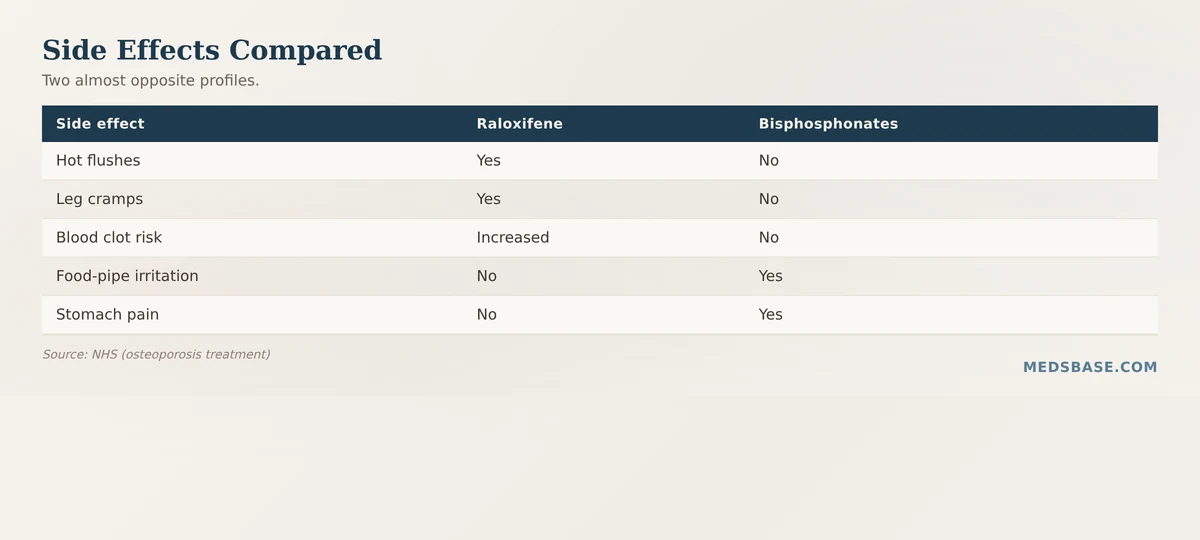
This is where raloxifene vs bisphosphonates becomes a very personal decision, because the side-effect profiles point in almost opposite directions.
Bisphosphonates primarily bother the digestive system. The NHS lists the main side effects as irritation to the food pipe, swallowing problems, and stomach pain. There is also a rare but serious side effect called osteonecrosis of the jaw, which the NHS notes is most frequently linked with high-dose intravenous bisphosphonate treatment for cancer rather than with osteoporosis treatment. If you already have stomach or oesophagus problems, this is the key drawback to weigh.
Raloxifene’s side effects are different. The NHS lists hot flushes and leg cramps, plus a potential increased risk of blood clots. That blood-clot risk is the most important one to understand: it means raloxifene is generally avoided in women with a history of blood clots or at high risk for them.
| Side effect | Raloxifene | Bisphosphonates |
|---|---|---|
| Hot flushes | Yes (common) | No |
| Leg cramps | Yes | No |
| Blood clot risk | Increased | No |
| Food-pipe irritation | No | Yes |
| Stomach pain | No | Yes |
| Swallowing problems | No | Yes |
| Jaw osteonecrosis | No | Rare (mostly high-dose IV) |
What this means for you: if your biggest worry is stomach discomfort, raloxifene’s profile may look more comfortable. If your biggest worry is blood-clot risk or you are bothered by hot flushes, a bisphosphonate may be the safer-feeling choice. Raloxifene vs bisphosphonates is genuinely a trade-off, which is why it should be discussed with a doctor who knows your full history.
How to Take Raloxifene vs Bisphosphonates
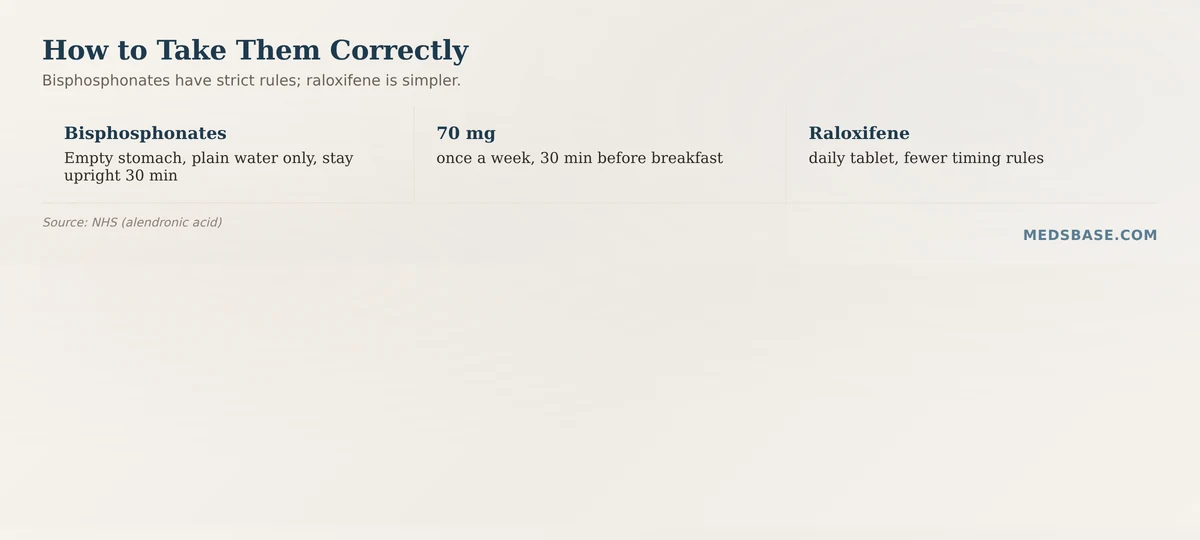
The practical, everyday difference between raloxifene vs bisphosphonates is hard to overstate: one has strict rules, the other is a simple daily tablet.
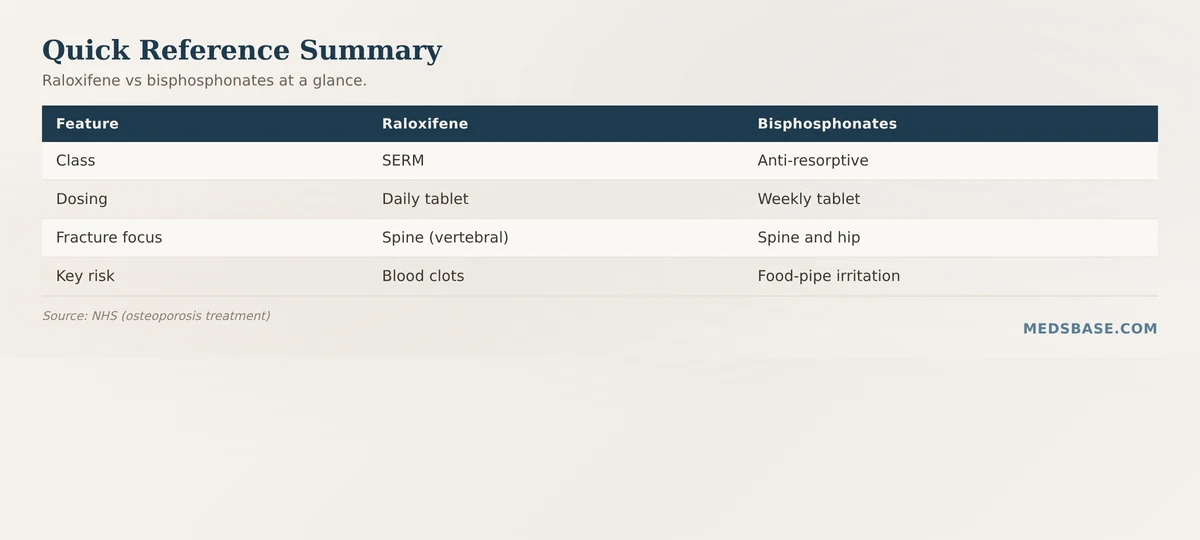
Raloxifene is taken as a daily tablet with no special food or posture requirements. It is, frankly, the easier routine — which matters for a medicine you may take for years.
Bisphosphonates demand more care, and getting it right is what makes them work. The NHS guidance on alendronic acid is precise: the usual dose is 70 mg taken once a week, on an empty stomach, 30 minutes before breakfast. You take it with plain tap water only — not mineral water, tea, coffee, juice, or milk, all of which can reduce absorption. And you must stay upright — sitting, standing, or walking — for 30 minutes afterward, and never take it at bedtime. These rules exist to protect your food pipe and to make sure the medicine is absorbed properly.
- Take bisphosphonates first thing, on an empty stomach, 30 minutes before food or other medicines
- Use plain tap water only — a full glass — and nothing else to wash it down
- Stay upright for 30 minutes after taking it; do not lie down
- Take raloxifene once daily, as a straightforward tablet with fewer timing rules
- Be consistent — both medicines protect bone only while you keep taking them
Mistakes to avoid:
- Taking a bisphosphonate with coffee or juice, which can sharply reduce how much is absorbed
- Lying down soon after a bisphosphonate dose, which can irritate the food pipe
- Stopping either medicine without a review — treatment is usually long term
If you are weighing an alendronate-based plan, getting the routine right is half the battle, and you can browse alendronate options at MedsBase to see what is available. If the stricter routine is a concern, raloxifene’s simplicity is a legitimate factor to raise with your doctor.
Raloxifene vs Bisphosphonates: Which Fits You
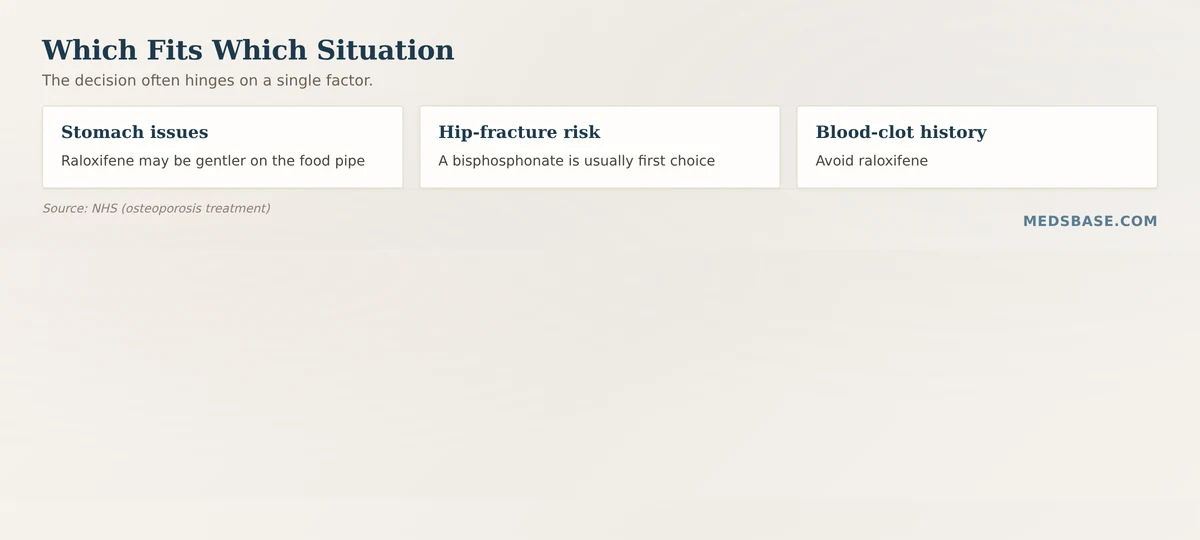
There is no single winner in raloxifene vs bisphosphonates — the right answer depends on your history, your risk factors, and your priorities. But a few patterns make the decision clearer.
A bisphosphonate is often the default first choice because it has the longest track record and strong evidence for reducing fractures at the hip and spine, and it works for a broad range of people. If you have osteoporosis confirmed by a bone-density scan, especially with a previous fracture, your doctor will very likely discuss a bisphosphonate first.
Raloxifene tends to come into its own in specific situations: when you are a postmenopausal woman who cannot tolerate or is at higher risk of digestive side effects from bisphosphonates, or when the breast-related protective effect is a relevant consideration for you. Its fracture-reduction evidence is strongest for the spine, which is why the decision sometimes hinges on which fracture matters most to you.
- For: postmenopausal women with thinning bones deciding between the two most common oral options.
- Raloxifene suits: women who want a simpler daily routine, who have stomach or oesophagus problems, or who value the breast-related effect.
- Bisphosphonates suit: people needing broad fracture protection, including hip-fracture risk, and those without digestive issues or who cannot take raloxifene due to clot risk.
- Avoid raloxifene: if you have a history of blood clots or are at high clot risk.
- Always: decide with a doctor, who will weigh your bone-density results, fracture history, and personal risk factors.
If you are leaning toward raloxifene, you can see raloxifene options at MedsBase to understand what is available. The important thing is not to choose raloxifene vs bisphosphonates alone — it is to walk into the conversation informed.
Why the type of fracture matters. One of the most useful questions to ask your doctor is “which bone are we most worried about?” because the two medicines have different strengths here. Bisphosphonates have broad, long-established evidence for reducing fractures at both the spine and the hip — and hip fractures are the ones most strongly linked to loss of independence and serious complications. Raloxifene’s fracture-reduction evidence is strongest for the spine, where it has been shown to reduce the risk of vertebral fractures. If your personal risk profile is dominated by hip-fracture risk, a bisphosphonate is usually the more natural starting point; if spinal fractures are the main concern and digestive side effects are a worry, raloxifene becomes a more attractive candidate. This single question — which bone, which risk — often clarifies the raloxifene vs bisphosphonates decision faster than any amount of general comparison.
Vertebral fractures hide in plain sight. A broken bone in the spine does not always announce itself dramatically. It can arrive as height loss, a stooped posture, or nagging back pain that is easy to write off. This is partly why osteoporosis is called a silent disease, and why the decision to treat — and treat consistently — is often made before any fracture occurs, based on a bone-density scan and a fracture-risk assessment rather than waiting for a break.
What the Research Says
The evidence behind raloxifene vs bisphosphonates is well established, and the authority sources agree on the core picture.
| Source | Key finding |
|---|---|
| NHS — osteoporosis treatment | Bisphosphonates slow bone breakdown; raloxifene is the only SERM for osteoporosis, for postmenopausal women only, with hot flushes/leg cramps/clot-risk side effects |
| NHS — alendronic acid | 70 mg weekly, empty stomach, plain water only, stay upright 30 min; long-term use 3–5+ years |
| MedlinePlus — osteoporosis | Bone loss from breakdown exceeding rebuild; more common in postmenopausal women; fractures most often in hip, spine, wrist |
What this means for you: the choice in raloxifene vs bisphosphonates is not about whether one works — both are backed by solid evidence — but about which profile matches your body and your life. That is a genuinely reassuring conclusion, because it means there is almost always a workable option; the task is matching it to you.
There is honest uncertainty too. No medicine removes fracture risk entirely, and both options require years of use to deliver their full benefit. Side effects, while real, are manageable when the medicine is chosen and monitored carefully — which is why regular follow-up is part of the deal.
The most reassuring takeaway from the research is how much clinical experience now sits behind both options. Bisphosphonates have been used for decades, and raloxifene has an established track record in postmenopausal women, which means the question in raloxifene vs bisphosphonates is rarely “does this work?” and almost always “which profile fits this patient?” — a much more answerable question, and one your doctor is well equipped to help you settle.
Beyond the Choice: Calcium, Vitamin D, and Bone-Health Habits
Choosing between raloxifene vs bisphosphonates is important, but neither medicine works in isolation. The foundation beneath both is the same, and it is worth getting right regardless of which option you and your doctor settle on.
Calcium and vitamin D come first. The NHS emphasises that adequate calcium and vitamin D are essential, and that people with osteoporosis may need supplements in addition to diet. Vitamin D helps the body absorb calcium, and the NHS advises that all adults aim for 10 micrograms of vitamin D a day, especially during autumn and winter when sunlight is scarce. Medicine can only work on a skeleton that has the raw materials to rebuild.
Weight-bearing movement protects bone. Bone responds to load, so activities that put gentle stress through the skeleton — walking, and for many people resistance training — help preserve density. Balance work matters too, because preventing a fall prevents the fracture that the medicine is trying to avoid. This is why any osteoporosis plan pairs medication with movement, not either alone.
The other lifestyle levers are the familiar ones. Not smoking and limiting alcohol both support bone health, and MedlinePlus lists smoking, heavy alcohol use, and physical inactivity among the lifestyle factors that contribute to bone loss. These are within your control, and they multiply the benefit of whichever medicine you choose.
Know there are options beyond these two. The decision is not only raloxifene vs bisphosphonates. The NHS treatment page also describes parathyroid-hormone treatment (such as teriparatide), which actually stimulates new bone formation rather than just slowing loss, and biological medicines (denosumab and romosozumab), given by injection. These are typically reserved for severe osteoporosis or people who cannot take the oral options. Knowing the full menu helps you understand where raloxifene vs bisphosphonates sits — it is usually the first decision, not the last resort.
Mistakes to avoid:
- Taking a bisphosphonate with the right timing but forgetting it needs calcium and vitamin D too
- Stopping treatment because a follow-up scan showed only a modest change
- Assuming medication removes the need for fall prevention and weight-bearing exercise
Frequently Asked Questions
Q: What is raloxifene?
A: Raloxifene is a selective oestrogen receptor modulator (SERM) — a medicine that acts like oestrogen in some tissues, including bone. The NHS explains that it helps maintain bone density and reduce fracture risk, particularly in the spine, and it is the only SERM available for treating osteoporosis.
Q: What are bisphosphonates?
A: Bisphosphonates are a class of medicines that slow the rate at which bone is broken down, maintaining bone density and reducing fracture risk. The NHS lists alendronic acid, ibandronic acid, risedronate, and zoledronic acid as the main examples.
Q: Is raloxifene or alendronate better for osteoporosis?
A: Neither is universally better — it depends on your situation. Alendronate (a bisphosphonate) has the longest track record and broad fracture protection, while raloxifene may suit women who cannot tolerate digestive side effects or who value its breast-related effect. Your doctor can weigh bone-density results, fracture history, and risk factors.
Q: Does raloxifene prevent fractures?
A: Yes. The NHS states that raloxifene helps maintain bone density and reduces the risk of fracture, particularly of the spine. Its evidence is strongest for vertebral (spinal) fractures.
Q: What are the side effects of bisphosphonates?
A: The NHS lists irritation to the food pipe, swallowing problems, and stomach pain as the main side effects, with osteonecrosis of the jaw as a rare side effect most often linked to high-dose intravenous treatment for cancer.
Q: Who should not take raloxifene?
A: Raloxifene is only recommended for women after the menopause, and the NHS notes a potential increased risk of blood clots. It is generally avoided in women with a history of blood clots or who are at high risk for them.
Q: How do I take alendronate correctly?
A: The NHS advises taking the usual 70 mg dose once a week, first thing on an empty stomach, 30 minutes before breakfast, with a full glass of plain tap water only — and staying upright for 30 minutes afterward.
Q: How long do you take bisphosphonates for?
A: The NHS notes that bisphosphonates are usually taken long term, for at least 3 to 5 years, after which your doctor reviews whether you still need them. Depending on your bone-density results and fracture risk, you may continue, take a break, or stop — which is why regular review is part of the plan.
Q: Can you take raloxifene and bisphosphonates together?
A: These two medicines are not typically used together — they are alternatives within a treatment plan, and your doctor will generally choose one based on your profile rather than combining them. Calcium and vitamin D, by contrast, are commonly recommended alongside whichever of the two you take. Always follow your doctor’s guidance on combining any medicines.
Q: Does raloxifene cause weight gain or affect the breasts?
A: Raloxifene’s commonly reported side effects are hot flushes and leg cramps, with a potential increased risk of blood clots. Because it is a selective oestrogen receptor modulator, it acts like oestrogen in bone while blocking oestrogen-like effects in breast tissue — a property some women value — but any question about breast-related effects should be discussed directly with your doctor.
The Bottom Line
Raloxifene vs bisphosphonates is not a contest with a single winner — it is a fit question, and understanding the difference is what turns an anxious decision into an informed one. Bisphosphonates are the proven, broad first choice with strict dosing rules and digestive side effects; raloxifene is a gentler-on-the-stomach, simpler-to-take alternative that works like oestrogen on bone but carries a blood-clot risk. Both protect bone; they simply protect it, and feel, differently.
Your next step is to bring the right questions to your doctor: your bone-density results, your fracture history, and your personal tolerance for each side-effect profile. And while you are preparing, it helps to understand the options concretely — compare the osteoporosis medicines available at MedsBase, starting with the raloxifene and alendronate options this guide covered. Want to go deeper on the bisphosphonate side before you decide? Read our full bisphosphonates guide.

Written by
Sophie ChenPharmaceutical Content Researcher · 8 years experience
Sophie Chen is a pharmaceutical content researcher with 8 years covering generic medication access and clinical pharmacology. She specialises in international regulatory frameworks, bioequivalence standards, and patient-facing education on therapeutic drug classes. She is not a clinician.