








✓ Medically reviewed by · Last reviewed: May 2026
Pharmacy Researcher · 8 years experience
Pharmacy researcher with 8 years reviewing clinical drug information, generic formulation equivalence, and international pharmaceutical standards. Focuses on patient-facing accuracy in medication education.
blood pressure medication morning vs evening — Blood Pressure Medication Morning vs Evening — What the 2026 Evidence Actually Says. Read on for an evidence-backed guide covering everything you need to know.
Key Takeaways
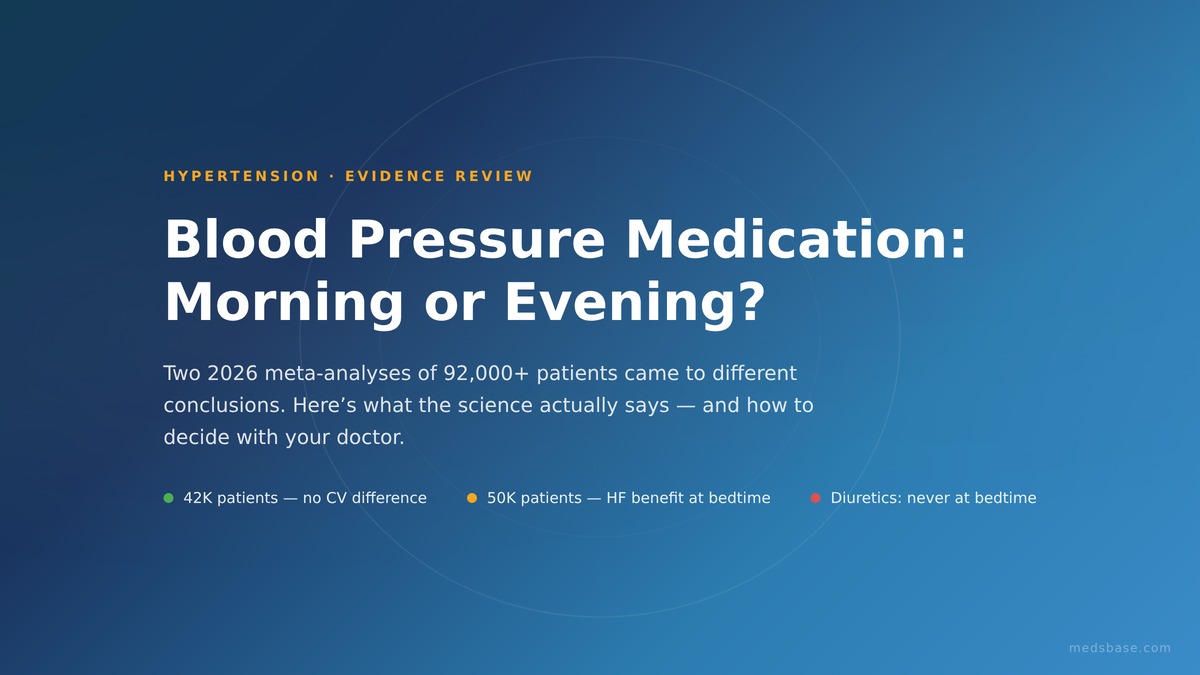
- Two major 2026 meta-analyses analyzing over 90,000 patients combined reach different conclusions — one finds no significant cardiovascular advantage to bedtime dosing, the other finds reduced heart failure risk
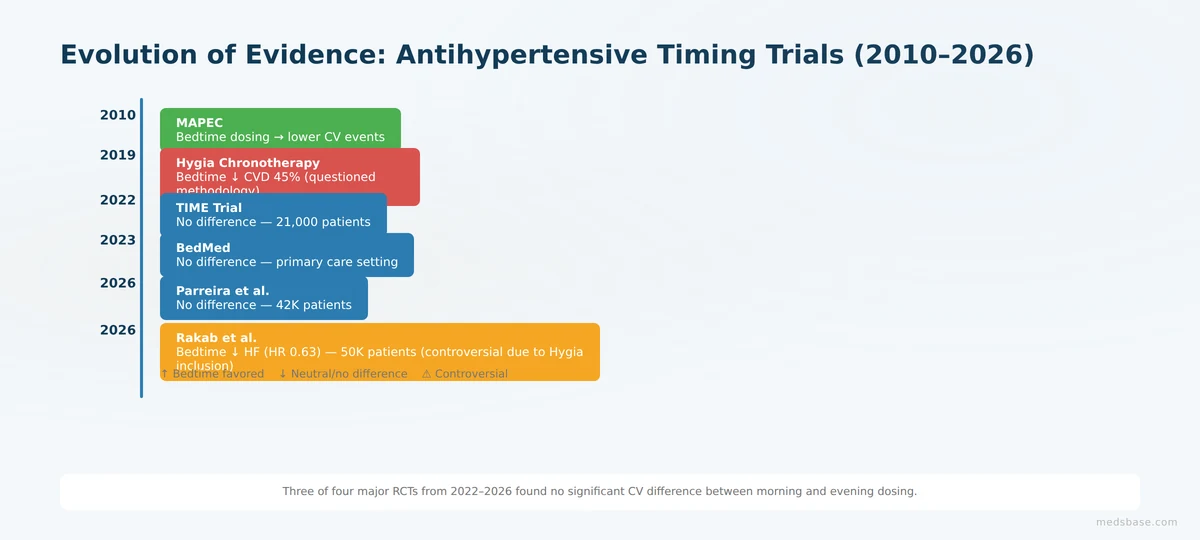
- The scientific controversy traces back to the Hygia Project (2019), whose dramatic findings of 45% cardiovascular risk reduction with bedtime dosing have been questioned over data integrity concerns
- The two largest, most rigorous contemporary trials — TIME (21,104 patients) and BedMed (3,357 patients) — found no significant difference between morning and evening dosing on cardiovascular outcomes
- Despite the conflicting evidence, one finding is consistent: blood pressure medications work when you take them consistently, regardless of time of day
- The 2026 meta-analyses highlight a critical point: earlier studies favored bedtime dosing, but the evidence has shifted as larger and better-controlled trials have been published
- Your individual circadian blood pressure pattern — not a one-size-fits-all rule — should guide the timing decision, and only 24-hour ambulatory monitoring can reveal that pattern
Blood pressure medication morning vs evening — if you take medication for high blood pressure, you have probably heard the advice: “Take it at night — it works better.” Maybe your friend switched to bedtime dosing and swears their numbers improved. Maybe you read a news headline claiming evening dosing cuts heart attack risk. But when you asked your doctor, they said morning is fine. Who is right?
Two major meta-analyses published in 2026 — analyzing a combined total of over 90,000 patients — reached different conclusions on a question that affects roughly 1.3 billion people worldwide. One review found no significant cardiovascular outcome difference between morning and evening dosing. The other found that bedtime dosing reduced heart failure incidence by 37% and lowered evening systolic blood pressure by nearly 5 mmHg. Both are peer-reviewed. Both analyze randomized controlled trials. And both were published within months of each other.
Blood pressure medication morning vs evening is not a settled question — and understanding why the evidence splits is more useful than picking a side. Here is exactly what the data shows, where the controversy comes from, and the one factor that matters more than timing.
- What Does Blood Pressure Medication Morning vs Evening Mean?
- How Does Blood Pressure Naturally Change Throughout the Day?
- What Does the 2026 Evidence Say About Blood Pressure Medication Morning vs Evening?
- Why Does the Evidence Conflict?
- Blood Pressure Medication Morning vs Evening by Drug Class
- Blood Pressure Medication Morning vs Evening vs Other BP Strategies
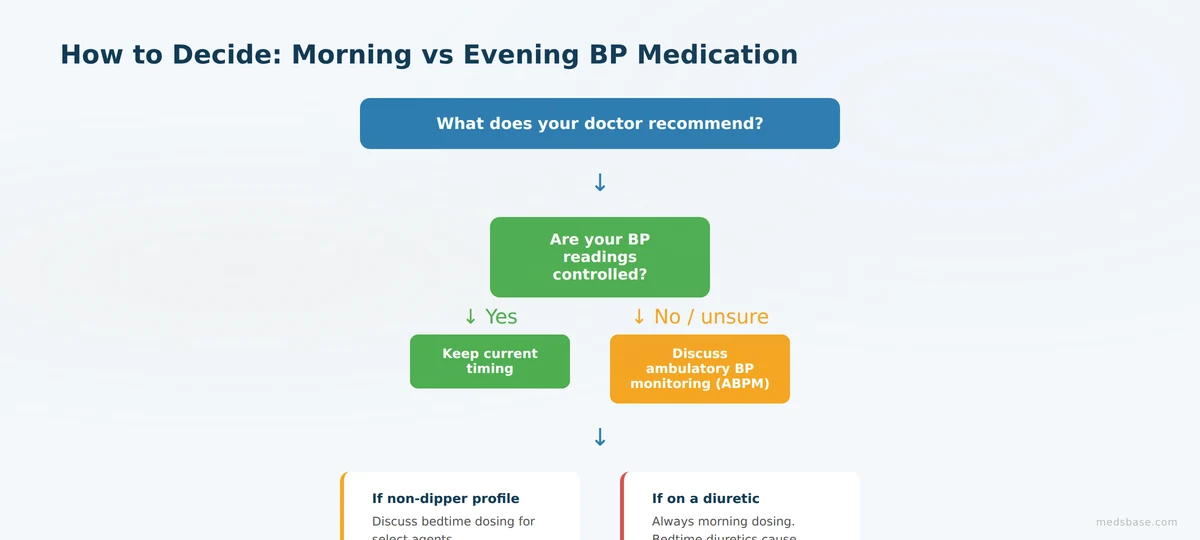
- How to Decide: Blood Pressure Medication Morning vs Evening for Your Situation
- Related Reading
- Frequently Asked Questions
- The Bottom Line
What Does Blood Pressure Medication Morning vs Evening Mean?
Quick Answer: “Chronotherapy” in hypertension means timing your blood pressure medication to align with your body’s natural circadian blood pressure rhythm. The theory: since heart attacks and strokes peak in the early morning hours (6 AM–noon), and blood pressure normally dips during sleep, taking medication at bedtime might provide better protection during the vulnerable morning surge. Morning dosing means taking all your blood pressure pills after waking. Evening dosing means taking them at bedtime.
Blood pressure medication morning vs evening — the question matters because high blood pressure is the leading preventable risk factor for cardiovascular disease worldwide. Even modest improvements in blood pressure control translate to fewer heart attacks and strokes at the population level. If simply changing the time of day you swallow a pill could meaningfully reduce your risk — without changing the dose, adding a medication, or spending more money — that would be one of the most cost-effective interventions in medicine.
Blood pressure medication morning vs evening — but biology is rarely that simple. Blood pressure medications have different durations of action. Some last 24 hours with once-daily dosing; others wear off after 12–18 hours. The body’s circadian clock influences drug metabolism, kidney function, and vascular tone — all of which affect how a given medication behaves at different times of day. And then there is the human factor: people are far more likely to remember a morning pill, attached to a morning routine like brushing teeth, than an evening pill.
How Does Blood Pressure Naturally Change Throughout the Day?
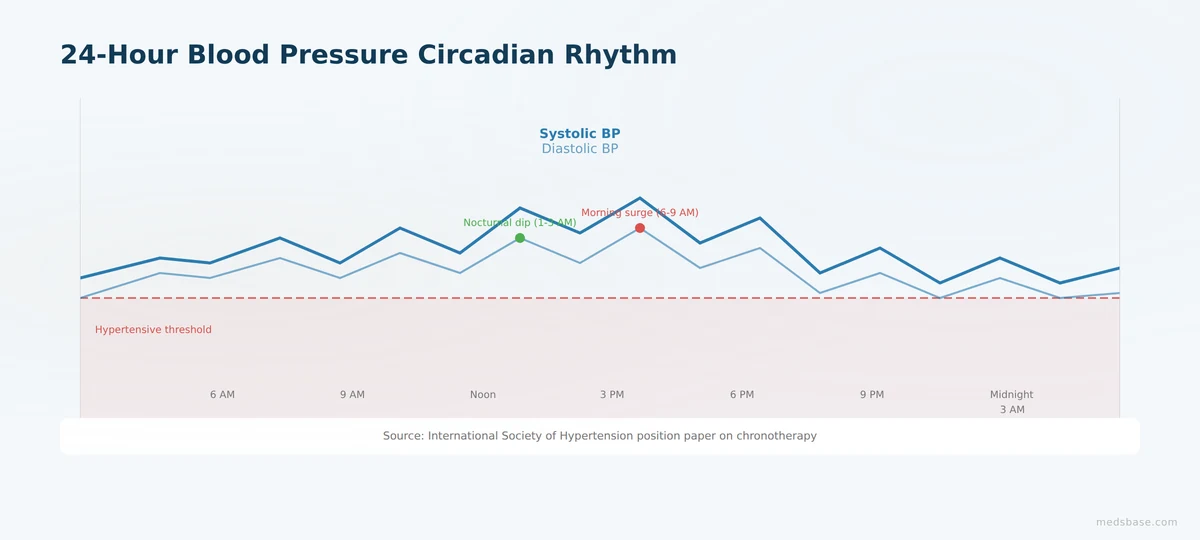
Quick Answer: Blood pressure follows a circadian rhythm. It drops by 10–20% during sleep (the “nocturnal dip”), rises sharply upon waking (the “morning surge,” peaking around 6–9 AM), stays elevated through the day, and begins declining again in the evening. A healthy “dipper” pattern — ≥10% drop in nighttime vs daytime blood pressure — is associated with lower cardiovascular risk. People whose blood pressure fails to dip at night (“non-dippers”) are at higher risk of heart attack, stroke, and kidney damage.
According to the International Society of Hypertension, nighttime blood pressure is a stronger predictor of cardiovascular events than daytime or clinic blood pressure. This finding — that what happens while you sleep matters more than what the doctor measures in the office — is the biological rationale for bedtime dosing. If taking medication at night lowers nighttime blood pressure, the logic goes, it should reduce cardiovascular events more than morning dosing.
Blood pressure medication morning vs evening — but there is a problem with this logic: lowering nighttime blood pressure with medication does not automatically translate to fewer heart attacks and strokes. The relationship between blood pressure and outcomes is not purely mechanical — it is mediated by complex pathways involving arterial stiffness, endothelial function, inflammation, and autonomic balance. A medication that lowers nighttime readings might or might not influence those pathways in a clinically meaningful way. That is why we need outcome trials, not just blood pressure measurements.
What Does the 2026 Evidence Say About Blood Pressure Medication Morning vs Evening?
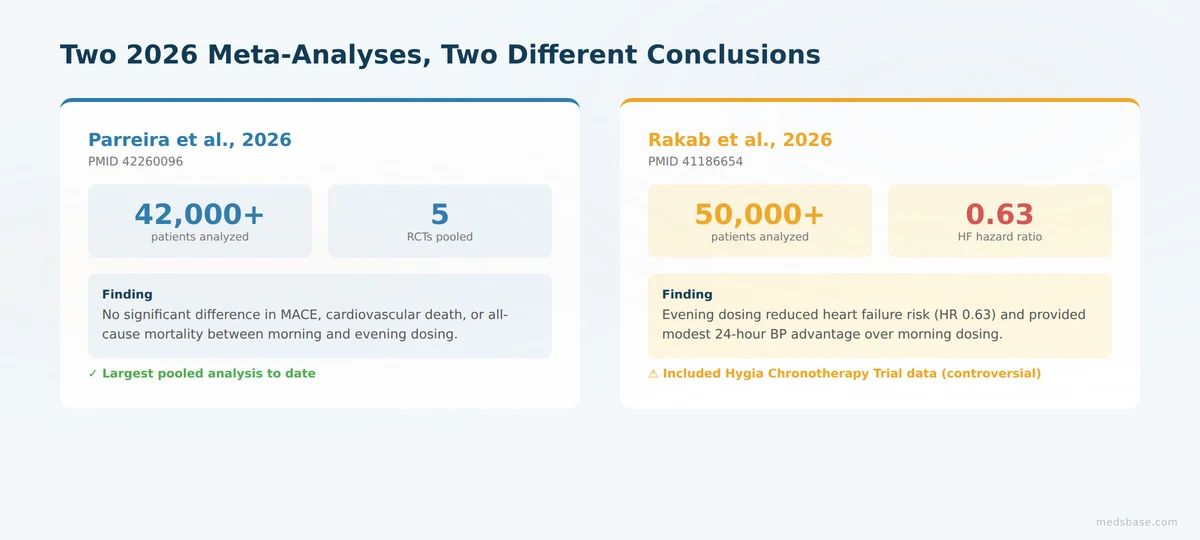
Blood pressure medication morning vs evening — two major meta-analyses published in 2026 analyzed the best available evidence — and reached different conclusions. Here is what each found:
Parreira et al. (2026) — No Significant Difference
This systematic review and meta-analysis published in the Journal of Human Hypertension analyzed 42,075 patients from five studies comparing morning versus nighttime antihypertensive dosing. The results:
| Outcome | Morning vs Nighttime | 95% CI | Interpretation |
|---|---|---|---|
| All-cause mortality | RR 0.99 | 0.91–1.08 | No difference |
| Myocardial infarction | RR 1.14 | 0.98–1.33 | No significant difference |
| Major adverse CV events | RR 1.04 | 0.92–1.19 | No difference |
| Stroke | RR 0.95 | 0.75–1.20 | No difference |
Blood pressure medication morning vs evening — the authors concluded: “These findings suggest that the timing of antihypertensive administration does not significantly influence major cardiovascular outcomes. Our results align with contemporary high-quality randomized trials (TIME, BedMed) and contrast with earlier meta-analyses.”
Rakab et al. (2026) — Bedtime May Reduce Heart Failure
This GRADE-assessed meta-analysis in High Blood Pressure & Cardiovascular Prevention analyzed 49,983 patients from six randomized controlled trials. The results:
| Outcome | Bedtime vs Morning | 95% CI | Interpretation |
|---|---|---|---|
| Heart failure | RR 0.63 | 0.47–0.85 | Bedtime dosing reduced HF by 37% |
| Myocardial infarction | RR 0.87 | 0.64–1.17 | Not statistically significant |
| Stroke or TIA | RR 0.71 | 0.49–1.05 | Not statistically significant |
| All-cause mortality | RR 0.75 | 0.53–1.06 | Not statistically significant |
| Evening systolic BP | MD -4.71 mmHg | -6.64 to -2.78 | Bedtime lowered SBP by 4.7 mmHg |
This analysis concluded: “Bedtime administration of anti-hypertensive medications may be associated with reduction in MACE and heart failure incidence.”
The contrast is stark: one meta-analysis says timing does not matter for any major cardiovascular outcome; the other says bedtime dosing may cut heart failure risk by over a third. How can two rigorous analyses of similar evidence come to opposite conclusions?
Why Does the Evidence on Blood Pressure Medication Morning vs Evening Conflict?
Quick Answer: The conflict traces back to which studies are included. The Hygia Project — a large Spanish study published in 2019 that reported a dramatic 45% reduction in cardiovascular events with bedtime dosing — heavily influenced earlier meta-analyses and guidelines. But Hygia’s methods and data integrity have been questioned by multiple independent researchers. When Hygia is excluded (as Parreira et al. did), the bedtime advantage largely disappears. When it is included (as Rakab et al. did), a signal for heart failure reduction remains. This single study — and the controversy around it — is the hidden variable behind most of the conflicting advice.
The Hygia Controversy
The Hygia Project, led by Dr. Ramón Hermida, enrolled over 19,000 patients in Spain and reported that bedtime dosing reduced cardiovascular death by 56%, myocardial infarction by 34%, and stroke by 49% compared to morning dosing. These are enormous effect sizes — larger than most blood-pressure-lowering drugs achieve. They attracted both excitement and scrutiny.
Independent statisticians and trialists raised concerns about the randomization method, the implausibly low event rates in the morning-dosing group, and inconsistencies in the reported data. The European Heart Journal, which published the original Hygia paper, issued an expression of concern in 2020. Hermida and colleagues defended their work, but the controversy has not been fully resolved.
The two landmark trials that followed — TIME (UK, 21,104 patients) and BedMed (Canada, 3,357 patients) — both used rigorous randomization and found no significant difference between morning and evening dosing on cardiovascular outcomes. These are the trials Parreira et al. emphasized and that have shifted the consensus away from a universal bedtime recommendation.
What This Means for You
The International Society of Hypertension’s 2022 position paper — endorsed by the World Hypertension League and European Society of Hypertension — acknowledged the Hygia controversy and concluded that while bedtime dosing may be considered for some patients, the evidence is not strong enough for a universal recommendation. The key insight: what matters is that you take your medication consistently, at a time you will remember, every single day.
Blood Pressure Medication Morning vs Evening by Drug Class
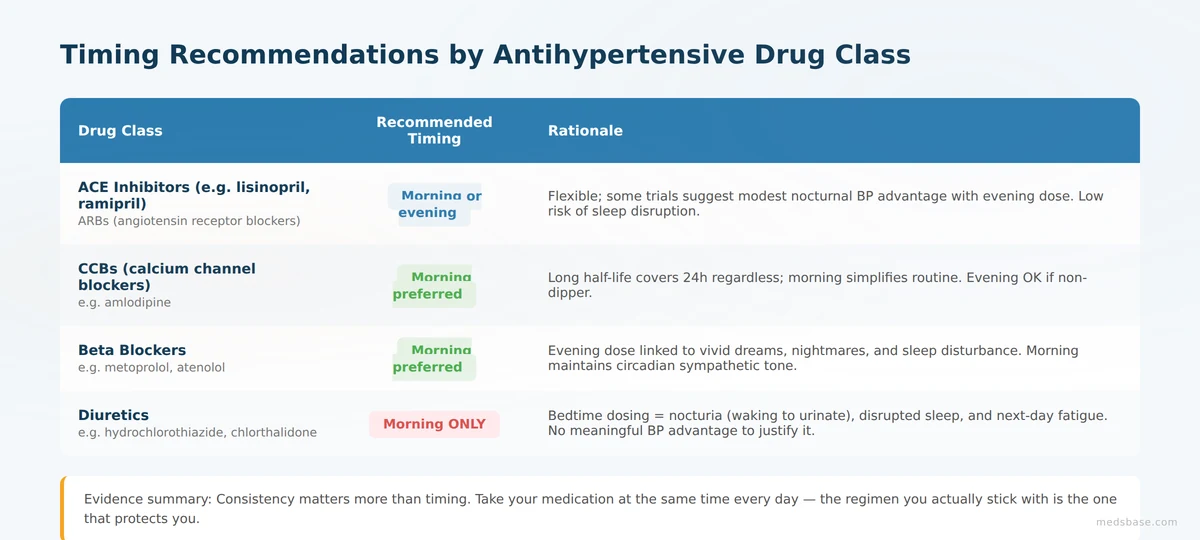
Not all blood pressure medications are created equal when it comes to timing. The duration of action, side-effect profile, and mechanism of each class affect whether morning or evening dosing is more appropriate.
| Drug Class | Examples | Typical Recommendation | Evening Consideration | Morning Consideration |
|---|---|---|---|---|
| ACE Inhibitors | Lisinopril, Enalapril, Ramipril | Morning or evening — no strong evidence favoring either | May be studied for bedtime; consistent timing matters more | Easy to remember with morning routine |
| ARBs | Losartan, Valsartan, Telmisartan | Morning or evening — telmisartan has longest half-life (24h) | Some evidence for evening; longer-acting ARBs cover 24h regardless | Standard for most patients |
| Calcium Channel Blockers | Amlodipine, Nifedipine | Morning standard; amlodipine has 30–50h half-life so timing flexible | No strong rationale for bedtime unless nocturnal HTN confirmed | Morning surge coverage is a theoretical advantage |
| Beta Blockers | Metoprolol, Atenolol, Bisoprolol | Morning standard | Evening may reduce morning surge but evidence is mixed | Matches natural heart-rate circadian pattern |
| Diuretics | Hydrochlorothiazide, Chlorthalidone, Furosemide | Morning ONLY — evening dosing causes nocturia and sleep disruption | Avoid evening dosing unless specifically directed by doctor | Prevents nighttime bathroom trips |
The critical exception: diuretics should almost always be taken in the morning. Taking a water pill at night guarantees you will wake up to use the bathroom — possibly multiple times — disrupting the very sleep that helps control blood pressure. No clinical trial has found a cardiovascular benefit to nighttime diuretic dosing that outweighs the sleep disruption it causes.
For other drug classes, the evidence is genuinely mixed. If your blood pressure is well-controlled on morning dosing, there is no compelling reason to switch based on current evidence. If your blood pressure runs high at night (confirmed by 24-hour ambulatory monitoring), discussing evening dosing of a long-acting ACE inhibitor or ARB with your doctor is reasonable.
Blood Pressure Medication Morning vs Evening vs Other BP Strategies
Timing is one variable among many. Here is how it compares with other evidence-based strategies for controlling blood pressure.
| Strategy | Evidence Strength | Effect Size | Effort Required |
|---|---|---|---|
| Taking medication consistently | Very strong | ~10-15 mmHg SBP reduction | Low (daily pill) |
| DASH diet / sodium reduction | Very strong | ~5-11 mmHg SBP reduction | Moderate to high |
| Regular aerobic exercise | Very strong | ~5-8 mmHg SBP reduction | Moderate (150 min/week) |
| Weight loss (if overweight) | Very strong | ~1 mmHg per kg lost | High (sustained caloric deficit) |
| Evening vs morning dosing | Mixed / controversial | 0-5 mmHg evening SBP; uncertain CV benefit | None (just timing change) |
| Stress reduction / meditation | Moderate | ~3-5 mmHg SBP reduction | Moderate (daily practice) |
The takeaway: if you are not yet consistently taking your medication every day, fixing adherence is far more impactful than debating morning versus evening timing. The best dosing time is the one you will remember. A missed morning pill does zero for your blood pressure; a consistently taken evening pill — even if the theoretical advantage is modest — is infinitely better than an inconsistently taken morning one.
How to Decide: Blood Pressure Medication Morning vs Evening for Your Situation
There is no universal answer, but there is a universal process. Here are the steps to follow, in order of importance:
- Do what your doctor says. If your doctor has specifically recommended morning or evening dosing based on your individual health profile, follow that advice. They know your full medication list, comorbidities, and blood pressure pattern in a way that no general guideline can account for.
- Prioritize consistency above all else. The single most important factor in blood pressure control is taking your medication every day. If you are more likely to remember a morning pill (attached to brushing your teeth or breakfast), take it in the morning. If you are more reliable with an evening routine, take it at night. A consistently timed pill beats an optimally timed but frequently missed one.
- Know your 24-hour blood pressure pattern. The only way to know whether you are a “dipper” or “non-dipper” is 24-hour ambulatory blood pressure monitoring (ABPM). If your nighttime blood pressure stays elevated (non-dipper pattern), you and your doctor may consider evening dosing of a long-acting medication — particularly an ACE inhibitor or ARB, given the meta-analysis signal for heart failure reduction.
- Watch for practical side effects. Diuretics at night = bathroom trips. Beta blockers at night may cause vivid dreams in some people. Some calcium channel blockers cause ankle swelling that might be more noticeable at night. If a particular timing causes side effects that impair your quality of life, the theoretical benefit is probably not worth it.
- Consider your drug class. As listed in the table above, some medications are clearly better suited to morning (diuretics), some to potentially either (ACE inhibitors, ARBs), and some have half-lives long enough that timing barely matters (amlodipine).
- Do not switch without talking to your doctor. If you are currently taking morning medication and your blood pressure is well-controlled, there is no compelling evidence that switching to evening dosing will improve your outcomes. But if you and your doctor decide to try evening dosing, switch gradually and monitor your blood pressure at different times of day to ensure coverage remains adequate.
The most common mistake patients make: hearing that “bedtime dosing is better” from a news article or friend, switching without telling their doctor, and ending up with poorly controlled daytime blood pressure because their medication’s duration of action does not cover the full 24 hours. Always involve your prescriber in timing changes.
Related Reading
- Read our practical guide: Isometric Exercise for Lowering Blood Pressure — how 12-minute wall sits and handgrip exercises can drop your systolic pressure by 5–8 mmHg without medication.
- Explore MedsBase’s blood pressure category to compare available medications and understand your options.
Frequently Asked Questions
Q: Should I take blood pressure medication in the morning or at night?
A:
A: Blood pressure medication morning vs evening is not settled by current evidence. Two 2026 meta-analyses reached different conclusions: one (Parreira et al., 42,075 patients) found no significant cardiovascular outcome difference between dosing times, while another (Rakab et al., 49,983 patients) found bedtime dosing reduced heart failure by 37% and lowered evening systolic blood pressure by 4.7 mmHg. The most important factor is taking your medication consistently every day at a time you will remember. Follow your doctor’s specific recommendation and do not switch timing without consulting them.
Q: Is it better to take blood pressure pills at bedtime?
A:
A: There is no universal “better.” The largest and most rigorous contemporary trials (TIME, 21,104 patients; BedMed, 3,357 patients) found no significant difference in cardiovascular outcomes between bedtime and morning dosing. Some earlier studies — particularly the Hygia Project — reported large benefits with bedtime dosing, but these findings have been questioned over methodological concerns. If your doctor has not specifically recommended bedtime dosing and your morning routine ensures you never miss a dose, morning dosing is supported by the best current evidence.
Q: Does timing of blood pressure medication really matter?
A:
A: The evidence is mixed. Blood pressure medication morning vs evening timing may matter for certain subgroups — such as people with confirmed nocturnal hypertension (non-dippers) — but the 2026 meta-analyses suggest that for most patients, the timing makes little to no difference in major cardiovascular outcomes. What matters more than timing: taking your medication every day, controlling your blood pressure to target, and combining medication with lifestyle strategies like sodium reduction and regular exercise.
Q: What did the TIME trial find about blood pressure medication timing?
A:
A: The TIME trial (Treatment in Morning versus Evening), published in 2022, randomized 21,104 patients in the UK to morning or evening dosing of their usual antihypertensive medications and followed them for a median of 5.2 years. It found no significant difference between morning and evening dosing for the primary composite endpoint of vascular death or hospitalization for non-fatal myocardial infarction or stroke. This was the largest and most methodologically rigorous trial on the question, and its neutral result significantly shifted the evidence landscape.
Q: What is the Hygia Project and why is it controversial?
A:
A: The Hygia Project was a large Spanish study (over 19,000 patients) that reported bedtime dosing reduced cardiovascular death by 56%, heart attack by 34%, and stroke by 49% compared to morning dosing. These dramatic results led to widespread recommendations for bedtime dosing. However, independent researchers raised concerns about the randomization methodology, implausibly low event rates in the control group, and data inconsistencies. The European Heart Journal issued an expression of concern in 2020. The controversy remains unresolved, and the two landmark trials that followed (TIME and BedMed) did not replicate Hygia’s findings.
Q: Can I switch my blood pressure medication from morning to evening?
A:
A: You can, but only after discussing it with your doctor. If you currently take a diuretic (water pill), switching to evening dosing is almost never recommended — it will cause nighttime urination that disrupts sleep. If you take a long-acting ACE inhibitor, ARB, or amlodipine, an evening switch may be reasonable if your doctor agrees. Key precautions: do not double-dose (taking both morning and evening on the day you switch), monitor your blood pressure at different times of day after switching, and report any new side effects to your doctor.
Q: What if I forget to take my blood pressure medication — should I take it later or skip?
A:
A: General guidance from the NHS and other health authorities: if you remember within a few hours of your usual time, take it. If it is nearly time for your next dose, skip the missed dose and continue your normal schedule. Never take a double dose to make up for a missed one. If you frequently forget doses, the timing debate is secondary — focus on establishing a consistent reminder system first. A morning-pill organizer, phone alarm, or linking medication to an existing daily habit (like making coffee) is more impactful than switching to a theoretically optimal time.
Q: Does blood pressure medication morning vs evening matter for people with diabetes or kidney disease?
A:
A: Patients with diabetes or chronic kidney disease are more likely to have a non-dipping blood pressure pattern (nighttime blood pressure that stays elevated rather than dropping by 10–20%). Some evidence suggests this subgroup may benefit more from evening dosing, but the 2026 meta-analyses did not find a consistent advantage across subgroups. If you have diabetes or kidney disease, 24-hour ambulatory blood pressure monitoring is particularly valuable — it can reveal whether your nighttime blood pressure is elevated and guide a personalized timing decision with your doctor.
The Bottom Line
Blood pressure medication morning vs evening is a debate where the best evidence has shifted over time. Early studies — particularly the Hygia Project — suggested large benefits from bedtime dosing. The largest and most rigorous contemporary trials (TIME, BedMed) found no significant difference. The two 2026 meta-analyses capture this split: one finds no advantage to either timing, the other finds a possible heart-failure benefit with evening dosing but no mortality or stroke difference.
The practical conclusion: take your blood pressure medication at the time you are most likely to remember, every single day. If your blood pressure is well-controlled and you never miss a morning dose, there is no compelling reason to switch based on current evidence. If you have confirmed nocturnal hypertension (via 24-hour ABPM) or are a “non-dipper,” discuss evening dosing of a long-acting ACE inhibitor or ARB with your doctor. And never take a diuretic at night — the sleep disruption alone counteracts any theoretical blood pressure benefit.
What to do today: If you are not sure about your 24-hour blood pressure pattern, ask your doctor about ambulatory blood pressure monitoring at your next visit. Knowing whether you are a dipper or non-dipper is more actionable than any general guideline about timing.
What to read next:
- Isometric Exercise for Lowering Blood Pressure — a medication-free strategy backed by strong evidence.
- Browse MedsBase’s blood pressure medications — compare options across all major drug classes.
Medical Disclaimer: This article is for informational purposes only and does not constitute medical advice. Never change the timing or dose of your blood pressure medication without consulting your doctor. Abrupt changes to antihypertensive therapy can cause dangerous blood pressure fluctuations.

Written by
Sophie ChenPharmaceutical Content Researcher · 8 years experience
Sophie Chen is a pharmaceutical content researcher with 8 years covering generic medication access and clinical pharmacology. She specialises in international regulatory frameworks, bioequivalence standards, and patient-facing education on therapeutic drug classes. She is not a clinician.