








✓ Medically reviewed by · Last reviewed: May 2026
Pharmacy Researcher · 8 years experience
Pharmacy researcher with 8 years reviewing clinical drug information, generic formulation equivalence, and international pharmaceutical standards. Focuses on patient-facing accuracy in medication education.
clomiphene vs enclomiphene — Clomiphene vs Enclomiphene: 7 Key Differences Explained. Read on for an evidence-backed guide covering everything you need to know.
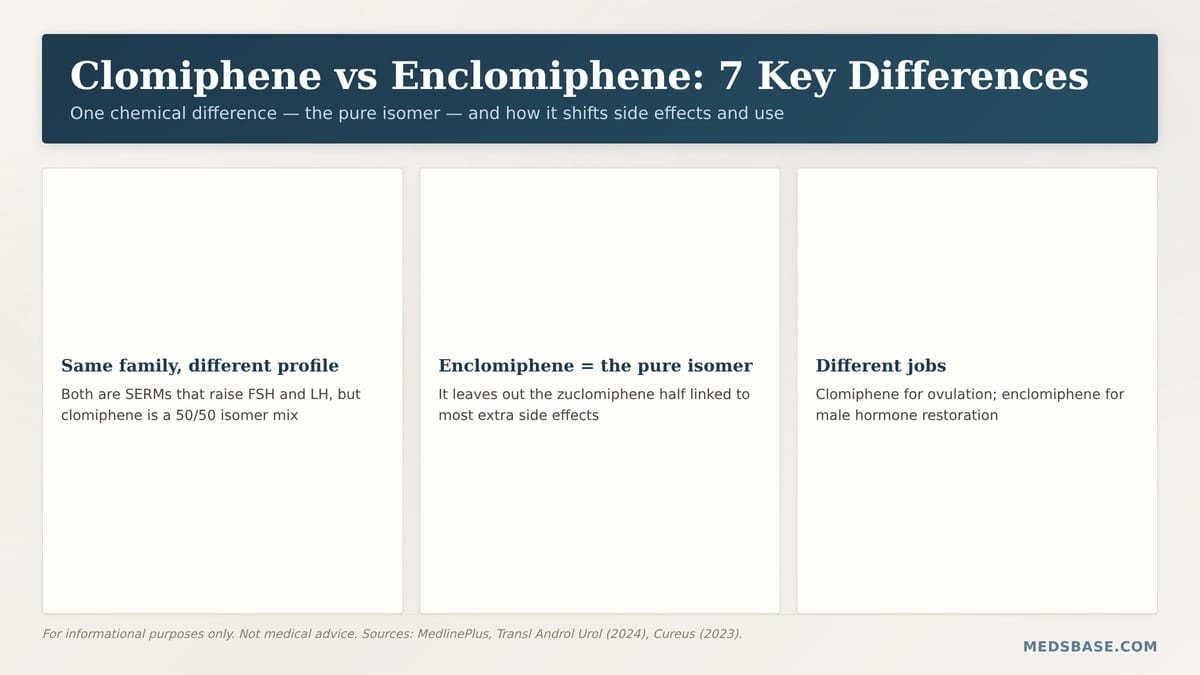
You are comparing two medicines that look almost identical on paper, and the difference feels frustratingly opaque. One is called clomiphene, the other enclomiphene — and the truth is they are chemically related in a way that makes the whole clomiphene vs enclomiphene question easy to get wrong. Here is the plain-English version, including the single detail that changes the side-effect picture.
By the end of this guide you will understand exactly how clomiphene vs enclomiphene differ, why the “isomer” question matters, and which one fits your situation — whether that is fertility or hormone restoration.
Key Takeaways
- Clomiphene vs enclomiphene is not a brand-versus-generic question — clomiphene is a 50/50 mix of two mirror-image molecules, and enclomiphene is just one of them, purified
- Both drugs work the same core way — blocking estrogen signals in the brain to raise FSH and LH — but the leftover isomer in clomiphene is behind most of its extra side effects
- For ovulation induction (PCOS and fertility), clomiphene remains the long-established standard, with decades of data and a proven pregnancy-rate benefit
- For male hormone restoration and post-cycle recovery, enclomiphene is increasingly preferred, because it raises testosterone while tending to cause fewer estrogen-related effects
- One side effect in the clomiphene vs enclomiphene comparison deserves special respect: visual disturbances — rare, but they mean you should stop and call your doctor
- What Are Clomiphene and Enclomiphene?
- The Chemical Difference That Matters
- How Does Clomiphene vs Enclomiphene Work?
- Uses: Fertility and Hormone Restoration
- Side Effects Compared
- What Does the Research Say?
- Clomiphene vs Enclomiphene: Which One Is Right for You?
- Related Reading
- Frequently Asked Questions
- The Bottom Line
What Are Clomiphene and Enclomiphene?
Clomiphene and enclomiphene are both medicines from a family called selective estrogen receptor modulators, or SERMs. In practice, clomiphene is the older, far more widely used drug, best known for inducing ovulation in women who do not ovulate regularly — including those with polycystic ovary syndrome (PCOS). Enclomiphene is the newer, purified cousin, marketed for a different job: raising testosterone in men whose bodies are not producing enough of it (secondary hypogonadism).
MedlinePlus describes clomiphene as a medicine used to treat infertility in women by causing ovulation, and it notes that clomiphene is not used to treat women whose ovaries no longer work. Clomifene — the British spelling of the same drug — is used for the same purpose in women who are not ovulating properly.
The clomiphene vs enclomiphene distinction matters because, although both are SERMs and both raise the body’s own reproductive hormones, they are not interchangeable and carry different side-effect expectations.
Clomiphene vs Enclomiphene: The Chemical Difference That Matters
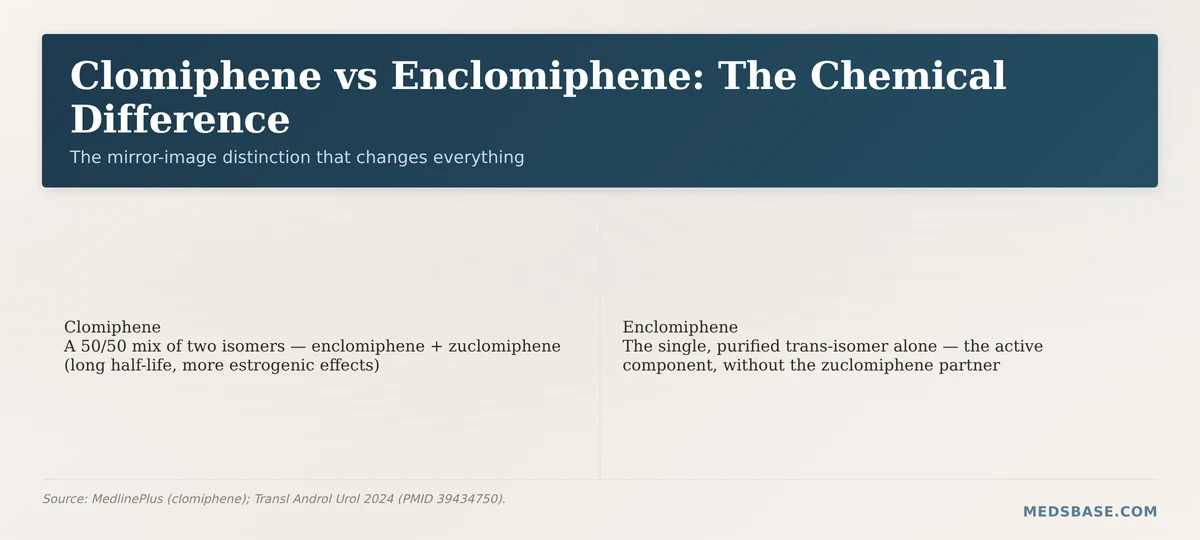
This is the detail that makes the clomiphene vs enclomiphene question finally click. Many medicines exist as “isomers” — molecules with the same atoms arranged as mirror images of each other. Clomiphene is a mixture of two of these isomers in roughly equal amounts: enclomiphene and zuclomiphene.
Here is the key insight: enclomiphene is the isomer that does most of the useful work — the one that blocks estrogen receptors and drives up FSH and LH. Zuclomiphene, the other half of clomiphene, lingers in the body far longer and is more strongly associated with estrogenic effects and certain side effects.
So when you see “clomiphene vs enclomiphene” framed as a competition, what is really being compared is the mixture versus the single, cleaner active component. Enclomiphene is essentially clomiphene with the problematic partner removed.
Clinical insight: This is why the two drugs feel different despite being so closely related. The zuclomiphene in clomiphene has a much longer half-life, so it accumulates and stays around after the enclomiphene half has been cleared. Patients who switch from clomiphene to enclomiphene often report that some of the lingering effects — mood changes and breast tenderness, for example — ease off.
How Does Clomiphene vs Enclomiphene Work?
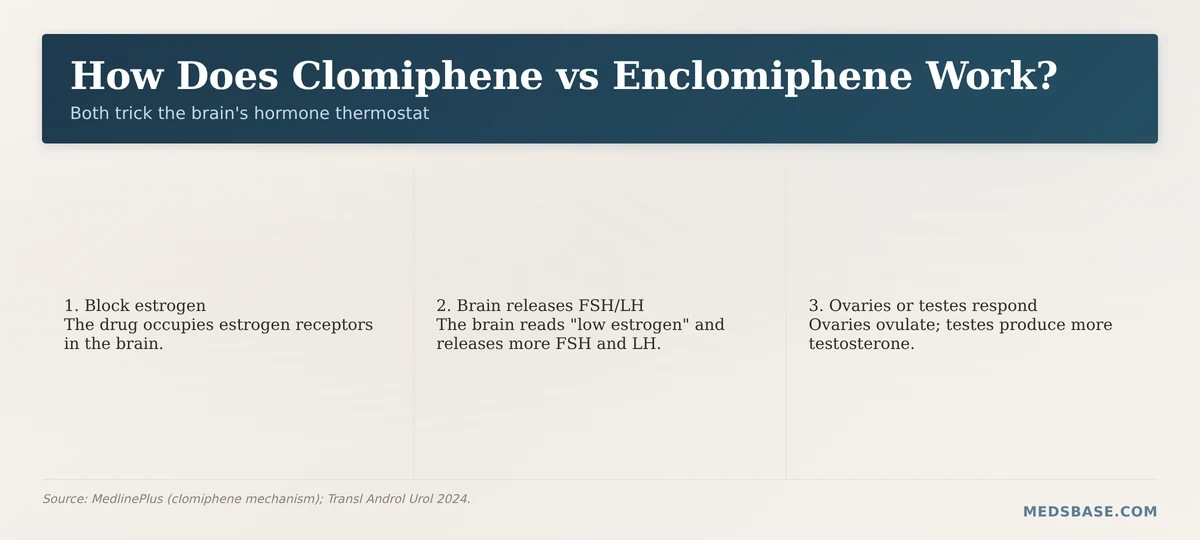
The mechanism is the same for both, and it is elegantly indirect. The body normally regulates its reproductive hormones through a feedback loop: when estrogen levels are high enough, the brain holds back on the hormones that tell the ovaries or testes to work.
Clomiphene vs enclomiphene — both drugs step in and block estrogen receptors in the brain. The brain reads this as “estrogen is low,” so it responds by releasing more FSH (follicle-stimulating hormone) and LH (luteinising hormone). In women, that extra FSH and LH pushes the ovaries to mature and release an egg. In men, the same LH signal pushes the testes to produce more testosterone.
An analogy: imagine the brain is a thermostat for reproductive hormones. Clomiphene and enclomiphene both trick the thermostat into thinking the room is colder than it is, so it turns the heating up. The difference is only in how much “noise” the drug produces while doing it — and enclomiphene is the quieter version.
Uses: Fertility and Hormone Restoration
The clomiphene vs enclomiphene question usually resolves based on what you are trying to achieve.
Clomiphene for Ovulation Induction
This is clomiphene’s classic role and where it has the deepest evidence. For a woman who is not ovulating — most commonly because of PCOS — clomiphene is typically taken for about five days early in the cycle to trigger ovulation. It is the long-standing first-line oral option, and its pregnancy-rate benefit is well documented. Because it stimulates the ovaries, it carries a meaningful chance of multiple pregnancy (most commonly twins).
Enclomiphene for Male Hormone Restoration
Enclomiphene’s modern niche is raising testosterone in men with secondary hypogonadism — a situation where the brain is not signalling the testes strongly enough. By blocking estrogen feedback, enclomiphene raises LH, which raises the body’s own testosterone production. The appeal is that it can do this while generally preserving sperm production, unlike direct testosterone therapy, which tends to suppress it.
Clomiphene Off-Label in Men
Clomiphene is also used off-label for the same male-hormone purpose, and it works — but the zuclomiphene it contains can bring more estrogen-related side effects, which is why many clinicians now prefer enclomiphene in this setting.
The Post-Cycle Therapy (PCT) Context
A large share of the everyday clomiphene vs enclomiphene searches come from men finishing a cycle of anabolic steroid use or testosterone therapy, who want a SERM to help restart the body’s own hormone production. This is a controversial, off-label area with little high-quality evidence, and it is exactly where careful medical supervision matters most. The mechanism is the same — blocking estrogen feedback to raise LH — but the doses, the monitoring, and the risks in this setting are not interchangeable, and self-directed use carries real cardiovascular and hormonal hazards. If this is your situation, the honest advice is to work with a doctor rather than self-prescribe from a comparison article.
- Clomiphene — for: women with anovulation or PCOS who need to induce ovulation under medical supervision
- Enclomiphene — for: men with secondary hypogonadism seeking to raise testosterone while preserving fertility
- Avoid or discuss first: anyone with liver disease, a history of ovarian cysts unrelated to PCOS, abnormal uterine bleeding of unknown cause, or hormone-sensitive conditions; both drugs require medical supervision and monitoring
Both drugs are serious medicines with real risks — including ovarian hyperstimulation in women — and neither should be used without a diagnosis and ongoing monitoring.
How They Are Taken
The dosing patterns differ because the uses differ. Clomiphene for ovulation is taken in a short, timed burst — most commonly 50 mg once daily for five days, early in the cycle — and the response is checked with monitoring and, if needed, a step-up in dose in later cycles. Enclomiphene for male hormone restoration is typically taken daily or every other day at a lower ongoing dose, with testosterone and other blood markers rechecked on a schedule. In both cases, the exact dose and duration are set by a doctor and adjusted on follow-up, which is part of why this clomiphene vs enclomiphene decision is not one to make — or dose — on your own.
Clomiphene vs Enclomiphene: Side Effects Compared
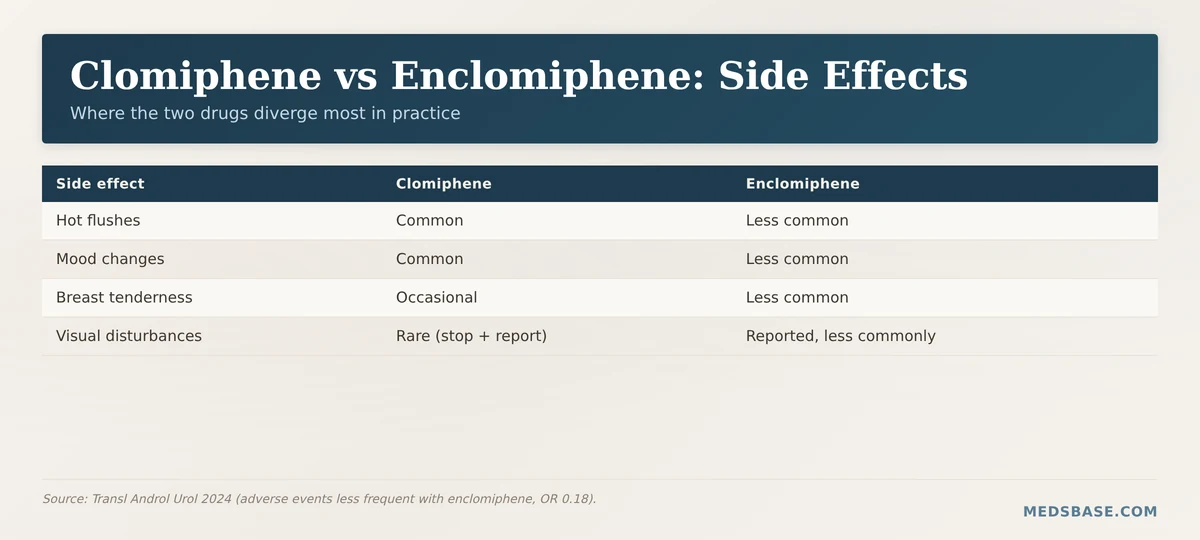
The side-effect conversation is where clomiphene vs enclomiphene diverges most in practice.
| Side Effect | Clomiphene | Enclomiphene | Notes |
|---|---|---|---|
| Hot flushes | Common | Less common | Estrogen-blockade effect, milder on enclomiphene |
| Mood changes | Common | Less common | Linked to the zuclomiphene isomer |
| Visual disturbances (blurring, flashes) | Rare but important | Reported, less commonly | Stop and report immediately if it occurs |
| Breast tenderness | Occasional | Less common | Estrogenic effect |
| Multiple pregnancy (ovulation use) | Real risk (often twins) | Lower data, similar mechanism | Discuss with doctor |
| Ovarian hyperstimulation | Rare | Rare | More relevant to ovulation use |
| Headache | Occasional | Occasional | Mild |
The side effect that deserves special respect. In the clomiphene vs enclomiphene comparison, visual disturbance is the one to take seriously. Clomiphene can occasionally cause blurred vision, flashes, or spots, and any visual symptom is a signal to stop the medicine and contact your doctor promptly. It is usually reversible when the drug is stopped, but it is not something to ignore.
The overall picture: because enclomiphene leaves out zuclomiphene, it tends to produce fewer estrogen-related effects — less mood change, less breast tenderness, fewer hot flushes. That said, enclomiphene is a newer drug with a shorter safety track record, and the honest summary is “different side-effect profile, not necessarily a side-effect-free drug.”
Clomiphene vs Enclomiphene: What the Research Says
The evidence for clomiphene’s role in ovulation induction is extensive and decades long, which is why it remains the standard first-line oral option. The evidence for enclomiphene is newer and centred on male secondary hypogonadism.
| Study / Source | Year | Finding | Source |
|---|---|---|---|
| Clomiphene for ovulation induction | Decades of data | Induces ovulation and improves pregnancy rates in anovulatory women | Cochrane / fertility literature |
| Enclomiphene for secondary hypogonadism | 2016 review | Raises testosterone by stimulating endogenous production; well tolerated | Rodriguez KM et al. |
| Enclomiphene vs testosterone therapy | Recent | Preserves spermatogenesis while raising testosterone | Andrology literature |
What this means for you: if your goal is ovulation and pregnancy, the clomiphene vs enclomiphene decision leans strongly toward clomiphene, simply because that is where the long-term pregnancy data lives. If your goal is raising testosterone in a man while keeping fertility intact, enclomiphene has the more targeted evidence and the more attractive side-effect profile.
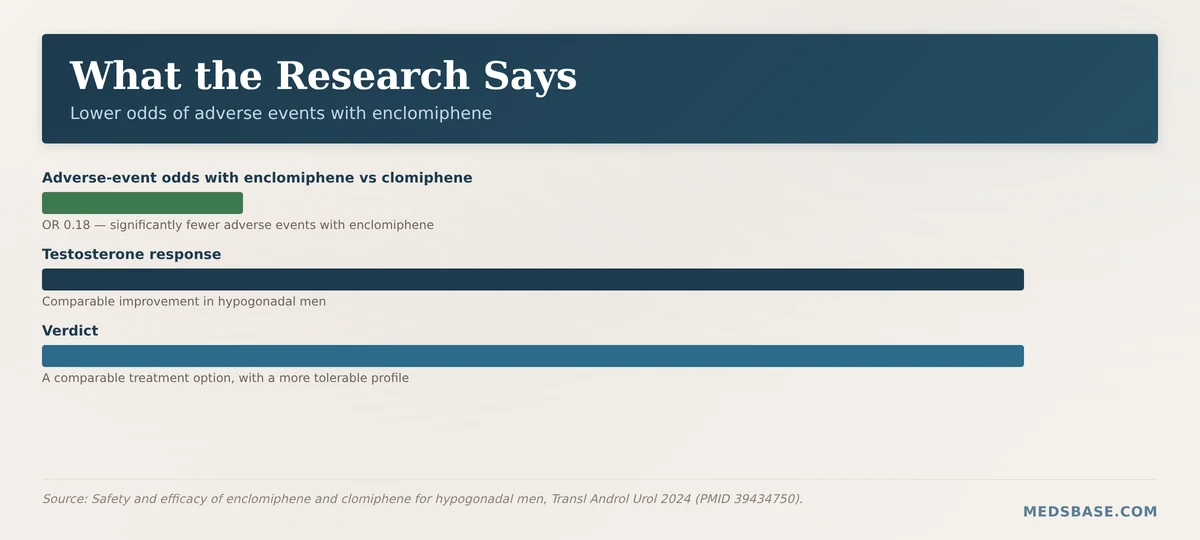
A 2024 review published in Translational Andrology and Urology looked specifically at the safety and efficacy of enclomiphene and clomiphene for hypogonadal men, and a 2023 retrospective study directly compared clomiphene citrate versus enclomiphene citrate for male infertility treatment. Both reinforce the same practical theme: the two drugs are similarly effective at raising testosterone in men, but enclomiphene tends to carry the more tolerable side-effect profile, which is precisely why it has gained ground in this setting.
The honest caveat: enclomiphene’s longer-term data is thinner than clomiphene’s, simply because it is newer. Admitting that uncertainty is part of making a genuinely informed choice rather than chasing the newest option.
Clomiphene vs Enclomiphene: Which One Is Right for You?
The decision mostly writes itself once you answer one question: what is the goal?
If the Goal Is Ovulation for Fertility
Clomiphene is the established first-line choice, with the deepest evidence for inducing ovulation and achieving pregnancy in anovulatory women. Enclomiphene is not the standard here.
If the goal is raising a man’s testosterone while preserving fertility. Enclomiphene is increasingly the preferred option, because it stimulates natural production and tends to cause fewer estrogen-related effects than clomiphene. Clomiphene still works in this setting but brings the zuclomiphene baggage.
Whichever you lean toward, this is a supervised medicine. Both drugs need a diagnosis, baseline monitoring, and follow-up. Do not self-direct dosing, and do not continue either drug indefinitely without review.
When you are ready to compare options, you can browse the MedsBase Fertility range, which includes both clomiphene and enclomiphene products.
Related Reading
- Comparing clomiphene with a different competitor (letrozole)? Clomid vs Letrozole: PCOS, Ovulation, PCT Compared
- Planning to combine with HCG? HCG Dose Protocol Guide: TRT, Fertility, PCT & Reconstitution
- Curious about the wider fertility-medication landscape? HMG Injection: Proven Fertility Benefits, Dosage & Safety
Frequently Asked Questions
Q: Is enclomiphene better than clomiphene?
A: It depends on the goal. For ovulation induction, clomiphene is the better-evidenced, standard choice. For raising testosterone in men while preserving fertility, enclomiphene is generally preferred because it tends to cause fewer estrogen-related side effects. “Better” in the clomiphene vs enclomiphene question always depends on what you are treating and who you are.
Q: What is the difference between clomiphene and enclomiphene?
A: Clomiphene is a 50/50 mixture of two isomers — enclomiphene and zuclomiphene. Enclomiphene is the single, purified active isomer. The zuclomiphene left out of enclomiphene has a longer half-life and is linked to more of the estrogen-related side effects, which is why the two feel different.
Q: Does clomiphene cause mood swings?
A: Yes, mood changes are among the more common side effects of clomiphene, and they are thought to be tied mainly to the zuclomiphene isomer. This is one of the reasons people exploring the clomiphene vs enclomiphene choice for male hormone use often find enclomiphene gentler on mood, though individual responses vary.
Q: Does enclomiphene have fewer side effects than clomiphene?
A: Generally, yes for the estrogen-related side effects — hot flushes, breast tenderness, and mood changes tend to be less common with enclomiphene because it removes the zuclomiphene isomer. However, enclomiphene is not side-effect-free, and its longer-term safety record is shorter than clomiphene’s.
Q: Can clomiphene cause multiple pregnancy?
A: Yes. Because clomiphene stimulates the ovaries to release an egg, it can occasionally release more than one, which is why the multiple-pregnancy rate (mostly twins) is higher than the natural baseline. This is a real consideration to discuss with your doctor before starting clomiphene for fertility.
Q: How long can you take clomiphene?
A: For ovulation induction, clomiphene is used in short, monitored cycles — typically five days per cycle, for a limited number of cycles — not continuously. Long-term use is not standard, both to limit ovarian-stimulation risk and because response is usually reassessed. Follow your doctor’s protocol exactly.
Q: Can clomiphene affect your eyesight?
A: Rarely, clomiphene can cause visual disturbances such as blurred vision, flashes, or spots. This is one of the more serious side effects in the clomiphene vs enclomiphene discussion. Any visual change is a reason to stop the medicine and contact your doctor straight away; the effect is usually reversible when the drug is stopped.
Q: Can men take enclomiphene?
A: Yes — enclomiphene is primarily used in men with secondary hypogonadism to raise testosterone by stimulating the body’s own production. Because it preserves the brain’s signalling to the testes, it can raise testosterone while generally keeping sperm production intact, unlike direct testosterone therapy. It should still be used under medical supervision with baseline and follow-up blood work.
The Bottom Line
Clomiphene vs enclomiphene is, at its heart, a story about one chemical difference with real consequences. Clomiphene — the 50/50 isomer mix — remains the workhorse for ovulation induction, backed by decades of data. Enclomiphene — the purified single isomer — is the more targeted tool for raising a man’s testosterone while protecting fertility, with fewer estrogen-related side effects.
Your one immediate action: define the goal before choosing. Ovulation and pregnancy point to clomiphene; male hormone restoration points to enclomiphene. Either way, this is a supervised medicine — get the diagnosis and the monitoring, not just the prescription.
Two next questions readers often ask:
- Comparing clomiphene with letrozole instead? Read our Clomid vs Letrozole guide.
- Planning a full hormone protocol? Here is our HCG Dose Protocol Guide.
Disclaimer: This article is for informational purposes only and does not constitute medical advice. Clomiphene and enclomiphene are prescription medicines with real risks, including ovarian hyperstimulation and visual disturbances, and should only be used under the supervision of a qualified healthcare professional. Individual responses vary.

Written by
Sophie ChenPharmaceutical Content Researcher · 8 years experience
Sophie Chen is a pharmaceutical content researcher with 8 years covering generic medication access and clinical pharmacology. She specialises in international regulatory frameworks, bioequivalence standards, and patient-facing education on therapeutic drug classes. She is not a clinician.