








✓ Medically reviewed by · Last reviewed: May 2026
Pharmacy Researcher · 8 years experience
Pharmacy researcher with 8 years reviewing clinical drug information, generic formulation equivalence, and international pharmaceutical standards. Focuses on patient-facing accuracy in medication education.
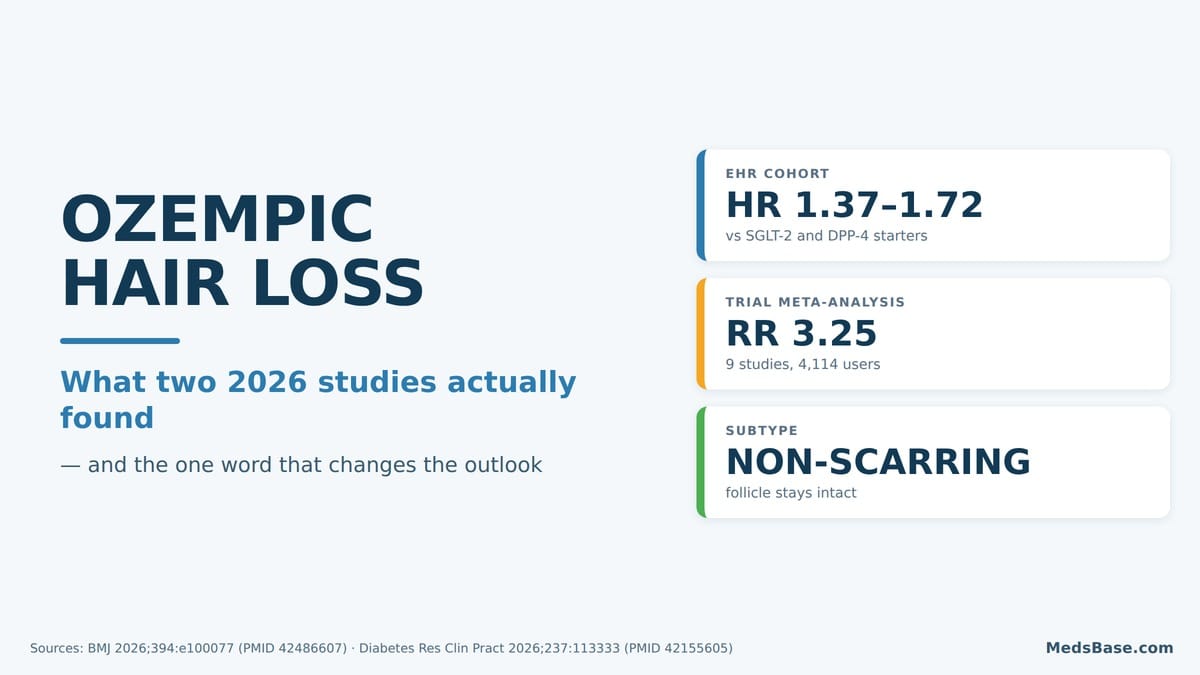
In the trials behind the highest approved dose of semaglutide, hair loss was reported by 8.4% of women and 0.2% of men. That gap is not from a headline or a press release — it is printed in the FDA prescribing information, dose by dose. If you searched ozempic hair loss because your shower drain has started to look frightening, that one number already tells you something the news coverage skipped: this is not random, and it is not landing on everyone equally.
Eight days ago, on 22 July 2026, the BMJ published a large study finding more diagnosed hair loss among people starting a GLP-1 than among people starting two other diabetes drug classes. Coverage stopped at “linked to.” It stopped one paragraph too early, because buried in the same paper is a subtype analysis that changes how worried you should be — and a separate meta-analysis of clinical trials, published weeks earlier, that nobody put beside it.
By the end you will know which kind of hair loss the evidence points to, why the timing feels disconnected from the cause, how long it runs, what regrows on its own, and when shedding is your thyroid or your iron rather than your injection. You will also know how many people in the highest-dose trial arm stopped treatment over it — the answer is smaller than you would guess.
- The BMJ subtype analysis found the signal is specific to non-scarring hair loss — the reversible kind, where the follicle survives. That one word is the difference between “this grows back” and “this doesn’t.”
- The FDA label says these events “were associated with weight reduction” — pointing at how fast you are losing, not at the molecule attacking your scalp.
- Two very different study designs, published weeks apart, found the same direction of effect. That agreement matters more than either number alone.
- There is a roughly three-month lag between trigger and shedding, which is why almost everyone blames the wrong month.
- Ozempic hair loss is reported far more by women than by men, and it rises with dose — both facts are on the label.
- In the highest-dose arm, of 1,311 people, exactly one stopped treatment permanently over it.
What ozempic hair loss actually is
Ozempic hair loss is diffuse thinning and increased shedding that appears a few months after starting semaglutide, most often as more hair in the drain, the brush and on the pillow rather than as a bald patch. On current evidence it reflects a temporary shift in the hair growth cycle driven by rapid weight loss, not destruction of the follicle. Alopecia is listed under post-marketing experience on the Ozempic label itself, with a frequency the manufacturer says cannot be reliably estimated.
What you are not seeing is diagnostically useful. You are almost certainly not seeing smooth, shiny bald patches with no visible pores. You are seeing hair that is thinner everywhere — the ponytail feels slimmer, the part looks a fraction wider, and grooming produces an alarming handful. Those are two different problems with two different outlooks.
Non-scarring vs scarring alopecia — why one word decides the outcome
Dermatology sorts hair loss into two families before anything else. Scarring (cicatricial) alopecia destroys the follicle and replaces it with fibrous tissue; once the follicle is gone, no drug brings it back, and speed of treatment matters enormously. Non-scarring alopecia leaves the follicle structurally intact — it has stopped producing visible hair, but the machinery is still there.
The BMJ team ran a subtype analysis rather than lumping every hair-loss diagnosis together, and the association they found sat squarely in the non-scarring group. That is the most useful sentence in the paper for you, and almost nobody reported it.
One honest caveat: “non-scarring alopecia” is a family of diagnostic codes, not a single condition. It includes pattern hair loss and alopecia areata alongside the shedding pattern rapid weight loss produces, and the design cannot tell you which one a given person had. What it can tell you is that the signal did not land in the scarring group — the group you would actually need to worry about.
Why does it happen? The hair cycle, explained without the jargon
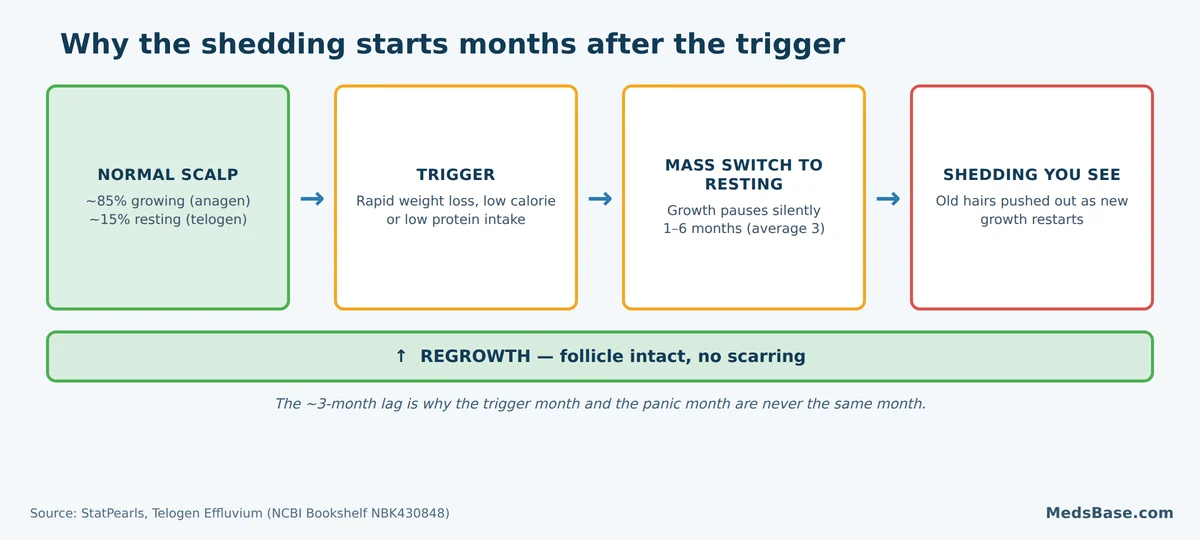
Think of your scalp as a factory running about a hundred thousand production lines, each cycling through growing, pausing and restarting on its own schedule. In a healthy scalp roughly 85% of hairs are actively growing and about 15% are resting at any moment. Because the lines are out of sync, you never notice the handover.
Now imagine a sudden budget cut across the whole factory. A large batch of lines shuts down at once — not permanently, just paused. The pattern that follows has a name: telogen effluvium.
Rapid weight loss hair loss is not unique to GLP-1s
Here is where it gets interesting. Telogen effluvium is one of the best-characterised responses in dermatology, and its trigger list reads like a list of physiological shocks: major surgery, high fever, serious infection, childbirth, an underactive thyroid, low iron — and, explicitly, crash dieting and low protein intake. Rapid weight loss hair loss was a recognised entity long before any GLP-1 existed; StatPearls even illustrates the condition with a case following a prolonged crash diet.
That is the mechanistic case in one line: semaglutide is extremely effective at producing fast weight loss, and fast weight loss has always been able to do this. The FDA label appears to agree — it states the hair loss events reported in the semaglutide trials “were associated with weight reduction.” Not with the molecule reaching the follicle. With the weight coming off.
That lag is the second open loop resolved. The month your hair starts falling is not the month something went wrong — it is roughly three months after. If you increased your dose in February and panicked in May, those are almost certainly the same event.
The practical consequence: by the time you notice shedding, the trigger is usually already behind you. That is why it so often settles without anyone doing anything.
Who gets it, and how likely is it really?
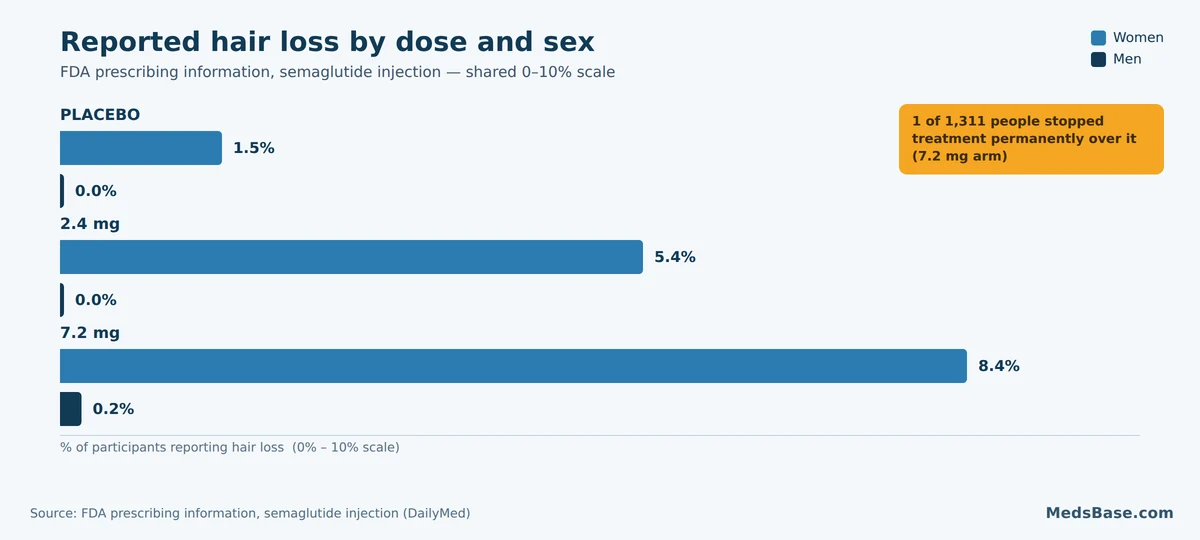
The most useful data source here is not a study at all. It is the label. The FDA prescribing information for semaglutide records hair loss by dose and by sex, and those numbers are more informative than anything in the news cycle.
Women vs men: the split in the semaglutide hair loss data
At the 2.4 mg dose, hair loss was reported by 4% of women and 0.9% of men, against 1% on placebo. Push to 7.2 mg and the split widens sharply: 8.4% of women and 0.2% of men, versus 1.5% and 0% on placebo.
Why the asymmetry? The label does not say, and I will not invent a reason. Two possibilities worth holding loosely: women tend to notice diffuse shedding earlier because of how hair is typically worn, and women more often start from lower iron stores, which is itself an independent trigger. Both plausible. Neither proven by this data.
Dose matters: hair shedding on Ozempic at different strengths
The dose gradient is clean: 1.0% on placebo, 3.3% at 2.4 mg, 5.8% at 7.2 mg. Since the higher dose also produces faster weight loss, that is exactly the pattern you would predict if weight loss — not a direct drug action on skin — drives it. It also puts the lower diabetes doses at the gentler end of the gradient, which fits alopecia appearing on the Ozempic label only as a post-marketing report with no estimable frequency.
GLP-1 hair loss in people with type 2 diabetes
The BMJ cohort studied a different population — adults with type 2 diabetes in routine care, using diagnostic codes rather than trial reporting. Comparing new GLP-1 starters against new SGLT-2 or DPP-4 starters is a smart choice: all three are people whose diabetes needed escalating, so they resemble each other far more than a GLP-1 group resembles the general population.
If you are already wondering what could be done, it is worth knowing what the evidence-backed non-scarring options actually look like before deciding whether to treat or wait — because for many people the honest answer is “wait,” and knowing that saves money.
Ozempic hair loss timeline: severity and what regrows
The ozempic hair loss timeline is the part almost no coverage gives you. Treat the weeks as approximate — individual hair cycles vary a great deal.
| Stage | When | What you’ll notice | What to do |
|---|---|---|---|
| Silent pause | Weeks 0–8 after starting or a dose increase | Nothing at all. Growth has stopped in a batch of follicles but the hairs are still anchored | Nothing yet. This is the window where protein and iron intake genuinely matter |
| Shedding starts | Around month 2–4 | More hair in the drain, brush and on the pillow. Diffuse, not patchy | Photograph your part and hairline in the same light. You will want a baseline later |
| Peak shedding | Roughly 4–8 weeks after it starts | The scary phase. Ponytail feels thinner, part looks wider | Get iron studies, ferritin and thyroid function checked. Do not change hair products in panic |
| Plateau | Usually by month 6 from the trigger | Daily shedding drops back toward normal | Compare against your photos rather than your memory — memory is unreliable here |
| Regrowth | Months 6–12 | Short new hairs standing up along the part and hairline | Nothing to do but let them grow. Resist heat styling on new growth |
| Density restored | Often within a year | Original thickness, or close to it | If density has clearly not recovered by 12 months, that warrants a proper assessment |
Worth keeping: shedding that is settling and regrowth that is starting look identical for weeks, because both produce a scalp full of short hairs. People routinely mistake early recovery for continued loss.
Hair regrowth after Ozempic: what actually comes back
Because the follicle is intact in non-scarring shedding, the expectation is full or near-full recovery of density. The reference literature is direct: the prognosis for recovery of hair density in acute telogen effluvium is good, and the condition is described as self-limiting.
Two honest qualifiers. First, if you also have pattern hair loss running quietly in the background — common, and easily unmasked by a burst of shedding — what regrows is your pattern-hair-loss baseline, not your twenty-year-old hairline. The shedding revealed it; it did not cause it. Second, if the trigger keeps repeating with each dose escalation or each new sharp drop in intake, shedding can run in waves rather than resolving cleanly.
What does the research say about ozempic hair loss?
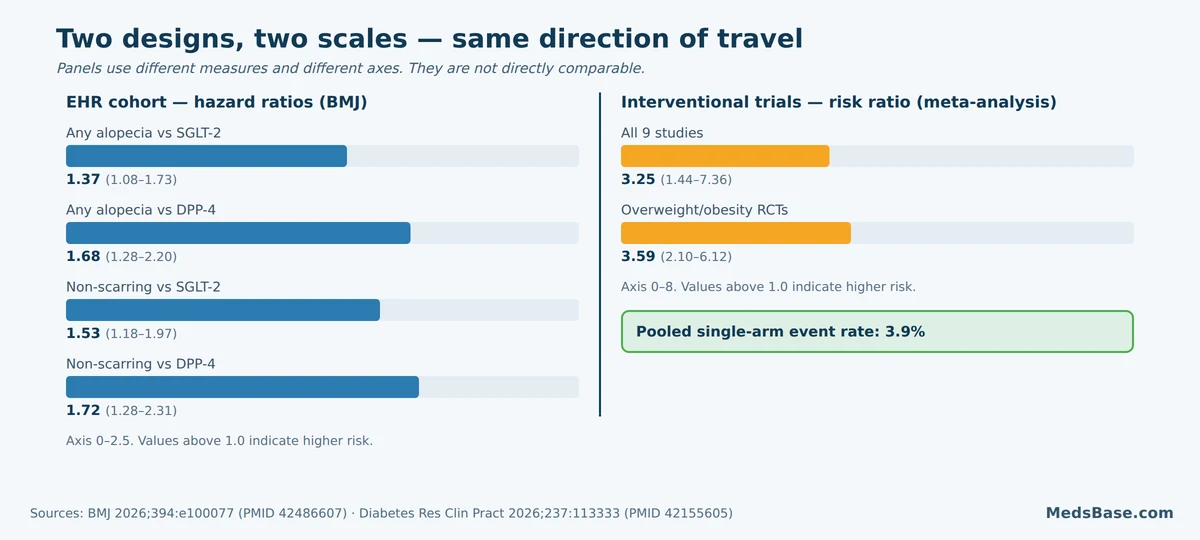
Two research groups, working with completely different data, published within about eight weeks of each other. Neither cites the other. Both point the same way — and that agreement is the real story about ozempic hair loss the coverage missed.
| Study | Year | Finding | Source |
|---|---|---|---|
| Target trial emulation, Penn Medicine electronic health records; 12,004 GLP-1 vs 15,221 SGLT-2 initiators, and 11,964 GLP-1 vs 11,238 DPP-4 initiators, 2019–2024 | 2026 | Higher rate of incident alopecia on GLP-1s: hazard ratio 1.37 (95% CI 1.08–1.73) vs SGLT-2 inhibitors and 1.68 (1.28–2.20) vs DPP-4 inhibitors | BMJ 2026;394:e100077 (PMID 42486607) |
| Same study — subtype analysis | 2026 | Association was specific to non-scarring alopecia: HR 1.53 (1.18–1.97) vs SGLT-2 and 1.72 (1.28–2.31) vs DPP-4 | BMJ 2026;394:e100077 |
| Systematic review and meta-analysis of 9 interventional studies (7 RCTs, 2 non-RCTs), 4,114 GLP-1 receptor agonist users | 2026 | Pooled risk ratio 3.252 (95% CI 1.437–7.358) vs placebo; in overweight/obesity RCTs only, 3.587 (2.100–6.124); single-arm pooled event rate 3.9% | Diabetes Res Clin Pract 2026;237:113333 (PMID 42155605) |
| FDA prescribing information, semaglutide 2.4 mg | Current label | Hair loss in 3.3% vs 1% on placebo; 4% of women vs 0.9% of men; label states events “were associated with weight reduction” | DailyMed (semaglutide injection) |
| FDA prescribing information, semaglutide 7.2 mg | Current label | Hair loss in 5.8% vs 3.3% at 2.4 mg vs 1.0% placebo; 8.4% women vs 0.2% men; 1 permanent discontinuation, 1 interruption, 5 dose reductions of 1,311 | DailyMed (semaglutide injection) |
| Ozempic (semaglutide) label | Current label | Alopecia listed under §6.2 post-marketing experience; frequency not reliably estimable | DailyMed (Ozempic) |
| StatPearls, Telogen Effluvium | 2024 | Non-scarring, benign, spontaneously reversible; trigger precedes shedding by ~3 months (range 1–6); acute form runs <6 months | NCBI Bookshelf NBK430848 |
What this means for you: an EHR cohort of real patients and a pooled analysis of randomised trials — two designs with completely different weaknesses — landed on the same signal, which makes a pure artefact unlikely. But their effect sizes are nowhere near identical, so the honest reading is “real, modest in absolute terms, and pointed at the reversible subtype.”
Reading these numbers without scaring yourself
Two traps to sidestep. First, a hazard ratio is not a probability. An HR of 1.68 does not mean 68% of people lose hair; it means new alopecia diagnoses occurred about 1.68 times as often in one group as the other, applied to an outcome that is uncommon to begin with. The BMJ authors state plainly that the absolute risk is low.
Second, the BMJ team ran negative control outcome calibration — a sanity check against outcomes the drug should not affect, which exposes hidden bias — and report attenuation after it. Translated: the true effect is likely somewhat smaller than the headline hazard ratios, and the authors said so themselves.
The meta-analysis has a mirror-image limitation: its pooled risk ratio of 3.252 spans 1.437 to 7.358, wide enough that the truth could be a modest increase or a large one. It also depends on hair loss being reported in trials not designed to look for it, which undercounts rather than overcounts. And although it appeared in the July 2026 print issue, it went online on 18 May 2026 — months old, not days.
Ozempic hair loss vs the other reasons hair falls out
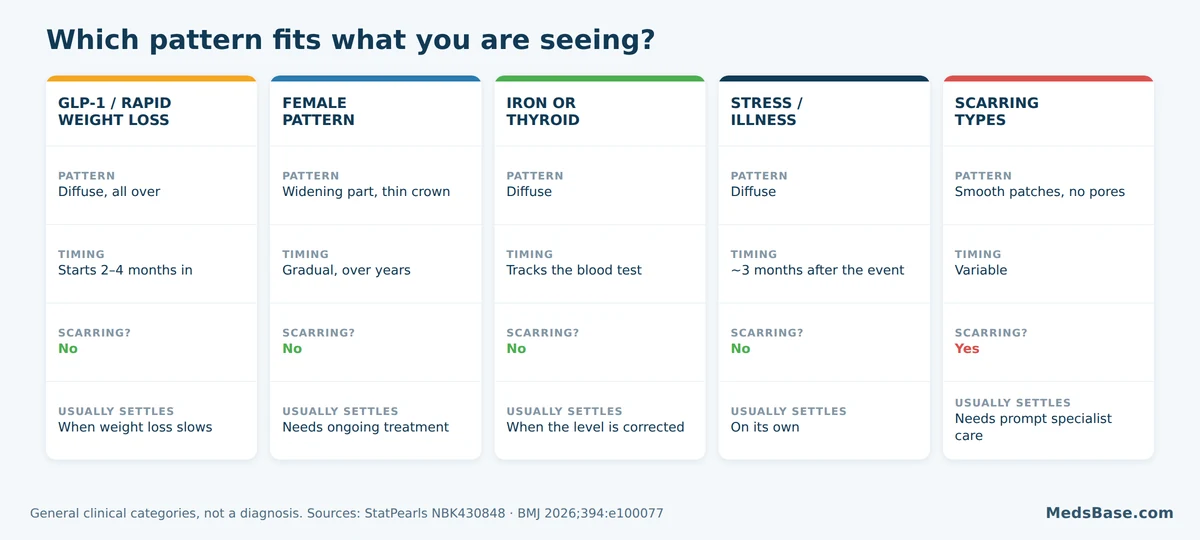
Assuming your injection is the cause is the most common mistake, and the one that leaves treatable conditions untreated. Several other things cause diffuse shedding, and a few are trivially easy to test for.
| Cause | Pattern you see | Timing clue | Leaves scarring? | What usually settles it |
|---|---|---|---|---|
| GLP-1 / rapid weight loss shedding | Diffuse, all over, no bald patches | Starts 2–4 months after starting or escalating; tracks the fastest weight-loss phase | No | Weight loss slowing; adequate protein and calories |
| Female or male pattern hair loss | Widening part, thinning crown, receding temples | Gradual over years, not weeks | No | Ongoing treatment; it does not self-resolve |
| Iron deficiency | Diffuse | Tracks ferritin; often with fatigue, heavy periods, or restricted intake | No | Correcting the deficiency, guided by blood tests |
| Thyroid disease | Diffuse, sometimes with coarse or dry hair | Often with cold intolerance, weight change, fatigue | No | Treating the thyroid condition |
| Stress or illness shedding | Diffuse | About three months after a fever, surgery, bereavement or major life event | No | Resolves on its own once the trigger passes |
| Alopecia areata | Sharply defined round patches | Can appear over days | No | Needs assessment; often treatable |
| Scarring alopecias | Smooth patches with lost pore openings; may itch, burn or hurt | Variable | Yes | Prompt specialist care — the priority exception |
Which one fits which situation? If the shedding is diffuse, began two to four months after you started or increased a GLP-1, and coincides with your steepest weight-loss stretch, the drug-plus-weight-loss explanation fits well — and it resolves on its own. If it started before treatment, or your part has been widening for years, look at pattern hair loss instead. If you are tired as well as shedding, or your periods are heavy, get ferritin and thyroid function tested before blaming the injection; both are common, both fixable, and both hide comfortably behind a convenient explanation. If a major life event or illness landed about three months ago, stress-driven shedding has its own timeline and its own tells and is worth reading separately. And if you can see smooth patches where the pores have vanished, stop self-diagnosing and get assessed — that is the one category here where waiting costs you something permanent.
Take Maya, 34 — an illustrative example, not a real patient. Five months into a GLP-1, down 14 kg, delighted, and shedding heavily. She also has heavy periods, has been skipping lunch entirely because she is not hungry, and had a bad flu in March. Three plausible triggers are stacked on each other, and only one is her injection. A ferritin test and an honest food diary would tell her more than another month of searching.
What to do about it — a practical plan
- Do not stop or change your dose unilaterally. Given that one person of 1,311 in the highest-dose trial arm discontinued permanently over this, abandoning a medication that is working is rarely proportionate. Raise it with your doctor or pharmacist — dose adjustment, slower escalation, or simply waiting are all real options, and which suits you is an individual call.
- Get a baseline photograph today. Same spot, same light, hair dry, part in the same place, once a fortnight. In four months this will be the only thing telling you the truth, because your memory of how thick your hair used to be is not reliable.
- Ask for iron studies, ferritin and thyroid function. These are the two most common non-drug triggers of diffuse shedding, they overlap heavily with the GLP-1 population, and they respond to treatment. Worth knowing: ferritin behaves as an acute-phase reactant, so inflammation can push it into the normal range in someone genuinely iron-deficient — which is why a full iron panel beats ferritin alone.
- Fix the intake problem — the one thing under your control. Appetite suppression is the point of the drug, and it makes accidental under-eating easy. Low protein intake and crash-level calorie restriction are both documented independent triggers of this exact pattern. Get protein into most meals; if you are skipping meals rather than eating smaller ones, that is what to change this week.
- Consider a topical only with clear eyes about the evidence. If waiting is intolerable, topical minoxidil, and what the evidence honestly does and does not show, is the usual candidate — it comes from WHO-GMP-certified manufacturers and is inexpensive. But the honest position from the reference literature is that minoxidil has not been proven to speed recovery in this particular pattern, only that there is a theoretical rationale. It is well established for pattern hair loss, which is a different reason to use it. See options if you want a bridge; do not expect it to do the heavy lifting.
- Be gentle, but do not overthink your routine. Washing and styling do not cause this shedding — hair on its way out comes out during grooming regardless, and patients are routinely reassured they can wash and style as usual. Skip tight ponytails and high heat on new growth, and leave it there.
- Set a review date six months out. If density has clearly not recovered by around twelve months from the trigger, that is when a proper dermatological assessment becomes warranted rather than premature.
- Stopping the drug in week one of shedding. The trigger is already three months behind you; stopping now cannot un-trigger it, and you may lose a working treatment over a shed that was going to settle anyway.
- Assuming it must be the injection. Iron deficiency and thyroid disease are common, cause identical diffuse shedding, and a blood test resolves both in a week.
- Buying a stack of supplements at once. If you do not know which deficiency you have — or whether you have one — you cannot tell what worked, and some hair supplements carry enough vitamin A to trigger shedding in their own right.
- Judging progress from memory instead of photographs. Almost everyone overestimates how much they have lost, and early regrowth looks like continued shedding for weeks.
- Losing weight as fast as physically possible. The label ties these events to weight reduction. Speed is the lever you actually control — and lean tissue pays the same price.
- The same question asked about muscle instead of hair — rapid weight loss has more than one cost, and this one is worth protecting against deliberately.
- How the hair-loss treatments actually compare — if you decide to treat rather than wait, start here.
- How GLP-1 injections work and what else to expect — the full picture of the drug class, side effects included.
Frequently asked questions
Q: Does Ozempic cause hair loss?
A: Research suggests an association rather than a proven direct cause. The BMJ 2026 cohort found more diagnosed hair loss in GLP-1 initiators than in people starting SGLT-2 inhibitors (HR 1.37) or DPP-4 inhibitors (HR 1.68), and a meta-analysis of nine interventional studies found a pooled risk ratio of 3.252 versus placebo. The FDA label lists hair loss and states the events were associated with weight reduction — which points at the speed of weight loss as the likely mechanism rather than the drug reaching your follicles directly.
Q: Is ozempic hair loss permanent?
A: On current evidence, almost certainly not. The BMJ subtype analysis found the association was specific to non-scarring alopecia, the category where the follicle stays intact. The reference literature describes this shedding pattern as benign and spontaneously reversible, with no scarring even during active shedding. The important exception is smooth patches where the pore openings have disappeared — that pattern is different, and it needs prompt assessment rather than patience.
Q: How long does ozempic hair loss last?
A: Typically the shedding phase runs under six months from the trigger, and often much less. Expect it to begin around two to four months after starting or escalating, peak over roughly four to eight weeks, then taper. Regrowth may take up to six months to become visible and several months to a year for density to look fully restored. If shedding is still worsening beyond six months, that is worth investigating rather than waiting out.
Q: Will my hair grow back if I stop the medication?
A: When a medication is the trigger, growth generally restarts after it is withdrawn — but stopping is not usually necessary, and it is not a decision to make alone. In the highest-dose semaglutide trial arm, one person of 1,311 stopped permanently because of hair loss. Because there is a roughly three-month lag between trigger and shedding, stopping today will not stop the shed already in progress. Discuss dose and timing with your prescriber first.
Q: Why is my hair falling out on semaglutide when my friend’s isn’t?
A: Sex and dose both matter, and so does how fast you are losing weight. On the FDA label, hair loss was reported by 8.4% of women versus 0.2% of men at the 7.2 mg dose, and the rate climbed with dose — 1.0% on placebo, 3.3% at 2.4 mg, 5.8% at 7.2 mg. Underlying iron status, protein intake and existing pattern hair loss also change who notices shedding and who does not.
Q: Can I use minoxidil while taking Ozempic?
A: Topical minoxidil is not known to interact with semaglutide, but its usefulness for this specific shedding pattern is uncertain. The reference literature states that minoxidil has not been proven to promote recovery in telogen effluvium, while acknowledging a theoretical rationale. It is well established for pattern hair loss, which is a different condition that a shed can unmask. Ask a pharmacist whether it fits your situation before adding it.
Q: Should I take biotin or a hair supplement?
A: Only if you have a documented deficiency. Biotin deficiency is rare and supplementing without one has little evidence behind it, while high-dose biotin interferes with several laboratory tests including thyroid and cardiac assays — unhelpful when you are trying to find the real cause. Iron and thyroid problems are the deficiencies actually worth testing for. Get the blood work, then treat what it shows.
Q: Does this mean the drug is damaging my body?
A: Not in the way it feels. This shedding pattern is a response to rapid physiological change, and the same pattern follows surgery, childbirth, high fever and crash dieting in people on no medication at all. The follicle is not being destroyed. Rapid weight loss does carry other costs worth managing deliberately, and adequate protein plus resistance training addresses several at once.
The bottom line on ozempic hair loss
The evidence on ozempic hair loss is real, consistent across two very different study designs, and much less frightening than the coverage suggested. A large electronic-health-record cohort and a meta-analysis of interventional trials both found a raised rate of hair loss on GLP-1s. The BMJ authors also reported that the absolute risk is low and that their effect estimates attenuated after negative control calibration — meaning the honest summary is a modest, real signal in the non-scarring category, where follicles survive and regrowth is the expected outcome.
The most useful sentence in all of it comes from the FDA label rather than either study: these events were associated with weight reduction. That reframes the problem from “my medication is attacking my hair” to “my body is responding to how fast things are changing” — and speed is something you and your prescriber can adjust.
One thing to do today: photograph your part and hairline in good light, then book iron studies, ferritin and thyroid function. In four months, those two things will tell you far more than any amount of searching.
If you have decided you want to support regrowth while you wait it out, browse the hair-loss options and go in knowing what the evidence supports and what it does not — and remember that for a lot of people, patience plus adequate protein is the whole treatment.
Still working through the side-effect list? Read why blurred vision on a GLP-1 has a similar too-fast explanation, or step sideways to why one acne drug works on hormones rather than bacteria.

Written by
Sophie ChenPharmaceutical Content Researcher · 8 years experience
Sophie Chen is a pharmaceutical content researcher with 8 years covering generic medication access and clinical pharmacology. She specialises in international regulatory frameworks, bioequivalence standards, and patient-facing education on therapeutic drug classes. She is not a clinician.