








✓ Medically reviewed by · Last reviewed: May 2026
Pharmacy Researcher · 8 years experience
Pharmacy researcher with 8 years reviewing clinical drug information, generic formulation equivalence, and international pharmaceutical standards. Focuses on patient-facing accuracy in medication education.
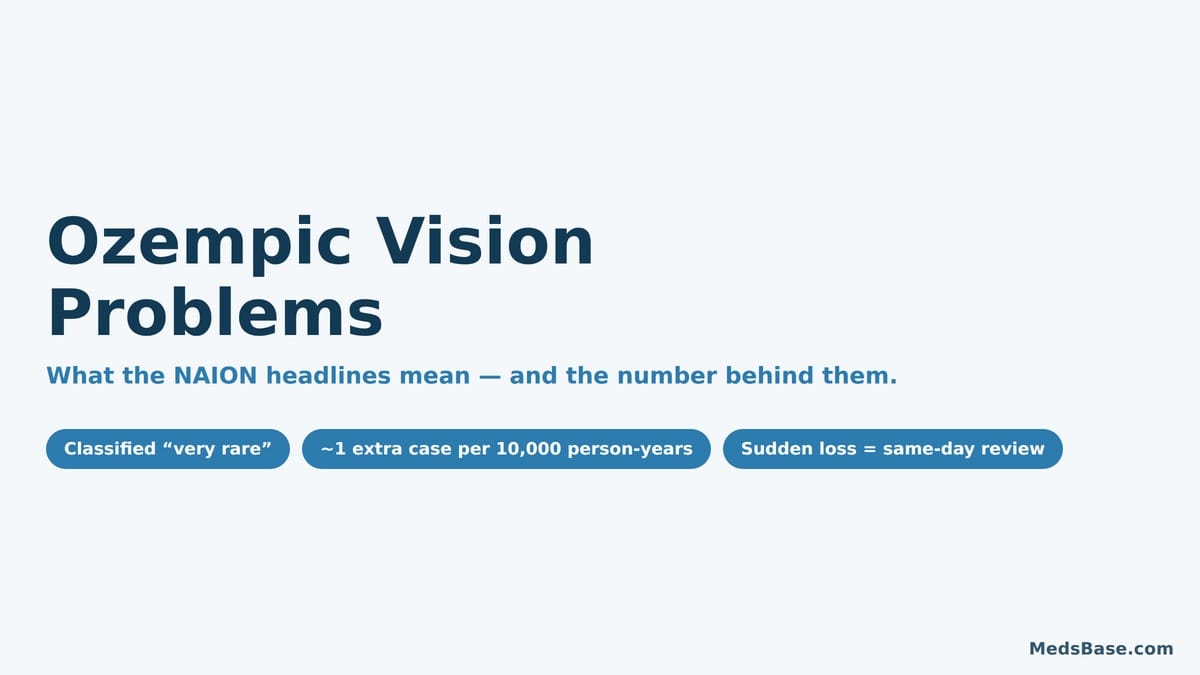
Here is a number worth holding on to before you read another headline about Ozempic vision problems: European regulators, after a full review, put the extra risk of the serious eye condition at issue at roughly one additional case per 10,000 person-years of treatment. That is the same regulator that agreed the risk is real and ordered it added to the label. Both things are true at once, and almost no coverage says so in the same breath.
By the end of this guide you will know exactly which eye condition the warnings are about, how to tell it apart from the far more common blurring that many people notice in their first weeks on a GLP-1, what the four main studies actually found, and the specific symptom pattern that means you should be seen the same day rather than at your next appointment.
One thing to watch for as you read: the most-quoted figure in this whole story comes from the smallest study, and the least-quoted figure comes from the largest. We will come back to why that matters when we get to the research.
- Regulators classified the serious eye risk as very rare — and still changed the label. Understanding why both happened is the whole story.
- The blurred vision most people notice early on is usually a different problem entirely, and it usually settles.
- The scary “seven-fold risk” figure comes from a study of fewer than 1,000 people at a single specialist clinic — the number to weigh more heavily is much lower.
- There is one symptom pattern that changes the urgency completely, and it takes about ten seconds to check.
- Stopping a diabetes medicine on your own carries its own risks — which is why the advice here is never simply “stop”.
What Ozempic Vision Problems Actually Means
The phrase covers a lot of ground, which is part of why the topic is so confusing. When people search for it, they are usually holding one of two very different experiences.
The first is mundane. Your vision goes soft around the edges for a few weeks, reading gets harder, your glasses feel wrong. This blurred vision is common when blood glucose drops substantially and fairly quickly, because the lens of your eye takes on and gives up water as glucose levels shift, which changes its focusing power. It affects both eyes, it fluctuates, and it typically resolves as your levels stabilise.
The second is not mundane at all. NAION is a stroke-like event in the optic nerve head — the small, crowded disc where the nerve fibres from your retina bundle together and exit the back of the eye. Blood supply there drops, nerve fibres are injured, and a section of your visual field goes dark. It usually affects one eye, comes on suddenly, and does not hurt.
The entire practical value of this article is in learning to tell those two apart, because they call for completely different responses.
Here is where it gets interesting. The reason NAION became headline news is not that it is common — it is not — but that a medicine taken by millions of people was linked to it. When a very rare event meets a very large population, even a small increase in relative risk produces a visible number of real cases. That is a genuine public-health concern and a very small individual one, simultaneously. Holding both ideas at once is the honest position.
How Semaglutide Could Affect the Optic Nerve
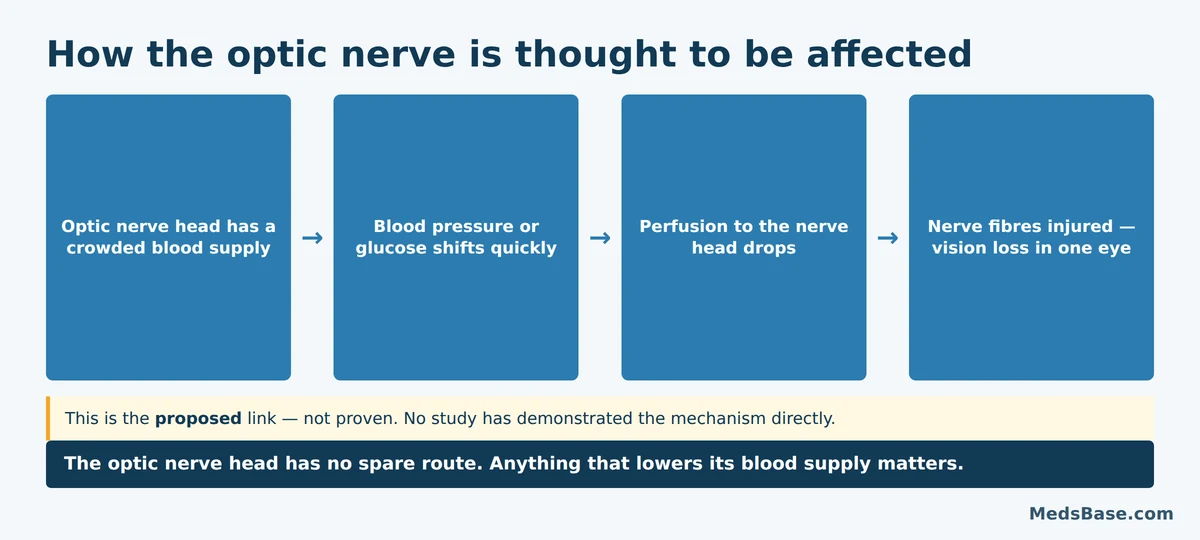
The optic nerve head has an unusual problem: it is crowded, and it has no spare route.
Think of it as a motorway junction where every lane from an entire city has to funnel through one narrow bridge. In most tissue, if one small vessel struggles, neighbouring vessels pick up the slack. At the optic nerve head, the fibres are packed tightly through a small opening with a blood supply that has very little redundancy. Reduce the pressure or flow through that supply enough, and the fibres downstream are injured quickly.
Anything that shifts blood flow or pressure at that junction is therefore worth studying. That includes low blood pressure overnight, sleep apnoea, certain anatomical variations of the disc — and, potentially, rapid metabolic change.
Two honest caveats about semaglutide eye side effects belong here, and skipping them would be misleading.
First, people taking semaglutide are not a random sample. They have type 2 diabetes or obesity, often both, plus hypertension, sleep apnoea and vascular disease at higher rates than the general population — and every one of those independently raises NAION risk. Untangling the drug from the people who take it is genuinely hard, and it is the main reason careful researchers disagree.
Second, there is a known and separate phenomenon in diabetes care: when long-standing high glucose is corrected quickly, existing diabetic retinopathy can transiently worsen before it improves. That is a different condition from NAION with a different mechanism, and it is well documented for intensive glucose control generally, not specific to any one medicine. If you already have diabetic retinopathy, this is the eye issue most worth raising with your team — not NAION.
The Two Eye Problems People Constantly Confuse
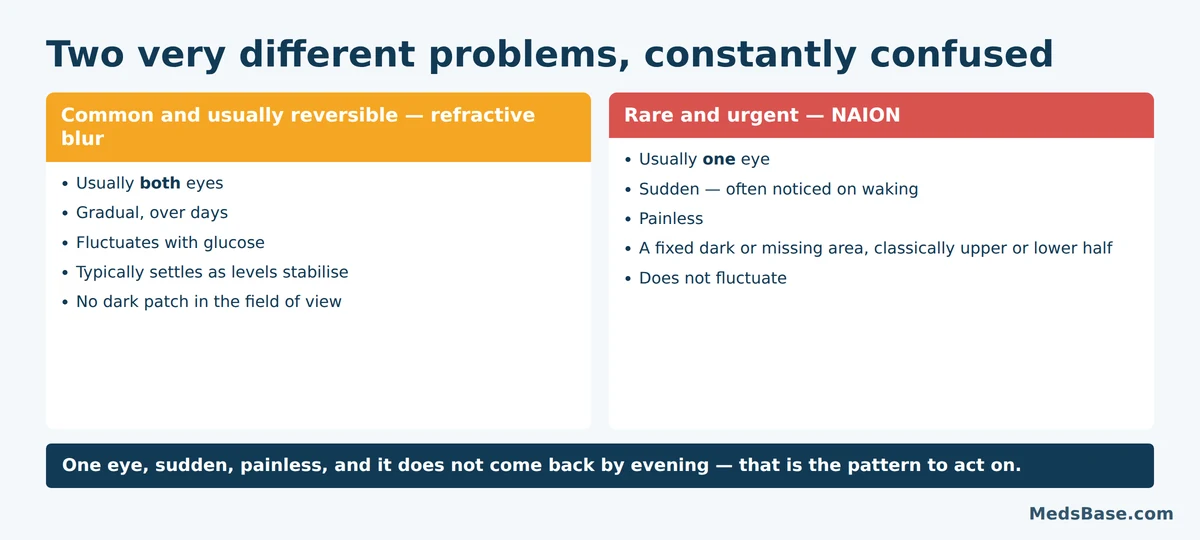
This section resolves the first open loop, and it is the most useful thing on this page. Nearly all confusion about Ozempic vision problems collapses once you separate these two.
Most people who search for Ozempic vision problems after noticing something themselves have refractive blurring, not NAION. The distinction is not subtle once you know what to look at.
| Feature | Refractive blurring (common) | NAION (very rare) |
|---|---|---|
| Which eye | Usually both | Usually one |
| Onset | Gradual, over days | Sudden — often noticed on waking |
| Pain | None | None (this does not rule it out) |
| Pattern | General softness, fluctuates | A fixed dark or missing area, classically upper or lower half |
| Over the day | Varies with glucose | Does not improve by evening |
| Course | Usually settles as levels stabilise | Usually permanent |
| What to do | Mention at your next review; do not buy new glasses yet | Seek medical assessment the same day |
Here is the ten-second check. Cover one eye, then the other, and look at a doorway or window frame. Refractive blurring makes everything soft in both eyes. NAION typically takes out a region — the top half or bottom half of the field in one eye specifically — and that region does not come back when you blink, rest, or wait until evening.
The classic description patients give is not “everything is blurry”. It is closer to “a curtain came down over half of what I can see with that eye”. If that sentence describes what you are experiencing, stop reading and arrange to be seen today.
There is a practical trap worth naming. Because the early weeks on a GLP-1 bring several adjustments at once — the same weeks when nausea is at its worst and appetite changes fastest — it is easy to file a vision change under “everything feels strange right now, it will pass.” Most of the time that instinct is correct. The cover test above is how you check cheaply whether this is the exception.
Ozempic Vision Problems: How Common Is NAION, Really?
This is where relative risk needs translating, because “doubles your risk” means nothing without knowing what it doubles from.
In the general population, NAION is uncommon — the frequently cited background figure is roughly 2 to 10 cases per 100,000 people per year in adults over 50. Doubling a small number gives you a slightly less small number. It does not produce a common event.
The regulators did the arithmetic. The European Medicines Agency concluded in June 2025 that NAION is a very rare side effect of semaglutide medicines — their formal frequency category meaning it may affect up to 1 in 10,000 people. Their summary of the epidemiology put it at approximately a two-fold increase in risk, corresponding to approximately one additional case per 10,000 person-years of treatment. The product information across the EU was updated accordingly. Shortly afterwards, the World Health Organization issued its own note carrying the same conclusion and the same advice.
One extra case per 10,000 person-years means that if 10,000 people take it for a year, the evidence suggests roughly one additional case of NAION among them than you would otherwise have expected.
That framing does two jobs at once. It should stop the panic, and it should also stop anyone claiming the concern is invented. A regulator does not change a label across three products for a risk it considers imaginary. It changed the label because the signal was consistent enough to warrant informing patients — and it used the “very rare” category because that is what the numbers supported.
There is a second reason the regulatory position matters more than any single study. Any semaglutide safety judgement worth trusting weighs the whole evidence base including the studies that found nothing, and there are several of those. Individual papers get headlines; the pooled view is what changes labels.
Who Is Most at Risk — and Who Should Be Cautious
Risk of Ozempic vision problems is not spread evenly, and the honest version of this section includes the part that argues against alarm.
That last line is the part most coverage omits, and leaving it out distorts the whole picture. Poorly controlled diabetes is one of the leading causes of preventable sight loss worldwide. Untreated obesity carries its own vascular consequences. The comparison that matters to a real person is never “this drug versus no risk at all” — it is “this drug versus the condition it treats.”
If you and your doctor decide a different approach suits you better, that is a legitimate conversation to have, and it is worth having with the full range of GLP-1 weight-loss options in front of you rather than deciding under the pressure of a headline.
The wrong response to this article is stopping a diabetes medicine tonight without telling anyone. Abrupt discontinuation has its own consequences — glucose control, rebound appetite, and in some cases a fast return of the weight. If you are worried enough to want to stop, you are worried enough to warrant a conversation first.
What the Research Says About Ozempic Vision Problems
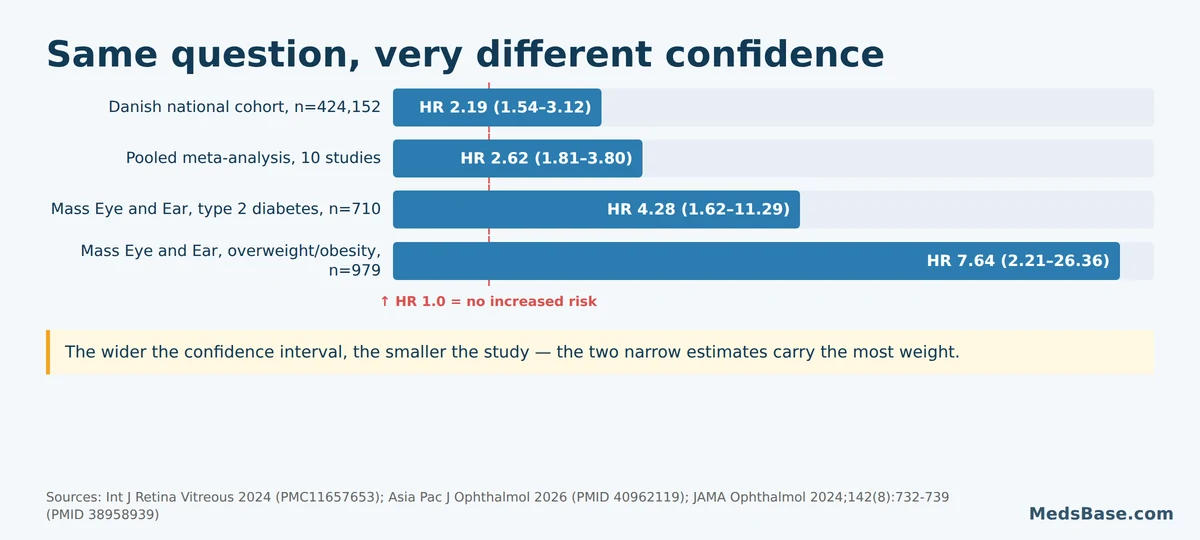
Now to the second open loop: across the research on Ozempic vision problems, the most-quoted number comes from the smallest study.
| Study | Year | Population | Finding | Source |
|---|---|---|---|---|
| Mass Eye and Ear retrospective cohort | 2024 | 710 with type 2 diabetes; 979 with overweight/obesity, single specialist clinic | HR 4.28 (95% CI 1.62–11.29) in the diabetes group; HR 7.64 (95% CI 2.21–26.36) in the overweight/obesity group | JAMA Ophthalmology 2024;142(8):732-739 |
| Danish national registry cohort | 2024 | 424,152 people with type 2 diabetes | HR 2.19 (95% CI 1.54–3.12); incidence 0.228 vs 0.093 per 1,000 person-years | Int J Retina Vitreous |
| Systematic review and meta-analysis | 2026 | 10 studies pooled | Pooled HR 2.620 (95% CI 1.808–3.795); risk elevation became statistically significant after roughly 2 years of exposure | Asia Pac J Ophthalmol |
| EMA pharmacovigilance review | 2025 | Full evidence base | NAION classified very rare; ~2-fold relative increase; ~1 extra case per 10,000 person-years | European Medicines Agency |
Read the confidence intervals, not just the headline numbers. The 2024 Massachusetts Eye and Ear analysis produced the famous “four-fold” and “seven-fold” figures — but look at the range on that second estimate: 2.21 to 26.36. An interval that wide is a study telling you honestly that it cannot pin the number down. It was also conducted at a specialist neuro-ophthalmology clinic, meaning the people in it were already there because something was wrong with their eyes. That is not a flaw in the research; it is a limitation the authors themselves flagged. It was designed to detect a signal, and it did.
Compare that with a Danish national cohort of 424,152 people — an entire country’s diabetes population rather than one clinic’s referrals. It found a hazard ratio of 2.19, with a much tighter interval, and it reported the absolute numbers that make the risk comprehensible: 0.228 versus 0.093 cases per 1,000 person-years. In plain terms, roughly two in 10,000 per year rather than one in 10,000.
Then a 2026 systematic review pooled ten studies and landed at 2.62 — very close to the Danish figure and to the regulators’ two-fold summary. It also reported something clinically interesting: the increase only reached statistical significance after around two years of exposure, which argues against a sudden early hazard.
What this means for you: the trustworthy estimate is roughly a doubling of a rare event, not a seven-fold jump, and the risk does not appear to spike in your first months.
It would be dishonest to stop there. Several well-conducted studies, including large database analyses, have found no significant increase at all. The evidence is genuinely mixed, the mixture is not evenly weighted, and the regulatory conclusion — real, but very rare — is the fairest summary anyone can currently give.
Is the Risk the Same Across All GLP-1 Medicines?
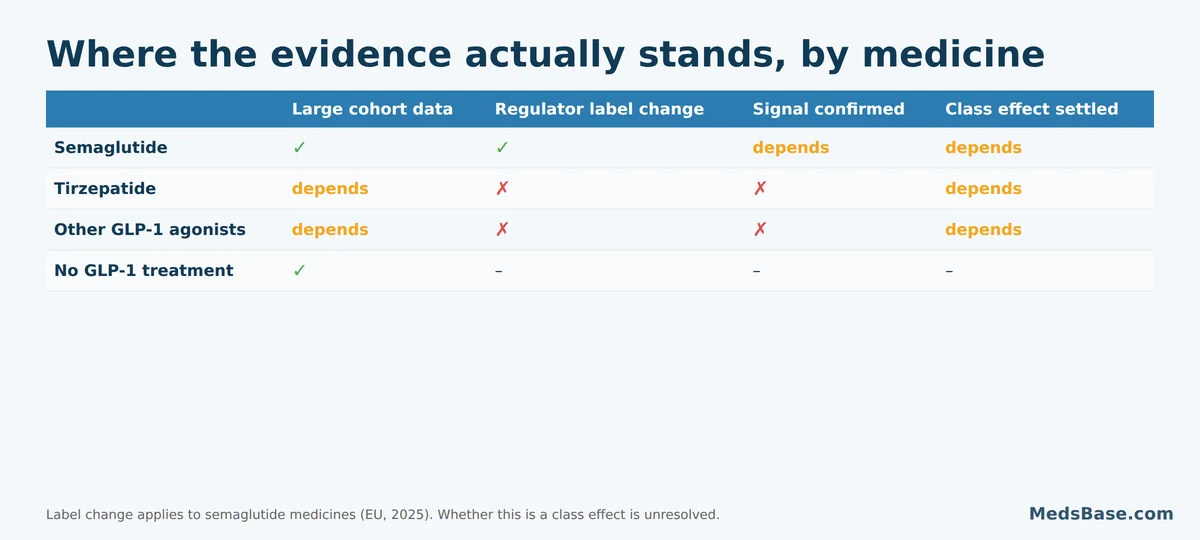
This question comes up immediately and deserves a straight answer: nobody fully knows whether Ozempic vision problems have any parallel in the rest of the class.
| Semaglutide | Tirzepatide | Other GLP-1 agonists | |
|---|---|---|---|
| Large cohort data available | Yes | Limited | Limited |
| Regulatory label updated for NAION | Yes (EU, 2025) | No | No |
| Signal consistently reproduced | Partly — mixed studies | Not established | Not established |
| Confirmed as a class effect | Unresolved | Unresolved | Unresolved |
The regulatory action applies specifically to semaglutide medicines. That is not the same as a finding that other GLP-1 medicines are safer — it mostly reflects where the data exist. Semaglutide has been used at scale for longer and in more people, so it generated the signal first. Whether this turns out to be a class effect or something specific to one molecule is an open question, and anyone telling you confidently either way is ahead of the evidence.
Which one fits which situation? If you have no personal risk factors, this data does not favour one option over another, and the choice should turn on the things that actually differ between these drugs — efficacy, tolerability, dosing schedule and cost. If you have already had NAION in one eye, that is a specialist conversation regardless of which molecule is proposed, because your baseline risk in the other eye is elevated independent of any medicine. If you are choosing on other grounds anyway, our breakdown of how the three main GLP-1 drugs actually differ compares them on the factors where the evidence is much clearer.
What to Do About Ozempic Vision Problems — Practical Guidance
Concrete steps for handling Ozempic vision problems, in order of usefulness.
- Run the cover test if you have noticed a change. One eye at a time, look at a straight edge. Both eyes soft and fluctuating points toward refractive change. One eye with a fixed missing region points toward something that needs same-day assessment.
- Treat sudden, painless, one-eyed loss as urgent. Not next week. NAION has no established treatment that reverses it, so the reason for urgency is diagnosis and protecting the other eye, not undoing the damage.
- Get a baseline eye examination if you have risk factors. If you are over 50, have sleep apnoea, or have any retinopathy, an examination before or early in treatment gives you something to compare against later. This is ordinary good practice for anyone with diabetes.
- Review the timing of your blood-pressure medication. If you take antihypertensives at night and your pressure runs low overnight, that is worth mentioning — overnight hypotension is one of the recognised associations with NAION and it is often adjustable.
- Don’t rush a new glasses prescription. Wait until glucose has been steady for several weeks.
- Don’t stop a prescribed medicine unilaterally. Report the symptom, let a clinician make the call. MedlinePlus lists vision changes among the effects worth reporting to your doctor, and that is exactly the mechanism to use.
Mistakes to avoid: assuming painless means harmless (NAION is painless); waiting for the second eye to be affected before acting; assuming a normal eye test six months ago rules anything out; treating a scary relative risk as a personal prediction; and quietly stopping treatment without telling the person managing your diabetes. That last one is, by some distance, the most likely of these to cause you harm.
Something else worth knowing, since early GLP-1 weeks bring several changes at once: many of them do settle. The same pattern applies to why nausea hits hardest in the first weeks and then fades. Vision softness usually behaves the same way. The point of the cover test is simply to catch the one presentation that does not.
- What happens when you stop taking it — if you and your doctor decide to pause treatment, this covers what to expect.
- Protecting muscle while you lose weight — the other side effect worth actively managing rather than just monitoring.
- How the three main GLP-1 drugs actually differ — a like-for-like comparison on efficacy, tolerability and cost.
Frequently Asked Questions
Q: Can Ozempic cause blindness?
A: Complete blindness is not the typical outcome. NAION, the condition flagged in the semaglutide safety reviews, usually causes permanent loss of part of the visual field in one eye rather than total sight loss, and the remaining vision in that eye often stays functional. Regulators classify it as a very rare side effect — up to 1 in 10,000 people — with roughly one additional case per 10,000 person-years of treatment. The far more common vision complaint on these medicines is temporary blurring, which typically resolves.
Q: Does blurry vision on Ozempic go away?
A: Usually, yes — and this is the most common of all Ozempic vision problems. Blurring that affects both eyes, comes on gradually and fluctuates through the day is most often caused by your eye’s lens adjusting to changing blood glucose levels. It commonly settles within a few weeks once levels stabilise. Two things are worth doing: mention it at your next review, and hold off on buying a new glasses prescription until your vision has been steady for several weeks. Blurring in one eye only, or a fixed dark patch, is a different situation and needs same-day assessment.
Q: How common is NAION with semaglutide?
A: The European Medicines Agency classified it as very rare, meaning up to 1 in 10,000 people may be affected, and estimated approximately one additional case per 10,000 person-years of treatment compared with people not taking it. A Danish national cohort of 424,152 people found incidence of 0.228 versus 0.093 cases per 1,000 person-years. A 2026 pooled analysis of ten studies reported a hazard ratio of 2.62 — roughly a doubling of an already uncommon event.
Q: Should I stop Ozempic if my vision changes?
A: Report it rather than stopping on your own. If you have sudden, painless loss of part of the vision in one eye, seek assessment the same day — and regulatory guidance is that if NAION is confirmed, semaglutide should be stopped. For gradual blurring in both eyes, there is usually no urgency beyond mentioning it at your next appointment. Stopping a diabetes medicine abruptly without telling your care team carries real risks of its own, which is why the sequence is report first, decide together.
Q: What are the first signs of NAION?
A: Typically a sudden, painless loss of vision in one eye, often first noticed on waking. People frequently describe a curtain or shadow over the upper or lower half of what they can see with that eye, rather than general blurriness. It does not fluctuate and does not clear by the end of the day. There is usually no pain, no redness and no discharge — which is exactly why it can be dismissed. If this describes your experience, arrange to be seen today.
Q: Does Ozempic make diabetic retinopathy worse?
A: This is a separate issue from NAION and worth raising specifically if you already have retinopathy. Rapid correction of long-standing high blood glucose is known to cause a temporary worsening of existing diabetic retinopathy before it improves — an effect described with intensive glucose control generally, not unique to any one medicine. If you have known retinopathy, ask your team about monitoring during a period of rapid improvement. If you do not have retinopathy, this particular concern does not apply to you.
Q: Do other GLP-1 medicines carry the same eye risk?
A: It is not yet established that Ozempic vision problems extend to the rest of the class. The EU label change applies specifically to semaglutide medicines, largely because that is where the large-scale data exist — semaglutide has been used at scale for longer than the newer alternatives. Whether NAION turns out to be a class effect across GLP-1 receptor agonists or something more specific remains genuinely unresolved. Nobody can currently tell you that another GLP-1 is safer for your eyes on evidence rather than assumption.
Q: Is there any treatment for NAION if it happens?
A: There is no established treatment that reverses the damage, which is why the World Health Organization’s note describes the vision loss as typically irreversible. Medical assessment still matters urgently for three reasons: confirming the diagnosis and excluding other causes of sudden vision loss that are treatable, reviewing whether to continue the medicine, and identifying modifiable risk factors — such as untreated sleep apnoea or overnight low blood pressure — that could reduce the risk to the other eye.
The Bottom Line
Ozempic vision problems are worth understanding, worth watching for, and not worth panicking about. The serious complication behind the headlines is real enough that regulators changed the label, and rare enough that they classified it as very rare while doing so. The most trustworthy estimate available — from the largest cohort, the pooled analysis and the regulators, all landing in the same place — is roughly a doubling of an uncommon event, amounting to about one extra case per 10,000 person-years.
The single most useful thing you can take from this page costs you ten seconds: cover one eye, then the other, and look at a straight edge. Blurring in both eyes that fluctuates is almost always the ordinary, reversible kind. A fixed missing region in one eye is the pattern that needs a same-day appointment. Knowing the difference is worth more than any risk statistic.
If this has you rethinking your approach, the productive next step is a conversation with the person managing your treatment — not a decision made alone tonight. If you are comparing options more broadly, you can see what is available across the GLP-1 weight-loss options and take a specific question to that appointment rather than a vague worry.
Wondering what else to keep an eye on while you are on a GLP-1? Our guide to protecting muscle while you lose weight covers the side effect that is far more likely to affect you — and far more within your control. And if the last thing you got flagged at a check-up was a raised uric acid result rather than anything to do with your eyes, how to lower uric acid without guesswork sorts out what diet can and cannot achieve.

Written by
Sophie ChenPharmaceutical Content Researcher · 8 years experience
Sophie Chen is a pharmaceutical content researcher with 8 years covering generic medication access and clinical pharmacology. She specialises in international regulatory frameworks, bioequivalence standards, and patient-facing education on therapeutic drug classes. She is not a clinician.