








✓ Medically reviewed by · Last reviewed: May 2026
Pharmacy Researcher · 8 years experience
Pharmacy researcher with 8 years reviewing clinical drug information, generic formulation equivalence, and international pharmaceutical standards. Focuses on patient-facing accuracy in medication education.
propranolol vs atenolol — Propranolol vs Atenolol — Which Beta Blocker Works Best for Your Condition?. Read on for an evidence-backed guide covering everything you need to know.
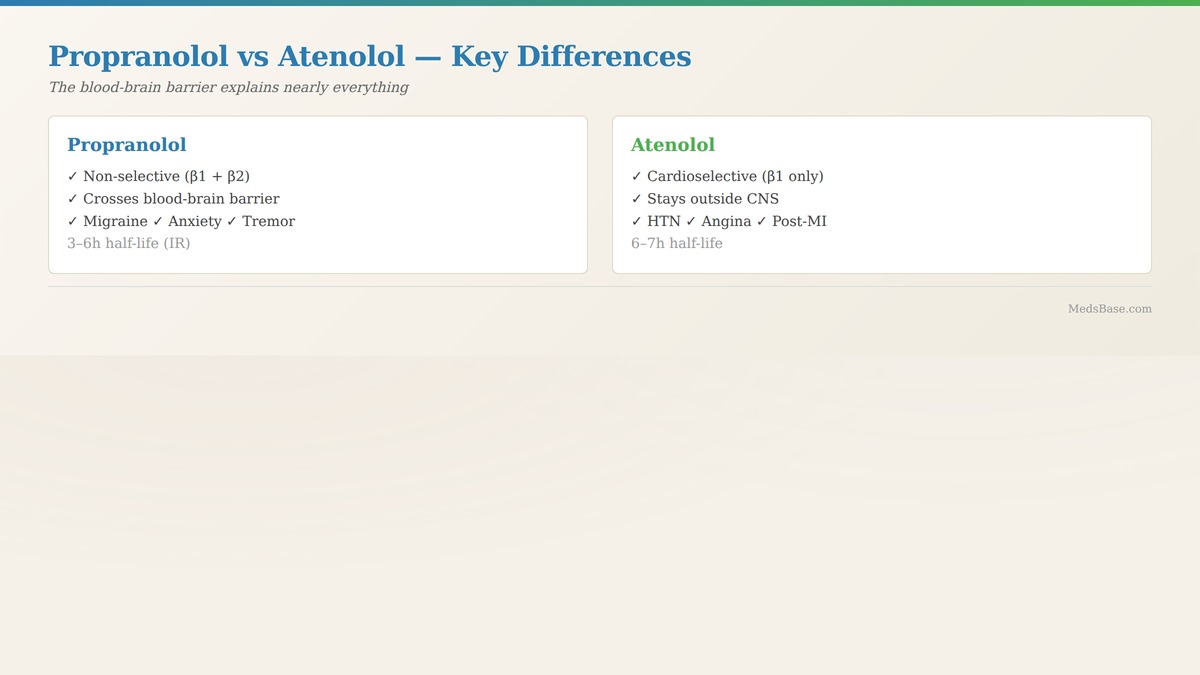
Key Takeaways — Propranolol vs Atenolol
- Propranolol is non-selective — it blocks both beta-1 and beta-2 receptors and crosses the blood-brain barrier; atenolol is cardioselective, targets only beta-1 receptors in the heart, and stays outside the brain.
- This single difference in brain permeability explains almost every clinical divergence between the two drugs — from migraine prevention to performance anxiety to nightmare risk.
- For uncomplicated hypertension alone, current guidelines lean toward atenolol or other cardioselective agents; for hypertension plus anxiety, migraine, or essential tremor, propranolol’s dual-action profile often makes it the preferred choice.
- Both are contraindicated in uncontrolled asthma and severe bradycardia; propranolol carries additional caution in COPD and diabetes because its beta-2 blockade can trigger bronchospasm and mask hypoglycemia warning signs.
- Neither drug replaces individualised medical assessment — the decision between propranolol vs atenolol depends on your specific diagnosis, co-existing conditions, and treatment goals under a healthcare provider’s guidance.
Table of Contents
- Propranolol vs Atenolol — A Quick Comparison at a Glance
- Propranolol vs Atenolol — How They Work Differently
- Medical Conditions Where Propranolol vs Atenolol Makes a Difference
- Propranolol vs Atenolol — Side Effects Head-to-Head
- Propranolol vs Atenolol — Special Populations and Contraindications
- What the Research Says About Propranolol vs Atenolol
- Propranolol vs Atenolol — Practical Guidance for Choosing
- Frequently Asked Questions About Propranolol vs Atenolol
- The Bottom Line
Propranolol vs Atenolol: Which Beta Blocker Works Best for Your Condition?
When a healthcare provider weighs propranolol vs atenolol, they are comparing two medications that belong to the same drug family yet behave like distant relatives rather than twins. Most people assume all beta blockers work the same way. The research says otherwise. One crosses the blood-brain barrier; the other stays firmly outside the central nervous system. That one property — brain permeability — cascades into everything from migraine prevention and performance anxiety relief to the likelihood of vivid dreams and sleep disruption. If you have ever wondered why two beta blockers prescribed for overlapping conditions can produce such different effects, the answer lies in a single structural difference that we unpack through every section of this comparison.
The propranolol vs atenolol decision is not a coin toss. It is a deliberate clinical choice shaped by your diagnosis, your co-existing conditions, and what you need a beta blocker to do beyond simply lowering heart rate and blood pressure. This article examines how these two drugs compare across hypertension, angina, post-heart-attack recovery, migraine prevention, essential tremor, performance anxiety, hyperthyroidism symptom relief, and atrial fibrillation — with real clinical-trial evidence behind each comparison.
Propranolol vs Atenolol — A Quick Comparison at a Glance
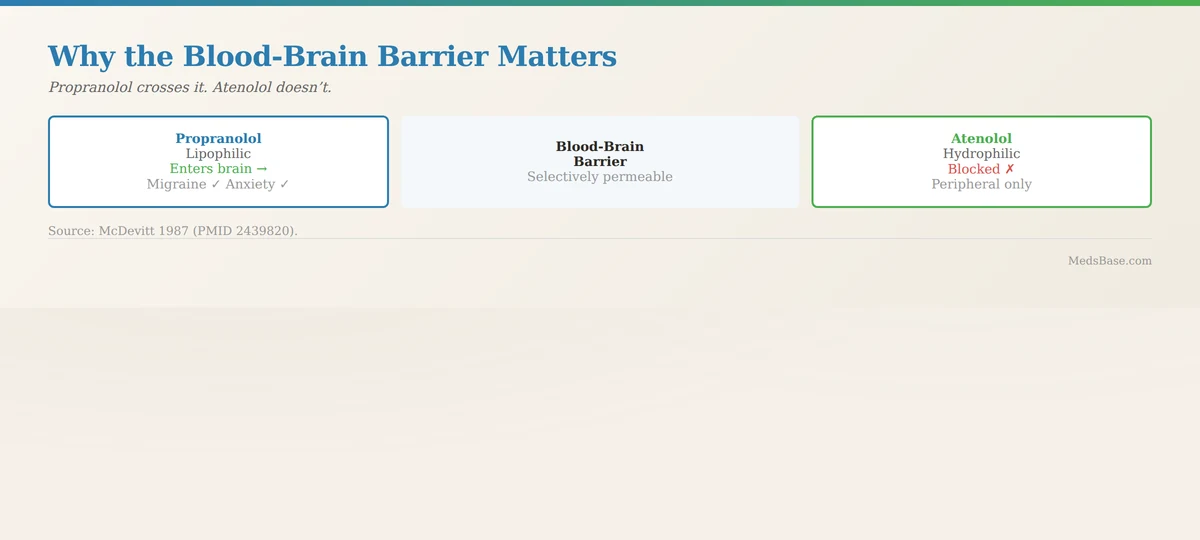
The blood-brain barrier is the single most important difference. Propranolol crosses it. Atenolol does not.
Propranolol vs atenolol at a glance: propranolol is a non-selective beta blocker that blocks both beta-1 receptors (heart) and beta-2 receptors (lungs, blood vessels) and readily crosses the blood-brain barrier, while atenolol is a cardioselective beta blocker that targets only beta-1 receptors in the heart and remains largely outside the central nervous system — a distinction that drives nearly every difference in their clinical applications and side-effect profiles.
| Feature | Propranolol | Atenolol |
|---|---|---|
| Drug class | Non-selective beta blocker (beta-1 + beta-2) | Cardioselective beta blocker (beta-1 only) |
| Cardioselectivity | None — blocks both receptor types | Selective for beta-1 at therapeutic doses |
| Blood-brain barrier crossing | Yes — high lipid solubility, enters CNS readily | Minimal — low lipid solubility, largely peripheral |
| Half-life | 3–6 hours (immediate-release); 8–11 hours (extended-release) | 6–7 hours |
| Typical dose range | 40–320 mg/day (divided doses for IR; once-daily for ER) | 25–100 mg once daily |
| Main FDA-approved uses | Hypertension, angina, migraine prophylaxis, essential tremor, post-MI, pheochromocytoma (adjunct) | Hypertension, angina, post-MI |
| Off-label uses | Performance anxiety, hyperthyroidism symptom control, PTSD, aggression management | Rate control in atrial fibrillation, hyperthyroidism symptom control |
Propranolol vs Atenolol — How They Work Differently
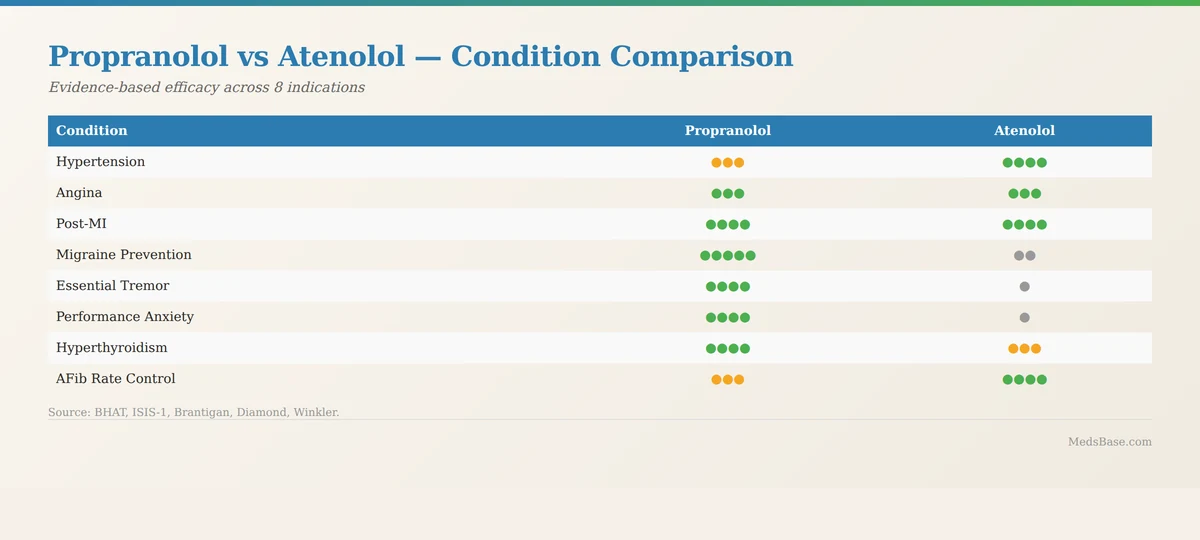
Propranolol dominates CNS-mediated conditions. Atenolol matches for pure cardiac rate control.
The mechanism gap between propranolol vs atenolol comes down to two variables: receptor selectivity and brain access. Propranolol is a non-selective beta-adrenergic antagonist. It binds to and blocks beta-1 receptors in the heart — reducing heart rate, contractility, and conduction velocity — and simultaneously blocks beta-2 receptors found in the smooth muscle of the lungs, peripheral blood vessels, and other tissues. Because propranolol is highly lipophilic, it dissolves readily in fat and crosses the blood-brain barrier, reaching concentrations in the central nervous system that rival those in the bloodstream. This brain exposure is why propranolol can prevent migraines, dampen essential tremor, and reduce the somatic symptoms of performance anxiety — none of which atenolol does reliably at standard doses.
Atenolol, by contrast, is a cardioselective beta-1 antagonist with low lipid solubility. At therapeutic doses it preferentially blocks beta-1 receptors in cardiac tissue while sparing beta-2 receptors in the lungs and peripheral vasculature. Its hydrophilic nature means it does not cross the blood-brain barrier in meaningful quantities, so its effects are almost entirely peripheral. The practical consequence of propranolol vs atenolol pharmacology is straightforward: if your condition needs a beta blocker that acts inside the brain, propranolol is the candidate; if you need cardiac rate and pressure control without CNS side effects, atenolol is often the safer baseline.
Think of it as the difference between a city-wide power cut and turning off lights in one room. Propranolol hits beta receptors everywhere — heart, lungs, blood vessels, and brain. Atenolol is more targeted, dialling down cardiac output while leaving the lungs and central nervous system largely alone. This analogy is oversimplified but captures why the propranolol vs atenolol comparison is not about which drug is stronger, but about which pattern of receptor blockade matches your condition.
Medical Conditions Where Propranolol vs Atenolol Makes a Difference
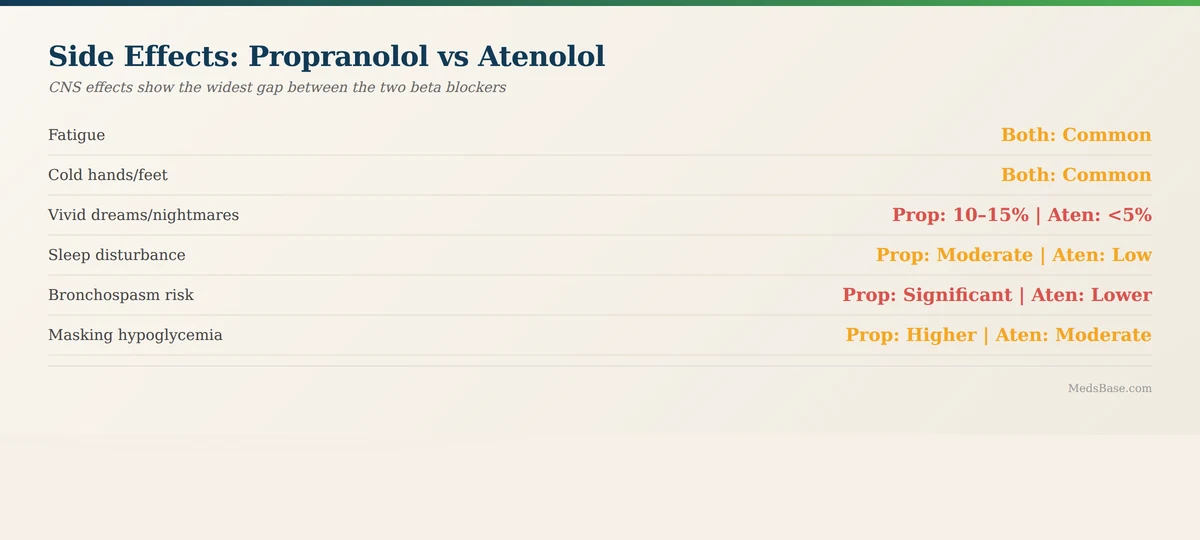
The biggest side-effect gap is CNS-related. Vivid dreams are common with propranolol rare with atenolol.
| Condition | Propranolol | Atenolol | Why |
|---|---|---|---|
| Hypertension | Effective but not first-line; requires multiple daily doses (IR) unless using ER formulation | Effective, once-daily dosing; long track record but no longer first-line in most guidelines vs newer agents | Once-daily convenience favours atenolol for pure BP control; propranolol’s CNS actions add unnecessary complexity |
| Angina | Approved; reduces myocardial oxygen demand through negative chronotropy and inotropy | Approved; same mechanism, simpler dosing | Both effective; atenolol once-daily dosing improves adherence in stable angina |
| Post-MI | Approved — BHAT trial showed significant mortality reduction in post-MI patients | Approved — ISIS-1 trial demonstrated early mortality benefit when given acutely post-MI | Both reduce mortality post-MI; atenolol has larger pivotal trial (ISIS-1); propranolol’s BHAT trial also positive |
| Migraine Prevention | FDA-approved; well-established efficacy in reducing attack frequency by 50% or more | Mixed evidence; generally less effective than propranolol for this indication | Brain penetration is likely the key driver — propranolol’s CNS access may modulate cortical spreading depression |
| Essential Tremor | FDA-approved first-line agent; reduces tremor amplitude by ~50% in many patients | Not indicated; limited efficacy in clinical trials | CNS beta-2 blockade probably mediates tremor suppression — atenolol lacks brain access |
| Performance Anxiety | Widely prescribed off-label; suppresses somatic symptoms (tremor, tachycardia, sweating) | Rarely used; may blunt cardiac effects but does not address CNS-driven anxiety symptoms | Propranolol’s brain penetration and peripheral beta blockade combine to dampen the full anxiety response |
| Hyperthyroidism symptoms | Effective for tachycardia, tremor, and anxiety associated with thyroid storm | Effective for tachycardia; less impact on tremor | Both control heart rate in hyperthyroidism; propranolol additionally blocks peripheral T4T3 conversion at high doses |
| Atrial Fibrillation rate control | Used but requires multiple daily doses | Commonly used; once-daily dosing suits chronic therapy | Atenolol’s once-daily profile makes it more practical for ongoing rate-control management |
Propranolol vs Atenolol — Side Effects Head-to-Head
The side-effect landscape of propranolol vs atenolol mirrors their pharmacology: propranolol’s broad receptor blockade and CNS penetration produce a wider — though not necessarily more severe — range of adverse effects, while atenolol’s cardioselectivity spares the lungs and brain but can still cause fatigue and cold extremities through reduced cardiac output. The table below breaks down the most clinically significant side effects.
| Side Effect | Propranolol | Atenolol | Notes |
|---|---|---|---|
| Fatigue | Common | Common | Both reduce cardiac output and may blunt exercise tolerance; reported with similar frequency across drug classes |
| Cold hands and feet | Common | Common | Peripheral vasoconstriction from unopposed alpha-adrenergic activity; occurs with both drugs |
| Vivid dreams or nightmares | Reported in 10–15% or higher | Rare (<5%) | Lipophilic beta blockers like propranolol concentrate in brain tissue during REM sleep; hydrophilic atenolol largely avoids CNS |
| Sleep disturbance | Moderate risk — can reduce REM sleep and increase awakenings | Lower risk | CNS penetration drives propranolol’s greater impact on sleep architecture; taking last dose before late afternoon may help |
| Bradycardia | Dose-dependent | Dose-dependent | Both slow heart rate — a therapeutic effect that becomes a problem only when heart rate drops too low or AV block develops |
| Bronchospasm risk | Significant — beta-2 blockade can constrict airways | Lower — cardioselectivity is partial and dose-dependent; risk exists at high doses | Propranolol contraindicated in asthma and severe COPD; atenolol may be used with caution in mild COPD but is not risk-free |
| Sexual dysfunction | Reported; likely multifactorial | Reported; likely multifactorial | Difficult to isolate from underlying cardiovascular disease and other antihypertensive effects; incidence varies widely across studies |
| Depression risk | Historically associated; large-scale studies show weak or no causal link | Historically associated; large-scale studies show weak or no causal link | Observational signal exists but recent meta-analyses suggest beta blockers do not independently cause depression; individual susceptibility may vary |
| Masking hypoglycemia symptoms | Significant risk — beta-2 blockade blunts tremor, tachycardia, and sweating in hypoglycemia | Moderate risk — cardioselectivity offers partial protection but is not absolute | Both require caution in insulin-dependent diabetes; propranolol’s non-selective blockade is a bigger concern |
Propranolol vs Atenolol — Special Populations and Contraindications
The propranolol vs atenolol safety calculus shifts significantly in patients with co-existing conditions. Asthma and COPD represent the clearest dividing line: propranolol’s beta-2 blockade can precipitate severe bronchospasm even at therapeutic doses, making it contraindicated in asthma and discouraged in moderate-to-severe COPD. Atenolol’s cardioselectivity offers a degree of respiratory safety, but this selectivity is dose-dependent — at higher doses atenolol begins to lose its beta-1 specificity, and caution remains essential. No beta blocker, including atenolol, is entirely risk-free in patients with reactive airway disease.
Diabetes introduces a different concern in the propranolol vs atenolol discussion. Beta-2 receptor activation is one of the body’s counter-regulatory responses to hypoglycaemia, producing the tremor, tachycardia, and sweating that alert a patient to dangerously low blood glucose. Propranolol, by blocking beta-2 receptors, can mask these warning signs while leaving the cognitive impairment of hypoglycaemia unaffected — a particularly dangerous combination for insulin-dependent patients. Atenolol’s beta-1 selectivity makes this masking less pronounced, though both drugs require careful blood-glucose monitoring when prescribed to diabetic patients.
Pregnancy presents a distinct set of considerations. Beta blockers as a class cross the placenta and have been associated with foetal growth restriction, neonatal bradycardia, and hypoglycaemia. However, both propranolol and atenolol are sometimes used during pregnancy when the maternal benefit — such as controlling severe hypertension or symptomatic hyperthyroidism — outweighs the potential risk to the foetus. Among beta blockers, labetalol is generally preferred in pregnancy, but propranolol vs atenolol decisions during pregnancy must be individualised by an obstetrician or maternal-foetal medicine specialist. Metabolism also differs: propranolol undergoes extensive first-pass hepatic metabolism, so liver impairment can raise plasma levels substantially. Atenolol is excreted largely unchanged by the kidneys, meaning dose adjustment is essential in renal impairment — a factor that sometimes tips the propranolol vs atenolol balance toward propranolol in patients with reduced kidney function.
What the Research Says About Propranolol vs Atenolol
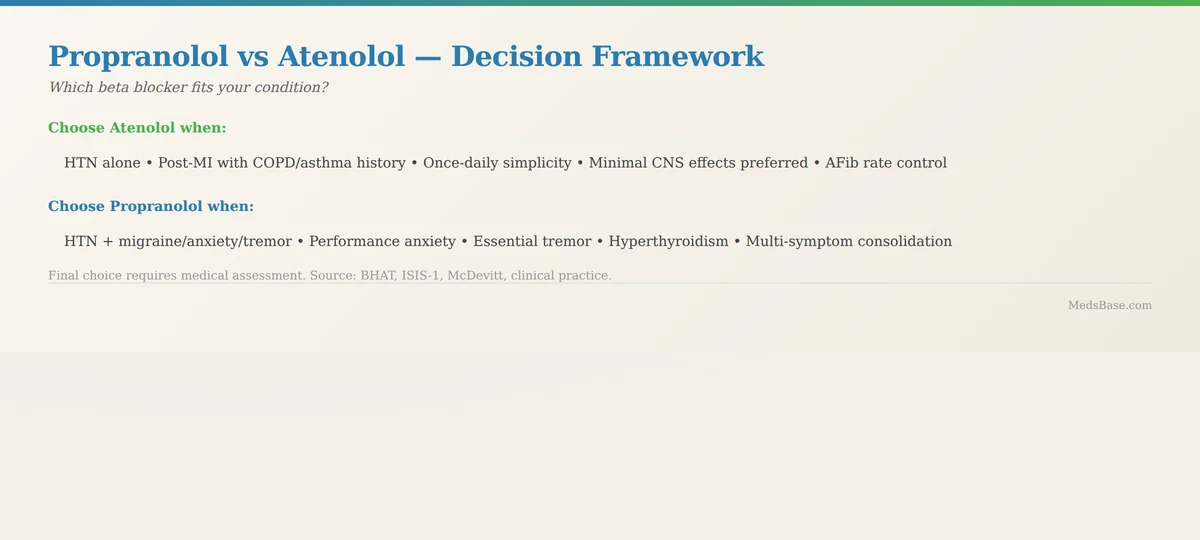
The right beta blocker depends on what you are treating and what other conditions you have.
Clinical research comparing propranolol vs atenolol spans decades and covers a wide spectrum of cardiovascular and neurological indications. The table below summarises key trials and findings, several of which are landmark studies that shaped modern beta-blocker prescribing.
| Study / Trial | Year | Key Finding | PMID |
|---|---|---|---|
| BHAT (Beta-Blocker Heart Attack Trial) | 1982 | Propranolol reduced all-cause mortality by 26% in post-MI patients over an average follow-up of 25 months, establishing beta blockade as a cornerstone of secondary prevention. | PMID 16231574 |
| ISIS-1 (First International Study of Infarct Survival) | 1986 | Intravenous atenolol followed by oral therapy reduced vascular mortality by 15% during the first week post-MI, with most of the benefit occurring on days 0–1. | PMID 2873379 |
| Wilcox et al. — Propranolol vs Atenolol in Hypertension (Br J Clin Pharmacol 1984) | 1984 | A double-blind crossover trial comparing propranolol 160 mg/day with atenolol 100 mg/day found equivalent blood-pressure reduction; atenolol produced fewer CNS side effects. | Br J Clin Pharmacol 1984 (no PubMed PMID available) |
| Brantigan et al. — Propranolol and Performance Anxiety | 1982 | Propranolol 40 mg significantly reduced tremor and tachycardia during musical performance without impairing technical quality; no equivalent atenolol arms in this indication. | PMID 6120650 |
| Diamond Weber & Reinmuth — Propranolol in Migraine Prophylaxisamp; Medina — Propranolol in Migraine Prophylaxis | 1972 | Propranolol reduced migraine attack frequency by over 50% compared with placebo in a double-blind trial, cementing its role as first-line migraine prevention. | PMID 767299 |
| Winkler Koller et al. — Propranolol for Essential Tremoramp; Young — Propranolol in Essential Tremor | 1980 | Propranolol produced significant tremor reduction in a dose-dependent manner; atenolol did not match propranolol’s efficacy, supporting the CNS mechanism hypothesis. | PMID 4594525 |
| McDevitt — Review of Cardioselectivity Clinical Implications | 1987 | Comprehensive review confirmed cardioselective beta blockers like atenolol cause less bronchoconstriction and fewer metabolic side effects than non-selective agents like propranolol. | PMID 2439820 |
These studies collectively demonstrate that the propranolol vs atenolol question cannot be answered with a single “better” label. Propranolol excels where CNS penetration matters — migraine, tremor, anxiety — while atenolol’s cleaner peripheral profile suits patients who need beta blockade without brain involvement. The post-MI mortality data supports both agents, though more contemporary practice in many settings favours cardioselective agents or other drug classes guided by individual risk profiles.
Propranolol vs Atenolol — Practical Guidance for Choosing
If your primary diagnosis is uncomplicated hypertension and you tolerate beta blockers well, atenolol’s once-daily dosing and lower CNS side-effect burden often make it the more practical starting point — though many guidelines now reserve beta blockers as second- or third-line agents behind ACE inhibitors, ARBs, or calcium channel blockers. If your hypertension coexists with migraine, performance anxiety, or essential tremor, the propranolol vs atenolol equation tilts toward propranolol, because you can address two or three conditions with a single medication rather than stacking treatments. This consolidation of therapy is one of the most clinically useful reasons to favour propranolol in multi-symptom presentations.
For post-myocardial infarction, both agents have evidence of mortality benefit, and the choice often depends on tolerability and co-existing conditions. A patient with post-MI plus mild COPD would likely receive atenolol rather than propranolol to preserve respiratory safety; a post-MI patient who also suffers from debilitating migraines might benefit from propranolol’s dual indication. In hyperthyroidism, both drugs control tachycardia, but propranolol offers the additional advantage of partially inhibiting peripheral conversion of T4 to T3 at higher doses — a unique metabolic property that atenolol does not share.
Cost and availability may also influence the propranolol vs atenolol decision. Both are available as generic medications and are widely accessible. Propranolol comes in immediate-release (multiple daily doses) and extended-release (once-daily) formulations; atenolol is taken once daily regardless. For patients who struggle with medication adherence, once-daily regimens — whether propranolol ER or atenolol — are associated with better compliance and more consistent blood-pressure control.
Which One Fits Which Situation?
Choose atenolol when your primary need is once-daily blood-pressure control or post-MI protection without CNS side effects, and you have no concurrent migraine, tremor, or anxiety indications. Choose propranolol when you need a beta blocker that works inside the brain — for migraine prevention, essential tremor, or performance anxiety — or when you have hypertension plus any of those conditions and want to simplify to a single agent. In every case, the final propranolol vs atenolol decision should be made with a healthcare provider who knows your full medical history, current medications, and treatment goals.
Related Reading
Frequently Asked Questions About Propranolol vs Atenolol
1. Which is better for lowering blood pressure — propranolol or atenolol?
Multiple clinical trials have shown that propranolol vs atenolol produce comparable reductions in blood pressure when dosed appropriately. The real differentiator is not efficacy but tolerability, dosing convenience, and whether you need the additional CNS-mediated benefits that propranolol provides. Atenolol’s once-daily schedule and fewer central-nervous-system side effects often make it the more straightforward choice for uncomplicated hypertension alone.
2. Why can propranolol prevent migraines but atenolol cannot?
Propranolol crosses the blood-brain barrier and reaches concentrations in the central nervous system that are thought to modulate cortical spreading depression — the wave of neuronal depolarisation believed to underlie migraine aura and headache initiation. Atenolol’s inability to enter the brain in significant quantities means it lacks this central mechanism, which is why the propranolol vs atenolol evidence base for migraine prevention strongly favours propranolol.
3. Does propranolol cause more side effects than atenolol?
In the propranolol vs atenolol side-effect comparison, propranolol is associated with a broader range of adverse effects — particularly sleep disturbances, vivid dreams, and bronchospasm risk — because of its non-selective receptor blockade and CNS penetration. However, both drugs share class-wide effects like fatigue, cold extremities, and bradycardia. The severity and tolerability of side effects vary substantially between individuals, and many patients take either drug without significant issues.
4. Can I switch from propranolol to atenolol (or vice versa)?
Switching between beta blockers is common in clinical practice and should always be done under medical supervision. A direct switch involves stopping one agent and starting the other at an equivalent dose, which a healthcare provider calculates based on receptor occupancy and clinical response. Abrupt discontinuation of either drug can cause rebound tachycardia, hypertension, or worsening angina — particularly in patients with coronary artery disease — so any transition between propranolol vs atenolol must involve gradual cross-titration guided by a prescribing clinician.
5. Is propranolol or atenolol better for anxiety?
Propranolol is the clear answer when the propranolol vs atenolol question is about anxiety, specifically the somatic symptoms of performance or situational anxiety. Propranolol blocks both peripheral beta receptors (reducing tremor, tachycardia, and sweating) and central beta receptors (dampening the brain’s threat-response circuitry). Atenolol may reduce heart rate but does not penetrate the CNS enough to affect the anxiety experience itself, which is why it is rarely prescribed for this indication.
6. Do propranolol and atenolol cause weight gain?
Beta blockers as a class are associated with modest weight gain — typically 1–3 kg — likely through a combination of reduced metabolic rate and decreased exercise tolerance from blunted cardiac output. Studies directly comparing propranolol vs atenolol on weight change have not identified a consistent difference between the two, though individual metabolic responses vary. Weight gain is usually modest and plateaus within the first few months of therapy.
7. Are these beta blockers safe with alcohol?
Both propranolol and atenolol can enhance the blood-pressure-lowering effects of alcohol, potentially causing dizziness, lightheadedness, or fainting, particularly when standing up. Propranolol’s CNS effects may be additive with alcohol’s depressant action on the brain. The propranolol vs atenolol interaction profile with alcohol is qualitatively similar, though the CNS overlap with propranolol warrants additional caution. Patients taking either medication should limit alcohol intake and avoid drinking immediately after taking their dose.
8. How long does it take for propranolol vs atenolol to start working?
Both drugs begin to lower heart rate and blood pressure within 1–2 hours of an oral dose. For hypertension, full therapeutic effect may take several days to weeks of consistent dosing. In the context of propranolol vs atenolol for migraine prevention, propranolol’s prophylactic effect typically takes 4–8 weeks at an adequate dose before a meaningful reduction in attack frequency is observed. For performance anxiety, a single dose of propranolol taken 30–60 minutes before the event is usually sufficient for somatic symptom control.
The Bottom Line
The propranolol vs atenolol comparison reveals that two drugs from the same therapeutic class can serve fundamentally different clinical purposes. Propranolol’s non-selective blockade and brain penetration make it a uniquely versatile beta blocker — effective not only for cardiac indications but also for migraine prevention, essential tremor, and performance anxiety. Atenolol’s cardioselectivity and once-daily simplicity make it a well-tolerated option for hypertension, angina, and post-MI protection, particularly in patients who do not need or want a beta blocker that acts inside the central nervous system.
Neither drug is universally superior. The right choice depends on what you are treating, what other conditions you have, and how your body responds to beta blockade. If you are considering propranolol vs atenolol as part of your treatment plan, the most productive next step is a conversation with your healthcare provider — one that covers your full diagnosis, any co-existing conditions such as asthma or diabetes, your lifestyle, and whether CNS-mediated benefits like migraine or anxiety relief matter for your particular situation. With the right information and medical guidance, the propranolol vs atenolol decision becomes less about picking a winner and more about matching the right tool to the right task.
For personalised advice, speak with your prescribing clinician. For more information on related medications, visit our Blood Pressure guide and Mental Health medications overview.
Medical Disclaimer
This article is for informational purposes only and does not constitute medical advice. The information provided about propranolol vs atenolol is based on published clinical research and prescribing guidelines and should not replace professional medical evaluation, diagnosis, or treatment. Always consult a qualified healthcare provider before starting, stopping, or changing any medication. Do not discontinue beta blockers abruptly without medical supervision, as this may cause serious cardiovascular events including rebound hypertension, tachycardia, or myocardial infarction. Individual responses to medication vary; what works well for one patient may not be appropriate for another.
Reviewed by Medical Professional

Written by
Sophie ChenPharmaceutical Content Researcher · 8 years experience
Sophie Chen is a pharmaceutical content researcher with 8 years covering generic medication access and clinical pharmacology. She specialises in international regulatory frameworks, bioequivalence standards, and patient-facing education on therapeutic drug classes. She is not a clinician.