








✓ Medically reviewed by · Last reviewed: May 2026
Pharmacy Researcher · 8 years experience
Pharmacy researcher with 8 years reviewing clinical drug information, generic formulation equivalence, and international pharmaceutical standards. Focuses on patient-facing accuracy in medication education.
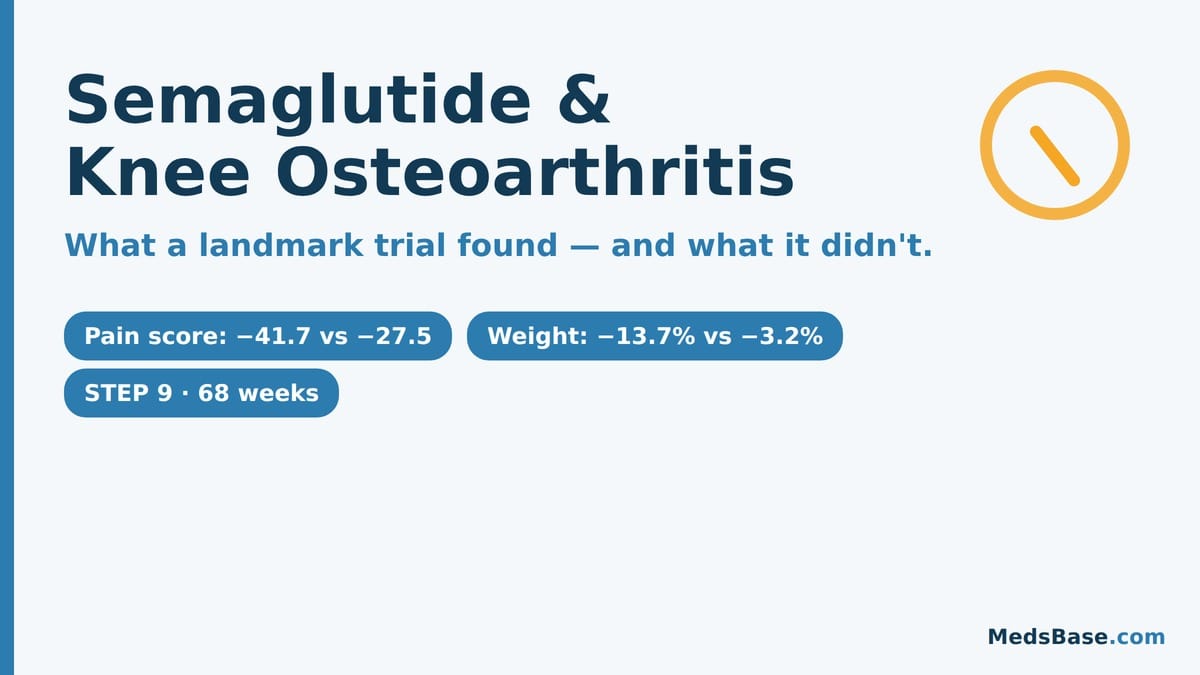
Here is a number that stopped a lot of joint specialists in their tracks: in a 68-week randomised trial, semaglutide cut knee-osteoarthritis pain scores by −41.7 points versus −27.5 for placebo. That is a large, statistically significant gap for a drug most people know as a weight-loss injection. So the question writes itself — is semaglutide for knee osteoarthritis a genuine breakthrough, or a headline that outran the evidence?
By the end of this guide, you will know exactly what the strongest trial proved, where a big database study points the opposite way, and how to think about a GLP-1 shot if your knees ache and the scale is part of the story. One finding surprised even the researchers — we will get to it in the safety section.
- Semaglutide cut knee-pain scores far more than placebo in the STEP 9 trial — but the benefit is tied to weight loss, not a proven joint-repair effect.
- Participants lost about 13.7% of body weight — one common reason the knees felt better within months.
- One large database study points the other way on surgery — the twist that keeps this from being a slam dunk.
- It is not approved for osteoarthritis, and normal-weight knees were never tested.
- The honest verdict: promising for the right person, oversold in the headlines.
What Is Semaglutide, and What Does It Have to Do With Your Knees?
Semaglutide is a GLP-1 receptor agonist — a once-weekly injectable medicine that mimics a gut hormone to curb appetite and slow stomach emptying. According to MedlinePlus, it is used for type 2 diabetes, weight management, cardiovascular risk reduction, and, more recently, liver disease. You know it by the brand names Ozempic and Wegovy.
So why is it turning up in osteoarthritis conversations? Because knee osteoarthritis and excess body weight are tightly linked. Every extra pound multiplies the load your knee absorbs with each step, and it also feeds low-grade inflammation that wears cartilage down faster. Osteoarthritis is one of the most common causes of disability in older adults, and the knee is its favourite target. For millions of people carrying extra weight, those two facts collide in the same joint.
That collision is exactly why a weight-loss medicine landed on osteoarthritis researchers’ radar. If a medication reliably takes weight off, it is reasonable to ask whether the knees underneath feel the relief. That is the core idea behind studying semaglutide for knee osteoarthritis — not that the drug repairs cartilage, but that it might remove some of the burden crushing it.
Here is where it gets interesting: researchers did not just guess. They ran a dedicated trial in exactly this population — people with obesity and diagnosed knee osteoarthritis — and measured the knees, not just the scale. That design matters, because most “weight-loss helps arthritis” claims rest on indirect data. STEP 9 measured the joint directly.
How Semaglutide May Help Knee Osteoarthritis
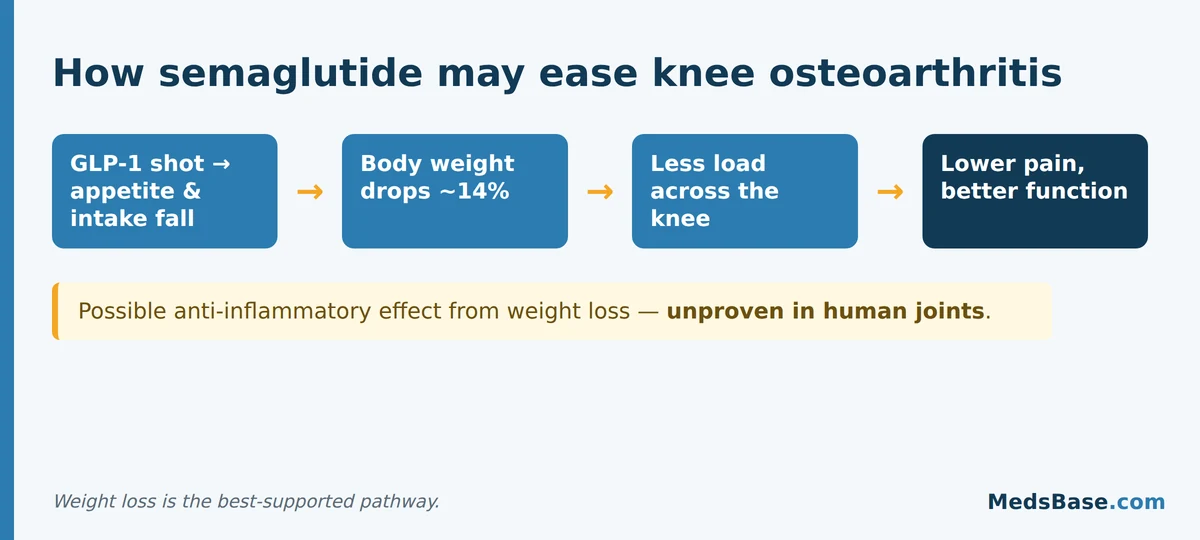
Think of your knee as a hinge carrying a backpack. The heavier the backpack, the more the hinge grinds. Take weight out of the backpack and the hinge moves easier. That is the simplest, best-supported explanation for why GLP-1 for osteoarthritis might work: less weight, less load, less pain.
The mechanism runs in stages. The GLP-1 signal reduces appetite and food intake. Over months, body weight falls — in the key trial, by nearly 14%. With less mass pressing through the joint, the mechanical stress on worn cartilage eases, and pain and stiffness often follow the weight down.
There is a second, quieter pathway worth understanding. Fat tissue is not inert padding — it releases inflammatory signals that circulate through the body and can irritate joints. When you lose a significant amount of fat, those inflammatory signals tend to fall too. So part of the relief people report may come from a calmer inflammatory environment, not just lighter mechanics. It is a plausible bonus, but in human joints it stays unproven, so treat it as a “maybe,” not a selling point.
Notice what this means for expectations. If your knee osteoarthritis pain is driven mostly by mechanical overload from excess weight, you are the person most likely to feel a difference. If your knees are worn for other reasons and your weight is already normal, the logic — and the evidence — is far weaker.
Who Benefits Most — and Who Should Be Cautious
The honest answer: semaglutide’s knee evidence exists almost entirely in people who also carry excess weight. That shapes who it may help.
Adults with obesity and symptomatic knee osteoarthritis
This is the group actually studied. If you have a BMI in the obese range, painful knee osteoarthritis, and your pain flares with activity and weight, you fit the trial population most closely.
People who want to avoid or delay surgery
For someone not ready for a knee replacement, a treatment that tackles both weight and pain is appealing — provided expectations stay realistic and a clinician is involved. Losing weight also makes eventual surgery safer if it does become necessary, since a lower body weight is linked to smoother recovery. So even for people heading toward a replacement someday, weight loss is rarely wasted effort.
People already using semaglutide for another reason
If you are taking a GLP-1 medication for type 2 diabetes or weight management and you happen to have knee osteoarthritis, the joint benefit may come along for the ride. That is a very different situation from starting the drug specifically to treat your knees — something no regulator has approved and no guideline recommends. The distinction matters when you talk to your doctor: a welcome side benefit is not the same as a licensed treatment.
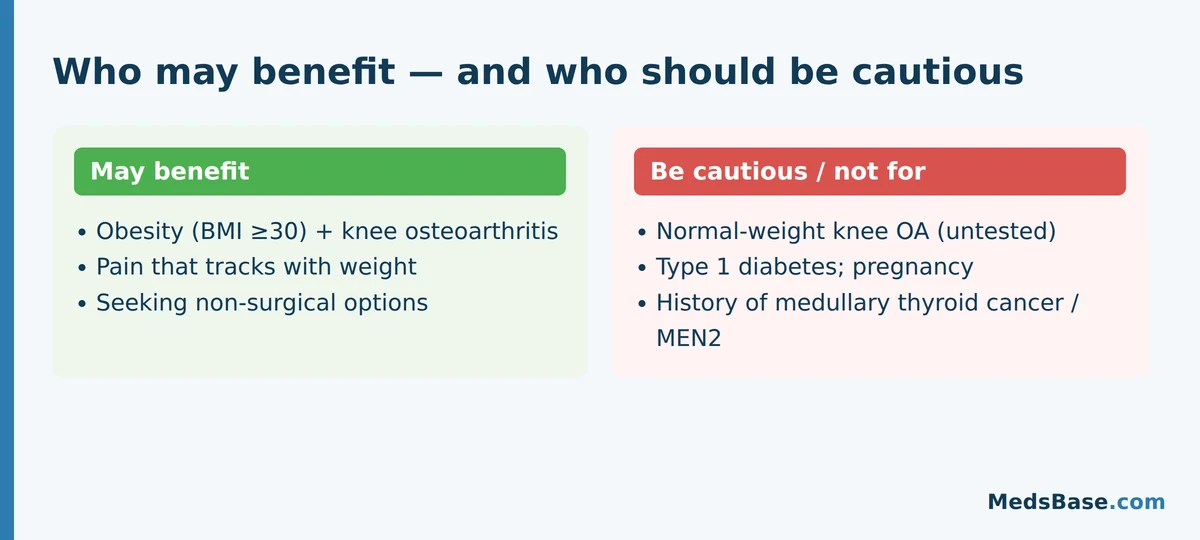
- May be a fit: adults with obesity (BMI ≥30) and symptomatic knee osteoarthritis; people whose knee pain clearly tracks with their weight; those seeking non-surgical options.
- Should be cautious or avoid: normal-weight people with knee osteoarthritis (never tested); anyone with type 1 diabetes, a history of medullary thyroid cancer or MEN2 syndrome, pregnancy, or severe gastrointestinal disease. Always confirm suitability with a doctor.
If you and your clinician decide semaglutide makes sense, MedsBase stocks generic semaglutide — and no prescription is needed to order from MedsBase.com. That is one soft option to explore, not a recommendation to self-treat a joint condition; osteoarthritis management should be guided by a professional.
Semaglutide Safety, Side Effects and Dosing for Knee Osteoarthritis
Semaglutide is generally well tolerated, but it is not side-effect free. Most issues are gastrointestinal and tend to fade as the dose is raised slowly. Here is the honest picture, neither hidden nor sensationalised.
| Side Effect | Frequency | Severity | What To Do |
|---|---|---|---|
| Nausea | Very common | Mild–moderate | Eat smaller, lower-fat meals; usually settles over weeks |
| Diarrhoea or constipation | Common | Mild–moderate | Hydrate, add fibre; tell your doctor if persistent |
| Vomiting | Common | Moderate | Slow the dose escalation; seek advice if you can’t keep fluids down |
| Reduced appetite / early fullness | Very common | Mild (often intended) | Expected; monitor you still eat enough protein |
| Gallbladder problems | Uncommon | Potentially serious | Report severe upper-right abdominal pain promptly |
| Pancreatitis (rare) | Rare | Serious | Stop and get urgent care for severe, persistent stomach pain |
Now, the finding that surprised people — the open loop from the intro. In STEP 9, semaglutide did not just lower pain scores; it also improved physical function, with an SF-36 physical-function gain of 12.0 points versus 6.5 for placebo. In other words, people did not merely report less pain — they reported moving better. That functional payoff is arguably as meaningful as the pain number.
On dosing: STEP 9 used the higher weight-management dose of 2.4 mg once weekly, reached by stepping up gradually over about 16 weeks to limit nausea. That slow climb matters — rushing it is the fastest way to feel awful and quit.
There is also a body-composition catch worth flagging. Rapid weight loss strips away some muscle along with fat, and muscle is exactly what stabilises and protects an arthritic knee. So the goal is not just a smaller number on the scale but keeping the muscle that supports the joint. In practice that means eating enough protein, staying as active as your knee allows, and treating the medication as one tool alongside movement — never a reason to stop using the joint. A weaker, lighter leg is not the win it sounds like.
What Does the Research Actually Say?
This is where you need both eyes open, because the evidence pulls in two directions.
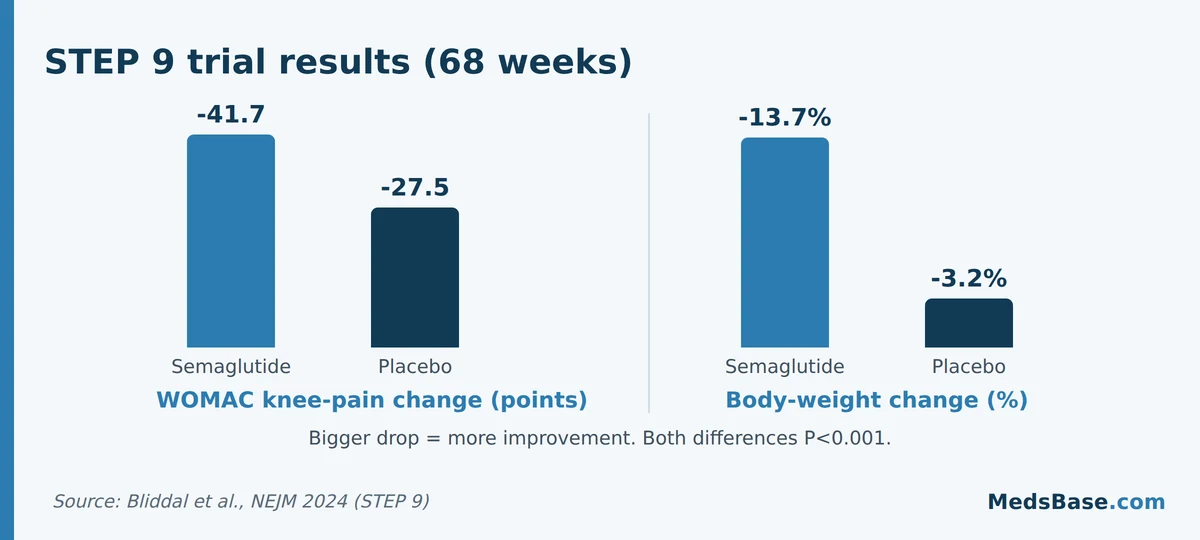
The strongest study is STEP 9, a randomised, placebo-controlled trial of 407 adults with obesity and knee osteoarthritis, run over 68 weeks. Its results, published in the New England Journal of Medicine, are the backbone of the “semaglutide helps knees” story.
| Study | Year | Finding | Source |
|---|---|---|---|
| STEP 9 (RCT, 407 adults) | 2024 | WOMAC knee-pain change −41.7 vs −27.5 for placebo (P<0.001); weight −13.7% vs −3.2% | Bliddal et al., NEJM |
| Joint-replacement database analysis (2.1M records) | 2024 | GLP-1 use linked to higher OA progression (knee HR 1.52); no difference in replacement rates | J Arthroplasty |
| Systematic review of GLP-1 in knee OA | 2025 | Potential benefit in obese/diabetic patients, but evidence “insufficient” — more RCTs needed | Frontiers in Pharmacology |
Why do these studies disagree? It comes down to design. STEP 9 is a randomised controlled trial — people were assigned by chance to semaglutide or placebo, which is the gold standard for proving cause and effect. The database study that found more osteoarthritis progression is observational: it looks back at records of people who happened to take these drugs. Those people may differ in ways that skew the result — they were often heavier or sicker to begin with, which is exactly why they were prescribed the medication. That is a classic reason observational joint data can point the “wrong” way even when a drug helps.
What this means for you: the randomised evidence for pain and weight is genuinely strong — a well-run trial rarely shows a gap this clear. But the claim that GLP-1 drugs help you avoid surgery rests on shakier, observational ground, and at least one large database study found the opposite association. A systematic review put it plainly: the evidence base is still insufficient. Read the headlines accordingly. When you see “GLP-1 saves your knees,” mentally translate it to “GLP-1 reduced knee pain in a weight-loss trial” — that is what the strong data actually shows.
Semaglutide vs Other Knee Osteoarthritis Options
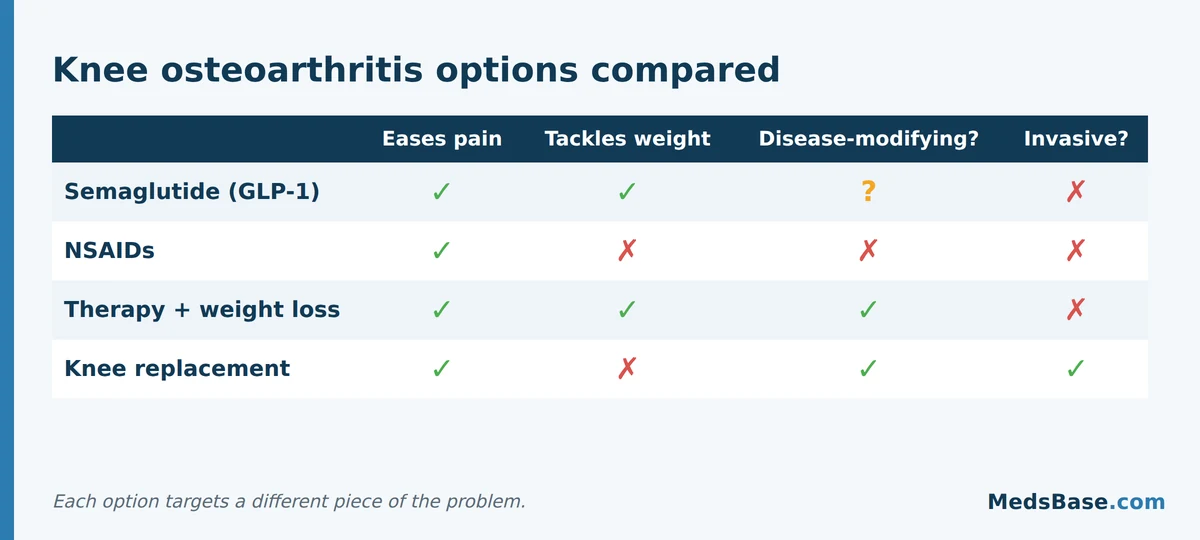
No single treatment does everything for knee osteoarthritis. Each tackles a different piece.
| Option | Eases pain | Tackles weight | Disease-modifying? | Invasive? |
|---|---|---|---|---|
| Semaglutide (GLP-1) | Yes (if weight-driven) | Yes | Unproven | No (weekly injection) |
| NSAIDs (e.g. ibuprofen) | Yes (short-term) | No | No | No |
| Physical therapy + weight loss | Yes | Yes | Partly | No |
| Knee replacement | Yes (definitive) | No | Replaces the joint | Yes (surgery) |
Which one fits which situation? If your knee pain is inseparable from excess weight, semaglutide’s dual action is a real advantage over an anti-inflammatory that only masks pain. If you need fast, occasional relief, NSAIDs still have a role. Structured physical therapy plus weight loss remains the evidence-based foundation for almost everyone. And when the joint is severely worn, replacement is still the definitive fix. For a sense of how semaglutide stacks up against the standard first-line diabetes drug, see our guide to Ozempic vs Metformin.
The smartest framing is not “which one wins,” but “which combination fits me.” In real life, many people layer these: physical therapy and weight loss as the base, an occasional NSAID for flares, and — if weight is a major driver — a GLP-1 medication to shift the load. Surgery sits at the end of that path for the joints that need it. Semaglutide does not replace any of these tools; it adds a lever most previous options never touched, which is your body weight.
The takeaway: semaglutide for knee osteoarthritis is best seen as a weight-and-pain lever, not a replacement for physical therapy or surgery when those are indicated.
How to Approach Semaglutide for Knee Osteoarthritis — Practical Guidance
If you and your doctor think a GLP-1 shot fits, a few practical rules make it safer and more effective.
- Treat it as weight-first therapy. The knee benefit rides on the weight loss. Pair the injection with the basics — activity you can tolerate, and enough protein to protect muscle while you lose fat.
- Escalate the dose slowly. Most nausea comes from climbing too fast. The trial took about 16 weeks to reach 2.4 mg for a reason.
- Keep moving within comfort. Semaglutide is not a substitute for physiotherapy. Gentle loading keeps the joint and surrounding muscle healthier.
- Set a realistic timeline. Pain relief tracked weight loss over months, not days. Judge it at 6–12 months, not week two.
- Plan for what happens if you stop. Weight — and possibly the knee benefit — can return if the medicine stops. Our guide on what happens when you stop taking Ozempic explains the rebound and safe-taper picture.
Common mistakes to avoid: expecting joint relief without weight loss; quitting in week two because of nausea; skipping physical therapy because “the shot is handling it”; and assuming a normal-weight knee will respond like an obese one — it was never tested.
If weight loss is a shared goal, you can compare options across our weight-loss medications range — again, as something to discuss with a clinician, not a green light to treat osteoarthritis on your own.
- Ozempic vs Metformin — how semaglutide compares to the standard first-line drug.
- What happens when you stop taking Ozempic — will the benefit last?
- Does stress cause hair loss? — another way your body quietly signals it’s under strain.
Frequently Asked Questions
Q: Does semaglutide really help knee osteoarthritis?
A: In the STEP 9 randomised trial, adults with obesity and knee osteoarthritis who took semaglutide had a much larger drop in knee-pain scores than those on placebo (−41.7 vs −27.5 points), alongside major weight loss. So the pain benefit is real and well-documented in that group. It is not a cure, and the effect is closely tied to losing weight rather than repairing the joint itself.
Q: Is semaglutide approved for arthritis?
A: No. Semaglutide is approved for type 2 diabetes, weight management, cardiovascular risk reduction, and liver disease — not specifically for osteoarthritis. Any use for knee osteoarthritis is based on trial evidence and clinical judgement, not a formal arthritis indication. Discuss it with your doctor, who can weigh it against approved options.
Q: How much weight do you need to lose for your knees to feel better?
A: There is no single threshold, but in the trial the average loss was about 13.7% of body weight, and pain improved alongside it. Even modest, sustained weight loss reduces the load your knee carries with every step. The more your pain tracks with your weight, the more likely weight loss is to help.
Q: Can GLP-1 drugs help me avoid a knee replacement?
A: This is genuinely uncertain. Some database studies suggest GLP-1 users need fewer replacements over time; another large analysis found no difference and even higher recorded osteoarthritis progression. Because these are observational, they cannot prove cause and effect. It is too early to promise semaglutide will keep you off the operating table.
Q: What are the main side effects?
A: Most are gastrointestinal — nausea, diarrhoea, constipation and reduced appetite — and usually ease as the dose is raised slowly. Rare but serious risks include gallbladder problems and pancreatitis. It is not suitable in pregnancy, type 1 diabetes, or with a history of medullary thyroid cancer or MEN2 syndrome.
Q: Do I need a prescription to get semaglutide?
A: Rules vary by country, and semaglutide is a prescription medicine in many places. At MedsBase.com, no prescription is needed to order. That said, osteoarthritis and weight management are individual medical decisions — it is wise to involve a doctor or pharmacist before starting, so your care is properly monitored.
The Bottom Line
Here is the balanced verdict on semaglutide for knee osteoarthritis: for an adult with obesity and painful knees, the randomised evidence for less pain and real weight loss is strong and hard to dismiss. What is not settled is whether it changes the long-term course of the disease or keeps you out of surgery — the observational data there conflicts, and the reviewers themselves call the evidence insufficient.
One immediate action: if your knee pain and your weight rise and fall together, raise semaglutide with your doctor as part of a weight-first plan — not as a magic joint fix.
Wondering how it compares to the standard diabetes drug, or whether the benefit sticks if you stop? Read Ozempic vs Metformin and what happens when you stop taking Ozempic next.

Written by
Sophie ChenPharmaceutical Content Researcher · 8 years experience
Sophie Chen is a pharmaceutical content researcher with 8 years covering generic medication access and clinical pharmacology. She specialises in international regulatory frameworks, bioequivalence standards, and patient-facing education on therapeutic drug classes. She is not a clinician.