








✓ Medically reviewed by · Last reviewed: May 2026
Pharmacy Researcher · 8 years experience
Pharmacy researcher with 8 years reviewing clinical drug information, generic formulation equivalence, and international pharmaceutical standards. Focuses on patient-facing accuracy in medication education.
SGLT2 inhibitors for heart failure — SGLT2 Inhibitors for Heart Failure: What the Research Shows Beyond Diabetes. Read on for an evidence-backed guide covering everything you need to know.
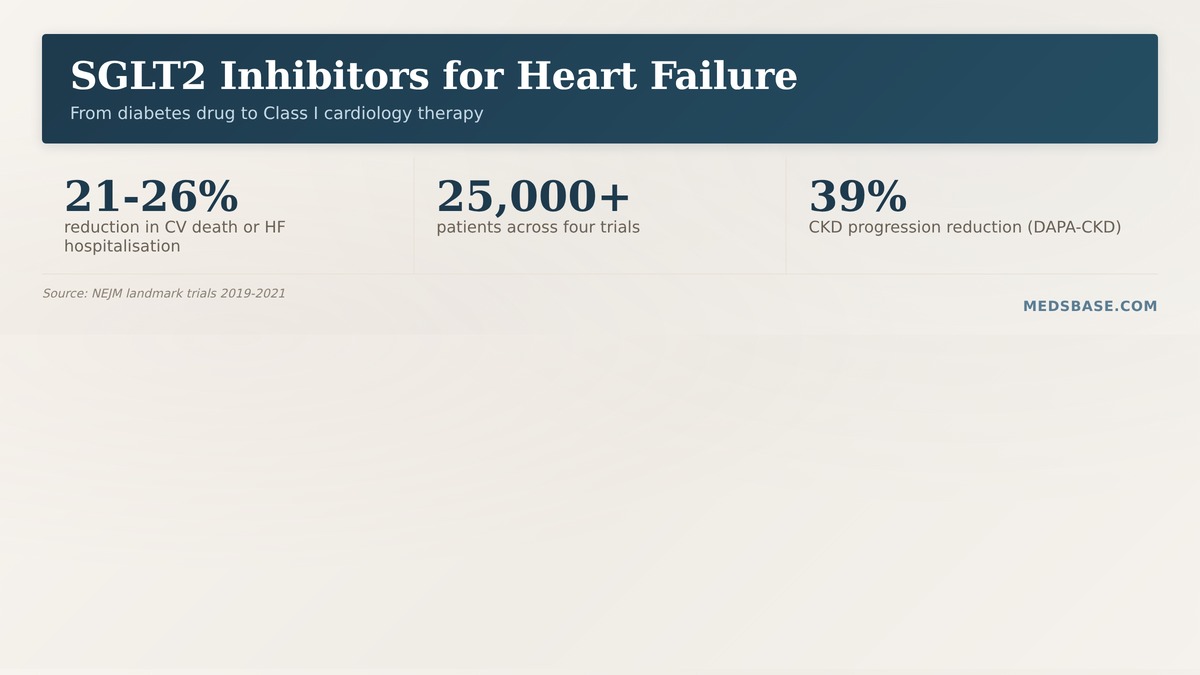
In 2019, the DAPA-HF trial delivered a result that reshaped cardiology: dapagliflozin, a drug originally developed to lower blood glucose, reduced the combined risk of cardiovascular death and heart failure hospitalisation by 26 percent — and it worked equally well in people with and without diabetes. Four years and four landmark trials later, SGLT2 inhibitors for heart failure are a Class I guideline recommendation, prescribed by cardiologists alongside beta blockers and ACE inhibitors. If you or someone you are caring for has been told to start one of these “diabetes pills” for heart failure — and you are not diabetic — you are not the first person to ask why. Here is a clear, evidence-backed guide to how these drugs work, what the trial data actually shows, and who should consider them.
- SGLT2 inhibitors for heart failure reduce the risk of cardiovascular death and hospitalisation by 21-26%, regardless of whether you have diabetes.
- The four landmark trials — DAPA-HF, EMPEROR-Reduced, EMPEROR-Preserved, and DAPA-CKD — enrolled a combined 25,000+ patients and all reached their primary endpoints.
- These drugs work through a kidney-mediated haemodynamic mechanism, not glucose-lowering — which is why they benefit people without diabetes just as much.
- SGLT2 inhibitors are now a Class I recommendation across the full ejection-fraction spectrum, from severely reduced EF (≤40%) to preserved EF (≥50%).
- The main side effects to know are genital fungal infections (~5-8%), a small risk of euglycaemic ketoacidosis in type 1 diabetes, and an amputation signal seen with canagliflozin (but not confirmed in dapagliflozin or empagliflozin).
- The drugs also slow chronic kidney disease progression — a dual cardiorenal protection that no other single drug class provides.
On this page:
- What Are SGLT2 Inhibitors? — From Diabetes to Heart Failure
- How Do SGLT2 Inhibitors Protect the Heart? — The Mechanism in Plain English
- The Four Landmark Trials — DAPA-HF, EMPEROR-Reduced, EMPEROR-Preserved, DAPA-CKD
- SGLT2 Inhibitors Across the Ejection Fraction Spectrum
- Safety Profile and Side Effects
- Who Should Take SGLT2 Inhibitors for Heart Failure? — Guideline Recommendations
- Frequently Asked Questions About SGLT2 Inhibitors for Heart Failure
SGLT2 Inhibitors for Heart Failure: What the Research Shows Beyond Diabetes
What Are SGLT2 Inhibitors?
SGLT2 inhibitors (sodium-glucose cotransporter-2 inhibitors) are a class of oral medications that block the SGLT2 protein in the kidneys, preventing glucose from being reabsorbed back into the bloodstream. The result — extra glucose is excreted in the urine — was the original rationale for their development as diabetes drugs. The first SGLT2 inhibitor, canagliflozin, was approved in 2013. Empagliflozin and dapagliflozin followed shortly after. All three were approved for glucose control in type 2 diabetes. None was designed to treat heart failure.
But in 2015, the EMPA-REG OUTCOME trial — a cardiovascular safety study required by the FDA for new diabetes drugs — produced an unexpected result: empagliflozin reduced cardiovascular death by 38% compared to placebo. This was the first signal that SGLT2 inhibitors for heart failure might do something beyond glucose-lowering. The benefit appeared too quickly (within months) and was too large to be explained by improved glucose control alone. Something else was happening — and it took a dedicated heart-failure trial programme to figure out what.
Today, the SGLT2 inhibitor class includes dapagliflozin (Farxiga), empagliflozin (Jardiance), canagliflozin (Invokana), and ertugliflozin (Steglatro). The first two — dapagliflozin and empagliflozin — have the strongest evidence for heart failure and are the ones most commonly prescribed for this indication. Both are now approved for heart failure with reduced ejection fraction (HFrEF) and for chronic kidney disease, regardless of diabetes status.
How Do SGLT2 Inhibitors Protect the Heart?
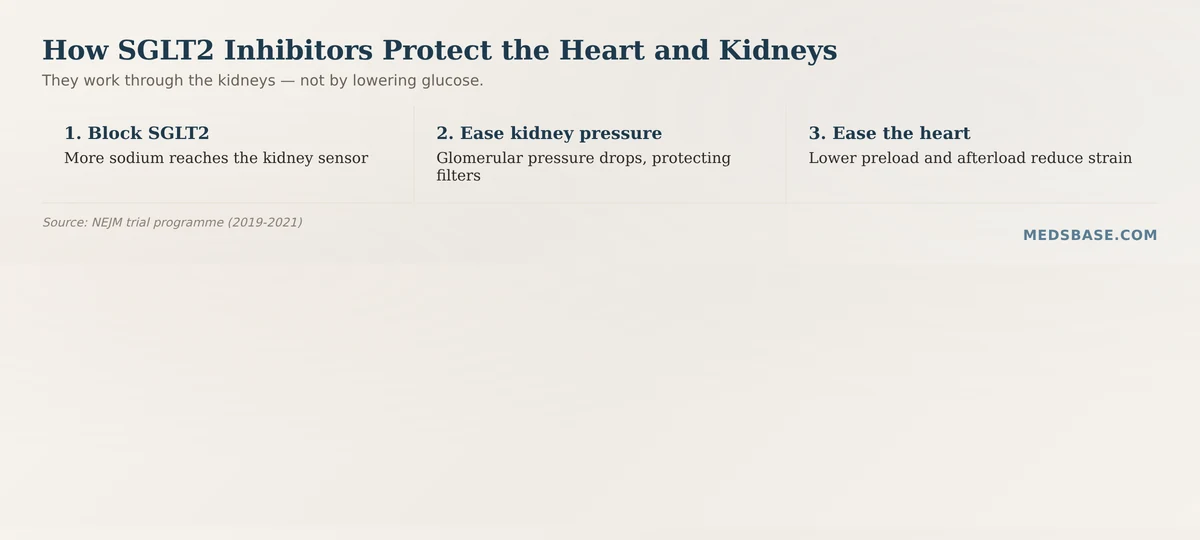
The mechanism by which SGLT2 inhibitors for heart failure work is conceptually elegant but biologically complex — and it operates through the kidneys, not the heart directly. Think of the glomerulus — the kidney’s microscopic filtration unit — as a leaky pipe. In heart failure, the body activates the sympathetic nervous system and the renin-angiotensin-aldosterone system (RAAS) to compensate for reduced cardiac output. This raises pressure inside the glomerulus, which temporarily preserves filtration but, over years, damages the delicate capillary network.
SGLT2 inhibitors reduce this intraglomerular pressure by restoring the tubuloglomerular feedback loop. By blocking sodium and glucose reabsorption in the proximal tubule, more sodium reaches the macula densa (a sensor further down the nephron). The macula densa interprets this as “too much sodium getting through” and signals the afferent arteriole — the vessel feeding the glomerulus — to constrict. Less blood enters the glomerulus. Pressure drops. The kidney is protected. And the heart benefits because it is no longer pumping against the systemic vasoconstriction that accompanies kidney stress.
The Four Landmark Trials
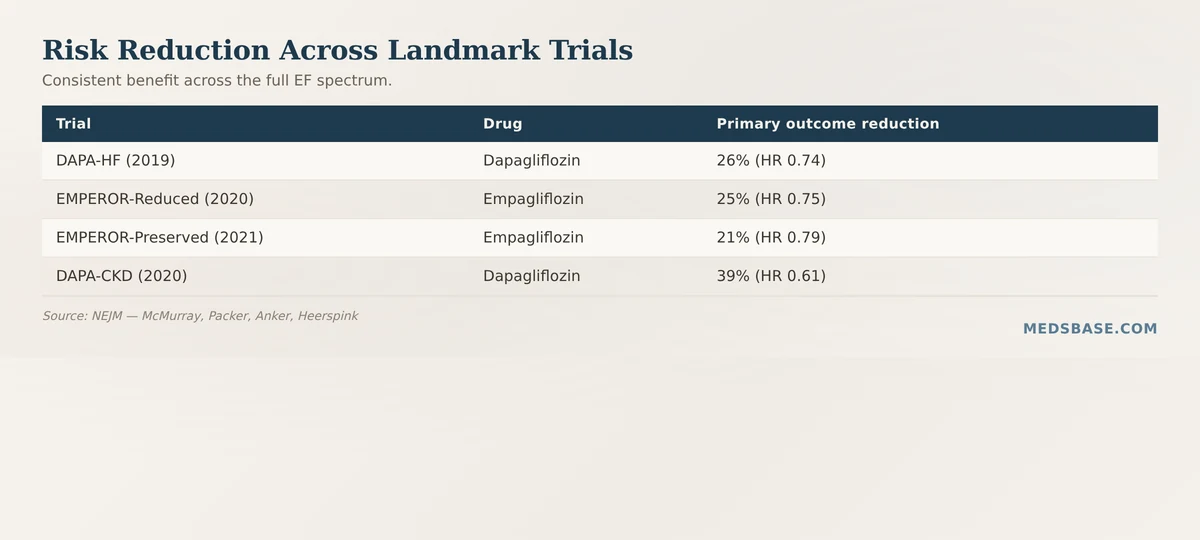
The evidence base supporting SGLT2 inhibitors for heart failure rests on four phase III trials, collectively enrolling over 25,000 patients. Together, they span the most complete cardiovascular and renal outcomes programme of any drug class in modern cardiology.
Two observations stand out. First, in every trial, the treatment effect was consistent regardless of diabetes status — the hazard ratios for patients with and without T2D overlap within the confidence intervals. This confirmed empirically what the mechanism suggested: SGLT2 inhibitors for heart failure are not diabetes drugs that happen to help the heart. They are cardiorenal drugs that happen to lower glucose. Second, the time-to-benefit curves began separating within 28 days — months before any glucose-lowering effect would translate into measurable clinical change. The mechanism is direct and rapid.
SGLT2 Inhibitors for Heart Failure Across the Ejection Fraction Spectrum
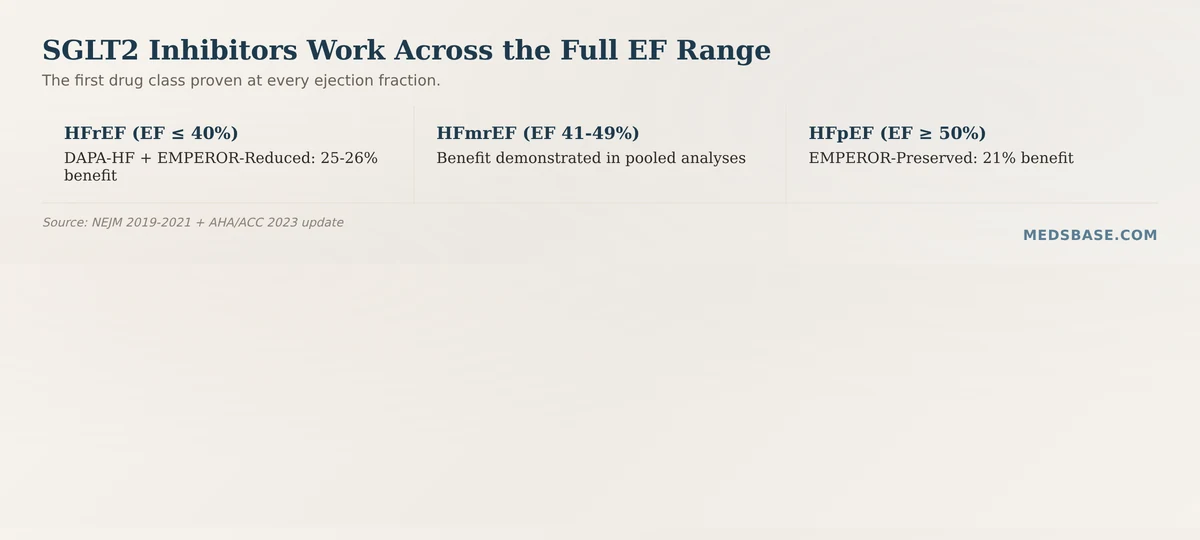
Heart failure is categorised by ejection fraction (EF) — the percentage of blood pumped out of the left ventricle with each contraction. For years, only drugs proven in reduced EF (≤40%) received guideline recommendations. EMPEROR-Preserved changed that. It was the first trial to demonstrate a statistically significant benefit for any drug class in heart failure with preserved ejection fraction (HFpEF, EF >40% or ≥50% depending on the definition), a condition that accounts for roughly half of all heart failure cases and previously had no disease-modifying therapy beyond diuretics for symptom relief. The landmark EMPEROR-Reduced trial (empagliflozin in HFrEF) and EMPEROR-Preserved trial (empagliflozin in HFpEF) together established that empagliflozin benefits patients across the ejection-fraction spectrum, while the DAPA-CKD trial proved the class also slows kidney disease progression.
The pooled analysis across DAPA-HF, DELIVER (dapagliflozin’s HFpEF trial, which reported in 2022 with similar results to EMPEROR-Preserved), EMPEROR-Reduced, and EMPEROR-Preserved confirmed that SGLT2 inhibitors for heart failure benefit patients across the entire EF continuum. The relative risk reduction is slightly larger in HFrEF (25-26%) than in HFpEF (21%), but the absolute benefit — measured in hospitalisations prevented — is clinically meaningful in both groups.
This breadth of effect is unprecedented. Beta blockers, ACE inhibitors, ARBs, and mineralocorticoid receptor antagonists (spironolactone, eplerenone) all showed clear benefit in HFrEF but failed in HFpEF. Only SGLT2 inhibitors have demonstrated benefit regardless of EF. The reason is likely mechanistic — the haemodynamic, metabolic, and anti-fibrotic effects of SGLT2 inhibition operate across the heart failure spectrum, while neurohormonal blockade (the mechanism of beta blockers and RAAS inhibitors) is most beneficial when the primary pathology is neurohormonal overactivation, which is more pronounced in HFrEF.
Safety Profile and Side Effects of SGLT2 Inhibitors
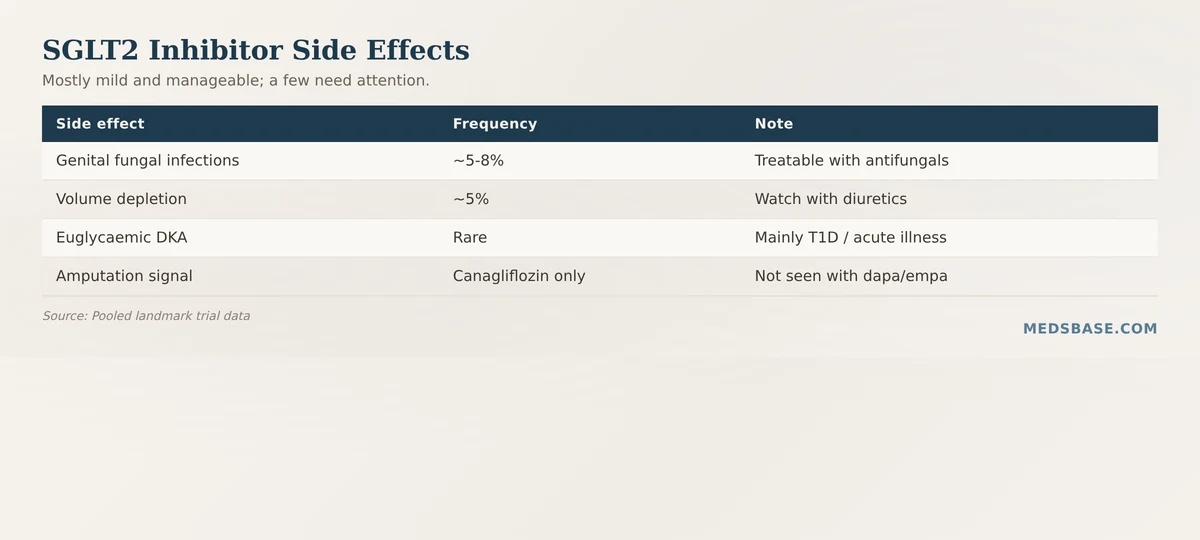
No drug class is free of side effects, and SGLT2 inhibitors for heart failure have a specific profile worth understanding. The good news: the overall safety data from the four landmark trials is reassuring, with slightly more patients discontinuing placebo than active drug in most analyses.
The volume-depletion risk is worth emphasising for heart failure patients specifically. Many are already taking loop diuretics (furosemide, bumetanide, torsemide) to manage fluid overload, and adding an SGLT2 inhibitor produces additional diuresis. The combined diuretic effect is generally safe and often beneficial — many patients can reduce their loop-diuretic dose after starting an SGLT2 inhibitor — but it requires monitoring, especially during the first few weeks and during hot weather or acute illness when dehydration risk is higher.
Who Should Take SGLT2 Inhibitors for Heart Failure?
The 2022 AHA/ACC/HFSA heart failure guideline positioned SGLT2 inhibitors for heart failure as a Class I (strongest) recommendation for HFrEF, alongside the established “quadruple therapy” of beta blocker, ACEi/ARB/ARNI, mineralocorticoid receptor antagonist, and SGLT2 inhibitor. The 2023 focused update extended the Class I recommendation to HFpEF and HFmrEF — meaning SGLT2 inhibitors are now guideline-recommended across the full EF spectrum.
The candidacy criteria are broader than patients often expect. If you have heart failure — any ejection fraction — and an eGFR above 20-25 mL/min/1.73 m², you may be a candidate. Diabetes is not a prerequisite. The absolute benefit is actually larger in patients with lower ejection fractions (higher event rate = more events prevented), but the relative benefit (~21-26%) is consistent. The NHS heart failure guide offers a helpful overview of the condition itself for patients newly diagnosed.
If you want to understand the full landscape of medications that support both cardiac and kidney health, our companion articles — [[finerenone for type 1 diabetes CKD — EDITOR: link to published post]](#) and our diabetes medications overview — can give you a broader picture. If your heart failure treatment is being discussed at your next appointment, the simple question worth asking is: “Am I on an SGLT2 inhibitor, and if not, is there a reason I should not be?”
Frequently Asked Questions About SGLT2 Inhibitors for Heart Failure
Q: Do SGLT2 inhibitors work for heart failure if I do not have diabetes?
A: Yes — and this is one of the most important findings from the SGLT2 inhibitor trials. In DAPA-HF, the 26% risk reduction was identical in patients with and without type 2 diabetes (HR 0.74 in both subgroups). The same was true in EMPEROR-Reduced, EMPEROR-Preserved, and DAPA-CKD. SGLT2 inhibitors for heart failure are not treating heart failure by lowering glucose — they are working through kidney-mediated haemodynamic, metabolic, and anti-fibrotic mechanisms that operate regardless of diabetes status. The drugs are approved for heart failure in patients without diabetes, and prescriptions for this indication are now common in cardiology practice.
Q: What is the difference between dapagliflozin and empagliflozin for heart failure?
A: Dapagliflozin (Farxiga) and empagliflozin (Jardiance) are both SGLT2 inhibitors with Class I guideline recommendations for heart failure reduction of cardiovascular death and heart failure hospitalisation. The drugs have never been compared head-to-head in a dedicated heart failure trial, so direct efficacy comparisons are not evidence-based. The choice between them is usually driven by: (1) local prescribing habits and formulary availability, (2) the specific CKD indication (dapagliflozin is approved down to eGFR 25, empagliflozin down to eGFR 20), (3) insurance coverage, and (4) patient preference. Both are once-daily oral drugs. Both have similar safety profiles. Switching from one to the other is clinically reasonable but should be discussed with your prescriber.
Q: Can SGLT2 inhibitors be used for preserved ejection fraction (HFpEF)?
A: Yes. EMPEROR-Preserved (2021) demonstrated a 21% reduction in the primary composite endpoint for empagliflozin in patients with heart failure and ejection fraction above 40%. The DELIVER trial (dapagliflozin in HFpEF, 2022) confirmed the class effect with similar results. Pooled analyses now show consistent benefit across the full EF continuum. Before these trials, no drug class had shown a statistically significant benefit in HFpEF — a condition affecting roughly half of all heart failure patients. The 2023 AHA/ACC focused update granted SGLT2 inhibitors a Class I recommendation for HFpEF.
Q: What are the most common side effects of SGLT2 inhibitors?
A: The most common side effect of SGLT2 inhibitors for heart failure is genital fungal infections (mycotic infections), occurring in approximately 5-8% of patients versus 1-3% on placebo. These are usually mild, respond well to topical antifungal treatment, and rarely require discontinuation. Other side effects include a slightly increased risk of urinary tract infections (~4-6%), and volume depletion (dehydration, low blood pressure) particularly when combined with loop diuretics. A rare but serious side effect is euglycaemic diabetic ketoacidosis — more common in type 1 diabetes but reported in T2D during acute illness. The “sick day” rule — pausing the drug during vomiting, diarrhoea, or reduced oral intake — reduces this risk substantially.
Q: How quickly do SGLT2 inhibitors start working for heart failure?
A: The clinical benefit begins surprisingly fast. In DAPA-HF, the Kaplan-Meier curves for cardiovascular death and heart failure hospitalisation began to separate within 28 days of starting treatment. This rapid onset was confirmed in EMPEROR-Reduced and EMPEROR-Preserved. The speed of effect is a key piece of evidence that the mechanism is not glucose-lowering — it takes months for improved glucose control to translate into reduced cardiovascular events. The rapid benefit suggests the primary mechanism is haemodynamic (reduced preload/afterload within days), with metabolic and anti-fibrotic benefits accruing over weeks to months.
Q: Do SGLT2 inhibitors replace beta blockers or ACE inhibitors for heart failure?
A: No — SGLT2 inhibitors are additive to, not replacements for, existing guideline-directed medical therapy. The current standard for HFrEF is “quadruple therapy”: a beta blocker, an ACE inhibitor/ARB/ARNI, a mineralocorticoid receptor antagonist, and an SGLT2 inhibitor. Each class targets a different pathway. Beta blockers reduce heart rate and sympathetic drive. ACE inhibitors/ARBs/ARNIs reduce afterload and ventricular remodelling. MRAs block aldosterone-driven fibrosis. SGLT2 inhibitors provide cardiorenal protection through haemodynamic and metabolic mechanisms. Together, they provide complementary benefit. In the trials, over 90% of participants were already on background beta blocker and ACEi/ARB/ARNI therapy.
Q: Are SGLT2 inhibitors safe for the kidneys?
A: Yes — and this is one of the most important aspects of the class. SGLT2 inhibitors for heart failure actually slow the progression of chronic kidney disease. The DAPA-CKD trial showed a 39% reduction in the primary renal composite (sustained eGFR decline ≥50%, end-stage kidney disease, or renal death) — the largest treatment effect for any drug in a dedicated CKD outcomes trial. A small initial dip in eGFR (typically 3-5 mL/min/1.73 m²) is expected when starting an SGLT2 inhibitor — this reflects the haemodynamic reduction in intraglomerular pressure and was associated with BETTER long-term kidney outcomes in the trials. Do not stop the drug for this initial dip without discussing it with your doctor.
Q: Will SGLT2 inhibitors affect my blood sugar if I do not have diabetes?
A: No — in patients without diabetes, SGLT2 inhibitors do not cause hypoglycaemia. The drug increases urinary glucose excretion, but in non-diabetic individuals, the liver compensates by increasing endogenous glucose production, maintaining normal blood glucose levels. In the DAPA-HF and EMPEROR trials, the rate of hypoglycaemia in non-diabetic patients was no different from placebo. This is an important practical reassurance for patients without diabetes who are prescribed these drugs for heart failure: you do not need to monitor your blood sugar, and the drug will not make you hypoglycaemic.
- Finerenone for Type 1 Diabetes CKD —. Another cardiorenal drug class explained — how a non-steroidal MRA protects kidneys independently of SGLT2s.
- Blood pressure medications at MedsBase — Browse the range of antihypertensives that form the backbone of heart failure management.
- Diabetes medications at MedsBase — Browse the full range of diabetes management options.
The Bottom Line
SGLT2 inhibitors for heart failure represent one of the most significant therapeutic advances in cardiology since the introduction of beta blockers for heart failure in the 1990s. The evidence — over 25,000 patients across four landmark trials — shows a consistent 21-26% reduction in cardiovascular death and heart failure hospitalisation, regardless of ejection fraction, regardless of diabetes status. The drugs work through a kidney-mediated mechanism that is fundamentally different from the neurohormonal blockade provided by beta blockers, ACE inhibitors, and MRAs — which is precisely why they add benefit on top of those established therapies.
The immediate action: if you or someone you care for has heart failure and is not yet taking an SGLT2 inhibitor, ask your cardiologist or primary care provider at the next appointment whether one is appropriate. The candidacy criteria are broad — EF below or above 40%, eGFR above 20-25, with or without diabetes. If you want to understand how cardiorenal medications fit together — including newer drugs like finerenone that target complementary pathways — [[read our finerenone for type 1 diabetes CKD guide — EDITOR: link]](#). And if your next question is about managing the conditions that often accompany heart failure, browse diabetes medications at MedsBase for a full overview.

Written by
Sophie ChenPharmaceutical Content Researcher · 8 years experience
Sophie Chen is a pharmaceutical content researcher with 8 years covering generic medication access and clinical pharmacology. She specialises in international regulatory frameworks, bioequivalence standards, and patient-facing education on therapeutic drug classes. She is not a clinician.