








✓ Medically reviewed by · Last reviewed: May 2026
Pharmacy Researcher · 8 years experience
Pharmacy researcher with 8 years reviewing clinical drug information, generic formulation equivalence, and international pharmaceutical standards. Focuses on patient-facing accuracy in medication education.
sumatriptan vs rizatriptan — Sumatriptan vs Rizatriptan: 7 Key Differences to Choose the Right Triptan. Read on for an evidence-backed guide covering everything you need to know.
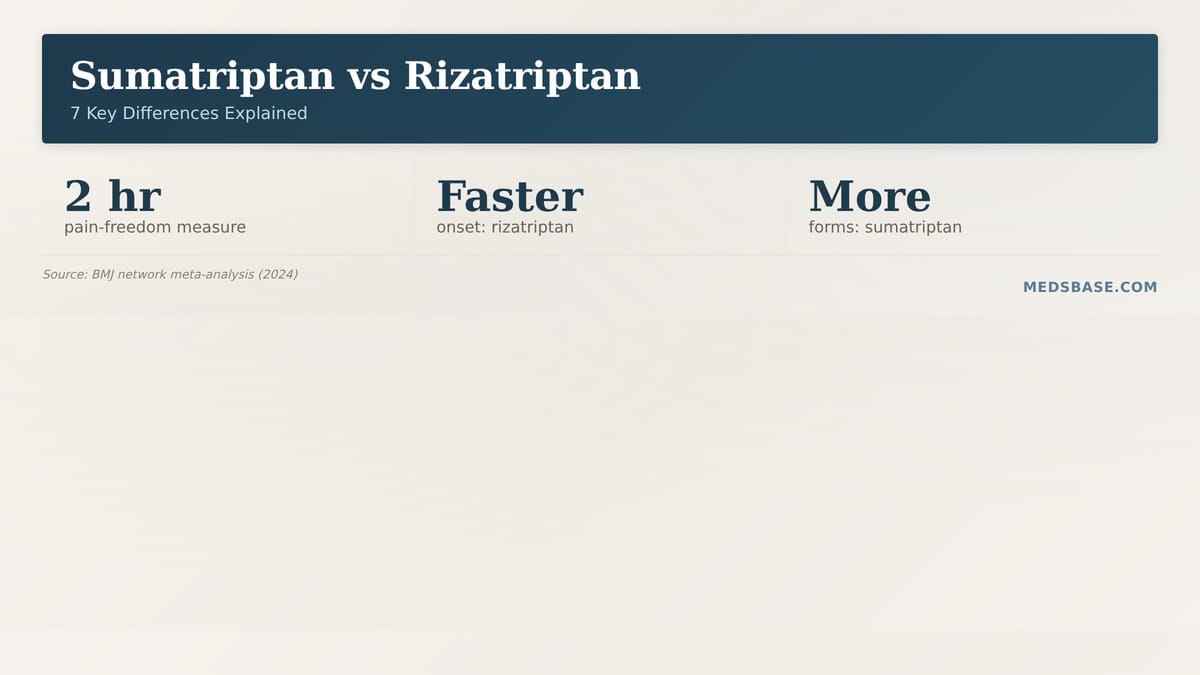
Two pills sit in front of you, both promise to stop a migraine in its tracks, and both belong to the same family of medicines — so how are you supposed to choose? If you have ever stared at a prescription for a triptan and wondered whether the “other one” would work faster or hurt less, you are asking exactly the right question. The answer to sumatriptan vs rizatriptan is not that one is simply “better” — it is that each one is better at slightly different things, and the research now makes those differences clear.
By the end of this guide you will know how sumatriptan vs rizatriptan stack up on speed, strength, available forms, and side effects, what a landmark 2024 network meta-analysis found about which one ends the pain fastest, and — most usefully — which one fits your specific migraines.
Key Takeaways
- Sumatriptan vs rizatriptan is a sibling rivalry: both are “triptans” that narrow blood vessels and calm pain signals, but rizatriptan tends to act faster and sumatriptan has the longer track record and more forms
- The 2024 BMJ network meta-analysis ranked rizatriptan ahead of sumatriptan for two-hour pain freedom — but eletriptan topped both
- Rizatriptan’s standout feature is its dissolving (ODT) tablet, which you can take without water — a real advantage when a migraine brings nausea
- Sumatriptan is the only one of the two that also treats cluster headaches, and it comes as a nasal spray and injection for the fastest possible relief
- Neither is a preventive — both are “stoppers” to be taken at the first sign of an attack, and never together within 24 hours
- Sumatriptan vs Rizatriptan: What Are They?
- How Sumatriptan vs Rizatriptan Work
- Sumatriptan vs Rizatriptan: What the Research Says
- Speed & Onset Compared
- Forms: Tablets, ODT, Spray & Injection
- Safety: Side Effects Compared
- Sumatriptan vs Rizatriptan: Which One Fits You?
- Related Reading
- Frequently Asked Questions
- The Bottom Line
Sumatriptan vs Rizatriptan: What Are They?
Sumatriptan vs rizatriptan is a comparison between two medicines in the same class, called triptans (selective serotonin receptor agonists). MedlinePlus describes sumatriptan as a medicine that narrows blood vessels in the head, stops pain signals from being sent to the brain, and blocks the release of natural substances that cause migraine pain and nausea. MedlinePlus describes rizatriptan in almost identical terms — because the two work through the same basic mechanism.
The key difference is their history and reach. Sumatriptan was the first triptan ever developed, in the early 1990s, and it has the largest body of evidence and the widest range of forms. The NHS notes that sumatriptan treats both migraine and cluster headaches. Rizatriptan arrived later, is used specifically for migraine, and was designed partly to address the two complaints people had about sumatriptan — speed of onset and ease of use during nausea.
Both are acute treatments: they stop an attack in progress but do not prevent future ones. MedlinePlus stresses that sumatriptan “does not stop migraine attacks from coming or reduce the number of headaches you have,” and the rizatriptan page says the same about rizatriptan.
How Sumatriptan vs Rizatriptan Work
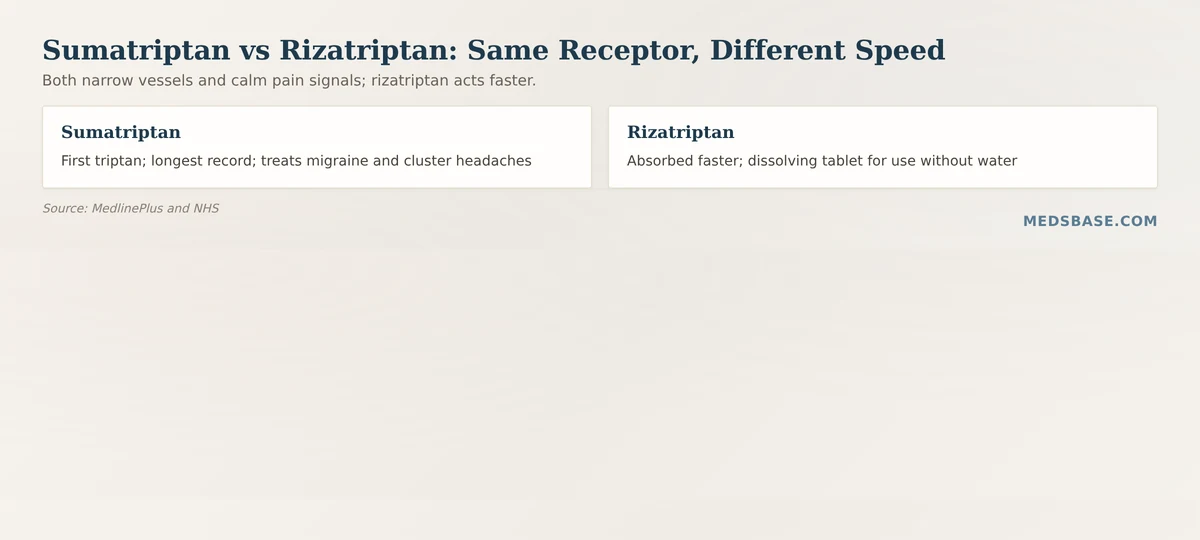
In a migraine, two things happen together: the blood vessels around your brain widen, and the nerves that carry pain become inflamed and overactive. Triptans act on a specific receptor — the 5-HT1B/1D serotonin receptor — found on both those vessels and those nerves.
When a triptan binds to that receptor, two useful things occur: the widened blood vessels constrict back toward normal, and the release of pain-signalling chemicals is dialled down. The combined effect is that the headache eases, and the nausea and sensitivity to light and sound often improve alongside it.
Here is where sumatriptan vs rizatriptan begin to differ. Both target the same receptor, but rizatriptan is absorbed more quickly by the body and reaches its peak concentration faster, which is why it tends to produce relief sooner. Sumatriptan, meanwhile, has been studied across more routes of administration — tablet, nasal spray, and injection — giving it flexibility that rizatriptan does not match.
A useful analogy: sumatriptan vs rizatriptan is a bit like comparing two delivery services to the same destination. They carry the same parcel (the migraine-stopping signal) and take the same road, but rizatriptan tends to leave the depot a little sooner, while sumatriptan offers more delivery options — including an express route via injection.
Clinical insight: Pharmacists see the same pattern with sumatriptan vs rizatriptan again and again — a patient says the first triptan they tried “did nothing,” and it often turns out they took it too late, when the migraine was already fully established. Triptans are time-sensitive medicines, not general painkillers. Before you conclude that rizatriptan is “better than” sumatriptan (or vice versa), check whether you are taking whichever one you have early enough. In many cases the real variable is the timing, not the drug.
Sumatriptan vs Rizatriptan: What the Research Says
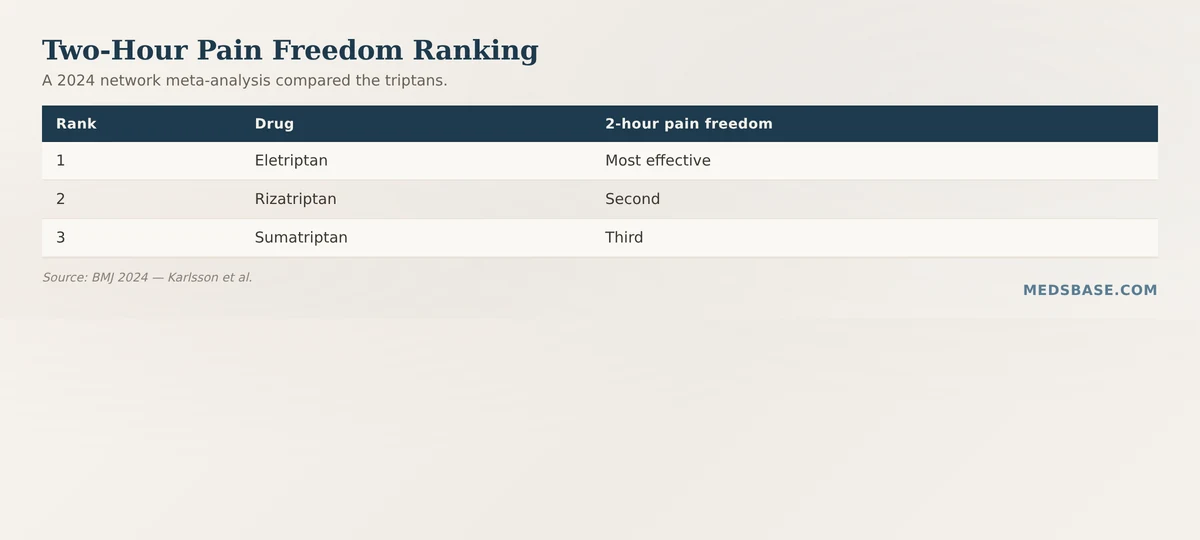
The most useful recent evidence comes from a systematic review and network meta-analysis published in the BMJ in 2024 by Karlsson and colleagues, which compared drug interventions for the acute management of migraine in adults.
In head-to-head comparisons between active drugs, the analysis found that eletriptan was the most effective for pain freedom at two hours, followed by rizatriptan, and then sumatriptan. Specifically, the odds ratios for two-hour pain freedom ranged from about 1.59 to 2.44 for rizatriptan, and lower for sumatriptan, when each was compared against the other active treatments. In plain English: on the strictest measure — being completely pain-free at two hours — rizatriptan edged ahead of sumatriptan, though both beat placebo by a wide margin.
This finding is consistent with older work. A 2001 study in the journal Neurology by Adelman and colleagues compared rizatriptan 10 mg with oral sumatriptan and found that more patients taking rizatriptan were symptom-free at two hours.
| Source | Year | Key finding |
|---|---|---|
| BMJ network meta-analysis (Karlsson et al.) | 2024 | For 2-hour pain freedom: eletriptan > rizatriptan > sumatriptan |
| Adelman et al., Neurology | 2001 | More patients symptom-free at 2 hours on rizatriptan 10 mg than sumatriptan |
| NHS sumatriptan | — | Treats migraine and cluster headaches |
| MedlinePlus (both drugs) | 2025 | Same mechanism; both acute-only, not preventive |
What this means for you: if your sole priority is the fastest chance of being pain-free at two hours, the research tips toward rizatriptan — but the differences are modest, and real-world fit matters just as much as trial rankings.
Speed & Onset Compared
The practical question behind sumatriptan vs rizatriptan is usually “which one kicks in faster?” — and the answer, on average, is rizatriptan.
Rizatriptan is absorbed more rapidly, which is why it is frequently described as a faster-acting option for oral migraine relief. Its dissolving tablet (the orally disintegrating form) can act even more quickly in some people because it begins to dissolve on the tongue rather than waiting for a tablet to break down in the stomach.
Sumatriptan’s speed depends on the form. The oral tablet is the slowest of its three forms; the nasal spray is faster; and the injection is the fastest of all, sometimes providing meaningful relief within ten to fifteen minutes. If you need speed above all else and nausea makes swallowing unreliable, sumatriptan’s injection or spray can outperform either oral tablet.
So the honest “speed” answer is nuanced: for oral tablets, rizatriptan tends to win. For the fastest possible onset overall, sumatriptan’s injection or nasal spray is the benchmark — but those forms are not always practical or available.
There is one more timing detail that applies equally to both sides of the sumatriptan vs rizatriptan question. MedlinePlus advises taking rizatriptan at the first sign of a migraine, and the sumatriptan page gives the same instruction. The longer a migraine has had to “set in,” the less responsive it becomes to either drug. This means the difference between taking a triptan when the pain is mild versus when it is severe can outweigh the small differences between the two medicines themselves.
Forms: Tablets, ODT, Spray & Injection
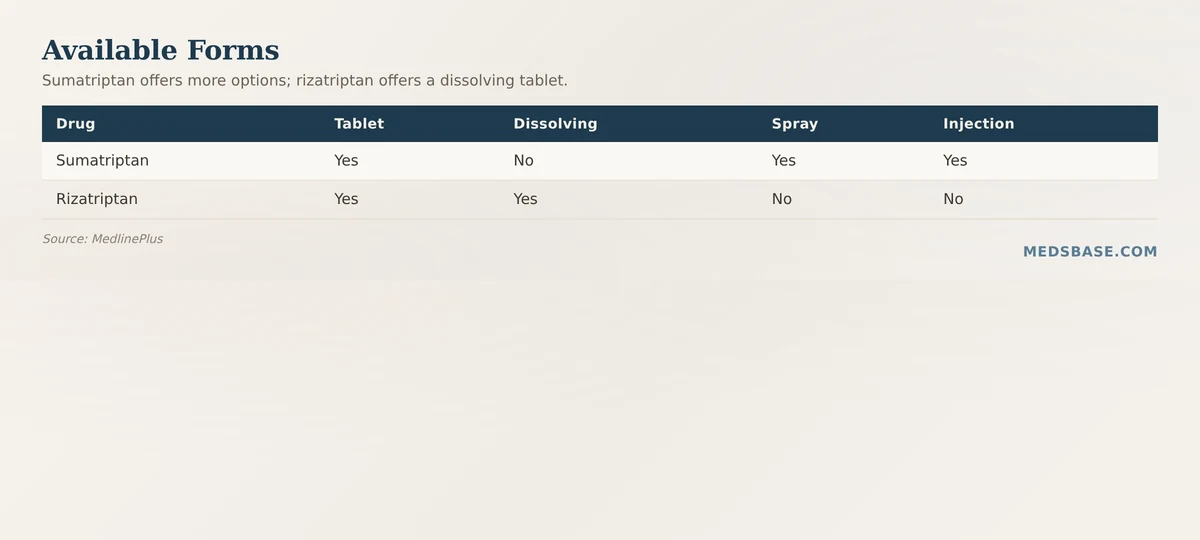
This is one of the clearest ways to separate sumatriptan vs rizatriptan, because they simply do not come in the same forms.
Sumatriptan is available as an oral tablet, a nasal spray, and an injection. The tablet is the default for most people; the spray helps when you cannot keep a tablet down; the injection is for severe or very rapid attacks. This flexibility is sumatriptan’s biggest structural advantage.
Rizatriptan is available as a standard tablet and an orally disintegrating tablet (ODT). The ODT dissolves on your tongue without water, MedlinePlus explains — you peel back the foil with dry hands and place the tablet on your tongue, where it dissolves and can be swallowed with saliva. That is a genuine advantage when a migraine brings nausea or when you are caught without water.
The trade-off is that rizatriptan has no injectable or nasal form, so for someone who needs the fastest possible relief or cannot swallow at all, sumatriptan has options rizatriptan cannot match. Conversely, for someone who simply wants a fast oral tablet they can take without water, rizatriptan’s ODT is the cleaner choice.
Safety: Side Effects Compared
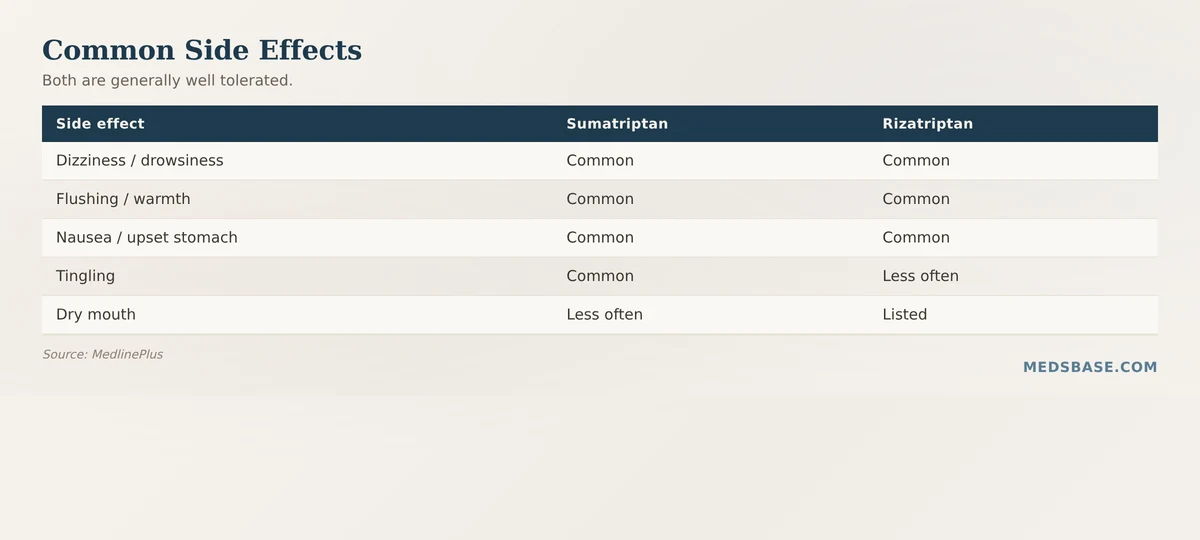
Because sumatriptan vs rizatriptan work the same way, their side-effect profiles overlap heavily — and both are generally well tolerated.
MedlinePlus lists sumatriptan’s common side effects as flushing, a tingling feeling, feeling warm or cold, drowsiness, tiredness, dizziness, upset stomach, diarrhoea, nausea, and muscle cramps. Rizatriptan’s list is similar: dizziness, tiredness, sleepiness, upset stomach, vomiting, diarrhoea, tremors, flushing, and dry mouth.
| Side effect | Sumatriptan | Rizatriptan |
|---|---|---|
| Dizziness / drowsiness | Common | Common |
| Flushing / warmth | Common | Common |
| Nausea / upset stomach | Common | Common |
| Tingling | Common | Less often reported |
| Tremors | Less often | Listed |
| Dry mouth | Less often | Listed |
The serious side effects are also shared. Both drugs can cause tightness, pressure, or heaviness in the chest, throat, neck, or jaw, and both require caution in people with a history of heart disease, stroke, or significant vascular problems. MedlinePlus notes rizatriptan should not be taken within 24 hours of other triptans or ergot medicines, and must not be combined with MAO-A inhibitors; the sumatriptan page carries the same 24-hour and MAOI cautions.
One practical safety point: rizatriptan’s dissolving tablet contains phenylalanine, so people with phenylketonuria (PKU) need to avoid the ODT and use the standard tablet instead.
Sumatriptan vs Rizatriptan: Which One Fits You?
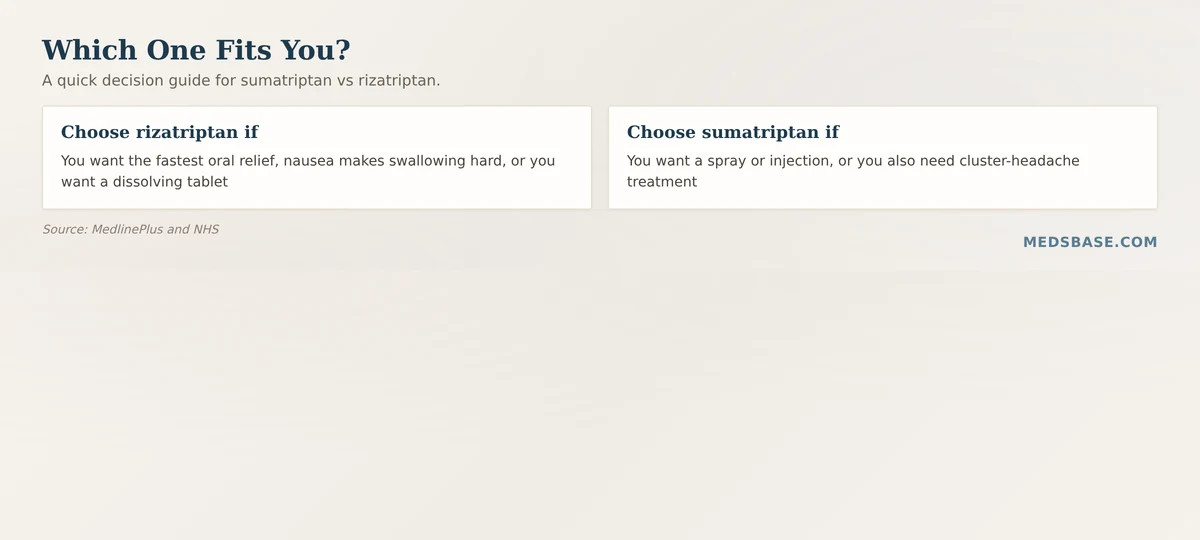
The research gives you the data; your own migraine pattern gives you the answer. Here is a straightforward way to decide.
Choose rizatriptan if: you want the fastest oral relief, your migraines come with nausea that makes swallowing a tablet hard, you prefer a dissolving tablet you can take without water, and you are treating migraine specifically.
Choose sumatriptan if: you want the flexibility of a nasal spray or injection for very severe or rapid attacks, you also need treatment for cluster headaches, or you and your doctor want the longest safety track record available.
Choose neither without guidance if: you have a history of heart disease, stroke, or significant blood-vessel problems, or you are already taking another triptan or an MAOI — in which case the decision must involve your doctor.
In practice, many people try one triptan and, if it works but is not quite right, switch to another under medical guidance. The “winner” of sumatriptan vs rizatriptan is the one that reliably ends your migraines with side effects you can tolerate — and that is a personal answer, not a universal one.
- Ask how fast your migraines peak — very fast attacks suggest a faster-acting option
- Ask whether nausea is part of your attacks — if so, a dissolving tablet or a spray is worth considering
- Ask whether you ever need cluster-headache treatment — only sumatriptan covers that
- Note the forms you can realistically use — tablet, dissolving tablet, spray, or injection
- Discuss all of the above with your doctor before switching
Whichever you choose, both are available at MedsBase, and no prescription is needed to order. Browse sumatriptan (Suminat) or see rizatriptan (Rizact) — and for the full range, visit the Anti Migraine category.
Frequently Asked Questions
Q: Which is better, sumatriptan or rizatriptan?
A: Neither is universally “better.” The 2024 BMJ network meta-analysis ranked rizatriptan ahead of sumatriptan for two-hour pain freedom, but sumatriptan offers more forms (tablet, spray, injection) and also treats cluster headaches. When weighing sumatriptan vs rizatriptan, the deciding factor is usually your own migraine pattern and your doctor’s guidance.
Q: How long does rizatriptan take to work?
A: Rizatriptan typically starts working within 30 to 60 minutes, and because it is absorbed more rapidly than sumatriptan, it tends to act faster. MedlinePlus advises taking it at the first sign of a migraine for the best chance of relief.
Q: How long does sumatriptan take to work?
A: The oral tablet generally starts working within 30 to 60 minutes, though the nasal spray and especially the injection can act faster. The NHS notes sumatriptan works best when taken as soon as the migraine begins.
Q: Does rizatriptan work faster than sumatriptan?
A: Yes, on average. Rizatriptan is absorbed more quickly and reaches its peak sooner, which is why oral rizatriptan is generally regarded as faster-acting than oral sumatriptan. For the fastest onset of all, however, sumatriptan’s injection is the benchmark.
Q: Can you take sumatriptan and rizatriptan together?
A: No. MedlinePlus warns against taking rizatriptan within 24 hours of another triptan, including sumatriptan, or of ergot medicines. Using two triptans together raises the risk of side effects without a clear benefit.
Q: What is the difference between sumatriptan and rizatriptan?
A: The main differences are speed, forms, and coverage. Rizatriptan is faster-acting and comes as a dissolving tablet; sumatriptan has more forms (tablet, nasal spray, injection), a longer track record, and also treats cluster headaches. Both work through the same 5-HT1B/1D receptor mechanism.
Q: What are the common side effects of rizatriptan?
A: MedlinePlus lists dizziness, tiredness, sleepiness, upset stomach, vomiting, diarrhoea, tremors, flushing, and dry mouth as common side effects. Serious side effects such as chest tightness require immediate medical attention.
The Bottom Line
Sumatriptan vs rizatriptan is less a contest with a winner than a choice between two capable tools with different strengths. The research gives a slight edge to rizatriptan on speed and two-hour pain freedom, while sumatriptan answers with more forms, a longer record, and cluster-headache coverage.
The practical verdict on sumatriptan vs rizatriptan is this: if your migraines come with nausea and you want a fast dissolving tablet, rizatriptan is a strong pick. If you want the option of a spray or injection, or you also get cluster headaches, sumatriptan earns its place. Most people land on the right answer by trying one under their doctor’s guidance and adjusting from there.
Your immediate action: take note of how your migraines actually behave — how fast they peak, whether nausea arrives, and how quickly you can get to a tablet — and bring that picture to your next conversation with your doctor or pharmacist. When you are ready to compare your options, browse the Anti Migraine range at MedsBase, including sumatriptan (Suminat) and rizatriptan (Rizact). Wondering how triptans compare with the broader migraine toolkit? Read our full guide to the best migraine medications.

Written by
Sophie ChenPharmaceutical Content Researcher · 8 years experience
Sophie Chen is a pharmaceutical content researcher with 8 years covering generic medication access and clinical pharmacology. She specialises in international regulatory frameworks, bioequivalence standards, and patient-facing education on therapeutic drug classes. She is not a clinician.