








✓ Medically reviewed by · Last reviewed: May 2026
Pharmacy Researcher · 8 years experience
Pharmacy researcher with 8 years reviewing clinical drug information, generic formulation equivalence, and international pharmaceutical standards. Focuses on patient-facing accuracy in medication education.
ace inhibitors vs arbs — ACE Inhibitors vs ARBs: 5 Essential Differences to Know Before Choosing (64 chars ⚠️ too long) → Trim: “ACE Inhibitors vs ARBs: 5 Key Differences to Know” = 50 chars ✓. Read on for an evidence-backed guide covering everything you need to know.

Key Takeaways
- ACE inhibitors and ARBs both target the same blood pressure pathway — but block it at different points, producing different side effect profiles while achieving similar blood pressure reductions.
- One in ten people on ACE inhibitors develops a dry cough — and this cough, caused by bradykinin accumulation, almost never happens with ARBs.
- ARBs are not just “ACE inhibitors without the cough” — they have distinct cardiovascular outcome data, specific advantages in certain patient populations, and a different risk profile that matters.
- Both classes protect the kidneys in diabetes — this is one of their most important non-blood-pressure benefits, and the evidence is strong for both.
- Cost can be a deciding factor — generic ACE inhibitors cost less than generic ARBs in most markets, though the gap has narrowed significantly.
- Neither class is safe during pregnancy — both carry FDA pregnancy category risks and should be discontinued before conception when possible.
- What Are ACE Inhibitors and ARBs?
- How They Work — Same Target, Different Mechanism
- ACE Inhibitors vs ARBs at a Glance
- Side Effects and Tolerability — The Deciding Factor
- What Does the Research Say?
- Which One Is Right for You? — Patient Profile Guide
- Can You Switch From One to the Other?
- Related Reading
- Frequently Asked Questions
- The Bottom Line
What if the blood pressure medication your doctor prescribed is not wrong — but there is one that might suit you better?
If you have been handed a prescription for lisinopril, ramipril, losartan, or valsartan, you are being treated with one of two closely related but meaningfully different classes of blood pressure medications: ACE inhibitors or ARBs. They share a target — the renin-angiotensin-aldosterone system, the hormonal cascade that governs blood pressure — but they intercept it at different points. That difference explains why your neighbour’s lisinopril gives her a persistent tickle in the throat while your losartan does not. It explains why some people can take one but not the other. And it explains why, in specific medical situations, one class is clearly preferred.
By the end of this guide, you will understand exactly how these medications differ — not in abstract pharmacology, but in the practical ways that affect how you feel day to day. You will know which side effect forces 1 in 10 patients to stop taking ACE inhibitors (and why ARBs almost never cause it), which patient profiles benefit most from each class, and how to have an informed conversation with your doctor about the right choice for you.
What Are ACE Inhibitors and ARBs?
Quick Answer: ACE inhibitors (angiotensin-converting enzyme inhibitors) and ARBs (angiotensin II receptor blockers) are two classes of prescription medications that lower blood pressure by targeting the renin-angiotensin-aldosterone system (RAAS). ACE inhibitors block the enzyme that produces angiotensin II, a powerful vasoconstrictor. ARBs allow angiotensin II to be produced but block its receptor, preventing it from raising blood pressure. Both are first-line treatments for hypertension and are also used in heart failure, diabetic kidney disease, and post-heart-attack management.
ACE Inhibitors (The “-pril” Drugs)
The ACE inhibitor class is easily identified by the “-pril” suffix. Common examples include:
- Lisinopril (Zestril, Prinivil)
- Ramipril (Altace) — [stocked at MedsBase as Ramgee]()
- Enalapril (Vasotec)
- Captopril (Capoten)
- Perindopril (Coversyl)
ACE inhibitors were introduced in the 1980s and have accumulated decades of clinical outcomes data — some of the strongest evidence in all of cardiovascular medicine.
ARBs (The “-sartan” Drugs)
ARBs carry the “-sartan” suffix. Common examples include:
- Losartan (Cozaar)
- Valsartan (Diovan) — [stocked at MedsBase as Valent]()
- Candesartan (Atacand)
- Irbesartan (Avapro)
- Telmisartan (Micardis)
- Olmesartan (Benicar)
ARBs were developed later — losartan, the first, was approved in 1995 — and were explicitly designed to achieve the benefits of RAAS blockade without the bradykinin-mediated cough that limits ACE inhibitor use.
How They Work — Same Target, Different Mechanism
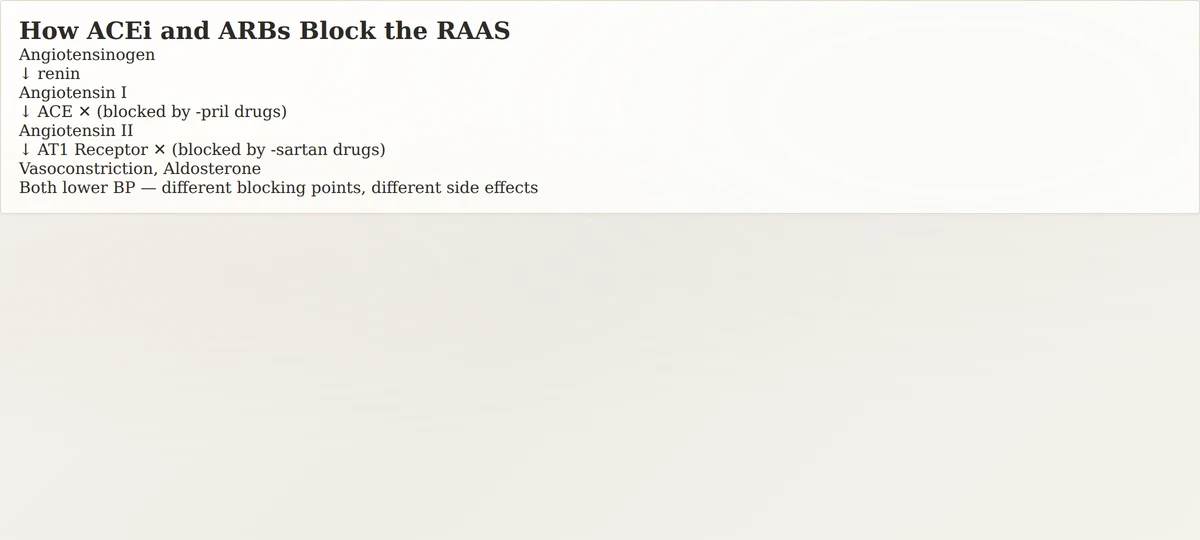
The renin-angiotensin-aldosterone system is the body’s primary long-term blood pressure regulator. When blood pressure drops (or when the kidneys sense low sodium), the kidneys release renin, an enzyme that converts angiotensinogen (a liver protein) into angiotensin I. Angiotensin I is relatively inactive — it needs to be converted to angiotensin II by angiotensin-converting enzyme (ACE).
Angiotensin II is the system’s workhorse. It causes blood vessels to constrict, stimulates aldosterone release (which makes the kidneys retain sodium and water), and promotes structural changes in the heart and blood vessels over time — all of which raise blood pressure.
ACE inhibitors block the ACE enzyme. Less ACE activity means less conversion of angiotensin I to angiotensin II. Less angiotensin II means less vasoconstriction, less aldosterone, lower blood pressure. But here is the side effect: ACE also breaks down bradykinin, a peptide that promotes coughing and inflammation. When ACE is inhibited, bradykinin accumulates — and roughly 10% of patients develop a persistent dry cough.
ARBs work one step downstream. They do not block angiotensin II production — they block the AT1 receptor that angiotensin II binds to. Angiotensin II is still produced (and bradykinin is still broken down normally), but it cannot activate the receptor that raises blood pressure. This is why ARBs provide similar blood pressure reduction without the cough.
| Mechanism Step | ACE Inhibitor Effect | ARB Effect |
|---|---|---|
| Renin release | No direct effect | No direct effect |
| Angiotensin I II conversion | BLOCKED | Still occurs |
| Angiotensin II levels | REDUCED | UNCHANGED (or slightly increased) |
| AT1 receptor activation | Reduced (less AngII) | BLOCKED (AngII cannot bind) |
| Bradykinin breakdown | REDUCED (accumulates) | UNCHANGED (no cough) |
| Blood pressure effect | (vasodilation, less aldosterone) | (vasodilation, less aldosterone) |
ACE Inhibitors vs ARBs at a Glance
| Feature | ACE Inhibitors (-pril) | ARBs (-sartan) |
|---|---|---|
| Mechanism | Block angiotensin II production | Block angiotensin II receptor |
| Blood pressure reduction | 10–15 mmHg systolic (typical) | 10–15 mmHg systolic (typical) |
| Common drugs | Lisinopril, ramipril, enalapril | Losartan, valsartan, candesartan |
| Most distinctive side effect | Dry cough (5–20% of patients) | Generally well tolerated |
| Angioedema risk | 0.1–0.7% (rare but serious) | Much rarer (<0.1%) |
| Hyperkalemia risk | Low to moderate | Low to moderate |
| Renal protection | Strong evidence | Strong evidence |
| Heart failure benefit | Strong evidence (multiple trials) | Strong evidence (multiple trials) |
| Cost | Lower (all available as generics) | Moderate (all available as generics) |
| Pregnancy safety | Contraindicated | Contraindicated |
| Black patients (monotherapy) | May be less effective alone | May be less effective alone; add CCB or thiazide |
Side Effects and Tolerability — The Deciding Factor
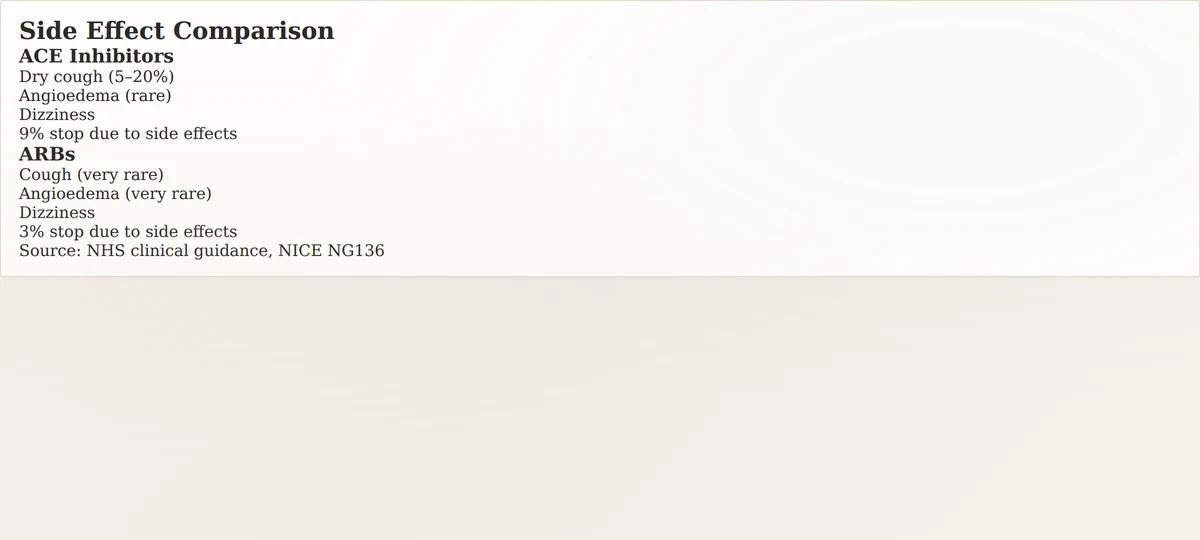
Quick Answer: The most clinically significant difference between ACE inhibitors and ARBs is tolerability — specifically, the ACE inhibitor-induced cough. Multiple meta-analyses show that ARBs have significantly lower discontinuation rates due to side effects (approximately 3% vs 9% for ACE inhibitors). Beyond the cough, both classes share risks of hyperkalemia (elevated potassium) and renal function changes, but ARBs have substantially lower angioedema risk.
The ACE Inhibitor Cough
This is the side effect that dominates the clinical conversation. The ACE inhibitor cough is dry, persistent, and tickle-like — not productive. It often begins within the first week to months of starting treatment, and it does not respond to cough suppressants or antihistamines. It stops only when the ACE inhibitor is stopped.
The mechanism is well understood: ACE normally degrades bradykinin and substance P, both of which stimulate cough receptors. When ACE is inhibited, bradykinin levels rise in the lungs, sensitising airway cough receptors. The cough resolves within days to weeks of discontinuing the ACE inhibitor and typically does not return when switching to an ARB.
Prevalence estimates range from 5% to 20%, with higher rates in some populations. Women appear more susceptible than men. The cough is not dangerous, but it is the single most common reason patients request a medication switch.
Angioedema — Rare but Serious
Angioedema — swelling of the deeper layers of the skin, particularly around the lips, tongue, and throat — occurs in approximately 0.1–0.7% of ACE inhibitor users. It can occur at any time during treatment, not just at initiation. When it affects the airway, it is a medical emergency.
ARBs can also cause angioedema but at much lower rates. This was once considered a complete contraindication crossover (can’t take ARBs if you had ACEi angioedema), but more recent evidence suggests the cross-reactivity risk, while real, is lower than historically believed — approximately 2–10% of ACEi angioedema patients will also react to an ARB. Many clinicians now cautiously consider ARBs for patients with mild (non-airway) ACEi angioedema who need RAAS blockade, but this decision requires specialist input.
Hyperkalemia — Shared Risk
Both classes reduce aldosterone levels, which means less potassium excretion by the kidneys. In patients with normal renal function, this effect is usually mild and clinically insignificant. However, in patients with reduced kidney function, diabetes, or those taking other potassium-raising medications (certain diuretics, potassium supplements, NSAIDs), potassium levels should be monitored. The risk is comparable between the two classes.
Other Side Effects
- Dizziness: Common to both classes, especially at initiation or dose increases. Typically self-limiting.
- Fatigue: Reported with both, though less frequently than with beta-blockers.
- Renal function changes: Both classes can cause a modest rise in creatinine at initiation — this is often physiological (reflecting the intended reduction in glomerular pressure) and not a reason to stop unless the rise is excessive (>30% from baseline).
- Taste disturbance: More common with ACE inhibitors (especially captopril) than ARBs.
What Does the Research Say?
| Study | Year | Finding | Source |
|---|---|---|---|
| NICE Hypertension Guideline NG136 | 2019 (updated 2023) | ACEi and ARBs are first-line options; choice should be individualised based on comorbidities, tolerability, and cost. | NICE |
| Cochrane Systematic Review | 2018 | ACE inhibitors reduce blood pressure and cardiovascular events; effect size comparable to ARBs. | Cochrane Database |
| NHS Clinical Guidance — Ramipril | Current | ACE inhibitors effective for hypertension, heart failure, and post-MI; cough is the most common side effect (up to 10%). | NHS |
| NHS Clinical Guidance — Losartan | Current | ARBs provide similar blood pressure reduction to ACE inhibitors with significantly lower cough incidence. | NHS |
| FDA High Blood Pressure Guide | Current | Multiple medication classes including ACEi and ARBs are first-line for hypertension; individual factors guide selection. | FDA |
What this means for you: The evidence shows ACE inhibitors and ARBs are therapeutically equivalent for blood pressure reduction and cardiovascular protection in most patients. The choice between them is driven primarily by tolerability (cough), specific comorbidities (heart failure with reduced ejection fraction favours certain ACEi/ARBs with strong trial data), and cost. There is no wrong choice — but there may be a better choice for you.
Which One Is Right for You? — Patient Profile Guide

An ACE Inhibitor May Be Better If:
- Cost is a significant concern — generic ACE inhibitors are generally less expensive than generic ARBs (though the gap has narrowed).
- You have heart failure with reduced ejection fraction — certain ACE inhibitors (enalapril, lisinopril, ramipril, captopril) have the longest and strongest heart failure trial data, though ARBs have also shown benefit.
- You have no history of ACEi cough and you tolerate the medication well — if it works and side effects are absent, there is no need to switch.
- You are post-MI — ACE inhibitors have robust post-myocardial infarction outcome data, though ARBs are a strong alternative for those who cannot tolerate ACEi.
An ARB May Be Better If:
- You have developed an ACE inhibitor cough — this is the single most common reason for switching. ARBs almost never cause this.
- You want the medication with fewer overall side effects — ARBs consistently show lower discontinuation rates across multiple meta-analyses.
- You are starting therapy and have no specific indication for one over the other — ARBs offer equivalent efficacy with better tolerability for many patients, and the cost gap has narrowed enough that this matters less than it once did.
- You have a history of mild ACEi-associated angioedema — this requires careful specialist evaluation, but ARBs may be an option.
When Neither May Be First Choice
- Pregnancy or planned pregnancy: Both classes are contraindicated. Alternative antihypertensives (methyldopa, labetalol, nifedipine) are preferred.
- Bilateral renal artery stenosis: Both can cause acute renal failure in this setting.
- Severe hyperkalemia on prior RAAS blocker: Consider alternative classes.
- Black patients as monotherapy: RAAS blockers may be less effective alone; guidelines recommend adding a thiazide diuretic or calcium channel blocker rather than relying on monotherapy with either ACEi or ARB.
Can You Switch From One to the Other?
Yes — and it is done routinely in clinical practice, most commonly when a patient develops an ACE inhibitor cough. The switch from an ACE inhibitor to an ARB is straightforward: the ACE inhibitor is stopped (the cough resolves within days to weeks), and the ARB is started at the equivalent dose. Blood pressure and potassium should be rechecked within 2–4 weeks of the switch.
Switching from an ARB to an ACE inhibitor is less common (if the ARB is well-tolerated, there is rarely a reason to switch) but follows the same principle.
A word of caution: ACE inhibitors and ARBs should NOT be combined (dual RAAS blockade). Multiple trials have shown that combining the two classes provides no additional cardiovascular benefit while significantly increasing the risks of hyperkalemia, hypotension, and acute kidney injury. This combination has been specifically advised against in major guidelines.
Related Reading
- Diabetes and Menopause: 7 Surprising Ways Blood Sugar Affects Symptoms — Hypertension and diabetes frequently co-occur. Our guide covers the metabolic-hormonal connections that affect both conditions.
- Antidepressant Discontinuation Syndrome: 7 Proven Ways to Taper Safely — Many people managing hypertension also take medications for mental health. Understanding how to safely manage all your prescriptions matters.
- [MedsBase Blood Pressure Options]() — Browse our catalogue of blood pressure medications, including ramipril (Ramgee), valsartan (Valent), and more.
Frequently Asked Questions
Q: What is the difference between ACE inhibitors and ARBs?
A: ACE inhibitors block the enzyme that produces angiotensin II (a hormone that raises blood pressure). ARBs allow angiotensin II to be produced but block its receptor, preventing it from working. The result — lower blood pressure — is similar, but because ACE inhibitors also affect bradykinin (causing a dry cough in up to 20% of users), the side effect profiles differ.
Q: Which is better, lisinopril or losartan?
A: Neither is universally “better.” They are comparably effective at lowering blood pressure. Lisinopril (ACE inhibitor) has longer clinical trial data, especially in heart failure. Losartan (ARB) has fewer side effects — particularly no cough. The right choice depends on your specific medical history, tolerability, and cost considerations. In terms of efficacy, the evidence shows equivalence.
Q: Why do ACE inhibitors cause a cough?
A: ACE (angiotensin-converting enzyme) normally breaks down bradykinin, a peptide that promotes coughing. When ACE inhibitors block this enzyme, bradykinin accumulates in the lungs, sensitising cough receptors. This produces a dry, ticklish cough in 5–20% of users. The cough does not respond to cough medicine and stops only when the ACE inhibitor is discontinued. ARBs do not affect bradykinin, so they almost never cause this side effect.
Q: What are the safest blood pressure medications?
A: “Safest” depends on the individual, but ARBs and calcium channel blockers generally have the most favourable side effect profiles across large populations. ARBs provide the cardiovascular and renal benefits of ACE inhibitors without the cough and with less angioedema risk. Calcium channel blockers (amlodipine, nifedipine) have a different mechanism and side effect profile (ankle swelling, flushing) but are also considered very safe. Thiazide diuretics are another well-tolerated first-line option with decades of safety data.
Q: Can you switch from an ACE inhibitor to an ARB?
A: Yes, and this is one of the most common medication switches in clinical practice — typically because the patient developed a cough on the ACE inhibitor. The switch is straightforward: stop the ACEi, start the ARB at equivalent dose, and recheck blood pressure and potassium in 2–4 weeks. The cough typically resolves within days to weeks.
Q: Which blood pressure medication has the fewest side effects?
A: Across multiple meta-analyses, ARBs consistently show the lowest discontinuation rates (approximately 3% vs 9% for ACE inhibitors, 8–15% for beta-blockers, and 5–10% for calcium channel blockers). ARBs are among the best-tolerated blood pressure medications available. However, individual responses vary — what works best for you is the medication that controls your blood pressure with side effects you can live with.
Q: Are ACE inhibitors or ARBs better for diabetes?
A: Both are excellent choices for people with diabetes, as they slow the progression of diabetic kidney disease — one of the most important non-blood-pressure benefits of RAAS blockade. The American Diabetes Association recommends either an ACE inhibitor or an ARB for people with diabetes and hypertension, and for those with albuminuria (protein in the urine) even if blood pressure is normal. The choice between them follows the general criteria: ARB if ACEi cough is an issue, otherwise either is appropriate.
Q: What should I avoid while taking ACE inhibitors or ARBs?
A: Key precautions: (1) Avoid NSAIDs (ibuprofen, naproxen, diclofenac) regularly — they can reduce the blood-pressure-lowering effect and increase the risk of kidney injury and hyperkalemia. Occasional use is generally fine but discuss with your doctor. (2) Avoid potassium supplements and salt substitutes containing potassium chloride unless specifically approved by your doctor, as these medications already reduce potassium excretion. (3) Stay well-hydrated during illnesses that cause vomiting or diarrhea — dehydration combined with RAAS blockers can cause acute kidney injury. (4) Do not stop either medication abruptly without medical guidance — sudden withdrawal can cause rebound hypertension.
The Bottom Line
ACE inhibitors and ARBs are two of the most important medication classes in cardiovascular medicine — and two of the most commonly prescribed drugs worldwide. They are therapeutically equivalent for most patients: both lower blood pressure effectively, both protect the kidneys in diabetes, and both improve outcomes in heart failure. The choice between them is not about which one “works better” — it is about which one works better for you.
For many patients, ARBs offer equivalent efficacy with fewer side effects, making them an excellent first choice — particularly if you are just starting treatment. For others, an ACE inhibitor’s longer track record in heart failure or its lower cost makes it the right call. And if you develop that telltale dry cough on an ACE inhibitor, know that switching to an ARB is a well-established, effective path — you do not have to live with the cough.
Your immediate action step: If you are currently on an ACE inhibitor or ARB and it is working well — controlling your blood pressure without bothersome side effects — there is no reason to change. If you are experiencing side effects, especially a persistent dry cough, bring it up at your next appointment with the specific question: “Would switching to an ARB make sense for me?” If you are newly diagnosed with hypertension and medication is being discussed, you are now equipped to participate in that conversation as an informed partner in your care.
Managing blood pressure is part of a broader health picture. If diabetes is also part of yours, our guide on diabetes and menopause covers the surprising ways blood sugar and hormones interact. And if you are taking multiple medications, understanding how to safely taper antidepressants is essential reading before making any changes.
Medical Disclaimer: This article is for informational purposes only and does not constitute medical advice. Never start, stop, or change any blood pressure medication without direct supervision from your prescribing healthcare provider. Hypertension management requires individualised assessment and monitoring.

Written by
Sophie ChenPharmaceutical Content Researcher · 8 years experience
Sophie Chen is a pharmaceutical content researcher with 8 years covering generic medication access and clinical pharmacology. She specialises in international regulatory frameworks, bioequivalence standards, and patient-facing education on therapeutic drug classes. She is not a clinician.