








✓ Medically reviewed by · Last reviewed: May 2026
Pharmacy Researcher · 8 years experience
Pharmacy researcher with 8 years reviewing clinical drug information, generic formulation equivalence, and international pharmaceutical standards. Focuses on patient-facing accuracy in medication education.
Quick Answer
Gabapentin for nerve pain is a first-line treatment for diabetic neuropathy and postherpetic neuralgia (shingles pain). It works by calming overactive pain signals in the nervous system, and most people reach an effective dose of 900–3,600 mg per day over two to four weeks of gradual titration. Pain relief builds slowly, so expect noticeable improvement in one to two weeks rather than overnight.
Gabapentin for nerve pain is one of the most frequently prescribed medications for neuropathic pain worldwide. If you have burning, shooting, or electric-shock pain from damaged nerves, your doctor may have already mentioned this drug. In this guide, we walk through eight proven facts about how gabapentin for nerve pain works, how to dose it safely, what side effects to expect, and how long it takes to feel relief.
Unlike ibuprofen or paracetamol, which blunt pain at the site of injury, gabapentin changes how the brain and spinal cord process pain signals. As a result, it is far more useful for nerve pain than for ordinary aches, sprains, or headaches. However, it also has a slow, gradual onset and a real list of side effects, so it matters how you start and stop it.
Key Takeaways
- Gabapentin for nerve pain is backed by the strongest evidence for diabetic neuropathy and shingles-related nerve pain.
- It works by binding the α2δ-1 subunit of calcium channels, which reduces overactive pain signalling — not by acting on GABA receptors.
- The typical effective dose is 900–3,600 mg per day, reached gradually over two to four weeks of titration.
- Dizziness, drowsiness, and leg swelling are the most common side effects, and they usually peak during dose increases.
- Never stop gabapentin suddenly; taper the dose over at least one week to avoid withdrawal symptoms.
What Is Gabapentin?
Gabapentin is a medication from a class called gabapentinoids. It was originally developed as an anti-seizure (anticonvulsant) drug, but doctors quickly noticed that people taking it also reported less nerve pain. Today, using gabapentin for nerve pain is one of the most common reasons the drug is prescribed, even though it was first approved for epilepsy.
The drug is sold under the brand names Neurontin, Gralise, and Horizant, and it is widely available as a generic. It comes in capsules of 100 mg, 300 mg, and 400 mg, tablets of 600 mg and 800 mg, and an oral solution. In most cases, gabapentin for nerve pain is started at a low dose and increased slowly — a process called titration — to keep side effects manageable.
A common misconception is that gabapentin works like an opioid or narcotic painkiller. In reality, it is not an opioid. Although it can cause significant drowsiness and carries its own risk of misuse, it does not act on opioid receptors. Understanding what gabapentin is — and what it is not — helps explain both its benefits and its limitations.
The drug has an interesting history. Gabapentin was first approved in the early 1990s as an add-on treatment for partial seizures, and it was only later that clinicians noticed its nerve-pain benefits and began prescribing it for that purpose. As a result, using gabapentin for nerve pain is technically an off-label practice for some conditions and a fully approved one for others — specifically postherpetic neuralgia. In practice, however, it has become one of the most common nerve pain medications in the world, precisely because so many patients and doctors have found it helpful.
How Gabapentin for Nerve Pain Works — Mechanism
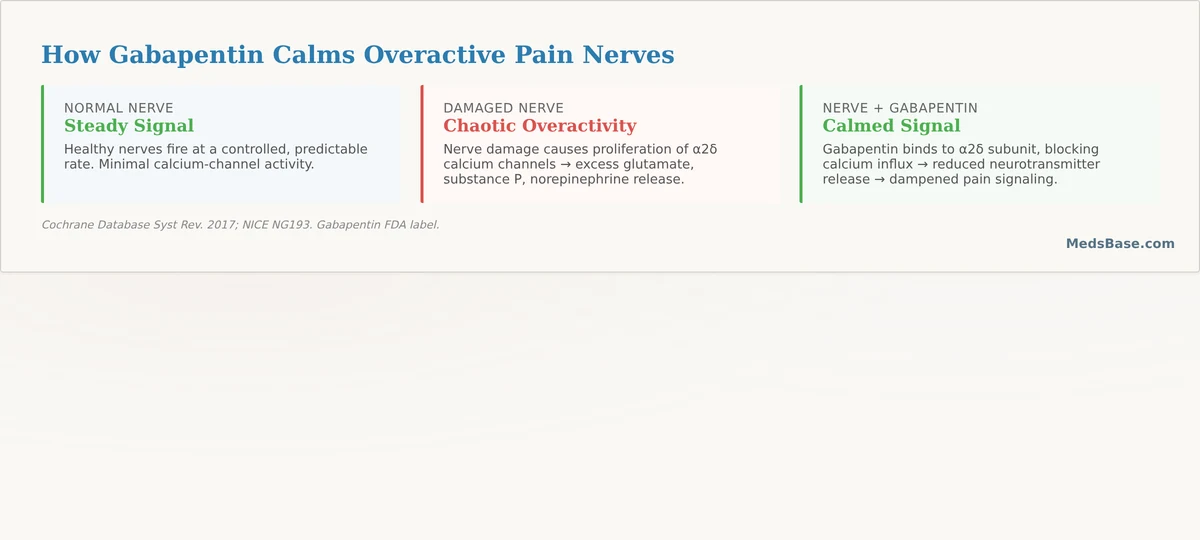
Gabapentin for nerve pain works differently from standard pain relievers such as ibuprofen or paracetamol, and it is also different from opioids. Rather than masking pain at the site of injury, it changes how the central nervous system processes pain signals in the first place.
At the molecular level, gabapentin binds to a specific part of voltage-gated calcium channels called the α2δ-1 subunit. This binding reduces the release of several excitatory neurotransmitters — including glutamate, noradrenaline, and substance P — from overactive nerve terminals. Because nerve pain is driven by hyper-excitable nerves that fire too easily, dampening this over-activity helps quiet the pain signal.
Importantly, gabapentin does not bind to GABA receptors, despite its name and its structural similarity to the neurotransmitter GABA. It also does not change how the body produces or breaks down GABA. This distinction matters because it explains why gabapentin for nerve pain is relatively selective for abnormal nerve firing rather than broadly depressing the whole nervous system. However, this same mechanism means the drug takes time to reach full effect, which is why gradual titration and patience are essential.
To understand why this matters, it helps to know how nerve pain develops in the first place. After nerves are damaged — by high blood sugar, a shingles infection, or physical injury — they can become sensitised. They fire spontaneously, send exaggerated signals in response to ordinary touch, and recruit neighbouring neurons into the pain pathway. This is called central sensitisation, and it is the reason nerve pain can feel so out of proportion to any visible injury. Because gabapentin for nerve pain targets this over-activity at its source, it addresses the underlying problem rather than simply covering up the sensation — which is also why it rarely works for muscle aches, cuts, or other forms of pain that do not involve sensitised nerves.
Types of Nerve Pain Gabapentin for Nerve Pain Treats
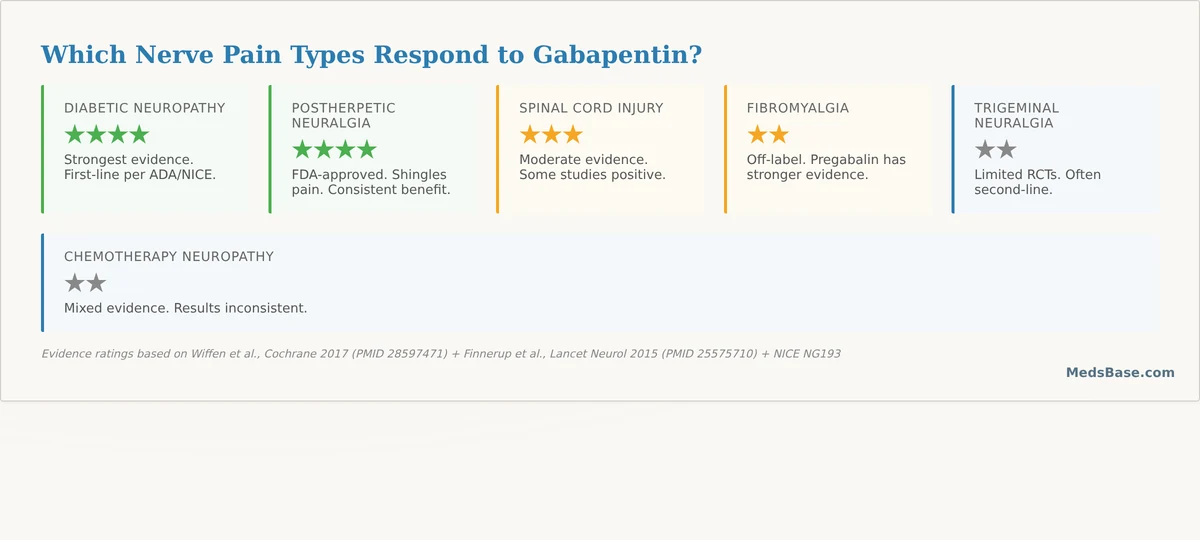
Not all pain is the same, and gabapentin for nerve pain is only effective for neuropathic pain — pain caused by damage or disease in the nerves themselves. It is far less useful for muscle aches, joint pain, or inflammation. Below are the conditions where the evidence is strongest, and a few where it is weaker.
Postherpetic neuralgia (shingles pain). This is the clearest approved use. After a shingles outbreak, some people develop burning nerve pain that lasts for months. Gabapentin for nerve pain is one of the few treatments shown to reduce this pain in large trials.
Diabetic peripheral neuropathy. High blood sugar damages the small nerves in the feet and hands, producing numbness, tingling, and burning. Gabapentin for nerve pain is widely used here and was the subject of a landmark 1998 study discussed later in this guide.
Sciatica and radiculopathy. Evidence is mixed. Sciatica is often caused by a compressed nerve root rather than primary nerve disease, so gabapentin for sciatica may help some people but is not reliably better than placebo for others.
Other nerve pain types. Gabapentin is sometimes used for cancer-related neuropathic pain, trigeminal neuralgia, and central pain after stroke or spinal cord injury. However, for trigeminal neuralgia specifically, carbamazepine is usually preferred as the first choice. For a broader look at options, see our guide to neuropathic pain treatment.
Cancer-related neuropathic pain. Chemotherapy drugs and tumours pressing on nerves can both produce neuropathic pain, and gabapentin for nerve pain is frequently added to other painkillers in this setting. The goal is usually to reduce the amount of opioid needed, which in turn lowers opioid side effects.
Central neuropathic pain. Pain caused by stroke, multiple sclerosis, or spinal cord injury is harder to treat than peripheral nerve pain, and gabapentin shows only modest benefit here. Nevertheless, it is often tried because the alternatives are limited.
Fibromyalgia. Although fibromyalgia is a centralised pain condition rather than classic nerve damage, gabapentin is sometimes used off-label. Pregabalin carries a formal approval for fibromyalgia in some countries, while gabapentin does not — but the two are closely related, and some clinicians prescribe gabapentin for nerve pain and related syndromes where the cost of pregabalin is a concern.
Gabapentin for Nerve Pain — Dosing & Titration Schedule
Getting the dose right is the single most important part of using gabapentin for nerve pain successfully. The drug is not taken at full strength from day one. Instead, it is titrated upward over several weeks, which dramatically reduces early dizziness and drowsiness while allowing the body to adjust.
A typical gabapentin titration schedule looks like the table below. Remember that this is a general example — your doctor will adjust the pace and final dose to your kidney function, age, and response.
| Time | Daily Dose | How It Is Split |
|---|---|---|
| Day 1 | 300 mg | Single evening dose |
| Day 2 | 600 mg | 300 mg twice daily |
| Day 3 | 900 mg | 300 mg three times daily |
| Days 4–14 | +300 mg every 2–3 days | Increase toward 900–1,800 mg/day |
| Maintenance | 900–3,600 mg/day | Divided into three doses |
The usual effective range for gabapentin dosing neuropathy patients is 900–1,800 mg per day, although some people need up to 3,600 mg per day for full relief. Because gabapentin is cleared by the kidneys, anyone with reduced kidney function needs a lower, less frequent dose. Consequently, kidney function should be checked before and during long-term treatment.
Kidney dose adjustments are an essential safety point. For patients with moderate kidney impairment (creatinine clearance 30–60 mL/min), the total daily dose is often halved or the interval between doses extended. In severe impairment (under 15 mL/min), doses may need to be cut to 300 mg every other day. In short, gabapentin for nerve pain requires a kidney-aware dosing strategy, which is why your doctor will check blood tests before deciding on the right schedule.
Older adults generally need a slower, gentler titration. Dizziness and unsteady gait are more dangerous in people over 65, who are already at higher risk of falls. As a result, many geriatric specialists start at 100 mg rather than 300 mg and increase more slowly, sometimes over four to six weeks rather than two.
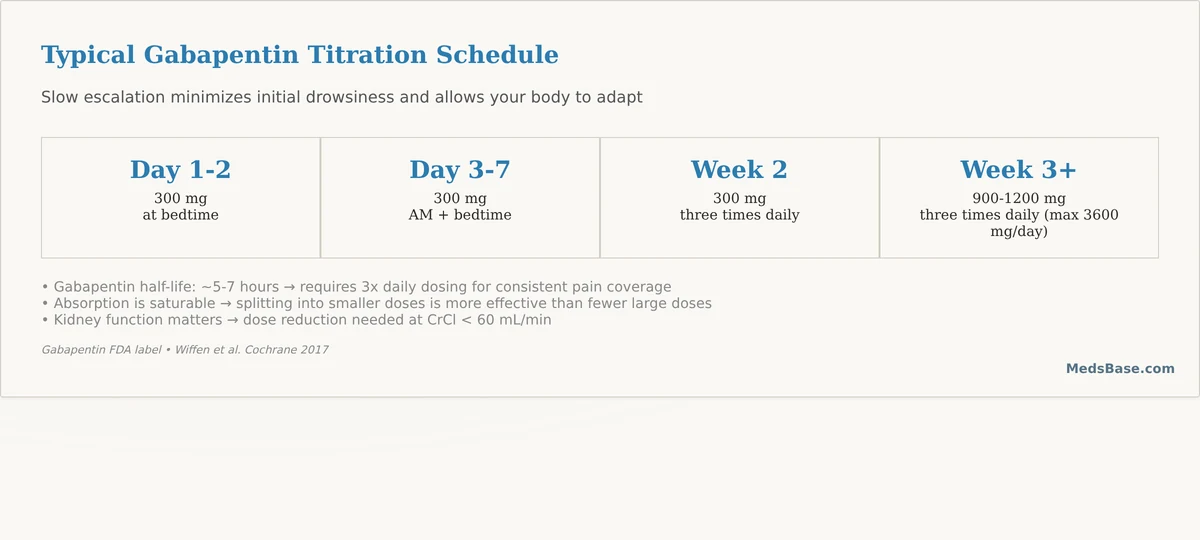
One practical tip: because gabapentin is absorbed more efficiently at lower doses, splitting a large daily dose into three smaller doses improves how much of the drug reaches your system. Taking the largest dose in the evening is also common, since drowsiness is usually worst in the first few hours after a dose.
Gabapentin for Nerve Pain — Side Effects & Safety
Gabapentin for nerve pain is generally well tolerated, but its side effects are real and predictable. Most of them appear early, during titration, and fade as the body adapts. However, some — such as weight gain and leg swelling — tend to build up over months of use.
| Side Effect | How Common | What Helps |
|---|---|---|
| Dizziness | ~20–28% | Slow titration; sit before standing |
| Drowsiness / fatigue | ~19–22% | Take evening dose at bedtime |
| Leg or foot swelling (oedema) | ~8% | Elevate legs; report to doctor |
| Unsteady gait (ataxia) | Common in older adults | Avoid stairs until adjusted |
| Weight gain | ~2–3% | Monitor weight; diet and exercise |
| Blurred vision / dry mouth | Occasional | Usually resolves on its own |
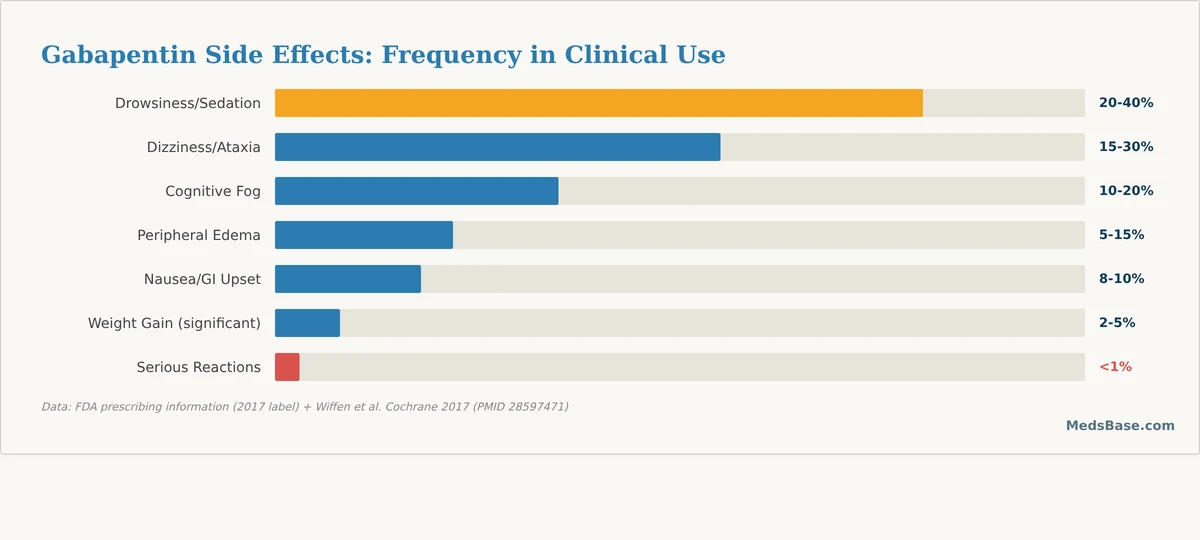
There are also rare but serious risks to know. Gabapentin for nerve pain can depress breathing, especially when combined with opioids, alcohol, or in people with lung disease. It carries a warning about mood changes and, very rarely, suicidal thoughts. In addition, stopping the drug suddenly can cause withdrawal symptoms such as anxiety, sweating, nausea, and rebound pain. For these reasons, the medication should always be started, adjusted, and stopped under medical guidance.
Respiratory depression is the risk that deserves the most attention. When gabapentin for nerve pain is combined with opioids, benzodiazepines, or even large amounts of alcohol, breathing can slow dangerously — particularly in older adults or anyone with chronic lung disease. In addition, a small number of people experience a serious, widespread rash or a reaction called DRESS syndrome, which requires immediate medical attention. While these events are uncommon, they are a reminder that this is a real medication with real risks, not a harmless supplement.
There are also a few situations where gabapentin needs extra caution. Because it can cause weight gain and fluid retention, it may worsen heart failure in susceptible people. It is also not recommended during pregnancy unless clearly needed, and it passes into breast milk. Therefore, anyone who is pregnant, planning a pregnancy, or breastfeeding should discuss the risks and benefits with their doctor before starting gabapentin for nerve pain.
Finally, although gabapentin is not an opioid, it does have some potential for misuse, and several countries and states now regulate it more tightly than in the past. Using it exactly as prescribed — and never sharing it — is important. If you are exploring other options, read our comparison of pain relief medication.
Gabapentin for Nerve Pain — What the Research Says
The reputation of gabapentin for nerve pain is built on decades of clinical research, not anecdote. Several large, well-designed trials and systematic reviews underpin its use today.
| Study | Year | Key Finding |
|---|---|---|
| Cochrane review (Wiffen et al.) | 2017 | Gabapentin at 1,200 mg/day or more gives substantial relief in roughly 1 in 6 people (NNT ~6.6) |
| Finnerup et al. meta-analysis | 2015 | Strong, consistent evidence for gabapentin and pregabalin in neuropathic pain |
| Backonja et al. (JAMA) | 1998 | Gabapentin 3,600 mg/day significantly reduced diabetic neuropathy pain versus placebo |
| Rowbotham et al. (JAMA) | 1998 | Gabapentin significantly reduced postherpetic neuralgia pain versus placebo |
These findings come with an important nuance. In the 2017 Cochrane review, gabapentin for nerve pain helped a meaningful minority — roughly one in six people achieved substantial relief. That is a real benefit, but it also means many people get only partial relief or none at all. Meanwhile, the Finnerup meta-analysis placed gabapentin and pregabalin among the treatments with the strongest evidence for neuropathic pain, alongside tricyclic antidepressants and SNRIs.
The two landmark diabetic neuropathy and postherpetic neuralgia trials, both published in JAMA in 1998, remain the foundation of modern prescribing. In short, gabapentin for nerve pain works — but expectation management matters, because the average effect is moderate rather than dramatic.
It is also worth understanding what “NNT of about 6.6” actually means. The number-needed-to-treat (NNT) is the number of people who must take a drug for one person to get a large benefit. An NNT of 6.6 means that for every seven people treated, roughly one achieves a big improvement in pain that they would not have got from a placebo. For comparison, the NNT for many commonly used painkillers is similar or worse, which is why gabapentin for nerve pain remains a reasonable first-line choice despite not helping everyone. On the other hand, this also explains why trials emphasise trying the drug for several weeks at an adequate dose before judging whether it works for you.
Gabapentin vs Pregabalin & Other Alternatives
Gabapentin and pregabalin (Lyrica) are close relatives, both belonging to the gabapentinoid class. They work through the same α2δ mechanism, so their benefits and side effects overlap heavily. Nevertheless, the pregabalin vs gabapentin choice often comes down to practical differences rather than raw effectiveness.
| Medication | Class | Evidence | Notes |
|---|---|---|---|
| Gabapentin | Gabapentinoid | Strong (NNT ~6–8) | Needs slow titration; saturable absorption |
| Pregabalin | Gabapentinoid | Strong (NNT ~7–8) | Predictable dosing, faster onset, higher cost |
| Duloxetine | SNRI | Strong | Also treats depression and anxiety |
| Amitriptyline | Tricyclic | Strong | Cheap and effective; sedation common |
| Carbamazepine | Anticonvulsant | Strong (trigeminal neuralgia) | First choice for trigeminal neuralgia |
Pregabalin has more predictable absorption and can be started closer to a therapeutic dose, so it sometimes acts faster than gabapentin for nerve pain. On the other hand, gabapentin is usually far less expensive and has a longer safety track record. Because both drugs act on the same target, they should never be combined. Finally, for people who cannot tolerate gabapentinoids at all, duloxetine or amitriptyline are well-supported alternatives worth discussing with a doctor.
How to Take Gabapentin for Nerve Pain Correctly
How you take gabapentin for nerve pain can make the difference between a treatment that works and one you abandon after a week of dizziness. Follow these steps to get the best results.
- Start low and go slow. Begin with a single small evening dose and increase every two to three days. This single habit prevents most early side effects.
- Split your dose. Because absorption is saturable, taking 300 mg three times a day delivers more usable drug than 900 mg at once.
- Separate it from antacids. Antacids containing aluminium or magnesium reduce gabapentin absorption. Leave a gap of at least two hours between them.
- Avoid alcohol and other sedatives. Alcohol multiplies drowsiness and dizziness, and combining gabapentin with opioids or sleep aids raises the risk of breathing problems.
- Give it time. Nerve pain does not resolve overnight. Expect gradual improvement over one to two weeks at a full dose.
- Never stop abruptly. Taper the dose over at least one week, ideally under your doctor’s direction, to avoid withdrawal symptoms.
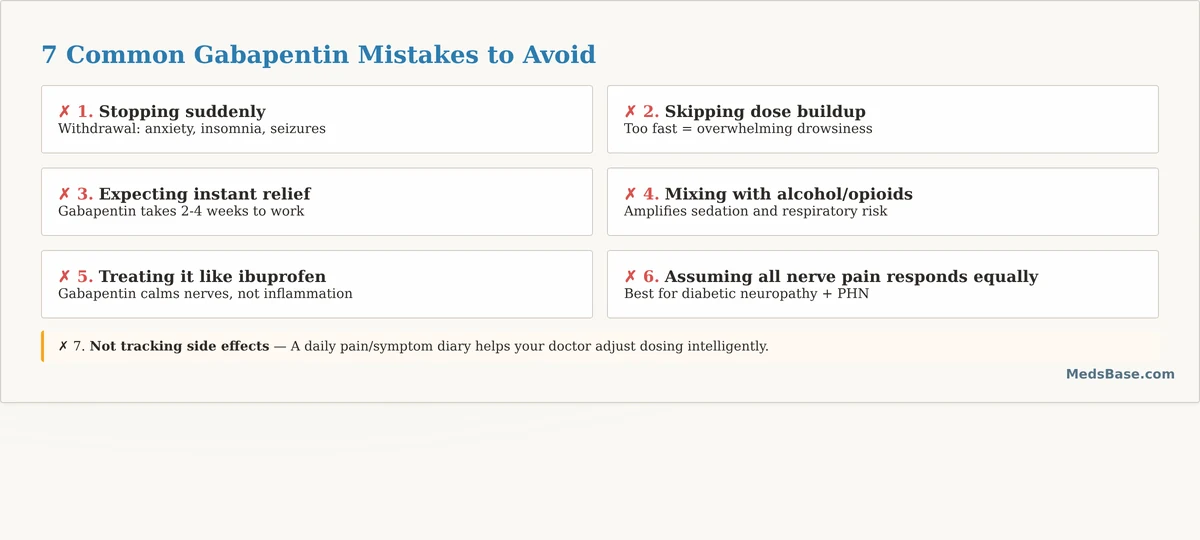
Mistakes to avoid. The most frequent errors are stopping suddenly, doubling a missed dose, expecting instant relief, and combining the drug with alcohol. Another common mistake is taking gabapentin for nerve pain alongside antacids, which quietly weakens each dose. If you miss a dose, take it as soon as you remember — unless it is nearly time for the next one, in which case skip the missed dose and continue normally. For more general guidance, see our pain management resource hub.
Frequently Asked Questions
How long does gabapentin for nerve pain take to work?
Gabapentin for nerve pain is not an instant painkiller. Most people notice some improvement within the first one to two weeks, but the full effect often takes several weeks because the dose must be titrated up gradually. In clinical trials, meaningful pain reduction was typically assessed after weeks of treatment at a full dose. Therefore, it is important not to give up too early — but if there is no meaningful change after a month at an adequate dose, your doctor may suggest a different option.
What is the best dose of gabapentin for nerve pain?
There is no single “best” dose, because the right amount depends on your kidney function, age, and response. However, most people land in a maintenance range of 900–1,800 mg per day, split into three doses, with an upper limit of 3,600 mg per day. The key is not the starting number but the gradual titration schedule that gets you there. As a result, a dose that feels too sedating on day two is often perfectly comfortable two weeks later.
Is gabapentin for nerve pain addictive?
Gabapentin is not an opioid, but it is not entirely free of dependence risk. Physical dependence can develop with long-term use, and stopping abruptly can trigger withdrawal symptoms such as anxiety, sweating, nausea, and difficulty sleeping. Some people also misuse gabapentin for its calming effects. Consequently, it should always be taken exactly as directed and tapered slowly when stopping. For most people using it correctly, the risk of addiction is modest but not zero.
Can I take gabapentin and pregabalin together?
No. Gabapentin and pregabalin both bind the same α2δ subunit of calcium channels, so combining them does not add benefit and simply stacks side effects such as dizziness, drowsiness, and swelling. Doctors prescribe one or the other, never both at once. If your current gabapentinoid is not working well enough, the correct step is to discuss switching — under medical guidance — rather than adding a second one.
Does gabapentin for nerve pain cause weight gain?
Yes, in a minority of people. Studies report weight gain in roughly 2–3% of users, typically developing gradually over months of treatment. The gain is usually modest, but it can be more noticeable at higher doses or with long-term use. The mechanism is thought to involve increased appetite and fluid retention. Therefore, monitoring your weight, staying active, and eating a balanced diet are sensible precautions while taking gabapentin for nerve pain.
Does gabapentin for nerve pain work for sciatica?
The evidence for gabapentin for sciatica is mixed. Sciatica is usually caused by a compressed or irritated nerve root, which is different from the nerve damage that gabapentin targets best. Some people do report relief, but trials have not consistently shown gabapentin to beat placebo for sciatica specifically. Consequently, it is often tried for short periods, but your doctor may prioritise other treatments such as physical therapy, anti-inflammatories, or addressing the underlying cause.
What is the difference between gabapentin and pregabalin?
Both are gabapentinoids that reduce nerve-pain signalling, but they differ in practical ways. Pregabalin has predictable, linear absorption and can be started closer to its effective dose, so it may work faster. Gabapentin has saturable absorption and needs slower titration but is typically much cheaper. Their side-effect profiles are similar. Ultimately, the choice often comes down to cost, tolerability, and how quickly relief is needed.
Can I stop gabapentin for nerve pain suddenly?
You should not stop gabapentin suddenly. Abrupt discontinuation can trigger withdrawal symptoms, including anxiety, agitation, sweating, nausea, insomnia, and a temporary worsening of pain. The safest approach is to taper the dose gradually over at least one week, and ideally longer after high-dose or long-term use. Because the right taper pace varies from person to person, always coordinate stopping gabapentin for nerve pain with your doctor rather than doing it alone.
The Bottom Line
Gabapentin for nerve pain is a proven, well-studied option for diabetic neuropathy and postherpetic neuralgia, and it can help other forms of neuropathic pain too. Its biggest strength is a mechanism that targets overactive nerve signalling rather than simply masking pain, which makes it genuinely different from common painkillers.
At the same time, it is not a quick fix. Success with gabapentin for nerve pain depends on a slow, disciplined titration schedule, realistic expectations about how long it takes to work, and careful attention to side effects and drug interactions. When used correctly — started low, increased gradually, and stopped slowly — gabapentin for nerve pain remains one of the most valuable tools available for managing nerve pain. If you think it might suit you, talk to your doctor about whether a gradual titration plan is appropriate for your situation.
Medical Disclaimer: This article is for informational purposes only and is not a substitute for professional medical advice, diagnosis, or treatment. Always consult a qualified healthcare provider before starting, changing, or stopping any medication.

Written by
Sophie ChenPharmaceutical Content Researcher · 8 years experience
Sophie Chen is a pharmaceutical content researcher with 8 years covering generic medication access and clinical pharmacology. She specialises in international regulatory frameworks, bioequivalence standards, and patient-facing education on therapeutic drug classes. She is not a clinician.