








✓ Medically reviewed by · Last reviewed: May 2026
Pharmacy Researcher · 8 years experience
Pharmacy researcher with 8 years reviewing clinical drug information, generic formulation equivalence, and international pharmaceutical standards. Focuses on patient-facing accuracy in medication education.
diclofenac gel vs oral diclofenac — Diclofenac Gel vs Oral Diclofenac — Which Form of Pain Relief Is Right for You?. Read on for an evidence-backed guide covering everything you need to know.
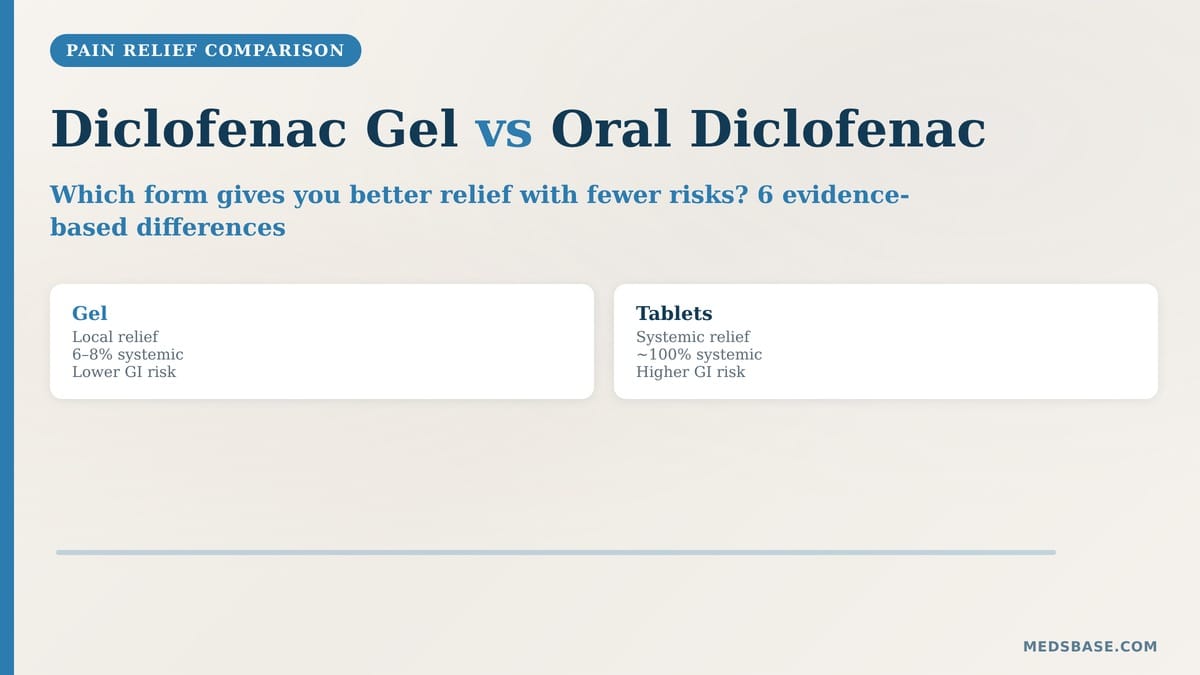
Your knee has been aching for weeks. You’ve finally decided to try something stronger than ice packs, and your doctor mentioned diclofenac. But now you’re staring at two options — an oral tablet and a topical gel — wondering which one will actually work without wrecking your stomach.
You’re not alone. Diclofenac is one of the most prescribed NSAIDs worldwide, available in both forms, and the choice between diclofenac gel vs oral diclofenac is genuinely more nuanced than most people realize. The form you choose changes the speed of relief, the side effects you risk, and even which body parts it works for.
Here’s what you’ll learn: the six evidence-based differences in the diclofenac gel vs oral diclofenac comparison, which one the research supports for specific pain types, the surprising bioavailability numbers most patients never see, and a practical decision matrix so you can walk into your next doctor’s appointment knowing which one to ask for.
Key Takeaways
- Diclofenac gel achieves therapeutic levels at the target joint while keeping systemic absorption to just 6-8% of the oral dose — but there’s one pain type where gel simply won’t work
- The GI side effect difference isn’t small — it’s roughly 4-10x lower risk with gel, and the cardiovascular difference is similarly dramatic
- Onset time is almost identical between the two forms, but one provides significantly longer local relief
- Three specific body areas respond dramatically better to gel, and one common pain location requires the oral form — getting this wrong is the most common mistake
- You should never use both forms together without specific medical instruction — and here’s why
- What Is Diclofenac and How Do the Two Forms Work?
- How Does Diclofenac Gel Absorb Differently From Oral Diclofenac?
- How Fast Does Each Form Work?
- Which Conditions Respond Best to Each Form?
- Side Effects and Safety: Gel vs Oral
- What the Research Says
- How to Use Each Form Correctly
- How to Choose: Decision Matrix
- Frequently Asked Questions
- The Bottom Line
What Is Diclofenac and How Do the Two Forms Work? — Diclofenac gel vs oral diclofenac Explained
Quick Answer: Diclofenac is a non-steroidal anti-inflammatory drug (NSAID) that blocks COX-1 and COX-2 enzymes, reducing prostaglandin production and thereby decreasing pain and inflammation. Oral diclofenac travels through the bloodstream to reach all tissues systemically. Diclofenac gel (topical) penetrates the skin and concentrates in the underlying tissues — muscle, tendon, and joint spaces — with minimal systemic absorption.
Understanding the diclofenac gel vs oral diclofenac difference starts with knowing what diclofenac actually does. Diclofenac belongs to the NSAID family alongside ibuprofen, naproxen, and aspirin. It’s a non-selective COX inhibitor, meaning it blocks both COX-1 (which protects the stomach lining) and COX-2 (which drives inflammation). This dual blockade makes it effective for pain but also creates the GI risk profile that has pushed many patients toward the topical option.
Take Sarah, 55, who has been managing knee osteoarthritis for three years. Her doctor initially prescribed oral diclofenac 50mg twice daily, and it worked — but six months in, she developed gastritis and had to stop. Switching to diclofenac gel meant she could continue treating her knee pain without the GI side effects. This is the classic use case where the diclofenac gel vs oral diclofenac decision matters most.
The diclofenac gel vs oral diclofenac question matters because the drug comes in several forms:
- Oral tablets: 25mg, 50mg, 75mg (immediate and extended-release)
- Topical gel: 1% and 2.32% (diclofenac sodium or diethylamine)
- Topical patches: 1.3% and 1.5% for localized delivery
- Topical solution: 1.5% and 2% liquid drops
In this article, we focus on oral tablets vs topical gel — the two most common forms and the comparison patients ask about most.
How Does Diclofenac Gel Absorb Differently From Oral Diclofenac? — Diclofenac gel vs oral diclofenac Explained
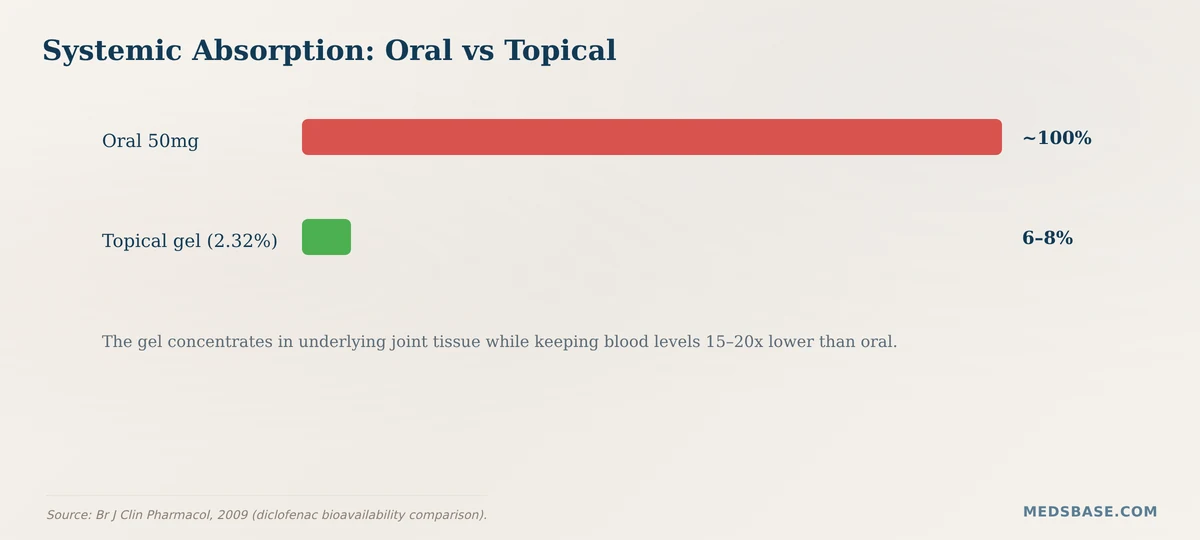
Quick Answer: Oral diclofenac is absorbed through the GI tract and distributed systemically, reaching all tissues including the joints. Diclofenac gel penetrates the skin and concentrates in the underlying soft tissues and joint spaces, with only 6-8% reaching systemic circulation. This means gel delivers therapeutic drug levels to the target site while dramatically reducing exposure to the stomach, kidneys, and cardiovascular system.
The bioavailability numbers in the diclofenac gel vs oral diclofenac comparison tell the story:
| Form | Systemic absorption | Joint tissue concentration | Stomach exposure |
|---|---|---|---|
| Oral 50mg | ~100% (systemic) | Therapeutic (via blood) | High (direct contact) |
| Topical 2.32% gel | ~6-8% | Therapeutic (via penetration) | Near zero |
This difference is the foundation of the diclofenac gel vs oral diclofenac comparison. Research published in the British Journal of Clinical Pharmacology confirmed that topical diclofenac achieves synovial fluid concentrations comparable to oral dosing while keeping plasma levels 15-20x lower. The drug doesn’t need to circulate through your entire body to work — it can reach knee joint tissue directly through the skin, underlying fat, and joint capsule.
But there’s a limiting factor in the diclofenac gel vs oral diclofenac equation: penetration depth. Diclofenac gel reaches therapeutic concentrations in tissues up to approximately 4-6 cm below the skin surface, depending on the joint and individual anatomy. This is why it excels for superficial joints (knees, hands, elbows) but struggles with deep structures (hip joints, spine, internal organs).
One counterintuitive point: because the gel avoids first-pass liver metabolism (which oral diclofenac undergoes), a higher proportion of the absorbed dose reaches the target tissue intact. Oral diclofenac goes through the liver before it reaches the knee; topical diclofenac goes to the knee first, with only the small fraction that eventually reaches systemic circulation passing through the liver. This pharmacokinetic advantage partially offsets the lower total dose.
Diclofenac gel vs oral diclofenac: How Fast Does Each Form Work?
The comparative onset times in the diclofenac gel vs oral diclofenac analysis are closer than most patients expect:
| Measure | Oral Diclofenac | Topical Diclofenac Gel |
|---|---|---|
| Initial pain relief | 30-60 minutes | 30-60 minutes (local) |
| Peak effect | 1-2 hours | 2-4 hours |
| Duration | 6-8 hours (standard release) | 6-12 hours |
| Steady state | 1-2 days | 2-3 days |
Oral diclofenac reaches peak plasma levels faster because absorption from the GI tract is rapid and complete. But when comparing diclofenac gel vs oral diclofenac for localized pain, the “time to tissue” matters more than “time to plasma.” The gel begins penetrating immediately, and local tissue concentrations build over 2-4 hours to levels that are sustained for 6-12 hours thanks to a depot effect in the skin and subcutaneous tissue.
The practical takeaway from the diclofenac gel vs oral diclofenac comparison: both forms provide initial relief within about 30-60 minutes. Oral may feel faster because you “feel it” systemically (the entire body responds). Gel provides more sustained local relief once tissue concentrations plateau. Neither is clearly superior for speed — the choice should be driven by pain location and safety profile, not onset time.
For acute flare-ups of joint pain, gel applied 3-4 times daily can match oral dosing in effectiveness within 1-2 days, according to a Cochrane systematic review of topical NSAIDs.
Which Conditions Respond Best to Each Form?
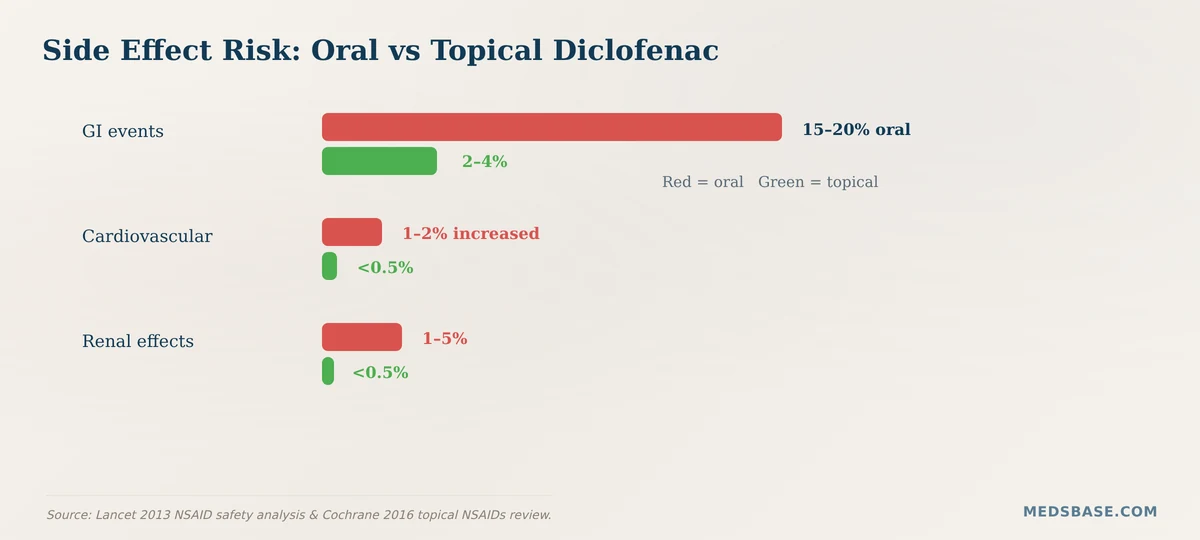
This is where the diclofenac gel vs oral diclofenac decision becomes practical. The form you choose should be driven by where your pain lives and how deep it is.
Conditions where choosing diclofenac gel vs oral diclofenac leads to gel winning:
- Knee osteoarthritis — The classic indication. The knee joint sits close to the surface, and gel penetrates effectively. A 2011 randomized controlled trial found topical diclofenac non-inferior to oral for knee OA over 12 weeks, with fewer GI events.
- Hand osteoarthritis — Hands are superficial and often affected by OA. Gel is preferred because it avoids systemic exposure in what is often a localized condition.
- Ankle and foot pain — Tendons, ligaments, and small joints of the ankle and foot respond well to topical application. Plantar fasciitis and Achilles tendinitis are common off-label uses.
- Elbow tendonitis — Tennis elbow and golfer’s elbow are superficial tendon conditions where topical diclofenac can reach the inflamed tissue.
- Soft tissue injuries — Sprains, strains, and contusions where the inflammation is in muscle or connective tissue near the surface.
Conditions where the diclofenac gel vs oral diclofenac decision favors tablets:
- Hip osteoarthritis — The hip joint sits too deep for topical penetration. Oral diclofenac is the appropriate form.
- Spinal pain — Disc herniation, spinal stenosis, and facet joint arthritis require systemic delivery. Topical cannot reach these depths.
- Widespread pain — Fibromyalgia, polyarticular gout, or generalized inflammatory arthritis (if NSAIDs are appropriate) require systemic treatment.
- Acute severe pain — Post-surgical pain or acute gout attacks where rapid, high-level systemic analgesia is needed.
- Internal inflammation — Bursitis of deep bursae, or inflammatory conditions involving internal organs.
The grey zone: Shoulder pain — the rotator cuff and glenohumeral joint sit at an intermediate depth. Some studies show benefit from topical diclofenac on the shoulder; others find oral more effective. Either form can work; individual anatomy and preference often determine the choice.
Side Effects and Safety: Gel vs Oral
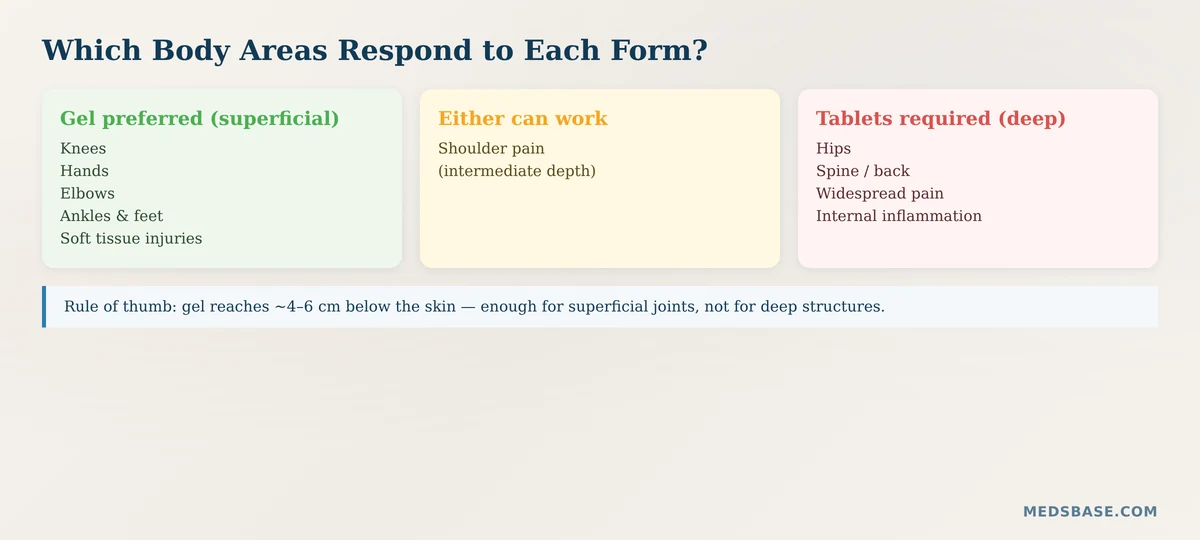
If there’s one reason to prefer diclofenac gel vs oral diclofenac, it’s safety. The side effect gap is substantial.
| Side effect category | Oral Diclofenac | Topical Diclofenac Gel | Risk Ratio |
|---|---|---|---|
| GI events (dyspepsia, ulcers, bleeding) | 15-20% | 2-4% | ~4-5× lower |
| Cardiovascular events (MI, stroke) | Modest increase (RR ~1.4) | Minimal increase (RR not significant at topical doses) | ~3-5× lower |
| Renal effects | 1-5% risk of renal impairment | <0.5% | ~5-10× lower |
| Liver enzyme elevation | 5-15% (usually mild) | <1% (minimal systemic absorption) | ~10× lower |
| Skin reactions | Not applicable | 5-10% (mild rash, pruritus — usually self-limiting) | Unique to topical |
| Drug interactions | Significant (warfarin, lithium, methotrexate, diuretics) | Minimal (low systemic levels) | Substantial difference |
The gastrointestinal risk difference in the diclofenac gel vs oral diclofenac equation stems from two mechanisms. First, oral diclofenac creates direct contact injury to the gastric mucosa. Second, systemic COX-1 inhibition reduces protective prostaglandins throughout the GI tract. Topical diclofenac bypasses both mechanisms — no stomach contact and minimal systemic COX-1 inhibition.
A safety analysis in The Lancet comparing NSAID risk profiles confirmed that the cardiovascular and GI risks of diclofenac are dose-dependent and primarily driven by systemic exposure. Topical administration, by keeping systemic levels at 6-8% of the oral equivalent, reduces these risks substantially.
That said, the diclofenac gel vs oral diclofenac safety comparison isn’t entirely one-sided — gel is not risk-free. People with pre-existing cardiovascular disease, renal impairment, or a history of GI bleeding should still consult their doctor before using topical diclofenac — the 6-8% systemic absorption is low but not zero. And topical diclofenac carries its own unique side effect: skin reactions at the application site, occurring in 5-10% of users. These are usually mild (redness, itching) and resolve when the gel is discontinued.
What the Research Says
| Study | Year | Finding | Source |
|---|---|---|---|
| RCT: topical vs oral for knee OA | 2011 | Topical diclofenac non-inferior to oral at 12 weeks for knee OA; 28% fewer GI events | Osteoarthritis Cartilage |
| Bioavailability comparison | 2009 | Topical diclofenac achieves therapeutic synovial fluid levels with 15-20× lower plasma levels vs oral | Br J Clin Pharmacol |
| Cochrane topical NSAIDs review | 2016 | Topical diclofenac effective for acute musculoskeletal pain; NNT = 4.6 for 50% pain reduction at 6-12 weeks | Cochrane Database |
| NSAID safety analysis | 2013 | Oral diclofenac associated with increased cardiovascular and GI risk vs naproxen and ibuprofen; risk is dose-dependent | Lancet |
| FDA prescribing info | 2023 | Topical systemic exposure 6% of oral; GI adverse events 2-4% vs 15-20% for oral | FDA |
What this means for you: The research consistently supports diclofenac gel as the safer first-line option for superficial joint pain, particularly for knee and hand osteoarthritis. The efficacy is comparable to oral diclofenac for these indications, while the safety advantage is substantial. For deep or widespread pain, oral diclofenac remains the evidence-based choice — but the lowest effective dose for the shortest necessary duration applies.
How to Use Each Form Correctly
The efficacy of diclofenac gel vs oral diclofenac depends partly on correct use. Many patients use both forms incorrectly, reducing benefit or increasing risk.
The right diclofenac gel vs oral diclofenac choice also depends on using each form correctly. Diclofenac gel — correct application:
- Clean and dry the affected area thoroughly — dirt or lotion creates a barrier
- Apply 2-4 grams of gel (use the dosing card included; a 2g strip is roughly the length of a cherry)
- Gently rub the gel into the skin over the painful joint — don’t massage aggressively
- Do NOT cover with an airtight bandage or wrap tightly; increased absorption can cause systemic side effects
- Wash hands immediately after application (unless treating hand joints, in which case wait 30 minutes before washing)
- Wait at least 10 minutes before applying clothing, sunscreen, or cosmetics over the treated area
- Apply 3-4 times daily, spacing doses by at least 4 hours
- Do NOT exceed 16g (eight 2g applications) per day for any single joint
Oral diclofenac — correct usage:
- Take with food or a glass of milk to reduce stomach irritation
- Swallow the tablet whole with a full glass of water — do not crush or chew
- Stay upright (sitting or standing) for at least 10 minutes after taking to prevent esophageal irritation
- Do not take other NSAIDs (ibuprofen, aspirin, naproxen) concurrently without your doctor’s OK
- Do not drink alcohol — it compounds the GI bleeding risk
- Take the lowest effective dose for the shortest possible time
- For extended-release tablets: take at the same time(s) each day; do not cut or crush
Can you use gel and oral together? Not without specific medical instruction. Combining both forms essentially gives you a higher systemic dose (via the gel’s 6-8% absorption added to the full oral dose), increasing your risks. In rare cases, a doctor may prescribe a bridging strategy (gel between oral doses), but this is not standard practice.
How to Choose: Decision Matrix
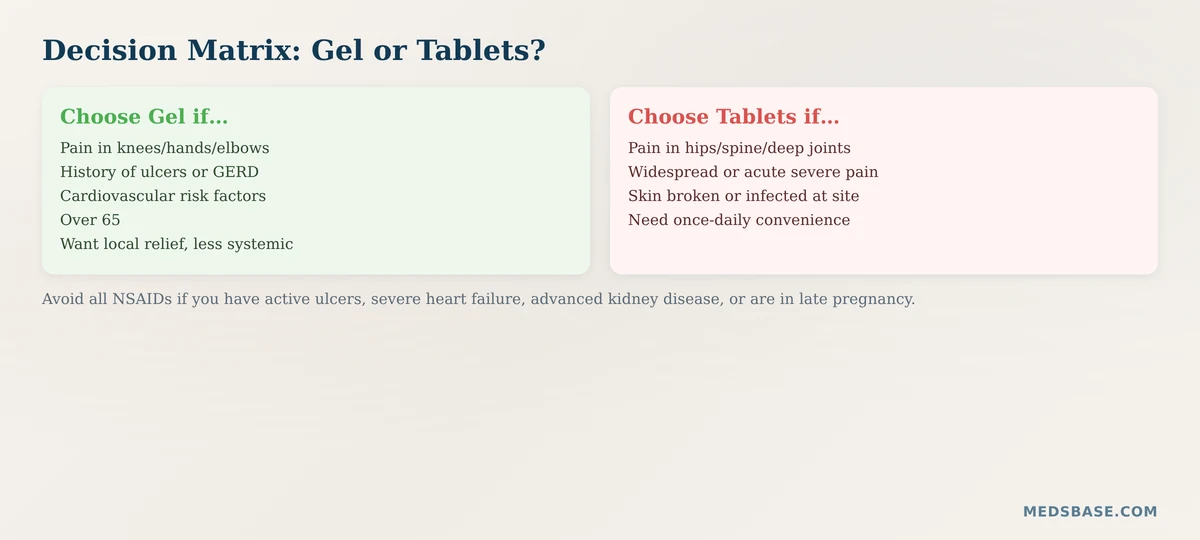
Use this evidence-based guide to the diclofenac gel vs oral diclofenac choice to decide between diclofenac gel vs oral diclofenac:
Choose gel if:
- Your pain is in the knees, hands, elbows, ankles, or feet (superficial joints)
- You have a history of stomach ulcers, gastritis, or GERD
- You have cardiovascular risk factors (hypertension, high cholesterol, family history of heart disease)
- You’re over 65 (higher GI and CV risk from oral NSAIDs)
- You’re taking other medications that interact with NSAIDs (blood thinners, lithium, methotrexate)
- You want sustained local relief without systemic exposure
- You need long-term treatment for a chronic localized condition like knee OA
In the diclofenac gel vs oral diclofenac decision, choose oral if:
- Your pain is in the hips, spine, or deep structures
- You have widespread pain affecting multiple body areas
- You need rapid systemic relief for acute severe pain
- Your skin at the pain site is broken, infected, or you have eczema/psoriasis there
- You need once-daily convenience (extended-release oral formulations exist)
- Your doctor has assessed your cardiovascular and GI risk and found oral NSAIDs appropriate
When the diclofenac gel vs oral diclofenac decision doesn’t apply — consider other options:
- If you have active stomach ulcers or GI bleeding — avoid all NSAIDs; discuss alternatives with your doctor
- If you have severe heart failure, advanced kidney disease, or are in your third trimester of pregnancy — NSAIDs are contraindicated
- If you need treatment during pregnancy (especially third trimester) — acetaminophen is generally the safer choice; consult your doctor
Frequently Asked Questions
Q: Is diclofenac gel as effective as oral diclofenac?
A: For superficial joint pain (knees, hands, elbows, ankles), yes — a 2011 trial found topical diclofenac non-inferior to oral at 12 weeks, with significantly fewer GI side effects. For deep joints (hips, spine) or widespread pain, oral diclofenac is more effective because the gel cannot penetrate deeply enough.
Q: Which is safer, diclofenac gel or oral tablets?
A: Diclofenac gel is considerably safer. GI side effects occur in 2-4% of gel users vs 15-20% of oral users. Cardiovascular risk is similarly reduced. However, gel is not risk-free — the 6-8% systemic absorption means some risk remains, especially with prolonged use on large body areas.
Q: How fast does diclofenac gel work?
A: Initial pain relief begins within 30-60 minutes, with peak local tissue concentrations at 2-4 hours. The onset is comparable to oral diclofenac, but the relief tends to be more sustained (6-12 hours vs 6-8 hours for standard-release oral).
Q: Can I use diclofenac gel and oral together?
A: Generally no — unless your doctor specifically instructs otherwise. Combining both adds the gel’s small systemic absorption to the full oral dose, increasing your cumulative NSAID exposure and risk. If you need more relief than one form provides, discuss dose adjustments or alternatives with your doctor rather than self-combining.
Q: Does diclofenac gel get into the bloodstream?
A: Yes, but minimally — approximately 6-8% of the applied dose reaches systemic circulation. This is enough to slightly increase NSAID risk if you’re using large quantities over large body areas, but it’s dramatically lower than the ~100% systemic absorption of oral diclofenac.
Q: What conditions is diclofenac gel best for?
A: Knee osteoarthritis is the best-studied and clearest indication. Hand OA, ankle/foot pain, elbow tendonitis, and soft tissue injuries (sprains, strains) also respond well. It is not appropriate for hip pain, spinal pain, or widespread pain conditions.
Q: Can I take diclofenac on an empty stomach?
A: It’s not recommended. Oral diclofenac should be taken with food or milk to reduce gastric irritation. Taking it on an empty stomach significantly increases the risk of dyspepsia and, with chronic use, ulcer formation.
Q: How long can I safely use diclofenac gel?
A: For acute injuries, use is typically 1-2 weeks. For chronic conditions like osteoarthritis, diclofenac gel can be used long-term provided it remains effective and no skin reactions develop. Follow the FDA and NHS recommendation to use the lowest effective dose for the shortest necessary duration, and have your doctor periodically reassess ongoing use.
The Bottom Line
The diclofenac gel vs oral diclofenac decision comes down to one core question: where is your pain, and how deep is it?
If it lives in a superficial joint — knees, hands, elbows, ankles — diclofenac gel gives you comparable pain relief to oral tablets with roughly 5-10× lower risk of GI, cardiovascular, and renal side effects. The evidence for this is robust and consistent across multiple high-quality studies.
If your pain is deep (hips, spine) or widespread, oral diclofenac is the appropriate choice in the diclofenac gel vs oral diclofenac decision — but at the lowest effective dose for the shortest necessary duration, always with food, and always under medical supervision.
For most people with knee or hand osteoarthritis — the most common reasons diclofenac is prescribed — starting with gel makes sense. If it works, you’ve spared yourself systemic NSAID exposure. If it doesn’t provide enough relief after 2-3 weeks of consistent use, oral diclofenac remains available as a next step.
Browse MedsBase pain management products for diclofenac and other pain relief options. For related comparisons, read our aspirin vs ibuprofen guide to understand where diclofenac fits in the NSAID family. If you’re dealing with nerve-related pain that NSAIDs won’t touch, see our complete gabapentin guide. Recovering from medication that disrupted your gut? Read about probiotics after antibiotics. And if you’re also managing changes from other medications, check our finasteride shedding phase guide.
Disclaimer: This article is for informational purposes only and does not constitute medical advice. Diclofenac is a medication that carries risks — including gastrointestinal bleeding, cardiovascular events, and renal impairment — that vary by individual. Never start, stop, or change your medication without consulting your doctor. If you experience black or bloody stools, severe stomach pain, chest pain, or signs of an allergic reaction, seek emergency medical attention.

Written by
Sophie ChenPharmaceutical Content Researcher · 8 years experience
Sophie Chen is a pharmaceutical content researcher with 8 years covering generic medication access and clinical pharmacology. She specialises in international regulatory frameworks, bioequivalence standards, and patient-facing education on therapeutic drug classes. She is not a clinician.