








✓ Medically reviewed by · Last reviewed: May 2026
Pharmacy Researcher · 8 years experience
Pharmacy researcher with 8 years reviewing clinical drug information, generic formulation equivalence, and international pharmaceutical standards. Focuses on patient-facing accuracy in medication education.
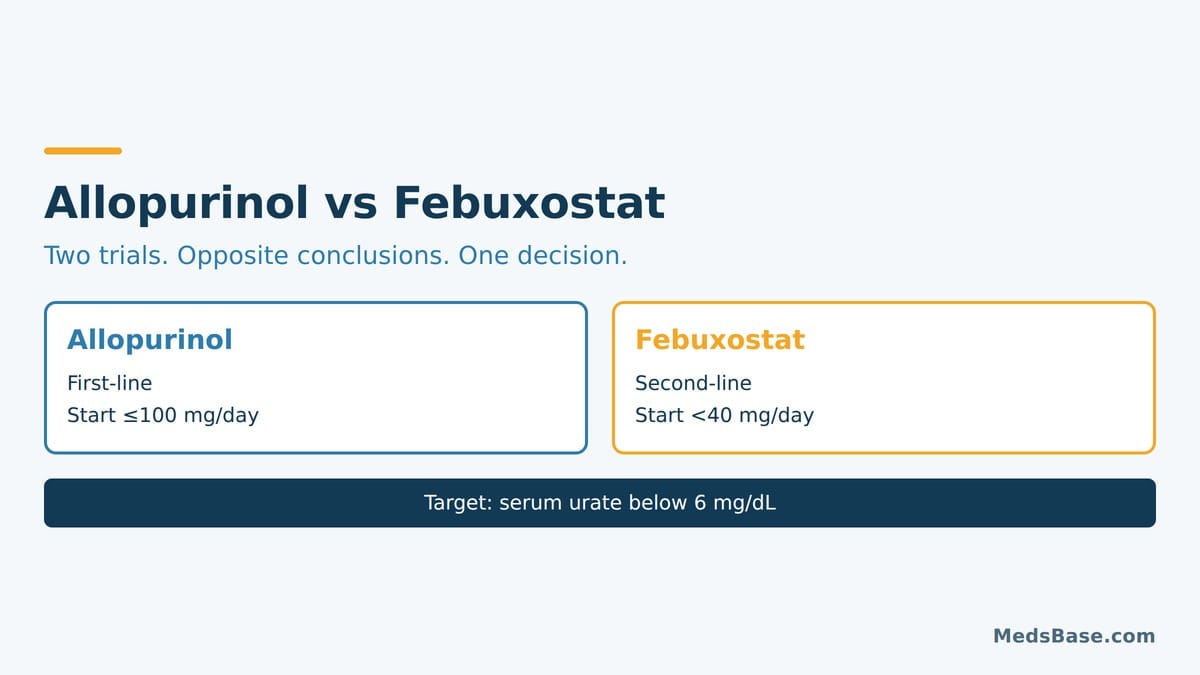
Most people comparing allopurinol vs febuxostat arrive having read one alarming sentence: a gout drug was linked to a higher risk of death. That is a real finding from a real trial, and it did lead to a warning on the label. What almost nobody mentions is that a second, larger, longer trial went looking for the same signal and did not find it.
By the end of this guide you will know what each trial actually measured, why two well-run studies reached opposite conclusions, and what the guidelines recommend once both are on the table. You will also see the practical difference that decides this choice for far more people than the heart question does — and it has nothing to do with your heart. We will get to it in the differences section.
- Both drugs block the same enzyme, so the choice is about safety and practicality, not potency.
- One major trial found higher mortality with febuxostat. A larger one found nothing of the kind. Both are quoted selectively.
- Guidelines name allopurinol first-line — and the reason includes kidney disease, where many people assume the opposite.
- The difference that actually decides this for most people is not cardiovascular at all.
- Whichever you take, the first few months come with a counter-intuitive catch that surprises nearly everyone who starts.
What Are Allopurinol and Febuxostat?
Allopurinol and febuxostat are urate-lowering therapies — daily medicines taken long-term to reduce the amount of uric acid in your blood, so that the crystals responsible for gout stop forming and existing deposits gradually dissolve. Neither treats an attack in progress. Both are prevention, and both work slowly and permanently rather than quickly and temporarily.
Allopurinol is the older of the two by decades and is by far the more widely used. Febuxostat is newer, chemically unrelated, and was developed as an alternative for people who could not take allopurinol. No prescription is needed to order either from MedsBase.com, and both come from WHO-GMP-certified manufacturers — but the choice between them genuinely benefits from a clinician who can see your kidney function and cardiac history.
The distinction that matters most before going further: these drugs are the only option in gout care that addresses the cause. Anti-inflammatories shorten attacks; urate-lowering therapy is what stops them recurring. If you are having frequent flares, this is the decision that changes your trajectory.
Both are judged against the same finish line. The American College of Rheumatology sets a treat-to-target strategy with a serum urate below 6 mg/dL, reached by titrating the dose upward with repeat blood tests rather than by fixing a dose at the start. So when you compare these two drugs, you are not comparing how much they lower urate — you are comparing how safely and reliably each gets you to the same number.
How Allopurinol and Febuxostat Work
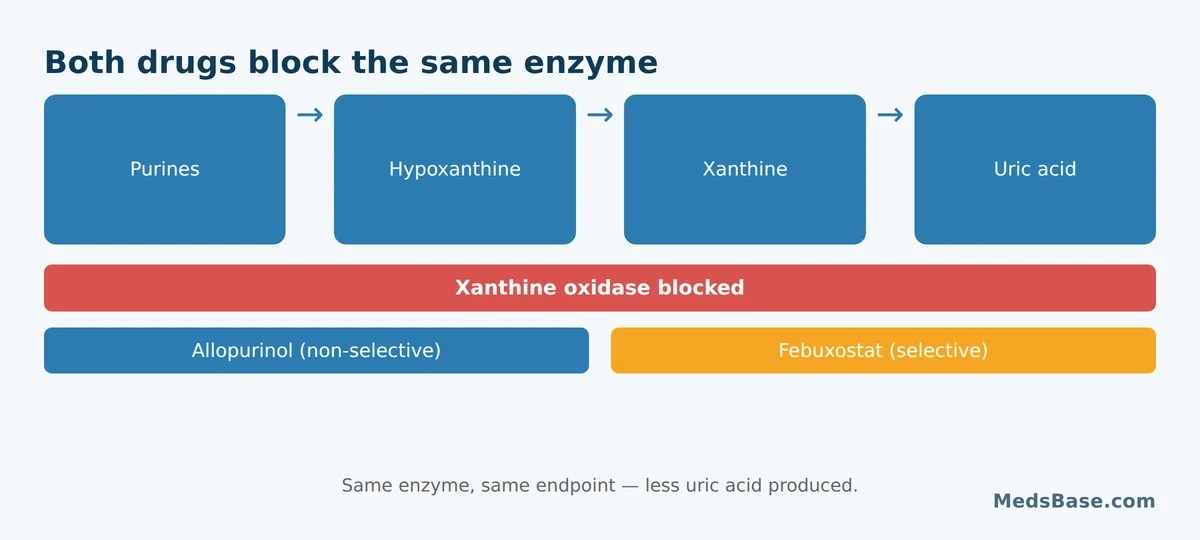
Think of uric acid production as a factory assembly line. Purines come in at one end; through a couple of steps they become hypoxanthine, then xanthine, then uric acid at the far end. A single enzyme — xanthine oxidase — runs the last two stages.
Both drugs jam that enzyme. As MedlinePlus’s allopurinol page puts it, allopurinol “works by reducing the production of uric acid in the body.” Febuxostat does the same job through a different chemical structure, blocking the enzyme more selectively.
That word selectively gets marketed harder than it deserves. Greater selectivity for one enzyme means fewer off-target effects on related enzymes in theory — but it does not automatically mean a safer drug in practice, and the trial evidence below is exactly why that distinction matters.
The practical consequence of the shared mechanism is that both take time. Uric acid falls within weeks, but dissolving crystal deposits that have accumulated over years takes many months. Neither drug produces a result you can feel — you confirm it with a blood test.
Key Differences: Allopurinol vs Febuxostat
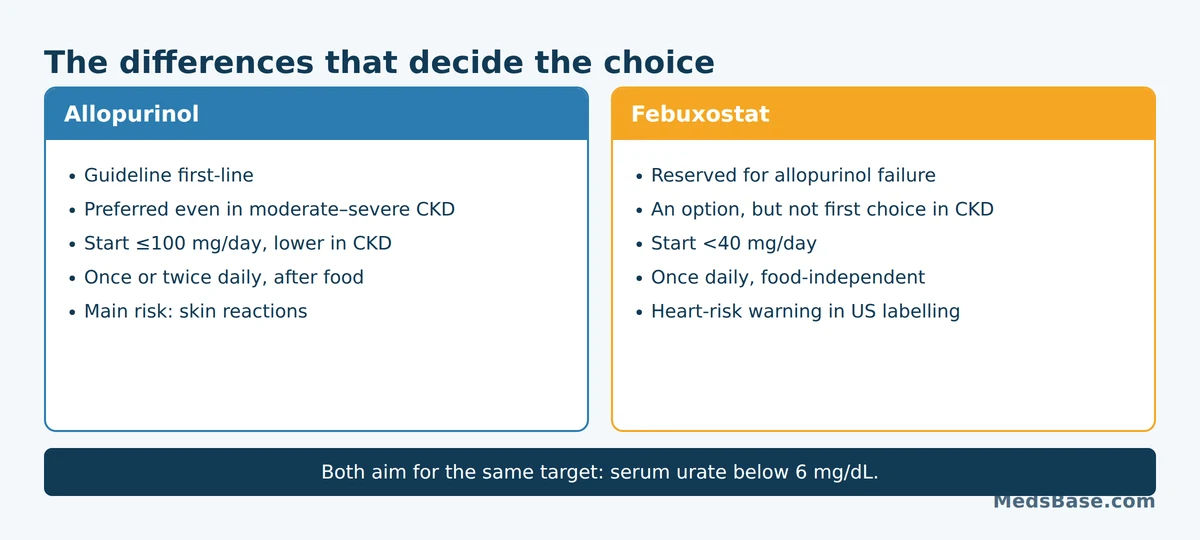
Here is the difference that decides this choice for more people than the cardiovascular question does, and it is a mundane one: kidney function and rash risk.
Many people assume that because allopurinol is cleared by the kidneys, febuxostat must be the kidney-friendly choice. The guideline says otherwise. The ACR recommends allopurinol as the preferred first-line urate-lowering therapy “including for those with moderate-to-severe chronic kidney disease” — with a lower starting dose, not a different drug.
| Allopurinol | Febuxostat | |
|---|---|---|
| Guideline position | Preferred first-line for almost everyone | Reserved for allopurinol failure or intolerance |
| Chronic kidney disease | Recommended, at a reduced starting dose | An option, but not the guideline’s first choice |
| Starting dose | ≤100 mg/day, lower in CKD, titrated upward | <40 mg/day, titrated upward |
| Daily routine | Once or twice a day, preferably after a meal | Once a day, with or without food |
| Main safety concern | Skin reactions, ranging from mild rash to rare severe reactions | Cardiovascular risk warning in US labelling |
| Serum urate target | Below 6 mg/dL | Below 6 mg/dL |
Allopurinol’s genuine drawback is skin reactions. MedlinePlus flags “rash, itching, or hives” and, more seriously, “peeling, blistering, or shedding skin” as reasons to seek immediate medical attention. Rare severe hypersensitivity reactions are the main reason people are moved off allopurinol — and they are the single most common route to febuxostat.
Febuxostat’s routine is slightly simpler: once daily, no relationship to meals, and dose escalation reviewed after about two weeks if uric acid is still too high. For someone whose adherence is the real obstacle, that convenience is not nothing.
For most readers the first-line answer applies, and MedsBase stocks allopurinol as Hyloric. If you are in the second-line situation — allopurinol tried and not tolerated — febuxostat is available as Febutaz in 40 mg and 80 mg strengths.
Allopurinol vs Febuxostat Safety, Side Effects and Dosing
| Concern | Allopurinol | Febuxostat | What to do |
|---|---|---|---|
| Skin rash | The signature risk; usually mild, rarely severe | Less prominent | Stop and seek advice immediately for any peeling, blistering or shedding skin |
| Cardiovascular | No comparable warning | Heart-risk warning in US labelling; use restricted to those not successfully treated with allopurinol | Disclose any heart attack, stroke or heart failure history before starting |
| Gout flares on starting | Common in the first months | Common in the first months | Anti-inflammatory cover for at least 3–6 months |
| Digestive upset, drowsiness | Nausea, diarrhoea, drowsiness reported | Generally well tolerated | Take allopurinol after food; report persistent symptoms |
| Kidney impairment | Lower starting dose required | Dose considerations apply | Dosing must be individualised — get advice |
Now the counter-intuitive catch flagged in the takeaways, and it is the single most common reason people abandon these drugs: starting urate-lowering therapy tends to trigger gout attacks.
MedlinePlus states it directly — allopurinol “may increase the number of gout attacks during the first few months that you take it, although it will eventually prevent attacks,” and a medicine such as colchicine is commonly given alongside to prevent them. The ACR guideline formalises this, strongly recommending concomitant anti-inflammatory prophylaxis for at least 3 to 6 months when starting.
The mechanism is almost cruel: as urate levels fall, existing crystal deposits begin to dissolve and shed crystals into the joint, which sets off exactly the inflammation you were trying to prevent. It means the drug is working. It also means that if nobody warns you, the natural conclusion is that the medicine failed — and people stop, right at the point it was starting to help.
Expect flares in the first months, plan cover for them, and do not read them as failure. This is the piece of information that most reliably determines whether someone is still on treatment a year later. If a flare does hit while you are starting out, our guide to gout attack treatment covers what to take alongside your daily tablet.
What Does the Research Say? CARES vs FAST
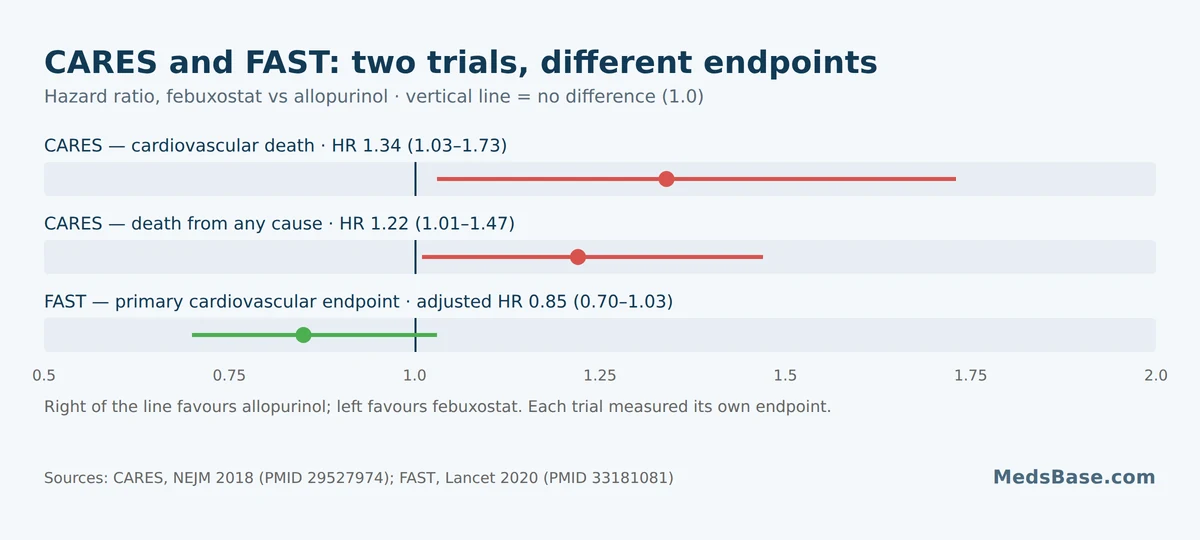
This is the heart of the comparison, and it deserves to be laid out properly rather than summarised to whichever conclusion suits.
| Trial | Year | Design | Headline finding | Source |
|---|---|---|---|---|
| CARES | 2018 | 6,190 people with gout and existing cardiovascular disease, randomised to febuxostat or allopurinol | Febuxostat was non-inferior on the primary combined cardiovascular endpoint (HR 1.03). But cardiovascular death was higher: HR 1.34 (95% CI 1.03–1.73), as was death from any cause: HR 1.22 (95% CI 1.01–1.47). | PMID 29527974 |
| FAST | 2020 | 6,128 people with gout, 3,063 febuxostat vs 3,065 allopurinol, median on-treatment follow-up ~3.6 years | Febuxostat was non-inferior on the primary cardiovascular endpoint: 1.72 vs 2.05 events per 100 patient-years, adjusted HR 0.85 (95% CI 0.70–1.03). No excess mortality signal. | PMID 33181081 |
| ACR guideline | 2020 | 42 recommendations, 16 strong | Allopurinol preferred first-line including moderate-to-severe CKD; target serum urate <6 mg/dL; start allopurinol ≤100 mg/day or febuxostat <40 mg/day; prophylaxis ≥3–6 months. | PMID 32391934 |
So why did two large trials disagree? Three reasons are worth understanding, because they change how much weight you should give each.
The populations differed. CARES enrolled only people who already had established cardiovascular disease — a group at high baseline risk, where a small difference produces more events. FAST enrolled a broader gout population. A signal in a high-risk group may simply not appear in a general one.
Follow-up and dropout differed. CARES had a high rate of participants discontinuing treatment and leaving follow-up, which complicates interpretation of deaths recorded afterwards. FAST followed participants for a median of roughly 3.6 years on treatment.
The endpoints were not identical. Both trials met non-inferiority on their primary combined endpoint. The mortality difference in CARES came from secondary analyses. Secondary findings from a trial that met its primary endpoint carry less weight than a primary result — but they are not nothing, especially when the outcome is death.
What this means for you: the honest position is that the cardiovascular question is unresolved rather than settled in either direction. Regulators responded to CARES by restricting febuxostat’s approved use — MedlinePlus describes it as indicated for “adults who were not treated successfully with or who are not able to take allopurinol” — and that restriction has not been reversed by FAST. If you have no cardiovascular history, the practical relevance of the CARES signal to you is limited. If you have had a heart attack, stroke or heart failure, it is a genuine reason to prefer allopurinol where possible.
Where evidence is mixed, saying so is more useful than picking a side. This is one of those cases.
Allopurinol vs Febuxostat: Which Should You Choose?
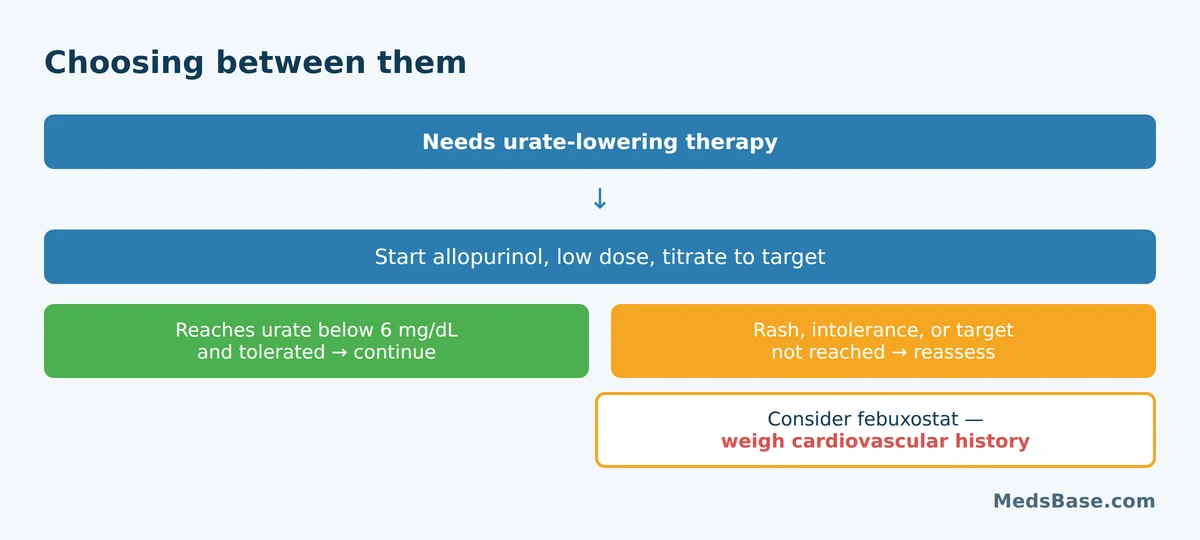
For most people: allopurinol, started low and titrated to target. The guideline backing is strong, it applies even in moderate-to-severe kidney disease, and it carries no cardiovascular warning. The ACR’s recommendation is not a narrow preference — allopurinol is named the preferred first-line agent for all patients with gout.
Consider febuxostat if allopurinol has genuinely been tried and found unsuitable. That means a rash or hypersensitivity reaction, another documented intolerance, or failure to reach a serum urate below 6 mg/dL on an adequately titrated dose. “I did not like taking it twice a day” is a reason to discuss adherence, not a reason to switch drug classes.
If you have established cardiovascular disease, weight the choice toward allopurinol. The CARES signal was found in exactly that population, and the labelling restriction reflects it. FAST offers real reassurance, but it did not erase the warning, and prudence in a high-risk group is reasonable rather than alarmist.
Whichever you choose, the target is the same and so is the discipline. Below 6 mg/dL, confirmed by blood tests, with anti-inflammatory cover for the first three to six months. A drug taken without checking whether it reached target is a habit, not a treatment.
How to Start Urate-Lowering Therapy — Practical Guidance
- Get a baseline serum urate. You cannot treat to target without knowing your starting number, and it is the measurement every later decision hangs on.
- Start low. Allopurinol at 100 mg a day or less, lower still with kidney impairment; febuxostat below 40 mg a day. Starting high increases flares without reaching target faster.
- Arrange anti-inflammatory cover from day one. At least three to six months of prophylaxis, per the guideline. This is the step most often skipped and most often regretted.
- Re-test and titrate. Repeat serum urate and increase the dose until you are consistently below 6 mg/dL. The dose that gets you there is individual.
- Take allopurinol after food; febuxostat can go with or without. Small detail, better tolerance.
- Report any rash immediately. Especially peeling, blistering or shedding skin — that is an urgent situation, not a wait-and-see one.
- Plan to continue. These are long-term treatments. Stopping usually allows urate to climb back and crystals to reform.
MedsBase carries both drugs plus the anti-inflammatory cover needed for those first months in its gout treatment range. What it cannot do is set your target dose — that comes from repeat blood tests and a clinician’s read of your kidney function.
- Treating a starting flare as proof the drug failed. It is usually proof it is working.
- Skipping prophylaxis to “keep it simple”. This is the leading cause of people abandoning treatment.
- Assuming febuxostat is the kidney-safe option. Guidelines put allopurinol first even in moderate-to-severe CKD.
- Switching to febuxostat after a low dose of allopurinol without titrating. Many “allopurinol failures” are under-dosed rather than genuinely unsuitable.
- Stopping either drug during a flare. Sudden urate shifts make flares worse.
- Never re-checking your serum urate. Without the number, you cannot know whether the treatment is doing its job.
- Gout attack treatment — what to take when a flare hits, including during those first months.
- Semaglutide for fatty liver — the metabolic company gout tends to keep.
- Best blood pressure medications — relevant because some blood pressure drugs raise uric acid.
Frequently Asked Questions
Q: Is febuxostat safer than allopurinol?
A: The evidence does not support that, and in one respect points the other way. The CARES trial found higher cardiovascular death (HR 1.34, 95% CI 1.03–1.73) and higher all-cause death (HR 1.22, 95% CI 1.01–1.47) with febuxostat compared with allopurinol in people who already had cardiovascular disease. The later, larger FAST trial did not reproduce that signal. Regulators restricted febuxostat’s use rather than withdrawing it, and guidelines still place allopurinol first. Allopurinol’s own main risk is skin reactions, which is a different kind of concern.
Q: Which is better for kidney disease, allopurinol or febuxostat?
A: Allopurinol, contrary to a widespread assumption. The 2020 ACR guideline recommends allopurinol as preferred first-line urate-lowering therapy including for people with moderate-to-severe chronic kidney disease — the adjustment is a lower starting dose, not a different drug. Starting doses in CKD go below the usual 100 mg a day, with slower titration. Febuxostat remains an option if allopurinol is unsuitable, but it is not the guideline’s kidney-specific answer.
Q: Why does febuxostat carry a heart-risk warning?
A: Because of the CARES trial. It was a post-approval safety study in over 6,000 people with gout and existing cardiovascular disease. Febuxostat met the primary non-inferiority endpoint, but analysis of the individual outcomes showed higher cardiovascular death and higher death from any cause than allopurinol. Regulators responded by adding a warning and limiting the approved use to adults not successfully treated with, or unable to take, allopurinol. The later FAST trial did not find the same signal, but the restriction remains.
Q: Can you switch from allopurinol to febuxostat?
A: Yes, and that is exactly the situation febuxostat is intended for — people who developed a rash or hypersensitivity on allopurinol, who could not tolerate it for another documented reason, or who did not reach a serum urate below 6 mg/dL on a properly titrated dose. The switch should be planned with a clinician, with anti-inflammatory cover in place, because any change in urate levels can provoke flares. Before switching, it is worth confirming the allopurinol dose was actually titrated rather than left at the starting dose.
Q: What uric acid level should I aim for?
A: Below 6 mg/dL. The ACR guideline strongly recommends a treat-to-target strategy with dose titration guided by repeat serum urate measurements, and that threshold is the standard target. Some people with heavy crystal deposits are given a lower target. The key point is that the target is a blood test result, not a dose — two people can need very different doses of the same drug to get to the same number, which is why re-testing matters more than which drug you started on.
Q: Do you have to take urate-lowering therapy forever?
A: For most people with recurrent gout, yes — it is a long-term treatment. Uric acid rises again after stopping and crystals reform, so flares typically return. The ACR recommends starting it for people with frequent flares, tophi, or radiographic joint damage, and those are situations that do not resolve on their own. Some people whose urate is driven by a removable cause, such as a particular medication, may be able to revisit the question with their doctor. That is a decision to make with test results, not a self-directed trial.
Q: Do these drugs stop a gout attack?
A: No, and this catches people out. Allopurinol and febuxostat are prevention — they lower uric acid over weeks and months so crystals stop forming. They do nothing for the inflammation of an attack already underway, and starting one mid-flare without anti-inflammatory cover can prolong it. Attacks are treated separately with NSAIDs, low-dose colchicine or corticosteroids. If you are already established on a urate-lowering drug, keep taking it through a flare and treat the flare alongside it.
Q: How long before I notice a difference?
A: Uric acid starts falling within weeks, but you will not feel that. What you are waiting for is fewer flares, and that typically takes months as accumulated crystal deposits slowly dissolve — often six months or longer, and longer still if you have visible deposits. Frustratingly, the early phase often brings more flares rather than fewer. Progress is measured by your serum urate number, not by how you feel, which is exactly why repeat testing is part of the treatment rather than optional.
The Bottom Line
On allopurinol vs febuxostat, the balanced verdict is clear even though the underlying evidence is not. Both block the same enzyme and aim at the same target of a serum urate below 6 mg/dL. Guidelines put allopurinol first for almost everyone, including people with moderate-to-severe kidney disease, and febuxostat second, for those who cannot take allopurinol or do not reach target on it.
The cardiovascular question that dominates search results is genuinely unsettled. CARES found higher cardiovascular and all-cause mortality with febuxostat in people who already had heart disease; FAST, larger and longer, found nothing comparable. If you have no cardiovascular history, that debate has limited bearing on you. If you do, it is a fair reason to prefer allopurinol.
And the thing that will most affect whether this works for you is not the drug at all. It is titrating to target, and covering the first three to six months against the flares that starting treatment provokes.
The one thing to do next: ask for your serum urate number and write it down. Without a baseline, neither drug can be titrated properly, and treatment becomes a guess.
Not sure what to take when a flare hits while you are getting established on treatment? Read gout attack treatment. Wondering what else your metabolic profile might be driving quietly in the background? Semaglutide for fatty liver covers a condition that keeps gout frequent company.

Written by
Sophie ChenPharmaceutical Content Researcher · 8 years experience
Sophie Chen is a pharmaceutical content researcher with 8 years covering generic medication access and clinical pharmacology. She specialises in international regulatory frameworks, bioequivalence standards, and patient-facing education on therapeutic drug classes. She is not a clinician.