








✓ Medically reviewed by · Last reviewed: May 2026
Pharmacy Researcher · 8 years experience
Pharmacy researcher with 8 years reviewing clinical drug information, generic formulation equivalence, and international pharmaceutical standards. Focuses on patient-facing accuracy in medication education.
Most people think the FDA just “banned” or “approved” peptides last week. Neither happened. FDA peptide compounding took a real step forward on July 23–24, 2026 — but it was a step, not a finish line. An advisory committee reviewed seven peptides and voted on whether they belong on a special list that pharmacies can compound from. That vote made headlines. It did not change a single line of law.
Here’s the payoff: by the end of this piece you’ll know exactly what the vote decided, why the FDA’s own scientists disagreed with the panel, which seven peptides were on the table, and what any of it means for the peptides you already use. You’ll also get the part most headlines skip — how thin the human evidence really is. That honesty matters, and it’s the thread we’ll pull all the way through. So did anything actually get banned? Keep reading, because the answer surprises almost everyone.
- FDA peptide compounding advanced via an advisory vote on July 23–24, 2026 — advisory means non-binding, so nothing changed in law that day.
- Seven peptides were reviewed: BPC-157, KPV, TB-500 and MOTS-c on day one; DSIP (delta sleep-inducing peptide), Semax and Epitalon on day two.
- The FDA’s own career scientists recommended against adding all seven. The advisory committee disagreed and voted in favour of several, including BPC-157 (roughly 8–6–1).
- Placement on the 503A bulks list still needs a separate final FDA decision. The vote is a recommendation, not a rule.
- Human evidence for these peptides is thin — mostly animal and lab studies. For BPC-157, a 2025 review found only 1 clinical study among 36.
- Five more peptides are expected at a later meeting, likely before the end of February 2027.
What Is FDA Peptide Compounding?
Compounding is old and ordinary. It’s when a pharmacist mixes, adjusts, or prepares a medication for one person — say, a liquid version for someone who can’t swallow pills, or a formula without a dye you’re allergic to. The FDA describes this in its own compounding Q&A, and it’s legal and common.
Peptides make this more complicated. A peptide is a short chain of amino acids — a small protein fragment your body already uses for signalling. Because most of the popular research peptides aren’t FDA-approved finished drugs, the only routes into a pharmacy are narrow. That’s where “FDA peptide compounding” as a policy question comes in: the agency has to decide, peptide by peptide, whether a compounding pharmacy may legally use the raw ingredient at all.
That decision runs through a list. And in July 2026, an advisory committee spent two days debating which peptides deserve a spot on it.
Why does FDA peptide compounding get its own debate at all? Because peptides sit in an awkward middle. They’re too complex to wave through like a simple generic chemical, yet most aren’t finished, approved drugs either. So the FDA peptide compounding question becomes the agency asking, one molecule at a time, whether a pharmacy should be trusted to prepare it for real patients when the usual approval scaffolding isn’t there.
How FDA Peptide Compounding Works
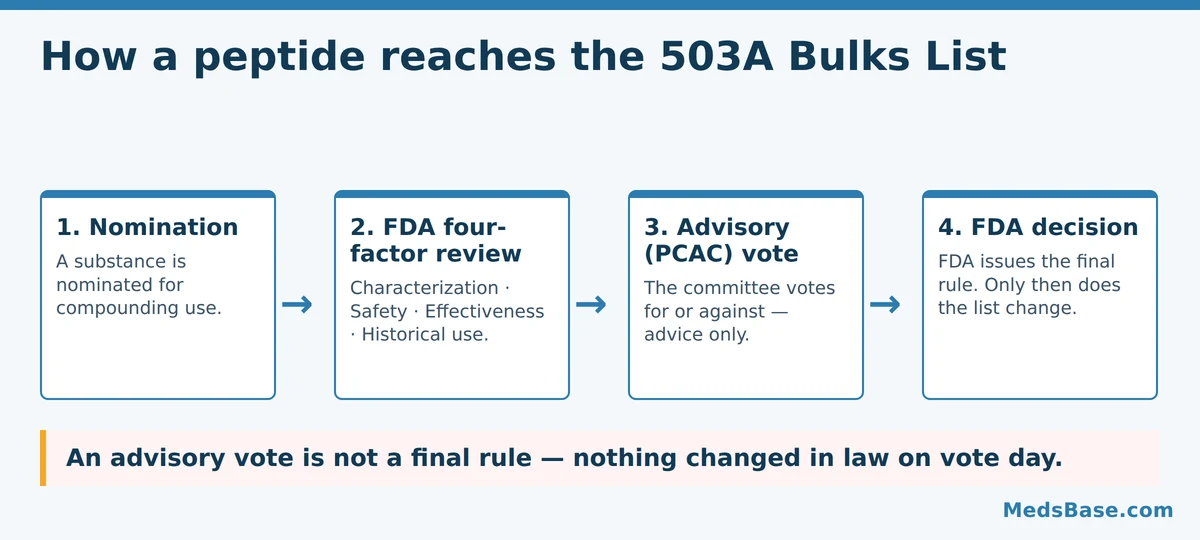
The system rests on two sections of federal law, and the difference between them matters more than it sounds.
Section 503A covers traditional compounding: a pharmacy makes a preparation for an individual patient, tied to that patient’s prescription. Think one bottle, one person. Section 503B covers registered outsourcing facilities — larger operations that produce bigger batches under stricter manufacturing oversight, often for clinics and hospitals. One is bespoke; the other is bulk.
Both rely on the same gatekeeper: the bulk drug substances list. This is the roster of raw active ingredients a pharmacy is permitted to compound with when there’s no FDA-approved product to start from. The 503A bulks list is the one everyone was watching in July. If a peptide isn’t on it, a 503A pharmacy generally can’t compound with the raw ingredient — full stop.
So how does a peptide get on the list? The FDA weighs a four-factor framework for every nominated substance:
- Physical and chemical characterization — can the substance be reliably identified, measured, and standardized? Is it a stable, well-defined molecule?
- Safety concerns — what’s known about its risks, impurities, and side effects?
- Evidence of effectiveness — is there real evidence it works for a use, or is that evidence largely missing?
- Historical use in compounding — has it actually been compounded and used before, including references in peer-reviewed literature?
Here’s the part people miss: these aren’t a checklist where three out of four wins. The FDA balances all four together, substance by substance. A peptide can look chemically tidy and still be turned away because factors two and three — safety and human effectiveness — come up short.
An advisory committee — the Pharmacy Compounding Advisory Committee (PCAC) — reviews the evidence in public and recommends. But recommending isn’t deciding. The FDA can accept, modify, or reject what the panel suggests. Hold onto that distinction; it’s the crux of everything that happened next.
None of this happens behind closed doors. The FDA peptide compounding process is deliberately public — nominations, briefing documents, and the meeting itself are all on the record. That’s how we can say plainly that agency staff opposed all seven: their conclusions were published before the panel ever raised a hand. Both sides worked from the same four factors; they simply weighed the evidence differently.
Key Uses: The 7 Peptides the FDA Reviewed
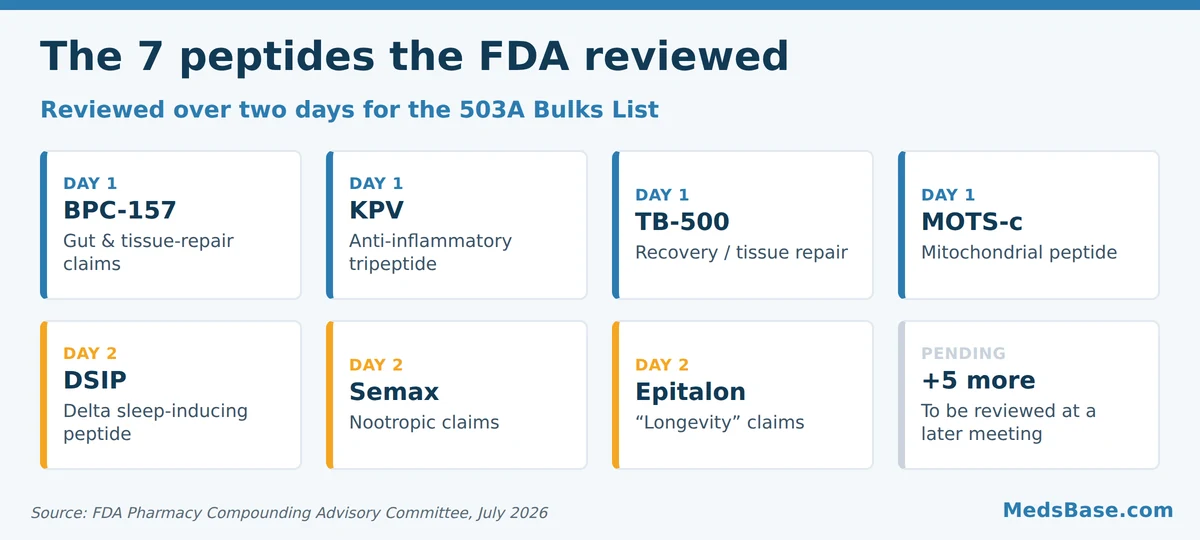
Across two days, the PCAC meeting on July 23–24, 2026 worked through seven nominated peptides — the heart of the current FDA peptide compounding debate. Here’s the honest rundown of each and what it’s commonly claimed to do — with the reminder that “commonly claimed” is not the same as “proven.”
Day one: BPC-157, KPV, TB-500, MOTS-c
BPC-157 is the headliner. It’s a synthetic peptide derived from a protein found in gastric juice, popular for claims around tendon, ligament, and gut healing. It drew the most attention — and the most favourable committee vote. If you want the deeper dive on the science and the hype, our BPC-157 healing and recovery guide walks through it without overselling.
KPV is a tiny three-amino-acid fragment related to a hormone your body uses to dampen inflammation. Interest centres on gut and skin inflammation. It also drew a favourable committee vote. Our KPV anti-inflammatory guide covers what the early research actually shows.
TB-500 is a synthetic version of a region of thymosin beta-4, a protein tied to cell migration and tissue repair. It’s marketed for recovery and healing, and it too received a favourable committee vote.
MOTS-c is a mitochondrial-derived peptide studied mostly in metabolic and exercise contexts. Its human evidence is early, and it did not draw the same favourable committee outcome as the three above.
Day two: DSIP, Semax, Epitalon
DSIP — delta sleep-inducing peptide, also called emideltide — has been studied on and off since the 1970s for sleep and stress, but with small, dated, and inconsistent human data.
Semax was developed in Russia and is used there in cognitive and neurological contexts; most of its human research sits outside the standard FDA evidence base.
Epitalon is promoted around ageing and “longevity” claims. Its supporting studies are small and largely preclinical, with no rigorous large trials to lean on.
And the FDA peptide compounding review isn’t finished. Beyond these seven, roughly five more peptides are already queued for a later PCAC meeting — expected before the end of February 2027 — so the roster of what’s under consideration will keep growing over the coming months.
MedsBase supplies these as research-grade peptides, not compounded pharmaceuticals and not approved medicines. If you want to see which are stocked, you can browse our research-grade peptides — no prescription needed — just remember that “available” and “clinically proven” are two different things.
FDA Peptide Compounding: Safety, Side Effects & the Evidence Gap
Now to resolve the loop from the intro — and it sits at the centre of the whole FDA peptide compounding story: did anything actually get banned? No. But the reason the FDA’s scientists said no to all seven is the same reason you should stay clear-eyed — the human safety and effectiveness data is genuinely thin. That’s not a scare tactic; it’s the state of the evidence.
Here’s an honest snapshot. “Human evidence level” below reflects how much published human clinical research exists — not how popular a peptide is online.
| Peptide | Commonly claimed use | Human evidence level | Key safety note |
|---|---|---|---|
| BPC-157 | Tendon, ligament & gut healing | Very low — mostly animal/lab; ~1 clinical study | No completed, published RCTs as of 2026 |
| KPV | Gut & skin inflammation | Low — mainly preclinical | Limited human safety data |
| TB-500 | Recovery & tissue repair | Low — preclinical, some early human signals | Long-term human safety not established |
| MOTS-c | Metabolic & exercise support | Very low — early human work | Little published side-effect data |
| DSIP | Sleep & stress | Low — small, dated human studies | Inconsistent, hard-to-replicate results |
| Semax | Cognitive/neurological | Low outside its region of origin | Not evaluated in standard FDA trials |
| Epitalon | “Longevity”/ageing | Very low — small preclinical studies | No rigorous large human trials |
The pattern is unmistakable: interest is high, human proof is low. That gap is exactly what factors two and three of the four-factor test are built to catch. It’s also why buying peptides should come with sober expectations rather than headline hype — and why verifying what you actually receive matters as much as the peptide’s reputation. In short, the FDA peptide compounding debate isn’t really about whether these peptides are exciting — it’s about whether the human proof has caught up to the excitement yet. It mostly hasn’t.
What Does the Research Say About Peptide Compounding?
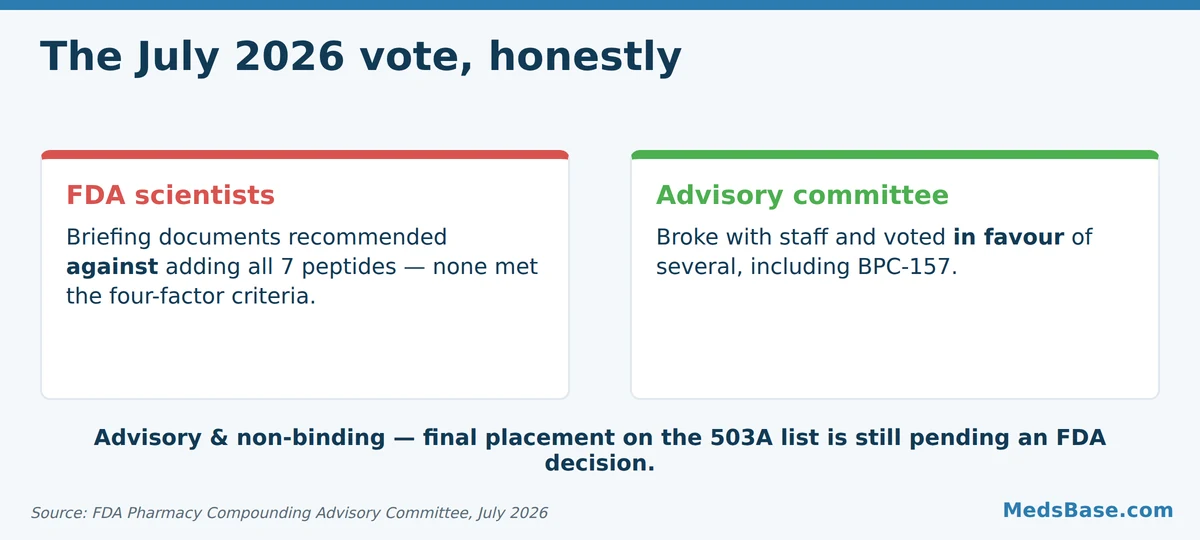
Let’s put real dates and sources under the FDA peptide compounding claims, because vague reassurance helps no one.
| Item | Year | Finding | Source |
|---|---|---|---|
| PCAC advisory vote | 2026 | Panel voted in favour of several peptides (incl. BPC-157) despite FDA staff opposition; advisory only | FDA PCAC meeting page |
| FDA staff briefing view | 2026 | Career scientists concluded none of the seven clearly met the four-factor criteria | FDA PCAC meeting page |
| BPC-157 systematic review | 2025 | 544 abstracts screened, 36 studies included — 35 preclinical, only 1 clinical; authors urge caution | HSS J (PMID 40756949) |
| Next peptide review | Expected | ~5 additional peptides slated for a later PCAC meeting, likely before end of Feb 2027 | FDA PCAC process |
That 2025 systematic review is worth sitting with. Researchers looking specifically at BPC-157 in orthopaedic sports medicine screened hundreds of papers and found essentially one clinical study among dozens of animal and lab reports — and they explicitly recommended caution because clinical safety data were missing. You can read the peer-reviewed review on PubMed yourself.
Notice the tension the vote exposed. The FDA’s own scientists, reading the same evidence, recommended against all seven. The advisory committee looked at the mix of chemistry, tradition, and demand and voted differently on several. Both can be “right” within their roles — the panel advises on the balance; the staff flags the evidence gaps. Early studies indicate potential; they do not equal proof.
That’s the honest core of the FDA peptide compounding story: high interest, thin human proof, and a regulatory system trying to weigh both without overpromising.
What this means for you: treat every one of these peptides as promising-but-unproven, price your expectations accordingly, and never mistake an advisory vote for a clinical green light.
Compounded vs Research-Grade vs Approved: What’s the Difference?
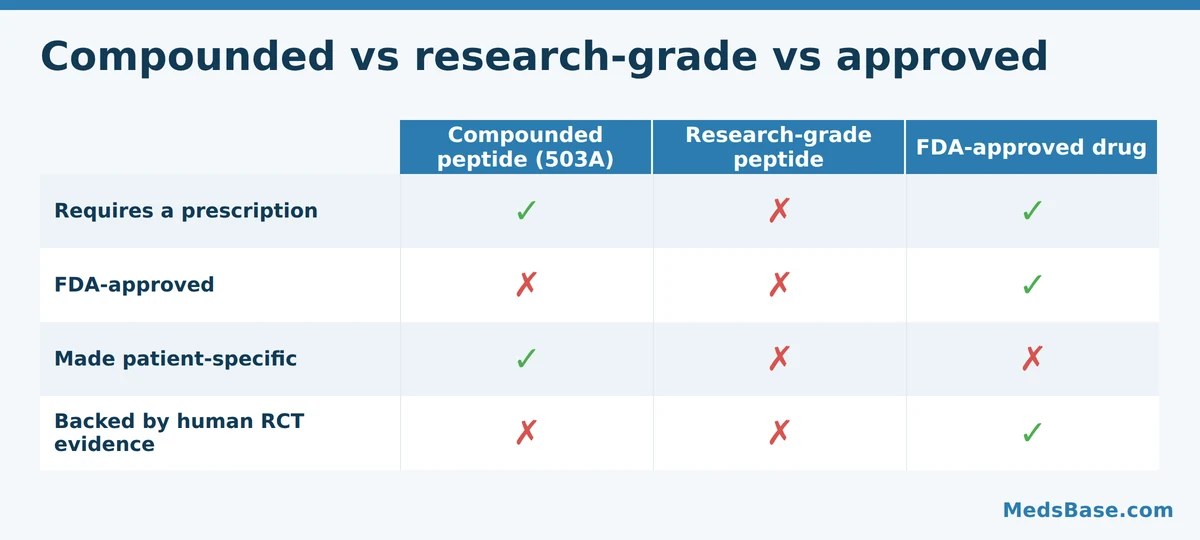
This is where a lot of the FDA peptide compounding anxiety comes from — people blur three very different categories into one. They aren’t the same, and knowing which is which tells you what protections you do and don’t have.
| Compounded peptide (503A, if listed) | Research-grade peptide | FDA-approved drug | |
|---|---|---|---|
| Requires a prescription | Yes | No | Yes |
| FDA-approved product | No (compounded, not approved) | No | Yes |
| Made patient-specific | Yes | No | No (mass-produced) |
| Backed by human RCT evidence | Usually limited | Usually limited | Yes (required) |
Which is which — the plain verdict. A compounded peptide is prepared by a pharmacy for one named patient, and only if the ingredient is on the bulks list. A research-grade peptide is a compound sold for research use — this is the category MedsBase supplies, with no prescription needed and no claim of FDA approval. An FDA-approved drug has cleared human trials for a specific use. None of the seven peptides in the FDA peptide compounding vote are FDA-approved drugs. If a seller implies their peptide is “FDA-approved” or a finished pharmaceutical, that’s a red flag. What you can control is verifying purity and identity — our guide to reading a peptide COA shows you how to check a certificate of analysis before you trust a vial.
What the Vote Means for You — Practical Guidance
If you use or research peptides, here’s how to act on the FDA peptide compounding news without panic-buying or panic-dumping.
- Understand that nothing is banned right now. The advisory vote didn’t remove access to anything. Research-grade peptides remain available, no prescription needed, exactly as before.
- Don’t read the favourable votes as approval. A committee recommending BPC-157 for the bulks list is not the FDA declaring it safe and effective. Final placement needs a separate FDA decision.
- Expect a slow timeline. Regulatory decisions lag votes by months, sometimes longer. Five more peptides are expected at a later meeting, likely before the end of February 2027 — the FDA peptide compounding timeline runs in months, not days. This is a process, not a switch.
- Verify what you buy, every time. Since human data is thin, your best protection is knowing the contents are what the label says. Check the COA; check storage and handling.
- Match your expectations to the evidence. Use qualifying language in your own head: “research suggests,” not “this will fix me.”
What to watch next. The signal that actually matters isn’t the vote — it’s the FDA’s follow-up. Keep an eye on the 503A bulks list itself: if and when the agency formally adds (or declines) a peptide, that’s the moment access could genuinely shift for compounding pharmacies. Advisory votes make headlines; the bulks list makes the rules. Until the FDA peptide compounding decision is published, treat everything as provisional.
- Panic-buying “before the ban.” There is no ban to beat.
- Reading advisory as final. Advisory votes are recommendations, not rules.
- Trusting a “pharmaceutical-grade / FDA-approved” peptide claim. None of these seven are approved drugs; that wording is a warning sign.
- Ignoring the COA. Reputation doesn’t verify purity — a certificate of analysis does.
- Assuming animal results transfer to people. Most of this evidence is preclinical.
When you’re ready to compare what’s stocked, you can browse our research-grade peptides — just carry the same honesty about the evidence that this whole article has.
Frequently Asked Questions
Q: Are peptides like BPC-157 now legal or banned after the FDA vote?
A: Neither changed. The July 23–24, 2026 vote was advisory and non-binding — it didn’t ban or approve anything. BPC-157 and the other reviewed peptides sit exactly where they did before the meeting. Research-grade peptides remain available with no prescription needed. Any final change to the 503A bulks list requires a separate FDA determination that hadn’t happened as of the vote — so the FDA peptide compounding rules you operated under before the meeting still apply.
Q: What is the 503A bulks list?
A: It’s the FDA’s roster of raw active ingredients that traditional pharmacies (under Section 503A) are allowed to compound with when there’s no FDA-approved product to start from. If a peptide’s ingredient isn’t on the list, a 503A pharmacy generally can’t compound with it. It’s the single most important document in the whole FDA peptide compounding debate — and the July vote was about whether seven peptides should be added to it.
Q: Did the FDA approve BPC-157?
A: No. An advisory committee voted in favour of recommending BPC-157 for the compounding bulks list (roughly 8 in favour, 6 against, 1 abstention). That is a recommendation about compounding eligibility — not FDA approval as a drug, and not a finding that it’s proven safe and effective. BPC-157 is not an FDA-approved drug.
Q: Which peptides did the FDA advisory committee review?
A: Seven, over two days. Day one: BPC-157, KPV, TB-500, and MOTS-c. Day two: DSIP (delta sleep-inducing peptide, also called emideltide), Semax, and Epitalon. About five more peptides are expected at a later meeting.
Q: Is TB-500 on the FDA bulks list?
A: Not automatically. TB-500 received a favourable advisory-committee vote, but a favourable vote is a recommendation, not final placement. Adding TB-500 to the 503A bulks list still needs a separate FDA decision, which hadn’t been finalized at the time of the meeting.
Q: Why did the FDA’s own scientists disagree with the committee?
A: The agency’s career scientists reviewed the four-factor evidence and concluded that none of the seven clearly met the criteria — mainly because human effectiveness and safety data are thin. The advisory committee weighed the same factors differently and favoured several. The staff flag evidence gaps; the panel advises on the overall balance. The FDA makes the final call on any FDA peptide compounding decision.
Q: How strong is the human evidence for these peptides?
A: Honestly, it’s limited. Most support is preclinical — animal and lab studies. For BPC-157, a 2025 systematic review found only one clinical study among 36 included papers. Early studies indicate potential, but “potential” isn’t “proven.” Treat these as research compounds, not established treatments.
Q: Can I still buy research-grade peptides without a prescription?
A: Yes. Research-grade peptides are a separate category from compounded or FDA-approved medicines, and nothing in the FDA peptide compounding vote restricted them. No prescription is needed. The smart move is to verify identity and purity via a certificate of analysis before you buy.
The Bottom Line on FDA Peptide Compounding
Here’s the balanced verdict. FDA peptide compounding moved a step forward on July 23–24, 2026, when an advisory committee broke with the agency’s own scientists and voted in favour of several peptides — BPC-157 among them. But “advisory” is the load-bearing word: nothing was banned, nothing was approved, and the raw human evidence for these compounds remains thin. A final decision on the 503A bulks list still sits ahead, with more peptides due for review before the end of February 2027.
Your immediate action is simple: don’t panic, and verify before you trust. If you buy peptides, learn to read the paperwork that proves what’s in the vial — start with how to read a peptide COA. And if you want the deeper science behind the headliner, our BPC-157 healing and recovery guide gives you the evidence without the spin. Browse the research-grade peptides when you’re ready — with clear eyes about what the science does and doesn’t yet show. Whatever the FDA peptide compounding rules ultimately become, that clarity is what protects you.

Written by
Sophie ChenPharmaceutical Content Researcher · 8 years experience
Sophie Chen is a pharmaceutical content researcher with 8 years covering generic medication access and clinical pharmacology. She specialises in international regulatory frameworks, bioequivalence standards, and patient-facing education on therapeutic drug classes. She is not a clinician.