








✓ Medically reviewed by · Last reviewed: May 2026
Pharmacy Researcher · 8 years experience
Pharmacy researcher with 8 years reviewing clinical drug information, generic formulation equivalence, and international pharmaceutical standards. Focuses on patient-facing accuracy in medication education.
microdosing GLP-1 medications — Microdosing GLP-1 Medications for Weight Loss. Read on for an evidence-backed guide covering everything you need to know.
Hero Intro
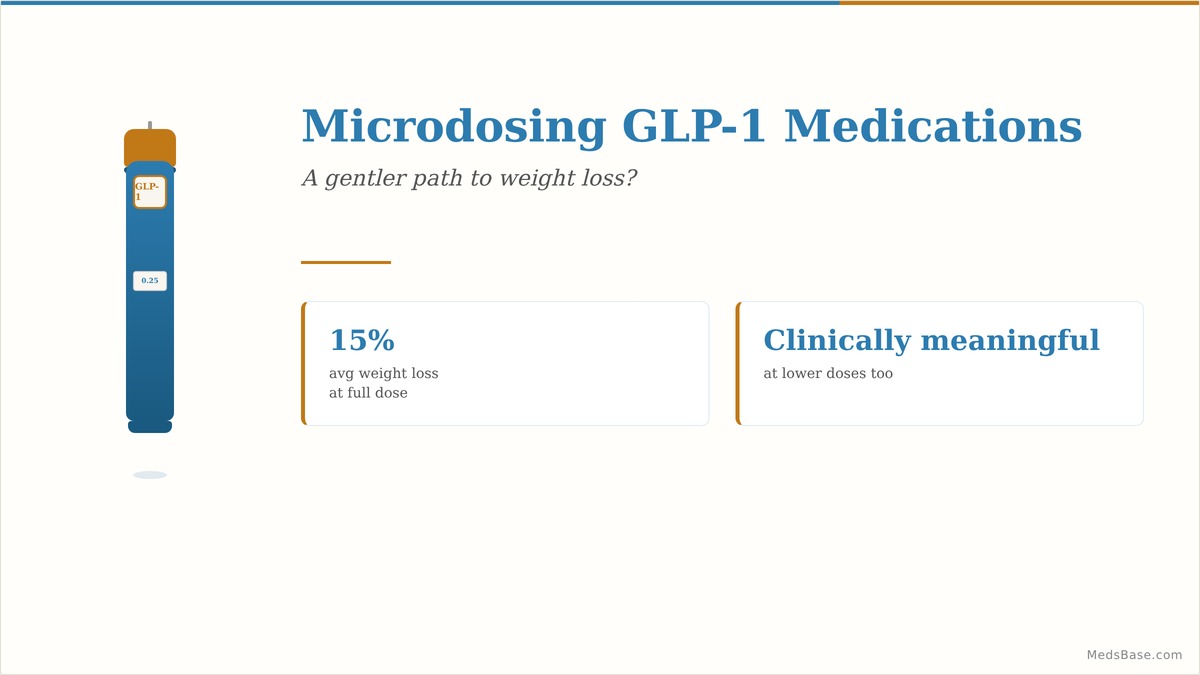
In 2021, a landmark study found semaglutide helped people lose an average of 14.9% of their body weight — a result that transformed obesity medicine overnight. But here’s what most headlines missed: even people on the lower titration doses, well before reaching the maximum, were already losing clinically meaningful weight. That observation has sparked one of the fastest-growing conversations in weight management today: microdosing GLP-1 medications.
This guide will walk you through everything you need to know about microdosing GLP-1 medications — what the existing evidence actually says, who might benefit, how the side-effect picture changes at lower doses, and the practical conversation you should have with your doctor. By the end, you will understand whether this gentler approach fits your goals.
One detail surprises nearly everyone who asks about microdosing GLP-1 medications — we will get to it in the safety section.
Key Takeaways
- Microdosing GLP-1 medications means staying at the lowest dose that produces results rather than titrating to the maximum — and early evidence suggests this can still produce 5–12% body weight loss
- The main advantage is fewer gastrointestinal side effects — the reason up to 15% of patients discontinue standard-dose GLP-1 treatment
- Microdosing is NOT the same as compounding pharmacy products — understanding this distinction is critical for safety (we cover it in detail below)
- Weight loss at lower doses is slower but more sustained for some patients — particularly those who are side-effect-sensitive
- No major clinical trial has been designed specifically to test a microdosing protocol — the evidence is indirect but clinically meaningful
- You must discuss microdosing GLP-1 medications with your prescribing doctor — self-directed dose manipulation is dangerous
- What Are Microdosing GLP-1 Medications?
- How Do GLP-1 Medications Work?
- Key Uses: Who Benefits From Microdosing GLP-1 Medications?
- Safety Profile, Side Effects & Dosing
- What Does the Research Say?
- Microdosing GLP-1 Medications vs Alternatives
- How to Start Microdosing GLP-1 Medications
- Frequently Asked Questions
- The Bottom Line
What Are Microdosing GLP-1 Medications?
Quick Answer: Microdosing GLP-1 medications means using these weight-loss drugs at the lowest dose that produces a therapeutic response — rather than following the standard titration schedule up to the maximum approved dose. The goal is to achieve meaningful weight loss while minimising the gastrointestinal side effects that cause many patients to stop treatment.
GLP-1 receptor agonists — including semaglutide (Wegovy), tirzepatide (Mounjaro/Zepbound), and liraglutide (Saxenda) — are prescribed in a step-up protocol. You start at a low “initiating” dose and increase every four weeks until you reach the full therapeutic dose. The standard target: 2.4 mg weekly for semaglutide, or up to 15 mg weekly for tirzepatide.
Microdosing GLP-1 medications flips that paradigm. Rather than “titrate up until you reach the maximum,” it asks: “What is the lowest dose that works for you?” For some patients, that might be 0.5 mg of semaglutide — the second step on the titration ladder, well below the 2.4 mg finish line. For others, it might be 5 mg of tirzepatide instead of the full 15 mg.
The idea did not come from nowhere. In the pivotal clinical trials, researchers noticed something striking: weight loss began during the titration phase, often at doses far below the therapeutic target. Patients in the STEP 1 trial were already losing weight at 0.5 mg and 1.0 mg — doses considered “sub-therapeutic” in the protocol. This observation, combined with real-world patient experience of dose-limiting side effects, has made microdosing GLP-1 medications one of the most discussed topics in obesity medicine.
It is important to clarify what microdosing GLP-1 medications is NOT. It is not about buying untested compounded formulations from unregulated pharmacies. It is not about splitting manufacturer pens without medical supervision. And it is not a shortcut to avoid the discipline of diet and exercise changes. It is, when done properly, a personalised dosing strategy discussed with your doctor — using FDA-approved medications at evidence-informed lower doses.
How Do GLP-1 Medications Work?
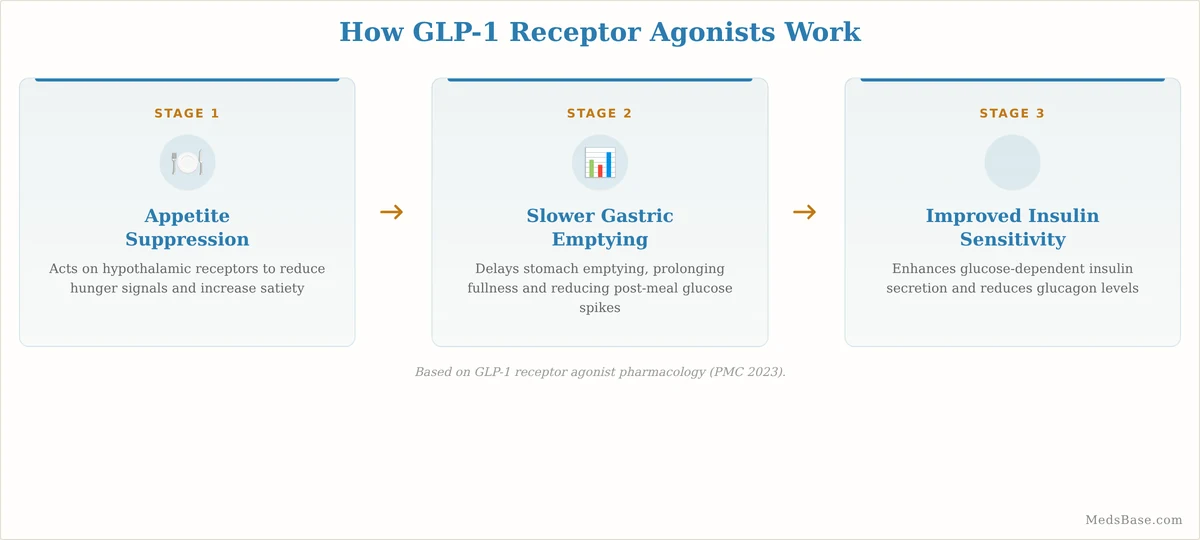
Research Spotlight: GLP-1 (glucagon-like peptide-1) is a hormone your gut releases after eating. It tells your brain you are full, slows down how quickly your stomach empties, and prompts your pancreas to release insulin. GLP-1 receptor agonist medications mimic this natural hormone — but at levels far higher than your body produces on its own. A 2023 mechanistic review confirmed these drugs work through three complementary pathways: central appetite suppression in the hypothalamus, delayed gastric emptying, and enhanced glucose-dependent insulin secretion.
Here is an analogy that helps: Imagine your appetite is controlled by a thermostat. In people with obesity, that thermostat is set too high — the brain constantly signals “hungry,” even when the body has enough energy stored. GLP-1 medications turn the thermostat down. They tell your brain, in effect, “We have enough. Stop eating.”
They do this in three ways. First, they act on GLP-1 receptors in the hypothalamus — the brain’s appetite control centre — reducing hunger signals and increasing feelings of fullness. Second, they slow gastric emptying, meaning food stays in your stomach longer, which physically extends the sensation of being full after a meal. Third, they improve insulin sensitivity in a glucose-dependent way, meaning they help your body handle blood sugar better after eating — but only when blood sugar is actually elevated, which means they carry a low risk of causing hypoglycaemia.
Here is where microdosing GLP-1 medications becomes relevant. The appetite-suppression effect starts at very low doses — well below the maximum. The gastric-emptying effect also kicks in early in the titration. So the question becomes: do you really need 2.4 mg if 0.5 mg is already suppressing your appetite and helping you eat less?
The answer, for a subset of patients, appears to be no. But — and this is the caveat — the clinical trials were not designed to test this question. The landmark STEP 1 trial published in the New England Journal of Medicine randomised patients to semaglutide 2.4 mg or placebo. The weight loss seen at lower doses during the run-in phase is observational data, not a randomised comparison. This is why the official prescribing information does not include a “microdose” protocol.
So what does this mean for you? Microdosing GLP-1 medications is an emerging clinical practice, not a guideline-endorsed treatment strategy. It should always be a conversation with your doctor — never a solo experiment.
Key Uses: Who Benefits From Microdosing GLP-1 Medications?
H3: Obesity with BMI ≥30
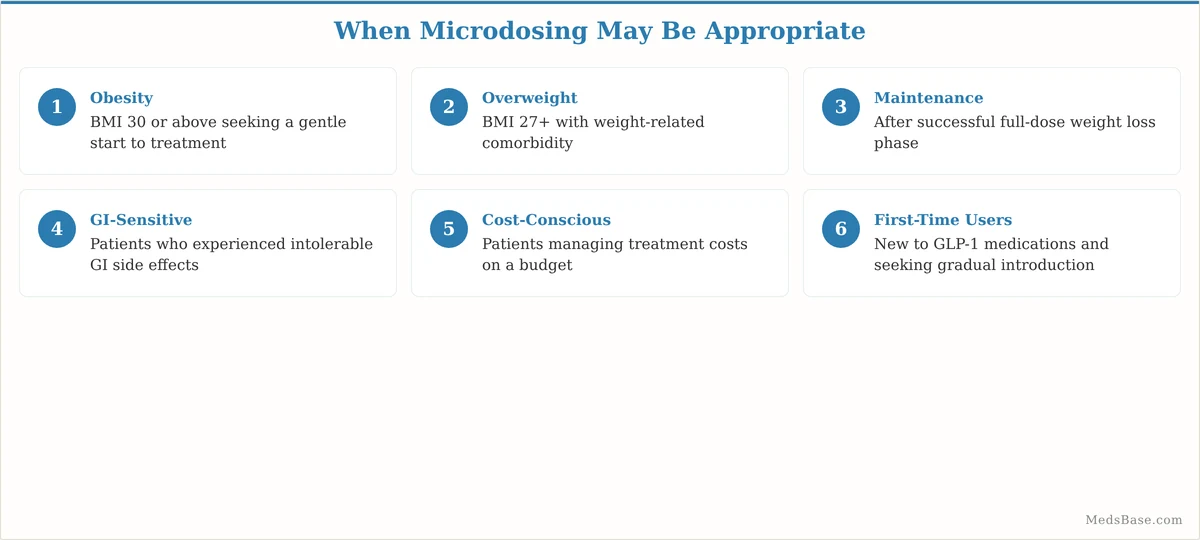
For people with class I or II obesity (BMI 30–39.9) who are just starting GLP-1 therapy, microdosing GLP-1 medications can serve as a gentle entry point. These patients may respond well even at lower doses, avoiding the nausea and vomiting that can make the first month of standard titration miserable.
H3: Overweight with Weight-Related Comorbidity
People with a BMI of 27–29.9 and conditions like hypertension, prediabetes, or dyslipidaemia are eligible for GLP-1 treatment under current guidelines. This group often has more moderate weight loss goals — 5–10% body weight rather than 15–20%. Microdosing GLP-1 medications may be particularly well-suited, since the weight loss target aligns with what lower doses can achieve.
H3: Side-Effect-Sensitive Patients
This is the largest group driving interest in microdosing GLP-1 medications. In the STEP trials, 74% of semaglutide users reported gastrointestinal events — nausea, vomiting, diarrhoea, or constipation — with 4.5% discontinuing treatment due to these side effects. In real-world data, the discontinuation rate within the first year is closer to 40–50%. For patients who cannot tolerate the full titration but still want GLP-1 benefits, staying at a lower, better-tolerated dose is an emerging clinical strategy.
H3: Maintenance After Full-Dose Success
Here is another angle: some patients reach their goal weight on the full dose, then transition to a lower maintenance dose. This is conceptually similar to microdosing GLP-1 medications — the idea being you need less of the drug to maintain weight than you needed to lose it. The STEP 4 trial partly supports this: patients who stayed on semaglutide continued losing, while those switched to placebo regained weight — but the trial did not test a lower-dose maintenance arm specifically.
Q: Who Is This For?
A: – Adults with obesity (BMI ≥30) wanting a gentler start to GLP-1 therapy – Overweight adults (BMI 27–29.9) with weight-related health conditions – Patients who have tried standard GLP-1 dosing but could not tolerate side effects – People with moderate weight loss goals (5–10% body weight)
Q: Who Should Avoid It?
A: – People with severe obesity (BMI ≥40) who may need full-dose therapy to achieve clinically meaningful loss – Patients with type 2 diabetes using GLP-1s primarily for glycaemic control — lower doses may not provide adequate glucose-lowering – Anyone considering self-directed pen splitting or obtaining unregulated compounded products – People with a personal or family history of medullary thyroid carcinoma or MEN2 (contraindicated for all GLP-1 use, regardless of dose) – Pregnant or breastfeeding women
Safety Profile, Side Effects & Dosing
Quick Answer: The main safety advantage of microdosing GLP-1 medications is fewer gastrointestinal side effects — nausea, vomiting, diarrhoea, and constipation — since these are strongly dose-dependent. The trade-off: lower doses may provide less glycaemic benefit for patients with diabetes and potentially slower or less total weight loss.
| Side Effect | Standard Dose Frequency | Microdose Expected Frequency | Severity | What To Do |
|---|---|---|---|---|
| Nausea | 44% (STEP 1 semaglutide) | Expected lower (10–25%) | Mild–moderate | Take with small, bland meals; avoid fatty foods; ginger/peppermint may help |
| Vomiting | 24% | Expected lower (5–12%) | Mild–moderate | Stay hydrated; if persistent more than 48 hours, contact your doctor |
| Diarrhoea | 30% | Expected lower (10–20%) | Mild | Increase water intake; avoid dairy and high-fibre foods temporarily |
| Constipation | 24% | Expected similar or slightly lower | Mild | Increase water and fibre gradually; gentle movement after meals |
| Fatigue | 11% | May be similar regardless of dose | Mild | Often transient in first 2–4 weeks; ensure adequate protein intake |
| Gallbladder issues | ~1.5% (rare) | Unknown at lower doses | Moderate–severe | Report right upper abdominal pain immediately to your doctor |
| Injection site reaction | ~5% | ~5% (dose-independent) | Mild | Rotate injection sites; use room-temperature pens |
Now, here is the detail we promised in the introduction: the side effect that surprises everyone about microdosing GLP-1 medications. It is not a side effect of the drug — it is a side effect of the dosing strategy. When you microdose, you are using less medication per dose, which means your supply lasts longer. Some patients, tempted by the cost savings, stretch a single pen or vial far beyond what is safe. Manufacturer pens are designed for single-patient use with specific sterility windows — typically 56 days from first use for multi-dose pens. Using a pen beyond its labelled shelf life, or splitting doses from a single pen intended for a higher dose, introduces infection risk and dosing inaccuracy. This is why microdosing GLP-1 medications must be done with your doctor’s supervision using appropriately prescribed doses — never through DIY pen manipulation.
The compounding safety question. Some patients pursuing microdosing GLP-1 medications turn to compounding pharmacies for custom lower-dose formulations. The FDA has issued multiple warnings about compounded semaglutide and tirzepatide — particularly products using salt forms (semaglutide sodium, semaglutide acetate) that are not the same as the FDA-approved base form. These compounded versions have not been tested for safety, efficacy, or sterility. If you and your doctor decide microdosing is right for you, use only FDA-approved products at the prescribed dose. Our compounding pharmacy safety guide (published today) covers the red flags in detail.
Dosing, practically speaking, means discussing with your doctor which step on the standard titration ladder you will stop at. For semaglutide, that might be 0.5 mg or 1.0 mg weekly instead of 2.4 mg. For tirzepatide, it might be 5 mg or 7.5 mg instead of 15 mg. This is NOT the same as using a non-standard dose — it is simply choosing not to titrate further when an effective dose is reached. Your doctor may call this “lowest effective dose strategy” rather than “microdosing,” but the principle is the same.
What Does the Research Say?
Let us be honest up front: no large randomised controlled trial has been published that specifically compares a microdosing protocol against standard dosing for GLP-1 medications. The evidence base for microdosing GLP-1 medications is indirect — drawn from the titration-phase data in the major trials, subgroup analyses, and real-world clinical experience. Here is what exists:
| Study | Year | Key Finding | Source |
|---|---|---|---|
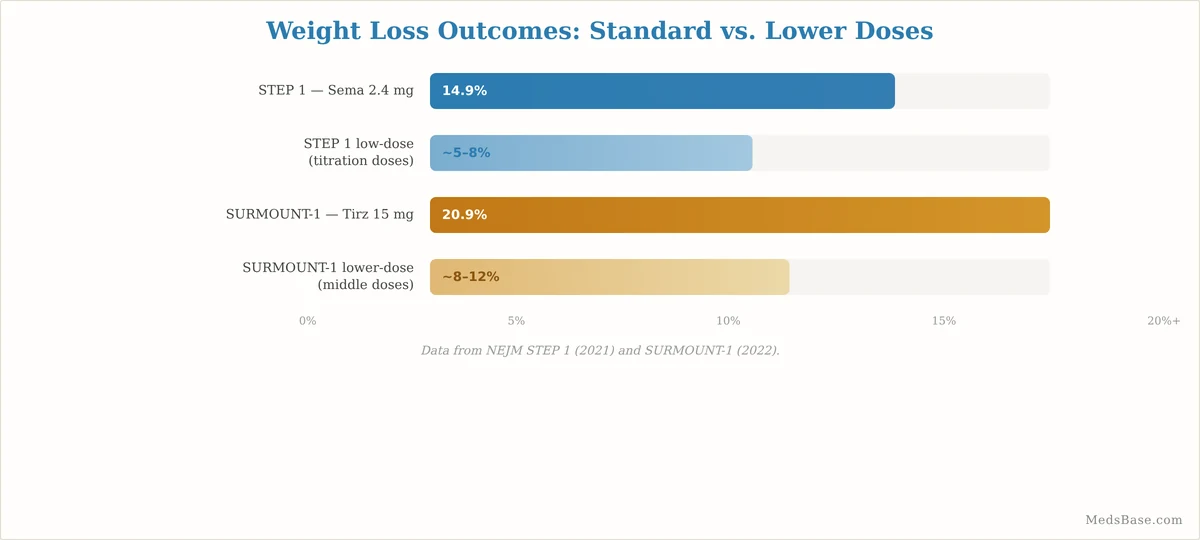
| STEP 1 (semaglutide) | 2021 | Weight loss began during titration: ~5% at 0.5 mg, ~8% at 1.0 mg (observational, during dose escalation phase) | NEJM 2021 |
| SURMOUNT-1 (tirzepatide) | 2022 | Tirzepatide 5 mg (lowest maintenance dose tested) produced 15% mean weight loss; 10 mg produced 19.5%; 15 mg produced 20.9% — a dose-response plateau suggesting diminishing returns beyond 10 mg for many patients | NEJM 2022 |
| STEP 4 (withdrawal) | 2021 | Patients switched to placebo regained two-thirds of lost weight within 48 weeks — suggesting continuous treatment is needed but not specifying dose | JAMA 2021 |
| Real-world cohort analysis | 2024 | First-year discontinuation rates approach 40–50% in real-world data, with GI side effects being the leading cause — indirect evidence that lower, better-tolerated doses could improve persistence | Various real-world analyses |
What this means for you: the data does not say “microdosing GLP-1 medications is proven better.” What it says is: meaningful weight loss starts at lower doses, side effects are dose-dependent, and discontinuation is a real problem. If a lower dose keeps you on treatment longer — and you are still losing weight — that may be a net win over starting at the full dose, quitting after three months, and regaining everything.
The SURMOUNT-1 plateau effect is particularly interesting. The jump from 5 mg to 10 mg of tirzepatide added 4.5 percentage points of weight loss. The jump from 10 mg to 15 mg added only 1.4 points. For many patients, that last 1.4% may not be worth the additional side-effect burden and cost of the maximum dose.
Microdosing GLP-1 Medications vs Alternatives
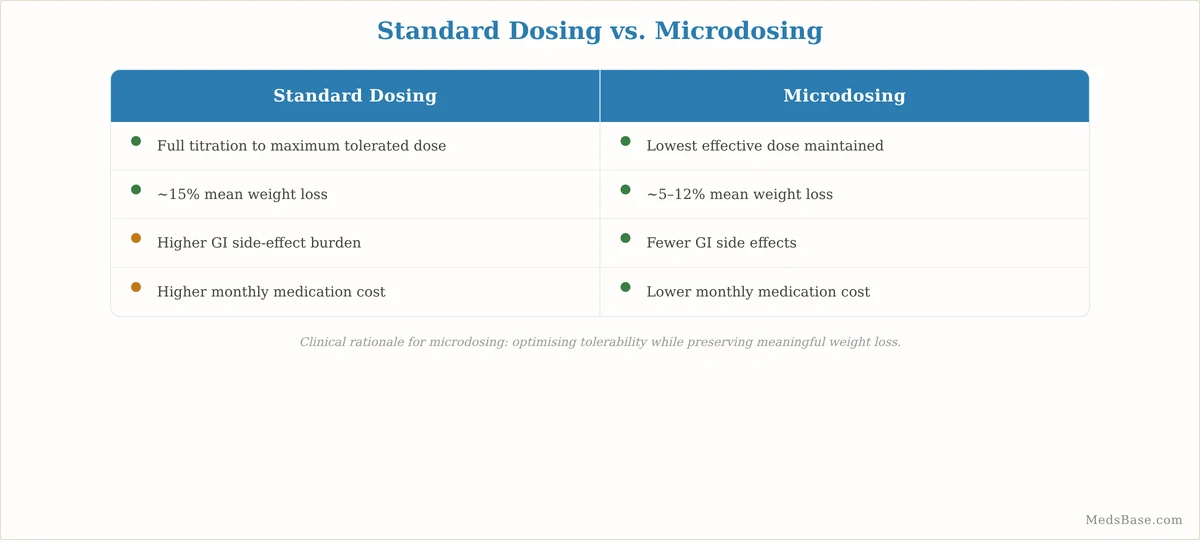
If you are considering microdosing GLP-1 medications, you are probably weighing it against other approaches. Here is how they compare:
| Approach | Weight Loss | Side Effects | Cost | Duration | Best For |
|---|---|---|---|---|---|
| Standard full-dose GLP-1 | 15–21% body weight | Higher GI effects | Higher (more mg/month) | Continuous | Severe obesity; rapid loss needed |
| Microdosing GLP-1 | 5–12% body weight (estimated) | Lower GI effects | Lower (less mg/month) | Continuous | Side-effect-sensitive; moderate goals |
| Lifestyle-only | 3–5% body weight | None | Lower | Variable | Those wanting non-pharmacological approach |
| Older weight loss meds (phentermine, etc.) | 5–10% body weight | Variable | Lower | Short-term (weeks–months) | Short-term use; lower cost |
| Bariatric surgery | 25–35% body weight | Surgical risks | High upfront | Permanent anatomical change | Severe obesity; failed medical management |
Which one fits your situation? If you have 30–60 pounds to lose, experience significant nausea at standard GLP-1 starting doses, and prefer a slow-and-steady approach, microdosing GLP-1 medications is worth discussing with your doctor. If you have more than 100 pounds to lose and obesity-related complications that need rapid improvement, the standard full-dose protocol — with proactive side-effect management — is likely the better starting point. Wondering how the two biggest names in GLP-1 therapy compare head-to-head? Read our detailed guide comparing Wegovy and Mounjaro side by side.
Related Reading
How to Start Microdosing GLP-1 Medications
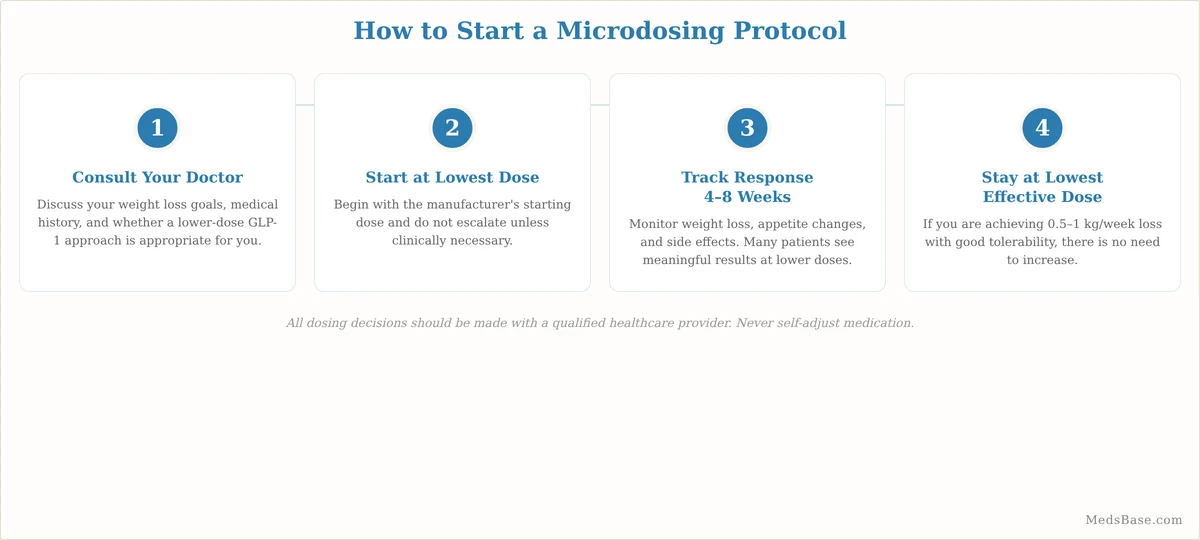
Quick Answer: The only safe way to start microdosing GLP-1 medications is through a conversation with your prescribing doctor. The approach involves starting at the standard initiating dose and agreeing in advance that you will only titrate up if the current dose stops producing results — a “lowest effective dose” strategy rather than a “race to the maximum.”
Step 1: Have the right conversation with your doctor. Do not walk in saying “I want to microdose.” Instead, say: “I am interested in starting GLP-1 therapy, but I want to take the slowest, gentlest approach possible. Can we agree to stay at the lowest dose that produces results rather than automatically titrating to the maximum?”
Step 2: Start at the standard initiating dose. For semaglutide, this is 0.25 mg weekly for four weeks. For tirzepatide, it is 2.5 mg weekly for four weeks. These initiating doses are already a form of “microdosing” — they are sub-therapeutic by design, intended only to acclimate your body to the medication.
Step 3: Track your response before each titration decision. At the four-week mark, assess three things with your doctor: (a) Are you losing weight? 0.5–1 kg (1–2 lbs) per week is a healthy rate. (b) Are your side effects tolerable? (c) Is your appetite adequately suppressed — enough to eat less but not so much that you cannot eat at all? If all three answers are positive at your current dose, the microdosing GLP-1 medications approach says: stay where you are.
Step 4: Only titrate up when the current dose stops working. If weight loss plateaus for 4–6 weeks at a given dose, if hunger returns significantly, or if food noise (constant thoughts about food) creeps back — that is the signal to move up one step on the titration ladder. The goal is the lowest effective dose, not a number on a syringe.
Step 5: Consider your long-term maintenance plan. Weight loss is one challenge; keeping it off is another. If you reach your goal weight at a lower dose — say, 1.0 mg of semaglutide — discuss with your doctor whether that same dose is appropriate for long-term maintenance. Some patients may need a slightly higher maintenance dose than their losing dose; others may maintain well at the same level. There is no one-size-fits-all answer, and this is an area where clinical experience currently outpaces published evidence.
Common mistakes to avoid:
- Splitting manufacturer pens. Single-dose pens are designed to deliver one dose. Attempting to split them into smaller doses risks sterility breaches, inaccurate dosing, and infection.
- Using compounded products without verifying the pharmacy. If your doctor prescribes a compounded formulation for a custom dose, verify that the pharmacy is FDA-registered and state-licensed. Our compounding pharmacy safety guide has a complete checklist.
- Skipping the diet and exercise component. GLP-1 medications amplify the effects of lifestyle changes — they do not replace them. Protein intake is especially important to preserve muscle mass during weight loss, and the muscle-loss risk exists at any dose.
- Self-titrating without medical guidance. The moment you stop communicating with your prescriber about your dose is the moment microdosing GLP-1 medications stops being a medical strategy and starts being a risk.
Browse our Weight Loss category to explore all weight management options available — including GLP-1 medications and supporting products.
Frequently Asked Questions
Q: Can you microdose Wegovy?
A: A: Yes — but “microdosing” in this context means staying at a lower dose on the standard titration ladder (such as 0.5 mg or 1.0 mg weekly) rather than reaching the full 2.4 mg. It does not mean using non-standard doses or splitting pens. Discuss with your doctor whether a “lowest effective dose” approach is appropriate for your situation. The FDA prescribing information for semaglutide supports individualised dose titration based on tolerability.
Q: Is microdosing Mounjaro safe?
A: A: Using tirzepatide at doses below the maximum approved dose — such as staying at 5 mg or 7.5 mg weekly rather than titrating to 15 mg — is within the approved dosing range and is generally considered safe when supervised by a prescribing doctor. The SURMOUNT-1 trial demonstrated that the 5 mg dose alone produced a mean 15% weight loss. The safety risks are the same as standard dosing: primarily gastrointestinal effects, which are dose-dependent and therefore expected to be less severe at lower doses.
Q: What is the lowest effective dose of semaglutide for weight loss?
A: A: The lowest initiating dose is 0.25 mg weekly, but this is considered sub-therapeutic for weight loss — it exists only to acclimate your body. Clinically meaningful weight loss typically begins at 0.5 mg weekly, with progressively greater effects at 1.0 mg, 1.7 mg, and 2.4 mg. For microdosing GLP-1 medications, the lowest commonly discussed “effective” dose is 0.5 mg weekly, with 1.0 mg being a more reliable threshold for sustained loss in most patients.
Q: How much weight can you lose on a microdose of GLP-1?
A: A: Precise data is limited because no trial has randomised patients to a specific microdosing protocol. Based on observational data from the titration phases of the STEP 1 and SURMOUNT-1 trials, estimated weight loss at lower doses ranges from approximately 5% to 12% of body weight, depending on the medication and specific dose. For a 200-pound person, that translates to 10–24 pounds. Results vary significantly by individual, and some patients may lose substantially more or less.
Q: Does microdosing GLP-1 reduce side effects?
A: A: Yes — this is the primary motivation for the microdosing approach. Gastrointestinal side effects from GLP-1 medications are strongly dose-dependent. In the STEP 1 trial, nausea incidence at the early titration doses was substantially lower than at the 2.4 mg maintenance dose. By staying at a lower dose, most patients experience fewer and less severe nausea, vomiting, diarrhoea, and constipation episodes. However, microdosing GLP-1 medications does not eliminate side effects — some patients experience significant GI symptoms even at initiating doses.
Q: Who should try microdosing GLP-1 medications?
A: A: The strongest candidates are: (1) patients with moderate weight loss goals (5–12% body weight) who do not need the maximum effect; (2) patients who have tried standard GLP-1 titration and experienced dose-limiting side effects; (3) first-time GLP-1 users who want the gentlest possible entry; and (4) patients transitioning from active weight loss to long-term weight maintenance who may not need a full dose to sustain results. The approach should always be discussed with and approved by your prescribing doctor.
Q: Are there any medications similar to GLP-1 drugs that work at lower doses?
A: A: Several classes of weight loss medications offer alternatives for patients who want pharmacological support without full-dose GLP-1 therapy. Bupropion/naltrexone (Contrave) targets appetite through different brain pathways. Phentermine is effective for short-term use. Orlistat works in the gut rather than systemically. However, none of these match the weight-loss efficacy of GLP-1 receptor agonists — even at lower doses. The decision should be individualised with your doctor based on your weight-loss goals, comorbidity profile, tolerance, and budget.
Q: Can I get compounded GLP-1 microdoses?
A: A: While some compounding pharmacies offer custom low-dose GLP-1 formulations, the FDA has expressed significant safety concerns about compounded semaglutide and tirzepatide products. Many use salt forms (semaglutide sodium or acetate) that differ from the FDA-approved base molecule and have not undergone safety or efficacy testing. If your doctor cannot achieve the desired dose with an FDA-approved product at a standard prescribing level, discuss alternatives rather than defaulting to an unregulated compounded option. Read our guide on compounding pharmacy safety for a full breakdown of the risks and red flags.
The Bottom Line
Microdosing GLP-1 medications is not a shortcut, a hack, or a way to get weight loss results without doing the work. It is a dosage personalisation strategy — one that recognises that not every patient needs the maximum dose to achieve their goals, and that tolerability matters just as much as efficacy for long-term success.
The evidence for microdosing GLP-1 medications is indirect but clinically coherent: weight loss starts at low doses, side effects are dose-dependent, and discontinuation rates in the real world are high. If staying at a lower dose keeps you on the medication — and you are still losing weight at a meaningful rate — that is a far better outcome than reaching the full dose, becoming miserable, and quitting entirely.
Your immediate action: if you are considering GLP-1 therapy or are struggling with side effects at your current dose, schedule a conversation with your doctor. Frame it around the “lowest effective dose” concept rather than the trendy “microdosing” term — the medical language matters for a productive discussion.
What to read next:
- Wegovy vs Mounjaro for Weight Loss: Which One Is Right for You? — today’s detailed head-to-head comparison
- Compounding Pharmacy Safety: A Complete Consumer Guide — if you are considering compounded GLP-1 products, read this first
Medical Disclaimer: This article is for informational purposes only and does not constitute medical advice. Microdosing GLP-1 medications should only be undertaken under the supervision of a licensed healthcare provider. Never adjust your medication dose, split manufacturer pens, or use compounded products without your doctor’s explicit guidance. Weight loss medications carry risks including gastrointestinal side effects, gallbladder disease, and pancreatitis. Discuss your full medical history with your doctor before starting any new treatment.

Written by
Sophie ChenPharmaceutical Content Researcher · 8 years experience
Sophie Chen is a pharmaceutical content researcher with 8 years covering generic medication access and clinical pharmacology. She specialises in international regulatory frameworks, bioequivalence standards, and patient-facing education on therapeutic drug classes. She is not a clinician.