








✓ Medically reviewed by · Last reviewed: May 2026
Pharmacy Researcher · 8 years experience
Pharmacy researcher with 8 years reviewing clinical drug information, generic formulation equivalence, and international pharmaceutical standards. Focuses on patient-facing accuracy in medication education.
sertraline vs fluoxetine — Sertraline vs Fluoxetine — head-to-head comparison. Read on for an evidence-backed guide covering everything you need to know.
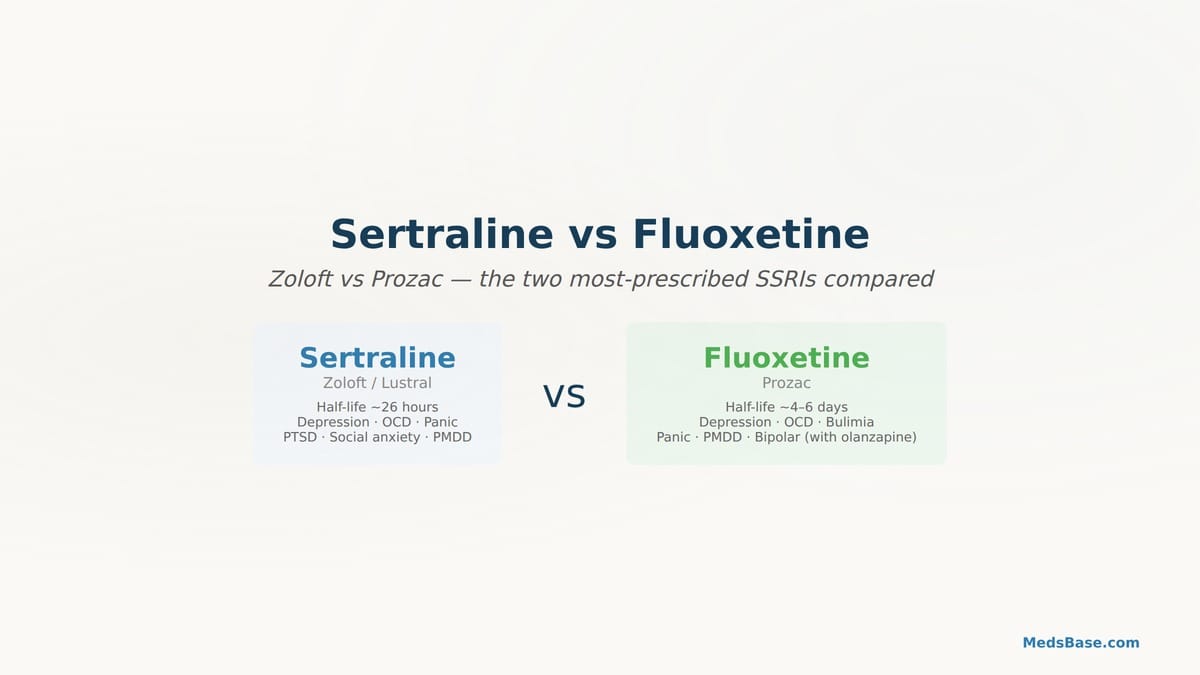
Most people believe all SSRIs are essentially interchangeable — same mechanism, same effects, just different brand names. The reality is more nuanced, and the difference between two of the most prescribed antidepressants on the planet can be the difference between a medication that works well for you and one you stop within weeks because of side effects you didn’t expect.
Sertraline (best known as Zoloft) and fluoxetine (best known as Prozac) are both selective serotonin reuptake inhibitors — and that shared mechanism is real. But their half-lives, their side-effect profiles, how they feel when you start them, and how hard they are to stop are genuinely different. By the end of this comparison, you’ll know which differences actually matter and which ones you can set aside.
Key Takeaways
- Both are first-line SSRIs, but fluoxetine’s half-life is dramatically longer (days vs hours) — which changes the withdrawal experience.
- Sertraline is often described as slightly more “activating”; fluoxetine can feel steadier, but both can cause initial anxiety.
- Weight effects, sexual side effects, and drug interactions all differ between the two — and these are the reasons someone might switch.
- Fluoxetine’s long half-life makes it self-tapering — missing a dose matters less, and stopping is gentler.
- Neither is universally “better” — the winner depends entirely on your history, your side-effect tolerance, and what you’re treating.
- What Are Sertraline and Fluoxetine?
- How Both SSRIs Work
- Approved Uses: Sertraline vs Fluoxetine
- Safety, Side Effects & Tolerance
- The Half-Life Difference
- Withdrawal: Which Is Easier to Stop?
- How to Start and Stop Safely
- Frequently Asked Questions
- The Bottom Line
What Are Sertraline and Fluoxetine?
Sertraline and fluoxetine are both selective serotonin reuptake inhibitors (SSRIs) — a class of antidepressants that increase the availability of serotonin, a neurotransmitter linked to mood, anxiety, and well-being. Sertraline is sold under the brand name Zoloft (Lustral in the UK); fluoxetine is sold as Prozac. (Featured-snippet-style definition.)
Both drugs are prescribed for depression and anxiety disorders, and both have been generic for years, making them widely accessible. The NHS describes sertraline as an antidepressant used for depression, obsessive-compulsive disorder (OCD), panic disorder, post-traumatic stress disorder (PTSD), and social anxiety disorder. Fluoxetine, per the NHS, is prescribed for depression, OCD, and bulimia, and is sometimes used for menopause symptoms.
The shared SSRI mechanism means they work the same way at the receptor level, but their pharmacokinetic profiles — how the body absorbs, distributes, and eliminates them — diverge sharply, and those differences drive many of the practical trade-offs.
How Both SSRIs Work
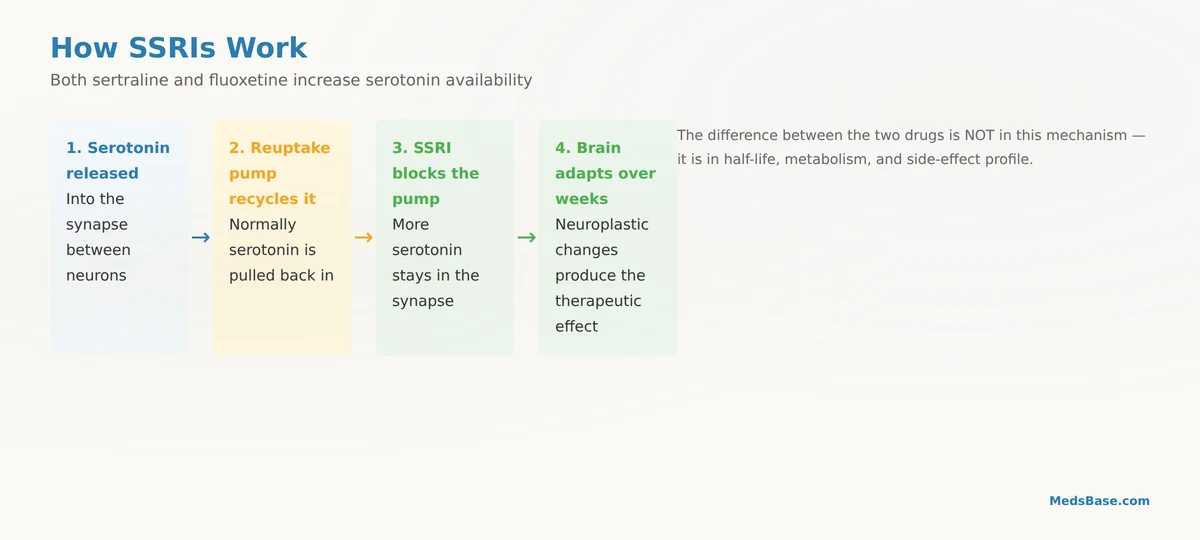
Both sertraline and fluoxetine block the serotonin reuptake pump on neurons, raising serotonin levels in the synapse. More serotonin availability is thought to improve mood, reduce anxiety, and ease obsessive thought patterns over weeks of consistent use.
Here’s the simplified version. Between neurons there’s a gap called a synapse. One neuron releases serotonin into that gap, and after it delivers its signal, a pump (the serotonin transporter) pulls it back in to be recycled. An SSRI blocks that pump. With the pump partially shut down, serotonin stays in the gap longer and signals more effectively. Over weeks, the brain adapts to those higher serotonin levels, and that adaptation — not the initial serotonin bump — is what produces the therapeutic effect.
The reason the two drugs feel different for many people despite the shared mechanism isn’t about serotonin at all — it’s about their half-lives, their effects on other receptors, and their metabolism in the liver. Fluoxetine has active metabolites that linger for days, giving it a very different on-ramp and off-ramp from sertraline, which clears the body within about a day of the last dose.
What this means for you: both drugs work, and the choice rarely comes down to “which works better for depression overall” — the real differentiators are side-effect tolerance, the withdrawal experience, and how each drug fits with your other medications and lifestyle.
Approved Uses: Sertraline vs Fluoxetine
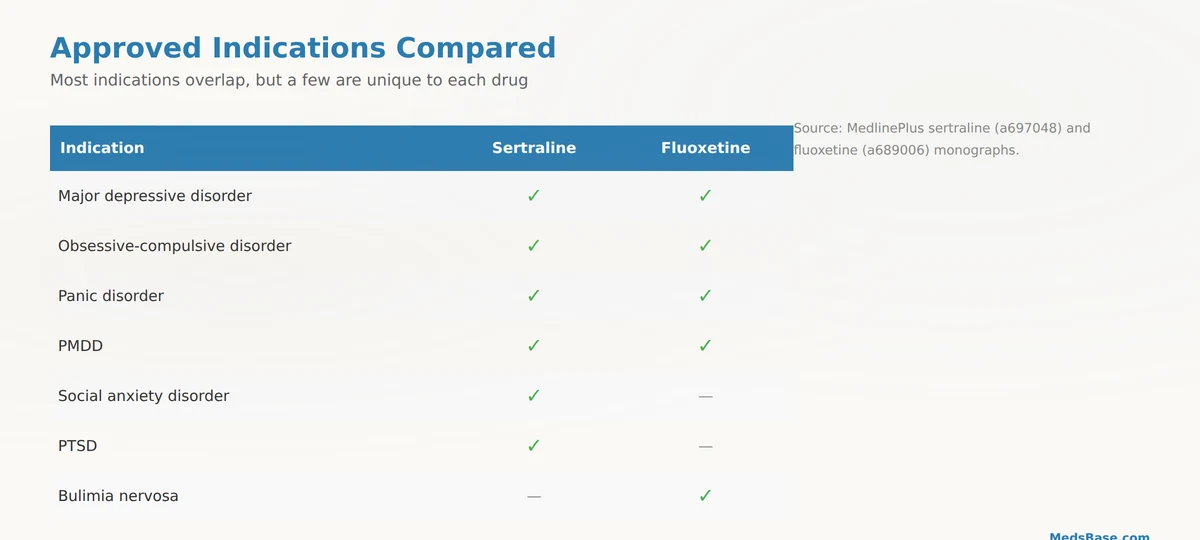
The two drugs overlap significantly but not completely:
| Indication | Sertraline (Zoloft) | Fluoxetine (Prozac) |
|---|---|---|
| Major depressive disorder | ||
| Obsessive-compulsive disorder (OCD) | ||
| Panic disorder | ||
| Social anxiety disorder | — | |
| Post-traumatic stress disorder (PTSD) | — | |
| Premenstrual dysphoric disorder (PMDD) | ||
| Bulimia nervosa | — | |
| Bipolar depression (with olanzapine) | — |
The MedlinePlus sertraline monograph confirms sertraline is approved for depression, OCD, panic attacks, PTSD, social anxiety disorder, and PMDD. Fluoxetine’s MedlinePlus entry covers depression, OCD, eating disorders, panic attacks, and PMDD, plus the combination with olanzapine for bipolar I depression.
In practice, many prescribers use both drugs off-label for generalized anxiety disorder and other conditions, so the approved list is a starting point, not a hard boundary. What your doctor prescribes depends on your full symptom picture.
Safety, Side Effects & Tolerance
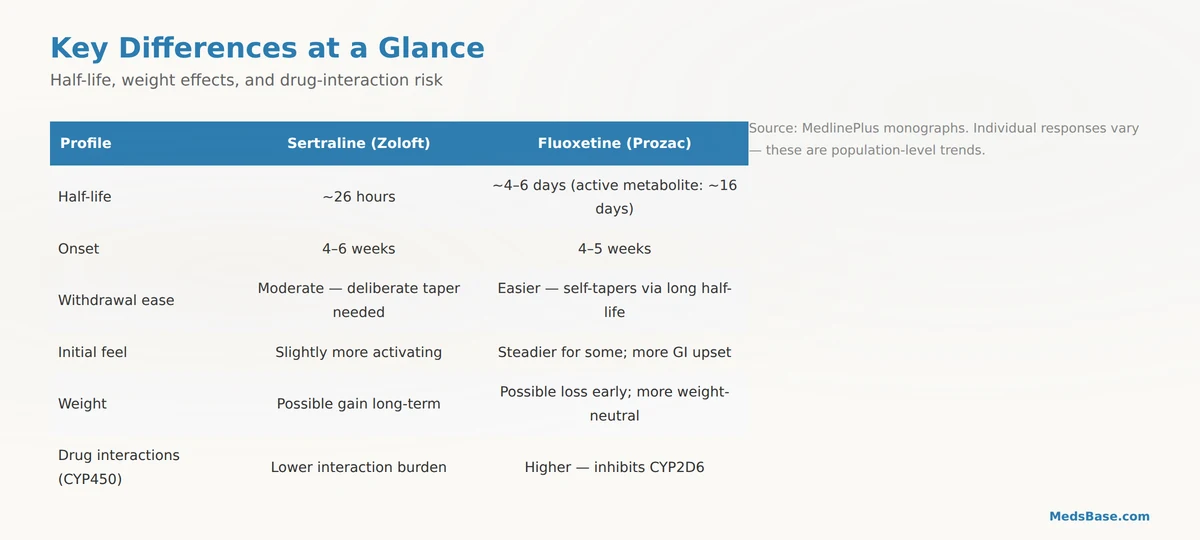
Both sertraline and fluoxetine share the SSRI-class side-effect profile, but their differences are meaningful enough that a person who struggles with one often tolerates the other better.
| Side Effect | Sertraline | Fluoxetine | Notable difference |
|---|---|---|---|
| Nausea / GI upset | Common | Common | Fluoxetine may cause more nausea early |
| Sexual dysfunction | Common (decreased libido, delayed ejaculation/orgasm) | Common (decreased libido, delayed ejaculation/orgasm) | Similar across both |
| Insomnia / activation | Common (often described as “activating”) | Common (can cause nervousness initially) | Sertraline slightly more activating for some |
| Weight changes | Possible weight gain (long-term) | Possible weight loss (early), then variable | Fluoxetine sometimes preferred for weight-neutral or weight-loss effect |
| Drowsiness / fatigue | Possible | Less common (sertraline may cause more) | Sertraline can be taken at night if drowsy |
| Dry mouth, sweating | Both | Both | Similar |
| Unusual dreams / yawning | Less common | More common (fluoxetine-classic) | Fluoxetine distinctly associated |
| Withdrawal symptoms | Moderate risk if stopped abruptly | Lower risk (long half-life self-tapers) | Major advantage for fluoxetine |
Who is sertraline vs fluoxetine for? Sertraline tends to suit someone who wants a well-rounded SSRI with broad approval range and appreciates feeling more alert — but may need to manage the possibility of initial activation or insomnia. Fluoxetine suits someone who values the “self-tapering” safety of a long half-life, someone with bulimia (it’s the SSRI indicated for that), or someone for whom weight gain on other antidepressants has been a concern.
Who should be cautious? Both carry the standard SSRI black-box warning for increased suicidal thoughts in children, adolescents, and young adults (under 24). Both should not be taken within 14 days of a monoamine oxidase inhibitor (MAOI). Fluoxetine’s longer washout means you need to wait at least 5 weeks after stopping fluoxetine before starting an MAOI — versus the 2-week washout for sertraline. This is a practical difference that matters if you need to switch drug classes.
The Half-Life Difference
This is the single most important difference between the two drugs, and the one most people miss when comparing them online.
Sertraline’s half-life is approximately 26 hours, meaning it takes roughly a day for half the drug to leave your system. Fluoxetine’s half-life is approximately 4 to 6 days for the parent drug, and its active metabolite (norfluoxetine) can take up to 16 days to clear. This means fluoxetine effectively stays in your body for weeks after your last dose.
Why this matters:
- Missing a dose of sertraline may cause a noticeable dip within a day or two — some people get “brain zaps,” dizziness, or irritability.
- Missing a dose of fluoxetine is usually not noticeable because the drug is still active from previous doses.
- Switching from fluoxetine to another drug requires a longer washout period to avoid interactions — sometimes weeks.
- Stopping fluoxetine is often gentler because the drug essentially tapers itself as it slowly clears.
This half-life difference doesn’t make one drug better than the other — but it strongly influences the practical experience of starting, taking, and stopping each one.
Withdrawal: Which Is Easier to Stop?
Fluoxetine is generally easier to stop than sertraline, thanks to its long half-life. Sertraline’s shorter half-life means withdrawal symptoms — dizziness, nausea, “brain zaps,” irritability, and mood swings — can appear within days of an abrupt stop or a dose reduction that’s too fast.
The sertraline MedlinePlus entry warns explicitly about discontinuation symptoms: “If you suddenly stop taking sertraline, you may experience withdrawal symptoms such as nausea, sweating, depression, mood changes, irritability, anxiety, confusion, dizziness, headache, tiredness, seizures, ringing in the ears, numbness or tingling.” The fluoxetine entry similarly lists mood changes, irritability, dizziness, and anxiety — but side-effect reporting data consistently shows that withdrawal from fluoxetine is milder and less frequent, to the point that some clinicians use it as a bridge drug to help patients discontinue other, shorter-half-life antidepressants.
Both drugs should be tapered under a doctor’s supervision, not stopped cold. The difference is that sertraline’s taper needs to be more deliberate, while fluoxetine’s long half-life provides a built-in buffer.
How to Start and Stop Safely
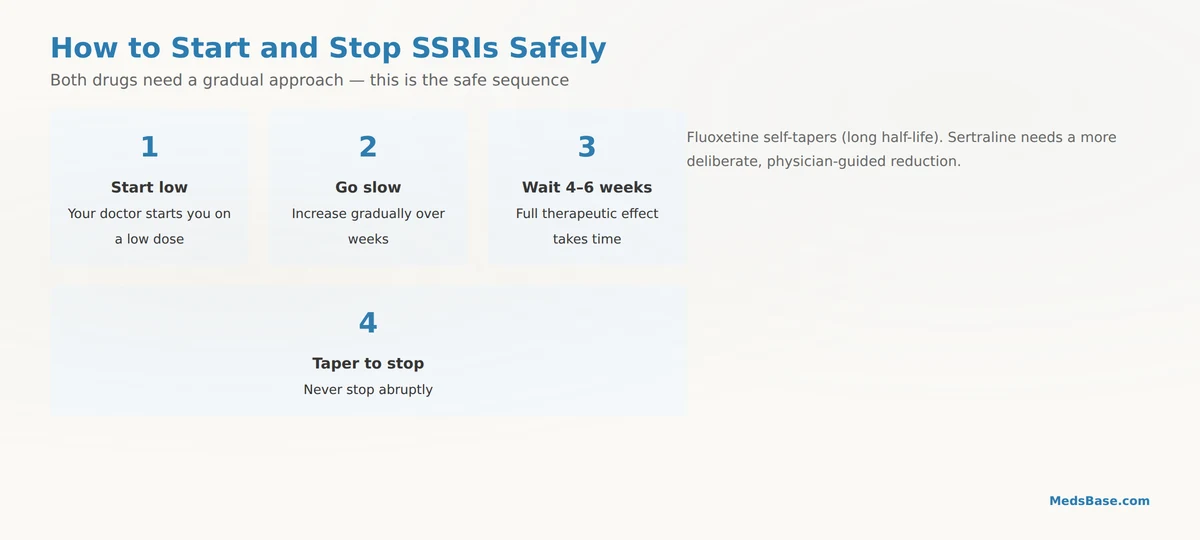
If you and your doctor have chosen one of these medications, the process for both is broadly similar, with a few medication-specific nuances:
- Start low and go slow. Your doctor will start you on a low dose and increase it gradually — not more than once a week for sertraline, and typically after 3–4 weeks for fluoxetine. This minimizes side effects.
- Expect 4–6 weeks for the full therapeutic effect. Both drugs work slowly. Feeling better in the first few days may be relief or placebo — the real, sustained antidepressant effect takes several weeks to consolidate.
- Take at the same time every day. Sertraline in the morning or evening depending on whether it makes you feel alert or drowsy. Fluoxetine in the morning, with or without food.
- Don’t stop abruptly. Taper under medical supervision. For fluoxetine the taper is often smoother; for sertraline, a slower, multi-week reduction is standard.
- Report concerning side effects early. Agitation, new or worsening suicidal thoughts, severe restlessness, or any unusual bleeding or bruising warrant a call to your doctor.
Mistakes to avoid:
- Comparing yourself to someone else’s experience. People metabolize these drugs differently; your friend’s success or struggle with sertraline tells you nothing about yours.
- Stopping because the first two weeks are rough. Initial anxiety or nausea often settles. Give it time and talk to your doctor before deciding.
- Mixing with St. John’s wort or other serotonin-boosting supplements without asking your pharmacist.
- Drinking heavily on either medication — alcohol worsens side effects and may blunt the antidepressant effect.
Related Reading
- Mental Health articles — more on managing mental-health conditions.
- Aspirin for Gum Disease — a practical evidence-first medication guide, written today.
- Fluconazole: 7 Proven Facts — another clear medication walkthrough, written today.
Frequently Asked Questions
Q: Is sertraline better than fluoxetine?
A: Neither is universally better. They are both effective first-line SSRIs, and they work via the same mechanism. The real difference is in half-life, side-effect profile, and approved indications — fluoxetine is indicated for bulimia and is easier to stop; sertraline covers a slightly wider anxiety range. The right one depends on your specific symptoms, side-effect sensitivities, and medical history.
Q: What is the difference between sertraline and fluoxetine?
A: The key differences are half-life (sertraline ~26 hours vs fluoxetine ~4–6 days), the withdrawal experience (fluoxetine self-tapers and is usually gentler to stop), the approved uses (sertraline covers PTSD and social anxiety; fluoxetine covers bulimia), and the initial side-effect feel — sertraline is often described as more activating, while fluoxetine can be steadier.
Q: Zoloft vs Prozac — which is better for anxiety?
A: Both treat anxiety disorders, but sertraline holds explicit FDA approval for social anxiety disorder and PTSD, while fluoxetine does not. In clinical practice, both are used off-label for various anxiety conditions. The deciding factor is often tolerance — whichever one causes fewer side effects for you is likely to be the better anxiety treatment.
Q: Which SSRI has the least side effects?
A: There is no universal least-side-effect SSRI, because side effects are individual. Fluoxetine tends to cause more GI upset early on but less drowsiness; sertraline tends to cause less nausea but more diarrhea and, for some, more initial activation. Both carry sexual side effects at similar rates. The only reliable way to find the best fit is to try one under medical supervision and switch if it doesn’t suit you.
Q: Does sertraline cause more weight gain than fluoxetine?
A: Fluoxetine is often associated with initial weight loss and a more weight-neutral profile long-term compared to sertraline, which some patients associate with modest weight gain over extended treatment. Individual responses vary widely, and weight changes on either drug should be discussed with your doctor.
Q: Which antidepressant is easier to stop?
A: Fluoxetine is generally easier to stop thanks to its very long half-life and active metabolite, which produce a natural “self-taper” over weeks after the last dose. Sertraline’s shorter half-life means withdrawal symptoms can appear within days of stopping. Both should be tapered under a doctor’s supervision — never stopped abruptly.
Q: Can I drink alcohol with sertraline or fluoxetine?
A: Neither drug has a direct interaction with alcohol in the way that, say, sedatives do, but alcohol can worsen SSRI side effects like drowsiness, dizziness, and nausea, and heavy drinking may blunt the antidepressant effect. The safest approach is to limit alcohol or avoid it, especially early in treatment. Ask your doctor or pharmacist for guidance specific to you.
The Bottom Line
Sertraline and fluoxetine are both effective, evidence-backed first-line SSRIs, and their similarities dominate the headlines: same drug class, same mechanism, broadly similar effectiveness. But the differences — half-life, withdrawal experience, the initial “feel,” and the specific conditions each has formal approval for — are where the real-world decision lives.
The balanced verdict: if you’re prone to missing doses or dread the idea of withdrawal, fluoxetine’s long half-life is a genuine practical advantage. If your anxiety extends to social situations or trauma-related symptoms, sertraline’s broader anxiety-label coverage may make it the natural starting point. If you try one and the side effects don’t settle, switching to the other — under medical supervision — is a common and reasonable next step.
Your immediate action is to bring your full symptom picture, your side-effect priorities, and your full medication list to a doctor. This comparison helps you ask the right questions; it doesn’t replace the individual decision.
Wondering how a completely different medication class works? Read our fluconazole guide for a clear, evidence-first walkthrough. Or, if you’d rather stay in the practical medication space, see how aspirin for gum disease — another everyday drug — surprised researchers this year.
Medical Disclaimer: This article is for informational purposes only and does not constitute medical advice. Depression and anxiety disorders require diagnosis and treatment by a qualified healthcare professional. Never start, stop, or change a medication — including antidepressants — without consulting your doctor.

Written by
Sophie ChenPharmaceutical Content Researcher · 8 years experience
Sophie Chen is a pharmaceutical content researcher with 8 years covering generic medication access and clinical pharmacology. She specialises in international regulatory frameworks, bioequivalence standards, and patient-facing education on therapeutic drug classes. She is not a clinician.