








✓ Medically reviewed by · Last reviewed: May 2026
Pharmacy Researcher · 8 years experience
Pharmacy researcher with 8 years reviewing clinical drug information, generic formulation equivalence, and international pharmaceutical standards. Focuses on patient-facing accuracy in medication education.
sildenafil side effects — Sildenafil Side Effects: 8 Facts Every Man Should Know Before Taking It. Read on for an evidence-backed guide covering everything you need to know.
Key Takeaways
- Headache is the most common sildenafil side effect, affecting about 1 in 6 users — but it almost always improves after the first few doses.
- Sildenafil’s side effects come directly from its mechanism: by relaxing blood vessels everywhere (not just where you want it), it causes flushing, headaches, and nasal congestion.
- Vision changes — that famous “blue tinge” — affect about 2% of users at standard doses but can become more likely at higher doses or with certain pre-existing eye conditions.
- Priapism (a prolonged, painful erection) is rare — roughly 1 in 10,000 — but it demands an ER visit within 4 hours to prevent permanent damage.
- You can safely manage most sildenafil side effects with simple strategies: taking it on an empty stomach, staying hydrated, and timing your dose.
Table of Contens
- What Are the Most Common Sildenafil Side Effects?
- Why Does Sildenafil Cause Headaches?
- Sildenafil and Vision: Is Blue-Tinted Sight Dangerous?
- Priapism — The One Side Effect That Requires Emergency Care
- How Long Do Sildenafil Side Effects Last?
- Who Should NOT Take Sildenafil?7. Can You Drink Alcohol with Sildenafil?8. How to Manage and Minimize Sildenafil Side Effects9. Frequently Asked Questions
- The Botom Line
What Are the Most Common Sildenafil Side Effects?
Sildenafil side effects — close your eyes and picture this: you’ve taken your first sildenafil dose, and 45 minutes later — right when things should be working — a pounding headache sets in. Your face feels flushed. Your nose is suddenly stuffy. Is this normal? Is something wrong?
Quick Answer: Yes, it’s normal. Sildenafil side effects are both predictable and well-documented. The most common — headache, flushing, dysepsia (indigestion), nasal congestion, and dizzness — affect between 2% and 16% of users in clinical trials. Almost all are mild to moderate, peaking at 1–2 hours after dosing, and resolving completly within 4–6 hours. And here’s the part most guides skip: about half of first-time users who get side effects find they significantly decrease or vanish after the third or fourth dose as the body adjusts.
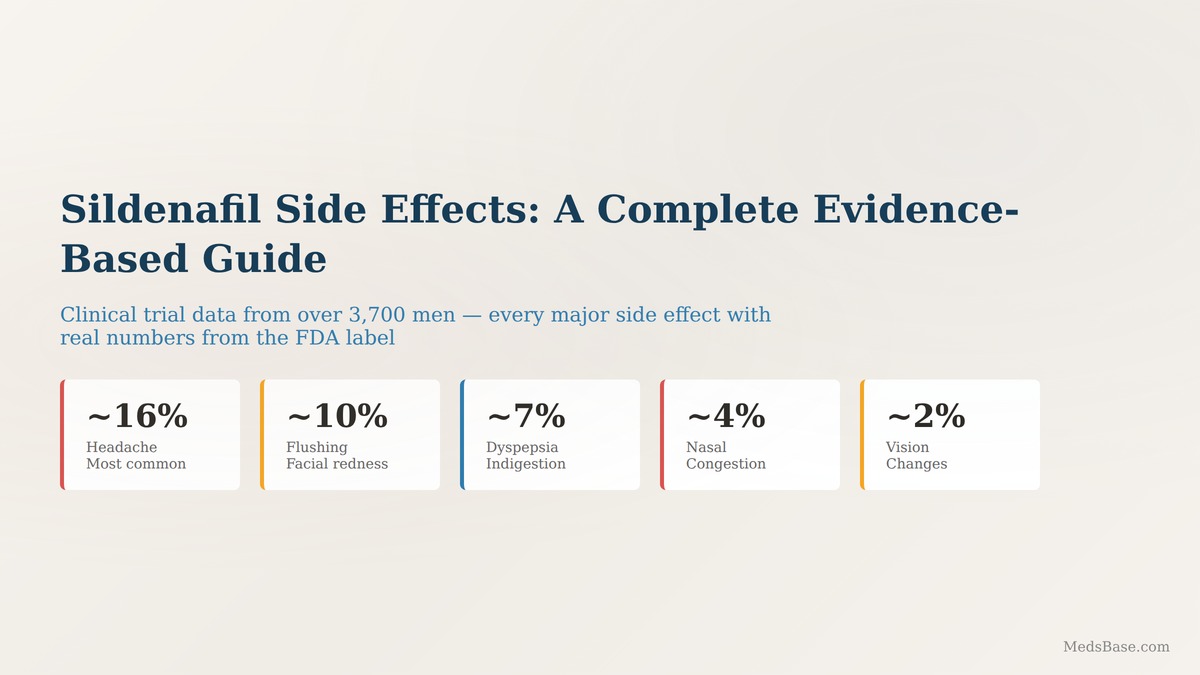
Sildenafil side effects — here’s the full breakdown, sourced directly from the FDA prescribing information and placebo-controlled clinical trials involving over 3,700 men:
| Side Effect | Frequency (Any Dose) | Placebo Rate | Dose-Dependent? |
|---|---|---|---|
| Headace | ~16% | ~4% | Yes — more common at 100mg |
| Flushing (facial/neck redness) | ~10% | ~1% | Yes — more common at 100mg |
| Dyspepsia (indigestion/heartburn) | ~7% | ~2% | Mildy dose-dependent |
| Nasal congestion | ~4% | ~2% | Modestly dose-dependent |
| Diziness | ~2% | ~1% | Yes — caution at higher doses |
| Abnormal vision (bluetinge, brightness sensitivity) | ~2% | ~0.5% | Yes — significantly more at >100mg |
| Back pain | ~2% | ~2% | No — may not be drug-related |
| Myalgia (muscle aches) | ~2% | ~2% | No — may not be drug-related |
| Rash | ~1% | ~1% | No |
Sildenafil side effects — two critical details in that table: First, look at the placebo rates. Men in the placebo arm of these trials also reported headaches at 4% — some of what gets attributed to sildenafil side effects is actually anxiety, anticipation, or coincidence. Second, notice the dose-dependence: if you’re getting side effects at 100mg, dropping to 50mg often resolves them without losing much efficacy.
Why Does Sildenafil Cause Headaches?
The headache isn’t random — it’s a direct consequence of how sildenafil works.
Sidenafil inhibits PDE5 (phosphodiesterase type 5), an enzyme that breaks down cGMP — the chemical messenger that relaxes blood vessels. In the penis, this is exactly what you want: relaxed vessels fill with blood. But PDE5 isn’t exclusive to penile tissue. It’s also found in vascular smooth muscle throughout the body — including cerebral blood vessels.
When sildenafil blocks PDE5 in brain blood vessels, those vessels dilate. The sudden change in cerebral blood flow triggers what’s called a “vascular headache” — the same mechanism behind migraine headaches. It’s not dangerous, but it’s uncomfortable.
What helps: Taking sildenafil on an empty stomach reduces headache severity (food delays absorption but doesn’t change total exposure, meaning the peak blood concentration — which correlates with side effects — can actually be higher with some high-fat meals).Staying well-hydrated helps. And if headaches persist, a simple dose reduction (100mg 50mg) often eliminates them entirely — without meaningfully affecting erection quality.
Sildenafil and Vision: Is Blue-Tinted Sight Dangerous?
About 2% of sildenafil users report visual disturbances —most commonly a bluish tinge to vision, increased sensitivity to bright light, or mild blurring. This happens because sildenafil also weakly inhibits PDE6, an enzyme found exclusivly in the retina’s photoreceptor cells. PDE6 is critical for the phototransduction cascade — the process that converts light hitting your retina into electrical signals your brain interprets as vision.
At standard doses (25–100mg), PDE6 inhibition is weak and temporary. The blue tinge fades as the drug clears. But at higher doses — or in people with pre-existing retinal conditions like retinitis pigmentosa — PDE6 inhibition becomes clinically relevant.
One serious concern that deserves honesty, not alarm: Non-arteritic anterior ischemic optic neuropathy (NAION), sometimes called an “eye stroke,” has been reported in a very small number of sildenafil users. The evidence for causation is uncertain — NAION shares the same cardiovascular risk factors (hypertenson, diabetes, high cholesterol, smoking) as erectile dysfunction itself, making it difficult to determine whether sildenafil causes NAION or whether the same men who take sildenafil are already at higher risk. The FDA does not list NAION asa definitively causal adverse event but includes a warning in the prescribing information.
What to do: If you experience sudden vision loss in one eye, blurred vision that doesn’t clear, or a “curtain” coming down over part of your visual field — stop sildenafil and seek immediate ophthalmological evaluation. For the routine blue tinge or light sensitivity, these resolve on their own and do not indicate any permanent damage.
Priapism — The One Side Effect That Requires Emergency Care
Here’s the side effect that scares everyone but affects almost nobody: priapism — a prolonged erection lasting more than 4 hours — occurs at an estimated rate of about 1 in 10,000 sildenafil users.
The mechanism is straightforward but the consequence is not: sildenafil enhances the cGMP-driven vasodilation that causes erection. In rare cases — usuallly in men with underlying anatomical predisposition, sickle cell disease, or those taking excessively high doses — the venous drainage of the penis fails to re-establish after the drug clears. Blood becomes trapped in the corpora cavernosa, deoxygenates, and becomes acidic, causing tissue damage.
The 4-hour rule is real. After roughly 4 hours of ischemic priapism, irreversible smooth muscle necrosis begins. After 24 hours, permanent erectile dysfunction is nearly certain.
If this happens to you: Do NOT apply ice — cold causes vasoconstriction and can make things worse. Do NOT take more sildenafil or any other ED medication — obviously. Go to the emergency room. Tell the treating physician you took sildenafil and when. The standard treatment is corporal aspiration (draning blood with a needle and syringe) followed by injection of a vasoconstrictor like phenylephrine. Most cases are resoled before permanent damage.
How Long Do Sildenafil Side Effects Last?
Sidenafil has a plasma half-life of approximately 4 hours. That’s the time it takes for your body to clear half the drug from your bloodstream. Practically speaking:
| Time After Dose | Blood Level | Typical Side Effects |
|---|---|---|
| 0–30 mins | Rising | Side effects rare; drug not yet fully absorbed |
| 30–60 mins | Peak (Cmax) | Side effectsonset — headache, flushing begin |
| 1–2 hours | Peak platteau | Side effects at maximum intensity |
| 2–4 hours | Declining | Side effects beginning to fade |
| 4–6 hours | ~25% of peak | Most side effects resolved |
| 6–8 hours | ~12.5%of peak | Traces or no perceptible effects for most men |
| 12+ hours | Negligible | Drug essentially cleared |
The vast majority of sildenafil side effects are fully resolved within 6 hours. The drug is metabolized by the liver (primarily CYP3A4) and excreted in feces(~80%) and urine (~13%).
One thing not widely discussed: some men report a mild “hangover” sensation the next morning — a slight residual headache or grogginess — especially at the 100mg dose or when taken late at night close to sleep. This is generally mild and resolves with breakfast and hydration.
Who Should NOT Take Sildenafil?
Sidenafil is safe for the vast majority of men, but there are absolute and relative contraindications that deserve emphasis.
Absolute contraindications (NEVER take sildenafil):
- You’re taking any form of nitrates (nitroglycerin, isosorbide mononitrate, isosorbide dinirate, amyl nitrite/”poppers,” nicorandil). Nitrates dramatically amplify sildenafil’s blood-pressure-lowering effect, potentially causing life-threatening hypotension. The original hemodynamic study published in the Journal of the American College of Cardiology found that taking sildenafil with nitrates can drop systolic blood pressure by more than 25 mmHg — enough to cause fainting, heart attack, or stroke in vulnerable individuals.
- You’ve been advised against sexual activity due to cardiovascular risk (recent heart attack within 90 days, unstable angina, severe heart failure, uncontrolled arrhythmia).
- You have severe hepatic impairment (liver cannot metabolize the drug).
- You’re taking riociguat (Adempas) — a soluble guanylate cyclase stimulator used for pulmonary hypertension. The combination can cause severe hypotension.
Relative contraindications (use with caution and medical guidance):
- Retinitis pigmentosa (theoretical risk from PDE6 inhibition)
- Severe hypotension (resting BP <90/50 mmHg)
- Anatomical penile deformities (Peyronie’s disease, angulation) that increase priapism risk
- Active peptic uler disease
- Bleeding disorders
- Medications that inhibit CYP3A4: ketoconazole, itaconazole, erythromycin, clarithomycin, ritonavir, saquinavir, nefinavir — these reduce sildenafil clearance and can raise blood levels 2–11-fold, multiplying side-effect risk
If you’reon any of the CYP3A4 inhibitors listed above, your starting sildenafil dose should be 25mg, not 50mg.
Can You Drink Alcohol with Sildenafil?
The short answer: one or two drinks are generally safe. Three or more, and you’re gambling with two things — yourblood pressure and your erection quality.
Alcohol is a vasodilator, and its effects on blood pressure are additive with sildenafil. A 2018 study in the Journl of Sexual Medicine found that combining sildenafil 50mg with alcohol to a blood alcohol concentration of ~0.08% (rougly 3–4 drinks for a 180-lb man) produced an additional 5–10 mmHg drop in systolic blood pressure compared with sildenafil alone. While not dangerous for most healthy men, this can cause significant dizziness, especially when standing — a phenomenon called orthostatic hypotension.
Beyond safety, alcohol impairs erectile function through multiple independent pathways: it’s a central nervous system depressant that blunts arousal signals, it reduces testosterone acutely, and it promotes dehydration. Taking sildenafil and then drinking heavily is like stepping on the accelerator and the brake simultaneously — and alcohol often wins.
Practical advice: One beer or glass of wine with dinner is fine. Three cocktails before your dose is not. If you’re going to drink, limit yourself to 1–2 standard drinks and take your sildenafil at least an hour before or after heavy drinking.
How to Manage and Minimmize Sildenafil Side Effects
Most sildenafil side effects are manageable with simple adjustments. Here are 5 evidence-backed strategies:
1. Start low, go slow. If you’re new to sildenafil, start at 25mg or 50mg — not 100mg. Give your body 3–4 doses to adapt. Many side effects that appear on dose 1 are gone by dose 4. If 50mg gives you acceptable results with tolerable side effects, stay there.
2. Take it on an empty stomach. A high-fat meal delays sildenafil absorption and can increase the peak concentration in some cases. Taking sildenafil on an empty stomach with a full glass of water 30–60 minutes before sexual activity minimizes side effects and maximizes reliability. MedsBase stocks sildenafil in 25mg, 50mg, and 100mg tablets — browse the full range to find your optimal starting dose.
3. Stay hydrated — before, not after. Pre-loading with 500mL (about 16 oz) of water in the hour before your dose reduces headache severity. Avoid chugging water after the headache starts; by then it’s too late.
4. Time your dose. The side-effect peak (1–2 hours) and the efficacy peak overlap — that’s the tradeoff. If side effects are bothersome, try timing intercourse closer to 2 hours post-dose rather than 1 hour. You’ll ride the tail end of the peak where side effects are fading but efficacy is still good.
5. Treat the specific symptom. For sildenafil-induced headache: acetaminophen (Tylenol) or ibuprofen is safe — but avoid aspirin if you’re also taking anticoagulants. For nasal congestion: saline nasal spray or a short-acting decongestant (oxymetazoline) is safe for occasional use. For heartburn: an antacid (calcium carbonate) is fine — proton pump inhibitors are generally not needed for this short-duration exposure.
When to seek help: If side effects persist beyond 12 hours, if you develop a rash (possible allergic rection), if you experience chest pain, or if you have any vision or hearing changes that do not resolve — contact your doctor. These are not typical sildenafil side effects and warrant evaluation.
If you’re ready to explore sildenafil at the right dose for you, MedsBase offers genuine WHO-GMP-certified sildenafil in all three standard strengths — see the full erectile dysfunction range.
Frequently Asked Questions
Q: What are the most common sildenafil side effects?
A: The most common sildenafil side effects are headache (~16%), facial flushing (~10%), indigestion/heartburn (~7%), nasal congestion (~4%), dizziness (~2%), and visual disturbancess (bluish vision, ~2%). These are dose-dependent — meaning they’re more likely at 100mg than at 25mg or 50mg — and typically resolve within 4–6 hours as the drug clears from your system.
Q: Can sildenafil cause permanent eye damage?
A: In the vast majority of cases, no. The transient blue-tinted vision or light sensitivity that affects ~2% of users at standard doses is temporary and related to weak PDE6 inhibition in the retina. A rare condition called NAION (non-arteritic anterior ischemic optic neuropathy) has been reported in sildenafil users, but causation is not definitivly established — men with erectile dysfunction share the same cardiovascular risk factors (hipertension, diabetes, smoking) that predispose to NAION. If you experience sudden vision loss or a “curtain” sensation in one eye, seek immediate medical care.
Q: What happens if you take too much sildenafil?
A: Taking more than 100mg — the maximum recommended dose — multiplies the risk and severity of all sildenafil side effects: severe headache, profound facial flushing, nasal congestion, dizziness, and significant blood-pressure drops. At very high doses (>200mg), priapism becomes more likely and the risk of serious hypotension increases substantially. Overdose sildenafil also increases PDE6-mediated visual effects. The maximum safe dose is 100mg in a 24-hour period. There is no benefit to exceeding it — the dose-response curve plateaus for efficacy above 100mg but side effects continue to worsen.
Q: Is sildenafil safe for daily use?
A: Sildenafil is approved for as-needed use, not daily use. The related PDE5 inhibitor tadalafil is approved for daily use (2.5mg or 5mg). That said, sildenafil taken as needed several times per week is generally safe for men without cardiovascular contraindications. The key risk of daily or near-daily use is cumulative PDE6 exposure in the retina (vision effects) and the theoretical cardiovascular load from repeated vasodilation. If you find yourself needing ED medication more than 3 times per week, discuss daily tadalafil with your doctor.
Q: Why do sildenafil side effects decrease over time?
A: This phenomenon — tachyphylaxis or physiologic adaptation — is well-recognized but poorly studied. The leading hypothesis is that repeated PDE5 inhibition leads to compensatory upregulation of PDE5 expression or downregulation of downstream signaling proteins, blunting the vasodilatory response in non-target tissues (cerebral vessels, nasal mucosa, skin) more than in penile tissue. Practically, this means sildenafil side effects often significantly decrease after 3–4 doses.
Q: Can you take sildenafil with blood pressure medication?
A: Generally yes — with one major exception. Sildenafil is safe with most antihypertensive medications including ACE inhibitors, ARBs, beta-blockers, calcium channel blockers, and diuretics. Clinical trial data show that men taking these medications do not experience greater blood-pressure drops with sildenafil than men not taking them. The one absolute contraindication is nitrates (nitroglycerin and related drugs), which can cause a dangerous synergistic hypotension. Alpha-blockers (tamsulosin, terazosin, doxazosin) require caution: take sildenafil at least 4 hours apart from your alpha-blocker dose. Always inform your doctor of all medications you’re taking.
Q: Is generic sildenafil the same as brand-name Viagra in terms of side effects?
A: Yes. Generic sildenafil contains the identical active ingredient (sildenafil citrate) at the same doses (25mg, 50mg, 100mg) as Viagra. The FDA requires generic drugs to demonstrate bioequivalence — meaning the same amount of drug reaches your bloodstream in the same timeframe. The side-effect profile isidentical. Generic sildenafil typically costs 80–95% less than Viagra.
Q: Can women take sildenafil? What are the side effects?
A: Sildenafil is not FDA-approved for women. However, it has been studied for female sexual arousal disorder and for pulmonary arterial hypertension (under the brand name Revatio, at 20mg). In women, the side-effect profile is similar — headache, flushing, nasal congestion, and dyspepsia — but studies show a higher rate of visual disturbances at equivalent doses, possibly due to differences in PDE6 expression or retinal blood flow. Sildenafil is not recommended for women without a specific medical indication and prescription.
The Botom Line
Sildenfil side effects are real, measurable, and — for most men — manageable. Headache, flushing, and nasal congestion affect a meaningful minority of users, but they’re nearly always mild, temporary, and diminish with repeated use. The scarier-sounding side effects — vision changes, priapism — are either misanderstood (the blue tinge is benign) or vanishingly rare (priapism at 1 in 10,000).
The bigger picture is this: sildenafil has been on the market for over 25 years. More than 60 million men have used it. Its safety record is exceptionally well-characterized, and the vast majority of adverse events are mild, self-limiting, and dose-dependent. If you understand the mechanism, respect the contraindications (especially nitrates), and start at a reasonable dose, sildenafil is one of the safest medications in the ED category.
If you’re ready to try it at the dose that makes sense for you, MedsBase carries sildenafil in 25mg, 50mg, and 100mg tablets — all from WHO-GMP-certified manufacturers, with discreet worldwide shipping and no prescription needed. Browse the Erectile Dysfunction range.
What to read next:
- Sidenafil vs Tadalafil vs Vardenafil: Which ED Medication Is Right for You? — a full comparison of side-effect profiles, duration, and food interactions across all three PDE5 inhibitors
- Sidenafil and Food: Why a Heavy Meal Halves Your Dose (And What to Eat Instead) — because managing side effects starts with smart timing
- When Generic Viagra Stops Working: 5 Reasons Sildenafil Loses Its Edge & What to Switch To — how to troubleshoot when things change
Medical Disclaimer: This article is for informational purposes only and does not constitute medical advice. Sildenafil is a prescription medication in many countres. Always consult your doctor or a qualified healthcare provider before starting, changing, or stopping any medication. If you experience chest pain, sudden vision loss, or an erection lasting more than 4 hours, seek emergency medical care immediately.

Written by
Sophie ChenPharmaceutical Content Researcher · 8 years experience
Sophie Chen is a pharmaceutical content researcher with 8 years covering generic medication access and clinical pharmacology. She specialises in international regulatory frameworks, bioequivalence standards, and patient-facing education on therapeutic drug classes. She is not a clinician.