








✓ Medically reviewed by · Last reviewed: May 2026
Pharmacy Researcher · 8 years experience
Pharmacy researcher with 8 years reviewing clinical drug information, generic formulation equivalence, and international pharmaceutical standards. Focuses on patient-facing accuracy in medication education.
tamsulosin vs finasteride — Tamsulosin vs finasteride — two different mechanisms for treating benign prostatic hyperplasia (BPH). Read on for an evidence-backed guide covering everything you need to know.
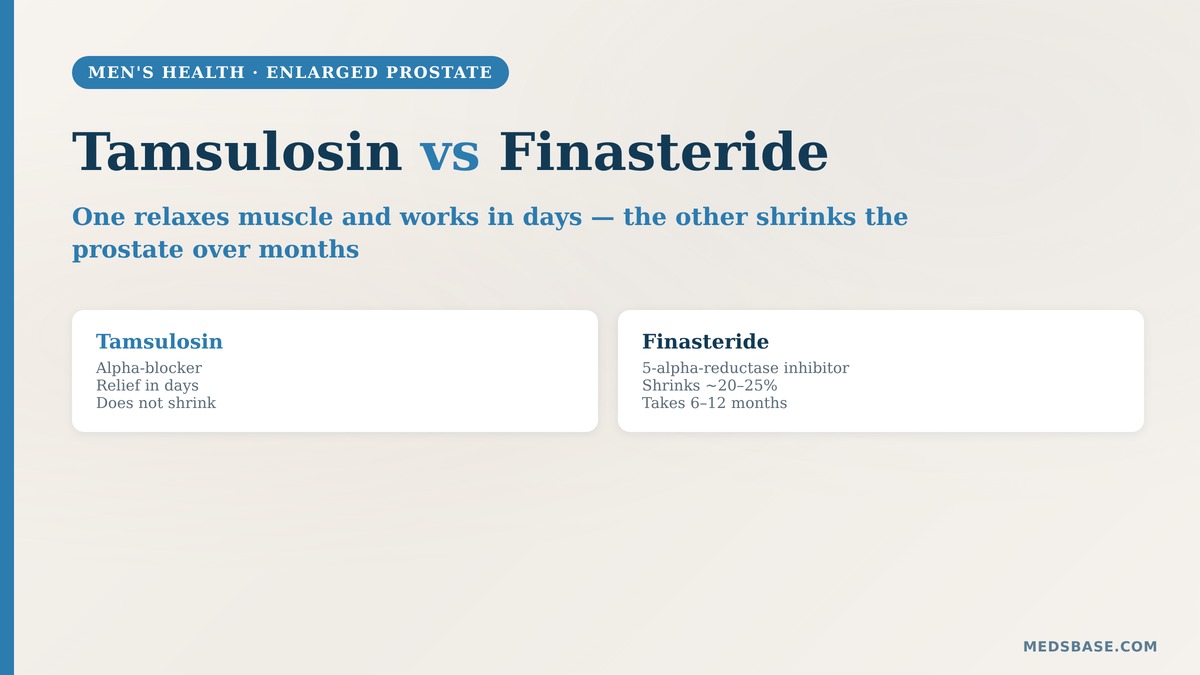
# Tamsulosin vs Finasteride: 7 Proven Differences for Enlarged Prostate
Tamsulosin vs finasteride — if you’re waking up two or three times a night to urinate and stopping mid-task to find a restroom, you’ve probably heard two drug names — tamsulosin and finasteride. They’re often lumped together as “enlarged prostate pills,” but they work in almost opposite ways, on different timelines, for overlapping-but-not-identical goals. Choosing between tamsulosin vs finasteride isn’t really a coin flip — it’s about what’s causing your symptoms and how fast you need relief.
Tamsulosin vs finasteride — by the end of this article, you’ll understand exactly how these two drugs differ, why one can take months to help while the other works in days, when they’re used together, and what to ask your doctor.
- Tamsulosin relaxes muscle and relieves symptoms within days; finasteride shrinks the prostate over months
- Only finasteride actually reduces prostate size — tamsulosin improves flow without shrinking anything
- The MTOPS trial showed combining the two beats either alone at preventing long-term worsening
- One side effect of finasteride surprises — and concerns — many men, and we’ll cover it honestly below
Tamsulosin vs finasteride: Why Two Drugs for the Same Problem?
Tamsulosin vs finasteride — the confusion is understandable, because both tamsulosin and finasteride treat the same condition: benign prostatic hyperplasia (BPH), a non-cancerous enlargement of the prostate that becomes common after 50. But the reason symptoms happen — and the way each drug intervenes — are genuinely different.
Quick Answer: Tamsulosin and finasteride both relieve enlarged-prostate symptoms, but through opposite mechanisms. Tamsulosin relaxes the muscle around the prostate and bladder neck to improve flow immediately. Finasteride shrinks the prostate itself over months by blocking the hormone that drives its growth.
Tamsulosin vs finasteride — think of the urethra as a garden hose pinched by a slowly inflating balloon — the balloon is your growing prostate, pressing on the tube. Tamsulosin doesn’t deflate the balloon; it loosens the clamp holding the hose. Finasteride actually deflates the balloon — but it does so very slowly, so slowly you won’t notice for months. Understanding that one distinction untangles the entire tamsulosin vs finasteride question.
Tamsulosin vs finasteride — it’s worth being specific about what BPH symptoms actually look like, because they’re easy to attribute to “just getting older.” The cluster includes a weak or interrupted urinary stream, hesitancy (trouble starting), a feeling the bladder hasn’t fully emptied, and — most disruptive for quality of life — nocturia, the need to wake repeatedly at night to urinate. These are the symptoms both drugs target, but they arrive at relief from opposite directions and on opposite clocks.
Tamsulosin vs finasteride: What Are They, and How Do They Work Differently?
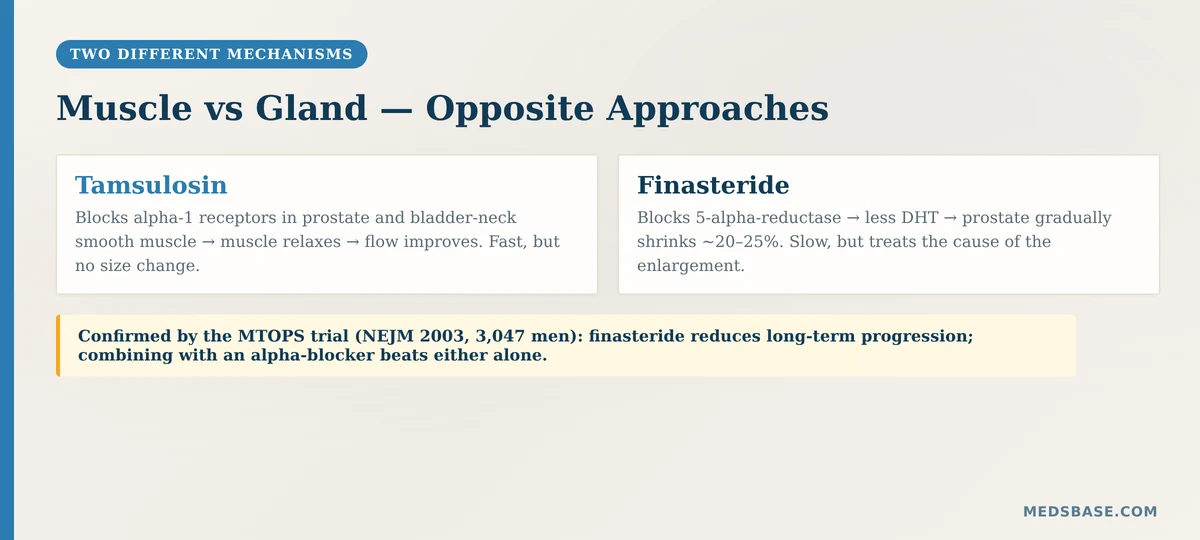
Tamsulosin vs finasteride — let’s name each mechanism precisely, because the mechanism is the differentiator.
Tamsulosin is an alpha-blocker (often sold under the brand Flomax). It blocks alpha-1 receptors in the smooth muscle of the prostate and bladder neck. When those receptors are blocked, the muscle relaxes, the opening widens, and urine flows more freely. It starts working within hours to days. Crucially, it does nothing to the size of the prostate.
Finasteride is a 5-alpha-reductase inhibitor (brand Proscar). It blocks the enzyme that converts testosterone into dihydrotestosterone (DHT), the hormone that drives prostate growth. With less DHT, the prostate gradually stops growing and may shrink by roughly 20–25% over six to twelve months. It treats the cause of the “balloon,” but on a timetable of months, not days. MedlinePlus describes both drug classes and their targets in its enlarged-prostate reference, and the NHS guidance on prostate enlargement walks through the same two-mechanism distinction for patients.
Pause on that for a moment, because it’s the crux of the entire tamsulosin vs finasteride conversation. One drug is a muscle relaxant that happens to make urination easier. The other is a hormone-regulating drug that actually shrinks the tissue causing the problem. If you only needed better flow this month, tamsulosin would look like the obvious winner. If you needed the prostate itself addressed over the long haul, finasteride is the one doing work no amount of tamsulosin can do. The two are almost incomparable on a single axis — which is why the question “which is better?” has no clean one-word answer.
How Fast Do They Work?
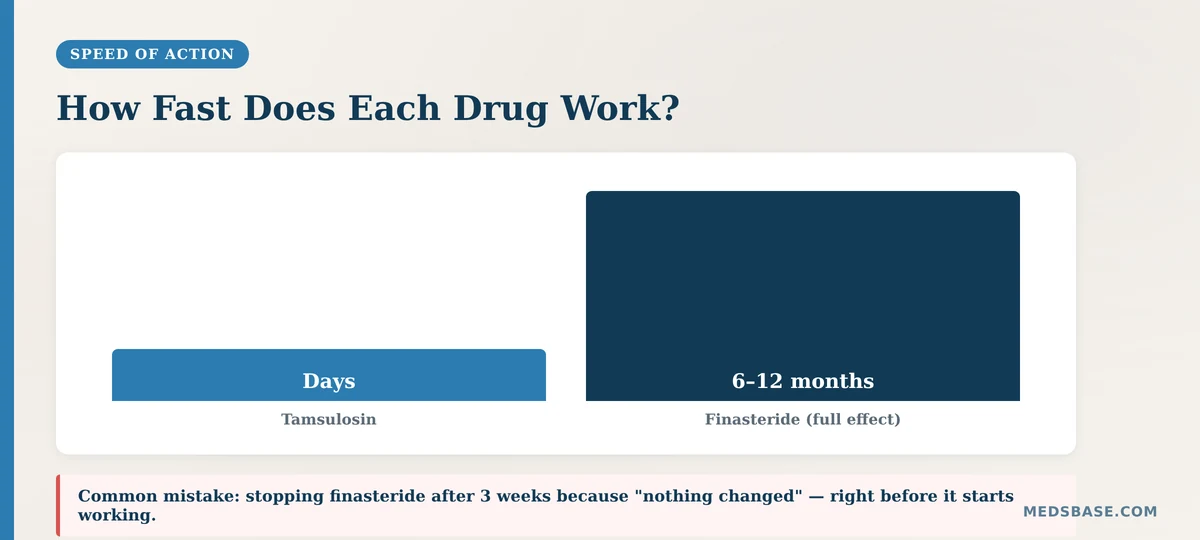
Tamsulosin vs finasteride — speed is where these two drugs diverge most sharply, and it shapes the real-world decision more than most men expect.
| Drug | Onset of symptom relief | Peak effect | Effect on prostate size |
|---|---|---|---|
| Tamsulosin | Days | 1–2 weeks | None (relaxes muscle only) |
| Finasteride | Weeks to months | 6–12 months | Shrinks by ~20–25% |
Quick Answer: Tamsulosin relieves symptoms within days; finasteride takes three to six months to show its full effect because it works by gradually shrinking the prostate.
Tamsulosin vs finasteride — this matters for your expectations. If your symptoms are acute — you’re profoundly bothered by weak stream and frequent night waking now — tamsulosin is the drug that will change this week. If your priority is preventing the prostate from enlarging further and reducing long-term risk of events like acute urinary retention (a painful inability to urinate), finasteride is the drug that does that job — but you have to be patient. Many men misunderstand finasteride, take it for three weeks, feel no change, and stop — right before it was about to start working. That’s one of the most common mistakes clinicians see.
Side Effects: An Honest Comparison
Tamsulosin vs finasteride — both drugs are generally well-tolerated, but their side-effect profiles are different and worth weighing honestly.
| Side effect | Tamsulosin | Finasteride |
|---|---|---|
| Dizziness / light-headedness | Common (blood-pressure effect) | Rare |
| Retrograde ejaculation (semen into bladder) | Common | Uncommon |
| Reduced libido / erectile dysfunction | Rare | Uncommon (reversible on stopping in many) |
| Breast tenderness / enlargement | Rare | Uncommon |
| Nasal congestion | Uncommon (vasodilation) | — |
| Reduced PSA (affects cancer screening interpretation) | No | Yes (~50% reduction) |
The two open loops you were promised. First, the finasteride side effect that concerns many men: a drop in libido and erectile function. It’s uncommon rather than common, and in a meaningful share of men it is reversible on stopping the drug — but it is real, it should not be minimised, and it’s exactly the kind of thing to raise directly with your doctor before starting.
Second, a hidden consequence of finasteride that isn’t really a “side effect” but matters: it reliably lowers PSA by roughly half. Since PSA is used to screen for prostate cancer, your doctor must double your measured PSA to interpret screening correctly. If you’re on finasteride and your doctor is unaware, a small PSA rise that would otherwise be investigated might be missed. This is a well-known clinical consideration, not a scare — but it’s why finasteride should always be disclosed to every clinician you see.
Tamsulosin’s notable side effect is dizziness, especially when standing quickly — because it relaxes blood vessels as well as prostate muscle. It’s usually most noticeable when first starting or raising the dose.
Stepping back, the honest framing on tamsulosin vs finasteride is that both are well-studied, widely used, and effective — the difference is a matter of matching the mechanism to your situation. Neither is the “gentle” or “hard” option; they simply target different parts of the same problem. That reframing alone clears up most of the confusion that brings men to this comparison in the first place.
Tamsulosin vs Finasteride: Which Is Better?
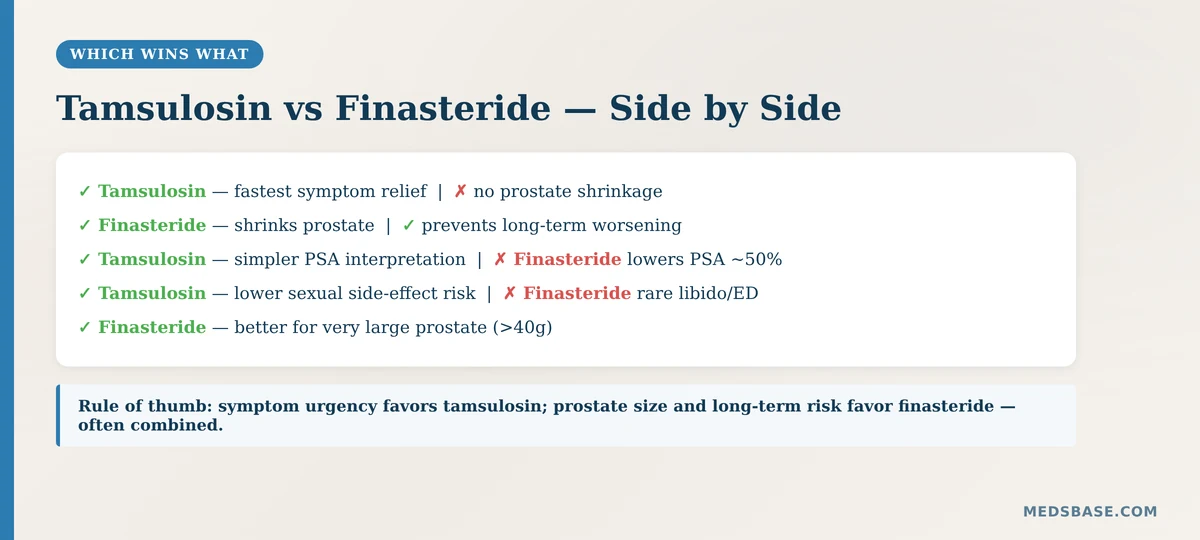
“Better” is the wrong lens; “better for whom” is the right one. Here’s the honest, criteria-based verdict.
| Criterion | Tamsulosin wins | Finasteride wins |
|---|---|---|
| Fast symptom relief | ||
| Shrinks the prostate | ||
| Prevents long-term worsening | ||
| Lower risk of sexual side effects | ||
| Simpler PSA interpretation | ||
| Useful for a very large prostate |
Quick Answer: For fast relief of a bothersome stream, tamsulosin is usually the first choice. For men with a significantly enlarged prostate — generally over about 40 grams — or those worried about long-term progression, finasteride (or the combination) tends to be preferred.
A useful clinical rule of thumb: symptom severity and urgency favour tamsulosin; prostate size and long-term risk favour finasteride. Many men start one, then adjust after a follow-up discussion. This is a conversation shaped by your urologist’s examination and measurement of your prostate, not a decision you should reach by gut feel alone.
A related question worth raising with your doctor is whether your symptoms are even prostate-driven. Urinary frequency and nocturia can also stem from overactive bladder, high blood pressure on certain medications, diabetes, or excessive evening fluid intake. A proper workup helps rule these in or out, so you don’t spend months on the wrong half of the tamsulosin vs finasteride decision. This is another reason the “just pick one” approach underperforms a genuine medical conversation.
That sequence — quick relief first, shrinkage second, combined when warranted — captures how the tamsulosin vs finasteride decision often plays out in practice far better than any single “pick one” answer.
When Doctors Use Both Together
Here’s where the tamsulosin vs finasteride framing dissolves into something more useful: these drugs are not rivals, they’re often partners.
Quick Answer: For men with bothersome symptoms and a large prostate, tamsulosin and finasteride are frequently combined — tamsulosin for immediate relief, finasteride for long-term shrinkage and risk reduction.
The reason combination therapy exists at all is that neither drug fully covers the other’s weakness. Tamsulosin acts fast but doesn’t shrink anything; finasteride shrinks tissue but acts slowly. Paired, they give you the fast relief and the durable, structural benefit — which is precisely why combination therapy is a legitimate, evidence-backed option rather than a fringe choice.
The MTOPS trial’s combination arm is the evidence backbone for this. It showed that combining an alpha-blocker with finasteride reduced the risk of overall clinical progression significantly more than either drug alone. After the prostate has had months to shrink under finasteride, some men can even discontinue the alpha-blocker — a decision to make with a doctor, not on your own.
So if you’re currently on tamsulosin and wondering whether you also need finasteride, the answer hinges on your prostate size and your long-term goals. If you’re on finasteride and still uncomfortable, the question may be whether short-term alpha-blocker support would bridge the waiting period. These are exactly the questions to pose at your next visit.
One practical note on how these drugs fit into a daily routine. Tamsulosin is typically taken once daily, often about 30 minutes after the same meal each day to steady its blood-pressure effect; finasteride is taken once daily with or without food. Consistency matters more than timing for both — finasteride in particular needs uninterrupted daily use for months to reach and hold its shrinking effect. Skipping doses erodes the very benefit you waited for.
For a companion look at other treatment comparisons, see our Tamsulosin vs Terazosin guide and, on the finasteride side, Finasteride vs Dutasteride.
Frequently Asked Questions
Q: What is the difference between tamsulosin and finasteride?
A: Tamsulosin is an alpha-blocker that relaxes prostate and bladder-neck muscle for rapid symptom relief, without changing prostate size. Finasteride is a 5-alpha-reductase inhibitor that blocks DHT to gradually shrink the prostate over months. One acts on muscle, the other on the gland itself.
Q: Does tamsulosin shrink the prostate?
A: No. Tamsulosin improves urine flow by relaxing muscle, but it does nothing to the size of the prostate. Only 5-alpha-reductase inhibitors like finasteride (or dutasteride) actually reduce prostate volume.
Q: How fast does finasteride work for BPH?
A: Finasteride works slowly. Symptom improvement typically begins within weeks to a few months, with full benefit at six to twelve months as the prostate gradually shrinks. Patience is essential — stopping early is a common reason men who could benefit never see the result.
Q: Can you take tamsulosin and finasteride together?
A: Yes. The combination is common and evidence-backed: tamsulosin provides immediate symptom relief while finasteride shrinks the prostate and reduces long-term risk. Trial data show the combination outperforms either drug alone at preventing disease progression.
Q: Which is better for enlarged prostate, tamsulosin or finasteride?
A: It depends on the goal. For fast, bothersome symptom relief, tamsulosin is usually first. For a significantly enlarged gland or long-term risk reduction, finasteride — or the combination — is preferred. Prostate size and urgency are the deciding factors.
Q: Does finasteride affect prostate cancer screening?
A: Yes, importantly. Finasteride lowers PSA by roughly half. Your doctor must account for this (typically doubling your measured PSA) to interpret cancer screening accurately. Always tell every clinician you’re taking finasteride.
Q: Do the sexual side effects of finasteride go away?
A: They are uncommon rather than common, and in a meaningful number of men they are reversible after stopping the drug. Some men choose to continue because the benefit outweighs the risk. This is a decision to make openly with your doctor before and during treatment.
The Bottom Line
Tamsulosin vs finasteride is less a rivalry than a question of timing and anatomy. Tamsulosin gives you days-fast relief by relaxing muscle; finasteride gives you gradual, durable improvement by shrinking the prostate itself. Many men ultimately benefit from the combination.
Your immediate action: pay attention to your own signals — how acute your symptoms are and whether you’ve had your prostate size assessed — then bring those specifics to a doctor. That single conversation turns a confusing comparison into a personal plan.
Want to go deeper on either drug class?
- Finasteride vs Dutasteride: Which Works Better for Hair Loss?
- The Health Risks of Ultra-Processed Foods: What the 8.8M-Person Study Found

Written by
Sophie ChenPharmaceutical Content Researcher · 8 years experience
Sophie Chen is a pharmaceutical content researcher with 8 years covering generic medication access and clinical pharmacology. She specialises in international regulatory frameworks, bioequivalence standards, and patient-facing education on therapeutic drug classes. She is not a clinician.